Showing posts with label beef. Show all posts

Thursday, May 1, 2025

Is The Spirit World Real? 19 Foods Banned Abroad, But Not in America.

.

Is the spirit world real?

Is the spirit world real?“In Western cultures today there is a growing fascination with the occult and Satanism, despite the traditional Christian teaching that Satan represents consummate evil.

(Photo: Envato)

If we believe the Bible, we know Satan is not only very real and powerful, but God clearly commands us not to get involved with him or the occult. However statistics show Satanism and Wicca are among the fastest-growing religions in the western world. A increasing number of people deny Satan, demons and a spirit world exist, and therefore regard participating in Wicca or Gothic culture as a harmless expression of personal taste.

The Internet is a ready source of "how-to" information for those interested in Satanism, Wicca or other aspects of Gothic culture. There are also a growing number of movies focussing on witchcraft, demonism and any number of "horror" themes. Books can also be checked out of the public libraries on how to cast spells or how to be a witch. Add to this tarot cards, Ouija boards, palm readers and psychic hotlines.

Wicca, from an Old English word for “witch,” incorporates many of the trappings of ancient British witchcraft practices. It is an umbrella group or movement that gathers under its fold very different beliefs and practices— but is at its core a thinly disguised type of old-fashioned witchcraft. We should not consult with people associated with these spirits in spite of any stated intentions to help us. God’s Word is clear: “Give no regard to mediums and familiar spirits; do not seek after them, to be defiled by them: I am the Lord your God” (Leviticus 19:31).

The Bible reveals Satan is a very real spirit being, who was originally created as "Lucifer," which means "light bringer." In the beginning of God’s creation there was no sin, evil, or disharmony, until Lucifer chose to rebel against his Creator (Isaiah 14:12-15). Ezekiel wrote of him, saying, "You were perfect in your ways from the day you were created, till iniquity was found in you" (Ezekiel 28:15).

When this very first sin took place, Lucifer, whose name was then changed to Satan (which means "adversary"), convinced a number of the angels to rebel against God with him. Together they fought God and lost. Satan and the rebellious angels, now known as demons, have been restrained on earth since that time (Job 1:7). Instead of being the "light bringer," Satan came to be known as a ruler of darkness (Ephesians 6:12).

Satan and his demons have not given up their goal of trying to destroy whatever God creates, as we can see by the example of Adam and Eve (Genesis 3:1-6). They cannot take control of a human being against his or her will, but we can inadvertently allow ourselves to be influenced. When Israel came into the Promised Land, God warned them not to allow anyone to practice witchcraft, cast spells or try to talk with the dead (Deuteronomy 18:9-14). Put in terms of today's practices, this would include tarot cards, Ouija boards, palm reading, horoscopes and psychics. It would also include filling our minds with music, books and movies about the occult.

In Matthew 4 we read Satan even tried to get Jesus Christ to fall for his perverted reasoning. After showing Him all the kingdoms of the earth and their wealth and power, Satan said, "All these things I will give You if You will fall down and worship me" (Matthew 4:9).

Perhaps the most powerful way in which Satan influences human beings is through his power to broadcast attitudes, and from this no one is immune. He is described as the "prince of the power of the air" (Ephesians 2:2). The devil cannot make us do anything, but he can make something sound or feel so appealing that you are willing to choose to do it. In Ephesians 6:12 (NIV) we are told: "For our struggle is not against flesh and blood, but against the rulers, against the authorities, against the powers of this dark world and against the spiritual forces of evil in the heavenly realms."

We struggle with ourselves, with the unrighteous influences of our society and with the powerful attitudes and temptations presented to us by Satan and his demons. Temptation worked effectively against Adam and Eve, and it can work just as effectively against us. The Apostle James gives very solid instruction about how to resist Satan and his influences: "Therefore submit to God. Resist the devil and he will flee from you. Draw near to God and He will draw near to you. Cleanse your hands, you sinners; and purify your hearts, you double-minded" (James 4:7-8).

We must come to know God through prayer and Bible study and learn to think as He does (Psalm 51:10). We are told to resist the devil, and remove ourselves from situations and activities that promote witchcraft and the occult.”

From:   https://www.ucg.org/vertical-thought/is-the-spirit-world-real

_________

19 Foods Banned Abroad, But Not in America

“If "you are what you eat" is true, what does that say about America's eating habits? Numerous popular American dishes are packed with potentially harmful ingredients, leading to bans in other nations. Discover 19 American favorites that have been rejected worldwide. 

1. Froot Loops

Banned in: France, Austria, Norway and Finland

Why it's banned: A glance at Kellogg's Froot Loops' ingredients might explain why the colorful cereals of our childhood are banned in many European countries.

The American breakfast staple is packed with food dyes such as yellow 5 and red 40, which are considered harmful. Many scientific studies link these artificial colors with the inhibition of cell development.

The sugary cereal also contains soybean,  cottonseed oil, and hydrogenated coconut — all considered dangerous and banned in the above mentioned countries.

2. US chicken

Banned in: European Union

Why it's banned: Chlorine-washed chicken doesn't sound very appetizing, does it?

In the U.S, the chicken is routinely washed in a chlorine solution before it is market ready.

This antimicrobial treatment reduces the possibility of salmonella contamination and other bacteria that can lead to foodborne illness. This is also the main reason the European Union has had a ban on American chicken since 1997.

The EU is not concerned about chlorine consumption per se. Rather, it questions why the chicken must go through deep cleaning in the first place. The EU thinks there should be a "high level of safety throughout the food chain, from farm to fork," not only cleaning the meat heavily at the end of the process to compensate for insufficient hygiene standards earlier.

3. Mountain Dew

Banned in:  The European Union and Japan

Why it's banned: We all know Mountain Dew is not the healthiest of drinks. But, if you still “do the Dew,” you might want to know the lemon-lime drink contains Brominated Vegetable Oil (BVO).

This food additive banned in Japan and the European Union contains bromine, the element found in flame retardants.

According to CDC, the consumption of bromine can lead to a number of health problems such as headaches, memory loss, and impaired balance and coordination. It’s also bad for the skin.

PepsiCo announced in 2014 that the dangerous chemical would be removed from its soft drinks. However, BVO wasn't removed from Mountain Dew's list of ingredients until 2020.

4. US milk

Banned in: Australia, New Zealand, Canada, Japan, and the EU

Why it's banned: Got rBGH? That's what Europe, Canada, and many other countries are asking about milk produced in the United States, where dairy cows are fed with a synthetic man-made growth hormone rBGH to increase milk production.

Developed by the agricultural biotech corporation Monsanto, recombinant bovine growth hormone rBGH, also known as rBST, was approved by the Food and Drug Administration (FDA) in 1993, allowing companies to produce vast amounts of cheaper milk in awful conditions at factory farms.

As one could imagine, drinking hormone-enriched milk cannot be the healthiest option. Studies have found that cows treated with rBGH produce milk that contains elevated levels of insulin-like growth factor-1 (IFG-1), which can increase the risk of breast cancer and other cancer types.

Luckily, according to a 2014 report by the USDA, the practice is decreasing as only 9.7 percent of U.S. dairy operations were using rbGH.

Still is highly recommended to stick with organic milk or one that says "does not contain rBGH.

5. Farmed salmon

Banned in: Austria and New Zealand

Why it's banned: Salmon is a go-to meal for many Americans, who enjoy the meaty flavor and health benefits of the omega-3-packed fish. However, the bad news here is there is a big chance that the salmon you are eating is farmed-raised.

Around two-thirds of salmon eaten by U.S. consumers comes from farms, and the other third is wild-caught. Salmon farming has long been scrutinized by sustainability advocates because of the harsh conditions in which the fish are raised.

Farm-raised salmon are kept in crowded cages and are fed with fed processed fish feed and all kinds of dangerous chemicals like methyl mercury and dioxins. Additionally, the fish are given a lot of antibiotics and other drugs that are not safe for humans to consume.

6. Maraschino cherries

Banned in: Norway, Finland, France, Austria, the U.K

Why it's banned: It turns out America's favorite cocktail garnish is actually a forbidden fruit in some countries.

Maraschino cherry, the syrupy sweet fruit, was invented during the Prohibition era to garnish virgin cocktails. Actually, the American maraschino cherry is an imitation of a Croatian delicacy made of Marasca cherries.

What the American version of the sweetened cherry has extra is the artificial food dye Red #40 to give that picture-perfect touch. Red #40 is one of the most widely used food dyes, as well as one of the most controversial. The dye is thought to be linked to allergies, migraine, and mental disorders in children.

7. US apples

Banned in: the European Union

Why it's banned: While apples are supposed to keep the doctor away, that's not exactly the case for those produced in the U.S.

American apples are treated with diphenylamine (DPA), a potentially carcinogenic compound used to keep the fruit from turning brown. It's this chemical that gives the apples you see in the supermarket that glow.

European food safety regulators banned the fruit in 2014 because the chemicals have been linked to various cancers.

Now, how do you like them apples?

8. Little Debbie Swiss Rolls

Banned in: Norway and Austria

Why it's banned: Little Debbie's smiling face isn't welcome in some countries, as the tasty snack contains food dyes that are a big no-no.

Little Debbie's Swiss Rolls contain artificial food color dyes yellow 5 and red 40, which are considered to be carcinogenic.

The European Union requires products with these dyes to include warning labels saying "the coloring agents may have an adverse effect on activity and attention in children." But come, countries like Norway and Austria just outright banned the snack.

In the United States, no such warning is required.

9. US breakfast cereal brands

Banned in: Japan, the European Union

Why it's banned: Breakfast may be the most important meal of the day, but not if you are having cereals like Rice Krispies, Honey Bunches of Oats and Frosted Flakes.

These breakfast cereals brands contain Butylated hydroxytoluene, or BHT, a lab-made flavor enhancer that has carcinogenic properties. It's banned in Japan and the European Union.

A number of processed foods, such as chewing gum and frozen foods, contain this preservative.

9. Instant mashed potatoes

Banned in: the Europe Union, Japan, Australia

Why it's banned: This one is easy. It's mashed potatoes in a box. Of course, there is something off.

Instant Mashed Potatoes like Hungry Jack come with a side of Butylated Hydroxyanisole (BHA). This preservative is also found in rubber and wax food packaging. So, it's definitely not something you would want in your body.

Although it's widely used in the U.S., it's banned in Japan, Australia, and the European Union, because it has been linked with cancer.

10. US prepackaged ground beef

Banned in: the European Union

Why it's banned: Pink slime is definitely not something you want in your burger. Yet, there is a good chance that the prepackaged ground beef you bought for your next barbecue contains pink slime.

According to an ABC News exposé from 2012, around 70% of ground beef sold in U.S. supermarkets contained pink slime - a meat by-product used as a filler in ground beef to reduce fat content.

If you are wondering "what’s the beef?" with pink slime, it is prepared with ammonia gas, an anti-microbial agent which is dangerous for consumption.

The FDA approved the pink goo for human consumption in the U.S. back in 2001.

11. Ritz Crackers

Banned in: Switzerland, Austria, Hungary, Iceland, Norway and Denmark.

Why it's banned: Ritz crackers are a must-have for any cheese board, right? Well, in Europe, you’ll have to look for a different brand as the salty snack is nowhere to be found.

Apparently, Ritz crackers contain high levels of sodium—hydrogenated cottonseed oil, a trans fat associated with cardiovascular diseases.

The FDA has actually deemed these types of oils to be "not generally recognized as safe," but certain loopholes allow them to continue to be used in products.

12. US pork

Banned in: the European Union, Russia, and China

Why it's banned: If you were wondering why pigs in the U.S. are much bigger than those in the rest of the world, ractopamine is your answer.

American pigs are given ractopamine, an animal feed additive used to speed up weight gain and increase carcass leanness in finishing swine.

The additive is linked to major health issues both in animals and humans, explaining why it is banned in more than 160 countries.

Next time you are craving some pork chops, opt for organic meat. (Or eat beef!)

13. Coffee-mate

Banned in: Austria, Hungary, and multiple Scandinavian countries,

Why it's banned: Shelf-stable coffee creamer that can make your coffee taste like vanilla or caramel maybe sounds perfect, but don’t expect to find it in Europe.

Creamers like Coffee Mate are generally made from sugar, stabilizers and bunch of flavorings. However, what makes the product a big no-no in several European countries are hydrogenated soybean and cottonseed oils found in this non-dairy product

Hydrogenated oils are packed with trans fats. Many studies have shown that trans fat is the worst type of fat because it raises bad cholesterol and lowers good cholesterol, increasing the risk of heart disease, diabetes, heart attack, and stroke.

So, take your coffee black next time.

14. Drumstick ice cream

Banned in: the European Union

Why it's banned: Don't expect to find Nestle's drumstick ice cream anywhere in Europe. The product has been banned for containing a sneaky ingredient within its cone, and it's not extra chocolate filling.

The famous ice cream treat contains carrageenan, a seaweed-derived thickening agent used to extend the shelf life of consumer products.

This food additive has been linked with inflammation and possibly cancer.

15. Skittles

Banned in: Norway and the European Union

Why it's banned: Many of us grew up eating Skittles. But we didn't know that while tasting the rainbow we were also eating food dyes and other harmful additives.

Artificial colors yellow 5 and yellow 6 are among the listed ingredients of the childhood-favorite snack. These food dyes are often linked with hyperactivity in children and allergic reactions. On top of the food dyes, the colorful candy contains another iffy ingredient that has led to its ban in the European Union in 2022.

Titanium dioxide is an additive used in consumer products to enhance opacity and brightness. The International Agency for Research on Cancer IARC classified titanium dioxide as possibly carcinogenic to humans after studies showed the substance caused more lung tumors in rats.

As a result, Europeans from now on will be tasting the duller-hued rainbow of Smarties.

16. Hawaiian papaya

Banned in: the European union

Why it's banned: Hawaiian Papaya was genetically engineered to resist the ringspot virus, which destroyed U.S. crops in the 1990s.

Although there are many debates about whether or not genetically engineered produce is safe, the European Union isn't taking any chances, making genetically engineered papaya a forbidden fruit.

17. Twinkies

Banned in: ​​ Norway, Finland, and Austria.

Why it's banned: This one is not a shocker as, well. This ultra-processed sponge cake contains yellow 5 coloring to give it its distinctive golden hue.

Yellow 5 coloring has been linked to allergic reactions such as hives, itching, coughing, and vomiting.

Food dyes that contain these dyes are required to carry warning labels in the EU, but countries such as Finland, Norway, and Austria have decided not to take that risk.

18. Arby's sourdough breakfast bread, croissant, and French toast sticks

Banned in: India, the UK, the European Union

Why it's banned: A tasty Arby's roast beef has tempted even those with the strongest willpower. Traveling abroad, however, will not require willpower, as many countries have banned the savory sandwiches.

Arby's American-style bread is banned in some countries because of a toxic ingredient the fast food chain uses in its baked goods.

Azodicarbonamide, or ACA  is a whitening agent that forms bubbles in foam or vinyl, to lighten and leaven the dough.

Despite concerns that it's a carcinogen, the FDA still permits its use in the U.S.

19. Stove Top stuffing

Banned in: the United Kingdom, Japan, and several European countries.

Why it's banned: Kraft Stove Top stuffing is a go-to choice for a quick weeknight dinner. But, the problem is the stuffing contains a combination of beta-hydroxy acid (BHA) and butylated hydroxytoluene (BHT).

Both preservatives are suspected to be carcinogenic and impair blood clotting.

That’s why the product is banned in the United Kingdom, Japan and some European countries.”

This article was produced and syndicated by MediaFeed.  See original with pictures at:  https://www.aol.com/lifestyle/19-foods-banned-abroad-not-135700980.html

_________

Monday, July 15, 2024

Lessons From A Hurricane. The Role of Taxpayer Subsidies in the Obesity Epidemic.

.

We just got power back from losing it during Hurricane Beryl!!

Lessons from A Hurricane

The most powerful and destructive storms on earth are called hurricanes, typhoons or cyclones, depending on where they occur. 

On Sept. 8, 1900, a very powerful hurricane struck Galveston, Texas, on the Gulf Coast of the United States.

The storm and the storm surge that followed destroyed more than 3,500 homes. The death toll from that storm was around 8,000, making it the worst and deadliest natural disaster in U.S. history—2.5 times deadlier than the 1906 San Francisco earthquake. 

Twenty-eight years later, on Sept. 12 and 13, the Okeechobee hurricane of 1928 plowed through the Caribbean before slamming into Florida, killing a total of 4,000 people, 2,500 of them in the U.S. In Puerto Rico alone, the storm left half a million people homeless.

In 2005, the costliest natural disaster in U.S. history hit the Mississippi and Louisiana coasts. Hurricane Katrina’s storm surge in places was 28 feet above the normal tide. In the end, Katrina was responsible for about 1,400 deaths, and caused $125 billion in damages.

To survive a hurricane or other natural disaster, it’s vital to be prepared. What should one do to be prepared? And, even more important, what spiritual lessons can you and I draw from this process?

Watch the news: Unlike a century ago, today weather satellites and radar can give warnings days in advance of the approach of a hurricane, typhoon or cyclone. Warnings go out several days before, encouraging people to prepare their properties and even evacuate if that is deemed necessary. 

Over a century ago, when the Galveston hurricane struck, it is probable that so many deaths occurred because they had so little warning. By the time they knew how big the storm was, it was too late.

How many times in Scripture are we given the admonition to watch and pray (Luke 21:36) or “take heed; see, I have told you all things beforehand” (Mark 13:23) or “I have told you before it comes” (John 14:29)?

I’ve heard prophecy described as news written in advance. One of the primary purposes of prophecy is to show in advance what will happen, so God’s people can be prepared (Amos 3:7).

Just as we have news stations showing satellite images and tracking storms, so we have prophecies providing written “storm warnings” about the events that are soon to smash through the lives of people in the end time.

Are we watching the “news” of the Bible? Or will we be like the majority of mankind, who will be surprised by the storms at the end of this age (Luke 21:34)?

Stock up on emergency supplies: Emergency preparedness includes having a supply of food that doesn’t need refrigeration, as well as drinking water, protective clothing, flashlights and batteries and, if possible, fuel. 

These are all items a family might need to survive until clean-up crews make it to them and normal utilities and services resume.

Jesus Christ made a similar spiritual point through the parable of the 10 virgins in Matthew 25. In this parable, righteousness and God’s Holy Spirit are likened to the oil needed as fuel for lamps in that time. 

When I was a boy on the farm, we always had kerosene lamps and kept extra kerosene on hand for those times when a storm would knock out power. I did homework by kerosene lamp more than once—and we were glad to have them! 

My wife and I still have some of those same old lamps—and we have spare kerosene also! Because, without oil or kerosene, your lamps are of no help in a crisis.

We are told this is the condition of the Christian who is not diligently working to repent, grow and build righteous character. A Christian must work daily to make sure his or her life is filled with and guided by God’s Spirit. 

When a crisis of faith or a heavy trial comes—and we know it will—we cannot just instantly obtain righteous character out of thin air any more than a man stranded after a storm can just instantly obtain kerosene (or flashlight batteries or food or water) out of thin air. 

Take action—NOW: With the benefit of advanced warning, government officials will begin urging residents to prepare for a storm, board up windows and gather needed supplies. 

If a storm is expected to be severe enough, evacuation warnings and orders will go out. People living in the most vulnerable areas will be urged to get out. 

Sadly, with every powerful storm, there are many people who refuse to leave their homes. With Katrina, some refused to leave until it was too late. 

They thought they were strong enough or prepared enough that they could survive what was coming. In many sad cases, they were wrong. 

Over the years I’ve heard brethren state they will start praying and studying more “after I retire” or “when the kids start school” or “after my business takes off and I don’t have to put so much time into it” or so forth. 

Others feel they are already spiritually mature and strong enough to endure whatever life may throw at them, and they don’t need anything more. Revelation 3:17 indicates this will be a problem Christians must beware of at the end of this age. 

Don’t put off prayer, Bible study and working hard to strengthen your spiritual life. Take action NOW! When the most severe crisis ever to hit mankind comes, we don’t want to be unprepared and without the spiritual resources we need to weather the storm with our faith intact!

Study this further in our online article “How to Prepare for the End Times.”

Kind regards, and have a great rest of your week,

Tom Clark, for Life, Hope & Truth

________  

The Role of Taxpayer Subsidies in the Obesity Epidemic

Transcript of the video at: https://nutritionfacts.org/video/the-role-of-taxpayer-subsidies-in-the-obesity-epidemic/

Below is an approximation of this video’s audio content. To see any graphs, charts, graphics, images, and quotes to which Dr. Greger may be referring, watch the above video.

“Why are U.S. taxpayers giving billions to support the likes of the sugar and livestock industries?

The rise in calorie surplus sufficient to explain the obesity epidemic was less a change in food quantity than in food quality, with an explosion in cheap, high-calorie, low-quality convenience foods. And the federal government very much played a role in making this happen. U.S. taxpayers give billions in subsidies to prop up the likes of the sugar industry; the corn industry and their high-fructose syrup, (HFCS); and soybean production, about half of which is processed into vegetable oil, and the other half used as cheap feed to help make dollar-menu meat. Why do taxpayers give nearly a quarter billion dollars a year to the sorghum industry? When was the last time you sat down to some sorghum? It’s almost all fed to livestock. We’ve created a pricing structure that favors the production of sugars, oil, and animal products.

The farm bill started out as an emergency measure during the Great Depression of the 1930s to protect small farmers, but was weaponized by Big Ag into a cash cow with pork barrel politics—including said producers of cows and pork. From 1970 to 1994, global beef prices dropped more than 60 percent. If it weren’t for taxpayers sweetening the pot with billions of dollars a year, high-fructose corn syrup would cost the soda industry about 12 percent more. (And then we hand them more billions through the “food stamp” program to give sugary drinks to the poor.)

Why is chicken so cheap? After one of the farm bills, corn and soy were subsidized below the cost of production for cheap animal fodder, effectively handing the poultry and pork industry about $10 billion each. That’s not chicken feed—or rather, it is!

This is changing what we eat. Thanks in part to subsidies, dairy, meats, sweets, eggs, oils, and soda were all getting relatively cheaper compared to the overall consumer food price index as the obesity epidemic took off, whereas the relative cost of fresh fruits and vegetables doubled. This may help explain why during about the same period, the percentage of Americans getting even five servings of fruits and vegetables a day dropped from 42 percent to 26 percent. Why not just subsidize produce instead? Because that’s not where the money is.

To understand what is shaping our foodscape today, it is important to understand the significance of differential profit. Whole foods, or minimally processed foods, such as canned beans or tomato paste, are what’s referred to in the food business as “commodities.” They have such slim profit margins. Sometimes they’re even sold at or below cost as “loss leaders” to attract customers in hopes they’ll also buy the “value-added” products. Some of the most profitable for producers and vendors alike are the ultra-processed fatty/sugary/salty concoctions of artificially flavored, artificially colored, and artificially cheap ingredients thanks to taxpayer subsidies.

Different foods reap different returns. Measured in profit per square foot of supermarket selling space, confectionaries like candy bars consistently rank among the most lucrative. The markups are the only healthy thing about them. Fried snacks like potato and corn chips are also highly profitable. PepsiCo’s subsidiary Frito-Lay brags that while their products represented only about 1 percent of total supermarket sales, they may account for more than 10 percent of operating profits for supermarkets, and 40 percent of profit growth.

It’s no surprise, then, that the entire system is geared towards garbage. The rise in the calorie supply wasn’t just more food, but a different kind of food. There’s a dumb dichotomy about the drivers of the obesity epidemic: is it the sugar or is it the fat? They’re both highly subsidized, and they both took off. Along with a significant rise in refined grain products that’s difficult to quantify, the rise in obesity was accompanied by about a 20 percent increase in per capita pounds of added sugars, and a 38 percent increase in added fats.

More than half of all calories consumed by most adults in the United States were found to originate from these subsidized foods, and they appear to be worse off for it. Those eating the most had significantly higher levels of chronic disease risk factors, including elevated cholesterol, inflammation, and body weight.” 

From: https://nutritionfacts.org/video/the-role-of-taxpayer-subsidies-in-the-obesity-epidemic/

_________

Sunday, May 26, 2024

Memorial Day: A Day of Remembrance. Does Grilled Meat Cause Cancer? Avoiding Cooked Meat Carcinogens.

.

Memorial Day: A Day of Remembrance

 Memorial Day: A Day of Remembrance“Memorial Day helps us remember those who have died in war. It can also help us long for the day when true peace will come to this war-torn world.

On Memorial Day Americans will honor those who died fighting in the many wars that have marked this nation’s nearly 248-year history. Flowers will be placed on the graves of the dead, and ceremonies will take place around the country to honor those who gave their lives in defense of this country.

Prayers will also be offered up for the safety of those actively serving in harm’s way.

As we honor those who sacrificed their lives in war, we might ask ourselves, will war or the threat of war always be with us?

A brief history of Memorial Day

Memorial Day was proclaimed in 1868 (three years after the Civil War) by General John Logan and was first observed on May 30 of that year when flowers were placed on the graves of Union and Confederate soldiers at Arlington National Cemetery. More Americans were killed fighting the Civil War than both world wars combined.

After World War I the holiday was changed to honor Americans who died fighting in any war. It is now celebrated on the last Monday in May.

Most have deep respect for the young men and women who willingly laid their lives on the line for the security of their families and country.

Sometimes in today’s ungodly world, it seems that there is no alternative to war.

The terrible toll of war

Though war is glorified in movies and video games, in reality it exacts a terrible toll on nations as well as individuals.

An age is coming when mankind will learn to live at peace with one another  Marriage and family life are disrupted when a soldier has to leave for months at a time. Fathers and mothers are often deprived of the joy of being with their children in the most formative years of their lives.

Bodies and minds are often scarred beyond repair by the carnage of war. Parents’ and grandparents’ hearts are torn apart by news of the sudden and tragic ending of the lives of their children and grandchildren in some far-off place.

To learn why wars occur, read “Why Does God Allow War?

Neither shall they learn war anymore

Thankfully, an age is coming when mankind will learn to live at peace with one another; when the disputes between nations will not be resolved on the battlefield, but by a just and righteous world government led by Jesus Christ, the King of Kings.

The Bible speaks of a future time following the return of Jesus Christ when there will no longer be a need for war colleges or warfare.

The World To Come Booklet“Now it shall come to pass in the latter days that the mountain of the LORD’s house shall be established on the top of the mountains, and shall be exalted above the hills; and peoples shall flow to it. Many nations shall come and say, ‘Come, and let us go up to the mountain of the LORD, to the house of the God of Jacob; He will teach us His ways, and we shall walk in His paths.’ For out of Zion the law shall go forth, and the word of the LORD from Jerusalem.

“He shall judge between many peoples, and rebuke strong nations afar off; they shall beat their swords into plowshares, and their spears into pruning hooks; nation shall not lift up sword against nation, neither shall they learn war anymore. But everyone shall sit under his vine and under his fig tree, and no one shall make them afraid; for the mouth of the LORD of hosts has spoken” (Micah 4:1-4).

The Bible also shows that the millions of young men and women who have died in wars down through the centuries will rise and live again. Their story is not over! (To learn more, read “What Are the Resurrections?”).

There are no greater truths to focus on during Memorial Day than the coming peace of the Kingdom of God and the resurrection of all those who have died through the ages!”

Watch this video presentation to learn more about the biblical hope of a better world to come at:  https://lifehopeandtruth.com/prophecy/blog/memorial-day-a-day-of-remembrance/

___________

Memorial Day: Reflections on War

“In the United States, every year in late May is the national holiday of Memorial Day. 

For many people, I suppose it is just another three-day weekend with time for outdoor activities, family gatherings and backyard barbecues.  

But the origins of this holiday are more sobering and are worth pausing to consider. 

The origins go back to the time immediately following the American Civil War (1861 to 1865) and the desire to commemorate those who died in the war.  

With American fighting American, the toll on the young nation was tremendous—over 600,000 dead before it was all over.

There were several key battles of the Civil War that were fought near where I live in Arkansas, including the Battle of Dripping Springs, the Battle of Pea Ridge and the Battle of Prairie Grove. And up around Springfield, Missouri, was the Battle of Wilson’s Creek.  

There is a small, rather old cemetery in the middle of a pasture across the road from our house.  

Some of the headstones that can still be read date back to the late 1700s, and there are a number marking the graves of young men who died in the mid 1860s—very likely killed in what is sometimes called the War Between the States.  

The observance of Memorial Day began in the mid 1860s in honor of the soldiers who died on both sides of the war. And over the years the holiday was expanded to include those who died in every war the U.S. has become involved with since.  

When I was a boy, most of my relatives called it Decoration Day, and I remember quite a few years when we spent much of the day driving from cemetery to cemetery, placing flowers on the graves of family members—not just soldiers, but all family members.

It is sobering to consider the history all around where I am privileged to live. 

From the cemetery across the road, to the sites of the battles that raged, I am reminded of the lives that were ended here. Each of those young men probably believed he was fighting for a just cause.  

And the military history of the United States is not unique. War, destruction, hatred and death have been ever-present and dominant themes throughout all human history. 

So much history, so much suffering, misery, waste and death. So many hopes and dreams destroyed; so many lives shattered. 

There is no way to know or even begin to count how many tears were shed so long ago over every one of those graves.  

It reminds me of a passage of scripture I’ve read at every funeral I’ve ever conducted.  

In speaking of the hope of the wonderful future that will come to pass, the apostle John recorded: “Behold, the tabernacle of God is with men, and He will dwell with them, and they shall be His people. God Himself will be with them and be their God. And God will wipe away every tear from their eyes; there shall be no more death, nor sorrow, nor crying. There shall be no more pain, for the former things have passed away” (Revelation 21:3-4).  

Bible prophecy is very clear that wars will continue up until the return of Jesus Christ to earth. In fact, Christ Himself warned that wars will become so intense that if the Father would not send Him back to earth when He will, all human life would be destroyed (Matthew 24:22). (Read more about how peace will come in our online article “How World Peace Will Come.”) 

Considering our human history of war and suffering should motivate us to pray more earnestly for the circumstances where we can live our faith in peace (1 Timothy 2:1-2). 

But we also have the hope of a future where our Creator will once and for all “wipe away every tear.” 

Kind regards, and have a great rest of your week,

Tom Clark, for Life, Hope & Truth

_________

Does Grilled Meat Cause Cancer?

“Studies have found that eating grilled meat or chicken may increase your risk of developing cancer.23

The problem comes down to carcinogens, cancer-causing substances which may be formed as part of the grilling process. The amino acids, sugars, and creatine in meats react at high temperatures forming heterocyclic amines.

Heterocyclic amines (HAs) are human carcinogens found on any meat cooked at high temperatures, whether on a grill or in a pan or under the broiler. The grilling is part of the problem, but the other is simply the heat. Pan-frying meats at high temperatures (over 300 F) also increases cancer risk.4

A group of chemicals called polycyclic aromatic hydrocarbons (PAHs) are also linked to cancer.5 PAHs form when the meat juices drip onto the coals or other heating surfaces and flare up in flames and smoke. They stick to meat and are only found on grilled or smoked meat.6

HAs and PAHs are mutagenic—they cause changes in the DNA of cells in the laboratory that could lead to cells becoming cancerous. The most important factor in PAH production appears to be the incomplete combustion of fats that drip on the grill.7

We don't have any direct studies on humans which show that HAs and PAHs cause cancer, but animal studies have found an increased risk of cancer in exposed animals.5 Population studies on people, in turn, have found an increased risk of some cancers in people who eat larger quantities of grilled and well-done meats.3

While most studies have focused on grilled meat and the incidence of cancer, a 2017 study found that women with breast cancer had lower survival rates if they consumed greater amounts of grilled, barbecued, or smoked meats.8

Limit Processed Meats

As for the hot dogs, you may want to take a pass. We know that, of all meats, processed meats likely confer the most cancer risk.13

Since you will already be limiting both the frequency and portion size of the meats you eat, it might be best to save those portions for cuts of non-processed meats you can genuinely savor, such as a good (but marinated) steak.

Summary

We know that high cooking temperatures and smoke put mutagenic chemicals into and onto the meat. Yet, there are several measures you can take to reduce the number of heterocyclic amines and other carcinogens in the meat you eat. These measures include marinating meat, cooking at lower temperatures, raising the grill rack, and more.

A Word From Verywell

Keep in mind that just like everything in life, moderation is key. You still can enjoy grilled meats, but just do so in moderation and when cooked at low temperatures. That said, women who have had breast cancer may want to limit the amount of grilled, barbecued, and smoked meats they consume, even if they take the measures above to reduce carcinogens.

Can eating too much grilled food cause cancer?
Yes, there is an increased risk of cancer from eating an excessive amount of grilled meat. This is due to heterocyclic amines (HAs) and polycyclic aromatic hydrocarbons (PAHs). These substances are carcinogens (cause cancer) formed as part of the grilling process.”  From: https://www.verywellhealth.com/is-grilled-meat-a-cancer-risk-514039

_______

Avoiding Cooked Meat Carcinogens

Image Credit: rhodes / Flickr. This image has been modified.

“When the muscles of mammals, fish, or birds are cooked at high temperatures carcinogenic chemicals called heterocyclic amines are created that may increase the risk of breast, colon, lung, pancreatic, and prostate cancer (see my last post Estrogens in Cooked Meat). Risky cooking methods don’t just include barbequing, frying, and grilling. Even just baking chicken at around 350o F for 15 minutes leads to significant production of these cancer-causing compounds.

In my video Estrogenic Cooked Meat Carcinogens I showed that these cooked meat carcinogens may stimulate breast cancer cell growth nearly as much as pure estrogen. In PhIP: The Three Strikes Breast Carcinogen I showed that these chemicals may promote breast cancer invasiveness even more than estrogen.

How do you decrease your exposure to these chemicals? As you can see in my 3-min. video Reducing Cancer Risk in Meateaters, fried bacon and fish are the worst, though skinless chicken breast might lead to the greatest exposure given its popularity.  If there are carcinogens in roasted chicken, what about roasted coffee? See Coffee and Cancer.

Women who consume meat very well done, appear to be at nearly 5 times higher risk for breast cancer compared to women who consumed their meats rare or medium done. This, however, raises the so-called “paradox” of preparing meat noted by the Harvard Health Letter. Well-cooked and you risk cancer; undercooked and you risk E. coli food poisoning.

Eating boiled meat—not broiled, but boiled in water—is probably the safest. Studies show if you eat meat that never goes above 212 degrees Fahrenheit, both your urine and feces damage DNA significantly less than if you eat meat dry cooked at higher temperatures.  A similar study where they compared the excretion of carcinogens formed in processed meats can be found in Prevention Is Better Than Cured Meat.

PhIP is also found in cigarette smoke, diesel fumes, and incinerator ash, but because the highest levels in food are found in common meats, toxicologists lament “Exposure to PhIP is difficult to avoid because of its presence in many commonly consumed cooked meats, particularly chicken, beef and fish.”  But if you’re able to somehow dodge those meats (and don’t suck on a cigarette, tailpipe, or incinerator smokestack) maybe it’s not so difficult to avoid after all.

The levels of heterocyclic amines flowing through one’s body may drop to zero after refraining from eating meat for just 24 hours. If you practice Meatless Mondays, by Tuesday, morning urine levels of PhIP and MeIQx—one the most potent mutagens ever tested—become undetectable. There are, however, ways even vegetarians may be exposed: cigarette smoke, eggs, cheese, and the popular sports supplement creatine. See my 4-min video Heterocyclic Amines in Eggs, Cheese, and Creatine? for details.

Caution may also be necessary with athletic protein supplementation. See Heavy Metals in Protein Powder Supplements. In general, Some Dietary Supplements May Be More Than a Waste of Money.

Heterocyclic amines are not the only class of meat carcinogens also found in cigarette smoke. See my video When Nitrites Go Bad. While the body can detox itself of both nitrosamines and these cooked meat chemicals within hours or days, some pollutants found in meat can persist in the body. See How Fast Can Children Detoxify from PCBs?”  From: https://nutritionfacts.org/blog/avoiding-cooked-meat-carcinogens/

_________

Sunday, September 24, 2023

Sharing My Faith With My Non-Christian Friends and Family? Day of Atonement A Christian Holy Day. What Is Really in Hot Dogs?

.

Is There Any Point in Sharing My Faith With My Non-Christian Friends and Family?

A group of friends on blanket in a park talking.“If they'll be in the second or general resurrection anyway, is there any point in sharing my faith with my non-Christian friends and family? Absolutely!

Ben Duchac/Unsplash

There is certainly a point in sharing our faith with others, but the method by which we share our faith is equally if not more important.

We see within Scripture that God is the One who calls people to His truth (John 6:44). But we also see in scripture that Christ Himself told His disciples—those who believed in and followed Him—to go out to the world and preach the gospel of the Kingdom of God to every creature (Mark 16:15-16). So the fact that God draws people to Christ didn't absolve the disciples of their personal responsibility to preach the gospel.

We don't know whether God is working with someone or not, and it's impossible to know how our example—or perhaps our words—might positively affect someone.

God desires that no man should perish and that all should come to repentance and knowledge of the truth (1 Timothy 2:3-4; 2 Peter 3:9), and there is an incredible amount of joy in heaven over every sinner that repents (Luke 15:7). Those individuals who overcome their sins in this life will inherit the Kingdom of God (Revelation 21:7).By extension, as followers of Jesus Christ, we have a similar responsibility today. What if we are the tool that God uses to draw another sheep into His fold? We don't know whether He is working with someone or not, and it's impossible to know how our example—or perhaps our words—might positively affect someone that God is working with. What if it leads another person to repent and turn to God?

The gospel that Jesus preached was the gospel of the Kingdom of God. Those who believe it, accept it and overcome in this life will have an opportunity to be a part of the first resurrection—a resurrection which is referred to in Hebrews 11 as a "better resurrection" (Revelation 20 discusses the resurrections in more detail).

So there is certainly a point in sharing our faith with others, but the method by which we share our faith is equally if not more important. In Matthew 5:14 Jesus suggests we are to be as a "light on a hill"—a soft and welcoming light in the distance that people can see and navigate towards. Have you ever accidentally shone a powerful flashlight into your eyes? Was it pleasant and inviting? If our interaction with others is "shining our light" in this way, effectively blinding them—there's a good chance that it won't be welcome or appreciated.

Instead of blinding others, Peter simply tells us to live good honorable lives among those who are not believers, that they might see our conduct and glorify God in the day of His coming, letting our light shine in an appropriate way (1 Peter 2:12).”  From: https://www.ucg.org/bible-study-tools/bible-questions-and-answers/is-there-any-point-in-sharing-my-faith-with-my-non-christian-friends-and-family

________

Day of Atonement,  A Christian Holy Day

Transcript of video at: https://www.ucg.org/beyond-today/beyond-today-daily/day-of-atonement-a-christian-holy-day

The Day of Atonement is relevant to Christians today, representing a beautiful step in God's plan of salvation.

[Steve Myers] “The Day of Atonement. Sounds kind of odd, especially to most Christians' ears. What is the Day of Atonement? Almost sound like it's Jewish. Well, many times people will turn to Leviticus 23 and point out the fact that it's listed there as a day we should observe. Many say no, it's just for the Jews or for the Israelites. What is amazing to notice is that in Leviticus 23, it immediately says, "These are the Feasts of the Lord."  So, they're not feasts of Jews, they're not feasts of Israelites, they're God's feasts. And most don't even realize Atonement is also an important New Testament church festival. It's mentioned in the Book of Acts. Acts 27 mentions the fast, and that is referring to the Day of Atonement.

What happens on the day of Atonement, and why is it important for Christians today? Is it a Christian festival? Yeah, the answer is absolutely. There is no doubt. Luke, the New Testament writer, refers to the Day of Atonement, and when you recognize the spiritual meaning, on the Day of Atonement we're told to fast, which means we don't eat, we don't drink. Sounds like just a basic physical kind of a thing but the reality is it is a spiritual festival, and eating and drinking and staying away from that causes us to recognize our humanity. That we need food and drink if we're going to live a physical life. It definitely reminds us if we're going to live a spiritual life, we need God in us. We can't survive spiritually without God, in the same way we can't survive spiritually without food and drink.

And so, it points to a time that ultimately the whole human race will have an opportunity to be at one with God. In fact, it's kinda seen that way in English when you think of Atonement, we are going to ultimately be at one. We'll ultimately be at one with God and this festival points to that very theme, that ultimately Christ will return. He's going to return to this earth, and He will reconcile man to Himself. He made the Atonement for our sins. We deserve death and we can be at one because Christ atoned, paid the penalty for our sins.

But even more than that, here's the amazing part when it comes to Atonement. Yes, it pictures the forgiveness of sin. Yes, it pictures more than that, that when Christ returns He will remove the primary cause of sin, and that's Satan himself. When Christ returns, we're told in scripture, that Satan will be bound. For 1,000 years he'll no longer be able to influence mankind. And so, Atonement pictures that very fact. So, by fasting on this day, we draw closer to God and we recognize that that ultimate reconnection, that reconciliation with God can take place. So, Atonement, it's not a Jewish feast, it is a Christian festival that represents a beautiful step in the process of God's plan for all of mankind.”  From: https://www.ucg.org/beyond-today/beyond-today-daily/day-of-atonement-a-christian-holy-day

__________

What Is Really in Hot Dogs?

Transcript of video at: https://nutritionfacts.org/video/what-is-really-in-hot-dogs-2/

“What percentage of a hot dog is actually muscle tissue?

Actually, there was a forensic study on hot dogs published earlier this year in the Annals of Diagnostic Pathology to answer the age-old question: what is really in them? It was like a CSI episode! They found…bone, blood vessels, nerves, cartilage, skin. But the kicker was that the amount of actual meat in a hot dog was less than ten percent.

Let’s look at hot dogs. Same serving size, but Bessie’s over here has almost five times more calories, 150 times more fat, infinitely more saturated fat, and cholesterol.

How did the meat industry respond to this devastating new cancer report? Well, the beef industry spin was that the report was “bad advice,” and that “another scientific study found no link between meat and cancer.” A study that was, in their words, “independent,” “comprehensive.” “How the WCRF research report could come to a different conclusion is perplexing,” they wrote. Well, I found the “independent, comprehensive study” to which the beef industry is referring, and wasn’t perplexed anymore!

I was on to this study like brown on rice. Here are the so-called “facts.” Let’s compare: the WCRF report looked at 7,000 studies; theirs looked at 500. This report has 537 pages; this one has four. This report was written by nine independent teams of scientists, hundreds of peer reviewers, and 21 of the top cancer researchers in the world. This one was written by these two guys. You can’t see, but the picture cuts off their cowboy hats.

Time spent to produce: this one took more than five years; this one just says “last summer.” And finally, the report that found a link between meat and cancer was overseen by the World Health Organization, and the Food and Agriculture Organization of the United Nations, and funded by a leading cancer charity. This other one was overseen by a scientists-for-hire, for-profit firm, which has come out with similar reports downplaying the risk of pesticides, asbestos, and, of course, cigarette smoke. This “independent” study? Bought and paid for by the National Cattlemen’s Beef Association.

But if you think that takes gall, wait until you see what the pork industry did. Smithfield, the largest pork producer in the world, launched the “Deli for the Cure” campaign, donating five cents to early detection for every pound sold of exactly the type of meat the WCRF report says causes the most cancer. I guess it’s the least they can do. If they’re going to give us cancer early, might as well help detect it early for us, too.”  From: https://nutritionfacts.org/video/what-is-really-in-hot-dogs-2/

To see any graphs, charts, graphics, images, and quotes to which Dr. Greger may be referring, watch the above video. This is just an approximation of the audio contributed by Dianne Moore.

________

Sunday, July 30, 2023

Are You Happy? Don’t Think Christ Came to Destroy the Law. Got Milk, Got Disease.

.

Are You Happy?

Are You Happy?“Many people are not happy! They lead unfulfilled lives and wonder if happiness will ever come. Are you happy? If not, there is a solution you should try.

In every country, people experience varying degrees of happiness and unhappiness.

Only a third of Americans say they are very happy, according to a Harris Poll. And, according to a worldwide ranking, the U.S. is the 19th happiest country in the world. The World Happiness Report lists another 137 countries that are even less happy!

Declining happiness

And even in a comparatively happy country like the United States, different groups can face decreasing levels of happiness.

According to the World Happiness Report 2019, “Happiness and life satisfaction among United States adolescents, which increased between 1991 and 2011, suddenly declined after 2012. … Thus, by 2016-17, both adults and adolescents were reporting significantly less happiness than they had in the 2000s.”

We all want to achieve a level of well-being and satisfaction in our lives, but few of us have been taught or discovered the keys to happiness. Many of the popular ideas and self-help solutions turn out to be temporary or even counterproductive. The pursuit of happiness can seem like a fool’s game.

How to become happy

However, becoming happy is not as difficult as you might imagine. God gave us guidance on how to become happy in Proverbs 29:18: “Happy is he who keeps the law.”

Can becoming happy be that simple, and will it work? The answer is yes!

Unfortunately, many teach that the laws of God are no longer relevant in this “enlightened” society. Listings of the 10 Commandments have been removed from U.S. schools and from other public institutions. The mention of God or Jesus Christ in public forums is frowned upon.

Jesus explains what makes you happy

Notice how the Founder of Christianity summarizes God’s law-the way to true happiness.

Jesus Christ makes it very plain in Matthew 22:37-40: “‘You shall love the Lord your God with all your heart, with all your soul and with all your mind.’ This is the first and great commandment. And the second is like it: ‘You shall love your neighbor as yourself.’ On these two commandments hang all the Law and the Prophets.”

These two great commandments encompass all of God’s laws. God wants us to honor Him and not allow idolatry or anything else to come between us and our worship of Him. He doesn’t want us to take His name in vain, and He wants us to keep His Sabbath.

God also wants us to respect others by honoring our parents and rejecting murder, adultery, stealing, lying and coveting.

These are the 10 Commandments. They reflect God’s thinking and bring automatic benefits for us and for those around us. And God promises blessings and happiness to those who obey His laws!

Happiness is a world with God’s laws

Can you imagine a world where everyone tries to keep God’s laws? Can you just picture the peace there would be? Can you visualize how much happiness and joy everyone would have?

The Bible says this will become a reality after Jesus Christ returns to the earth and initiates a world of peace and happiness. Everyone will be taught to keep the laws of God.

Isaiah 2:3-4 says, “Many people shall come and say, ‘Come, and let us go up to the mountain of the LORD, to the house of the God of Jacob.; He will teach us His ways, and we shall walk in His paths.’ For out of Zion shall go forth the law, and the word of the LORD from Jerusalem.”

And one of the results of that action will be that “nation shall not lift up sword against nation, neither shall they learn war anymore” (verse 4).

Happy day: no more war!

Think of that—no more war! Wars have claimed millions of lives over the centuries. The vast majority of wars are the result of lust (disobeying the 10th Commandment) and break the Sixth Commandment, “you shall not murder” (James 4:1-2; Exodus 20:13).

Even now, if everyone obeyed the Sixth Commandment, there would be no more war, plus no one would be murdered! We would never hear of tragic stories of school or workplace shootings. People would be freed from the fear of being shot, stabbed or poisoned.

Ultimately, when God writes His laws in our hearts and minds, there will be no more hatred—of anyone. Jesus equated unrighteous anger toward others with the sin of murder (Matthew 5:21-22). A world without hatred would no longer see bigotry, road rage, violent beatings or bullying.

Just keeping this one commandment would change the entire way people deal with others. Therefore, if you want to be happy now, don’t harbor the spirit of murder or hate others.

Happiness comes by obedience

Just think how happy everyone would be if they obeyed all the laws of God!

For instance, the Seventh Commandment demands that we not commit adultery. How many marriages would be saved if no one gave in to infidelity? How many people would be spared from contracting horrific sexually transmitted diseases if everyone obeyed this one law?

Just as Jesus emphasized the deeper meaning of the commandment against murder, so He expanded on the meaning of the command against adultery (Matthew 5:27-28). For a man to even look lustfully upon a woman who isn’t his wife is adulterous!

If this law were obeyed, the pornography industry would no longer exist, children would never be sexually exploited again, and rape would be a scourge of the past.

If you want to be happy, don’t commit adultery—period.

The same reasoning applies to all of God’s commandments. If you want to be happy—don’t lie, don’t cheat, don’t steal and, above all, honor God at all times and keep His Sabbath holy.

You want to be happy and God wants to help

Doing these things is not impossible—and God wants to help. The apostle John wrote the following definitive statement in 1 John 5:3: “For this is the love of God, that we keep His commandments. And His commandments are not burdensome.”

And you will be happier! Though even those who obey God suffer in this current evil world, they are making the choices that will lead to satisfaction and joy now and for eternity (Psalms 34:19; 16:11).

As the apostle Paul wrote to Timothy, “For bodily exercise profits a little, but godliness [becoming like our loving God] is profitable for all things, having promise of the life that now is and of that which is to come” (1 Timothy 4:8).

So give it a try! According to Revelation 22:14, “Blessed are those who do His commandments, that they may have the right to the tree of life.” The sooner we begin to keep God’s laws, the happier and more blessed we will be.”  From: https://lifehopeandtruth.com/bible/10-commandments/the-ten-commandments/are-you-happy/

________

Don’t Think Christ Came to Destroy the Law

Matthew 5:17-19

“Do not think that I came to destroy the Law or the Prophets. I did not come to destroy but to fulfill. For assuredly, I say to you, till heaven and earth pass away, one jot or one tittle will by no means pass from the law till all is fulfilled. Whoever therefore breaks one of the least of these commandments, and teaches men so, shall be called least in the kingdom of heaven; but whoever does and teaches them, he shall be called great in the kingdom of heaven.”

“Some misunderstand Jesus Christ’s mission, feeling He did away with the teachings of the Old Testament and replaced them with new teachings. But Christ made clear that His teachings were a continuation of the teachings He inspired to be a part of the Holy Scriptures.

It was the One who became Jesus Christ who thundered the 10 Commandments from Mount Sinai and spoke to Moses (1 Corinthians 10:4; see “Jesus in the Old Testament?”).

What does it mean to “fulfill” the law? The Greek word translated “fulfill” is pleroo, which means “to make full, to fill to the full” (Vine’s Complete Expository Dictionary of Old and New Testament Words).

Jesus Christ continued in the Sermon on the Mount (Matthew 5, 6 and 7) to expand the meaning of God’s law, to show its spiritual intent. By doing this, He gave fuller understanding and magnified and exalted the law (Isaiah 42:21). He in no way destroyed or annulled it.

In Matthew 5:19 Jesus clearly tells His followers to obey even what someone might consider “one of the least of these commandments.”

The essence of the New Covenant is not a change in the commandments, but the fact that they can be written on our hearts and minds by the Holy Spirit dwelling in Christians (Hebrews 10:16). This allows us to internalize and fully obey God in a way ancient Israel never could.”    Listen to the "Verse by Verse" episode covering this scripture at: https://lifehopeandtruth.com/bible/blog/dont-think-christ-came-to-destroy-the-law/?

For more about God’s commandments, see “The 10 Commandments for Today” and download our free booklet God’s 10 Commandments: Still Relevant Today.

________

Got Milk, Got Disease

milk-carton-300x200-9531803The British Medical Journal reported in the news on October 29, 2014 on “Milk intake and risk of mortality and fractures in women and men: cohort studies.” This observational study found higher death rates for men and women who drank 3 or more glasses of milk daily, compared to less than a glass a day. There were also more fractures in general, and hip fractures, in the higher milk-consuming women. The researchers from Sweden focused on the milk sugar, D-galactose, as the trouble causer. They believe that oxidative stress and inflammation all over the body is caused by D-galactose.

An accompanying editorial in the British Medical Journal, as well as the worldwide lay press; have tried to put these findings in perspective for the consumer.  In reality, this balanced reporting has kept the consumer from making sensible decisions that would undermine the dairy industry.

Cow’s milk is not only unnecessary for strong bones and healthy bodies, but this category of food is a more important cause of obesity and illness than is red meat. See my article: When Friends Ask: Where Do You Get Your Calcium?

May I remind you of some of the harmful qualities of this product?

1) The milk sugar, galactose, is toxic. As far back as 1981, cow’s milk was reported to cause cataracts of the eyes.

2) The fat you eat is the fat you wear. (Overweight and obesity.) Whole milk is 50% fat, milk advertised as 1% (low fat) is still 18% fat, and cheese is 70% fat.

3) Risk for heart attacks and stroke is most strongly tied to animal fats also called saturated fats. Dairy fat is 97% saturated fat. Dairy is loaded with cholesterol.

4) Milk is loaded with people poisoning chemicals. High levels of pesticides and herbicides are present in these foods. They cause cancer and brain damage.

5) Milk is filthy with microbes. Cow’s milk drinkers consume bovine leukemia viruses, bovine immunodeficiency viruses, listeria bacteria, mad cow prions, and much more.

6) Osteoporosis and kidney stones are from bone loss caused by eating animal proteins and dietary acids. Hard cheese is the greatest source of dietary acids.

7) Constipation is caused by lack of dietary fiber. Dairy products contain no dietary fiber. Plus cow’s milk protein causes allergic reactions, which paralyze the bowels making it almost impossible for children and adults to move their rock-hard stools.

8) Cow’s milk protein is the most common dietary cause of allergy and autoimmune diseases, including nephritis (kidney disease) and severe forms of arthritis.

9) Lactose, the basic milk sugar, causes the majority of people worldwide to become sick with diarrhea, stomach cramps, and gas (lactose intolerance).

10) The factory farming of dairy cows is considered to be animal abuse and production of dairy foods is a leading cause of environmental pollution and climate change.

Hopefully, today’s headlines will cause you to eliminate all cows’ milk products from your life.”  From: https://www.drmcdougall.com/education/nutrition/got-milk-got-disease/

_________

Sunday, July 23, 2023

What’s the Real Source of Contentment? Don’t Miss The Beauty! Pets & Human Lymphoma.

.

What’s the Real Source of Contentment?

What Is the Real Source of Contentment“Why are some of the most prosperous people some of the least satisfied? What is the real secret of satisfaction and contentment?
Where do satisfaction and contentment come from?

Throughout human history, people have been searching for contentment and satisfaction—but when they think they have found it, the feelings have been fleeting and temporary. Mostly people have been looking in all the wrong places.

For example, it is common and seems logical to conclude that if everyone were prosperous, everyone would automatically be content and satisfied. But is having enough to eat and drink with the peace to enjoy it enough to make us lastingly content? Is physical abundance the cause of contentment and satisfaction?

What is the real source of deep, lasting contentment and eternal satisfaction? We’ll see it’s not prosperity that will bring contentment. It’s something much more important.

The satisfaction experiment

How do we know that physical things alone won’t satisfy people? We may know this by personal experience or by learning about others’ experiences.

We can also learn it by reading about it in a book of revealed wisdom. There are verses in the biblical book of Ecclesiastes that tell us:

“The eye is not satisfied with seeing, nor the ear filled with hearing” (1:8).

“All the labor of man is for his mouth, and yet the soul is not satisfied” (6:7).

No matter what we see or hear or taste—whatever we experience with our physical senses—it will be temporary.

King Solomon performed the quintessential experiment on this subject. He recorded his experimental search for happiness and satisfaction in Ecclesiastes 2. In this chapter, we see a man who had it all—who was rich and powerful and had everything he could imagine. Few people in history have had all the blessings he had—and yet he was not satisfied. He decided to try an experiment to see what would really bring him the satisfaction he longed for. He tried humor and wine and song—every type of entertainment. He tried building projects and big fancy homes and gathering all the treasures and luxuries he could.

Solomon summarized his experiment this way: “Whatever my eyes desired I did not keep from them. I did not withhold my heart from any pleasure, for my heart rejoiced in all my labor; and this was my reward from all my labor” (Ecclesiastes 2:10).

Yes, he had some level of rejoicing and reward for what he accomplished. God designed the physical world to give us joy. But Solomon goes on in verse 11 to show the longer-term outcome of his experiment: “Then I looked on all the works that my hands had done and on the labor in which I had toiled; and indeed it was vanity and grasping for the wind. There was no profit under the sun.”

He found it all futile—empty—like trying to grab a handful of wind!

Solomon’s reign was a time of plenty. The people of Israel, and Solomon in particular, were blessed with peace and abundance. But Solomon learned that peace and prosperity are not everything. These physical blessings aren’t what bring ultimate satisfaction and contentment. You can have it all—physically—but still feel empty inside.

The real source of satisfaction

So what does bring true contentment—real satisfaction?

Solomon concluded the book of Ecclesiastes with this moral of the story: “Fear God and keep His commandments, for this is man’s all” (12:13). This is what makes us whole and complete.

Solomon explained it more completely in Proverbs 19:23: “The fear of the LORD leads to life, and he who has it will abide in satisfaction; he will not be visited with evil” (emphasis added).

The main Hebrew and Greek words translated fear in the Bible can have several shades of meaning, but in the context of the fear of the Lord, they convey a positive reverence.

The Hebrew verb yare can mean “to fear, to respect, to reverence” and the Hebrew noun yirah “usually refers to the fear of God and is viewed as a positive quality. This fear acknowledges God’s good intentions. … This fear is produced by God’s Word … and makes a person receptive to wisdom and knowledge” (The Complete Word Study Dictionary: Old Testament).

The fear of the Lord is not talking about a paralyzing terror. The positive fear of the Lord taught in the Bible is a key element in leading us to change. It helps us have a proper, humble perspective of ourselves in relation to our awesome God; it helps us in times of temptation when we need to remember the serious consequences of disobeying God; and it motivates us to become more like our loving Creator.

By doing these things, the fear of the Lord helps us build a strong, loving relationship with God that brings eternal benefits. (Learn more about this in our article “Fear of the Lord: What Does It Mean?”)

When we do put God first—fearing to displease Him and seeking to please Him always—we will be on the way to true and eternal satisfaction. Even in the “Millennium”—the utopian age God promises will spread around the world after Jesus Christ’s second coming—peace and prosperity and physical things won’t be the cause of satisfaction. The real contentment comes from a right relationship with God.

When we do put God first—fearing to displease Him and seeking to please Him always—we will be on the way to true and eternal satisfaction.

God has real and permanent eternal blessings in store—He has things that the human eyes have not seen and that human minds have not even imagined!

Consider some wisdom recorded by King Solomon’s wise and God-fearing father, King David. Psalm 36 starts by talking about those who do not fear God, and how that leads to sin, wickedness and evil. But in verses 7-8 David shows the eternal blessings of a close relationship with God:

“How precious is Your lovingkindness, O God! Therefore the children of men put their trust under the shadow of Your wings. They are abundantly satisfied with the fullness of Your house, and You give them drink from the river of Your pleasures.”

Learn the lessons of King Solomon in Ecclesiastes and recognize that the true source of satisfaction and contentment—now and forever—is a right relationship with our loving God!

Related reading:

_________

Don’t miss the beauty!

“For as long as I can remember, I’ve been continually astounded by the incredible beauty in the world. 

Whether it is a dazzling sunset, a mirror-smooth mountain lake, an undulating field of ripening wheat or palm trees gently swaying on the breeze next to the ocean, these sights have always impressed me, making me want to drink them in completely.  And no photograph I’ve ever taken can really do justice to those beautiful vistas!

Every autumn, my wife and I are struck by the awesome fall colors of the trees on the mountains.  During the fall we’ve had the opportunity to travel a two-lane blacktop road through the Ozark National Forest as we went to visit some church members. We were both greatly impressed with the beauty and majesty of this part of the country—this part of God’s creation! 

Have you ever wondered why God created things of such beauty?  In fact, why did God create beauty at all? 

The theory of evolution would only allow for something to develop (evolve) if there were a useful purpose for it, so what could be the evolutionary purpose of incredible beauty?  From a purely practical standpoint, it would be easier for deciduous trees to have “evolved” for their leaves to simply turn brown and fall off, rather than going through incredible shades of reds and yellows before becoming brown and dropping to the ground.  But they don’t generally work that way.  

Couldn’t the same thing be said about sunrises and sunsets, the aurora borealis (northern lights), gurgling mountain streams, a proud whitetail buck, a strutting wild turkey or a thousand other beautiful sights we may be privileged to witness? 

The world doesn’t have to be this way, but it is—by God’s design!  It seems He purposefully created awesome beauty all around us, rather than making the creation bland or just various shades of gray. He infused color and texture everywhere in creation!

I can only conclude that our loving God appreciates and enjoys beauty.  So, as a special gift, He has given us senses that allow us to enjoy it as well. And it isn’t limited to just sight! He also gave us hearing so we could enjoy a bird singing and beautiful music, as well as give our hearts a stir with loving words from a mate or a child. 

He gave us the sense of taste to enjoy a wonderful meal. And the sense of touch to express love and tenderness to a mate, or to caress the soft coat of a loving and loyal pet.  To my way of thinking, all of these are things of beauty, and they are all around us.

The problem is that we sometimes get so busy with all the things in life, and perhaps so burdened down by the weighty challenges we may be facing, that the beauty of things around us pass by without our even noticing.  It is also so human to become embroiled in all the “negatives” of life that the beautiful is not appreciated.  It seems such a shame to have gifts of beauty all around us, only to miss them. 

I encourage us all to take the time to recognize and appreciate the beauty God has created, and enjoy that gift our Father has given.

Kind regards, and have a great rest of your week,

Tom Clark, for Life, Hope and Truth

_________

Pets & Human Lymphoma

Transcript of video at: https://nutritionfacts.org/video/pets-human-lymphoma/

To see any graphs, charts, graphics, images, and quotes to which Dr. Greger may be referring, watch the above video. This is just an approximation of the audio contributed by veganmontreal.

“Is having a cat or dog associated with a higher or lower risk of developing non-Hodgkin’s lymphoma?

Every year, for example, 60,000 Americans come down with non-Hodgkin’s lymphoma—a blood cancer that goes on to kill about 1 in 3 patients. There’s been a significant rise in incidence in past decades, and no one really knows why.

Some have suspected exposure to the bovine leukemia virus, which infects the majority of herds in this country, and can cause similar tumors in cattle. More than five years ago, we learned that about three-quarters of people tested have been exposed to this virus; likely, through their consumption of meat and dairy products.

The risk may extend beyond those just eating animal products, though. The viral contamination of meat, in general, can give people who handle fresh meat for a living unpleasant conditions, with names like contagious pustular dermatitis. In fact, meat is so laden with viruses that there’s a well-defined medical condition colloquially known as “butcher’s warts,” which affects the hands of those who handle fresh meat—including poultry and fish. Even the wives of butchers appear to be at higher risk for cervical cancer, a cancer definitively associated with wart virus exposure.

So, in the first study of its kind, researchers looked at farm animal exposure as a risk factor for human non-Hodgkin’s lymphoma. To be fair, though, there’s also feline leukemia virus. And a child is likely to have more intimate contact with their family cat or dog, or other pets, than with livestock. Animal contact and cancer risk—harmful, harmless, or helpful? And no matter how this comes out, remember, I’m just the messenger.

In terms of our risk of developing non-Hodgkin’s lymphoma, contact with cows—harmful, harmless, or helpful? Harmful, increases our risk.  What about pig contact? Harmful, harmless, or helpful? Same as cattle; harmful, increases our risk.

What about having a cat? Or three, like we do. Do cats increase our cancer risk, do nothing to our cancer risk, or maybe having cats is even protective against cancer? What do you think? It turns out cats are protective against cancer. In fact, even if you don’t live with a cat now, but did in the past, you seem to be protected against developing lymphoma.

All right, now, for you dog people. Canine companionship—now, or in the past: harmful, harmless, or helpful? Good boy.  And finally, what about other companion animals, like corn-loving hamsters? Rodents in the house—increased risk, no risk, or decreased risk? Decreased risk.”  From: https://nutritionfacts.org/video/pets-human-lymphoma/

________

Sunday, April 9, 2023

Good Friday + Easter Sunday, It Doesn’t Add Up! Did Jesus Christ Teach Easter? How to Reduce Cholesterol Oxidation.

.

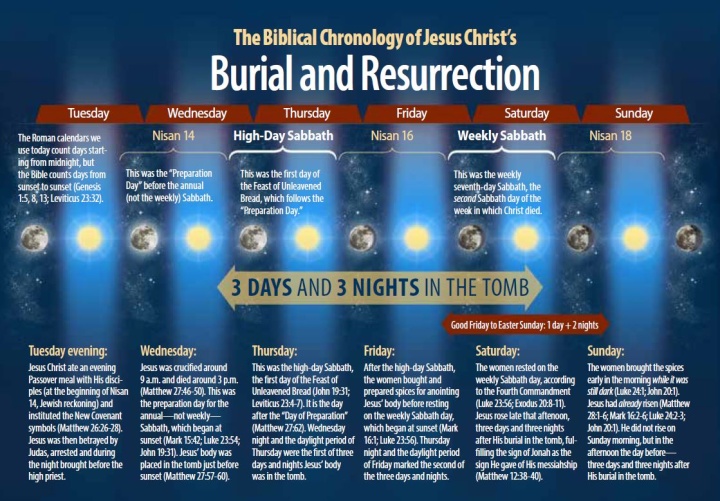
Good Friday + Easter Sunday, It Doesn’t Add Up!

“How can we fit three days and three nights between a Friday afternoon crucifixion and an Easter Sunday sunrise? The fact is, we can’t. So what is the truth about when Jesus was crucified and resurrected?

The Biblical Chronology of Jesus Christ’s Burial and ResurrectionUCG.org

The Biblical Chronology of Jesus Christ’s Burial and Resurrection

About one billion Protestants and another billion Catholics believe that Jesus Christ was crucified and entombed on a Friday afternoon—“Good Friday”—and raised to life again at daybreak on Easter Sunday morning, a day and a half later.

Yet when we compare this to what Jesus Himself said about how long He would be in the tomb, we find a major contradiction. How long did Jesus say He would be in the grave? “For as Jonah was three days and three nights in the belly of the great fish, so will the Son of Man be three days and three nights in the heart of the earth” (Matthew 12:40, emphasis added throughout).

The context in which Jesus Christ said these words is important. The scribes and Pharisees were demanding a miraculous sign from Him to prove that He was indeed the long-awaited Messiah. “But He answered and said to them, ‘An evil and adulterous generation seeks after a sign, and no sign will be given to it except the sign of the prophet Jonah’” (verse 39).

This was the only specific sign Jesus gave that He was the promised Messiah: “For as Jonah was three days and three nights in the belly of the great fish, so will the Son of Man be three days and three nights in the heart of the earth.”

Traditional timing doesn’t add up

The Gospels are clear that Jesus died and His body was hurriedly placed in the tomb late in the afternoon, just before sundown marking the beginning of a Sabbath (John 19:30-42).

By the traditional “Good Friday–Easter Sunday” timing, from Friday sundown to Saturday sundown is one night and one day. Saturday night to Sunday daybreak is another night, giving us a total of two nights and one day. So where do we get another night and two days to equal the three days and three nights Jesus said He would be in the tomb?

This is definitely a problem. Most theologians and religious scholars try to work around it by arguing that any part of a day or night counts as a day or night. Thus, they say, the final few minutes of that Friday afternoon were the first day, all day Saturday was the second day, and the first few minutes of Sunday morning were the third day.

Sounds reasonable, some conclude.

The trouble is, it just doesn’t work. That only adds up to three days and two nights, not three days and three nights.

Also, John 20:1 tells us that “on the first day of the week Mary Magdalene went to the tomb early, while it was still dark, and saw that the stone had been taken away from the tomb.”

Did you catch the problem here? John tells us it was still dark when Mary went to the tomb on Sunday morning and found it empty. Jesus was already resurrected well before daybreak. Thus He wasn’t in the tomb any of the daylight portion of Sunday, so none of that can be counted as a day!

That leaves us with, at most, part of a day on Friday, all of Friday night, a whole daylight portion on Saturday, and most of Saturday night. That totals one full day and part of another, and one full night and most of another—still at least a full day and a full night short of the time Jesus said He would be in the tomb!

Clearly something doesn’t add up. Either Jesus misspoke about the length of time He would be in the tomb, or the “Good Friday–Easter Sunday” timing is not biblical or accurate.

Obviously both cannot be true. So which one is right?

God-given time reckoning is the key

The key to understanding the timing of Christ’s crucifixion and resurrection lies in understanding God’s timetable for counting when days begin and end, as well as the timing of His biblical festivals during the spring of the year when these events took place. It’s not hard to figure out when we look closely at what the Bible says.

We first need to realize that God doesn’t begin and end days at midnight as we now do. That is a humanly devised method of counting time. Genesis 1:5 tells us quite plainly that God counts a day as beginning with the evening (the night portion) and ending at the next evening: “So the evening [nighttime] and the morning [daylight] were the first day.” God repeats this formula for the entire six days of creation.

In Leviticus 23, where God lists all of His holy Sabbaths and festivals, He makes it clear that they are to be observed “from evening to evening” (Leviticus 23:32)—in other words, from sunset to sunset, when the sun went down and evening began.

This is why Joseph of Arimathea and Nicodemus, followers of Jesus, hurriedly placed His body in Joseph’s nearby tomb just before sundown (John 19:39-42). A Sabbath was beginning at sundown (John 19:31), when work would have to cease.

Two kinds of “Sabbaths” lead to confusion

As John tells us in John 19:31: “Therefore, because it was the Preparation Day, that the bodies [of those crucified] should not remain on the cross on the Sabbath (for that Sabbath was a high day), the Jews asked Pilate that their legs might be broken [to hasten death], and that they might be taken away.”

In the Jewish culture of that time, the chores of cooking and housecleaning were done on the day before a Sabbath to avoid working on God’s designated day of rest. Thus the day before the Sabbath was commonly referred to as the “preparation day.” Clearly the day on which Christ was crucified and His body placed in the tomb was the day immediately preceding a Sabbath.

The question is, which Sabbath?

Most people assume John is speaking of the regular weekly Sabbath day, observed from Friday sunset to Saturday sunset. From John’s clear statement here, most people assume Jesus died and was buried on a Friday—thus the traditional belief that Jesus was crucified and died on “Good Friday.”

Most people have no idea that the Bible talks about two kinds of Sabbath days—the normal weekly Sabbath day that falls on the seventh day of the week (not to be confused with Sunday, which is the first day of the week), and seven annual Sabbath days, listed in Leviticus 23 and mentioned in various passages throughout the Bible, that could fall on any day of the week.

Because traditional Christianity long ago abandoned these biblical annual Sabbath days (as well as the weekly Sabbath), for many centuries people have failed to recognize what the Gospels plainly tell us about when Jesus Christ was crucified and resurrected—and why “Good Friday–Easter Sunday” never happened that way.

Most people fail to note that John explicitly tells us that the Sabbath that began at sundown immediately after Jesus was entombed was one of these annual Sabbath days. Notice in John 19:31 his explanation that “that Sabbath was a high day” —  high day” being a term used to differentiate the seven annual Sabbaths from the regular weekly Sabbath days.

So what was this “high day” that immediately followed Jesus Christ’s hurried entombment?

The Gospels tell us that on the evening before Jesus was condemned and crucified, He kept the Passover with His disciples (Matthew 26:19-20; Mark 14:16-17; Luke 22:13-15). This means He was crucified on the Passover day.

Leviticus 23, which lists God’s festivals, tells us that on the day after the Passover a separate festival, the Feast of Unleavened Bread, begins (Leviticus 23:5-6). The first day of this Feast is “a holy convocation” on which “no customary work” is to be done (Leviticus 23:7).

This day is the first of God’s annual Sabbaths in the year. This is the “high day” of which John wrote. Several Bible commentaries, encyclopedias and dictionaries note that John is referring to an annual Sabbath here rather than the regular weekly Sabbath day.

Passover began at sundown and ended the following day at sundown, when this annual Sabbath began. Jesus kept the Passover with His disciples, then was arrested later that night. After daybreak the next morning He was questioned before Pontius Pilate, crucified, then hurriedly entombed just before the next sunset when the “high day,” the first day of the Feast of Unleavened Bread, began.

It should be noted that the Jews often generically referred to the whole Feast of Unleavened Bread as “Passover,” explaining why the day of Christ’s trials and crucifixion is even called “the Preparation Day of the Passover” (John 19:14)—that is, of the first Holy Day or annual Sabbath of the Passover week.

Leviticus 23 tells us the order and timing of these days, and the Gospels confirm the order of events as they unfolded.

Jesus crucified on Wednesday, not Friday

It can be shown that in the year Jesus was crucified the Passover meal must have been eaten on Tuesday night and that Wednesday sundown marked the beginning of the “high day,” the first day of the Feast of Unleavened Bread.

Jesus, then, was crucified and entombed on a Wednesday afternoon, not on Friday. Proof of this can be found in the Gospels themselves.

Let’s turn to a seldom-noticed detail in Mark 16:1: “Now when the Sabbath was past, Mary Magdalene, Mary the mother of James, and Salome bought spices, that they might come and anoint Him.”

In that time, if the body of a loved one was placed in a tomb rather than being buried directly in the ground, friends and family would commonly place aromatic spices in the tomb alongside the body to reduce the smell as the remains decayed.

Since Jesus’ body was placed in the tomb just before that high-day Sabbath began, the women had no time to buy those spices before the Sabbath. Also, they could not have purchased them on the Sabbath day, as shops were closed. Thus, Mark says, they bought the spices after the Sabbath—“when the Sabbath was past.”

But notice another revealing detail in Luke 23:55-56: “And the women who had come with [Christ] from Galilee followed after, and they observed the tomb and how His body was laid. Then they returned and prepared spices and fragrant oils. And they rested on the Sabbath according to the commandment.”

Do you see a problem here? Mark clearly states that the women bought the spices after the Sabbath—“when the Sabbath was past.” Luke tells us that the women prepared the spices and fragrant oils, after which “they rested on the Sabbath according to the commandment.”

So they bought the spices after the Sabbath, and then they prepared the spices before resting on the Sabbath. This would be a clear contradiction between these two Gospel accounts—unless two Sabbaths were involved!

Indeed when we understand that two different Sabbaths are mentioned, the problem goes away.

Mark tells us that after the “high day” Sabbath, which that year must have begun Wednesday evening at sundown and ended Thursday evening at sundown, the women bought the spices to anoint Jesus’ body. Luke then tells us that the women prepared the spices—activity which would have taken place on Friday—and that afterward “they rested on the Sabbath [the normal weekly Sabbath day, observed Friday sunset to Saturday sunset] according to the commandment.”

By comparing details in both accounts along with a proper understanding of three days and three nights, we can clearly see that two different Sabbaths are mentioned along with a workday—Friday—in between. The first Sabbath was a “high day”—the first day of the Feast of Unleavened Bread, which fell on a Thursday that year. The second was the weekly seventh-day Sabbath.

The original Greek in which the Gospels were written also plainly tells us that two Sabbath days were involved in these accounts. In Matthew 28:1, where Matthew writes that the women went to the tomb “after the Sabbath,” the word Sabbath here is actually plural and should be translated “Sabbaths.” Bible versions such as Alfred Marshall’s Interlinear Greek-English New Testament, Green’s Literal Translation, Young’s Literal Translation and Ferrar Fenton’s Translation make this clear.

When was Jesus resurrected?

We have seen, then, that Jesus Christ was crucified and entombed on a Wednesday, just before an annual Sabbath began—not the weekly Sabbath. So when was He resurrected?

John 20:1, as noted earlier, tells us that “on the first day of the week Mary Magdalene went to the tomb early, while it was still dark, and saw that the stone had been taken away from the tomb.” The sun had not yet risen—“it was still dark,” John tells us—when Mary found the tomb empty.

Obviously, then, Jesus was not resurrected at sunrise on Sunday morning. So when did that happen? The answer is plain if we simply read the Gospels—especially Jesus Christ’s own words—and accept them for what they say.

“For as Jonah was three days and three nights in the belly of the great fish, so will the Son of Man be three days and three nights in the heart of the earth,” said Jesus (Matthew 12:40).

As we have seen, Jesus must have been entombed—placed “in the heart of the earth”—just before sundown on a Wednesday. All we have to do is count forward. One day and one night brings us to Thursday at sundown. Another day and night brings us to Friday at sundown. A third day and night brings us to Saturday at sundown.

According to Jesus Christ’s own words, He would have emerged from the grave three days and nights after He was entombed, at around the same time—near sunset. Does this fit with the Scriptures? Yes—as we have seen, He was already risen and the tomb empty when Mary arrived “while it was still dark” on Sunday morning.

While no one was around to witness His resurrection (which took place inside a sealed tomb watched over by armed guards), Jesus Christ’s own words and the details recorded in the Gospels show that it had to have happened three days and three nights after His burial, near sunset at the end of the weekly Sabbath.

Try as one might, it is impossible to fit three days and three nights between a late Friday burial and a Sunday morning resurrection. The Good Friday–Easter Sunday tradition simply isn’t true or biblical. But when we look at all the details recorded in the Gospels and compare them with Jesus’ own words, we can see the truth—and it matches perfectly.

The words of the angel of God, who so startled the women at the empty tomb, are proven true: “Do not be afraid, for I know that you are looking for Jesus, who was crucified. He is not here; he has risen, just as he said” (Matthew 28:5-6, New International Version).

Let’s not cling to religious traditions and ideas that aren’t supported by Scripture. Be sure that your own beliefs and practices are firmly rooted in the Bible. Are you willing to make a commitment to worship God according to biblical truth rather than human tradition?”  From: From: https://www.ucg.org/beyond-today/beyond-today-magazine/good-friday-easter-sunday-it-doesnt-add-up  

Centuries-Old Documents Show Evidence for a Wednesday Crucifixion

“Did you know there is additional historical evidence for a Wednesday crucifixion? Although it was a minority position and ran against the prevailing teachings of the Roman church, some early historical documents acknowledge a Tuesday night Passover, a Wednesday crucifixion and a Saturday afternoon resurrection—matching the biblical record.

Around the year 200, a document purporting to pass on apostolic instruction, called the Didascalia Apostolorum, mentions that the last Passover of Jesus Christ and His disciples was on a Tuesday night.

This document states: “For when we had eaten the Passover on the third day of the week at even [Tuesday evening], we went forth to the Mount of Olives; and in the night they seized our Lord Jesus. And the next day, which was the fourth of the week [Wednesday], He remained in ward in the house of Caiaphas the high priest” (emphasis added throughout).

Paradoxically, the text goes on to mention that Jesus was crucified on a Friday—showing great confusion about the dates, for the biblical account clearly states that Christ was crucified in the daylight period following the night of that Passover meal and arrest. Nonetheless, the document demonstrates that Passover was then understood by some to have been on Tuesday evening, which would place the crucifixion on the next day, Wednesday.

By the fifth century, Easter Sunday celebrations were widespread. However, a church historian of the time named Socrates notes in a section of his history titled “Differences of Usage in Regard to Easter” that some Christians celebrated the resurrection on the Sabbath rather than on Sunday. As he put it, “Others in the East kept that feast on the Sabbath indeed.” 

So rather than a monolithic acceptance of the Good Friday–Easter Sunday scenario, there was confusion about the timing of Christ’s crucifixion in early centuries. Moreover, these historical records show that a minority of Christians during that time understood the biblical timing of a Tuesday evening Passover, a Wednesday crucifixion and a late Saturday afternoon resurrection.”  

________

Did Jesus Christ Teach Easter?

The truth about Jesus' death and resurrection is very different from what most Christians believe.

Transcript From: https://www.ucg.org/beyond-today/beyond-today-daily/did-jesus-christ-teach-easter

[Darris McNeely] “Was Jesus Christ resurrected on Easter Sunday morning after having been killed on a Good Friday afternoon? The answer is no. Whatever you've learned, whatever you've been taught about that topic from your church and your religious studies does not match up with Scripture.

Let's read Matthew 12:40, and notice something here. Christ was challenged by some to give a sign as to who He was. He said, "An evil adulterous generation seeks after a sign. There's only going to be one sign that you will know that I am the Messiah. It's the same sign as Jonah." He said that, "As Jonah was three days and three nights in the belly of the great fish, so will the Son of Man be three days and three nights in the heart of the earth." Three days and three nights.

It's the only sign Jesus gave that He was the Messiah. Now when you look at the gospel accounts of the death and the resurrection of Jesus Christ with all the Scriptures put together, it's very clear the week that Jesus died shows us a very different story than the one that you have been taught and may still believe.

Jesus Christ had a Passover meal with his disciples on the night before he was arrested and crucified. He was betrayed by Judas Iscariot at 9 a.m. the next morning, which was actually the 14th day of the month when the Passover's services were to be held. He was crucified. He died at 3 p.m.. And yet they put his body into the grave, according to Scripture, before sundown or right at sundown on that 14th day. So as that day was ending, dawning to what was called a Sabbath and in reality was a holy day, the first day of what is called the Days of Unleavened Bread, His body was in the tomb and remained there for one full day and one full night. The next day was a Friday, the 16th day of the Hebrew calendar. His body was still in the grave all day and again all night. That's two days and two nights. The third day was a weekly Sabbath, a Saturday, that week. Christ's body was in the grave through the night all that day. And then at the very end of the day, after three days and three nights in the grave is when Jesus Christ was resurrected. Not the next day on Sunday morning as the Easter tradition says.

So, we have one day, one night, two days and two nights, three days and three nights. It's all in the Scripture. It's all in the Bible. Check it out. Jesus was not resurrected on Easter Sunday. That's a tradition that was added later on. The truth opens up the true understanding of who Jesus Christ was, why he came, and what his life, death, and resurrection means. Check out your belief, and check it out with your Bible.”  From: https://www.ucg.org/beyond-today/beyond-today-daily/did-jesus-christ-teach-easter

________

How to Reduce Cholesterol Oxidation

Transcript of video at: https://nutritionfacts.org/video/how-to-reduce-cholesterol-oxidation/

Below is an approximation of this video’s audio content. To see any graphs, charts, graphics, images, and quotes to which Dr. Greger may be referring, watch the above video.

‘'Chicken, fish, and egg powder in processed foods present greater risk from cholesterol oxidation byproducts, but there are things you can do to reduce exposure.

A significant body of evidence indicates that oxidized cholesterol [may be] one of the main triggers of [Alzheimer’s disease].” But, that’s not all. Cholesterol oxidation products “are associated with the initiation and progression of [multiple] major chronic diseases,” including heart disease, diabetes, and kidney failure. And, they’re produced when animal products are heated. All forms of cooking can do it, since you can get “maximum cholesterol oxidation” at only about 300 degrees Fahrenheit. But, is there some type of cooking that’s worse than others? Well, if you look at foal meat, which is like baby horse meat, higher levels of oxidation in general were found in microwaved meat.

And, indeed, microwaving chicken or beef appears to produce about twice as much cholesterol oxidation as frying. Whereas, if you look at bacon, raw bacon wasn’t found to have any oxidized cholesterol—it has cholesterol, like all animal products, but it’s not oxidized until you cook it. Grilling seems to be the safest the first time around, but then, when you put it back in the fridge and reheat it later using the same method, the oxidized cholesterol levels all shoot up.

It’s not just heat, though. Although levels in raw meats are usually low, “concentrations tend to increase dramatically after exposure to pro-oxidation agents, such as light.” What are you supposed to do, crawl inside the pig and eat the bacon from the inside? No, you could wrap the meat in red plastic wrap. Clear plastic wrap doesn’t seem to work, but the red blocks some of the light waves and can “delay…cholesterol oxidation.” This was for “horse meat slices.” The problem is worse with “sliced meat products,” because more of the meat is exposed to air and light. Same problem with ground meat; it’s just so much more exposed.

Unless you keep meat in some kind of vacuum pack, even in a dark refrigerator, the oxygen exposure alone can shoot up oxidation levels. Or, in the freezer. Yeah, cooking raw fish can boost levels from 8 to 18, but after a few months, frozen fish—even raw—starts out about ten times higher and just goes up from there.

And, in terms of which meat is the worst, microwaved or fried, chicken was twice as bad as beef. The reason, it seems, has to do with the “polyunsaturated fat…content of the muscle,” which goes fish, then poultry, then pork, then beef, then lamb. So, white meat is more susceptible to cholesterol oxidation. Yes, red meat has more saturated fat, but fish and chicken tend to build up more oxidized cholesterol. So, “chicken and roasted salmon…have been shown to generate greater amounts of [cholesterol oxidation products] than other [types of meat].” Surprisingly, though, “the highest increase of [oxidized cholesterol in salmon] was found through steaming—mainly just because it’s exposed to heat longer. Cholesterol oxidation “increased after each cooking procedure…[but] steaming increased the total amount by more than 1000%.”

There are two ways chicken meat may pull ahead, though. One is if you feed the chickens rancid fat in the first place. And, unfortunately, all sorts of substandard stuff ends up at the rendering plants to be turned into animal feed. And also irradiation. When chicken meat is irradiated to improve its food safety from an infectious disease standpoint, it may diminish food safety from a chronic disease standpoint. But, hey; it’s better than dying from salmonella.

In terms of dairy, in my last video, ( https://nutritionfacts.org/video/oxidized-cholesterol-as-a-cause-of-alzheimers-disease/) I talked about the potential dangers of ghee, which made me wonder about UHT milk, which stands for ultra-high temperature processing, to make little half-and-half no-refrigeration-needed coffee creamers. That does seem to boost oxidized cholesterol levels by about 50%—worse than just regular pasteurization, though, interestingly, if you can find goat milk half-and-half, that would be safer.

Same problem with eggs. Egg powder in processed foods is good for shelf life, but may not be so good for human life. So, that’s like packaged food with eggs in it, like pasta, many baked goods, mayonnaise. So, even people who stay away from egg eggs, may still be unwittingly exposed through processed foods, if they don’t read the label.

If it’s all about oxidation, why not just add “synthetic or natural antioxidants” to the animal products themselves? They’ve certainly tried; like, what about adding lemon balm tea to hamburger patties? It didn’t work, but that’s likely because they couldn’t add enough without affecting the taste. What about adding cherries—they’re red—they would blend right in. And, it worked! Two different types of tart cherries significantly reduced the cholesterol oxidation, but meat with a cherry on top seems a little out of place. How about just good old garlic and onions? Here’s the amount of oxidized cholesterol in a plain pork chop, significantly reduced by adding onion or garlic—though, interestingly, in chicken, cholesterol oxidation was helped by sage, but not garlic. In fact, garlic may even accelerate fat oxidation.

So, “there are several measures that can be taken to reduce cholesterol oxidation in foods: reducing the total cholesterol content [in food] by not cooking food with cholesterol-containing fat” [like butter or lard]; maybe we can “feed…animals…antioxidants before, or add them afterwards; use as low a temperature to cook as possible; use some kind of opaque vacuum packing, or something. But, if you take a step back, only foods that start out with cholesterol can end up with oxidized cholesterol. So, the primary method, in terms of reducing cholesterol oxidation in foods, may be to “reduce the total cholesterol content of the food”—not just by avoiding adding extra with butter, but instead, centering one’s diet around whole plant foods, which don’t have any cholesterol to get oxidized in the first place.”      From: https://nutritionfacts.org/video/how-to-reduce-cholesterol-oxidation/

_______