Showing posts with label Jewish. Show all posts

Tuesday, December 23, 2025

Christmas: The Untold Story (Part 1) (Part 2)

.

Christmas: The untold story (part 1)

Christmas: The untold story (part 1)“Christmas is one of the world’s most popular holidays, celebrated by people of many faiths. Yet the holiday has a strange and convoluted past, one hinted at in such puzzling symbols as decorated trees, holly wreaths and mistletoe.

William Walsh (1854-1919) summarizes the holiday's origins and practices in his book The Story of Santa Klaus: "We remember that the Christmas festival ... is a gradual evolution from times that long antedated the Christian period ... It was overlaid upon heathen festivals, and many of its observances are only adaptations of pagan to Christian ceremonial" (1970, p. 58). 

During the second century B.C. the Greeks practiced rites to honor their god Dionysus (also called Bacchus). The Latin name for this celebration was Bacchanalia, which spread from Greece to Rome. "It was on or about December 21st that the ancient Greeks celebrated what are known to us as the Bacchanalia or festivities in honor of Bacchus, the god of wine. In these festivities the people gave themselves up to songs, dances and other revels which frequently passed the limits of decency and order" (Walsh, p. 65).

In addition to the Bacchanalia, the Romans celebrated the Saturnalia, held "in honor of Saturn, the god of time, [which] began on December 17th and continued for seven days. This also often ended in riot and disorder. Hence the words Bacchanalia and Saturnalia acquired an evil reputation in later times" (p. 65).

Notice the customs surrounding the Saturnalia: "All businesses were closed except those that provided food or revelry. Slaves were made equal to masters or even set over them. Gambling, drinking, and feasting were encouraged. People exchanged gifts, called strenae, from the vegetation goddess Strenia, whom it was important to honor at midwinter ... Men dressed as women or in the hides of animals and caroused in the streets. Candles and lamps were used to frighten the spirits of darkness, which were [considered] powerful at this time of year. At its most decadent and barbaric, Saturnalia may have been the excuse among Roman soldiers in the East for the human sacrifice of the king of the revels" (Gerard and Patricia Del Re, The Christmas Almanac, 1979, p. 16).

"From the Romans also came another Christmas fundamental: the date, December 25. When the Julian calendar was proclaimed in 46 [B.C.], it set into law a practice that was already common: dating the winter solstice as December 25. Later reforms of the calendar would cause the astronomical solstice to migrate to December 21, but the older date's irresistible resonance would remain" (Tom Flynn, The Trouble With Christmas, 1993, p. 42). On the heels of the Saturnalia, the Romans marked December 25 with a celebration called the Brumalia. Bruma is thought to have been contracted from the Latin brevum or brevis, meaning brief or short, denoting the shortest day of the year.

"The time of the winter solstice has always been an important season in the mythology of all peoples. The sun, the giver of life, is at its lowest ebb….It is the time when the forces of chaos that stand against the return of light and life must once again be defeated by the gods. At the low point of the solstice, the people must help the gods through imitative magic and religious ceremonies. The sun begins to return in triumph. The days lengthen and, though winter remains, spring is once again conceivable. For all people, it is a time of great festivity" (The Christmas Almanac, 1979, p. 15).”   From: https://www.ucg.org/learn/bible-study-tools/bible-study-aids/holidays-or-holy-days-does-it-matter-which-days-we-observe/christmas-untold-story

________

Christmas: The untold story (part 2)

Christmas: The untold story (part 2)“During the days of Jesus' Apostles, in the first century, the early Christians had no knowledge of Christmas as we know it. But, as a part of the Roman Empire, they may have noted the Roman observance of the Saturnalia while they themselves persisted in celebrating the customary "feasts of the Lord" (listed in Leviticus 23).

The image is a painting titled "A Roman Feast" (also known as "Saturnalia") by Italian artist Roberto Bompiani, depicting a lively banquet scene during the ancient Roman festival of Saturnalia.

The Encyclopaedia Britannica tells us "the first Christians ... continued to observe the Jewish festivals, though in a new spirit, as commemorations of events which those festivals had foreshadowed" (11th edition, Vol. 8, p. 828, "Easter"). But over the following centuries, new, nonbiblical observances such as Christmas and Easter were gradually introduced into traditional Christianity.

These new days came to be forcibly promoted while the biblical feast days of Apostolic times were systematically rejected. "Christmas, the [purported] festival of the birth of Jesus Christ, was established in connection with a fading of the expectation of Christ's imminent return" (Encyclopaedia Britannica, 15th edition, Macropaedia, Vol. 4, p. 499, "Christianity"). The Christmas celebration shifted Christianity's focus away from Christ's promised return to His birth, something the Bible does not direct Christians to do.

Gerard and Patricia Del Re explain the further evolution of December 25 as an official Roman celebration: " the tradition of celebrating December 25 as Christ's birthday came to the Romans from Persia. Mithra, the Persian god of light and sacred contracts, was born out of a rock on December 25…. and in the third century [274] the unchristian emperor Aurelian established the festival of Dies Invicti Solis, the Day of the Invincible Sun, on December 25.

"Mithra was an embodiment of the sun, so this period of its rebirth was a major day in Mithraism, which had become Rome's latest official religion with the patronage of Aurelian. It is believed that the emperor Constantine adhered to Mithraism up to the time of his conversion to Christianity. He was probably instrumental in seeing that the major feast of his old religion was carried over to his new faith" (The Christmas Almanac, 1979, p. 17).

Although Christmas had been officially established in Rome by the fourth century, later another pagan celebration greatly influenced the many Christmas customs practiced today. That festival was the Teutonic feast of Yule (from the Norse word for "wheel," signifying the cycle of the year). "During this time log-fires were burnt to assist the revival of the sun. Shrines and other sacred places were decorated with such greenery as holly, ivy, and bay, and it was an occasion for feasting and drinking.

"Equally old was the practice of the Druids… to decorate their temples with mistletoe, the fruit of the oak-tree which they considered sacred. Among the German tribes the oak-tree was sacred to Odin, their god of war, and they sacrificed to it until St Boniface, in the eighth century, persuaded them to exchange it for the Christmas tree, a young fir-tree adorned in honour of the Christ child ..." (L.W. Cowie and John Selwyn Gummer, The Christian Calendar, 1974, p.22).

It wasn't long before such non-Christian rites and practices were assimilated into a new church religious holiday supposedly celebrating Christ's birth. William Walsh describes the rationalization behind it: " In order to reconcile fresh converts to the new faith, and to make the breaking of old ties as painless as possible, these relics of paganism were retained under modified forms ...Thus we find that when Pope Gregory [540-604] sent Saint Augustine as a missionary to convert Anglo-Saxon England he directed that so far as possible the saint should accommodate the new and strange Christian rites to the heathen ones with which the natives had been familiar from their birth.... On the very Christmas after his arrival in England Saint Augustine baptized many thousands of converts and permitted their usual December celebration under the new name and with the new meaning" (p. 61).

Even colonial America considered Christmas more of a raucous revelry than a religious occasion: "So tarnished, in fact, was its reputation in colonial America that celebrating Christmas was banned in Puritan New England, where the noted minister Cotton Mather described yuletide merrymaking as ‘an affront unto the grace of God'" (Jeffery Sheler, "In Search of Christmas," U.S. News and World Report, Dec. 23, 1996, p. 56).”  From: https://www.ucg.org/learn/bible-study-tools/bible-study-aids/holidays-or-holy-days-does-it-matter-which-days-we-observe/christmas-untold-story

_________

Sunday, June 29, 2025

Simon The Magician. A Great Blessing. God Cares About What We Eat.

.

Simon The Magician

Simon the Magician“Simon the Magician came from the Middle East, but his religious cult expanded over a wide area perverting the teachings of Jesus Christ. He is mentioned in the book of Acts and founded a counterfeit Christianity promoting false ideas and doctrines.

After Jesus' crucifixion, death and resurrection His followers spread the Gospel message. A disciple named Philip taught in Samaria, an area not far from Jerusalem, and many people began to respond to his message.

During his time in Samaria Philip came in contact with a pagan religious leader known as Simon the Magician, who is described in Acts 8:9-10: “But there was a certain man, called Simon, which beforetime in the same city used sorcery, and bewitched the people of Samaria, giving out that himself was some great one. To whom they all gave heed, from the least to the greatest, saying, "This man is the great power of God.”

Many of Simon's followers believed Philip's message about Jesus as the prophesied Messiah, and were baptized. Even Simon himself professed to be a Christian and he too was baptized (Acts 8:12-13). A short time later the Apostles Peter and John traveled to Samaria to teach the new converts and lay hands upon them so they would receive the Holy Spirit (Acts 8:17-19). When Simon saw the people were given God's Spirit, he offered the Apostles money to give him this power. (This is the origin of the English word ‘simony’, which refers to the selling and buying of religious offices.)

The biblical account doesn't say Simon wanted to give up his false teachings or even change his way of life. What he wanted was power (Acts 8:19). The Apostles knew this and called him a man of “...bitterness, and in the bond of iniquity” rejecting his request (Acts 8:23). After this, Simon Magus (magus means magician or sorcerer) disappears from the biblical account, but he continued to lead his religious cult, adding elements of the teachings of Jesus to his pagan-Jewish mixture, and becoming part of a movement to create a paganized Christianity.

Simon carried his message from city to city, just as Christ’s Apostles spread the true Gospel. He translated the doctrine of grace as license to disobey God’s law. The Encyclopaedia Britannica, 11th edition, Vol. 25, states, in its article titled “Simon Magus,” that he identified with the “Hellenized Gnosticism of Samaria.” The article referred to him as the “Samaritan Messiah” and the “father of all heresy.” The Samaritans had been placed in the land from which the northern kingdom of Israel had been taken captive by the Assyrians. These Samaritans had been brought from Babylon and continued to practice their ancient Babylonian religion, mixed with other religions.

The belief, at the heart of Simon's heresy, was he could receive power from God without changing his ways. The religious movement became known as gnosticism, and in the New Testament this false teaching is referred to as ‘lawlessness’.  Even today many believe the law of God was done away by the sacrifice of Jesus Christ. The Apostle Paul maintained this approach was already gathering momentum during his lifetime, "For the mystery of lawlessness is already at work..." (2 Thessalonians 2:7).

The Ten Commandments define the most basic behaviors of love. Do not steal. Do not lie. Do not murder. 1 John 5:3 very plainly tells us that love is keeping the commandments. In the Sermon on the Mount, Jesus expanded the meaning of the word ‘love’ beyond the simple letter of the law. For example he explained obedience to the commandment "do not murder" entailed learning not to hate, because hatred is the root cause of murder.

Nearly 300 years after Peter confronted Simon, a bishop named Eusebius lamented the Simonian cult still existed: "It is an astonishing fact that this is still the practice of those who to the present day belong to his (this) disgusting sect. Following in…. [Simon's] footsteps they slip into the church like a pestilential and scabby disease, and do the utmost damage to all whom they succeed in smearing with the horrible, deadly poison concealed on them" (The History of the Church by Eusebius.)

Even after Simon died in AD 68 his greatest heresies were still infecting Christianity hundreds of years after he is mentioned in the book of Acts. One of the reasons God inspired Luke to record these events is because Christians will be combating the "mystery of lawlessness" until the return of Jesus Christ. No wonder the Apostle John warns Christians: “Beloved, believe not every spirit, but try the spirits whether they are of God: because many false prophets are gone out into the world” (1 John 4:1)

_______

A Great Blessing

A great blessing“The desire for revenge, retaliation and mudslinging is reflected in our entertainment and society in general. In spite of the fact we are told to forgive, many seek an active or passive form of revenge against their real or perceived enemies.

The sacrifice of Jesus Christ paid the death penalty earned by mankind as a result of sin. "But God demonstrates His own love toward us, in that while we were still sinners, Christ died for us.... when we were enemies we were reconciled to God through the death of His Son..." (Romans 5:8-10). God expects us to develop this same attitude of mercy, graciousness and forgiveness. He will not forgive our sins if we are unforgiving toward others.

"And forgive us our debts, as we forgive our debtors.... For if you forgive men their trespasses, your heavenly Father will also forgive you. But if you do not forgive men their trespasses, neither will your Father forgive your trespasses" (Matthew 6:12,14-15). II Timothy 3:1-4 includes being unforgiving in the list of characteristics people will exhibit in the “perilous times” prevalent in the “last days” just before Jesus Christ returns to earth.

When a woman caught in adultery was brought to Jesus the Scribes and Pharisees demanded: “'Teacher, this woman was caught in adultery...Moses, in the law, commanded us that such should be stoned. But what do You say?' This they said, testing Him, that they might have something of which to accuse Him.” Jesus’s response was, “'He who is without sin among you, let him throw a stone at her first.' And…those who heard it, being convicted by their conscience, went out one by one…When Jesus had raised Himself up and saw no one but the woman, He said to her, 'Woman, where are those accusers ... .Has no one condemned you?' She said, 'No one, Lord.' And Jesus said to her, 'Neither do I condemn you; go and sin no more'" (John 8:1-11).

Another example showing Christ expects us to develop a forgiving attitude occurred when Peter asked, “‘…how often shall my brother sin against me, and I forgive him? Up to seven times?' Jesus answered, “…up to seventy times seven'" (Matthew 18:21-22). The Apostles were stunned at this statement and answered, “‘Increase our faith.’” (Luke 17:5).

The parable in Matthew 18:23-35 illustrates the consequences of being unforgiving. The account of the forgiven servant persecuting someone who owed him a pittance in comparison with the amount he had just received forgiveness for is a lesson for us. Christ warned the unforgiving servant his attitude was unacceptable, pointing out: "Should you not also have had compassion on your fellow servant, just as I had pity on you?' (verse 33).

This is not to say we cannot make a judgment regarding other people's actions as to whether or not we should follow their example, but we cannot read minds and hearts. Christ instructs us not to judge others: "Judge not, that you be not judged... First remove the plank from your own eye, and then you will see clearly to remove the speck from your brother's eye" (Matthew 7:1 and 5). Luke 6:36-37 reinforces this admonition: "Judge not, and you shall not be judged. Condemn not, and you shall not be condemned. Forgive, and you will be forgiven" (Luke 6:37).

Proverbs 19:11 states, “it is his [our] glory to pass over a transgression” (King James Version). Jesus' example just before His death sets the standard for us as far as forgiveness is concerned: "When Jesus was being crucified and in agony He prayed: Father, forgive them, for they do not know what they do" (Luke 23:34). When we forgive, we reflect the Father’s love, giving us the opportunity to extend to others the great blessing God has extended to us.

________

God Cares About What We Eat.

God cares about what we eat“God’s instructions to mankind concerning the food we should eat was an established law of God long before the time of the Mount Sinai covenant (See Leviticus 11 and Deuteronomy 14).

Noah was aware of these laws at the time of the flood. When God told him in Genesis 7:2, “You shall take with you seven…pairs of every kind of clean animal…and one pair of every kind of unclean animal….” He did not explain which creatures were clean and unclean because Noah already knew.

Act 10:13-35 describes a dream the Apostle Peter had ten years after Christ’s crucifixion, in which he initially thought God was instructing him to eat unclean food. It is clear from Peter’s reaction the Apostles did not think Christ had abolished the food laws of Leviticus 11 and Deuteronomy 14. His response was: "Not so, Lord! For I have never eaten anything common or unclean" (Acts 10:14). Peter eventually correctly understood the significance of his dream was that God’s message of salvation applies to all nations, and He was calling people from all races and backgrounds. “...God has shown me that I should not call any man common or unclean (verse 28).” Shortly thereafter Peter baptized the first uncircumcised gentiles God called into the Church (Acts 10:34-35; 45-48).

The account in Mark 7 is also often misunderstood and thought to indicate the food laws in Deuteronomy and Leviticus no longer applied in the New Testament era. However, the topic of discussion here is food in general, as Mark 7:2 points out: “Now when they (the Pharisees) saw some of His disciples eat bread with defiled, that is, with unwashed hands, they found fault." They then asked Jesus, "Why do Your disciples not walk according to the tradition of the elders, but eat bread with unwashed hands?" (verse 5).

In Mark 7:18-19 Jesus explained: “...whatever enters a man from outside cannot defile him because it doesn’t enter his heart, but his stomach, and is eliminated….” Many modern translations of the New Testament erroneously insert additional words into the text of Mark 7:18-19. The New International Version ends verse 19 with the comment: "In saying this, Jesus declared all foods 'clean'." The New King James Version has "thus purifying all foods."   The food laws are not in question here. The disciples were being criticized for not following ceremonial hand-washing procedures and, after decrying the hypocrisy of this and other religious practices, Jesus describes the attitudes that defile us “... out of the heart of men, proceed evil thoughts, adulteries, fornications, murders, thefts, covetousness, wickedness, deceit, licentiousness, an evil eye, blasphemy, pride, foolishness. All these evil things come from within and defile a man" (Mark 7:21-23). Some of these same qualities are listed in Galatians 5:19-21 as "works of the flesh." They are contrasted with the "fruit of the Spirit" which are listed as: "Love, joy, peace, longsuffering, kindness, goodness, faithfulness, gentleness [and] self-control…." (Galatians 5:22-23).

Many also believe Romans 14 tells us Christians are free from all former biblical restrictions regarding the meats they may eat. They cite as proof verse 14 in which Paul wrote, "I know and am convinced by the Lord Jesus that there is nothing unclean of itself; but to him who considers anything to be unclean, to him it is unclean." This approach, however, fails to consider the context of Paul's letter as well as the specific Greek words he used.

The food controversy here was over meat sacrificed to idols. The Romans of the day commonly offered both meat and wine to idols, with portions of the offerings later being sold in the marketplace. Some thought there was nothing wrong with eating this meat, while others had a guilty conscience about it. Paul explained those whose consciences were not troubled by eating meat that might have been ceremonially offered to idols could go ahead and eat it as long as they did not offend others who may believe it was a wrong thing to do. Paul instructs, "..let each be fully convinced in his own mind" (Romans 14:5) because "...whatever is not from faith is sin" (Romans 14:23). (See our article Does Romans 14 Abolish God’s Law About Clean And Unclean Meats for a more detailed explanation of these scriptures and the Greek words Paul used here.)”

_________

Sunday, April 20, 2025

Would Jesus celebrate Easter? How Easter Supplanted Passover Observance.

.

Would Jesus celebrate Easter?

Would Jesus celebrate Easter?“Many Christian churches prepare special easter programs commemorating the death and resurrection of Jesus Christ, and parents hide easter eggs so their children can hunt for them on Easter morning. Then there are the Easter sunrise services, when Jesus' miraculous resurrection is supposedly honoured by watching the sun rise in the east.”

Image: Church Easter egg hunt (source: wikimedia commons)

“But can we find any historical or biblical record of Jesus or His disciples celebrating Easter or teaching us to meet to honor His resurrection at sunrise on Easter Sunday—or at any other time, for that matter?

There is no reference to Easter anywhere in the New Testament. In the King James Version of the Bible the word ‘Easter' is used once in Acts 12:4, but it is an erroneous mistranslation. The original Greek word is ‘pascha’, which is correctly translated as Passover in virtually every modern version of the Bible.

The original Apostles, and even the Apostle John, who died near the end of the first century, left no record of celebrating Easter. The Apostle Paul, some 25 years after Jesus' death and resurrection, told the Corinthian church they should continue to keep the Passover as Christ commanded (1 Corinthians 11:23-27). (See also the previous issue of Bible Insights Weekly #324 Why Christians Should Keep The Annual Passover). Paul and Luke, his traveling companion and author of the book of Acts, regularly mention observing the weekly Sabbath day and the annual biblical festivals listed in Leviticus 23, but mention of Easter is conspicuously absent ( 1 Corinthians 5:6-8 and 6:8; Acts 2:1-4; 13:42-44; 17:1-3; 18:4; 20:6 and 16).

Many scholars point out Easter is a pre-Christian religious holiday, observed long before Jesus' human lifetime. Vine's Complete Expository Dictionary of Old and New Testament Words notes: "The term 'Easter' is not of Christian origin. It is another form of Astarte, one of the titles of the Chaldean [Babylonian] goddess, the queen of heaven. The festival of Pasch [Passover] held by Christians in post-apostolic times was a continuation of the Jewish feast…From this Pasch the pagan festival of 'Easter' was quite distinct and was introduced into the apostate Western religion, as part of the attempt to adapt pagan festivals to Christianity" (W.E. Vine, 1985, "Easter").

Alexander Hislop in his book The Two Babylons also explores the origins of Easter. Although his work has been criticized as lacking scholarship, it is heavily footnoted with sources—and much of what he presents can be verified through other historical works. He points out Easter and the practices associated with it can be traced back to pagan rituals. For example "the forty days' abstinence of Lent [a 40-day period of fasting, prayer, and almsgiving observed by many Christian denominations in preparation for Easter] was directly borrowed from the worshippers of the Babylonian goddess" (p. 104). Hislop continues, "Among the pagans this Lent seems to have been an indispensable preliminary to the great annual festival in commemoration of the death and resurrection of Tammuz…." (p. 105). Tammuz was a chief Babylonian deity and husband of the goddess Ishtar, and a great festival was held every spring to celebrate Tammuz's death and supposed resurrection.

One Catholic writer explains how eggs and rabbits came to be connected with Easter: "The egg has become a popular Easter symbol…In ancient Egypt and Persia friends exchanged decorated eggs at the spring equinox, the beginning of their New Year. These eggs were a symbol of fertility for them….Christians of the Near East adopted this tradition, and the Easter egg became a religious symbol. It represented the tomb from which Jesus came forth to new life" (Greg Dues, Catholic Customs and Traditions, 1992, p. 101). Rabbits came to be linked with Easter because they were potent symbols associated with ancient fertility rites.

Not until the Council of Nicaea in 325—almost three centuries after Jesus was crucified and rose again—did Easter replace the Passover, the biblical ceremony Jesus and the Apostle Paul instructed Christians to observe. "A final settlement of the dispute [whether and when to observe Easter or Passover] was one among the other reasons which led Constantine to summon the council of Nicaea in 325….The decision of the council was unanimous that Easter [which they wrongly called Passover] was to be kept on Sunday, and on the same Sunday throughout the world, and 'that none should hereafter follow the blindness of the Jews'" (The Encyclopaedia Britannica, 11th edition, pp. 828-829, "Easter").

Constantine's decision was a fateful turning point for Christianity. Those who remained faithful to the instruction of Jesus and the Apostles would become a persecuted minority as a vastly different set of beliefs and practices—recycled from ancient pre-Christian religions dressed in a Christian cloak—would take hold among the majority.

Easter is a pagan tradition that was involved in the worship of false gods and is abhorrent to God. It is rooted in ancient pre-Christian fertility rites that have nothing to do with Jesus. Scripture does not support this pre-Christian holiday and condemns pagan worship practices even if done to honor the true God (Deuteronomy 12:29-32).

______

How Easter supplanted Passover observance

How Easter supplanted Passover observance“After Adam and Eve rejected God in the Garden of Eden (Genesis 3), humanity looked for other explanations for life with fertility rites and customs being incorporated into religious practices early on in human history.

Forces of nature and seasons that could not be controlled began to be viewed as gods, goddesses and supernatural powers to be worshipped and feared. Man soon created his own gods, contradicting God's instruction against idolatry (Exodus 20:3-6; Deuteronomy 5:7-10). “The most prominent myth to cross cultural lines was that of the fertility cycle. Many pagan cultures believed that the god of fertility died each year during the winter but was reborn…in the spring." (Nelson's New Illustrated Bible Dictionary, 1995, "Gods, Pagan," p. 508).

The Babylonian and Assyrian fertility goddess was Ishtar. She was the goddess of love, and the practice of ritual prostitution became widespread in the fertility cult dedicated to her name. "Associated with Ishtar was the young god Tammuz (Ezek. 8:14)... [who] died annually and was reborn…representing the yearly cycle of the seasons and the crops. This pagan belief later was identified with the pagan gods Baal and Anat in Canaan" (Nelson's New Illustrated Bible Dictionary, "Gods, Pagan," p. 509).

It was believed that Ishtar brought about the rebirth or resurrection of Tammuz in the spring, coinciding with the blossoming of nature. Though Easter was clearly pagan in origin, Christian leaders of the first two centuries concluded it was easier to draw pagan worshippers into Christianity by identifying the time-honored spring resurrection feast of the pagan mystery religions with the resurrection of Christ. Believing that people are free to select their own times and customs of worship, they gradually replaced the biblically commanded Passover with their humanly devised celebration of Easter.

This movement to replace Passover with popular Easter customs was the basis for contention over the next three centuries: "The earliest Christians celebrated the Lord's Passover at the same time as the Jews…[but]...By the middle of the 2nd century, most churches had transferred this celebration to the Sunday after the Jewish feast….[however] certain churches of Asia Minor clung to the older custom, for which they were denounced as ‘judaizing' “(Eusebius, Ecclesiastical History, Book 5, chapters 23-25).

Before A.D. 70 Christianity was "regarded by the Roman government and by the people at large as a branch of the Jewish religion" (Jesse Lyman Hurlbut, The Story of the Christian Church, 1954, p. 34). Christianity and Judaism shared the biblical feast days, although Christians observed them with added meanings introduced by Jesus and the Apostles. However, two Jewish revolts against the Roman Empire, in 64-70 and 132-135, led to widespread persecution of Jews and suppression of Jewish religious practices.

As pressure mounted, some Christians began to abandon beliefs and practices perceived as being too Jewish, such as the weekly Sabbath and instead worshiped on Sunday, the pagan day of the sun, as well as abandoning the Passover in favor of Easter to distance themselves from Jews. The New Catholic Encyclopedia explains: "Originally both observances [Passover and Easter] were allowed, but gradually it was felt incongruous that Christians should celebrate Easter on a Jewish feast, and unity in celebrating the principal Christian feast was called for" (1967, Vol. 5, p. 8, "Easter Controversy"). The first ecumenical Council of Nicaea in 325 decreed that all churches should observe the feast together on a Sunday" (15th edition, Macropaedia, Vol. 4, pp. 604-605, "Church Year").

Two religious leaders of the mid-second century—Polycarp, bishop of Smyrna in Asia Minor, and Anicetus, bishop of Rome—debated this point. Anicetus argued for Easter while Polycarp, a student of the Apostle John, defended observing "the Christian Passover, on the 14th of Nisan…regardless of the day of the week" (Encyclopaedia Britannica, 15th edition, Micropaedia, Vol. 8, p. 94, "Polycarp"). Eusebius said Polycarp did so because this was the way "he had always observed it with John the disciple of our Lord, and the rest of the Apostles, with whom he associated" (Eusebius' Ecclesiastical History, 1995, pp. 210-211).

Several decades later another church leader, Polycrates, argued with a new bishop of Rome, Victor, over the same issue. Eusebius wrote of the continuing debate: “The bishops ... of Asia, persevering in observing the custom handed down to them from their fathers, were headed by Polycrates…."We,' said he, ‘therefore, observe the genuine day; neither adding thereto nor taking therefrom ...For they who are greater than I, have said, ‘we ought to obey God rather than men'" (pp. 207-209).

Regrettably, people's reasoning won out over the directions of God and the example of Jesus Christ and His original disciples. As Easter replaced Passover, not only was a new date selected, but a new theme was introduced. Rather than commemorating Christ's death as directed by the Scriptures (1 Corinthians 11:26), the new holiday was designed to celebrate His resurrection, easily accommodating the pagan fertility symbols. It also helped distinguish the Christian community from the Jews, a major goal of church leaders of the time.

Although Christ's resurrection is an important basis of our hope that we, too, can be resurrected (1 Corinthians 15:17; Romans 5:10), the love of God is primarily expressed to humanity through the crucifixion of Jesus Christ (John 3:16; Hebrews 9:28). His death, through which our sins may be forgiven, is the primary focus of the Passover.”     From: https://www.ucg.org/learn/bible-study-aids/holidays-or-holy-days-does-it-matter-which-days-we-observe/holidays-or-11

_______

Monday, October 7, 2024

7th October.

.

The Brandenburg Gate is illuminated with the flag of Israel in Berlin, Germany, Monday, Oct. 7, 2024, to mark the anniversary of the Hamas attack on Israel on Oct. 7, 2023.

4e30c69b41165f06607cfb04901b098b.jfif-7th

“It is hereby officially recognized a day of remembrance for the victims of October 7th Hamas attack on Israel,”

_________

Sunday, June 9, 2024

Pentecost and God’s Gifts. PENTECOST PROVES THE SABBATH. Why Meat Is Bad For You- In 60 Seconds.

.

shavuot.png[7]Pentecost, Shavout, will start on the evening of Sat. 15th. June this year, and end on evening of 16th.

For in depth look at the festival:

https://thebiblicalnutritionist.com/why-christians-celebrate-shavuot/

_________

Pentecost and God’s Gifts

Acts 2:38-39

Then Peter said to them, “Repent, and let every one of you be baptized in the name of Jesus Christ for the remission of sins; and you shall receive the gift of the Holy Spirit. For the promise is to you and to your children, and to all who are afar off, as many as the Lord our God will call.”

“Peter’s call to action also provides a list of some of God’s greatest gifts.

The basic idea of repentance is “a reversal of thinking which changes one’s life” (The Nelson Study Bible, note on Matthew 3:2). When we see how our sins have gone against God’s perfect law, and that Jesus Christ gave His life to pay for our death penalty, it is only right to have godly sorrow and a fervent desire to change. But even repentance is a gift from God (Romans 2:4).

It's time to get to know God. Start your 7-day guided Journey.After repenting, God wants us to demonstrate our commitment through water baptism, a symbol of the death of our old person. This is followed by God’s gift of forgiveness of sins and the gift of God’s Holy Spirit—a seed of spiritual life, a lifeline to God, a connection to the spiritual vine. Through the Holy Spirit, God makes available so many other priceless gifts.

So, while Peter called on new believers to take action in this passage, it is really God whose acts of giving make the difference.

For more about responding to God’s call to repent and be baptized, download our free booklet Change Your Life!”  From: https://lifehopeandtruth.com/bible/blog/pentecost-and-gods-gifts/

_________

PENTECOST PROVES THE SABBATH

“In Leviticus chapter 23, God revealed a series of celebrations to be observed throughout the year. One of them is called Pentecost. It also goes by other names such as Shavuot, the Feast of Weeks, and First fruits (of the wheat harvest). It is a unique festival in two aspects. Firstly, it is the only holy day that does not fall on a specific day of the Hebrew Calendar. Instead, we must calculate its timing. Secondly, we must know when the weekly Sabbath occurs.

The verses about this celebration are found in Leviticus chapter 23:15-22. We will look at a few of these verses: “15 And you shall count for yourselves from the day after the Sabbath, from the day that you brought the sheaf of the wave offering: seven Sabbaths shall be completed. 16 Count fifty days to the day after the seventh Sabbath; then you shall offer a new grain offering to the Lord…21 And you shall proclaim on the same day that it is a holy convocation to you. You shall do no customary work on it. It shall be a statute forever in all your dwellings throughout your generations.”

Notice that Pentecost is the day after the seventh weekly Sabbath from Unleavened Bread. This means it always occurs on the first day of the week. Any church body who celebrates Pentecost on Sunday is acknowledging that the true Sabbath is from Friday sunset to Saturday sunset. This includes the Catholic Church. Some of their authors and clergy have admitted this!

John Laux, an author of textbooks for Catholic schools, wrote: “If we consulted the Bible only, we should still have to keep holy the Sabbath Day, that is, Saturday, with the Jews, instead of Sunday…” (Laux, p 51).

John Gibbons, a Catholic Cardinal, wrote: “But you may read the Bible from Genesis to Revelation, and you will not find a single line authorizing the sanctification of Sunday. The Scriptures enforce the religious observance of Saturday, a day which we never sanctify” (Gibbons, pp 72-73).

The Catholic Church acknowledges the timing of the Biblical Sabbath. Any church that celebrates Pentecost on Sunday reflects the same belief. Pentecost proves the Sabbath.”

Kelly McDonald, Jr, BSA President, www.biblesabbath.org

________

Why Meat Is Bad For You- In 60 Seconds

The Vegan Activist

“We have been told that animal flesh is an essential part of a healthy diet, but meat consumption has been associated with almost all the major diseases. Meat is high in fat, saturated fat and cholesterol, which will increase the risk of heart disease and can cause other serious health problems like diabetes. It is high in animal-protein, which is far too acidic for the human body and has been linked to kidney disease, cancer and osteoporosis.

Most meat also contains antibiotics and growth hormones, like oestrogen and testosterone, which can promote cancer growth. And fish is often contaminated with mercury, which is toxic, and can cause brain damage, and may also contribute to atrial fibrillation and fatal heart attack risk. Fortunately, there is no need to consume meat or other animal products, and a wholefoods, plant-based diet can provide all the essential nutrients for long-term health.”        

RESEARCH REFERENCED: http://www.pcrm.org/health/health-top... http://cebp.aacrjournals.org/content/... http://nutritionfacts.org/topics/merc... http://nutritionfacts.org/video/uproo...   YouTube: / @theveganactivist

________

Sunday, April 21, 2024

Feasts in the Bible: Why Should They Matter to Christians? Q & A About the Christian Passover. The Role of Processed Foods in the Obesity Epidemic.

.

Feasts in the Bible: Why Should They Matter to Christians?
Feasts in the Bible: Why Should They Matter to Christians?“Leviticus 23 records the “feasts of the Lord.” What are these feasts? Though often dismissed as “Jewish” holidays, are they also relevant to Christians?

God commanded Moses, “The feasts of the LORD, which you shall proclaim to be holy convocations, these are My feasts” (Leviticus 23:2; emphasis added).

The word feasts in this passage means appointed times, specific observances God has designated as holy, or set apart. Their holiness comes from the tremendous spiritual significance God has attached to each.

These seven biblical feasts build upon one another in meaning and progressively reveal how God will save the world. 

Do you know what they are and what they mean?

1. Passover

As the first of God’s seven annual feasts, Passover sets the stage for every major event to follow. This foundational feast directs our attention to the need for blood to be shed in order for us to be saved from the penalty of death.

It is a feast that commemorates the perfect sacrifice of the Son of God.

  • Historical: God devastated the Egyptians by killing all their firstborns, but He spared the Israelites through a sacrificial substitute. Passover was observed annually as a reminder of how the Israelites were saved from death by putting the blood of a lamb on their doorposts (Exodus 12:26-27).
  • Fulfillment: The sacrifice of Jesus Christ, “our Passover,” makes entrance into the New Covenant possible (1 Corinthians 5:7; Luke 22:20). Christians are to continue observing this day as a reminder of how the Savior’s sacrifice provides redemption from sins and eternal death (Hebrews 9:12).

To learn more about this biblical feast, read “Passover: What Did Jesus Do for You?

More at: https://lifehopeandtruth.com/god/blog/feasts-in-the-bible-why-should-they-matter-to-christians/?

_______

Questions and Answers About the Christian Passover

“This evening, many Christians will gather to observe the New Covenant Passover. This festival may seem mysterious to many. In this blog post, we address six frequently asked questions about the New Testament Passover.”

Transcript of:  https://hubs.la/Q02twqnM0 

“Most Christians believe Passover is a Jewish holiday. But should Christians observe Passover? This post covers this and other questions about the Christian Passover.Questions and Answers About the Christian Passover

If you look at your calendar for March or April, you will probably see “Passover” marked. Most people think of Passover as just a Jewish national holiday that celebrates Israel’s departure from Egypt, as told in the book of Exodus. The Ten Commandments, the 1956 movie starring Charlton Heston and Yul Brynner, is often shown on network TV around this time of year.

This may be the extent of your knowledge about the Passover. It is largely ignored in Christianity, which observes other spring holidays such as Easter, Lent and Good Friday.

(To learn about the problems with Easter, read our article “Is Easter Pagan?”)

But did you know that the Passover is found throughout the Bible—both in the Old Testament and New Testament? So why don’t most Christians celebrate Passover? Should they?

This post will answer some frequently asked questions about the Passover.

Passover Question 1: What does Passover commemorate? Doesn’t it celebrate the Israelites being “passed over” and protected from the 10th plague in Egypt?

Yes, when the Passover was introduced, it commemorated the night God performed the 10th and final plague against ancient Egypt. God caused the firstborn of Egypt to die—a plague that probably took millions of lives throughout the land. God would spare the Israelites from this plague only if they painted lamb’s blood on the doorposts of their dwellings (Exodus 12:7, 12-13).

Throughout their generations, the Israelites were to celebrate the Passover to remember how God delivered them from slavery in Egypt. That evening, the Israelites were also instructed to prepare a special meal and get ready to leave Egypt the next day (verses 8-11). God declared this observance was “the LORD’S Passover” (verse 11). He commanded them to observe it as “a memorial,” “a feast to the LORD throughout your generations” and “an everlasting ordinance” (verse 14).

Years later, God reinforced the observance in the formal list of God’s festivals given to Moses: “On the fourteenth day of the first month at twilight is the LORD’S Passover” (Leviticus 23:2, 5).

Throughout their generations, the Israelites were to celebrate the Passover to remember how God delivered them from slavery in Egypt. This was the original meaning of the observance. Jews around the world understand and observe this.

These events are also meaningful for Christians, who are called “the Israel of God” (Galatians 6:16) and are delivered from the slavery of sin (Romans 6:7). But, as we will see, the Passover holds even deeper significance for Christians today.

Passover Question 2: Did Jesus celebrate Passover?

Yes, Jesus observed the Passover throughout His life.

Luke records that Jesus and His family observed the Passover faithfully: “His parents went to Jerusalem every year at the Feast of the Passover” (Luke 2:41).

One of the most famous accounts of Jesus’ childhood—when He got separated from His parents and they frantically looked for Him, eventually discovering Him discussing the Bible in the temple—took place just after Jesus and His family had observed the Passover in Jerusalem (verses 42-50).

Jesus observed the Passover up until the day He died—literally. He observed the Passover with His disciples the night He was betrayed and arrested (Matthew 26:2, 17-19; Luke 22:15).

To learn more about the feast days Jesus celebrated throughout His life, read “Hidden in Plain Sight: The Festivals Jesus Celebrated.”

Passover Question 3: Is there a connection between Jesus and the Passover?

Yes, the Bible makes a strong link between the Passover and the death of Jesus Christ. Putting the scriptures together, we see that the events of the first Passover foreshadowed Jesus Christ’s death. Notice the following parallels:

Putting the scriptures together, we see that the events of the first Passover foreshadowed Jesus Christ’s death. The Israelites were in bondage to Egypt (Exodus 1:14). All human beings are in slavery to sin (Romans 6:16-17, 20; 7:23; 2 Peter 2:19).

The Israelites were spared from death that night only through the sign of the Passover lamb’s blood on their doorposts (Exodus 12:22-23). Christians are freed from death only through Jesus’ shed blood as the “Lamb of God” (John 1:29; Ephesians 1:7; 2:13; Hebrews 9:14, 22; 1 Peter 1:19).

As a result of the plague against Egypt and the Israelites’ being spared through the Passover lamb’s blood, Israel was freed from slavery and started a new life by coming out of Egypt (Exodus 12:31-41). As a result of Jesus Christ’s sacrifice, Christians can have freedom from the captivity of sin and live a new way of life (Romans 6:4, 6, 18, 22; Ephesians 4:24).

These are just a few of the parallels between the Exodus Passover and Jesus Christ. It is also important to remember that Jesus observed the Passover on the evening before His crucifixion and that His sacrifice occurred on the daylight portion of the Feast of Passover (Matthew 26:18-19).

But perhaps no scripture proves the link better than 1 Corinthians 5:7: “For indeed Christ, our Passover, was sacrificed for us.”

To learn more about the connection between Jesus and the Passover, read “Passover: What Did Jesus Do for You?” and “Why Is Jesus Called the Lamb of God?

Passover Question 4: Did the early Church observe the Passover?

Yes, the New Testament is very clear that Christians in the early Church observed the Passover.

We must first understand that they didn’t observe it in the same way Israel did in the past. At His last Passover, Jesus Christ instituted new symbols to reflect His sacrifice for sins. These new symbols were a new element He added to the Passover for New Covenant Christians.

We read about the institution of the New Covenant Passover in Matthew 26.

Unleavened bread now symbolized the “body” of Jesus Christ (verse 26).

Wine now symbolized Jesus’ “blood” (verse 28).

Jesus commanded His disciples to “do this in remembrance of Me” (Luke 22:19). He also instituted a foot-washing ceremony to teach His people the importance of humility and service (John 13:3-15). (To learn more about the meaning behind washing feet, read “What Is the Meaning of John 13:14—“Wash One Another’s Feet”?”)

The Bible shows us that the early Church continued observing the Passover in obedience to Christ (1 Corinthians 5:7-8; 11:23-26). Today, Christians around the world observe the New Testament Passover in March or April (on the 14th day of Nisan on the Hebrew calendar) to remember and commemorate Jesus Christ’s death and its significance to our lives.

In 2024 the New Covenant Passover ceremony will be observed after the sun sets on April 21 (on the Gregorian calendar). 

You can learn about the dates of the biblical festivals for the next few years at “Festival Calendar.”

The fact that early Christians observed the Passover on the 14th of Nisan is a generally recognized historical fact. Unfortunately, the Roman Church eventually substituted Good Friday and Easter Sunday for the biblical Passover—a change that is still accepted and practiced by the majority of mainstream Christianity today.

To learn more about the change from Passover to Easter, read our article “Christian Festivals.”

Passover Question 5: Isn’t the Christian ceremony of bread and wine called the Lord’s Supper or Communion?

This name, “The Lord’s Supper,” is a common title given to partaking of bread and wine in the Protestant community. Some denominations call this ceremony Eucharist (Greek for “give thanks”) or Communion (Latin for “fellowship” or “sharing”). There is much variance in how these ceremonies are kept. Some keep these ceremonies weekly; some, monthly; some, quarterly; and others, annually.

But none of these names are the biblical name for the ceremony Jesus instituted on the last evening of His life. The Gospels are very clear that He was observing the Passover (Matthew 26:18; Mark 14:14; Luke 22:8).

If you read through each Gospel record of this evening, you will notice that Jesus specifically said He was changing the symbols of the bread and wine—but He never said He was changing the name from Passover to anything else.

The Lord’s Supper? If you search the Bible, you will find the phrase “The Lord’s Supper” is only used once (in 1 Corinthians 11:20). But when you actually read the verse, you may be surprised that the verse is actually saying not to use that title for the observance. “Therefore when you come together in one place, it is not to eat the Lord’s Supper” (verse 20, emphasis added).

The apostle Paul was correcting the Corinthian congregation for not properly keeping the Passover ceremony with reverence and solemnity. These Christians were coming to the Passover and selfishly eating their own food while others went hungry. Some were even getting drunk (verse 21).

So, instead of calling this observance “the Lord’s Supper,” Paul was actually reminding them that it wasn’t! They were to come together to solemnly partake of the bread and wine symbols—not to eat supper (verses 27-29).

Communion? The title “Communion” is taken from 1 Corinthians 10:16: “The cup of blessing which we bless, is it not the communion [the “fellowship” or “sharing”] of the blood of Christ?” This is not a designation of a title for the event, but a statement that the symbols of bread and wine are necessary to have a relationship, or fellowship, with Jesus Christ. The Passover is necessary for truly knowing and having a relationship with Jesus Christ.

To learn more about the proper name for this important observance, read “The Last Supper or Passover?

Passover Question 6: How do you observe Passover as a Christian?

As we have seen, the New Testament shows that Jesus Christ instituted new symbols for the Passover on the night He was betrayed and arrested. Those symbols are foot washing, unleavened bread and wine. In order to keep the Passover as a Christian in the 21st century, there are four basic requirements for baptized members of the Church of God:

  • Observe it on the same night Jesus observed it, on the anniversary of the night of His betrayal and arrest. That is the evening of the 14th of Nisan on the Hebrew calendar. In 2024, that corresponds to the evening after the sun sets on April 21. (April 22 is the daylight portion of the Passover in 2024.)
  • Wash the feet of another baptized Christian also observing the Passover.
  • Eat a small, broken piece of unleavened bread that symbolizes Christ’s broken and beaten body.
  • Drink a sip of red wine that symbolizes Christ’s shed blood.

The ideal way to observe the Passover is with other converted Christians who are partaking of the Passover in a ceremony conducted by a minister of Jesus Christ. 

For more insight on keeping the Passover today, read “Should Christians Celebrate the Passover?

Finding more answers about the Christian Passover

If you are just learning about the Passover, we hope these answers have been helpful and informative. We encourage you to continue studying the origins of the popular holidays celebrated in the spring (in the northern hemisphere) and the deep meaning of the festivals found in the Bible.”  From: https://lifehopeandtruth.com/god/blog/questions-and-answers-about-the-passover/?

___________

The Role of Processed Foods in the Obesity Epidemic

“The rise in the U.S. calorie supply responsible for the obesity epidemic wasn’t just about more food but a different kind of food.”

Transcript of video at: https://nutritionfacts.org/video/the-role-of-processed-foods-in-the-obesity-epidemic/?

Below is an approximation of this video’s audio content. To see any graphs, charts, graphics, images, and quotes to which Dr. Greger may be referring, watch the above video.

“The rise in the number of calories provided the U.S. food supply since the 1970s is more than sufficient to explain the entire obesity epidemic. Similar spikes in calorie surplus were noted in developed countries around the world in parallel with, and presumed primarily responsible for, the expanding waistlines of their populations. By the year 2000, the United States was producing, after taking exports into account, 3,900 calories for every man, woman, and child—nearly twice as much as many people need.

It wasn’t always this way. The number of calories in the food supply actually declined over the first half of the twentieth century, only starting its upward climb to unprecedented heights in the 1970s. The drop in the first half of the century was attributed to the reduction in hard manual labor. The population had decreased energy needs, so they ate decreased energy diets. They didn’t need all the extra calories. But then, the so-called energy balance flipping point occurred, when the “move less, stay lean” phase that existed throughout most of the century turned into the “eat more, gain weight” phase that plagues us to this day. So, what changed?

What happened in the 1970s was a revolution in the food industry. In the 1960s, most food was prepared and cooked in the home. The average “not working” wife spent hours a day cooking and cleaning up after meals. (The husband averaged nine minutes.) But then, a mixed blessing transformation took place. Technological advances in food preservation and packaging enabled manufacturers to mass-prepare and distribute food for ready consumption. The metamorphosis has been compared to what happened a century before in the industrial revolution, with the mass production and supply of manufactured goods. This time they were just mass-producing food. Using new preservatives, artificial flavors, and techniques such as deep freezing and vacuum packaging, food corporations could take advantage of economies of scale to mass produce ready-made, durable, palatable edibles that offer an enormous commercial advantage over fresh and perishable foods.

Think ye of the Twinkie. With enough time and effort, any ambitious cook could create a cream-filled cake, but now they are available around every corner for less than a dollar––or delivered straight to your door for 30 cents! If every time someone wanted a Twinkie, they had to bake it themselves, they’d probably eat a lot less Twinkies. The packaged food sector is now a multi-trillion dollar industry.

Or, consider the humble potato. We’ve long been a nation of potato-eaters, but they were largely baked or boiled. Anyone who’s made fries from scratch knows what a pain it is, with all the peeling, cutting, and splattering. But with sophisticated machinations of mechanization, french fry production became centralized, and could be shipped at -40o to any fast food deep fat fryer or frozen food section in the country to become America’s favorite vegetable. Nearly all the increase in potato consumption in recent decades has been in the form of french fries and potato chips.

Cigarette production offers a compelling parallel. Up until automated rolling machines were invented, cigarettes had to be rolled by hand. It took 50 workers to produce the number of cigarettes a machine could make in a minute. The price plunged, and production leapt into the billions. Cigarette smoking went from relatively uncommon to almost everywhere. In the 20th century, the average per capita cigarette consumption rose from 54 a year to 4,345 cigarettes a year by the time of the 1964 Surgeon General’s report. The average American went from smoking about one cigarette a week to a half-pack a day.

Tobacco itself was just as addictive before and after mass marketing. What changed was cheap, easy access. French fries have always been tasty, but they went from being rare, even in restaurants, to omnipresent access around every and each corner (likely next to the gas station where you can get your Twinkies and cigarettes).

The first Twinkie dates back to 1930, though, and Ore-Ida started selling frozen french fries in the 1950s. There has to be more to the story than just technological innovation…which we’ll explore, next.:  From: https://nutritionfacts.org/video/the-role-of-processed-foods-in-the-obesity-epidemic/?

_________

LEARN MORE

__________

Saturday, April 13, 2024

How Easter Replaced the Biblical Passover. How Did Passover Become Easter? Does Prevagen Really Work?

.

Our church will be having our Passover meal at sundown around 7.30pm on the 22nd. of April.

________

How Easter Replaced the Biblical Passover

A crown of thorns, nails, hammer and post.Why did Easter replace the Passover?

James Pauls/iStock/Thinkstock

It was easier to draw pagan worshippers into Christianity and maintain their devotion by identifying the time-honored spring resurrection feast of the pagan mystery religions with the resurrection of Christ.

Though Easter was clearly pagan in origin, Christian leaders of the first two centuries after Christ's crucifixion employed the same philosophy in establishing the new holiday that they later applied to Christmas. Believing that people are free to select their own times and customs of worship, they went about gradually replacing the biblically commanded Passover with their humanly devised celebration of Easter.

It was easier to draw pagan worshippers into Christianity and maintain their devotion by identifying the time-honored spring resurrection feast of the pagan mystery religions with the resurrection of Christ.

Anti-Jewish prejudice also seems to have been a major factor in the church leaders' decision to make such changes. According to R.K. Bishop: "The early development of the celebration of Easter and the attendant calendar disputes were largely a result of Christianity's attempt to emancipate itself from Judaism. Sunday had already replaced the Jewish sabbath early in the second century, and despite efforts in Asia Minor to maintain the Jewish passover date of 14 Nisan for Easter [or, rather, the true Passover] (hence the name Quartodecimans [meaning 'Fourteeners']), the Council of Nicaea adopted the annual Sunday following the full moon after the vernal equinox (March 21)" (Walter Elwell, editor, Evangelical Dictionary of Theology, 1984, "Easter").

Before A.D. 70, Christianity was "regarded by the Roman government and by the people at large as a branch of the Jewish religion" (Jesse Lyman Hurlbut, The Story of the Christian Church, 1954, p. 34). Christianity and Judaism shared the biblical feast days, although Christians observed them with added meanings introduced by Jesus and the apostles.

However, two Jewish revolts against the Roman Empire, in 64-70 and 132-135, led to widespread persecution of Jews and suppression of Jewish religious practices. Jews were even driven from Jerusalem and forbidden to return on pain of death. As pressure mounted, some Christians began to abandon beliefs and practices perceived as being too Jewish. Over time many abandoned their weekly Sabbath day of rest and worship in favor of worship on Sunday, the pagan day of the sun, and abandoned the Passover in favor of Easter to distance themselves from Jews.

The New Catholic Encyclopedia explains: "Originally both observances [Passover and Easter] were allowed, but gradually it was felt incongruous that Christians should celebrate Easter on a Jewish feast, and unity in celebrating the principal Christian feast was called for" (1967, Vol. 5, p. 8, "Easter Controversy").”  From: https://www.ucg.org/bible-study-tools/booklets/easter-the-rest-of-the-story/how-easter-replaced-the-biblical-passover

________

How Did Passover Become Easter?

“The early New Testament Church didn’t celebrate Easter. Why not—and what changed? Phil Sandilands discusses the shift from Passover (which God commanded) to Easter (which God NEVER commanded). Discover why Passover is still important to God—and why Easter will never be an acceptable replacement. Watch our latest Life, Hope & Truth Presents video program, “How Did Passover Become Easter?” at: https://lifehopeandtruth.com/videos/series/life-hope-truth-presents/how-passover-became-easter/

________

“I Must by All Means Keep This Coming Feast”

Acts 18:21

[Paul] took leave of them, saying, “I must by all means keep this coming feast in Jerusalem; but I will return again to you, God willing.” And he sailed from Ephesus.

“As we saw in Acts 20:16, the apostle Paul planned his journeys around the biblical festivals. Here in Acts 18:21 he also explains his need to get to Jerusalem for one of the festivals.

Though it is not explicit about which festival, this passage gives more evidence of the continued importance of God’s festivals to the New Testament Church.

For more about the biblical festivals, see the second half of the free booklet From Holidays to Holy Days: God’s Plan for You.”  From: https://lifehopeandtruth.com/bible/blog/i-must-by-all-means-keep-this-coming-feast/

_________

Does Prevagen Really Work?

“Why did the makers of Prevagen settle a class action lawsuit in 2020 with the FTC over deceptive business practices and false advertising? Is Prevagen safe?”

Below is an approximation of this video’s audio content. To see any graphs, charts, graphics, images, and quotes to which Dr. Greger may be referring, watch the above video.

“Over the last twenty years or so, Big Pharma has invested more than a half trillion dollars into dementia treatment research, but so far to little avail. In light of this, many have turned to supplements. An AARP commissioned survey found that 36 percent of those 74 years and older take a supplement for brain health, to the tune of billions of dollars a year. The most commonly marketed brain supplement was one I’d frankly never heard of before: Prevagen.

Prevagen contains a protein derived from a luminescent jellyfish the company claims “has been clinically shown to improve memory.” According to the company website, “A landmark double-blind and placebo controlled trial demonstrated Prevagen improved short-term memory, learning, and delayed recall over 90 days.” But when you actually pull up the study, not only did Prevagen fail to improve memory, learning, or recall over placebo, it failed to show a significant improvement in any of the nine measured cognitive tasks tested.

As an inquiry into Prevagen published by the Center for Science in the Public Interest was titled, “How Can This Memory Supplement Flunk Its One Trial and Still Be Advertised as Effective?” And not just as effective, but the #1 pharmacist recommended brand. Considering the lack of sound clinical evidence, how is that possible? Presumably, they’re just as blitzed with the same kind of advertising as everyone else.

It’s no surprise the supplement didn’t do anything, since the company’s own studies showed the jellyfish protein was rapidly digested by stomach enzymes. Of course, that didn’t stop them from raking in more than $20 million a year. Claiming the “marketers of Prevagen preyed on the fears of older consumers experiencing age-related memory loss,” the Federal Trade Commission and New York State’s Attorney General filed a consumer protection complaint charging the company with making false and unsubstantiated claims. The AARP weighed in, accusing the company of “deceiving millions of aging Americans.”

In a move straight out of the Big Pharma aducanumab playbook, the company went back and conducted more than 30 post hoc analyses of the data, and found a few positive findings on a few tasks for some subgroups. This cherry-picking of subgroups after the fact is a classic example of manipulation, sometimes called “p-hacking” or “data dredging,” that can be described as “placing a bet on a horse after watching the race.”

The makers of Prevagen settled a class action lawsuit in 2020 with the FTC over deceptive business practices and false advertising. Remarkably, though, the settlement allows them to continue to market it, with the court-approved disclaimer that claims are “based on a clinical study of subgroups of individuals …” But with the amount of slicing and dicing of data they did, the chances of finding at least one false positive was estimated at 80 percent.

Prevagen may be more than just a waste of money. The manufacturer was cited for failing to report more than a thousand adverse events related by consumers to the Food and Drug Administration (FDA). Regulators can’t have it both ways, though. If the jellyfish protein is digested away, how can it pose a safety risk? Because dietary supplements are too often adulterated with contaminants. FDA inspectors specifically cited Prevagen’s manufacturing facilities for “objectionable conditions or practices.”

A 2019 survey by Pew found that more than half believed that the Food and Drug Administration requires supplements be tested for safety, but that isn’t true. One study of 24 supplements sold as cognitive performance boosters found that most claimed an ingredient on the label that wasn’t actually in the supplement. And worse, 38 percent contained ingredients not allowed in supplements, like prohibited drugs. Another study of a dozen so-called “brain health supplements” similarly found 8 out of 12 were misbranded (missing an ingredient promised on the label), and 10 out of 12 were deemed adulterated (containing unlisted compounds, for example caffeine in a product that explicitly highlighted all-caps ‘‘DECAFFEINATED’’ on the label). Only 1 of 12 was certified to contain what it said it did. ​​The bottom line for Prevagen—there is no acceptable evidence that it is effective, and patients should be advised not to take it.”  From: https://nutritionfacts.org/video/does-prevagen-really-work/?

________

Sunday, March 31, 2024

Did Jesus Replace the Passover? I’m A Christian, But I Don’t Keep Easter. Are Fortified Children’s Breakfast Cereals Just Candy?

.

This is Easter weekend, but Passover isn’t until the end of next month!!  Starts evening of 22nd. April 2024.

_______

Did Jesus Replace the Passover?


Did Jesus Replace the Passover?

“Did the God of the Old Testament do things that Jesus Christ had to clean up? For example, is the Passover outdated and no longer necessary?

Religious writers of a gnostic bent, past and present, frequently mix truth with error. One of their major themes falsely claims that the Creator God was rather “over the hill,” necessitating a youthful, vigorous Jesus to zoom in to repair the damage and rescue human souls.

In his book Primitive Christianity in Crisis, Alan Knight explains the gnostic approach: “Salvation depends on rejecting both the material world and the God that created it. … The wrathful God of the Old Testament cannot be the same as the true spiritual Father” (third edition, pp. 22, 48).

Is the big story plot of the Bible, “Jesus Christ the Savior replaces a fading Creator God”?

Did Jesus scrap the Creator’s work, or did He build on it, adding the finished structure to the foundation God had laid?

Jesus came to reveal the Father, not replace Him (Matthew 11:27; John 5:37). Could it be that Father and Son have been closely collaborating all along? They are on the same page, with the same goals and same objectives, in complete agreement.

As a case in point, consider the biblical story of the Passover, in the Old Testament and the New.

The Old Testament Passover

In Exodus 12 we read of the Passover being revealed to the Israelites. It was to be observed on the 14th day of the first month of the Hebrew calendar. For each household a lamb was slaughtered, a male without blemish. No bones of the lamb were broken. They smeared the Passover lamb’s blood around the doors of their homes as a sign.

God spared the congregation of Israel as He passed over the blood-stained doors in the night and did not send destruction on their firstborn.

The following day, the 15th of the first month, was a holy day, the first day of the Feast of Unleavened Bread. On that day Israel began leaving Egypt and eating unleavened bread. Israel was finally delivered from their hard bondage in slavery.

Jesus’ New Testament Passover

Some 15 centuries later the Bible records another Passover, this time in the holy city, Jerusalem. Compare this one to that first ancient drama.

  1. A key event of the New Testament is the sacrifice of a human male Passover lamb, Jesus Christ. “For indeed Christ, our Passover, was sacrificed for us” (1 Corinthians 5:7).
  2. Jesus was crucified on the exact same 14th day of the first month, the preparation day before the first day of the Feast of Unleavened Bread, a holy day. “Therefore, because it was the Preparation Day, that the bodies should not remain on the cross on the Sabbath (for that Sabbath was a high day), the Jews asked Pilate that their legs might be broken, and that they might be taken away” (John 19:31).
  3. Jesus’ sacrifice delivered mankind from bondage to sin and death (Romans 8:2).
  4. Jesus was without sin, an unblemished sacrifice (1 Peter 2:22; 1 John 3:5).
  5. None of His bones were broken. “But when they came to Jesus and saw that He was already dead, they did not break His legs” (John 19:33).
  6. Jesus spared all repentant sinners from eternal death, the consequence of our sins. We have been washed in His own blood (Revelation 1:5). Compare this to how the Israelites were saved from the death of the firstborn.
  7. Jesus’ disciples continued to keep the Passover annually to remember His sacrifice and still do even to this day, along with the Feast of Unleavened Bread. “Therefore let us keep the feast, not with old leaven, nor with the leaven of malice and wickedness, but with the unleavened bread of sincerity and truth” (1 Corinthians 5:8, penned some 20-plus years after Jesus ascended).
Finishing touches?

Did Jesus start a new approach with the nonbiblical holidays of Christmas and Easter? Or did He put the finishing touches on the age-old Passover festival to be observed for all time, precisely as the Father and Jesus planned in exact detail from the very beginning?

  • “In the beginning was the Word, and the Word was with God, and the Word was God” (John 1:1).
  • “I and My Father are one,” of one mind and purpose (John 10:30).
  • “O My Father, if this cup cannot pass away from Me unless I drink it, Your will be done” (Matthew 26:42, Jesus prayed this to the Father about His terrible trial that was to commence).

The Bible shows that the first Passover festival of the sacrifice of unblemished lambs back in ancient Egypt was a brilliantly fashioned shadowy precursor of greater things to come centuries later—the sacrifice of Jesus Christ for all sins, for all mankind, for all time (Colossians 2:16-17).

For more about Passover, see “Passover: What Did Jesus Do for You?” For more about God and Jesus, check out the section about God. “  From: https://lifehopeandtruth.com/god/blog/did-jesus-replace-the-passover/

________

I’m a Christian, but I Don’t Keep Easter

“The Bible gives us instructions on how to worship God, Easter is not commanded there, but the Passover is... which will you observe?

Transcript Of video at:  https://www.ucg.org/beyond-today/beyond-today-daily/im-a-christian-but-i-dont-keep-easter

[Darris McNeely]

“I'm a Christian but I don't keep Easter. I'm a Christian, and I keep Passover. Now, when I say the word Passover, you may think, "Well, that's Jewish. How can you be a Christian and keep what you consider think to be a Jewish festival Jewish holiday?" Well, very simply, very easily. I read the Scripture, and I understand what it says and I understand what the Passover of the New Testament really is. And I see instruction for me to keep that and I don't see the instruction for Easter, and a lot of other holidays that have been substituted for God's Festivals. But for a moment, let's just focus on the Passover.

As I speak here, at this time, we're just a few weeks away from keeping the Passover, a very important service for a Christian. One who has given their life to God, to Jesus Christ, accepted His sacrifice and are a disciple. In 1 Corinthians 5, Paul is writing to a Gentile church in the city of Corinth, and he's giving them instructions about their life, but then also about keeping the Festival of the Days of Unleavened Bread. And in verse 7 of 1 Corinthians 5, he tells them, "Purge out the old leaven, that you may be a new lump since you truly are unleavened." Now, that's a reference to putting out the leaven in anticipation of the seven days of unleavened bread, another festival, and keeping that with the unleavened bread of sincerity of truth. And he says, "For indeed, Christ, our Passover, was sacrificed for us." Christ, our Passover.

There are many scriptures that talk about the Passover service. There's certainly Old Testament Scriptures that define what it was in the Old Testament. And there are New Testament Scriptures that define what it means in the New Testament under the New Covenant, how Christ kept it, and how the church was instructed to keep it. And this is one of those and it says that Christ is our Passover, sacrificed for us. In the New Testament Passover, we don't kill a lamb. We don't spread its blood on the doorposts as they did back in Exodus, at the time of the Exodus.

We keep the Passover with the symbols of the body and blood of Jesus Christ, but we keep the Passover. We keep the Passover because it points us to Christ who is our Passover. It's something that you should think about if you haven't before because, from the scriptures, we find that Christ is our Passover. And that's what I keep as a Christian. And I hope it will make you think if you're not already doing it, that that's what you should be doing instead of whatever you may be doing to worship God. Doing it this way is the godly way, the biblical way.”  From: https://www.ucg.org/beyond-today/beyond-today-daily/im-a-christian-but-i-dont-keep-easter

________

Are Fortified Children’s Breakfast Cereals Just Candy? 

“The industry responds to the charge that breakfast cereals are too sugary.

In 1941, the American Medical Association’s Council on Foods and Nutrition was presented with a new product, Vi-Chocolin, a vitamin-fortified chocolate bar, “offered ostensibly as a specialty product of high nutritive value and of some use in medicine, but in reality intended for promotion to the public as a general purpose confection, a vitaminized candy.” Surely, something like that couldn’t happen today, right? Unfortunately, that’s the sugary cereal industry’s business model.

As I discuss in my video Are Fortified Kids’ Breakfast Cereals Healthy or Just Candy?, nutrients are added to breakfast cereals “as a marketing gimmick to “create an aura of healthfulness…If those nutrients were added to soft drinks or candy, would we encourage kids to consume them more often?” Would we feed our kids Coke and Snickers for breakfast? We might as well spray cotton candy with vitamins, too. As one medical journal editorial read, “Adding vitamins and minerals to sugary cereals…is worse than useless. The subtle message accompanying such products is that it is safe to eat more.”

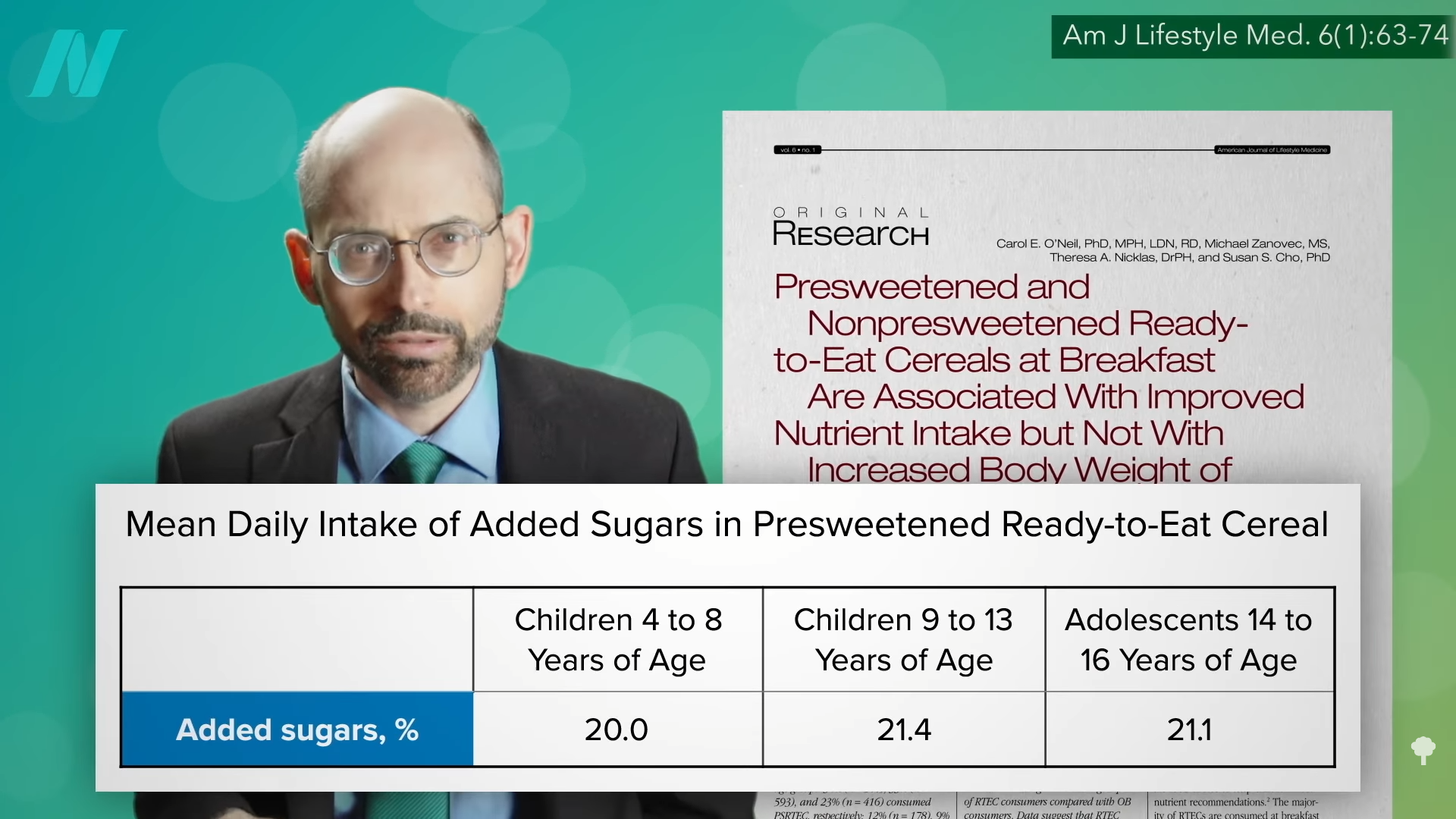
General Mills’ “Grow up strong with Big G kids’ cereals” ad campaign featured products like Lucky Charms, Trix, and Cocoa Puffs. That’s like the dairy industry promoting ice cream as a way to get your calcium. Kids who eat presweetened breakfast cereals may get more than 20 percent of their daily calories from added sugar, as you can see below and at 1:28 in my video.

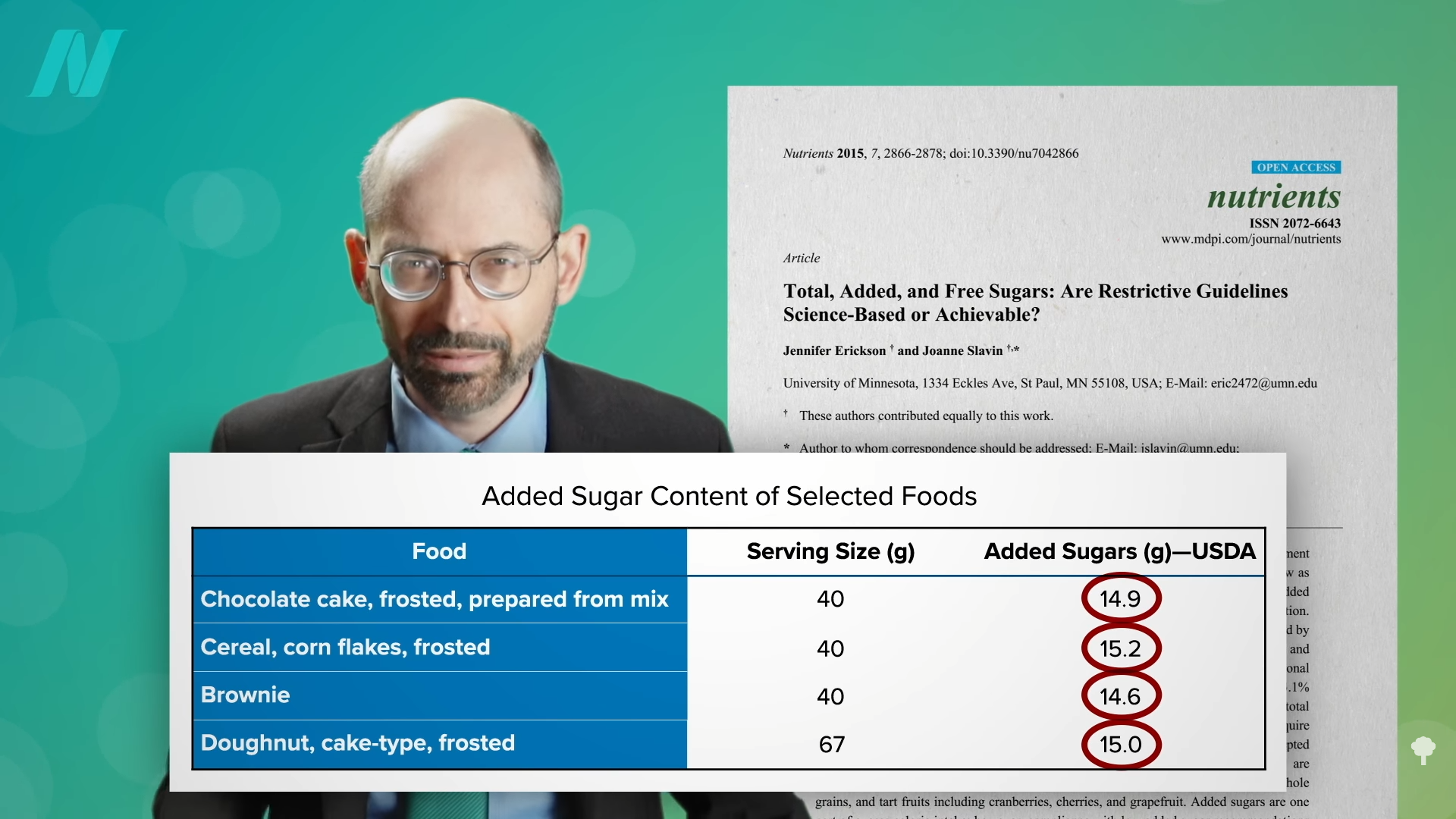
Most sugar in the American diet comes from beverages like soda, but breakfast cereals represent the third largest food source of added sugars in the diets of children and adolescents, wedged between candy and ice cream. On a per-serving basis, there is more added sugar in a cereal like Frosted Flakes than there is in frosted chocolate cake, a brownie, or even a frosted donut, as you can see below and at 1:48 in my video.

Kellogg’s and General Mills argue that breakfast cereals only contribute a “relatively small amount” of sugar to the diets of children, less than soda, for example. “This is a perfect example of the social psychology phenomenon of ‘diffusion of responsibility.’ This behavior is analogous to each restaurant in the country arguing that it should not be required to ban smoking because it alone contributes only a tiny fraction to Americans’ exposure to secondhand smoke.” In fact, “each source of added sugar…should be reduced.”

The industry argues that most of their cereals have less than 10 grams of sugar per serving, but when Consumer Reports measured how much cereal youngsters actually poured for themselves, they were found to serve themselves about 50 percent more than the suggested serving size for most of the tested cereals. The average portion of Frosted Flakes they poured for themselves contained 18 grams of sugar, which is 4½ teaspoons or 6 sugar packets’ worth. It’s been estimated that a “child eating one serving per day of a children’s cereal containing the average amount of sugar would consume nearly 1,000 teaspoons of sugar in a year.”

General Mills offers the “Mary Poppins defense,” arguing that those spoonsful of sugar can “help the medicine go down” and explaining that “if sugar is removed from bran cereal, it would have the consistency of sawdust.” As you can see below and at 3:17 in my video, a General Mills representative wrote that the company is presented “with an untenable choice between making our healthful foods unpalatable or refraining from advertising them.” If it can’t add sugar to its cereals, they would be unpalatable? If one has to add sugar to a product to make it edible, that should tell us something. That’s a characteristic of so-called ultra-processed foods, where you have to pack them full of things like sugar, salt, and flavorings “to give flavor to foods that have had their [natural] intrinsic flavors processed out of them and to mask any unpleasant flavors in the final product.”

The president of the Cereal Institute argued that without sugary cereals, kids might not eat breakfast at all. (This is similar to dairy industry arguments that removing chocolate milk from school cafeterias may lead to students “no longer purchasing school lunch.”) He also stressed we must consider the alternatives. As Kellogg’s director of nutrition once put it: “I would suggest that Fruit [sic] Loops as a snack are much better than potato chips or a sweet roll.” You know there’s a problem when the only way to make your product look good is to compare it to Pringles and Cinnabon.

Want a healthier option? Check out my video Which Is a Better Breakfast: Cereal or Oatmeal?.

For more on the effects of sugar on the body and if you like these more politically charged videos see the related posts below.

Finally, for some additional videos on cereal, see Kids’ Breakfast Cereals as Nutritional Façade and Ochratoxin in Breakfast Cereals.

Key Takeaways
  • Vi-Chocolin, a vitamin-fortified chocolate bar, was purportedly offered as a product with high nutritive value but was really just vitaminized candy. The sugary cereal industry follows a similar business model.

  • The sugary cereal industry has been criticized for adding nutrients to cereals “as a marketing gimmick,” creating an illusion of health benefits.

  • Children who consume pre-sweetened breakfast cereals may derive more than 20 percent of their daily calories from added sugar. Breakfast cereals rank as the third-largest food source of added sugars in the diets of kids and adolescents, listed between candy and ice cream. On a per-serving basis, a cereal like Frosted Flakes has more added sugar than a frosted chocolate cake, a brownie, or a frosted donut.

  • Kellogg’s and General Mills’ contention that breakfast cereals contribute only a “relatively small amount” of sugar to children’s diets is likened to the social psychology phenomenon of “diffusion of responsibility.”

  • Consumer Reports’ findings reveal that children often pour themselves 50 percent more cereal than the suggested serving size. A child eating a single daily serving of kids’ cereal with the average amount of sugar would consume almost a thousand teaspoons of sugar in one year.

  • The industry argues it has to add sugar to its cereals to make them palatable, which is a characteristic of ultra-processed foods.  From: https://nutritionfacts.org/blog/are-fortified-childrens-breakfast-cereals-just-candy/?

__________