Showing posts with label bread. Show all posts

Wednesday, July 16, 2025

Your Truth, My Truth or THE Truth? What's Wrong With Our Human Nature? WFPB For Reversing Diabetes.

.

Your truth, my truth or THE truth?

Your truth, my truth or THE truth?“The subtle, philosophical idea that everyone can determine what they believe to be true values challenges the authority of the Bible and insidiously permeates Christian beliefs and standards.

When Bob began his freshman year at university he was not prepared to have his Christian beliefs and values challenged. The philosophical idea that everyone determines his or her own truth was insidiously permeating Bob’s new life and it was so subtle that, at first, he didn’t even realize it was happening. It was something that would challenge his Christianity to its very core.

While exposure to different ideas has always been a part of one's college experience, what many young people don't realize is that their understanding of absolute truth—the kind found in the Bible—is going to be strongly tested when they pursue higher education. The campuses of most public universities today are smorgasbords of ideas. Every imaginable philosophy seems to be represented and debate reigns supreme with the underlying assumption human beings should decide for themselves what is best.

Many people today pride themselves on being able to see things from multiple perspectives. Although this approach provides subject for debate, having flexible positions isn’t good when it comes to Christianity. Isaiah 5:20 tells us: “Woe to those who call evil good, and good evil….Woe to those who are wise in their own eyes, and prudent in their own sight!”  Furthermore, to publicly state something is right or wrong has come to be considered judgmental, which is looked down upon in today’s secular world. Most people have embraced the self-empowering myth that whatever they sincerely believe is true. They have forgotten about God and His Word. Truth has become relative. According to religious pollster George Barna, the majority opinion today is that moral truth depends on the circumstances. In a February 2002 report titled "Americans Are Most Likely to Base Truth on Feelings," Barna wrote:

"In two national surveys… one among adults and one among teenagers, people were asked if they believe that there are moral absolutes that are unchanging or that moral truth is relative to the circumstances. By a 3-to-1 margin (64% vs. 22%) adults said truth is always relative to the person and their situation. The perspective was even more lopsided among teenagers, 83% of whom said moral truth depends on the circumstances, and only 6% of whom said moral truth is absolute."

Confusion about moral absolutes has been a human problem for a long time. In the Garden of Eden, Adam and Eve ate from “the tree of the knowledge of good and evil” (Genesis 2:9). Mankind, following their mistaken example of self-determination apart from God, has generally been confused about good and evil ever since. As Jeremiah exclaimed, "O Lord , I know the way of man is not in himself; it is not in man who walks to direct his own steps" (Jeremiah 10:23).

There is a God who really does know the truth and wants what is best for us because He loves us. The humanistic idea that human beings are capable of determining our own way apart from God just doesn’t square with reality. God alone determines truth which is found in the Bible (John 17:17). Recognizing and practicing the eternal, absolute values of God is what sanctifies and sets apart true Christians.They know Jesus intended Christians to be lights to others rather than accepting or being overwhelmed by the world and its values (Matthew 5:14-16).

________

 What's wrong with our human nature?

What's wrong with our human nature?“When God formed Adam and Eve in the Garden of Eden, they were part of a created order that was "very good" (Genesis 1:31). But in describing their creation as good, God did not mean Adam and Eve were inherently good or were inclined to choose to live God's way.

Initially, Adam and Eve made no choice in terms of good and evil. Their way of thinking and behavior was neutral, but as flesh-and-blood human beings, they had physical drives and material interests common to all mankind. They had desires for self-preservation, for physical pleasures, for appreciation, for learning and for bettering their circumstances. The focus on self in such characteristics was not inherently sinful, but this self-oriented focus could lead to sin if it contradicted God's direction and instructions.

When Satan the devil came onto the scene in the form of a serpent, he wasted no time in tempting the first human beings to sin. He deceived Eve about partaking of the fruit God had forbidden, tempting her to take advantage of her desire to become wise and better her life. Adam was not deceived, but he also submitted to Satan's scheming (Genesis 3:1-24; 1 Timothy 2:14 NKJV). Adam and Eve thus set a pattern the human race that would spring from them would follow—accepting the rule and influence of Satan rather than following God.

From then on, human beings would be led to pursue selfishness and rebel against God's commandments. Children would still be born with a neutral nature but, under the influence of Satan. In a world in which people were deceived into unwittingly following him and his ways, they would very quickly develop the selfish nature of the corrupted human society and culture around them. This tendency to exalt self and disobey God is known as human nature, with the primary motivation being selfishness rather than a desire to obey and please God.

Paul explained that, as "the god of this age," Satan "has blinded the minds of unbelievers, so that they cannot see the light of the gospel" (2 Corinthians 4:4). With the exception of Jesus Christ, "all have sinned and fall short of the glory of God" (Romans 3:23). He described the sorry spiritual condition of the human race in Romans 3:10-18, and reminds Christians that "you once walked according to the course of this world, according to the prince of the power of the air, the spirit who now works in the sons of disobedience, among whom also we all once conducted ourselves…fulfilling the desires of the flesh and of the mind…." (Ephesians 2:2-3). However, as powerful as his influence is, the devil cannot force us to sin. He simply seduces us through our fleshly weaknesses and the wrong ways of thinking he has led us into over time. Following are some of the ways we are easily manipulated by Satan:

1. Our selfish, fleshly desires often get us into trouble: "Now the works of the flesh are evident, which are: adultery, fornication, uncleanness, lewdness, idolatry, sorcery, hatred, contentions, jealousies, outbursts of wrath, selfish ambitions, dissensions, heresies, envy, murders, drunkenness, revelries, and the like…those who practice such things will not inherit the kingdom of God" (Galatians 5:19-21). Paul graphically describes the effect corrupt desires have on human behavior. "Therefore God gave them over in the sinful desires of their hearts to sexual impurity for the degrading of their bodies with one another….Furthermore, just as they did not think it worthwhile to retain the knowledge of God, so God gave them over to a depraved mind, so that they do what ought not to be done. They have become filled with every kind of wickedness, evil, greed and depravity. They are full of envy, murder, strife, deceit and malice. They are gossips, slanderers, God-haters, insolent, arrogant and boastful…. Although they know God's righteous decree that those who do such things deserve death, they not only continue to do these very things but also approve of those who practice them" (Romans 1:24 and 28-32, NIV).

2. Our ingrained deviousness, including self-deception, is a major weakness of the fleshly mind. "The heart is deceitful above all things, and desperately wicked; who can know it?" (Jeremiah 17:9). Subject to Satan's influence, we naturally look for ways to justify our lusts and sinful desires, along with the behaviors arising from them. We deceive ourselves into believing that, since our desires are natural, they can’t be so bad, in spite of the fact that God's Word reminds us "there is a way that seems right to a man, but its end is the way of death" (Proverbs 14:12 and 16:25). Death is the end result of living that wrong way (Romans 6:23).

3. Under the devil's influence we develop the tendency to resent having our selfish desires limited by rules, even God's commandments: "For those who live according to the flesh think about the things of the flesh, but those who live according to the Spirit, about the things of the Spirit….the mind-set of the flesh is death, but the mind-set of the Spirit is life and peace. For the mind-set of the flesh is hostile to God because it does not submit itself to God's law, for it is unable to do so. Those who are in [that is, within control of] the flesh cannot please God" (Romans 8:5-8, HCSB).

Without the positive influence of God's Spirit, our primary inclination is to serve ourselves and resist living according to God's biblical instructions. Satan is a powerful deceiver and manipulator, taking advantage of our self-focused nature by persuading us to give in to our human wants and desires. Because of this Paul warns: "If you live according to the flesh you will die; but if by the Spirit you put to death the deeds of the body, you will live. For as many as are led by the Spirit of God, these are sons of God" (Romans 8:13-14).

_________

Beginner’s Guide to a Whole-Food Plant-Based Diet

“Right off the bat, we want you to know that a whole-food, plant-based lifestyle is NOT a diet of vegetables only.

So if you were hesitant to start because you think you are only going to be eating rabbit food, let’s put those fears to rest.

You, along with tens of millions of people just like you, have taken an important first step to improving your life.

We are grateful that so many people worldwide have helped improve their health, manage their weight, and prevent and reverse chronic diseases through a whole-food, plant-based diet.”

“If you’re new to eating a whole-food plant-based diet, or if you’re just curious, you came to the right spot. It’s worth mentioning that neither whole-food plant-based eating, diet nor a vegan diet are “diets” in the sense of restricting calories. The term is used here as a description of how someone eats on a consistent basis.

What exactly is a whole-food plant-based diet?

First up, following a whole-food plant-based (WFPB for short) diet is different from eating vegan. While neither includes animal-based foods nor foods derived from animal-based ingredients, WFPB goes a step further and removes overly processed foods like oil, junk food, white flour, white sugar, vegan ice cream, vegan cookies from the mix. Why? Because overly processed foods are typically very high in calories but low in nutrition. Calorie density isn’t necessarily a bad thing, but when paired with little or no nutritional value, it’s best to avoid those types of foods. Plus, high quantities of salt, fat, and sugar release super powerful chemicals in our brains that make us crave more and can turn down our body’s natural satiation signals, meaning it’s easy to eat way more of those foods more often than we intend.

What should you eat when following a WFPB diet?

When you eat a whole-food plant-based diet, you’ll find yourself enjoying:

  • Vegetables
  • Whole grains
  • Beans & legumes
  • Fruit
  • Nuts
  • Seeds
  • Herbs & spices
  • Minimally processed plant based ingredients like tofu, tempeh, unsweetened plant milk, and sprouted grain bread

whole-food plant-based diet food groups chart

Benefits of whole-food plant-based eating

Whether your motivation to eat more plants is to boost your immune system and your overall health, drop some pounds, get off your diabetes medication, help protect the environment, or animal welfare, it’s never too late to start, and there are no prerequisites. You simply start where you’re at and ease into it however you like.

Reverse diabetes

Lower your A1C and manage your blood glucose by harnessing the power of plants. A whole-food plant-based diet can help you find joy in eating again while reversing diabetes. We’ve seen it happen for countless members.” 

Dr. Elina Tomski reverses pre-diabetes with a whole-food plant-based diet >

More at: https://cleanfooddirtygirl.com/beginners-guide-to-a-whole-food-plant-based-diet/

_________

    Sunday, June 29, 2025

    Simon The Magician. A Great Blessing. God Cares About What We Eat.

    .

    Simon The Magician

    Simon the Magician“Simon the Magician came from the Middle East, but his religious cult expanded over a wide area perverting the teachings of Jesus Christ. He is mentioned in the book of Acts and founded a counterfeit Christianity promoting false ideas and doctrines.

    After Jesus' crucifixion, death and resurrection His followers spread the Gospel message. A disciple named Philip taught in Samaria, an area not far from Jerusalem, and many people began to respond to his message.

    During his time in Samaria Philip came in contact with a pagan religious leader known as Simon the Magician, who is described in Acts 8:9-10: “But there was a certain man, called Simon, which beforetime in the same city used sorcery, and bewitched the people of Samaria, giving out that himself was some great one. To whom they all gave heed, from the least to the greatest, saying, "This man is the great power of God.”

    Many of Simon's followers believed Philip's message about Jesus as the prophesied Messiah, and were baptized. Even Simon himself professed to be a Christian and he too was baptized (Acts 8:12-13). A short time later the Apostles Peter and John traveled to Samaria to teach the new converts and lay hands upon them so they would receive the Holy Spirit (Acts 8:17-19). When Simon saw the people were given God's Spirit, he offered the Apostles money to give him this power. (This is the origin of the English word ‘simony’, which refers to the selling and buying of religious offices.)

    The biblical account doesn't say Simon wanted to give up his false teachings or even change his way of life. What he wanted was power (Acts 8:19). The Apostles knew this and called him a man of “...bitterness, and in the bond of iniquity” rejecting his request (Acts 8:23). After this, Simon Magus (magus means magician or sorcerer) disappears from the biblical account, but he continued to lead his religious cult, adding elements of the teachings of Jesus to his pagan-Jewish mixture, and becoming part of a movement to create a paganized Christianity.

    Simon carried his message from city to city, just as Christ’s Apostles spread the true Gospel. He translated the doctrine of grace as license to disobey God’s law. The Encyclopaedia Britannica, 11th edition, Vol. 25, states, in its article titled “Simon Magus,” that he identified with the “Hellenized Gnosticism of Samaria.” The article referred to him as the “Samaritan Messiah” and the “father of all heresy.” The Samaritans had been placed in the land from which the northern kingdom of Israel had been taken captive by the Assyrians. These Samaritans had been brought from Babylon and continued to practice their ancient Babylonian religion, mixed with other religions.

    The belief, at the heart of Simon's heresy, was he could receive power from God without changing his ways. The religious movement became known as gnosticism, and in the New Testament this false teaching is referred to as ‘lawlessness’.  Even today many believe the law of God was done away by the sacrifice of Jesus Christ. The Apostle Paul maintained this approach was already gathering momentum during his lifetime, "For the mystery of lawlessness is already at work..." (2 Thessalonians 2:7).

    The Ten Commandments define the most basic behaviors of love. Do not steal. Do not lie. Do not murder. 1 John 5:3 very plainly tells us that love is keeping the commandments. In the Sermon on the Mount, Jesus expanded the meaning of the word ‘love’ beyond the simple letter of the law. For example he explained obedience to the commandment "do not murder" entailed learning not to hate, because hatred is the root cause of murder.

    Nearly 300 years after Peter confronted Simon, a bishop named Eusebius lamented the Simonian cult still existed: "It is an astonishing fact that this is still the practice of those who to the present day belong to his (this) disgusting sect. Following in…. [Simon's] footsteps they slip into the church like a pestilential and scabby disease, and do the utmost damage to all whom they succeed in smearing with the horrible, deadly poison concealed on them" (The History of the Church by Eusebius.)

    Even after Simon died in AD 68 his greatest heresies were still infecting Christianity hundreds of years after he is mentioned in the book of Acts. One of the reasons God inspired Luke to record these events is because Christians will be combating the "mystery of lawlessness" until the return of Jesus Christ. No wonder the Apostle John warns Christians: “Beloved, believe not every spirit, but try the spirits whether they are of God: because many false prophets are gone out into the world” (1 John 4:1)

    _______

    A Great Blessing

    A great blessing“The desire for revenge, retaliation and mudslinging is reflected in our entertainment and society in general. In spite of the fact we are told to forgive, many seek an active or passive form of revenge against their real or perceived enemies.

    The sacrifice of Jesus Christ paid the death penalty earned by mankind as a result of sin. "But God demonstrates His own love toward us, in that while we were still sinners, Christ died for us.... when we were enemies we were reconciled to God through the death of His Son..." (Romans 5:8-10). God expects us to develop this same attitude of mercy, graciousness and forgiveness. He will not forgive our sins if we are unforgiving toward others.

    "And forgive us our debts, as we forgive our debtors.... For if you forgive men their trespasses, your heavenly Father will also forgive you. But if you do not forgive men their trespasses, neither will your Father forgive your trespasses" (Matthew 6:12,14-15). II Timothy 3:1-4 includes being unforgiving in the list of characteristics people will exhibit in the “perilous times” prevalent in the “last days” just before Jesus Christ returns to earth.

    When a woman caught in adultery was brought to Jesus the Scribes and Pharisees demanded: “'Teacher, this woman was caught in adultery...Moses, in the law, commanded us that such should be stoned. But what do You say?' This they said, testing Him, that they might have something of which to accuse Him.” Jesus’s response was, “'He who is without sin among you, let him throw a stone at her first.' And…those who heard it, being convicted by their conscience, went out one by one…When Jesus had raised Himself up and saw no one but the woman, He said to her, 'Woman, where are those accusers ... .Has no one condemned you?' She said, 'No one, Lord.' And Jesus said to her, 'Neither do I condemn you; go and sin no more'" (John 8:1-11).

    Another example showing Christ expects us to develop a forgiving attitude occurred when Peter asked, “‘…how often shall my brother sin against me, and I forgive him? Up to seven times?' Jesus answered, “…up to seventy times seven'" (Matthew 18:21-22). The Apostles were stunned at this statement and answered, “‘Increase our faith.’” (Luke 17:5).

    The parable in Matthew 18:23-35 illustrates the consequences of being unforgiving. The account of the forgiven servant persecuting someone who owed him a pittance in comparison with the amount he had just received forgiveness for is a lesson for us. Christ warned the unforgiving servant his attitude was unacceptable, pointing out: "Should you not also have had compassion on your fellow servant, just as I had pity on you?' (verse 33).

    This is not to say we cannot make a judgment regarding other people's actions as to whether or not we should follow their example, but we cannot read minds and hearts. Christ instructs us not to judge others: "Judge not, that you be not judged... First remove the plank from your own eye, and then you will see clearly to remove the speck from your brother's eye" (Matthew 7:1 and 5). Luke 6:36-37 reinforces this admonition: "Judge not, and you shall not be judged. Condemn not, and you shall not be condemned. Forgive, and you will be forgiven" (Luke 6:37).

    Proverbs 19:11 states, “it is his [our] glory to pass over a transgression” (King James Version). Jesus' example just before His death sets the standard for us as far as forgiveness is concerned: "When Jesus was being crucified and in agony He prayed: Father, forgive them, for they do not know what they do" (Luke 23:34). When we forgive, we reflect the Father’s love, giving us the opportunity to extend to others the great blessing God has extended to us.

    ________

    God Cares About What We Eat.

    God cares about what we eat“God’s instructions to mankind concerning the food we should eat was an established law of God long before the time of the Mount Sinai covenant (See Leviticus 11 and Deuteronomy 14).

    Noah was aware of these laws at the time of the flood. When God told him in Genesis 7:2, “You shall take with you seven…pairs of every kind of clean animal…and one pair of every kind of unclean animal….” He did not explain which creatures were clean and unclean because Noah already knew.

    Act 10:13-35 describes a dream the Apostle Peter had ten years after Christ’s crucifixion, in which he initially thought God was instructing him to eat unclean food. It is clear from Peter’s reaction the Apostles did not think Christ had abolished the food laws of Leviticus 11 and Deuteronomy 14. His response was: "Not so, Lord! For I have never eaten anything common or unclean" (Acts 10:14). Peter eventually correctly understood the significance of his dream was that God’s message of salvation applies to all nations, and He was calling people from all races and backgrounds. “...God has shown me that I should not call any man common or unclean (verse 28).” Shortly thereafter Peter baptized the first uncircumcised gentiles God called into the Church (Acts 10:34-35; 45-48).

    The account in Mark 7 is also often misunderstood and thought to indicate the food laws in Deuteronomy and Leviticus no longer applied in the New Testament era. However, the topic of discussion here is food in general, as Mark 7:2 points out: “Now when they (the Pharisees) saw some of His disciples eat bread with defiled, that is, with unwashed hands, they found fault." They then asked Jesus, "Why do Your disciples not walk according to the tradition of the elders, but eat bread with unwashed hands?" (verse 5).

    In Mark 7:18-19 Jesus explained: “...whatever enters a man from outside cannot defile him because it doesn’t enter his heart, but his stomach, and is eliminated….” Many modern translations of the New Testament erroneously insert additional words into the text of Mark 7:18-19. The New International Version ends verse 19 with the comment: "In saying this, Jesus declared all foods 'clean'." The New King James Version has "thus purifying all foods."   The food laws are not in question here. The disciples were being criticized for not following ceremonial hand-washing procedures and, after decrying the hypocrisy of this and other religious practices, Jesus describes the attitudes that defile us “... out of the heart of men, proceed evil thoughts, adulteries, fornications, murders, thefts, covetousness, wickedness, deceit, licentiousness, an evil eye, blasphemy, pride, foolishness. All these evil things come from within and defile a man" (Mark 7:21-23). Some of these same qualities are listed in Galatians 5:19-21 as "works of the flesh." They are contrasted with the "fruit of the Spirit" which are listed as: "Love, joy, peace, longsuffering, kindness, goodness, faithfulness, gentleness [and] self-control…." (Galatians 5:22-23).

    Many also believe Romans 14 tells us Christians are free from all former biblical restrictions regarding the meats they may eat. They cite as proof verse 14 in which Paul wrote, "I know and am convinced by the Lord Jesus that there is nothing unclean of itself; but to him who considers anything to be unclean, to him it is unclean." This approach, however, fails to consider the context of Paul's letter as well as the specific Greek words he used.

    The food controversy here was over meat sacrificed to idols. The Romans of the day commonly offered both meat and wine to idols, with portions of the offerings later being sold in the marketplace. Some thought there was nothing wrong with eating this meat, while others had a guilty conscience about it. Paul explained those whose consciences were not troubled by eating meat that might have been ceremonially offered to idols could go ahead and eat it as long as they did not offend others who may believe it was a wrong thing to do. Paul instructs, "..let each be fully convinced in his own mind" (Romans 14:5) because "...whatever is not from faith is sin" (Romans 14:23). (See our article Does Romans 14 Abolish God’s Law About Clean And Unclean Meats for a more detailed explanation of these scriptures and the Greek words Paul used here.)”

    _________

    Sunday, April 13, 2025

    Why Christians Should Keep The Annual Passover. What Does The Feast of Unleavened Bread Mean For Christians?

    .

    Why Christians should keep the annual Passover.

    Why Christians should keep the annual Passover“In ancient Israel the first Passover was a time of deliverance. The blood of the Passover lamb was smeared on the doorposts of those Israelites who put their trust in God, and they were spared (Exodus 12:23), while the firstborn of the Egyptians were slain.

    Many years later, during His final Passover with His disciples, Jesus Christ introduced new symbols for the observance of the annual Passover, which commemorate Him as “our Passover, [who] was sacrificed for us” (1 Corinthians 5:7). The observance of the New Testament Passover was revealed as the first step toward salvation, reminding Christians not only of how God delivered ancient Israel, but of our deliverance from sin today.

    Only 3½ years after He began His ministry, Jesus of Nazareth was apprehended by the religious authorities at the time of the Passover feast (Matthew 26:2; Mark 14:1). After a brief trial, while mocking and beating Him, they took Jesus before the Roman authorities and accused Him of "perverting the nation…saying that He Himself is Christ, a King" (Luke 23:2).

    Pontius Pilate, the Roman governor in Jerusalem, after analyzing the charges, declared to the chief priests and the others present: "...having examined Him in your presence, I have found no fault in this Man ... .no, neither did Herod….I will therefore chastise Him and release Him" (Luke 23:14-16). Pontius Pilate was then faced with angry shouts of, "Away with this Man, and release to us Barabbas [a murderer]" (Luke 23:18), and "Crucify Him, crucify Him!" (Luke 23:21).The priests and the crowd eventually prevailed, and the Roman governor freed a murderer and sentenced an innocent man to death.

    God's way of redeeming us from the death penalty without compromising His perfect law was for the penalty to be paid in our place by Jesus Christ, the Son of God: "For God so loved the world that He gave His only begotten Son, that whoever believes in Him should not perish but have everlasting life" (John 3:16). Our sins separated us from God, because through sin we lived hostile to God and His ways (Isaiah 59:1-2; Romans 3:10-12 and 8:7). As sinners we had the death penalty hanging over us: "We know that our old self was crucified with him so that the body of sin might be destroyed, and we might no longer be enslaved to sin" (Romans 6:6, New Revised Standard Version).

    In order to observe the first New Testament Passover, when Jesus introduced the symbols of the bread and the wine, Jesus Christ and His disciples assembled on that evening, after sunset, in a large upper room. Assuming the role of a servant, Jesus washed His disciples' feet: "And supper being ended…[Jesus] rose from supper and laid aside His garments, and took a towel…and began to wash the disciples' feet, and to wipe them with the towel ..." (John 13:2-5), instructing them: "If I then, your Lord and Teacher, have washed your feet, you also ought to wash one another's feet. For I have given you an example, that you should do as I have done to you…If you know these things, blessed are you if you do them" (John 13:14-15 and 17).

    Then Jesus "took bread, gave thanks and broke it, and gave it to them, saying, 'This is [or 'means,' James Moffatt Translation; i.e., 'represents'] My body which is given for you; do this in remembrance of Me'" (Luke 22:19). He also "took the cup, and gave thanks, and gave it to them, saying, 'Drink from it, all of you. For this is [represents] My blood of the new covenant, which is shed for many for the remission of sins'" (Matthew 26:27-28).

    The Bible makes it clear that all who will follow Christ should observe this New Testament Passover in remembrance of His love and sacrifice for our sins and as a reminder of our commitment to Him for what God has done in our lives (1 Corinthians 5:7-8; Luke 22:19-20). The observance of the annual New Testament Passover reminds Christians not only of how God delivered ancient Israel out of Egypt, but of our deliverance out of sin today.”  From: https://www.ucg.org.au/learn/read/bible-insights-weekly/biw-archive/why-christians-should-keep-the-annual-passover

    ________

    What does the Feast of Unleavened Bread mean for Christians?

    What does the Feast of Unleavened Bread mean for Christians?“During the spring of each year (March-April in the northern hemisphere), immediately after Passover and before the Feast of Pentecost, another biblical feast is observed—the seven-day Feast of Unleavened Bread (Leviticus 23:6-8; Exodus 12:17-18).


    The Exodus from Egypt, which took place immediately after Passover during the Feast of Unleavened Bread (Numbers 33:3), was one of the great events to occur during this time. The crossing of the Red Sea is traditionally assigned to the seventh or last day of Unleavened Bread.

    After Israel entered the Promised Land, the miraculous conquest of Jericho also took place during the Days of Unleavened Bread. Other great events occurring during this time of year involved rededicating the people of God to their Creator. 2 Chronicles chapters 29 through 31 describe the religious reform led by Hezekiah, and chapters 34 and 35 tell of the reform by Josiah.

    However, one other event that took place during the Days of Unleavened Bread had a much greater impact than any of these, and that was the resurrection of Jesus Christ. John 19:31 tells us He was crucified on the day before a Sabbath. While most people assume this was the regular weekly Sabbath (observed Friday sunset to Saturday sunset), John tells us this Sabbath "was a high day" — a term used for the seven annual Holy Days. A careful reading of the Gospels shows this "high day" was the first day of Unleavened Bread, a Holy Day (Leviticus 23:2, 6-7) that can fall on a weekday.

    Jesus remained in the grave for three days and three nights just as He had prophesied (Matthew 12:40), making it impossible to reconcile Jesus' statement in Matthew 12 with a Friday afternoon crucifixion followed by a Sunday morning resurrection. (See "Jesus Wasn't Crucified on Friday—or Resurrected on Sunday!")

    Three days and three nights from the time of His entombment, just before the beginning of the first Holy Day of Unleavened Bread, brings us to the sunset at the end of the weekly Sabbath, during the seven-day Feast of Unleavened Bread, as the time Jesus was resurrected. On that Sunday, after His resurrection the day before, Jesus appeared first to Mary Magdalene (John 20:11-18) and then to others.

    These Days of Unleavened Bread marked a turning point in the way the spring festival was celebrated. Christians observing these annual festivals would still recall the exodus from Egypt as a type of redemption from sin and release from the bondage of Satan. There would still be an emphasis on eating unleavened bread as a physical reminder we are to become spiritually unleavened by removing sin from our lives. But the core meaning of the Feast of Unleavened Bread is that Jesus Christ, the One who was resurrected during this time, now lives His life in every Christian.

    Jesus repeatedly emphasized the importance of His own resurrection. During the last supper, He told the disciples that although He would soon be betrayed, He would live again: "Because I live, you will live also" (John 14:19). He had just promised they would not be left as orphans (verse 18)—that is, spiritually unprotected and vulnerable to Satan. Both the Father and He would live in the hearts and minds of Christians by the indwelling of the Holy Spirit (verses 20-26), empowering us to overcome "the sin which so easily ensnares us" (Hebrews 12:1).

    The Apostle Paul encouraged the church there to "keep the feast, not with old leaven, nor with the leaven of malice and wickedness [lingering sinful attitudes], but with the unleavened bread of sincerity and truth"(1 Corinthians 5:8) —a clear reference to the Feast of Unleavened Bread.

    The Feast of Unleavened Bread is a festival that helps us focus on replacing sin with righteousness. We are reminded to "...work out your own salvation with fear and trembling" (Philippians 2:12), but the Apostle Paul was not preaching a works-based salvation. In verse 13 he explains "it is God who works in you both to will [that is, to have the desire to overcome] and to do [to act on that desire] for His good pleasure."   From: https://www.ucg.org/the-good-news/what-does-the-feast-of-unleavened-bread-mean-for-christians

    _________

    Tuesday, January 21, 2025

    God Rules With Strength and Gentleness. Want to Live to 100? Eat More Beans!

    .

    God Rules With Strength and Gentleness

    Isaiah 40:10-11

    Behold, the Lord GOD shall come with a strong hand, and His arm shall rule for Him; behold, His reward is with Him, and His work before Him. He will feed His flock like a shepherd; He will gather the lambs with His arm, and carry them in His bosom, and gently lead those who are with young.

    “These two verses condense a tremendous amount of information about how God will rule when Jesus Christ returns to establish the Kingdom of God on this earth.

    The book of Revelation explains that as Jesus Christ is coming down to this earth, the armies of the nations of this world will attack Him as if He were an alien invader (Revelation 19:19). Christ’s response to these unprovoked attacks will be with “a strong hand,” as He forcefully puts down the rebellion and makes it clear who is in charge (Revelation 19:20-21).

    But that is just one aspect of Jesus Christ’s rule. Isaiah mentions that He will bring a “reward” with Him for His faithful followers who will then assist Him in “His work” of teaching His way of life to the survivors of the end-time troubles.

    Isaiah 40:11 is a beautiful picture of our all-powerful God gently gathering people like little lambs and feeding and caring for them.

    God is both strong and gentle at the right times. He wants us to learn to follow His lead in this area of life as well.”          Listen to the "Verse by Verse" episode covering this scripture at:  https://lifehopeandtruth.com/bible/blog/god-rules-with-strength-and-gentleness/?

    For more about Isaiah 40, see “God’s Perspective on Prophecy.” For more about how God will rule in the Kingdom of God, see the articles in our “Kingdom of God” section. 

    _________

    It's time to get to know God. Start your 7-day guided Journey.

    ________

    Want to Live to 100? Eat More Beans!

    Eat beans and live 100“Want to know how to live to 100? Eat plenty of beans, says plenty of research studies on the longest-living populations in the world.

    Campodimele, Italy, a hilltop village south of Rome, has so many centenarians that it’s known in Europe as the “Village of Longevity.” Daily, its citizens enjoy a diet full of beans like lentils, chickpeas, and white beans.

    How to live to 100

    A few years ago, scientists identified five groups of long-lived elderly people (aged 70 and older) – Japanese in Japan, Swedes in Sweden, Anglo-Celtic people in Australia, and Greeks in both Greece and Australia – and observed them for the next seven years, tracking their health status and food choices among nine different categories: vegetables, legumes, fruits, nuts, cereals, dairy products, meat, fish, and monounsaturated fats. A total of 785 elderly people were followed.

    Eating Beans May Help You Live To 100Nowadays, there are many tasty varieties of beans on the market, not only staples like garbanzos but also choices like cranberry, cannellini, and fava beans. Eat beans and live longer, maybe even live to 100.

    The researchers found that legumes were the most important dietary predictor of survival among the elderly, “regardless of their ethnicity,” they wrote.* For every 20-gram increase in daily legume intake (20 grams is about three-quarters of an ounce), “there is a 7 to 8% reduction in mortality hazard ratio.”

    You’d be hard-pressed to find a more perfect food than beans. They are an excellent source of protein, vitamins, minerals, and complex carbohydrates. They’re very low in fat and virtually sodium-free. Plus, they’re filling.

    And fiber? Even the lowest-fiber bean puts most other foods to shame. A cup of high-fiber beans, like pinto or black beans, tallies up 16 grams of fiber.You’d have to eat about eight slices of whole-wheat bread to get the same amount of fiber. And it’s primarily cholesterol-reducing soluble fiber, which makes beans an excellent heart-healthy alternative to meat.

    Bean prep these days has gotten so much easier, thanks to the ready availability of cans of already-cooked beans, and you can find many “no salt added” varieties, which is really wonderful for keeping blood pressure under control. If all you can find is salted varieties, get rid of some of the salt by rinsing the beans through a colander.

    Here are some simple tips for how to get more beans into your life (and how to live to 100):
    • Toss a handful of beans into your salads (try the rich, buttery flavor of cannellini  beans)
    • Stir beans into your pasta sauces or soups. Make an easy, sensational bean soup by combining canned white beans, any vegetables you already have, low-sodium chicken stock, and chopped fresh Italian parsley. Season with no-salt-added Italian blend seasonings and 1 tablespoon of low-sodium soy sauce. Bring to a boil and simmer for about 15 minutes.
    • Fold beans, like black and pinto beans, into corn tortillas with salsa, shredded nonfat jalapeno cheese, and shredded lettuce.
    • Puree beans for dips. For a zesty Mexican-style dip, combine pinto beans, chopped red onion, fresh cilantro leaves, and lime juice in a food processor and blend. Whip up your own delicious and inexpensive hummus dip in a processor with just five ingredients: two garlics, one can of no-salt-added garbanzo beans, three-quarter teaspoon sesame oil, two tablespoons plain nonfat yogurt, and two tablespoons fresh lemon juice.
    Source:   https://www.pritikin.com/your-health/healthy-living/eating-right/539-want-to-live-to-be-100-eat-more-beans.html

    * Asia Pacific Journal of Clinical Nutrition, 2004; 13 (S): S126.

    _________

    Tuesday, October 29, 2024

    It’s All Pagan Tradition. Acrylamide in Table Olives

    .

    · ·May be an image of text

    “Don’t dabble in it. Don’t do it for the kids. Don’t keep one and get rid of the others. It’s all pagan tradition. Who cares where it comes from? Who cares if it’s different than it once was? Who cares if it’s not as bad as something else?

    It’s pagan. If you are trying to be pagan then carry on…If not then walk away. All the way.

    YHWH (Our Lord) has given you many great things to celebrate. Things that actually honor Him and give Him due glory and praise. Why would you want to choose pagan things over His things? And yes it is choosing theirs over His. You can’t have both.

    Either own the holidays as pagan and yourself as pagan too or else surrender them all to Yeshua and follow Him in celebrating the Holidays of YHWH.”

    Question Everything”

    templecrier.com/paganism

    _______

    Researchers Find Ways to Reduce Acrylamide in Table Olives

    “A recent study conducted by Extremadura’s provincial government in Spain has identified some strategies to mitigate the presence of acrylamide during the industrial processing of black olives.

    Acrylamide is a compound found in carbohydrate-rich foods after being heated. The International Agency for Research on Cancer considers the compound carcinogenic.

    The study provides different strategies that, without imposing any additional cost in its manufacture, upgrade the processing of Californian-style black ripe olives by removing acrylamide from the final product.- Daniel Martín-Vertedor and Antonio Fernández, researchers, Junta de Extremadura

    According to the researchers, acrylamide generation in table olives is evident in larger quantities in Californian-style black ripe olives. The compound develops as a result of oxidation after thermal sterilization occurs during the table olive production process.

    The amount of acrylamide in table olives is dependent on many factors such as how olives are processed, thermal sterilization conditions, packaging methods that may or may not involve the use of brine and cooking.

    The researchers conducted their study using Hojiblanca olives, a common Spanish variety with an intermediary level of acrylamide content.

    By changing different phases of the production process – olive maturation stage, length of storage period and type of washing treatment – the researchers were able to lower levels of acrylamide and thus improve the quality of the table olives.

    “Applying these mitigation measures at industrial scale, black table olives consumers will intake a significatively minor quantity of this toxic compound,” Daniel Martín-Vertedor and Antonio Fernández, the two lead researchers on the project, told Olive Oil Times.

    “Therefore, this type of table olive elaboration can be more present in the human diet, taking advantage of the benefits of table olives,” they added.

    The researchers used olives harvested at two different points of maturation: the green and yellow-green stages. Olives harvested at the yellow-green maturation stage – when they are one step closer to veraison – had higher levels of acrylamides.

    Furthermore, green olives stored for 21 months presented the lowest acrylamide levels. Acrylamide levels also lowered by 18 percent when the olives were sprayed with water before rinsing. Washing the olives with water heated to 25 ºC for 40 minutes also led to a 36-percent reduction in the chemical.

    However, following treatment with lye, which is commonly used to remove the compound responsible for the bitter taste of table olives, acrylamide levels increased. Pitted olives retained the lowest levels of the chemical, followed by unpitted olives and sliced olives.

    The researchers further found that table olives canned in brine with higher concentrations of salt after the production process also increased the acrylamide content. However, this was not observed in olives stored in other liquids.”  More at: https://www.oliveoiltimes.com/health-news/researchers-find-ways-to-reduce-acrylamide-in-table-olives/97968

    Also see: The major food sources of acrylamide are French fries and potato chips; crackers, bread, and cookies; breakfast cereals; canned black olives; prune juice; and coffee.  From: https://www.cancer.gov/about-cancer/causes-prevention/risk/diet/acrylamide-fact-sheet

    __________

    Sunday, May 12, 2024

    God’s Harvest Festivals. Hurrying to Be at Jerusalem for Pentecost. How Did Doctors Not Know About the Risks of Hormone Therapy?

    .LifeHopeandTruth_Proverbs_31_29_1280_1280_80


    Happy Mother’s Day to all those so ordained!!


    God’s Harvest Festivals

    Exodus 23:14-16

    “Three times you shall keep a feast to Me in the year: You shall keep the Feast of Unleavened Bread (you shall eat unleavened bread seven days, as I commanded you, at the time appointed in the month of Abib, for in it you came out of Egypt; none shall appear before Me empty); and the Feast of Harvest, the firstfruits of your labors which you have sown in the field; and the Feast of Ingathering at the end of the year, when you have gathered in the fruit of your labors from the field.”

    God’s seven annual festivals listed in Leviticus 23 are several times grouped together as three main festival seasons of the year.

    • Passover and the Feast of Unleavened Bread fall in an eight-day period in the spring.
    • The Feast of Harvest, called Pentecost in the New Testament, falls in late spring or early summer.
    • And the Feast of Ingathering, better known as the Feast of Tabernacles, comes in the fall, along with the Feast of Trumpets, the Day of Atonement and the Eighth Day/Last Great Day.

    For an overview of God’s festivals and God’s plan of salvation, see “Festival Meaning: What Are the Meanings of Each of God’s Festivals?”         From: https://lifehopeandtruth.com/bible/blog/gods-harvest-festivals/?

    ________

    Hurrying to Be at Jerusalem for Pentecost

    Acts 20:16

    “For Paul had decided to sail past Ephesus, so that he would not have to spend time in Asia; for he was hurrying to be at Jerusalem, if possible, on the Day of Pentecost.

    Listen to the "Verse by Verse" episode covering this scripture.

    The apostle Paul planned his travel around God’s annual festivals. He spent the Passover and Days of Unleavened Bread that year in Philippi (Acts 20:6). Because of a plot on his life, he traveled overland instead of by sea (verse 3). But verse 16 shows that he was still determined to get back to Jerusalem in time for the Feast of Pentecost.

    For an overview of God’s annual festivals, see “The Seven Feasts of the Lord.”

    For more about Pentecost, see “Pentecost: God Gives the Holy Spirit” and “The Sermon That Launched the Church.” From: https://lifehopeandtruth.com/bible/blog/hurrying-to-be-at-jerusalem-for-pentecost/

    _________

    Paul Continues to Celebrate Pentecost

    1 Corinthians 16:8

    “But I will tarry in Ephesus until Pentecost.

    Listen to the "Verse by Verse" episode covering this scripture.

    “The apostle Paul’s first letter to the Corinthians was written perhaps 25 years after the New Testament Church of God was founded on the Day of Pentecost in A.D. 31. His note to the Corinthians in this passage shows that Paul and the Church continued to celebrate Pentecost, also called “the Feast of Weeks, of the firstfruits of wheat harvest” (Exodus 34:22) and other names in the Old Testament.

    The New Testament record shows that the New Testament Church continued to observe all seven of God’s festivals. For example, earlier in 1 Corinthians Paul also mentioned the Passover and the need to “keep the feast, not with old leaven,” referring to the Feast of Unleavened Bread (1 Corinthians 5:7-8).”

    For more about Pentecost, see “Pentecost: God Gives the Holy Spirit”  From: https://lifehopeandtruth.com/bible/blog/paul-continues-to-celebrate-pentecost/?

    ________

    “I Must by All Means Keep This Coming Feast”

    Acts 18:21

    [Paul] took leave of them, saying, “I must by all means keep this coming feast in Jerusalem; but I will return again to you, God willing.” And he sailed from Ephesus.

    “As we saw in Acts 20:16, the apostle Paul planned his journeys around the biblical festivals. Here in Acts 18:21 he also explains his need to get to Jerusalem for one of the festivals.

    Though it is not explicit about which festival, this passage gives more evidence of the continued importance of God’s festivals to the New Testament Church.

    For more about the biblical festivals, see the second half of the free booklet From Holidays to Holy Days: God’s Plan for You.”       From: https://lifehopeandtruth.com/bible/blog/i-must-by-all-means-keep-this-coming-feast/

    _________

    How Did Doctors Not Know About the Risks of Hormone Therapy?

    Transcript of the video at: https://nutritionfacts.org/video/how-did-doctors-not-know-about-the-risks-of-hormone-therapy/

    Below is an approximation of this video’s audio content. To see any graphs, charts, graphics, images, and quotes to which Dr. Greger may be referring, watch the above video.

    “Women were placed in harm’s way by their physicians, who acted as unsuspecting patsies for the drug companies.

    We’ve known about the role of estrogen in breast cancer going back to the 1800s, when in some cases, surgical removal of the ovaries seemed to help. Ovaries were said to send out mysterious influences to the rest of the body, which, in 1923, we identified as estrogen. The medical profession jumped on this discovery, and started injecting menopausal women by the thousands—shots that gave a respectable hook on which to hang visits to the doctor. Soon, there were pills, and patches, and medical journals—like the Journal of the American Medical Associationregaled doctors with ads on how they can “help women to happiness” by prescribing estrogen. You could turn this into that. “For when women outlive their ovaries,” there was Premarin.

    As far back as the 40s, concerns were raised that this practice might cause breast cancer, noting it would have been nice to figure this out first, before we started dosing women en masse. But breast cancer risk didn’t matter, because heart disease is the #1 killer of women, concluded reviews, and because women taking hormones appeared to have lower heart attack rates that would outweigh the extra breast cancer.

    But, women taking estrogen tended to be of higher socioeconomic class, tended to exercise more, and engage in other healthy lifestyle changes, like increased fiber intake and getting their cholesterol checked. So, maybe that’s why women taking estrogens appeared to be protected from heart disease. Maybe it had nothing to do with the drugs themselves. Despite the medical profession’s enthusiasm for the stuff, only a randomized clinical trial could really resolve this question—you split women into two groups; half get the hormones; half get a placebo, and you follow them out for a few years. But, there was no such study, until the 1990s, when the Women’s Health Initiative study was designed.

    Wait a second. Why did it take the bulk of a century to decide to definitively study the safety of something they prescribed to millions of women? Maybe it’s because there had never been a female director of the National Institutes of Health until then. Just three weeks after being named NIH Director, she went before Congress to announce, “We need a moonwalk for women.” And, that “moonwalk” took the form of the Women’s Health Initiative study.

    The bombshell landed. Summer, 2002. There was so much more invasive breast cancer in the hormone users that they were forced to stop the study prematurely. Yeah, but what about heart disease? Wasn’t that supposed to balance things out? The women didn’t just have more breast cancer; they had more heart attacks, more strokes, more blood clots to their lungs.

    The news that women treated with hormone replacement therapy experienced higher rates of breast cancer, cardiovascular disease, and overall harm rocked women and physicians across the country. Estrogen started out as the most prescribed drug in America before the study, but the number of prescriptions dropped immediately, and, within a year, so did the incidence of breast cancer in the United States. Here’s the data from California; a nice drop-off in the rate of invasive breast cancer.

    But the most important part of this story was why were we all so surprised? There had been decade after decade of repeated warnings about the risks of cancer. In fact, the reason breast cancer patients had so much trouble suing the drug company was that the drugs contained warning labels for decades. And, having disclosed it, surely, any reasonable physician would have included it in their risk and benefit discussion with their patients. It’s like the warning labels on packs of cigarettes. If you get lung cancer, now, you should have known better. And so, if you got breast cancer, don’t blame the drug company. They warned you about the risks, right there, clear as day.

    Why didn’t more doctors warn their patients? Even after the study came out, millions of prescriptions continued to be dispensed. That’s a lot of cancer in our patients we caused, wrote one doctor. How long will it take us to stop listening to the drug companies, “admit that we are harming many of our patients, and…start changing our prescription habits?” Why did this practice continue in the face of mounting evidence of harm?

    Well, it is a multibillion dollar industry. Despite an overwhelming amount of evidence to the contrary, many physicians still believe that estrogenic hormones have overall health benefits, a non-evidence-based perception that may be the result of decades of carefully orchestrated corporate influence on the medical literature. Dozens of ghostwritten reviews were published in medical journals to promote unproven benefits, and downplay the harms of menopausal hormone therapy. They’d pay PR companies to write the articles, and then pass them off as written by some expert.

    So, “gynecologists must switch allegiance from eminence-based to evidence-based medicine”— consider what the science actually says, and not just what some so-called expert says. One might say the “current culture of gynecology encourages the dissemination of health advice based on advertising, rather than science. Women were placed in the way of harm by their physicians, who acted as unsuspecting patsies for the pharmaceutical companies.”

    If we really wanted to prevent heart attacks in women, simple lifestyle behaviors can eliminate more than 90% of heart attack risk. So—instead of being Big Pharma’s pawns—recommending a healthful diet, increased exercise, and smoking cessation would truly benefit women’s health.”  From: https://nutritionfacts.org/video/how-did-doctors-not-know-about-the-risks-of-hormone-therapy/

    _______

    Sunday, March 31, 2024

    Did Jesus Replace the Passover? I’m A Christian, But I Don’t Keep Easter. Are Fortified Children’s Breakfast Cereals Just Candy?

    .

    This is Easter weekend, but Passover isn’t until the end of next month!!  Starts evening of 22nd. April 2024.

    _______

    Did Jesus Replace the Passover?


    Did Jesus Replace the Passover?

    “Did the God of the Old Testament do things that Jesus Christ had to clean up? For example, is the Passover outdated and no longer necessary?

    Religious writers of a gnostic bent, past and present, frequently mix truth with error. One of their major themes falsely claims that the Creator God was rather “over the hill,” necessitating a youthful, vigorous Jesus to zoom in to repair the damage and rescue human souls.

    In his book Primitive Christianity in Crisis, Alan Knight explains the gnostic approach: “Salvation depends on rejecting both the material world and the God that created it. … The wrathful God of the Old Testament cannot be the same as the true spiritual Father” (third edition, pp. 22, 48).

    Is the big story plot of the Bible, “Jesus Christ the Savior replaces a fading Creator God”?

    Did Jesus scrap the Creator’s work, or did He build on it, adding the finished structure to the foundation God had laid?

    Jesus came to reveal the Father, not replace Him (Matthew 11:27; John 5:37). Could it be that Father and Son have been closely collaborating all along? They are on the same page, with the same goals and same objectives, in complete agreement.

    As a case in point, consider the biblical story of the Passover, in the Old Testament and the New.

    The Old Testament Passover

    In Exodus 12 we read of the Passover being revealed to the Israelites. It was to be observed on the 14th day of the first month of the Hebrew calendar. For each household a lamb was slaughtered, a male without blemish. No bones of the lamb were broken. They smeared the Passover lamb’s blood around the doors of their homes as a sign.

    God spared the congregation of Israel as He passed over the blood-stained doors in the night and did not send destruction on their firstborn.

    The following day, the 15th of the first month, was a holy day, the first day of the Feast of Unleavened Bread. On that day Israel began leaving Egypt and eating unleavened bread. Israel was finally delivered from their hard bondage in slavery.

    Jesus’ New Testament Passover

    Some 15 centuries later the Bible records another Passover, this time in the holy city, Jerusalem. Compare this one to that first ancient drama.

    1. A key event of the New Testament is the sacrifice of a human male Passover lamb, Jesus Christ. “For indeed Christ, our Passover, was sacrificed for us” (1 Corinthians 5:7).
    2. Jesus was crucified on the exact same 14th day of the first month, the preparation day before the first day of the Feast of Unleavened Bread, a holy day. “Therefore, because it was the Preparation Day, that the bodies should not remain on the cross on the Sabbath (for that Sabbath was a high day), the Jews asked Pilate that their legs might be broken, and that they might be taken away” (John 19:31).
    3. Jesus’ sacrifice delivered mankind from bondage to sin and death (Romans 8:2).
    4. Jesus was without sin, an unblemished sacrifice (1 Peter 2:22; 1 John 3:5).
    5. None of His bones were broken. “But when they came to Jesus and saw that He was already dead, they did not break His legs” (John 19:33).
    6. Jesus spared all repentant sinners from eternal death, the consequence of our sins. We have been washed in His own blood (Revelation 1:5). Compare this to how the Israelites were saved from the death of the firstborn.
    7. Jesus’ disciples continued to keep the Passover annually to remember His sacrifice and still do even to this day, along with the Feast of Unleavened Bread. “Therefore let us keep the feast, not with old leaven, nor with the leaven of malice and wickedness, but with the unleavened bread of sincerity and truth” (1 Corinthians 5:8, penned some 20-plus years after Jesus ascended).
    Finishing touches?

    Did Jesus start a new approach with the nonbiblical holidays of Christmas and Easter? Or did He put the finishing touches on the age-old Passover festival to be observed for all time, precisely as the Father and Jesus planned in exact detail from the very beginning?

    • “In the beginning was the Word, and the Word was with God, and the Word was God” (John 1:1).
    • “I and My Father are one,” of one mind and purpose (John 10:30).
    • “O My Father, if this cup cannot pass away from Me unless I drink it, Your will be done” (Matthew 26:42, Jesus prayed this to the Father about His terrible trial that was to commence).

    The Bible shows that the first Passover festival of the sacrifice of unblemished lambs back in ancient Egypt was a brilliantly fashioned shadowy precursor of greater things to come centuries later—the sacrifice of Jesus Christ for all sins, for all mankind, for all time (Colossians 2:16-17).

    For more about Passover, see “Passover: What Did Jesus Do for You?” For more about God and Jesus, check out the section about God. “  From: https://lifehopeandtruth.com/god/blog/did-jesus-replace-the-passover/

    ________

    I’m a Christian, but I Don’t Keep Easter

    “The Bible gives us instructions on how to worship God, Easter is not commanded there, but the Passover is... which will you observe?

    Transcript Of video at:  https://www.ucg.org/beyond-today/beyond-today-daily/im-a-christian-but-i-dont-keep-easter

    [Darris McNeely]

    “I'm a Christian but I don't keep Easter. I'm a Christian, and I keep Passover. Now, when I say the word Passover, you may think, "Well, that's Jewish. How can you be a Christian and keep what you consider think to be a Jewish festival Jewish holiday?" Well, very simply, very easily. I read the Scripture, and I understand what it says and I understand what the Passover of the New Testament really is. And I see instruction for me to keep that and I don't see the instruction for Easter, and a lot of other holidays that have been substituted for God's Festivals. But for a moment, let's just focus on the Passover.

    As I speak here, at this time, we're just a few weeks away from keeping the Passover, a very important service for a Christian. One who has given their life to God, to Jesus Christ, accepted His sacrifice and are a disciple. In 1 Corinthians 5, Paul is writing to a Gentile church in the city of Corinth, and he's giving them instructions about their life, but then also about keeping the Festival of the Days of Unleavened Bread. And in verse 7 of 1 Corinthians 5, he tells them, "Purge out the old leaven, that you may be a new lump since you truly are unleavened." Now, that's a reference to putting out the leaven in anticipation of the seven days of unleavened bread, another festival, and keeping that with the unleavened bread of sincerity of truth. And he says, "For indeed, Christ, our Passover, was sacrificed for us." Christ, our Passover.

    There are many scriptures that talk about the Passover service. There's certainly Old Testament Scriptures that define what it was in the Old Testament. And there are New Testament Scriptures that define what it means in the New Testament under the New Covenant, how Christ kept it, and how the church was instructed to keep it. And this is one of those and it says that Christ is our Passover, sacrificed for us. In the New Testament Passover, we don't kill a lamb. We don't spread its blood on the doorposts as they did back in Exodus, at the time of the Exodus.

    We keep the Passover with the symbols of the body and blood of Jesus Christ, but we keep the Passover. We keep the Passover because it points us to Christ who is our Passover. It's something that you should think about if you haven't before because, from the scriptures, we find that Christ is our Passover. And that's what I keep as a Christian. And I hope it will make you think if you're not already doing it, that that's what you should be doing instead of whatever you may be doing to worship God. Doing it this way is the godly way, the biblical way.”  From: https://www.ucg.org/beyond-today/beyond-today-daily/im-a-christian-but-i-dont-keep-easter

    ________

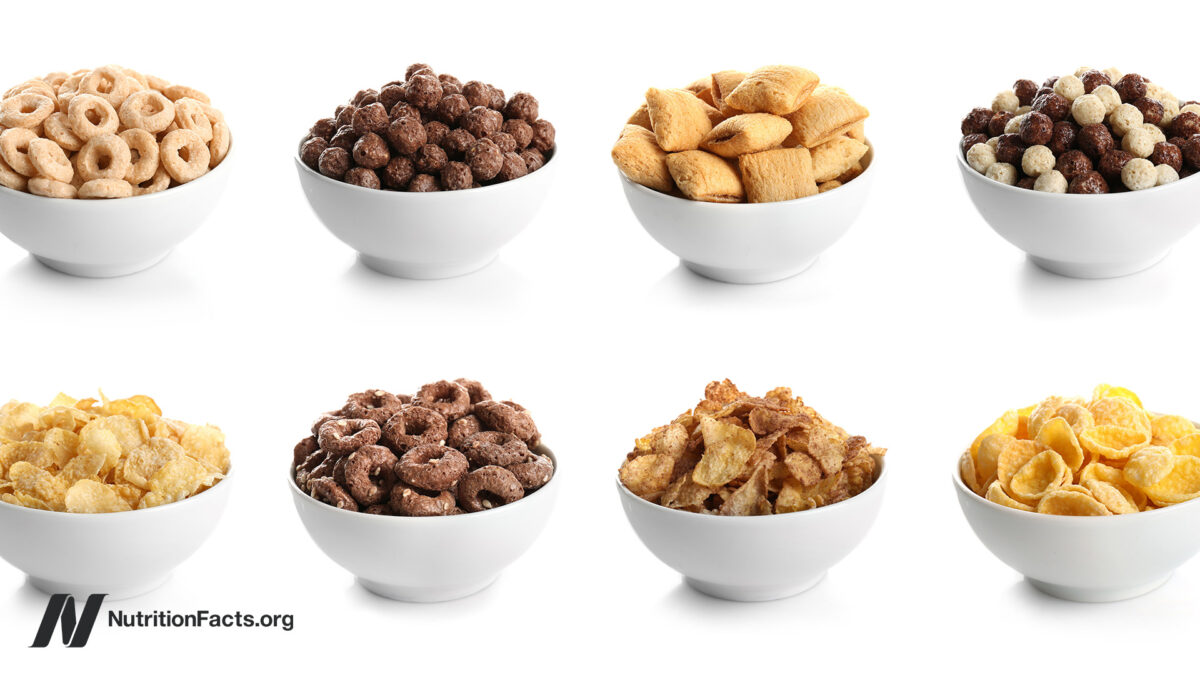
    Are Fortified Children’s Breakfast Cereals Just Candy? 

    “The industry responds to the charge that breakfast cereals are too sugary.

    In 1941, the American Medical Association’s Council on Foods and Nutrition was presented with a new product, Vi-Chocolin, a vitamin-fortified chocolate bar, “offered ostensibly as a specialty product of high nutritive value and of some use in medicine, but in reality intended for promotion to the public as a general purpose confection, a vitaminized candy.” Surely, something like that couldn’t happen today, right? Unfortunately, that’s the sugary cereal industry’s business model.

    As I discuss in my video Are Fortified Kids’ Breakfast Cereals Healthy or Just Candy?, nutrients are added to breakfast cereals “as a marketing gimmick to “create an aura of healthfulness…If those nutrients were added to soft drinks or candy, would we encourage kids to consume them more often?” Would we feed our kids Coke and Snickers for breakfast? We might as well spray cotton candy with vitamins, too. As one medical journal editorial read, “Adding vitamins and minerals to sugary cereals…is worse than useless. The subtle message accompanying such products is that it is safe to eat more.”

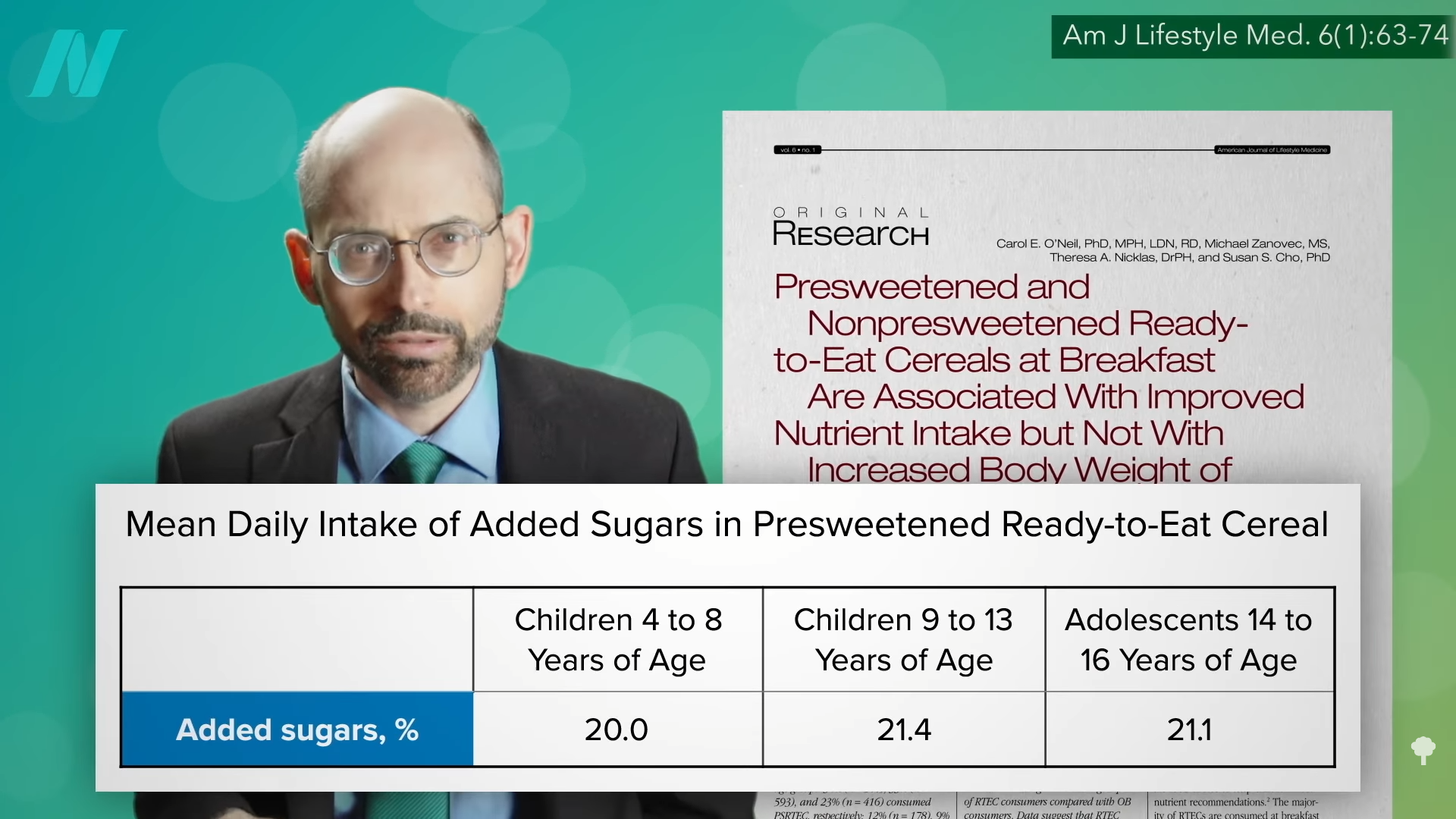
    General Mills’ “Grow up strong with Big G kids’ cereals” ad campaign featured products like Lucky Charms, Trix, and Cocoa Puffs. That’s like the dairy industry promoting ice cream as a way to get your calcium. Kids who eat presweetened breakfast cereals may get more than 20 percent of their daily calories from added sugar, as you can see below and at 1:28 in my video.

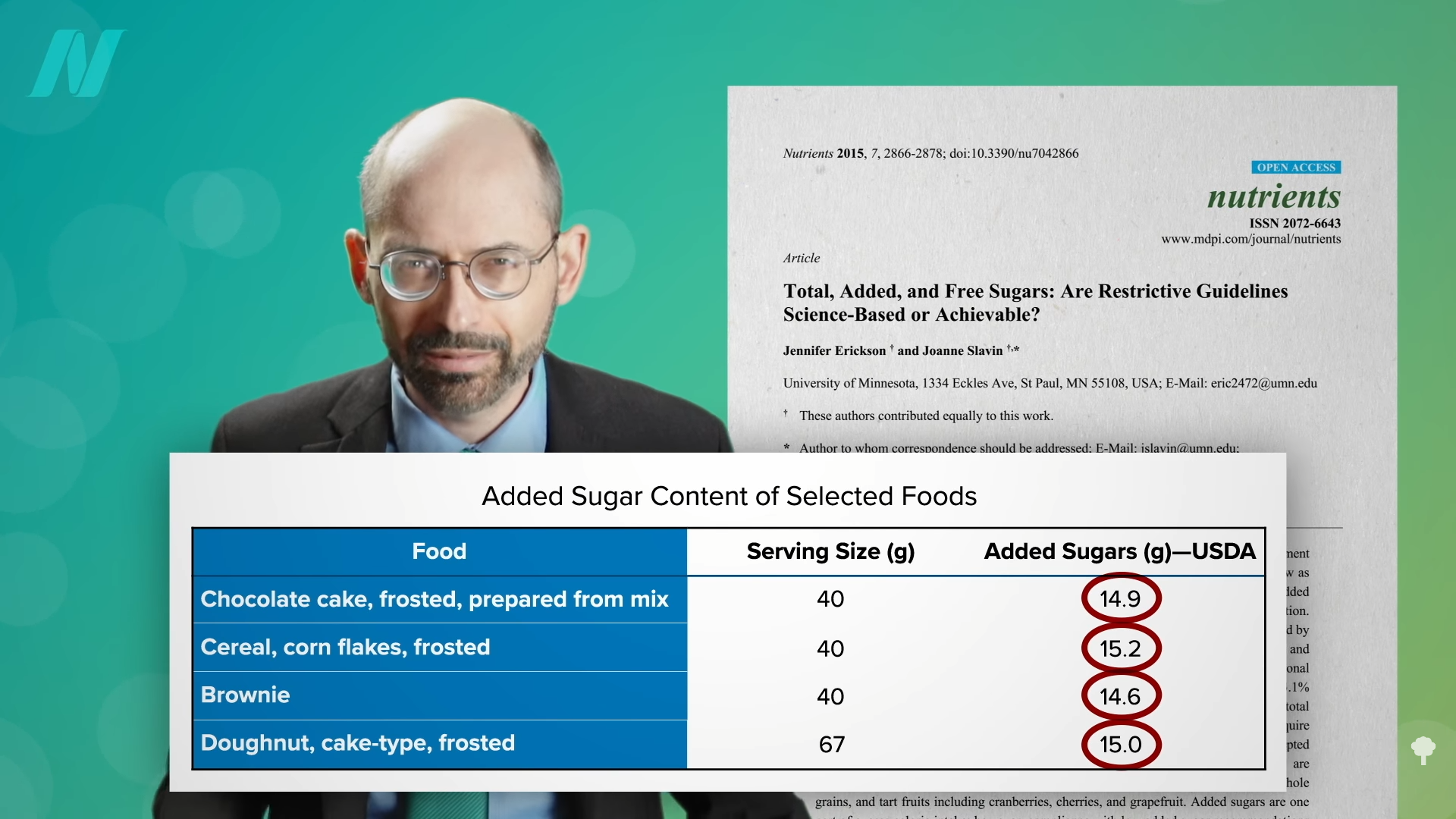
    Most sugar in the American diet comes from beverages like soda, but breakfast cereals represent the third largest food source of added sugars in the diets of children and adolescents, wedged between candy and ice cream. On a per-serving basis, there is more added sugar in a cereal like Frosted Flakes than there is in frosted chocolate cake, a brownie, or even a frosted donut, as you can see below and at 1:48 in my video.

    Kellogg’s and General Mills argue that breakfast cereals only contribute a “relatively small amount” of sugar to the diets of children, less than soda, for example. “This is a perfect example of the social psychology phenomenon of ‘diffusion of responsibility.’ This behavior is analogous to each restaurant in the country arguing that it should not be required to ban smoking because it alone contributes only a tiny fraction to Americans’ exposure to secondhand smoke.” In fact, “each source of added sugar…should be reduced.”

    The industry argues that most of their cereals have less than 10 grams of sugar per serving, but when Consumer Reports measured how much cereal youngsters actually poured for themselves, they were found to serve themselves about 50 percent more than the suggested serving size for most of the tested cereals. The average portion of Frosted Flakes they poured for themselves contained 18 grams of sugar, which is 4½ teaspoons or 6 sugar packets’ worth. It’s been estimated that a “child eating one serving per day of a children’s cereal containing the average amount of sugar would consume nearly 1,000 teaspoons of sugar in a year.”

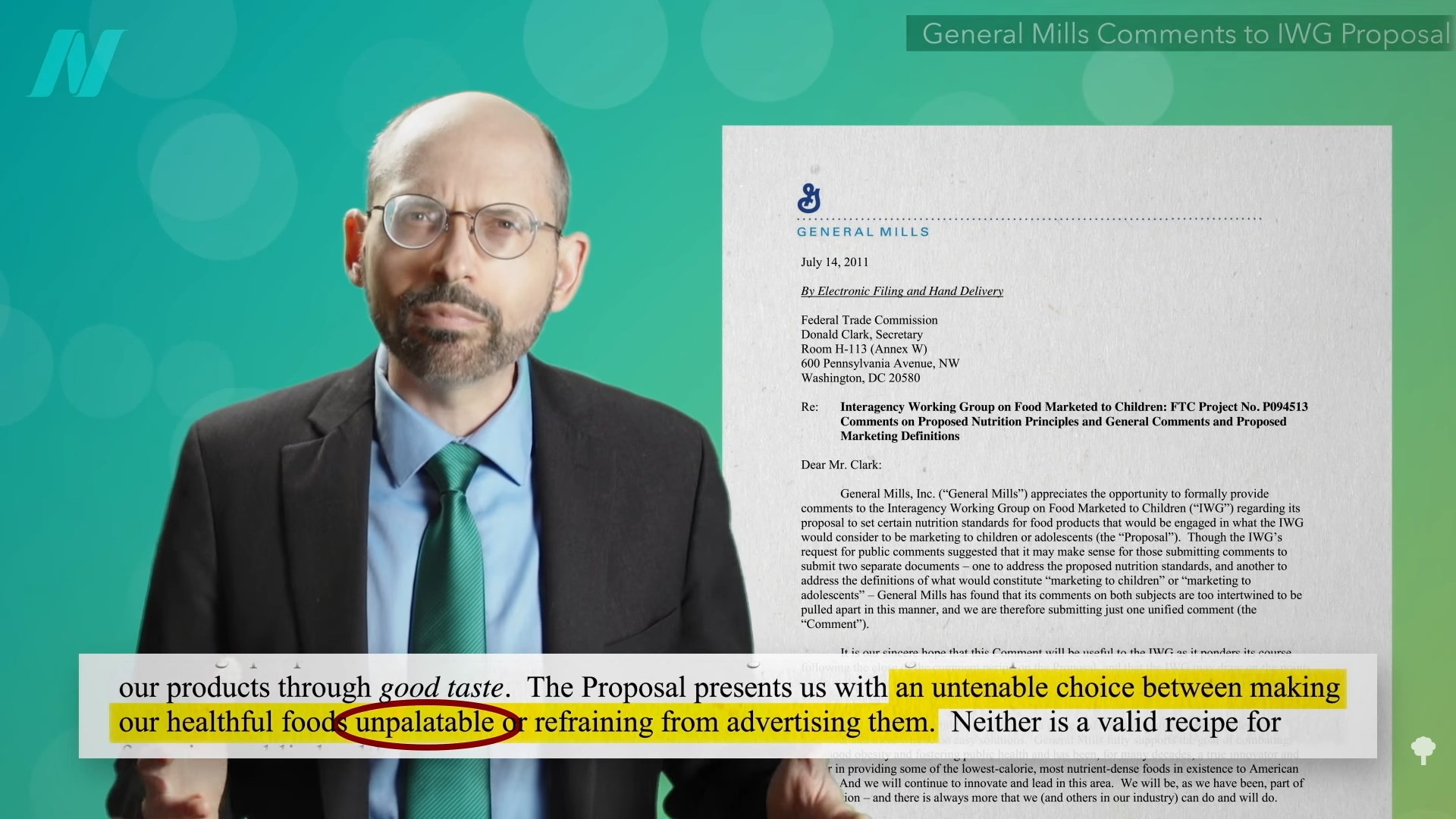
    General Mills offers the “Mary Poppins defense,” arguing that those spoonsful of sugar can “help the medicine go down” and explaining that “if sugar is removed from bran cereal, it would have the consistency of sawdust.” As you can see below and at 3:17 in my video, a General Mills representative wrote that the company is presented “with an untenable choice between making our healthful foods unpalatable or refraining from advertising them.” If it can’t add sugar to its cereals, they would be unpalatable? If one has to add sugar to a product to make it edible, that should tell us something. That’s a characteristic of so-called ultra-processed foods, where you have to pack them full of things like sugar, salt, and flavorings “to give flavor to foods that have had their [natural] intrinsic flavors processed out of them and to mask any unpleasant flavors in the final product.”

    The president of the Cereal Institute argued that without sugary cereals, kids might not eat breakfast at all. (This is similar to dairy industry arguments that removing chocolate milk from school cafeterias may lead to students “no longer purchasing school lunch.”) He also stressed we must consider the alternatives. As Kellogg’s director of nutrition once put it: “I would suggest that Fruit [sic] Loops as a snack are much better than potato chips or a sweet roll.” You know there’s a problem when the only way to make your product look good is to compare it to Pringles and Cinnabon.

    Want a healthier option? Check out my video Which Is a Better Breakfast: Cereal or Oatmeal?.

    For more on the effects of sugar on the body and if you like these more politically charged videos see the related posts below.

    Finally, for some additional videos on cereal, see Kids’ Breakfast Cereals as Nutritional Façade and Ochratoxin in Breakfast Cereals.

    Key Takeaways
    • Vi-Chocolin, a vitamin-fortified chocolate bar, was purportedly offered as a product with high nutritive value but was really just vitaminized candy. The sugary cereal industry follows a similar business model.

    • The sugary cereal industry has been criticized for adding nutrients to cereals “as a marketing gimmick,” creating an illusion of health benefits.

    • Children who consume pre-sweetened breakfast cereals may derive more than 20 percent of their daily calories from added sugar. Breakfast cereals rank as the third-largest food source of added sugars in the diets of kids and adolescents, listed between candy and ice cream. On a per-serving basis, a cereal like Frosted Flakes has more added sugar than a frosted chocolate cake, a brownie, or a frosted donut.

    • Kellogg’s and General Mills’ contention that breakfast cereals contribute only a “relatively small amount” of sugar to children’s diets is likened to the social psychology phenomenon of “diffusion of responsibility.”

    • Consumer Reports’ findings reveal that children often pour themselves 50 percent more cereal than the suggested serving size. A child eating a single daily serving of kids’ cereal with the average amount of sugar would consume almost a thousand teaspoons of sugar in one year.

    • The industry argues it has to add sugar to its cereals to make them palatable, which is a characteristic of ultra-processed foods.  From: https://nutritionfacts.org/blog/are-fortified-childrens-breakfast-cereals-just-candy/?

    __________

    Saturday, March 9, 2024

    Maundy Thursday and Good Friday. Three Days and Three Nights. Increased Lifespan from Beans.

    .

    3 Things You May Not Know About Maundy Thursday and Good Friday

    3 Things You May Not Know About Maundy Thursday and Good FridayDevout Catholics participate in a Good Friday procession.
    “Reflecting on Jesus’ death is sobering. Unfortunately the timing is rarely understood. Do Maundy Thursday and Good Friday fit the timing in the Bible?

    Churches will soon be packed with some of their largest attendances of the year. The “CEOs” (Christmas and Easter Only attendees) will make one of their semiannual appearances for Easter, the most holy observance of the year for mainstream Christianity. Good Friday, which occurs two days before Easter Sunday, is also significant as the most solemn occasion because it recalls the crucifixion of Christ.

    Most professing Christians understand that Jesus died so our sins can be forgiven. What is not common knowledge is the timing of His death, which has been hidden by the establishment of Easter and its closely related observances of Lent, Palm Sunday, Holy Wednesday, Maundy Thursday and Good Friday in lieu of the biblical festivals observed by Jesus, His apostles and the first-century Church.

    If you sincerely want to honor Christ at this time of year, you need to know the real story—the one that shows us the correct timing of His death and how to properly commemorate this event.

    Doesn’t Christ deserve the respect to have the true, biblical history of His death told and remembered on this sobering occasion?

    In that light, here are three important things to know about Maundy Thursday and Good Friday:

    1. Of all the man-made holidays, Maundy Thursday and Good Friday are the only ones that claim to commemorate something Jesus said to commemorate.

    On the evening before His crucifixion, Jesus told His disciples to keep the Passover as an annual festival “in remembrance of Me” (Luke 22:19; 1 Corinthians 11:24-25).

    In teaching the Corinthians to observe this solemn service, Paul told them that through this memorial they would “proclaim the Lord’s death till He comes” (verse 26, emphasis added throughout).

    Jesus never commanded Christians to celebrate His birth or resurrection. Rather, His instruction was for us to memorialize His death—something that Maundy Thursday and Good Friday actually do attempt to do.

    But does that mean you should observe Maundy Thursday and Good Friday?

    2. Maundy Thursday and Good Friday aren’t the biblical names of the observance that commemorates Christ’s death.

    The terms Maundy Thursday and Good Friday appear nowhere in the Bible. But the Bible does talk about another festival to honor Christ’s death: the Passover.

    The New Testament Passover established by Christ Himself includes taking bread and wine. The bread represents His broken body and the wine represents His shed blood (Matthew 26:26-28).

    Churches vary in how often they partake of the symbols of bread and wine. Some take these symbols daily, some monthly and some on Maundy Thursday. But the Bible instructs us to observe it only once a year on a specific day (Leviticus 23:5). When we take the Passover symbols of unleavened bread and wine, we annually “proclaim the Lord’s death till He comes” (1 Corinthians 11:26).

    Observing the Passover is a memorial of Christ’s death. Jesus did not die on many different days throughout the year. He died on only one day, and He observed the Passover on the prescribed evening before the day of His death.

    Passover is the annual festival that reminds us of Christ’s death. To learn more about this observance, see “Passover: What Did Jesus Do for You?” and “Questions and Answers About the Passover.”

    3 Things You May Not Know About Maundy Thursday and Good Friday

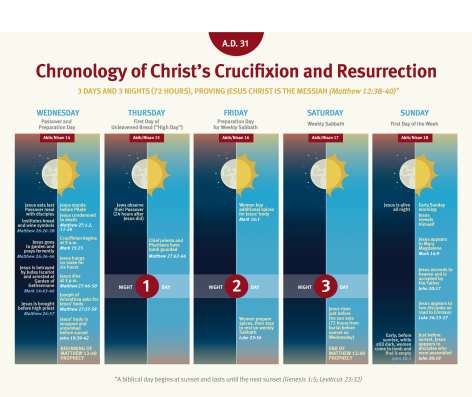
    Download "The Chronology of Christ’s Crucifixion and Resurrection" infographic.

    This chart includes the key events during this momentous week, demonstrating how Jesus’ promise to rise after three days and three nights was fulfilled, proving He is the Messiah.

    3. Jesus didn’t die on a Friday.

    Today documentation is commonly recorded for births and deaths. While we don’t have these same types of records from the first century giving us the exact day of Christ’s death, the Bible does give us enough details to show that Jesus definitely didn’t die on a Friday.

    Let’s begin with the best known facts about Christ’s death. The Bible clearly tells us: “Now after the Sabbath [Saturday], as the first day of the week [Sunday] began to dawn, Mary Magdalene and the other Mary came to see the tomb,” but Jesus was not there because He had risen (Matthew 28:1, 6). So Jesus had already been resurrected by very early Sunday morning.

    The next biblical key to note is that Jesus said, “As Jonah was three days and three nights in the belly of the great fish, so will the Son of Man be three days and three nights in the heart of the earth” (Matthew 12:40). We can also note that Jesus died at about 3 p.m., the ninth hour after sunrise, and was buried that evening shortly before the beginning of a Sabbath (Matthew 27:46-50, 57, 62).

    People have assumed that the Sabbath mentioned in these verses is a Saturday, leading them to the conclusion that Jesus died on a Friday—hence the name Good Friday. But there is a problem with this timeline. There simply are not three days and three nights between Friday evening and Sunday morning. There aren’t even parts of three days and three nights in this time period between Friday evening and Sunday morning (as some have tried to interpret the three days and three nights).

    The biblical fact is, Jesus died on a Wednesday—not on a Friday as many believe. A careful reading of a companion scripture explains this apparent dilemma. John 19:31 tells us that the day Jesus was buried preceded a “high day”—a designation reserved for an annual Sabbath, which could fall on any day of the week and not necessarily Saturday. In fact, Jesus was buried just prior to the beginning of the first day of the Feast of Unleavened Bread—an annual Sabbath.

    The weekday timeline that fits the facts we have noted is easily constructed. Jesus observed the Passover with His disciples on Tuesday evening. He was crucified and died on Wednesday, buried near sunset on Wednesday prior to the beginning of the annual Sabbath called the first day of the Feast of Unleavened Bread, and resurrected three days and three nights later near sundown on Saturday, the weekly Sabbath. When the women arrived at the tomb early Sunday morning, they discovered that He had already been resurrected.

    The fact that there were two Sabbaths during the timeline of Jesus’ burial and resurrection is confirmed by several Bible translations, including the International Standard Version, which translates Matthew 28:1: “After the Sabbaths, around dawn on the first day of the week, Mary Magdalene and the other Mary went to take a look at the burial site.” The annual Sabbath occurred on Thursday that year; the weekly Sabbath, on Saturday.

    The biblical fact is, Jesus died on a Wednesday—not on a Friday as many believe. Interestingly when we look at the years for God’s holy days falling on the days of the week indicated by the Scriptures, we find that Jesus died on the 14th day of the first month of the Hebrew calendar in A.D. 31."   From: https://lifehopeandtruth.com/life/blog/3-things-you-may-not-know-about-maundy-thursday-and-good-friday/

    _________

    Three Days and Three Nights

    Matthew 12:39-40

    But He answered and said to them, “An evil and adulterous generation seeks after a sign, and no sign will be given to it except the sign of the prophet Jonah. For as Jonah was three days and three nights in the belly of the great fish, so will the Son of Man be three days and three nights in the heart of the earth.”

    Listen to the "Verse by Verse" episode covering this scripture.

    In our Fundamental Beliefs “8. Three Days and Three Nights,” we state, “Jesus Christ was raised from the dead by the Father after His body lay for three days and three nights in the grave. The length of time that He was in the grave was the only sign He gave to prove He was the Messiah.”

    Jesus had done many miracles, but still the Pharisees sought “how they might destroy Him” (Matthew 12:14). So Jesus didn’t offer them more miracles as a sign, only this reference to the length of time He would be in the grave.

    Strangely, though, most Christians today do not believe that Christ was literally three days and three nights in the grave as He promised, since it is not possible to count three days and three nights between Good Friday afternoon and Easter Sunday morning.

    For a detailed explanation of the biblical chronology of Christ’s crucifixion and resurrection, including a helpful chart, see “Sign of Jonah: Did Jesus Die Good Friday, Rise on Easter?” From: https://lifehopeandtruth.com/bible/blog/three-days-and-three-nights/

    _________

    Increased Lifespan from Beans

    “The intake of legumes—beans, chickpeas, split peas, and lentils—may be the single most important dietary predictor of a long lifespan. But what about concerns about intestinal gas?”

    Transcript of video at: https://nutritionfacts.org/video/increased-lifespan-from-beans/

    Below is an approximation of this video’s audio content. To see any graphs, charts, graphics, images, and quotes to which Dr. Greger may be referring, watch the above video.

    “Legumes may be “the most important…predictor of survival in older people” from around the globe. They looked at “five [different] cohorts in Japan, Sweden, Greece, and Australia.” And, of all the food factors they looked at, only one was associated with a longer lifespan across the board: legume intake. Whether it was the Japanese eating their soy, the Swedes eating their “brown beans and peas,” or those in the Mediterranean eating “lentils, chickpeas, and white beans,”…”[o]nly for legumes intake was the result plausible, consistent, and statistically significant from [the] data” across all the populations combined. We’re talking an “8% reduction in risk of death for every 20 grams increase in daily legumes intake.” That’s just like two tablespoons’ worth! So, if a can of beans is 250 grams, and you get 8% lower mortality for every 20 grams, maybe, if we eat a can a day, we’ll live forever? Let’s find out!

    If you want to increase your lifespan, eat beans. If, however, you’re suicidal, and want to decrease your lifespan, “A bean-free diet” may increase the risk of death.

    So, having arrived at the one dietary fountain of youth, what’s the #1 reason people aren’t clamoring for them? Fear of flatulence. So, is that the choice we’re left with? Breaking wind or breaking down? Passing gas or passing on? Turns out that “[p]eople’s concerns about excessive flatulence from eating beans may be exaggerated.”

    Add a half-cup of beans every day to people’s diets for months, and what happens? What’s the #1 symptom? Nothing. The vast majority of people experienced no symptoms at all—though a few percent did report increased flatulence. So, it may occur in some individuals. But, “not all people are affected.” Even among those that were, “[s]eventy percent or more of the participants who experienced flatulence felt that it dissipated [no pun intended] by the second or third week of bean consumption”. So, we’ve just got to stick to it.

    And, you know, a small percentage reported increased flatulence on the control diet without any beans. People have preconceived notions about beans, such that “just the expectation of flatulence from eating beans may influence their perceptions of having gas.” They didn’t actually measure farts in this study; they just asked people what their perception of the amount of gas they had was. And, we know from previous studies that you give someone a product labeled to contain something that may cause intestinal distress, and it causes more intestinal distress whether it actually contains the ingredient or not. In other words, “just thinking they were eating [it] caused digestive distress, or the perception of it, to a proportion of persons.”

    So, people thinking beans are going to cause gas may just be more likely to notice the gas they normally have. Either way, it tends to go away; “after a few weeks of daily bean consumption, people perceive that flatulence occurrence returns to normal levels.”

    In this other study, where they added more than a half a cup of kidney beans to people’s daily diets, the research subjects reported that the discomfort they initially felt within the first day or two of adding beans “quickly disappeared.” So, again, stick with it.

    Bottom line (no pun intended!): “An increasing body of research and the [latest] Dietary Guidelines…supports the benefits of a plant-based diet, and legumes specifically, in the reduction of chronic disease risks.” In some people it “may result in more flatulence initially.” However, doctors should emphasize that it “will decrease over time” if we just keep it up.

    And, “the nutritional attributes of beans in the diet outweighs the potential for transitory discomfort. The long-term health benefits of bean consumption are great.” And, indeed, eating beans in the long term may make your term—on Earth—even longer.” From: https://nutritionfacts.org/video/increased-lifespan-from-beans/

    _________