Showing posts with label candy. Show all posts

Monday, July 15, 2024

Lessons From A Hurricane. The Role of Taxpayer Subsidies in the Obesity Epidemic.

.

We just got power back from losing it during Hurricane Beryl!!

Lessons from A Hurricane

The most powerful and destructive storms on earth are called hurricanes, typhoons or cyclones, depending on where they occur. 

On Sept. 8, 1900, a very powerful hurricane struck Galveston, Texas, on the Gulf Coast of the United States.

The storm and the storm surge that followed destroyed more than 3,500 homes. The death toll from that storm was around 8,000, making it the worst and deadliest natural disaster in U.S. history—2.5 times deadlier than the 1906 San Francisco earthquake. 

Twenty-eight years later, on Sept. 12 and 13, the Okeechobee hurricane of 1928 plowed through the Caribbean before slamming into Florida, killing a total of 4,000 people, 2,500 of them in the U.S. In Puerto Rico alone, the storm left half a million people homeless.

In 2005, the costliest natural disaster in U.S. history hit the Mississippi and Louisiana coasts. Hurricane Katrina’s storm surge in places was 28 feet above the normal tide. In the end, Katrina was responsible for about 1,400 deaths, and caused $125 billion in damages.

To survive a hurricane or other natural disaster, it’s vital to be prepared. What should one do to be prepared? And, even more important, what spiritual lessons can you and I draw from this process?

Watch the news: Unlike a century ago, today weather satellites and radar can give warnings days in advance of the approach of a hurricane, typhoon or cyclone. Warnings go out several days before, encouraging people to prepare their properties and even evacuate if that is deemed necessary. 

Over a century ago, when the Galveston hurricane struck, it is probable that so many deaths occurred because they had so little warning. By the time they knew how big the storm was, it was too late.

How many times in Scripture are we given the admonition to watch and pray (Luke 21:36) or “take heed; see, I have told you all things beforehand” (Mark 13:23) or “I have told you before it comes” (John 14:29)?

I’ve heard prophecy described as news written in advance. One of the primary purposes of prophecy is to show in advance what will happen, so God’s people can be prepared (Amos 3:7).

Just as we have news stations showing satellite images and tracking storms, so we have prophecies providing written “storm warnings” about the events that are soon to smash through the lives of people in the end time.

Are we watching the “news” of the Bible? Or will we be like the majority of mankind, who will be surprised by the storms at the end of this age (Luke 21:34)?

Stock up on emergency supplies: Emergency preparedness includes having a supply of food that doesn’t need refrigeration, as well as drinking water, protective clothing, flashlights and batteries and, if possible, fuel. 

These are all items a family might need to survive until clean-up crews make it to them and normal utilities and services resume.

Jesus Christ made a similar spiritual point through the parable of the 10 virgins in Matthew 25. In this parable, righteousness and God’s Holy Spirit are likened to the oil needed as fuel for lamps in that time. 

When I was a boy on the farm, we always had kerosene lamps and kept extra kerosene on hand for those times when a storm would knock out power. I did homework by kerosene lamp more than once—and we were glad to have them! 

My wife and I still have some of those same old lamps—and we have spare kerosene also! Because, without oil or kerosene, your lamps are of no help in a crisis.

We are told this is the condition of the Christian who is not diligently working to repent, grow and build righteous character. A Christian must work daily to make sure his or her life is filled with and guided by God’s Spirit. 

When a crisis of faith or a heavy trial comes—and we know it will—we cannot just instantly obtain righteous character out of thin air any more than a man stranded after a storm can just instantly obtain kerosene (or flashlight batteries or food or water) out of thin air. 

Take action—NOW: With the benefit of advanced warning, government officials will begin urging residents to prepare for a storm, board up windows and gather needed supplies. 

If a storm is expected to be severe enough, evacuation warnings and orders will go out. People living in the most vulnerable areas will be urged to get out. 

Sadly, with every powerful storm, there are many people who refuse to leave their homes. With Katrina, some refused to leave until it was too late. 

They thought they were strong enough or prepared enough that they could survive what was coming. In many sad cases, they were wrong. 

Over the years I’ve heard brethren state they will start praying and studying more “after I retire” or “when the kids start school” or “after my business takes off and I don’t have to put so much time into it” or so forth. 

Others feel they are already spiritually mature and strong enough to endure whatever life may throw at them, and they don’t need anything more. Revelation 3:17 indicates this will be a problem Christians must beware of at the end of this age. 

Don’t put off prayer, Bible study and working hard to strengthen your spiritual life. Take action NOW! When the most severe crisis ever to hit mankind comes, we don’t want to be unprepared and without the spiritual resources we need to weather the storm with our faith intact!

Study this further in our online article “How to Prepare for the End Times.”

Kind regards, and have a great rest of your week,

Tom Clark, for Life, Hope & Truth

________  

The Role of Taxpayer Subsidies in the Obesity Epidemic

Transcript of the video at: https://nutritionfacts.org/video/the-role-of-taxpayer-subsidies-in-the-obesity-epidemic/

Below is an approximation of this video’s audio content. To see any graphs, charts, graphics, images, and quotes to which Dr. Greger may be referring, watch the above video.

“Why are U.S. taxpayers giving billions to support the likes of the sugar and livestock industries?

The rise in calorie surplus sufficient to explain the obesity epidemic was less a change in food quantity than in food quality, with an explosion in cheap, high-calorie, low-quality convenience foods. And the federal government very much played a role in making this happen. U.S. taxpayers give billions in subsidies to prop up the likes of the sugar industry; the corn industry and their high-fructose syrup, (HFCS); and soybean production, about half of which is processed into vegetable oil, and the other half used as cheap feed to help make dollar-menu meat. Why do taxpayers give nearly a quarter billion dollars a year to the sorghum industry? When was the last time you sat down to some sorghum? It’s almost all fed to livestock. We’ve created a pricing structure that favors the production of sugars, oil, and animal products.

The farm bill started out as an emergency measure during the Great Depression of the 1930s to protect small farmers, but was weaponized by Big Ag into a cash cow with pork barrel politics—including said producers of cows and pork. From 1970 to 1994, global beef prices dropped more than 60 percent. If it weren’t for taxpayers sweetening the pot with billions of dollars a year, high-fructose corn syrup would cost the soda industry about 12 percent more. (And then we hand them more billions through the “food stamp” program to give sugary drinks to the poor.)

Why is chicken so cheap? After one of the farm bills, corn and soy were subsidized below the cost of production for cheap animal fodder, effectively handing the poultry and pork industry about $10 billion each. That’s not chicken feed—or rather, it is!

This is changing what we eat. Thanks in part to subsidies, dairy, meats, sweets, eggs, oils, and soda were all getting relatively cheaper compared to the overall consumer food price index as the obesity epidemic took off, whereas the relative cost of fresh fruits and vegetables doubled. This may help explain why during about the same period, the percentage of Americans getting even five servings of fruits and vegetables a day dropped from 42 percent to 26 percent. Why not just subsidize produce instead? Because that’s not where the money is.

To understand what is shaping our foodscape today, it is important to understand the significance of differential profit. Whole foods, or minimally processed foods, such as canned beans or tomato paste, are what’s referred to in the food business as “commodities.” They have such slim profit margins. Sometimes they’re even sold at or below cost as “loss leaders” to attract customers in hopes they’ll also buy the “value-added” products. Some of the most profitable for producers and vendors alike are the ultra-processed fatty/sugary/salty concoctions of artificially flavored, artificially colored, and artificially cheap ingredients thanks to taxpayer subsidies.

Different foods reap different returns. Measured in profit per square foot of supermarket selling space, confectionaries like candy bars consistently rank among the most lucrative. The markups are the only healthy thing about them. Fried snacks like potato and corn chips are also highly profitable. PepsiCo’s subsidiary Frito-Lay brags that while their products represented only about 1 percent of total supermarket sales, they may account for more than 10 percent of operating profits for supermarkets, and 40 percent of profit growth.

It’s no surprise, then, that the entire system is geared towards garbage. The rise in the calorie supply wasn’t just more food, but a different kind of food. There’s a dumb dichotomy about the drivers of the obesity epidemic: is it the sugar or is it the fat? They’re both highly subsidized, and they both took off. Along with a significant rise in refined grain products that’s difficult to quantify, the rise in obesity was accompanied by about a 20 percent increase in per capita pounds of added sugars, and a 38 percent increase in added fats.

More than half of all calories consumed by most adults in the United States were found to originate from these subsidized foods, and they appear to be worse off for it. Those eating the most had significantly higher levels of chronic disease risk factors, including elevated cholesterol, inflammation, and body weight.” 

From: https://nutritionfacts.org/video/the-role-of-taxpayer-subsidies-in-the-obesity-epidemic/

_________

Sunday, March 31, 2024

Did Jesus Replace the Passover? I’m A Christian, But I Don’t Keep Easter. Are Fortified Children’s Breakfast Cereals Just Candy?

.

This is Easter weekend, but Passover isn’t until the end of next month!!  Starts evening of 22nd. April 2024.

_______

Did Jesus Replace the Passover?


Did Jesus Replace the Passover?

“Did the God of the Old Testament do things that Jesus Christ had to clean up? For example, is the Passover outdated and no longer necessary?

Religious writers of a gnostic bent, past and present, frequently mix truth with error. One of their major themes falsely claims that the Creator God was rather “over the hill,” necessitating a youthful, vigorous Jesus to zoom in to repair the damage and rescue human souls.

In his book Primitive Christianity in Crisis, Alan Knight explains the gnostic approach: “Salvation depends on rejecting both the material world and the God that created it. … The wrathful God of the Old Testament cannot be the same as the true spiritual Father” (third edition, pp. 22, 48).

Is the big story plot of the Bible, “Jesus Christ the Savior replaces a fading Creator God”?

Did Jesus scrap the Creator’s work, or did He build on it, adding the finished structure to the foundation God had laid?

Jesus came to reveal the Father, not replace Him (Matthew 11:27; John 5:37). Could it be that Father and Son have been closely collaborating all along? They are on the same page, with the same goals and same objectives, in complete agreement.

As a case in point, consider the biblical story of the Passover, in the Old Testament and the New.

The Old Testament Passover

In Exodus 12 we read of the Passover being revealed to the Israelites. It was to be observed on the 14th day of the first month of the Hebrew calendar. For each household a lamb was slaughtered, a male without blemish. No bones of the lamb were broken. They smeared the Passover lamb’s blood around the doors of their homes as a sign.

God spared the congregation of Israel as He passed over the blood-stained doors in the night and did not send destruction on their firstborn.

The following day, the 15th of the first month, was a holy day, the first day of the Feast of Unleavened Bread. On that day Israel began leaving Egypt and eating unleavened bread. Israel was finally delivered from their hard bondage in slavery.

Jesus’ New Testament Passover

Some 15 centuries later the Bible records another Passover, this time in the holy city, Jerusalem. Compare this one to that first ancient drama.

  1. A key event of the New Testament is the sacrifice of a human male Passover lamb, Jesus Christ. “For indeed Christ, our Passover, was sacrificed for us” (1 Corinthians 5:7).
  2. Jesus was crucified on the exact same 14th day of the first month, the preparation day before the first day of the Feast of Unleavened Bread, a holy day. “Therefore, because it was the Preparation Day, that the bodies should not remain on the cross on the Sabbath (for that Sabbath was a high day), the Jews asked Pilate that their legs might be broken, and that they might be taken away” (John 19:31).
  3. Jesus’ sacrifice delivered mankind from bondage to sin and death (Romans 8:2).
  4. Jesus was without sin, an unblemished sacrifice (1 Peter 2:22; 1 John 3:5).
  5. None of His bones were broken. “But when they came to Jesus and saw that He was already dead, they did not break His legs” (John 19:33).
  6. Jesus spared all repentant sinners from eternal death, the consequence of our sins. We have been washed in His own blood (Revelation 1:5). Compare this to how the Israelites were saved from the death of the firstborn.
  7. Jesus’ disciples continued to keep the Passover annually to remember His sacrifice and still do even to this day, along with the Feast of Unleavened Bread. “Therefore let us keep the feast, not with old leaven, nor with the leaven of malice and wickedness, but with the unleavened bread of sincerity and truth” (1 Corinthians 5:8, penned some 20-plus years after Jesus ascended).
Finishing touches?

Did Jesus start a new approach with the nonbiblical holidays of Christmas and Easter? Or did He put the finishing touches on the age-old Passover festival to be observed for all time, precisely as the Father and Jesus planned in exact detail from the very beginning?

  • “In the beginning was the Word, and the Word was with God, and the Word was God” (John 1:1).
  • “I and My Father are one,” of one mind and purpose (John 10:30).
  • “O My Father, if this cup cannot pass away from Me unless I drink it, Your will be done” (Matthew 26:42, Jesus prayed this to the Father about His terrible trial that was to commence).

The Bible shows that the first Passover festival of the sacrifice of unblemished lambs back in ancient Egypt was a brilliantly fashioned shadowy precursor of greater things to come centuries later—the sacrifice of Jesus Christ for all sins, for all mankind, for all time (Colossians 2:16-17).

For more about Passover, see “Passover: What Did Jesus Do for You?” For more about God and Jesus, check out the section about God. “  From: https://lifehopeandtruth.com/god/blog/did-jesus-replace-the-passover/

________

I’m a Christian, but I Don’t Keep Easter

“The Bible gives us instructions on how to worship God, Easter is not commanded there, but the Passover is... which will you observe?

Transcript Of video at:  https://www.ucg.org/beyond-today/beyond-today-daily/im-a-christian-but-i-dont-keep-easter

[Darris McNeely]

“I'm a Christian but I don't keep Easter. I'm a Christian, and I keep Passover. Now, when I say the word Passover, you may think, "Well, that's Jewish. How can you be a Christian and keep what you consider think to be a Jewish festival Jewish holiday?" Well, very simply, very easily. I read the Scripture, and I understand what it says and I understand what the Passover of the New Testament really is. And I see instruction for me to keep that and I don't see the instruction for Easter, and a lot of other holidays that have been substituted for God's Festivals. But for a moment, let's just focus on the Passover.

As I speak here, at this time, we're just a few weeks away from keeping the Passover, a very important service for a Christian. One who has given their life to God, to Jesus Christ, accepted His sacrifice and are a disciple. In 1 Corinthians 5, Paul is writing to a Gentile church in the city of Corinth, and he's giving them instructions about their life, but then also about keeping the Festival of the Days of Unleavened Bread. And in verse 7 of 1 Corinthians 5, he tells them, "Purge out the old leaven, that you may be a new lump since you truly are unleavened." Now, that's a reference to putting out the leaven in anticipation of the seven days of unleavened bread, another festival, and keeping that with the unleavened bread of sincerity of truth. And he says, "For indeed, Christ, our Passover, was sacrificed for us." Christ, our Passover.

There are many scriptures that talk about the Passover service. There's certainly Old Testament Scriptures that define what it was in the Old Testament. And there are New Testament Scriptures that define what it means in the New Testament under the New Covenant, how Christ kept it, and how the church was instructed to keep it. And this is one of those and it says that Christ is our Passover, sacrificed for us. In the New Testament Passover, we don't kill a lamb. We don't spread its blood on the doorposts as they did back in Exodus, at the time of the Exodus.

We keep the Passover with the symbols of the body and blood of Jesus Christ, but we keep the Passover. We keep the Passover because it points us to Christ who is our Passover. It's something that you should think about if you haven't before because, from the scriptures, we find that Christ is our Passover. And that's what I keep as a Christian. And I hope it will make you think if you're not already doing it, that that's what you should be doing instead of whatever you may be doing to worship God. Doing it this way is the godly way, the biblical way.”  From: https://www.ucg.org/beyond-today/beyond-today-daily/im-a-christian-but-i-dont-keep-easter

________

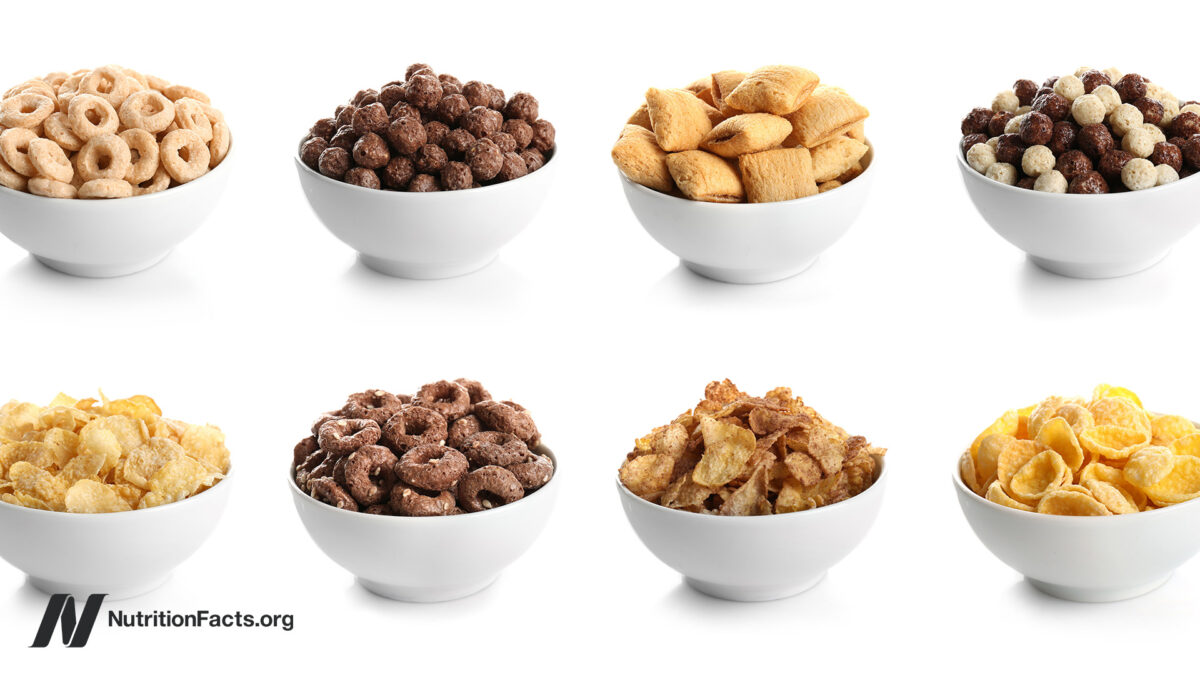
Are Fortified Children’s Breakfast Cereals Just Candy? 

“The industry responds to the charge that breakfast cereals are too sugary.

In 1941, the American Medical Association’s Council on Foods and Nutrition was presented with a new product, Vi-Chocolin, a vitamin-fortified chocolate bar, “offered ostensibly as a specialty product of high nutritive value and of some use in medicine, but in reality intended for promotion to the public as a general purpose confection, a vitaminized candy.” Surely, something like that couldn’t happen today, right? Unfortunately, that’s the sugary cereal industry’s business model.

As I discuss in my video Are Fortified Kids’ Breakfast Cereals Healthy or Just Candy?, nutrients are added to breakfast cereals “as a marketing gimmick to “create an aura of healthfulness…If those nutrients were added to soft drinks or candy, would we encourage kids to consume them more often?” Would we feed our kids Coke and Snickers for breakfast? We might as well spray cotton candy with vitamins, too. As one medical journal editorial read, “Adding vitamins and minerals to sugary cereals…is worse than useless. The subtle message accompanying such products is that it is safe to eat more.”

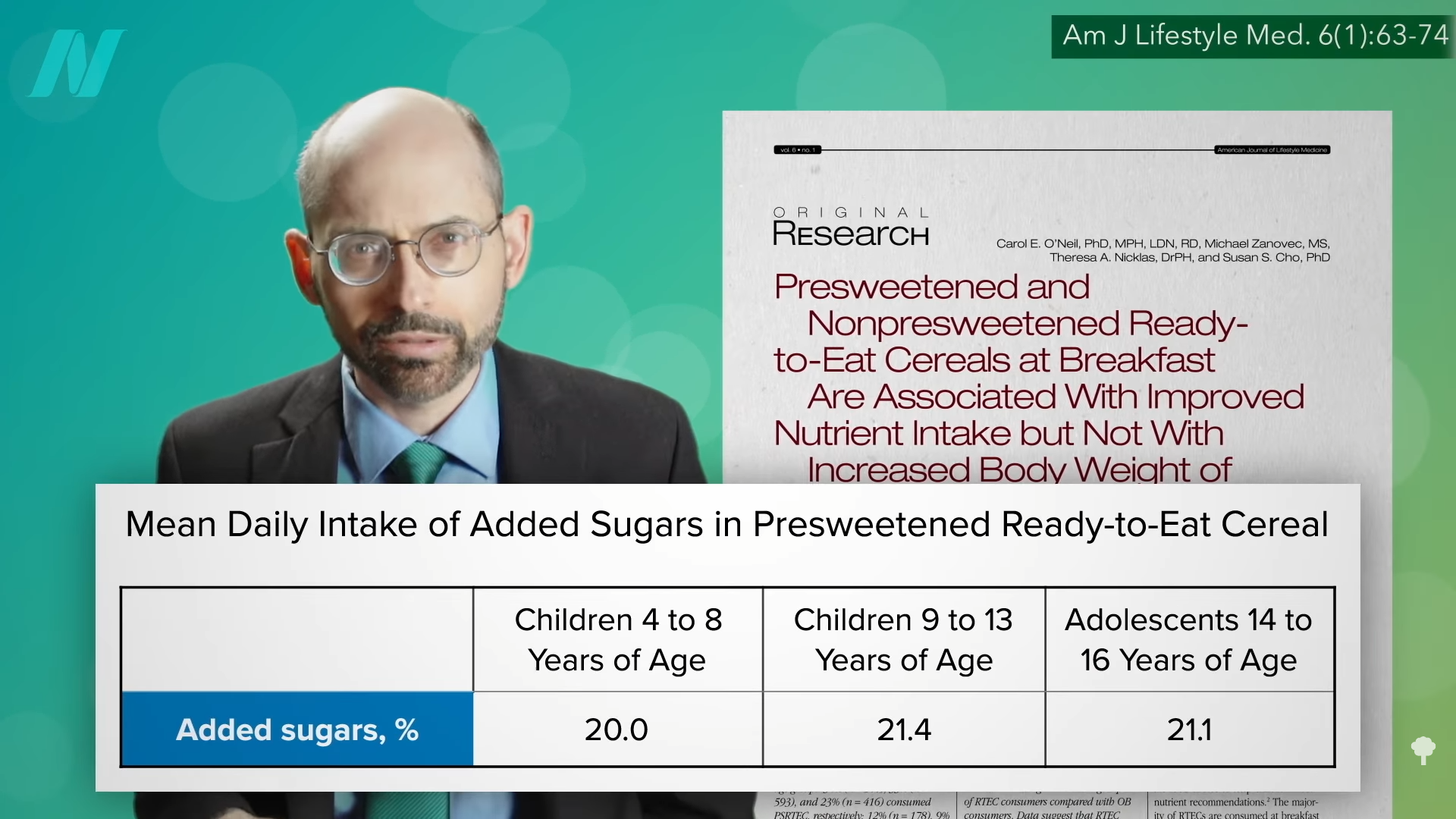
General Mills’ “Grow up strong with Big G kids’ cereals” ad campaign featured products like Lucky Charms, Trix, and Cocoa Puffs. That’s like the dairy industry promoting ice cream as a way to get your calcium. Kids who eat presweetened breakfast cereals may get more than 20 percent of their daily calories from added sugar, as you can see below and at 1:28 in my video.

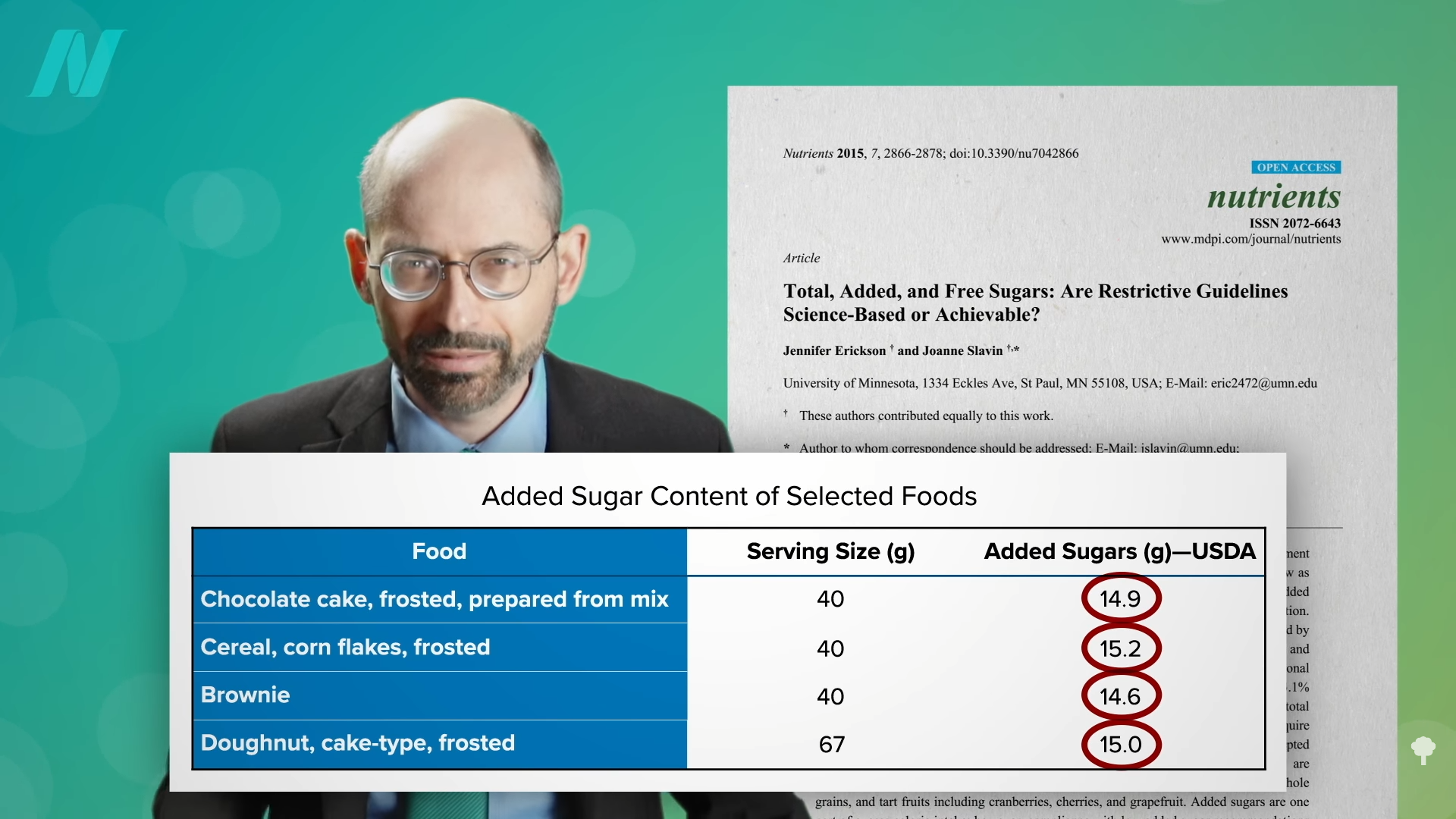
Most sugar in the American diet comes from beverages like soda, but breakfast cereals represent the third largest food source of added sugars in the diets of children and adolescents, wedged between candy and ice cream. On a per-serving basis, there is more added sugar in a cereal like Frosted Flakes than there is in frosted chocolate cake, a brownie, or even a frosted donut, as you can see below and at 1:48 in my video.

Kellogg’s and General Mills argue that breakfast cereals only contribute a “relatively small amount” of sugar to the diets of children, less than soda, for example. “This is a perfect example of the social psychology phenomenon of ‘diffusion of responsibility.’ This behavior is analogous to each restaurant in the country arguing that it should not be required to ban smoking because it alone contributes only a tiny fraction to Americans’ exposure to secondhand smoke.” In fact, “each source of added sugar…should be reduced.”

The industry argues that most of their cereals have less than 10 grams of sugar per serving, but when Consumer Reports measured how much cereal youngsters actually poured for themselves, they were found to serve themselves about 50 percent more than the suggested serving size for most of the tested cereals. The average portion of Frosted Flakes they poured for themselves contained 18 grams of sugar, which is 4½ teaspoons or 6 sugar packets’ worth. It’s been estimated that a “child eating one serving per day of a children’s cereal containing the average amount of sugar would consume nearly 1,000 teaspoons of sugar in a year.”

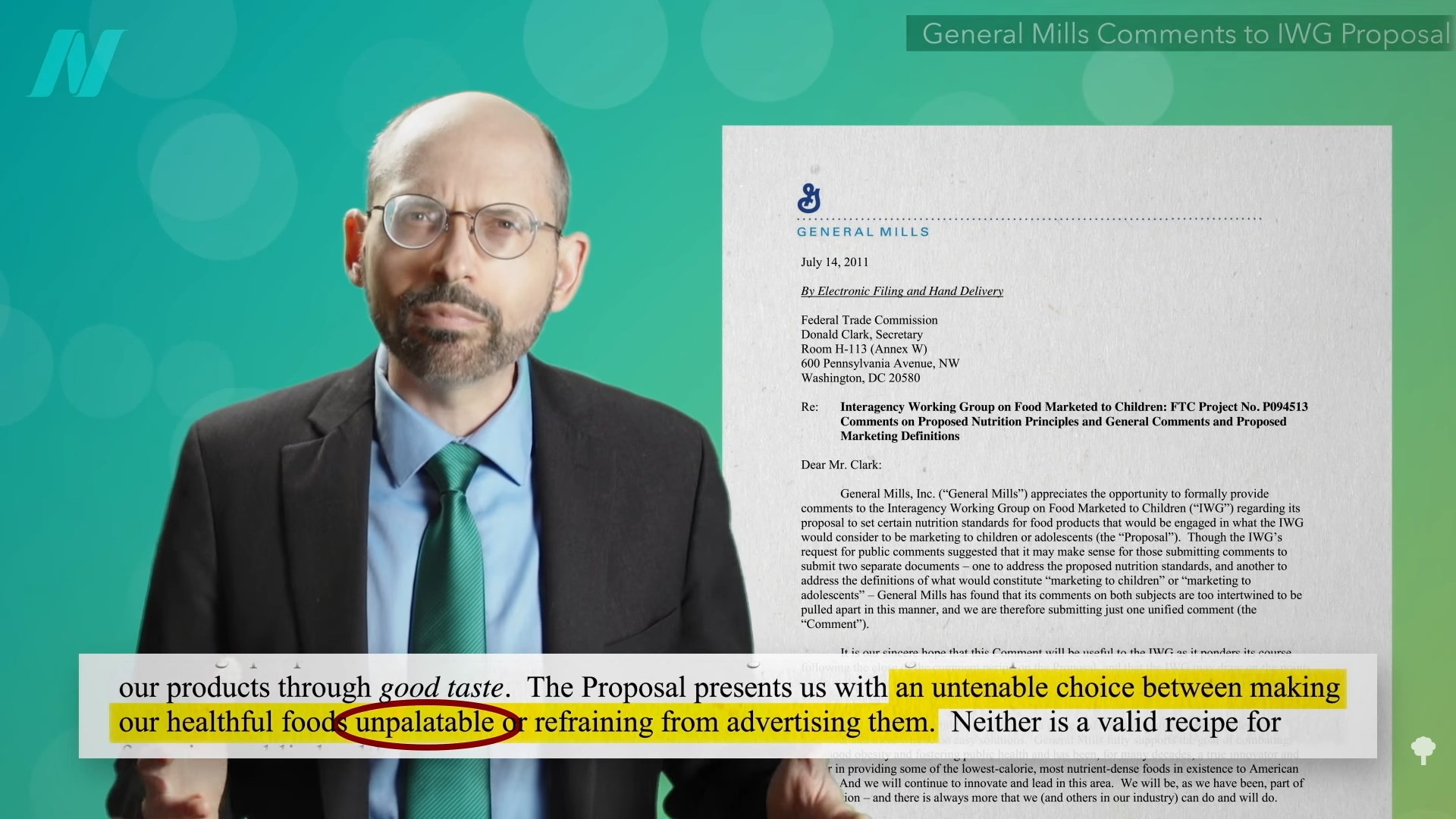
General Mills offers the “Mary Poppins defense,” arguing that those spoonsful of sugar can “help the medicine go down” and explaining that “if sugar is removed from bran cereal, it would have the consistency of sawdust.” As you can see below and at 3:17 in my video, a General Mills representative wrote that the company is presented “with an untenable choice between making our healthful foods unpalatable or refraining from advertising them.” If it can’t add sugar to its cereals, they would be unpalatable? If one has to add sugar to a product to make it edible, that should tell us something. That’s a characteristic of so-called ultra-processed foods, where you have to pack them full of things like sugar, salt, and flavorings “to give flavor to foods that have had their [natural] intrinsic flavors processed out of them and to mask any unpleasant flavors in the final product.”

The president of the Cereal Institute argued that without sugary cereals, kids might not eat breakfast at all. (This is similar to dairy industry arguments that removing chocolate milk from school cafeterias may lead to students “no longer purchasing school lunch.”) He also stressed we must consider the alternatives. As Kellogg’s director of nutrition once put it: “I would suggest that Fruit [sic] Loops as a snack are much better than potato chips or a sweet roll.” You know there’s a problem when the only way to make your product look good is to compare it to Pringles and Cinnabon.

Want a healthier option? Check out my video Which Is a Better Breakfast: Cereal or Oatmeal?.

For more on the effects of sugar on the body and if you like these more politically charged videos see the related posts below.

Finally, for some additional videos on cereal, see Kids’ Breakfast Cereals as Nutritional Façade and Ochratoxin in Breakfast Cereals.

Key Takeaways
  • Vi-Chocolin, a vitamin-fortified chocolate bar, was purportedly offered as a product with high nutritive value but was really just vitaminized candy. The sugary cereal industry follows a similar business model.

  • The sugary cereal industry has been criticized for adding nutrients to cereals “as a marketing gimmick,” creating an illusion of health benefits.

  • Children who consume pre-sweetened breakfast cereals may derive more than 20 percent of their daily calories from added sugar. Breakfast cereals rank as the third-largest food source of added sugars in the diets of kids and adolescents, listed between candy and ice cream. On a per-serving basis, a cereal like Frosted Flakes has more added sugar than a frosted chocolate cake, a brownie, or a frosted donut.

  • Kellogg’s and General Mills’ contention that breakfast cereals contribute only a “relatively small amount” of sugar to children’s diets is likened to the social psychology phenomenon of “diffusion of responsibility.”

  • Consumer Reports’ findings reveal that children often pour themselves 50 percent more cereal than the suggested serving size. A child eating a single daily serving of kids’ cereal with the average amount of sugar would consume almost a thousand teaspoons of sugar in one year.

  • The industry argues it has to add sugar to its cereals to make them palatable, which is a characteristic of ultra-processed foods.  From: https://nutritionfacts.org/blog/are-fortified-childrens-breakfast-cereals-just-candy/?

__________

Sunday, January 21, 2024

Should You Keep Valentine’s Day? 5 Reasons NOT to Celebrate Valentine's Day. How Much Added Sugar Is Too Much?

.

Should You Keep Valentine’s Day?

Should You Keep Valentine’s Day?“On Feb. 14, couples around the world will express their love through Valentine’s Day gifts. But many deeply devoted Christian couples will not. Should you?

I recently returned from a pastoral trip visiting congregations of the Church of God in Ghana. Since I returned to the United States, it seems like every time I turn on a radio (mostly when I’m in the car) or see ads in the newspaper or on TV, I’m encouraged to buy flowers, candy, “unique gifts” or even a brand-new car for “someone special” for Valentine’s Day.

I have not observed Valentine’s Day for over 40 years. Why do my wife and I, as well as thousands of Christians around the world, choose not to observe this seemingly innocent, romantic holiday?

Pagan origins

The details surrounding the origins of Valentine’s Day can be a bit muddy, but without a doubt it originated in pagan festivals focused on fertility rites. Most authoritative historical sources will cite the pagan Roman festival of Lupercalia as the genesis of the modern celebration. That three-day celebration was focused on purification, fertility and “love” (read that as sexual lust) among the young, single Roman population.

Most authoritative historical sources will cite the pagan Roman festival of Lupercalia as the genesis of the modern celebration. After sacrifices had been made (apparently both goats and dogs figured prominently in these sacrifices), bachelors would draw the names of young single women from an urn, and then they would be paired together for a year. In some cases these pairings would result in marriage, but not always. As Clyde Kilough, editor of Discern magazine, states on a Life, Hope & Truth video commentary, “The pagans knew how to mix a lot of illicit sex into their religious celebrations.”

Sometime before A.D. 500, the Catholic Pope Gelasius I “Christianized” the celebration by transforming it from a celebration of pagan fertility into a focus on a “Christian” saint. Valentine was the one chosen to be so honored (apparently, there were multiple Catholic saints with that name).

However, the “Christianized” celebration retained its focus on “love” and sex, including images of Cupid, the Roman god of love. Cupid was originally depicted to have sharpened his arrows of love on a grindstone whetted with the blood of an infant. That repulsive imagery was gradually replaced with a more commercially suitable image of a cute, pudgy baby during the 1800s.

To learn more about the origins of Valentine’s Day, read “Valentine’s Day Is Pagan? So What?

Should Christians keep Valentine’s Day today?

Fast-forward to today. While many people generally understand the pagan origins of this celebration, they really don’t see a problem with keeping it as a day to send romantic gifts to their significant other. After all, it is a “harmless” holiday all about love, romance and sweetness toward that someone special in your life; how could that possibly be wrong?

The answer comes from some rather straightforward warnings in the Scriptures:

“Then it shall be, if you by any means forget the LORD your God, and follow other gods, and serve them and worship them, I testify against you this day that you shall surely perish” (Deuteronomy 8:19). To be clear, participating in Valentine’s Day is involving ourselves in the ancient worship practices of “other gods”—not the true God.

God doesn’t want His people adding pagan practices from other religions:

“Take heed to yourself that you are not ensnared to follow them, after they are destroyed from before you, and that you do not inquire after their gods, saying, ‘How did these nations serve their gods? I also will do likewise.’ You shall not worship the LORD your God in that way. … Whatever I command you, be careful to observe it; you shall not add to it nor take away from it” (Deuteronomy 12:30-32).

Some may want to argue that Valentine’s Day isn’t really that religious anymore, so these scriptures don’t apply. But that argument ignores the clear origins and the ancient focus on illicit sexual activity that was part of this practice. The fact that some may not consider it to be the same today does not remove the pagan origins that bring the practice down to us today. Nor does it change how the true God views these things.

Happy couples do not need to give gifts on Valentine’s Day to show their love for each other. Read our blog “3 Romantic Alternatives to Valentine’s Day” to learn more.”  From: https://lifehopeandtruth.com/life/blog/should-you-keep-valentines-day/

_________

5 Reasons NOT to Celebrate Valentine's Day

Transcript of video at: https://www.ucg.org/beyond-today/beyond-today-daily/5-reasons-not-to-celebrate-valentines-day

“Here's five tongue-in-cheek reasons not to celebrate Valentine's Day. But can you find another?

[Steve Myers] “Here's a little tongue-in-cheek discussion on 5 reasons not to celebrate Valentine's Day.

Number one: Flowers make you sneeze and they don't last very long.

Number two: Pink does not make you look thinner.

In fact, number three: Pink's a girly color that makes men feel wimpy.

Number four: Chocolate makes you fat.

Number five: Valentine's Day is just commercialism by the greeting card companies to make millions of dollars.

Are those any reasons that you shouldn't celebrate Valentine's Day? There is a more important reason, but it comes back to realizing what is life all about. What is romance after all because Valentine's Day is supposed to focus on romance? And we often think of the flowers and the candy and the meals out and all those kinds of things.

But you know what? Romance is sometimes vacuuming the house.  Romance is sometimes, yeah, cleaning the toilet or maybe changing a diaper or two or maybe making his favorite dessert. That's what real romance comes down to so much of the time, real life. And sometimes we get fooled by taking one day and trying to make something huge out of it when in reality love is a daily thing. It's something that we show every single day of our life.

Christ Himself said that whatever we want men to do to us, we should do to them. And it should be something that's on going, not just a onetime thing.

It reminded me of a passage that's over in Ecclesiastes in Ecclesiastes 9:9. Ecclesiastes 9:9 says, "Live joyfully with the wife whom you love all the days of your vain life, which He's given you under the sun." So it's all our days not just one day.

And so you could probably come up with a longer list of reasons not to celebrate Valentine's Day, but you know they're not all humorous. There is another reason.

You know that many of the world's holidays are focused and come from roots of paganism. That's where they're rooted. Valentine's Day is no different, named after a Catholic saint. It's rooted in paganism. Maybe that's a question you could ask yourself. What does God think about Valentine's Day?

Check it out a little bit. Look at what Deuteronomy 12 has to say about it. Check it out. Do a little bit of research. You may be very surprised what you find. In fact, you'll probably add one more big reason not to celebrate Valentine's Day.”  From: https://www.ucg.org/beyond-today/beyond-today-daily/5-reasons-not-to-celebrate-valentines-day

_______

How Much Added Sugar Is Too Much?

Transcript of video at: https://nutritionfacts.org/video/how-much-added-sugar-is-too-much/

To see any graphs, charts, graphics, images, and quotes to which Dr. Greger may be referring, watch the above video. This is just an approximation of the audio contributed by Katie Schloer.

“Are table sugar and high fructose corn syrup just empty calories or can they be actively harmful?

In 1776—at the time of the American Revolution—Americans consumed about 4 lbs of sugar per person each year. By 1850, this had risen to 20 lbs, and by 1994, to 120 lbs, and now we’re closer to 160. Half of that is fructose, taking up about 10% of our diet. This is not from eating apples, but rather the fact that we’re each guzzling the equivalent of 16-oz soft drink every day; that’s about 50 gallons a year.

Even researchers paid by the likes of the Dr. Pepper Snapple Group and The Coca- Cola Company, acknowledge that sugar is empty calories, containing no essential micronutrients, and therefore if we’re trying to reduce calorie intake, reducing sugar consumption is obviously the place to start.

Concern has been raised, though, that sugar calories may be worst than just empty. A growing body of scientific evidence suggests that the fructose added to foods and beverages in the form of table sugar and high fructose corn syrup in large enough amounts can trigger processes that lead to liver toxicity and other chronic diseases.

Fructose hones in like a laser beam on the liver, and like alcohol, fructose can increase the fat in the liver, increasing the risk for nonalcoholic fatty liver disease, which is one of the most remarkable medical developments over the past 3 decades—the emergence of fatty liver inflammation as a public health problem here and around the globe.

These may not be messages that the sugar industry or beverage makers want to hear. In response, the director-general of the industry front group World Sugar Research Organization, replied “Overconsumption of anything is harmful, including of water and air.” Yes, the overconsumption of sugar compared to breathing too much.

As one author expressed, I suppose it is natural for the vast and powerful sugar interests to seek to protect themselves, since sugar takes up the single greater percentage of our daily caloric intake.

The American Heart Association is trying to change that. Under their new sugar guidelines, most American women should consume no more than 100 calories per day from added sugars, and most American men should eat or drink no more than 150. That means one can of soda could take us over the top for the day. The new draft guidelines from the World Health Organization suggests we could benefit from restricting added sugars to under 5% of calories. That’s about 6 spoonfuls of added sugar. I don’t know why they don’t just recommend zero as optimal, but you can get a sense of how radical their proposal is given that this is how many we consume right now.”  From: https://nutritionfacts.org/video/how-much-added-sugar-is-too-much/

_________

Sunday, October 29, 2023

Should Christians Celebrate Halloween? Is That True? Not A Palestinian State. Hospitals Profit on Junk Food.

.

Should Christians Celebrate Halloween?

Halloween is a major holiday in the Western world for people of various backgrounds. Can Halloween celebrations be reconciled with a Christian worldview and lifestyle? The Bible holds the answer.

A little boy trick or treating with his mother.

Photos.com

Does Halloween serves a positive Christian purpose?

Tuesday night millions of children around the nation will be donning costumes, ringing doorbells and uttering the traditional "trick or treat" Halloween greeting. Most people consider this a harmless, fun activity for children. Others condemn the entire occasion because of the pagan origin of the day and connect it with demonism and the occult.

An article from a prominent Christian magazine suggested that "Christians should embrace the 'devilish' holiday with gusto—and laughter." The author suggests that Halloween presents us with an opportunity to "mock" and "laugh at" Satan and "the forces of evil."

A local pastor, writing wistfully of his past childhood Halloween celebration, said, "I enjoyed being a devil." He asserted that "a child doesn’t think of a red devil as an enemy of God or the apostle of hate and destruction." He went on to defend wearing costumes as merely superficial, and suggested that opposition to celebrating Halloween stems from lack of confidence in Christian beliefs.

Really only harmless fun?

Wait a minute! Is it unchristian for parents not to want their children to dress up as the Devil? Or does Satan the Devil even exist? According to a recent Barna survey, nearly 50 percent of professing Christians do not believe that Satan is a living being. For these folks, the whole question must be a moot point. But perhaps the rest of us ought to reconsider our perspective regarding Halloween.

Would anyone dare to suggest applying this reasoning to Hitler? Would wearing Hitler masks and swastikas and dressing like the skeletal remains of his victims be an appropriate way to "laugh at" Hitler and "mock" the diabolical evils of Nazism?

Is Satan a laughing matter? Does God want our children to associate fun and treats with the forces of evil?

I am not implying that a child who puts on a Halloween mask is dabbling in the occult or is in danger of demon possession. I am simply questioning the suggestion that Halloween serves a positive Christian purpose.

According to Deuteronomy 12:31-32 God does not approve of recycling, reconstituting and relabeling pagan customs to celebrate Christian events.

Carnal holidays trumped by God's Holy Days

My wife and I just finished celebrating eight fun-filled days of the Feast of Tabernacles with more than 700 men, women and children here in Central Oregon. I so much wish all of Christianity could share the joy of this meaningful occasion. Here is a God-ordained festival that was observed by Jesus, Paul and the apostolic Church and is still celebrated today by many Christians. It is one of seven annual Holy Days that foreshadow future events in God's plan (Colossians 2:16-17) rather than focusing on the powers of darkness that form the legacy of Halloween.

Anyone who dares express objections to Halloween has two strikes against him: 1. It is fun for the kids, and 2. It is a long-standing, firmly entrenched custom in our culture.

But the Feast of Tabernacles has Halloween beat in both categories: 1. It is fun for kids and the whole family and is eight days long, and 2. It was established thousands of years ago by God Himself. And most importantly, it and all of Holy Days of the Bible teach valuable lessons about the plan of God.”  From: https://www.ucg.org/beyond-today/blogs/should-christians-celebrate-halloween

_________

Is That True?

“Occasionally in life you come across something that goes so contrary to your beliefs that you exclaim, “Is that true?!”

Growing up, I became familiar with the concept of “pagan” or “paganism.” These were pejorative terms that were used to describe practices which were steeped in the worship of a different god and in opposition to Christianity.

Even as a child, when I first learned that Easter and Christmas had their origins in pagan customs, I avoided celebrating these days. Anything “pagan” was clearly something to be avoided; but as I quickly learned, not everyone agreed with that idea.

Over the years, the term “pagan” has increasingly taken on a more benign meaning. Take, for example, Halloween, which comes up in a couple of days. If you do even a cursory search on the Internet, you will find that Halloween is a celebration praised by those who profess witchcraft as their religious preference.

There is actually a church for witches that provides a list of ways to celebrate Easter, Halloween and Christmas as primary days of worship for pagans. They refer to them as Ostara, goddess of the spring and the beginning of life; the Festival of the Dead, which we call Halloween; and the Yule festival, which we call Christmas. These three festivals have “pagan” stamped all over them, so how is it that more than a billion people professing Christianity also celebrate them each year?

According to its pagan origins, the evening of Oct. 31 is when the veil between the world of the living and the world of the dead is at its thinnest level. Nov. 1 is the first day of the Celtic new year and the day set aside for all saints in the Catholic religion.

Oct. 31, Halloween, is a celebration of this crossover between the world of the dead and the world of the living. It is celebrated by people dressing up in costume to commemorate those who are called the living dead—goblins, ghosts and ghouls. Some try to Christianize the celebration by using the term “hallowed” or holy evening. But it is a vain attempt to add Christianity to something that is clearly pagan.

Isn’t it time we looked at our lives and asked some basic questions about what we are doing? Whenever you see a celebration that isn’t found in the Bible, yet is proclaimed to be Christian, shouldn’t you ask, “Is that true?” After all, isn’t Christianity supposed to be based on truth?

The truth of the matter is that Easter, Christmas and Halloween are not found in the Bible. They originate in pagan celebrations. They were adopted and integrated into mainstream Christianity centuries ago.  

Can you really be a Christian and embrace pagan rituals? Isn’t this in conflict with the first two of the 10 Commandments, which are against worshipping other gods—the goddess of spring, the sun god and, oh yes, let’s not forget the god of the underworld, who is being honored this week on Halloween?

We live in a world of lies and distortions of fact. Don’t just follow customs that are attractive! Ask questions; and whenever you’re presented with a celebration that is called Christian, never forget to ask, “Is that true?”  From: https://lifehopeandtruth.com/speaking-of/is-that-true/

_________

I'm sure you all have friends who are asking questions, you can send them this :

1)Before the modern state of Israel there was the British mandate, Not a Palestinian state .

2) Before the British mandate there was the ottoman empire, Not a Palestinian state .

3) Before the ottoman empire there was the Islamic mamluk sultanate of Egypt, Not a Palestinian state .

4) Before the Islamic mamluk sultanate of Egypt there was the ayyubid dynasty, Not a Palestinian state . Godfrey of bouillon conquered it in 1099.

5) Before the ayyubid dynasty there was the Christian kingdom of Jerusalem, Not a Palestinian state .

6) Before the Christian kingdom of Jerusalem there was the Fatimid caliphate, Not a Palestinian state .

7) Before the Fatimid caliphate there was the byzantine empire, Not a Palestinian state .

8) Before the byzantine empire there was the Roman empire, Not a Palestinian state .

9) Before the Roman empire there was the hasmonean dynasty, Not a Palestinian state .

10)Before the hasmonean dynasty there was the Seleucid empire,Not a Palestinian state .

11) Before the Seleucid empire there was the empire of Alexander the 3rd of Macedon, Not a Palestinian state .

12) Before the empire of Alexander the 3rd of Macedon there was the Persian empire, Not a Palestinian state .

13) Before the Persian empire there was the Babylonian empire, Not a Palestinian state .

14) Before the Babylonian empire there was the kingdoms of Israel and Judea, Not a Palestinian state .

15) Before the kingdoms of Israel and Judea there was the kingdom of Israel, Not a Palestinian state .

16) Before the kingdom of Israel there was the theocracy of the 12 tribes of Israel, Not a Palestinian state .

17) Before the theocracy of the 12 tribes of Israel there was the individual state of Canaan, Not a Palestinian state .

In fact in this corner of the earth there was everything but a Palestinian state!

Origins @voiceofisrael

_________

Hospitals Profit on Junk Food

Transcript of video at: https://nutritionfacts.org/video/hospitals-profit-on-junk-food/

Below is an approximation of this video’s audio content. To see any graphs, charts, graphics, images, and quotes to which Dr. Greger may be referring, watch the above video.

“Why is hospital food so unhealthy?

Put in stark terms, cardiovascular disease claims one American life every 39 seconds”; and for most heart attack deaths, you just keel over. “Sudden cardiac death is the first manifestation of coronary heart disease for the majority of individuals, particularly among women.”  So, for many of these sudden death victims, their first indication of the presence of heart disease was their demise. They didn’t even know they had heart disease! That’s why an ounce of prevention is worth way more than a pound of cure, because there is no cure for dead.

But that’s why the prevention of sudden cardiac death remains such a major public health challenge, because most people don’t even know they’re at risk. But we’ve known for over a half century, when we first started autopsying young servicemen who died in the Korean war, that coronary artery disease begins in our youth even among young children. So, business as usual is simply “not going to yield the improvements necessary to radically improve the cardiovascular health of the United States.”

But the good news is “a low-risk lifestyle (not smoking, exercising regularly, having a prudent diet, and maintaining a healthy weight)” may be able to wipe out the vast majority of risk for sudden cardiac death. So, “the time is now long overdue to start aggressive preventive cardiovascular disease programs in our schools, our homes, and our worksites.” How about starting in our hospitals?

A significant percentage of hospitals surveyed had fast food restaurants inside them, with Krispy Kreme topping the list. Brilliant marketing, given that families surveyed in hospitals with McDonald’s were twice as likely to think McDonald’s was healthy—after all, they let it in a hospital. But what about food served in hospital cafeterias themselves? Are they much better? 384 entrees were analyzed at 14 children’s hospitals in California, and only 7 percent could be classified as healthy. And just in case someone accidentally picked the rare healthy option, 81 percent of eating venues in children’s hospitals made sure to have junky impulse buys like ice cream, cookies, and candy near the checkout register. And 38 percent had signs that explicitly encouraged unhealthy eating. Why would they do that?

If you ask hospital cafeteria managers that exact question: “Why they don’t tend to follow nutrition standards?” “Why nutrition is not a top priority?”  It’s the same answer why unhealthy food is sold anywhere else—the pressure to generate profit. “Increased emphasis [is being] placed on running a hospital foodservice department as a profit center,” a bigger and bigger profit center. It’s such a metaphor for our sickness-care system in general, where healthy treat-the-cause approaches are eclipsed by the pills and procedures that bring in the most money.

Well, what do you expect from the private sector? But public hospitals don’t seem much better. A 2019 analysis of veterans’ hospitals found that “all VA hospitals contain vending machines providing a majority of soda, candy, and junk foods that directly conflict with” our government’s own healthy food choice recommendations such that, ironically, “hospital visits could theoretically promote worse health.” This raises the question why any soda or candy machines are available at our VA hospitals? “Are we trading the health of our veterans for profits?”

Maybe it’s time to ban junk food on hospital premises. “On daily rounds it is appalling to see patients…gorging on [potato chips, candy, and soda]—the very food[s] that may have contributed to their admission in the first place”—obscene to see fast food franchises on site, legitimizing “the acceptability and consumption of such foods in the daily diet.” “The obesity epidemic represents a public health crisis, but it is a public health scandal that by legitimizing junk food, hospitals have themselves become a risk factor for diet-related disease.” Maybe “it’s time to stop selling sickness in the hospital….” What message do residents receive when they are fed pizza and soda pop at grand rounds on obesity? We need a healthcare system with “more Hippocrates and less hypocrisy.”  From: https://nutritionfacts.org/video/hospitals-profit-on-junk-food/

_________

Monday, July 3, 2023

Prove Evolution Is False Without The Bible. Living lessons from the Dead Sea. Kids’ Breakfast Cereals as Nutritional Façade.

.

Prove evolution is false without the Bible

Prove evolution is false without the Bible“Charles Darwin's theory of evolution is a biological explanation of how creatures have supposedly "evolved" through natural selection and variation (now known as mutation) over eons of time from the tiny cell to the largest creatures on earth today.

What is taught in classrooms is not mere microevolution—small changes within a species—but macroevolution, the change from one type of creature to another quite distinct life form.

Many who support the theory of evolution therefore believe there is no need for a Creator, since evolution is the mechanism for creating and transforming life. They believe life arose from non-life and evolved from simpler creatures to more complex life forms. The tiny cell eventually became an amoeba, then a lizard, then a monkey, and finally—you!

In this article, in order to remember key points disproving Darwinian evolution the acronym FALSE is used. Some of these points will also disprove the compromise of theistic evolution—the notion God employed macroevolution over eons in forming the creatures we see on earth today.

F for Fossils

A fossil is the preserved remains of a living thing. The fossil record around the earth extends to an average of one mile deep. Below this level there is no evidence of any living creatures. The fossils of the earliest type of complex creatures with hard bodies are called trilobites. No previous ancestors of these arthropods have been found.

Trilobites were similar to some marine "bugs" we see today on the seashore that disappear into the sand when the waves retreat. They had hard shells, all the basic organs, and complex eyes like those of flies, with hundreds of sophisticated lenses connected to the optic nerve. Trilobite fossils are found around the earth, and in all cases the level of rock beneath them does not reveal other creatures with similar features.

As one source states: "The dominant life form was the now-extinct sea creature known as a trilobite, up to a foot long, with a distinctive head and tail, a body made up of several parts, and a complex respiratory system. But although there are many places on earth where 5,000 feet of sedimentary rock stretch unbroken and uniformly beneath the Cambrian [layer], not a single indisputable multi-celled fossil has been found there…Darwin himself said he could give 'no satisfactory answer' to why no fossils had been discovered. Today's scientists are none the wiser" (Francis Hitching, The Neck of the Giraffe, 1982, pp. 26-27).

"If throughout past ages life was actually drifting over in one continual stream from one form to another, it is to be expected that as many samples of the intermediate stages between species should be discovered in fossil condition as of the species themselves…But these missing links are wanting. There are no fossils of creatures whose scales were changing into feathers or whose feet were changing into wings, no fossils of fish getting legs or of reptiles getting hair. The real task of the geological evolutionist…is to find those thousands upon thousands of missing links that connect the many fossil species with one another" (Byron Nelson, After Its Kind, 1970, pp. 60-62).

A for Assumption

When there is no real evidence, assumptions are made. We do see limited changes within species, but we do not see any changes into other species. There is also no evidence of gradual change in the fossil record. Yet evolutionists continue to assume that transitional forms must have existed.

In Darwin's book On the Origin of Species there are some 800 subjective clauses, with uncertainty repeatedly admitted instead of proof. Words such as "could," "perhaps" and "possibly" plague the entire book. Evolution is still called a theory—a possible explanation or assumption—because it is not testable according to the scientific method, as this would require thousands or millions of years.

L for Life

The law of biogenesis as taught in biology class states that only life can produce life. You've probably heard the famous question: Which came first, the chicken or the egg? It's a real dilemma for an evolutionist to answer. An egg comes from a chicken, yet the chicken comes from an egg. How can there be one without the other?

To complicate matters even more, the chicken has to come from a fertilized egg that has the mixture of two different genetic strains from both its parents. So the problem of the origin of life and initial reproduction is still a mystery evolutionary science cannot adequately answer. Yet for someone who believes in special creation by a Creator, there is no dilemma. First God made the male and female chickens, which produced the first fertilized egg.

S for Symbiosis

When one living thing needs another different living thing to survive, it's called a symbiotic relationship. An example of this is the relationship between bees and flowers. The bees need the nectar from some types of flowers, while these flowers need bees to pollinate them. Both depend on the other to survive.

The question for evolutionists is: How did these plants exist without the bees, and how did the bees exist without these plants? Yet if you believe in a Creator who specially created the various forms of life on earth, the answer is simple—both were created at about the same time.

E for Engineering

All living things are exquisitely engineered or designed. A bacterium is as majestically built for its purpose as a human body is for its function. Yet evolution says it's only an illusion of design—that there is no real designer behind it. Living things are multi-functional. They do many complex things at the same time, something evolution with its step-by-step process has never been able to demonstrate.

One example of a living thing with exquisite engineering is the tree. It provides breathable oxygen for us while processing carbon dioxide, which in high amounts in the air would be toxic to us. It supplies wood, housing for birds, roots to limit erosion, fruit and seeds to eat, is biodegradable and gives shade. According to the U.S. Department of Agriculture, "A healthy tree provides a cooling effect equivalent to 10 room-size air conditioners operating 20 hours a day."

How could something so complex arise from a random, undirected evolutionary process? We need more "faith" to believe in blind evolution than in an all-knowing Creator who designed the marvelous tree in the first place! Evolution is F-A-L-S-E and the story of creation in the Bible, our Creator's great book of truth, tells us what really took place.

Source:  The Good News Magazine (Mar-Apr 2012) From: https://www.ucg.org/the-good-news/prove-evolution-is-false-even-without-the-bible

_________

Living lessons from the Dead Sea

“The Dead Sea between Israel and Jordan is aptly named—because it is dead in nearly every sense.  It is a dead end. Several rivers flow into it, but none exit.  Because of the blistering desert sun, water evaporates, leaving minerals behind. The brine that is left is choked with salt, bromide, magnesium chloride, potassium chloride and sulfur.  The salt and mineral content is between 25 and 30 percent—where the average salt level in the oceans is less than 5 percent. No marine life can live in the Dead Sea.  Swimmers regularly enter the sea, and some claim its high mineral content will help cure a variety of skin disorders. But you have to be careful not to splash the water on your face or in your eyes! 

The Dead Sea is the lowest body of water on earth. 

The surface of the Dead Sea is an incredible 1,400 feet below sea level, and it is estimated that in places the bottom extends an additional 1,300 feet down. Standing on its shores, one has a sense of being at the bottom of the earth!  To add to the meaning of its name, some scholars believe the destroyed remains of the cities of Sodom and Gomorrah may lie beneath the Dead Sea.  Those oily, briny waters may therefore cover the graves of thousands, or tens of thousands, of people who provoked the God of creation to take their lives in an onslaught of what the Bible calls fire and brimstone (Genesis 19:24). 

When I stop to evaluate my own spiritual condition, I think back to the time I was baptized. I had come to see that I was nothing, had nothing, and was as spiritually dead and valueless as the waters of the Dead Sea. Apart from God’s grace, and a powerful miracle, I had no hope.  Ezekiel 47:8-10 prophesies of a time when a river will flow from Jerusalem down to the Dead Sea, and its waters will be healed—something unthinkable now. Any fisherman who would launch his boat to fish the Dead Sea today would probably be the subject of scorn. 

But we are told in the future God is going to purify those waters so that fishermen will throw their nets into waters that are teeming with fish!  That’s how you and I become after conversion. God’s Spirit begins to flow into and through our minds, and we are purified and healed.  We become converted and change from people with little or no spiritual value into the children of God, offered eternal life in the Kingdom of God if we will remain faithful to our calling. 

I was able to visit the Dead Sea in 1984, and the memories are still clear. There were salt and mineral formations all around the shores, various shades of yellows and whites, but no life. I remember coming back out of the water with the feeling that I’d been swimming in cooking oil, and needing to shower off before getting back into regular clothes. 

The picture Ezekiel paints of those waters being healed and vibrantly healthy is amazing! Even more amazing is that God intends to restore even the lives of those who died in Sodom and Gomorrah—the ancient towns whose ruins may lay deep beneath the Dead Sea.  Ezekiel 37 talks about a time when those who have died will live again and be offered God’s Holy Spirit (verse 14). Revelation 20:11-12 also talks about this time of judgment. And Jesus talked about Sodom and Gomorrah being in the judgment. They are awaiting this second resurrection, when God will teach them the way to live in peace and happiness.

That healing and restoration is happening now in the minds of those He has called. Looking back to my baptism reminds me where I’ve come from, and the wonderful future God has laid out before me!

I’ve often wondered where I’d be today without God’s calling

Whatever it might have been, my life would be very different from what I have today. I’d never have met my wife, nor most of the people I know today.  Whether I’d be well off or very poor, I don’t know. But I do know that spiritually I’d be of about as much value as the Dead Sea is today.  We are all in the same position, and we should draw great encouragement from this as we press on to lay hold of what Christ Jesus has for us (Philippians 3:12).”

Kind regards, and have a great rest of your week, Tom Clark, for Life, Hope and Truth.

__________

Kids’ Breakfast Cereals as Nutritional Façade

“Plastering front-of-package nutrient claims on cereal boxes is an attempt to distract from the incongruity of feeding our children multicolored marshmallows for breakfast.

Transcript of video at: https://nutritionfacts.org/video/kids-breakfast-cereals-as-nutritional-facade/

Below is an approximation of this video’s audio content. To see any graphs, charts, graphics, images, and quotes to which Dr. Greger may be referring, watch the above video.

“The American Medical Association started warning people about excess sugar consumption over 75 years ago, based in part on our understanding that “sugar supplies nothing in nutrition but calories, and the vitamins provided by other foods are sapped by sugar to liberate these calories.” Hence, added sugars aren’t just empty calories, but like negative nutrition—the more added sugars one consumes, the more nutritionally depleted one may become.

Given the totality of scientific evidence, the FDA decided to make processed food manufacturers declare “added sugars” on the nutrition facts label. The National Yogurt Association was livid, opposing the added sugars declaration, since they needed “added sugars” to increase their products’ palatability. The junk food association questioned the science…whereas the ice cream folks seemed to imply consumers would be too stupid to use it, so, better leave it off. The world’s biggest cereal company, Kellogg’s, took a similar tact, opposing it so as not to confuse the consumer, and should the FDA proceed with such labeling against their objections, added sugars should at most be “communicated in a footnote.” See, their goal is to provide consumers with “useful information so they can make informed choices.” This from a company that describes their Froot Loops as “packed with delicious fruity taste, fruity aroma, and bright colors. Made with whole grains and ‘lightly sweetened,’ a good source of fiber.”

Lightly sweetened? Froot Loops has more sugar than a Krispy Kreme doughnut…. Froot Loops is more than 40% sugar by weight.

The tobacco industry used similar terms, such as “light,” “low,” and “mild” to make their products appear healthier before they were recently barred from doing so. Now, sugar interests are fighting similar battles over whether their “healthy,” “natural,” and “lightly sweetened” terminology is similarly deceptive.

But just look at all those vitamins and minerals they added. That was one of the ways the cereal companies responded to calls for banning sugary cereals. General Mills defended the likes of Franken Berry, Trix, and Lucky Charms for being fortified with essential vitamins. Sir Grapefellow, I learned, was a grape-flavored cereal complete with sweet grape starbit marshmallows––but don’t worry, it was “vitamin charged.”

Sugary breakfast cereals, said Dr. Jean Mayer from Harvard, are not a complete food even if fortified with eight or 10 vitamins. “I think your point is well taken,” replied Senator McGovern, “that these products may be mislabeled, perhaps more correctly called candy vitamins than cereals.”

Plastering nutrient claims on the box can create a “nutritional facade,” acting to distract attention away from unsavory qualities, such as excess sugar content. The majority of parents have been found to misinterpret the meaning of claims commonly used on children’s cereals, raising significant public health concerns…. Ironically, cereal boxes bearing low-calorie claims were found to have more calories on average than those without such a claim; so, it’s like the cereal doth protest too much.

Even candy bar companies are getting in on the action, bragging about their protein content because it has some peanuts, but it’s also a candy bar, with 50 grams of sugar, just like Froot Loops could be considered breakfast candy, as the same serving would have 40….

Given research suggesting “consumers believe front-of-package claims, perceive them to be government-endorsed, and use them to ignore the Nutrition Facts Panel” on the back, there’s been a call from nutrition professionals to consider “an outright ban on all front-of-package claims.” The industry’s short-lived Smart Choices label was met with disbelief when it was found adorning qualifying cereals like Froot Loops and Cookie Crisp. The processed food industry spent more than a billion dollars lobbying against the adoption of more informative labeling, a traffic-light approach, railing against the suggestion that “any food [might be] too high in anything.”  From: https://nutritionfacts.org/video/kids-breakfast-cereals-as-nutritional-facade/

________

Monday, May 8, 2023

Biblical Conflict Resolution. What Is God’s Dietary Plan? Hospitals Selling Sickness.


Biblical Conflict Resolution

“As interpersonal conflicts increase, how should we best deal with them? What are some of the strategies of biblical conflict resolution?

Biblical Conflict ResolutionFrom the time of Cain and Abel, offenses and conflicts have been incessant human problems. And the Bible warns that in the end time, many will be offended (Matthew 24:10).

Have you ever witnessed someone being offended? Have you ever been offended? Have you ever offended someone else? It is very likely that you have.

Offenses generally produce conflict. The Cambridge Dictionary defines conflict as “an active disagreement between people with opposing opinions or principles.”

And resolving conflict is no easy task! It can be uncomfortable and difficult because of the hard feelings and strong emotions that are involved.

Small offenses may require little more than extending forgiveness to the person who’s committed the offense. Our blog post “Conflict Resolution: Should I Say Something?” explains, “With the majority of small offenses, the best response is usually simply to forgive the offense, recognize we have similarly offended others and bear with the other person in love (Ephesians 4:2).”

The purpose of this article is to explore the situations when a more involved response is needed.

No doubt, you will face conflict at some point in your life. Countless books have been written on this subject, some of which have proven to be very helpful. But, more important, God Himself provides us with some conflict resolution strategies within the Bible, His inspired Word.

What is the lesson of Abigail in the Bible?

The courageous example of Abigail provides a good illustration of an individual with exceptional conflict resolution skills. Her reaction to a very difficult situation—the strategies that she used to address conflict—can help us be prepared to resolve potential conflicts in our own lives.

We find the story in 1 Samuel 2      We will continue to see increased numbers of offenses and conflicts in the world around us, and you will most likely face difficult conflicts in your own personal life. But the Bible provides a way for us to deal with them:  “Now there was a man in Maon whose business was in Carmel, and the man was very rich. He had three thousand sheep and a thousand goats. And he was shearing his sheep in Carmel. The name of the man was Nabal, and the name of his wife Abigail. And she was a woman of good understanding and beautiful appearance; but the man was harsh and evil in his doings” (verses 2-3).

It is here that we’re first introduced to Abigail, along with her husband, Nabal. Verse 3 provides us with a key description of Abigail: She was a woman of “good understanding.” This good understanding was beneficial throughout Abigail’s life, both to her and to those around her.

It is not unreasonable to conclude that being married to a harsh man whose name literally meant “fool” left her vulnerable to moments of conflict.

We have no way of knowing every conflict that Abigail faced, but we are made aware of one significant situation that she faced. This tense situation involved her husband and another man who became extremely angry. Strong emotions and hard feelings often accompany moments of conflict.

David and Nabal

Nabal was a successful businessman; he possessed thousands of animals and was very rich. And while he was shearing his sheep in Carmel, along came David with a band of his men.

As background, it’s important to understand that when Nabal’s shepherds had been working in the fields, David’s men had provided security and protection for Nabal’s men and animals.

So David sent some of his men to remind Nabal of this. They were sent to entreat Nabal to share some supplies with them.

David’s message was, “Therefore let my young men find favor in your eyes, for we come on a feast day. Please give whatever comes to your hand to your servants and to your son David” (verse 8).

They were simply asking this wealthy man to be hospitable, which was the custom at the time. It was not an unreasonable request from David. They were not forcing Nabal’s hand; they were simply asking him to share whatever he was willing to give at this festive time. After all, they had provided some protection for his men and animals.

True to his name, Nabal’s reaction was churlish. He rudely responded with an insult in verses 10-11:

“Who is David, and who is the son of Jesse? There are many servants nowadays who break away each one from his master. Shall I then take my bread and my water and my meat [notice his emphasis on my throughout] that I have killed for my shearers, and give it to men when I do not know where they are from?”

Nabal made it quite clear that he had no intention of sharing anything with David. Not only was he unwilling to share, but he verbally insulted David as well.

Enter conflict. Nabal’s unkind reply greatly offended David and made him angry. He gathered up his men, told them to get their swords, and vowed to kill every male within Nabal’s camp.

Nabal was upset with David for asking him to share, and David was upset with Nabal for being unwilling to share. Nabal incited David by hurling insults, and David threatened to kill all of Nabal’s men.

Abigail and David

Standing in the midst of this very tense conflict was Abigail.

In verses 14-16, Abigail received a quick briefing on what was going on. She was informed of what her husband had done, as well as how David had reacted to Nabal’s conduct. The servants affirmed that David’s men did exactly as they said they had done, describing the men as a “wall [of protection] to us both by night and day.”

“Now therefore, know and consider what you will do” (verse 17).

Abigail was faced with this difficult question. As she faced the possibility of an attack by David, what would she do?

There is certainly no one-size-fits-all solution, but Abigail’s response does provide a few important lessons about biblical conflict resolution.

1. Face the problem—don’t hide from it.

Abigail discerned the situation and acted quickly to address the problem. She didn’t ignore it, hoping that it would go away. She didn’t try to hide from the problem. Abigail faced the matter head-on.

Notice the first four words in verse 18: “Then Abigail made haste.” She quickly gathered a collection of gifts for David and rode out on a donkey to meet him.

“Now when Abigail saw David, she dismounted quickly from the donkey, fell on her face before David, and bowed down to the ground” (verse 23).

Takeaway: When we’re faced with a conflict, we must be willing to address the situation. Avoiding the issue does not help resolve it.

2. Base your response on Scripture.

Abigail did not address the situation by angrily accosting David, but expressed genuine humility instead. When it comes to conflict resolution, there is quite possibly no passage more significant than Proverbs 15:1: “A soft answer turns away wrath, but a harsh word stirs up anger.” (See “Dealing With Difficult People” and “5 Tips for Dealing With Difficult People” for further reading on this topic.)

Through an attitude of humility and incorporating the biblical principle of a soft answer, Abigail’s approach helped defuse David’s anger.

“So she fell at his feet and said: ‘On me, my lord, on me let this iniquity be! And please let your maidservant speak in your ears, and hear the words of your maidservant. Please, let not my lord regard this scoundrel Nabal. For as his name is, so is he: Nabal is his name, and folly is with him! But I, your maidservant, did not see the young men of my lord whom you sent’” (1 Samuel 25:24-25).

She essentially told David, “I didn’t know that any of this had happened. Please forgive us for offending you.” She presented her gift of food, fulfilling what David had wanted in the first place. And she let David know that she knew he was fighting God’s battles (verse 28).

Once she’d softened him up, Abigail provided David with some encouragement to change his mind.

To paraphrase her reply, Abigail said, “Please forgive me. God will reward you and defeat all your enemies. I believe He has restrained you from taking revenge so you won’t have any regrets in the future.”

As you break down Abigail’s response to David, you can clearly see the resulting fruit of a soft answer turning away wrath.

Takeaway: Each situation is unique and may require a modified approach, but our response should always be based upon biblical principles.

3. Seek God’s help and know He is with you.

If we seek God’s help and strive to act as He tells us, we can know that He will be with us (Hebrews 13:5-6).

“Then David said to Abigail: ‘Blessed is the LORD God of Israel, who sent you this day to meet me!’” (1 Samuel 25:32).

That’s an important statement that should not be overlooked. The Lord God of Israel sent Abigail to meet with David. God was with her. She had to do her part as well (see lessons 1 and 2), but God was with her as she faced this conflict. Through Abigail, He helped address and resolve a situation that affected many people.

Takeaway: As we face moments of conflict in our lives, we must recognize that God can be right there with us. (See “God Is There for You” for further reading on this subject.)

Prepare to apply these conflict resolution strategies

We will continue to see increased numbers of offenses and conflicts in the world around us, and you will most likely face difficult conflicts in your own personal life. But the Bible provides a way for us to deal with them.

As you face those tense moments of conflict, let Abigail’s example be a source of encouragement. Resolving conflict is no easy task, but it is attainable.

Learn more in our three-part blog series on conflict resolution, beginning with “Conflict Resolution: Should I Say Something?”  From: https://lifehopeandtruth.com/relationships/friendship/biblical-conflict-resolution/?

Also see: https://lifehopeandtruth.com/relationships/friendship/dealing-with-difficult-people/

________

What Is God’s Dietary Plan?

“Therefore, whether you eat or drink, or whatever you do, do all to the glory of God.” ~1 Corinthians 10:31

Can we glorify God by disobeying His word? Absolutely not. There is but one way to bring glory to God, and that is through obedience to His infallible word! We must decide this one thing, are we going to obey God or man?

“But Peter and the other apostles answered and said: We ought to obey God rather than men.”   ~Acts 5:29

​So, what exactly is a Godly diet? Let’s break this down into some very simple steps, a Godly diet plan for us in the here and now consists first and foremost of eating only clean foods!  This not only refers to God’s do and do not eat list of clean and unclean animals, it also refers to eating foods that are unblemished by man.

Let’s talk just a bit about GMO’s, genetically modified (mutated) organisms. I know this is a tough concept to get our brains wrapped around, so I’m going to be extremely generalized in my explanation of this horrendous condition.

Should I eat

Misguided human beings have messed with God’s perfect foods, and corrupted both plants and animals for monetary gain as well as for power to control their propagation. They have messed with the very core of these creations, better known as the DNA! Click here for a crash course on Genetics and DNA.

God had a perfect plan, a plan that can not be improved on. By messing with and genetically corrupting these organisms, man has recreated God’s creation into what I call “Frankenstein-foods.”  So, without going into anymore boring genetic science, suffice to say, we absolutely should not be consuming any of these genetically mutated Frankenstein-foods. And that leaves us with what is better known as organic foods.

“For the creation was subjected to futility, not willingly, but because of Him who subjected it in hope; because the creation itself also will be delivered from the bondage of corruption into the glorious liberty of the children of God.”   ~Romans 8:20-21

Now for a brief understanding of organic foods versus chemically treated foods. Organic means natural, in other words, foods that are grown as God intended, not genetically modified or sprayed with harmful chemical pesticides (bug-sprays), dangerous herbicides (weed-killers), or chemical fertilizers. We should only eat organically grown foods that have been treated naturally, fertilized with herbivore manure or composted seaweed and vegetation mulch.

Lastly, we need to look at the condition of the foods that we’re consuming. Natural, unprocessed is what God intended for us. Not bleached, over processed, artificially colored, artificially sweetened, artificially preserved, or foods full of any additives, no matter what the purpose might be. A good rule to follow is to read all labels, and if they contain anything you can’t pronounce, don’t eat it!

We were created to eat whole natural organic, non-GMO foods like; fruits and vegetables, nuts and seeds, clean wild-caught fish, and minimal free-range/chicken, grass-fed clean meats and dairy (without steroid, growth hormone or antibiotic injections).

No refined sugar, and absolutely no artificial sweeteners. Only natural, raw honey or plant nectars like agave nectar, real maple syrup, and molasses. No processed and refined chemically preserved anything. If it doesn’t come in, what I refer to as a God wrapper (peeling or skin covering), don’t eat it!

I was recently at a friend’s house one morning, and he asked me if I’d like to join him in a bowl of instant maple flavored oatmeal. He knew my stance on organics, as well as how I felt about GMOs. He protested that it was organic and that oatmeal is very good for you!

I politely declined and tried to explain the difference to him. Yes, organic is good, and yes, oatmeal is good for you as well, however, instant anything is processed and altered to microwave super fast, as well as “maple flavoring” which is just that, artificial flavoring, a man-made chemical substitute for real maple syrup, and is totally unnatural and downright harmful.

I am no longer willing to compromise my beliefs to please others. I will not jeopardize my health, nor will I go against God’s rules for optimal health.  I’m to the point in my life that I don’t care what people think. I no longer care that many of my friends and relatives feel I’ve gone overboard with my dietary restrictions.

“Listen to Me, you who know righteousness, you people in whose heart is My law: do not fear the reproach of men, nor be afraid of their insults.”   ~Isaiah 51:7

​I fully understand that God wants us to be healthy, and that’s the whole reason He made all these dietary rules in the first place. This is overwhelmingly apparent by a number of Biblical facts. First off, God is extremely specific about exactly what we should and should not eat. Secondly, Jesus spent the majority of His adult life healing the sick and lame. As well as the fact that God created us. Who could possibly know better what these organic bodies should consume for fuel?

With that said we must now ask, how can we get as close as possible to what God wants for us? In a nutshell, here it is.

What should we eat...?

  • ​Eat only biblically “clean foods”
  • Eat uncontaminated meats; not treated w/steroids, hormones or antibiotics
  • Eat non-GMOs; foods that have not been genetically altered by man
  • Eat organic foods that have not been chemically treated
  • Eat quantities that reflect Biblical moderation and self-control
  • Eat more raw and live foods like fresh fruits and veggies, nuts and seeds, and less animal, as well as less cooked, refined/over-processed anything

One of the biggest problems with the average American diet isn’t just how much we eat; it’s the percentage of our diet made up of cooked and over-processed foods. Eat more raw, natural foods like fresh fruits and vegetables (remember about the God wrapper) i/e the fresher, the better and the more color, the healthier. Follow God’s rules rather than man’s. The more natural the foods you eat, the healthier you will be!

Anything that isn’t labeled organic has more than likely been treated with dangerous chemical insecticides, herbicides, and fertilizers. As well as animals that are injected with steroids, growth hormones and antibiotics. Anything that isn’t labeled non-GMO has probably been genetically mutated to replicate something it isn’t. Have you ever heard the saying, only God can make a tree? Let that sink in! Man can try to improve on God’s perfection all he wants, but I assure you he will ultimately fail.

The following was a newsflash on the internet that a friend sent me. She commented on how happy she was about this discovery. “Science Confirms Eating Chocolate Cake For Breakfast Is Good For Your Brain And Waistline”  Sadly, I informed her that she was more than old enough to understand that you can’t believe everything you read.

God has given us the ability to discern. This simply means, if it quacks and waddles, it’s a duck! I don’t care what anyone might tell you it is. Use your God-given common sense, if it sounds too good to be true, that’s because it isn’t true.

The thing is, people choose to believe what they want to believe. Yes, it would be great if chocolate cake for breakfast, ice cream for lunch and Krispy Kreme donuts for dinner were good for you, but really, it doesn’t take a nutritional expert to understand that they aren’t.

What shouldn't we eat...?

Besides all of the “unclean foods“ that God tells us to avoid, we also need to use our God-given ability to discern regarding things that are not mentioned in the Bible. For example, GMO’s of any kind, chemically treated foods, over-processed foods, refined foods, artificial preservatives, and toxic chemical additives like aspartame, just to name a few. God created perfect, clean foods—man modified and mutated it into toxic, unclean trash, and sells it as a convenience!

This is what we should be eating!

Additionally, any type of soft drink is extremely unhealthy due to the excessive amount of refined sugar, but diet soda is by far the worst possible choice.

Here are the ingredients in diet coke:

​Carbonated water, caramel coloring, artificial sweetener (Aspartame, or Sucralose for the Splenda version), phosphoric acid, potassium benzoate (to protect taste), sodium (40mg), natural flavors, citric acid, caffeine. GMO: This product includes ingredients sourced from genetically engineered (GE) crops, commonly known as GMOs.

All artificial sweeteners are bad for you—Aspartame being one of the most unhealthy and down-right dangerous choices possible—its absolute poison in every sense of the word. The harmful effects of ingesting this stuff are endless. It can cause seizures, headaches, depression, ADHD, weight gain, dizziness, birth defects, cancer, lupus, Alzheimer’s, MS, and internal bleeds, just to name a few!

Opt to eat the good of the land—the foods that God has created to nourish our bodies—rather than man-made trash and fake foods!

​“If you are willing and obedient, you shall eat the good of the land.”   ~Isaiah 1:19

​Q: Are you ready to accept God’s diet?”  From: https://thetruthmission.org/what-is-gods-dietary-plan/

________

Hospitals Selling Sickness

Transcript of video at: https://nutritionfacts.org/video/hospitals-selling-sickness/

“The movement to remove fast food operations from hospitals parallels the successful movement in the 80s to bar hospital tobacco sales.

The food industry spends billions of advertising. Promotion costs for individual candy bars could run in the tens of millions, and this was years ago. McDonald’s alone spends a billion dollars on advertising every year. Such figures dwarf the National Cancer Institute’s million dollar annual investment promoting fruit and vegetable consumption or the 1.5 spent on cholesterol education. And that McBillion goes a long way.

Children’s food preferences are being molded by McDonald’s even before they learn to tie their shoelaces. By the early age of 3 to 5 years, preschoolers preferred the taste of foods and drinks if they thought they were from McDonald’s. This was true even for carrots. Baby carrots placed on a bag with McDonald’s logo reportedly tasted better.

And then if they get sick, they can continue to eat McDonald’s in the hospital. Nearly 1 in 3 children’s hospitals had a fast food restaurant inside, leading parents to have more positive perceptions of the healthiness of McDonald’s food. Or they can just buy the naming rights altogether: The Ronald McDonald Children’s Hospital.

In teaching hospitals, Krispy Kreme tops the list. Hospitals may wish to revisit the idea of serving high-calorie fast food in the very place where they also care for the most seriously ill.

This is reminiscent of the fight back in the 80s to get tobacco out of hospitals, when public health advocates made radical suggestions like cigarettes should not be sold in the hospital. By working to make our hospitals ultimately smoke-free, we become part of a global campaign to completely eliminate the tobacco scourge. The task is difficult, but so was eradicating smallpox.

Maybe it’s time to stop selling sickness in hospitals.”

To see any graphs, charts, graphics, images, and quotes to which Dr. Greger may be referring, watch the above video. This is just an approximation of the audio contributed by Katie Schloer.

_________