Showing posts with label King. Show all posts

Thursday, June 6, 2024

D-Day and Divine Intervention.

.

D-Day and Divine Intervention

Posted on May 10, 2019 by Tom Robinson
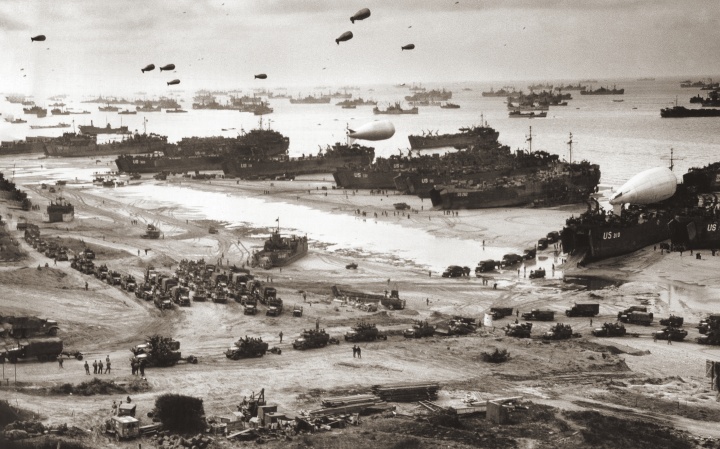
With the Normandy beachhead secured, vast numbers of Allied troops and military vehicles flood ashore.“On this 75th (now 80th) anniversary of D-Day, a crucial event in the push to Allied victory in World War II, we look back on the remarkable miracle of its success—an answer to prayer and the fulfillment of destiny.

Imperial War Museum

With the Normandy beachhead secured, vast numbers of Allied troops and military vehicles flood ashore.

It’s been 75 (now 80) years since D-Day, June 6, 1944, when Western Allied forces during World War II launched the largest invasion in history with nearly 7,000 ships of all sorts and more than 11,000 planes, crossing the English Channel and landing more than 150,000 troops (and more over the days that followed) on the beaches of Normandy to free France and the rest of Europe from Nazi tyranny.

German leader Adolf Hitler had prepared a vast defensive network of artillery, gun emplacements, mines and other deadly obstacles stretching from the west coast of France up to Norway. This “Atlantic Wall” had to be breached for the Allies to press forward and defeat this evil, genocidal regime that with its Axis partners was intent on continuing the carnage of many millions while trying to conquer the world.

Famed war correspondent Ernie Pyle, who arrived at Normandy the day after D-Day, noted that the Allies achieved victory “with every advantage on the enemy’s side and every disadvantage on ours.” Yet, as he wrote, the total Allied casualties “were remarkably low—only a fraction, in fact, of what our commanders had been prepared to accept.” Pyle concluded, “Now that it is all over, it seems to me a pure miracle that we ever took the beach at all.”

What was miraculous about D-Day, and why would God have intervened?

The weather and other surprises—flukes or God’s handiwork?

Gen. Dwight Eisenhower, Supreme Allied Commander (and later U.S. president), said later on the 1952 anniversary of the operation launch: “This day eight years ago, I made the most agonizing decision of my life. If there were nothing else in my life to prove the existence of an almighty and merciful God, the events of the next twenty-four hours did it . . . The greatest break in a terrible outlay of weather occurred the next day and allowed that great invasion to proceed, with losses far below those we had anticipated.”

The Allies had tried to plan for every eventuality, but they had no control over the vital weather. They hoped for good weather to make the 100-mile sea crossing to Europe, as had miraculously occurred in the mass evacuation from Europe at Dunkirk early in the war. What they didn’t realize was that bad weather—the windiest in 20 years—would hand them success beyond all expectation.

D-Day was originally scheduled for June 5 and could only be postponed for the short term to the 6th or 7th, while the tides were still low and the moon was full for visibility (along with clear weather), especially for clearing or avoiding mines in the surf. Otherwise it would have to have been put off a good while later.

With the terrible weather that sprang up on June 5, it looked like the operation was a no-go, but meteorologists reported a break was about to occur in the weather to allow the 17-hour crossing, though there was as yet no sign of any calming. Eisenhower made the agonizing decision for the ships to launch on the 5th (to arrive the next day) in the face of severe winds. As it turned out, the weather was only marginally better on the 6th, yet enough for the invasion to succeed even with weather-related losses.

What really helped win the day was that the Germans could not believe the Allies would cross the English Channel in such awful weather, and they were caught completely unprepared. They had stood alert at low-tide and full-moon days in May, but they now did not see the need. Half the German division commanders and a fourth of the regiment commanders left for war games exercises in Brittany. Field Marshal Erwin Rommel, in charge of the Normandy defenses, decided to travel 500 miles to Germany to celebrate his wife’s birthday. He came back at word of the invasion, but it took him all day—by then too late.

Also, Adolf Hitler and other leaders under him were convinced by Allied ploys and their own theories that the Allied invasion was going to be further east. And when it arrived they assumed it was a diversion, with the real landing to take place elsewhere—a belief that Hitler bizarrely clung to up through August!

Meanwhile, most of the Luftwaffe (German air force) planes based in Normandy had been relocated to Germany to defend against increasing Allied bombing. With that and the bad weather, German planes were not patrolling the English Channel. Moreover, this was the only night the German U-boat submarines did not patrol it. So the Allies encountered hardly any enemy forces on the way.

Confusion among German defenders

A key early step in the invasion was for paratroopers to come in gliders at 100 mph with no guiding lights and to land secretly next to two critical guarded bridges and secure them—to keep the Germans back and prevent the Germans from destroying them so the Allies couldn’t use them. The weather helped in this too, hiding the gliders in the low clouds as they flew by stopwatches until they dropped out at 200 feet, when the pilots could then see.

The first paratroopers to land were stunned, British platoon leader Maj. John Howard later stating: “When we came to our senses, we realized there was no firing. There was no enemy firing. It all seemed quite unbelievable.” The 22 paratroopers trotted over the bridge, the terrified guards dove into the bushes, and the garrison was taken in 10 minutes. But two German tanks arrived, with four more on the way. The paratroopers had only a single anti-tank gun, and with one chance succeeded in hitting the tank right in the middle, setting off all the ammunition inside—the burning tank now blocking the German advance and enabling lost paratroopers to be reoriented.

The Germans were not then able to counterattack there or across the wider area. They now had only two panzer (or tank) divisions near the Normandy landings. Early in the morning, Field Marshal Gerd von Rundstedt ordered these to move in, not believing such a large-scale invasion could be a deception.

But he had to get approval, as these forces were under the German high command. Approval was not given, as Hitler had to give the order, and he was still sleeping—and he didn’t awaken until noon. Hitler’s approval did not come until 4 p.m., and by that time the weather had cleared and Allied aircraft ruled the skies over Normandy, smashing anything that moved on the ground. (Much more could be said of Hitler’s terrible blunders, which some speculate may have resulted from disease or drug and chemical interactions affecting his brain.)

Many remarkable things happened on D-Day. The landing at Utah Beach was actually in the wrong place, but this worked out in the Allies’ favor, as the beach was less defended there. Of course, other places saw far worse fighting. The taking of the Normandy beaches was still horrific, with thousands dead or wounded. Yet the casualty count had been expected to be many times higher. And the victory allowed the liberation of Europe to follow over the next year.

The weather that seemed poised to thwart the Allied cause in reality greatly helped it. And the Nazi leadership was in many ways confounded. Eisenhower and many others saw this as clear help from Almighty God. In fact, newspapers at the time declared the events of D-Day, Dunkirk, El Alamein, the Battle of Britain and a number of other battles to be miraculous, particularly in the wake of widespread prayer to God for deliverance.

U.S. and British leaders and people look to God

Gen. Eisenhower told the troops embarking for Normandy: “The eyes of the world are upon you. The hopes and prayers of liberty-loving people everywhere march with you . . . The tide has turned! The free men of the world are marching together to Victory! I have full confidence in your courage, devotion to duty and skill in battle. We will accept nothing less than full Victory! Good Luck! And let us all beseech the blessing of Almighty God upon this great and noble undertaking.”

British Field Marshal Bernard Montgomery had told the troops, “Let us pray that the Lord, mighty in battle, will give us victory.”

As the forces approached Normandy, U.S. President Franklin Roosevelt took to the airwaves with this call: “In this poignant hour, I ask you to join with me in prayer.”

He publicly prayed: “Almighty God: Our sons, pride of our nation, this day have set upon a mighty endeavor, a struggle to preserve our Republic, our religion, and our civilization, and to set free a suffering humanity . . . They will need Thy blessings. Their road will be long and hard . . .

“They fight not for the lust of conquest. They fight to end conquest. They fight to liberate . . . They yearn but for the end of battle, for their return to the haven of home. Some will never return. Embrace these, Father, and receive them, Thy heroic servants, into Thy kingdom.

“And for us at home . . . help us, Almighty God, to rededicate ourselves in renewed faith in Thee in this hour of great sacrifice.

“Many people have urged that I call the nation into a single day of special prayer. But because the road is long and the desire is great, I ask that our people devote themselves in a continuance of prayer. As we rise to each new day, and again when each day is spent, let words of prayer be on our lips, invoking Thy help to our efforts . . .

“And, O Lord, give us faith. Give us faith in Thee; faith in our sons; faith in each other; faith in our united crusade . . . With Thy blessing, we shall prevail over the unholy forces of our enemy. Help us to conquer the apostles of greed and racial arrogances. Lead us to the saving of our country, and with our sister nations into a world unity that will spell a sure peace—a peace invulnerable to the schemings of unworthy men. And a peace that will let all of men live in freedom, reaping the just rewards of their honest toil.

“Thy will be done, Almighty God. Amen.”

As word of the invasion spread, prayer vigils were quickly organized throughout the country. Many businesses closed for prayer.

“This was the Lord’s doing, and it is marvellous in our eyes”

Britain’s King George VI said in a worldwide radio address on D-Day: “Four years ago our nation and Empire stood alone against an overwhelming enemy, with our backs to the wall. Tested as never before in our history, in God’s providence we survived that test . . .

“Once more a supreme test has to be faced. This time the challenge is not to fight to survive, but to fight to win the final victory for the good cause . . . That we may be worthily matched with this new summons of destiny, I desire solemnly to call my people to prayer and dedication.

“We are not unmindful of our own shortcomings, past and present. We shall ask not that God may do our will, but that we may be enabled to do the will of God; and we dare to believe that God has used our nation and Empire as an instrument for fulfilling His high purpose.

“I hope that throughout the present crisis of the liberation of Europe there may be offered up earnest, continuous and widespread prayer . . .

“If from every place of worship, from home and factory, from men and women of all ages and many races and occupations, our intercessions rise, then, please God, both now and in the future, not remote, the predictions of an ancient psalm may be fulfilled: ‘The Lord will give strength unto His people; the Lord will give His people the blessing of peace.’”

Did God answer this great outpouring of prayer? Many are justifiably convinced that He did.

After the Allies swept triumphantly through France in 1944, Gen. Montgomery felt compelled to say: “Such an historic march of events can seldom have taken place in such a short space of time . . . Let us say to each other, ‘This was the Lord’s doing, and it is marvellous in our eyes.’”

A God who intervenes and answers national prayer

The Bible reveals that God cares about what happens in the affairs of nations and intervenes in working out His overall plan. “For wisdom and might are His. And He changes the times and the seasons; He removes kings and raises up kings” (Daniel 2:20-21)—sometimes to punish sinful nations and rulers (compare Genesis 15:16; Isaiah 10:12)—and also to protect His servant people from annihilation.

He chose the people of Israel to fulfill a very special destiny. In prophesying of the Israelites in the last days, God promised to make Joseph’s descendants through his sons Ephraim and Manasseh the most blessed nations in the world and strengthen them against their enemies (Genesis 49:22-24), declaring that their descendants would “push the peoples to the ends of the earth” (Deuteronomy 33:17). He further said the Israelites would be “like a lion . . . Your hand shall be lifted against your adversaries, and all your enemies shall be cut off” (Micah 5:8-9).

Other verses show that God would also discipline the Israelites through losses to enemies. But He promised that if His people would humble themselves in prayer, He would forgive them and heal their land (2 Chronicles 7:14).

All of this plays a huge part in what happened at D-Day and the various other instances of divine intervention during World War II and in other conflicts. For, as incredible as it may seem, the prophecies regarding end-time Israel have been fulfilled primarily through the United States and Britain and other nations of British descent. In fact, these nations are in large part actually formed of the descendants of Joseph! (Be sure to read our free study guide The United States and Britain in Bible Prophecy for the proof of this identity and heritage.)

Though this truth is unknown to most, many over the last few centuries have had a sense of the promises to Israel applying in some ways to these great Bible-believing nations.

Leaders who recognized the hand of God at work

Observe what Winston Churchill, British Prime Minister at the time of D-Day, said in his memoirs of the First World War regarding an encounter with Scripture just after he took charge of the Royal Navy:

“That night when I went to bed, I saw a large Bible lying on a table in my bedroom. I thought of the peril of Britain, peace-loving, unthinking, little prepared . . . I thought of mighty Germany . . . wave after wave of valiant manhood . . . of the sudden and successful wars by which her power had been set up. I opened the Book at random, and in the 9th Chapter of Deuteronomy I read—

“‘Hear, O Israel: Thou art to . . . possess nations greater and mightier than thyself . . . a people great and tall of whom thou hast heard say, who can stand before the children of Anak!

“‘Understand therefore this day, that the Lord thy God is he which goes over before thee; as a consuming fire . . . Not for thy righteousness, or for the uprightness of thy heart . . . but for the wickedness of these nations the Lord thy God doth drive them out from before thee, and that he may perform the word which the Lord sware unto thy fathers, Abraham, Isaac and Jacob.’

“It seemed a message full of reassurance” (The World Crisis, Mentor edition, 1968, pp. 58-59). Indeed it was.

During the Second World War, the same Churchill, now prime minister, gave a message in 1942 stating: “I sometimes have a feeling of interference. I want to stress that. I have a feeling sometimes that some Guiding Hand has interfered. I have a feeling that we have a Guardian because we have a great Cause, and we shall have that Guardian so long as we serve that Cause faithfully.”

At the victorious conclusion of the war, Churchill led the British House of Commons to “give humble and reverent thanks to Almighty God for our deliverance.”

Harry Truman, U.S. president at the end of World War II, later remarked in 1951: “I do not think that anyone can study the history of this nation without becoming convinced that Divine Providence has played a great part in it. I have the feeling that God has created us and brought us to our present position of power and strength for some great purpose. It is not given to us to know fully what that purpose is.”

Will we continue to look to God?

While these men did not grasp the big picture of what God was working out, they and others at the time still realized who had saved them and seen them through. Do we?

It’s heartrending to contemplate, but it will not be long before the world is plunged into the worst time of trouble ever—far worse than World War II. America and Britain will not then succeed in beating back the enveloping tyranny but, having drifted far from God, will experience devastating defeat and destruction.

Yet, thankfully, a great deliverance will at last come—from the same God. The Father will send Jesus Christ to return to the earth in awesome power. Descending with the hosts of heaven, Jesus will come in divine war, crushing the armies arrayed against Him. Overthrowing the tyranny of wicked men and of Satan behind it all, He will take over the governing of the whole world, then bringing an end to war and guiding mankind into the way of peace.

As we remember D-Day, let’s be grateful for God’s great intervention then and at other times and, humbling ourselves in prayer, continue to trust Him now and for the future deliverance He will ultimately bring.”  From: https://www.ucg.org/beyond-today/beyond-today-magazine/d-day-and-divine-intervention

_________

Monday, December 25, 2023

You Don't Have to Know. The Christmas Shopping Season. Animal Protein Intake and IGF-1 Production.

.

You Don't Have to Know

a surface of gray stones slightly covered with water“Anyone can choose to humbly ask God for ways to serve when they see someone who may be struggling.

Aaron Burden/Unsplash

Encourage an open and healing connection with others so they may feel understood and supported.

Have you ever seen a situation in which you wanted to do something but were afraid you might say or do something wrong or unhelpful? I have.

Admittedly, there can be situations that may not be our business. If that is the case, realize it quickly and leave it alone, an issue for another time. But there may be times you encounter a situation where your heart is moved to help, but you are not sure how.

I had four brothers, one of whom was born with Down Syndrome and a number of even more challenging conditions. I was his legal guardian for the last 35 years of his life. It was difficult for my parents and later for me to deal with countless situations that involved difficult, binding decisions. When I see people in similar situations, I cannot turn away. I recall that Proverbs instructs: “Rescue those who are unjustly sentenced to die; save them as they stagger to their death. Don’t excuse yourself by saying, ‘Look, we didn’t know.’ For God understands all hearts, and he sees you. He who guards your soul knows you knew. He will repay all people as their actions deserve” (Proverbs 24:11-12, New Living Translation). This reminds us how important it is to be aware of serious situations of which we may be able to help, versus living in denial of the fact that I could do something to make the situation better.

I have been blessed to meet families in Church at Feast of Tabernacles sites etc., that, like me, faced similar challenging situations. Each time I was moved to action by considering the difficult times they faced as their lot in life. As I reached out to them, I experienced some feelings of nervousness but was able to overcome the apprehension by focusing on their needs and offering to serve.

It may seem easier to approach these situations with understanding and sensitivity when you’ve already had a similar experience. But, the fact is, anyone can choose to humbly ask God for ways to serve when they see someone who may be struggling.

I suggest your perspective should be: “I don't have to know or have the answers, just ask.” You could say something like, “How are you, really? But, if you’d rather not share, that’s fine.” Or you could say, “You appear to be distressed.” This may open a door and lead to meaningful conversation and additional ways to help and serve.

At the Feast of Tabernacles one year, I was saddened to hear one family tell me that they were rarely asked by brethren how they were getting along. It struck me how important it is to reach out and show true care and concern for others.

When faced with these circumstances, start by giving your ears and your heart, right then and there. Ask God to help you serve if you can (Proverbs 3:27-28). Don’t minimize or judge them, but encourage an open and healing connection so they may feel understood and supported (Proverbs 18:13). You can also make it a point not to ignore other family members who may feel neglected because of the necessary care and attention given to one family member. For me, reaching out resulted in that family feeling encouraged and comfortable enough to talk for a number of hours, sharing their situation.

People, in and out of Church struggle with many isolating and lonely battles. If you prove to someone that you are a “safe place” to trust and to share with, and you sense it is the appropriate time, you could use Fred Rogers’ simple but powerful question, “What’s the matter?” There may be potential here for fulfilling Galatians 6:2 to, “Bear one another’s burdens, and so fulfill the law of Christ.”

A good way to learn how some of your brothers and sisters are working through serious difficulties is to visit the Breaking Free blog at ucg.org. They have much to share that may help in breaking the silence that typically surrounds issues of overcoming.

We await the return of Jesus Christ, the Mighty God and Counselor (Isaiah 9:6), who will begin to create a safe place when He returns to earth. As His helpers and “princes” (Isaiah 32:1), we will become hiding places and “shelters” (Isaiah 32:2), for those who live through the Great Tribulation. So, as we look forward to that time ahead, let’s be present for others today by choosing to “just ask.” From: https://www.ucg.org/beyond-today/blogs/breaking-free/you-dont-have-to-know

________

Matthew 2:11

(11) And when they had come into the house, they saw the young Child with Mary His mother, and fell down and worshiped Him. And when they had opened their treasures, they presented gifts to Him: gold, frankincense, and myrrh.

“When it comes to the "most important" part of all in this Christmas observance—the Christmas shopping season—the buying and exchanging of gifts—many will exclaim triumphantly, "Well, at least the Bible tells us to do that! Didn't the wise men give gifts, when Christ was born?"

Again, we are due for some surprises, when we learn the plain truth. First, let us look at the historic origin of trading gifts back and forth, then see exactly what the Bible does say about it.

From the Bibliotheca Sacra, volume 12, pages 153-155, we quote, "The interchange of presents between friends is alike characteristic of Christmas and the Saturnalia, and must have been adopted by Christians from the Pagans, as the admonition of Tertullian plainly shows."

The fact is, this custom fastened upon people of exchanging gifts with friends and relatives at the Christmas season has not a single trace of Christianity about it, strange though that may seem! This does not celebrate Christ's birthday or honor it or Him! Suppose someone you love has a birthday. You want to honor that person on his or her birthday. Would you lavishly buy gifts for everyone else, trading gifts back and forth with all your other friends and loved ones, but ignore completely any gift for the one whose birthday you are honoring? Rather absurd, when viewed in that light, is it not?

Yet this is exactly what people the world over are doing! They honor a day that is not Christ's birthday by spending every dime they can scrape together—even spending what they cannot afford—in buying presents to trade back and forth among friends and relatives.

Now consider what the Bible says about giving gifts when Christ was born. It is in Matthew 2:1-11. "Now when Jesus was born in Bethlehem of Judea in the days of Herod the king, behold there came wise men from the east to Jerusalem, saying, Where is he that is born King of the Jews?' . . . And when they were come into the house, they saw the young child with Mary His mother, and fell down, and worshipped him: and when they had opened their treasures, they presented unto HIM gifts; gold and frankincense, and myrrh."

Notice, they inquired for the child Jesus, who was born King of the Jews! Now why did they present gifts to Him? Because it was His birthday? Not at all, because they came several days or weeks after the date of His birth! Was it to set an example for us, today, to trade gifts back and forth among ourselves? No, notice carefully! They did not exchange gifts among themselves, but "they presented unto Him gifts." They gave their gifts to Christ, not to their friends, relatives, or one another!

Why? Let me quote from the Adam Clarke Commentary, volume 5, page 46: "Verse 11. (They presented unto him gifts.) The people of the East never approach the presence of kings and great personages, without a present in their hands. The custom is often noticed in the Old Testament, and still prevails in the East, and in some of the newly discovered South Sea Islands."

There it is! They were not instituting a new Christian custom of exchanging gifts with friends to honor Christ's birthday. They were following an old and ancient eastern custom of presenting gifts to a king when they come into his presence. They were approaching Him, born King of the Jews, in person. Therefore custom required they present gifts—even as the Queen of Sheba brought gifts to Solomon—even as many people today take a gift along when they visit the White House for an appointment with the President.

No, the custom of trading gifts back and forth does not stem from this scriptural incident at all, but rather, as quoted from history above, it is the continuance of an ancient pagan custom.”

To learn more, see:
The Plain Truth About Christmas 

Related Topics:
Christ's Birth
Christ's Birth Not In December
Christ's Birth Not In Winter
Christmas
Christmas, Pagan Origins of 

From: https://www.theberean.org/index.cfm/main/default/id/6337/ver/nkjv/matthew-2-11.htm

________

Protein Intake and IGF-1 Production

Transcript of video at: https://nutritionfacts.org/video/protein-intake-and-igf-1-production/

“Animal protein consumption triggers the release of the cancer-promoting growth hormone IGF-1.

What is the mechanism by which our diet can affect our levels of this cancer-promoting growth hormone IGF-1? Imagine you’re a kid with some Tinkertoys. Then, Christmas comes early, and you get one of those huge sets dumped down in front of you. All excited with this new load of building raw materials, you may really start scaling up. And basically, it’s the same thing with your liver and Insulin-like Growth Factor 1.

When you dump a load of protein on your body, your liver’s like whoa, look at all this. What are we going to do with all? We can’t just waste it; we’ve got to do something with it. Let’s just start growing stuff; add a few new additions, maybe a new wing. So your liver decides to start pumping out IGF-1 to tell all the cells in the body, it’s growin’ time! Be fruitful and multiply. Spare no expense, go crazy—look how much excess protein we got to work with!

The problem, of course, is that some of the new additions may be tumors. When you’re a fully grown adult, cell growth is something we want to slow down—not accelerate. So one might imagine the goal would be to maintain adequate, but non-excessive, overall protein intake—but wait a second.

Studies have found no association between total protein intake and IGF-1 levels. Doesn’t that just go against everything I just said? Ah, but these studies didn’t take into account animal versus plant protein.

In this study of meat-eaters, vegetarians, and vegans, they found no significant difference in IGF levels between people eating lots of protein, compared to people eating less protein. But before ditching the theory that excessive protein intake boosts the levels of IGF-1, they decided to break it down into animal protein versus plant protein.

Higher IGF-1 levels were just associated with animal protein intake. In fact, the plant protein seemed to decrease IGF-1 levels. So, no wonder there was no net effect of total protein intake. Animal protein appears to send a much different signal to our livers than most plant proteins. So even those vegans eating the same amount of protein as meat-eaters still had lower levels of the cancer-promoting hormone, IGF-1.

So, it’s apparently not about excessive protein in general, but animal protein in particular.” From: https://nutritionfacts.org/video/protein-intake-and-igf-1-production/

To see any graphs, charts, graphics, images, and quotes to which Dr. Greger may be referring watch the above video. This is just an approximation of the audio contributed by Kerry Skinner.

__________

Monday, December 11, 2023

When Was Jesus Born? Part 1, 2 & 3. Why You Should Never Eat Pork.

.

When Was Jesus Born? Part 1

Luke 1:5

There was in the days of Herod, the king of Judea, a certain priest named Zacharias, of the division of Abijah. His wife was of the daughters of Aaron, and her name was Elizabeth.

“The Bible does not tell us exactly when Jesus Christ was born. The closest hint, found in this verse, seems to point to Christ’s birth in the fall of the year.

What’s the connection? Verse 36 shows that Jesus Christ was born about six months after John the Baptist was born. And John the Baptist would have been conceived nine months earlier (15 months before Christ’s birth), shortly after his father Zacharias had received a message from an angel while serving at the temple.

When did Zacharias serve at the temple? One source says he probably served one-week stints around mid-May and mid-November. (E.W. Bullinger uses the dates June 13-19.) King David had divided the priests into 24 courses, of which the division of Abijah was the eighth (1 Chronicles 24:10). These divisions each served a week at a time, so that each division served two weeks at the temple each year according to the sacred calendar, in addition to the festivals.

A number of commentators lean toward a May or June date for Zacharias’ meeting with Gabriel. Adding 15 months to that would put Jesus Christ’s birth in perhaps August or September. (If Zacharias met Gabriel around November or December, Christ’s birth would have been in perhaps February or March.)

Either way would not support a Dec. 25 birth date.”

From: https://lifehopeandtruth.com/bible/blog/when-was-jesus-born-part-1/

_______

When Was Jesus Born? Part 2

Luke 2:1 

And it came to pass in those days that a decree went out from Caesar Augustus that all the world should be registered.

“The vast Roman Empire was a structured and expensive government, and this census was “organized to facilitate the collection of taxes” (NKJV Study Bible). In an agrarian society, both tithes and taxes were collected shortly after the fall harvest when the farmer would have sold his crop. Collecting taxes in the winter or any other time is not very effective.

Also, since such a census required people like Joseph to travel back to their ancestral home, it is unlikely the census would have been conducted in the winter time when travel was difficult. This is but one more hint in the text that Jesus Christ’s birth did not occur on Dec. 25. Though the Bible does not give an exact date for His birth, it seems clear that it could not have been in the winter.”

From: https://lifehopeandtruth.com/bible/blog/when-was-jesus-born-part-2/

__________

When Was Jesus Born? Part 3

Luke 2:8 

Now there were in the same country shepherds living out in the fields, keeping watch over their flock by night.

“One commentary states, “As these shepherds had not yet brought home their flocks, it is a presumptive argument that October had not yet commenced, and that, consequently, our Lord was not born on the 25th of December, when no flocks were out in the fields. On this very ground the nativity in December should be given up” (Adam Clarke’s Commentary, note on Luke 2:8).

The Interpreter’s One-Volume Commentary agrees: “These humble pastoral folk are out in the field at night with their flock—a feature of the story which would argue against the birth (of Christ) occurring on Dec. 25 since the weather would not have permitted it” (1971, note on Luke 2:4-7).

For more about why Jesus Christ’s birth could not have been Dec. 25 and how it came to be celebrated that day, see our article “Christmas: Should Christians Celebrate It?”” From: https://lifehopeandtruth.com/bible/blog/when-was-jesus-born-part-3/

_________

Why You Should Never Eat Pork

Why you should never eat pork9 reasons why you shouldn’t eat pork

“Sausages, bacon, and ham are all popular pork products. And with good reason: they’re delicious! There’s nothing quite like starting your day with a juicy bacon sandwich or enjoying a delicious plate of ham and eggs.

But as with most things that taste great, there’s a downside to eating pork. Pork is, in fact, one of the unhealthiest meats you can eat. In this article, we’re going to discuss why you should seriously consider cutting pork out of your diet altogether.

1. Pork contains parasites

One of the main reasons why you shouldn’t eat pork is because it contains parasites. These parasites can cause disease and even death in humans.

Some of the most common parasites found in pork include roundworms, tapeworms, and trichinosis. Trichinosis is a worm infection that can be passed on to humans from pigs. This infection can cause fever, diarrhea, vomiting, and muscle pain. In severe cases, it can also lead to death.

While cooking pork may kill some of the parasites, it won’t remove all of them.

2. Pork may cause cancer

Another reason to avoid eating pork is that it may contribute to cancer. Pork products contain heterocyclic amines (HCAs) and polycyclic aromatic hydrocarbons (PAHs).

These are both carcinogenic (cancer-causing) compounds that have been linked to an increased risk of various types of cancer, including stomach, colon, and pancreatic cancer.

3. Eating pork can lead to allergies

Some people are allergic to the protein found in pigs. These proteins include pork insulin and pork trypsinogen.

Pork insulin is similar to human insulin and can cause an allergic reaction in some people. Pork trypsinogen is a protein that helps the pig digest its food. This protein has also been known to cause allergic reactions in humans.

4. Pig farming is harmful to the environment

Pig farming is one of the most damaging types of farming to the environment. Pigs produce large amounts of manure, which contains nitrogen and phosphorus.

These substances can pollute the air, water, and soil. In addition, pig farms often use large amounts of antibiotics, which can lead to the development of antibiotic-resistant bacteria. These antibiotics tend to leach into the environment and can contaminate water sources and the earth.

5. Pigs are generally left in unsanitary conditions

Pigs are intelligent animals that can feel pain and suffering. Unfortunately, they’re often kept in unsanitary conditions on factory farms.

These farms confine pigs to small metal cages or pens. The floors of these pens are often slatted, so the waste falls through into a pit below. The pigs are cramped and have no room to move around or exercise.

The conditions on these farms are so bad that pigs often develop sores and ulcers. They also, believe it or not, suffer from anxiety, boredom, and depression.

6. Pigs eat other animals

There’s a somewhat unspoken rule that humans should avoid eating animals that eat other animals. Pigs are one of the few exceptions to this rule.

Pigs are omnivores, which means they’ll eat just about anything. This includes dead animals, feces, and even their own young. As a result, pigs can harbor all sorts of diseases and parasites.

Thus, whatever they eat, you end up eating too.”        From: https://whyyoushouldnever.com/why-you-should-never-eat-pork/

_______

Just like the saying:      You are what you eat, AND WHAT IT ATE!!

_______

What diseases do pigs carry?

“The diseases associated with swine include ringworm, erysipelas, leptospirosis, streptococcosis, campylobacterosis, salmonellosis, cryptosporidiosis, giardiasis, balantidiasis, influenza, infection with pathogenic E. coli, and brucellosis.

Do pigs poop out of their hooves?

In addition to adapted digestive systems that support opportunistic scavenging, pigs can excrete excess toxins through their hooves. So, in the event that they do eat too much garbage, their bodies still have a back-up plan to rid the poison.

Can pig poop make you sick?

It is important to thoroughly wash hands after contact with pigs or their fecal material to avoid infection with diseases that can be spread via fecal-oral contact. Campylobacteriosis is an infection of the intestines caused by a bacterium called Campylobacter.

What happens if a pig bites you?

Pig bites are often severe with a high incidence of infection that is often polymicrobial with organisms including Staphylococcus and Streptococcus spp. (including Streptococcus suis), Haemophilus influenzae, Pasteurella, Actinobacillus and Flavobacterium species.

Why do pigs eat faeces?

Coprophagia is the term for an animal eating excrement—both their own and that of others. Most of them eat feces because it contains some undigested food—and thus vital nutrients—that would otherwise go to waste.  (Rabbits do this, too, that is why they are also an “unclean” meat.)

Do pigs have STDS?

They are responsible for a broad range of diseases in animals and humans. In pigs, Chlamydia suis, Chlamydia abortus, Chlamydia pecorum and Chlamydia psittaci have been isolated.”  From: https://yourwiseadvices.com/how-do-pigs-excrete-toxins/

_______

Monday, October 16, 2023

The Israeli-Palestinian Conflict. Meditate on These Things. The Best Diet for Colon Cancer Prevention.

.

The Israeli-Palestinian Conflict: Will Peace Ever Come?

The Israeli-Palestinian Conflict: Will Peace Ever Come?“The conflict between the Israelis and the Palestinians appears to be unending. Will real, lasting peace between these two peoples ever be achieved?


Horrific violence broke out yet again Oct. 7, 2023, when Hamas terrorists attacked Israeli civilians at a music festival and in communities near Gaza. In the early days of this latest war, more than a thousand Israelis and a thousand Palestinians died. Hamas also took about 150 hostages into Gaza.

EU chief Ursula von der Leyen told the European Commission: “Hamas terrorists killed women and children in their homes. They hunted hundreds of young men and women who were celebrating life and music . . .

“These innocents were killed for one single reason: For being Jewish and living in the State of Israel. It is an ancient evil, which reminds us of the darkest past and shocks all of us to the core” (The Times of Israel).

The latest in a long history of conflict

Historically, the Middle East has been a hotbed of contention. Over the centuries the area now known as the nation of Israel and the Palestinian territories has been fought over again and again.

What is the importance of the Israeli-Palestinian conflict to world peace and the future of mankind?

What brought about the Israeli-Palestinian conflict?

The recent history of the Israeli-Palestinian conflict goes back at least 100 years (BBC.com).

The Ottoman Empire had ruled the area for hundreds of years, but after the Ottomans were defeated in World War I, Britain took control of the land. At the time, the population of Arabs was larger than the population of Jews in the area.

The number of Jews in the area increased between the 1920s and 1940s, especially after World War II and the Holocaust, as European Jews were fleeing persecution and seeking a homeland.

The newly formed United Nations (UN) in 1947 voted for the land to be split into two states—a Jewish state and an Arab state. Jerusalem was to become an international city. This plan was accepted by Jewish leaders, but rejected by the Arab leaders.

Within 12 months, Britain withdrew from the region leaving the Israeli-Palestinian conflict unsolved.

Jewish leaders immediately established the nation of Israel on May 14, 1948. The Palestinians objected, leading to a war between the state of Israel and the Palestinians and neighboring Arab countries. This war produced hundreds of thousands of Palestinian and Jewish refugees.

When fighting ended in 1949, Israel controlled the most land, including West Jerusalem, while Jordan controlled the West Bank (of the Jordan River) and East Jerusalem. Gaza was taken by Egypt.

Israel absorbed the Jewish refugees, but the Palestinians were not absorbed by the Arab nations, and many continue living in increasingly crowded refugee camps to this day.

Israeli-Palestinian conflicts and peace efforts

Since there was no peace agreement ending this war, the conflict continues to this day. Within the ongoing conflict, specific times of increased levels of fighting include:

  • The 1956 Suez Crisis.
  • The 1967 Six-Day War.
  • The 1973 Yom Kippur War.
  • The 1987 beginning of the First Intifada.
  • The 2000 beginning of the Second Intifada.

Many other conflicts erupted between these and have continued ever since.

Many American presidents and others have attempted to negotiate peace deals in the Israeli-Palestinian conflict, with some successes and many frustrating failures. Some notable peace efforts include:

  • The 1978 Camp David Accords, and subsequent 1979 peace treaty between Israel and Egypt.
  • The 1993 and 1995 Oslo Accords.
  • The 1994 peace treaty between Israel and Jordan.
  • The 2020 Abraham Accords between Israel and various Arab nations.

Though these peace efforts are laudable, the overall process of negotiation between Israelis and Palestinians has stalled, and the Palestinian leadership has not been pleased that Arab nations have been making agreements with Israel.

At the heart of the Israeli-Palestinian conflict remains the desire of the Palestinians for autonomy and repossession of some or all of the land occupied by the Israelis versus the Israelis’ claim to their ancestral land as well as their desire for security.

At this point in history, neither side seems willing to compromise enough to obtain lasting peace—or to believe peace is really possible.

A land of conflict throughout history

This land has been embattled for thousands of years.

The biblical history of the land begins with Abraham, the progenitor of both the Israelis and Palestinians. Beginning with Genesis, the books in the Old Testament of the Bible cover this history. What follows is a brief synopsis.

Abraham was told by God to leave his home and go to the land of Canaan, which God was going to give to him and his offspring (Genesis 12:1-7; 13:14-18).

Abraham, his son Isaac, his grandson Jacob and their families were then nomads in the land of Canaan until a famine forced Jacob (also known as Israel), his sons and their families to move to Egypt. While in Egypt, the families of the 12 sons of Jacob grew substantially, and their sheer numbers caused Egypt to feel threatened.

Realizing they had a free workforce and not wanting the tribes of Israel to turn against them, the Egyptians enslaved the Israelites for many years.

Under the leadership of Moses, God eventually freed the tribes of Israel from Egyptian slavery and led them back to the land of Canaan. In fulfillment of God’s promise to Abraham, over a period of time the fledgling nation of Israel took possession of the Promised Land.

During the time of the judges, the nation of Israel slipped into a tragic cycle of disobeying God, which led to the occupation of ancient Israel by some of its neighbors. Upon their repentance, God would rescue the Israelites from their captors. This cycle of occupation and deliverance lasted nearly 400 years.

Throughout the reigns of the kings of ancient Israel, there were many conflicts involving the surrounding nations. After the death of Solomon, the nation of Israel split into the 10 northern tribes of Israel and the southern kingdom of Judah.

Israel continued to disobey God during the reigns of the kings of Israel and Judah. God allowed the 10 northern tribes of Israel to fall to Assyria around 721 B.C. The Assyrians removed the conquered Israelites from the Holy Land and replaced them with captives from other lands. In 586 B.C. the disobedient tribe of Judah was completely conquered, and many of the people in the southern portion of the land were displaced by the Babylonians.

The 10 northern tribes of Israel did not return to the Promised Land; however, 70 years after their captivity, a number of Jews were given permission by Cyrus, king of Persia, to return to Jerusalem to rebuild the temple.

The descendants of the Jews endured many additional occupations of the Holy Land, including ones by the Greeks, Romans, Byzantines, Muslims and the Crusaders.

Also, over the centuries, many descendants of Esau (Edomites) and Ishmael (Arabs) moved into the area. These peoples were also descendants of Abraham, but the Bible describes longstanding jealousies and hatreds between them and the descendants of Israel (Psalm 83:4-6; Ezekiel 35:5).

Will peace be achieved between the nation of Israel and the Palestinians?

The seemingly endless cycle of conflict between the Israelis and the Palestinians does not bode well for a peaceful solution.

The chances of a human solution to the Israeli-Palestinian conflict are slim.

With the Holy Land at the crossroads of the world—and at the intersection of Christianity, Judaism and Islam—the resulting conflict is predicted to be the catalyst for future events that will change this world forever.

Biblical prophecy foretells a future time when the Holy Land will be occupied again by a world superpower—the king of the North (Daniel 11:41). The Bible says that leading up to this event, the king of the South will attack the king of the North (verse 40), and the king of the North could very well enter the Holy Land in an attempt to bring peace to the region.

Instead, however, it will usher in an unprecedented time of trouble labeled the Great Tribulation (Matthew 24:21). It will be so horrendous a time for the world that, we’re told, there has never been a time like it in the past and there will never be a time like it in the future (Daniel 12:1).

Unless God intervened at this time, the earth would become lifeless (Matthew 24:22). Thankfully, God is going to intervene and send His Son Jesus Christ to establish the Kingdom of God (Matthew 24:29-31).

In the battle culminating during the end time, the armies of the world will gather at Armageddon in what is northern Israel today to fight the returning Christ and His saints (Revelation 16:16). Man’s armies will be completely defeated. Christ will conquer the nations and become the King of Kings and the Lord of Lords of a righteous, just and peaceful world government (Revelation 19:19-21).

Peace at last for the Israelis and the Palestinians

At the beginning of the millennial rule of Christ, the earth will be rebuilt. Instruments of war will be turned into instruments of agriculture. Humans will not learn war anymore (Isaiah 2:4). The way of peace will be taught and enforced.

In this new world, even the nature of predatory animals will be changed (Isaiah 11:6-9). What is more important—and the key to peace throughout this new world—the nature of man will begin to be changed, as individuals choose repentance and conversion (Jeremiah 31:31-34; Hebrews 10:16).

Once they are converted and given the Holy Spirit, people will no longer be the belligerent beings they were in their former world. This dramatic change will be brought about by their new nature and the lack of Satan’s influence in their lives (Revelation 20:1-3).

God will ensure there will be peace for all of mankind. Children will be able to play in the streets of cities while their grandparents watch them (Zechariah 8:4-5).

The transformations that will occur on this earth will be astonishing. People will become healthier, as the sick are healed, the crippled walk, the blind see, and the deaf hear (Isaiah 35:4-6).

The deserts will bloom, and the land will become so productive that those planting will overtake those harvesting (Amos 9:13).

God, at this time, will restore not only the nation of Judah, but also the other tribes of Israel to the Promised Land (verses 14-15).

Does this mean the Palestinians will be without a homeland? No!

God will provide the Palestinians and all peoples of the world with their own lands flowing with milk and honey. Everyone will sit under his or her fig tree, so to speak, and enjoy the prosperity of this wonderful world tomorrow (Micah 4:4-5).

There will be peace at last, as man, under the rulership of Jesus Christ, progresses toward the time when there will be no more tears, sorrow, pain, crying and death (Revelation 21:4).

Will you be there to see the transition from a world of bigotry and hate to a world of true outgoing concern and peace?

Learn more in our enlightening free booklet The World to Come: What It Will Be Like.  From: https://lifehopeandtruth.com/prophecy/prophecy-in-the-news/israeli-palestinian-conflict/?

________

Meditate on These Things

Philippians 4:8

“Finally, brethren, whatever things are true, whatever things are noble, whatever things are just, whatever things are pure, whatever things are lovely, whatever things are of good report, if there is any virtue and if there is anything praiseworthy—meditate on these things.

What do we normally focus our minds on? Bad news, scandals and problems fill our media and our minds. The apostle Paul encourages us to focus instead on the things of God, the things that are truly pure and praiseworthy, and that ultimately lead to the best news that can be reported—the coming Kingdom of God.

We can’t hide our heads in the sand to the bad news of today. Jesus Christ told us to watch world events and to be aware of the signs of the times (Luke 21:36; Matthew 16:3). But we don’t have to look for the juicy details of the latest scandal. We can focus instead on the words of God and the just and virtuous things that are the hallmarks of His coming Kingdom.

We are to meditate or “think on” (King James Version) these things for a purpose. “Think on—have a continual regard to, so as to ‘do’ these things (vs. 9)” (Jamieson, Fausset and Brown Commentary on Philippians 4:8). Our thoughts should guide our actions. Christians are called to not only meditate, but to do.

For more about Philippians 4:8, see our blog series beginning with “Meditate on These Things: ‘Whatever Things Are True.’”   For more about meditation, see our article “What Is Meditation?” See also “Reading the Mind of God.”  From: https://lifehopeandtruth.com/bible/blog/meditate-on-these-things/?

_________

The Best Diet for Colon Cancer Prevention

What would happen within just two weeks if you swapped the diets of Americans with that of healthier eaters?

Transcript of video at: https://nutritionfacts.org/video/the-best-diet-for-colon-cancer-prevention/

Below is an approximation of this video’s audio content. To see any graphs, charts, graphics, images, and quotes to which Dr. Greger may be referring, watch the above video.

“Colon cancer is our second leading cancer killer, but some places, like rural Africa, have more than 10 times lower rates than we do. The reason we know it’s not genetic is that “[m]igrant studies, such as those in Japanese Hawaiians, have demonstrated that it only takes one generation for the immigrant population to assume the colon cancer incidence of the host Western population.” Now, “the change in diet is [considered] most probably responsible for this.” But there are all sorts of changes when you move from one culture to another—like smoking rates, different exposures to chemicals, infections, antibiotics. You don’t know if it’s the diet…until you put it to the test.

It’s rare I do a whole video on a single study, but I think you’ll agree this one is worth it. This international group of researchers were trying to find out why colon cancer rates were an order of magnitude higher here—in African-Americans and Caucasians—than in rural Africa. If you look at American colons, they’re a mess: polyps, diverticulosis—not to mention hemorrhoids— whereas the African colons were “remarkably pristine.” And more importantly, sevenfold lower colonic epithelial proliferation rates, a characteristic of precancerous conditions. They measured everything they were eating, and concluded that the higher colorectal cancer risk and proliferation rates were most closely “associated with higher dietary intakes of animal products,” which may have led to “higher colonic populations of these potentially toxic [acid] and bile-salt-producing bacteria.” But you don’t know… until you put it to the test. “The higher rates are associated with higher animal protein and animal fat, and lower fibre consumption,” more of those bad bile acids, less of those good short chain fatty acids like butyrate, and that “higher mucosal proliferation. But how do we know it’s the diet that’s mucking things up? You don’t know…until you perform an interventional study.

How about we just swap their diets? Feed the Americans a high-fiber African-style diet, and the poor Africans get the SAD, Standard American Diet—like sausage and white flour pancakes for breakfast, a burger and fries for lunch, and some meatloaf and white rice for supper. That was day one for the rural Africans in the experiment, whereas the Americans were forced to eat fruits and vegetables, corn and beans. To help with compliance, they threw in more familiar foods like veggie dogs, though note it was not a vegan diet, just generally plant-based.

And the food exchanges weren’t for years, but just two weeks. Could they see changes that fast? The dietary changes “resulted in remarkable reciprocal changes” in the lining of their colons in terms of cancer risk and their microbiome. Switching to plant-based boosted the fiber fermentation and “suppressed the [carcinogenic] bile acid synthesis.” Let’s look at some before-and-after pictures. They took biopsies, and this is the colon lining of an African-American under a microscope. Those brown dots mark dividing cells; their colon lining was in overdrive, the cells rapidly dividing, a sign of premalignancy, a risk factor for cancer. But just two weeks eating a healthier diet, and their colons calmed right down.

The African-Africans started out with some proliferation, but it got worse on the American diet. This is a different marker measuring inflammation. Each of the brown dots here represents an inflammatory cell; so, rife inflammation before calmed way down after just two weeks, and the opposite in those eating worse.

We know that when our friendly flora ferment fiber, they produce beneficial compounds like butyrate, which is anti-inflammatory and anti-cancer. Impressively, “Africanization” of the diet more than doubled butyrate production, whereas “westernization” cut it in half. And in terms of toxic metabolites, a significant drop on the healthier diet, whereas the meatloafy diet increased the levels of these carcinogens by 400 percent within just two weeks. So, bottom line (no pun intended): what they were able to show is that just by changing the food, you can remarkably change your risk. In fact, that’s how the lead investigator put it: “change your diet, change your cancer risk!”  It may be “never too late to start” eating healthier.

Based on these kind of data, “adopting a whole-food vegan or [even just] near-vegan diet rich in fruits and vegetables,” along with other healthy lifestyle decisions, “could have a stunningly positive impact on the cancer risks not only of black Americans, but of all peoples.” “While it [might] be unrealistic to expect rapid and profound lifestyle changes in the general population, [hey]…at least we have sound, effective advice to offer to those who [make the choice] to take the steps needed to optimize their healthful longevity.”  From:  https://nutritionfacts.org/video/the-best-diet-for-colon-cancer-prevention/

__________

Tuesday, October 3, 2023

Is Karma in the Bible? Feast of Tabernacles? An Attitude of Gratitude. Bacon & Botulism

.

Is Karma in the Bible?

“In recent years, the Eastern concept of karma has become popular in Western culture. Can the idea of karma be harmonized with the Bible? Is karma biblical?” 

Is Karma in the Bible?

“Cause and effect is not karma

However, the Bible does teach the principle of cause and effect, which some incorrectly confuse with karma. There are two basic kinds of cause and effect:

1. Cause and effect by God’s blessings or punishment. The Bible is clear that God has the power to bless and punish. God told Israel He’d bless them if they obeyed and curse them if they rebelled (Leviticus 26; Deuteronomy 28). He exercised that authority with ancient Israel and will punish the nations in the end time for their wickedness and refusal to repent (Revelation 16:8-9).

God also promises to bless those who seek and obey Him (Psalm 1:1-2; Proverbs 10:6; James 1:25). But those blessings aren’t always immediately visible. Many seemingly innocent people have suffered hard lives throughout history (John 16:33; Hebrews 11; James 1:2-3). But the Bible promises that ultimately “all things work together for good” for God’s faithful people (Romans 8:28).

The Bible also shows that God is extremely merciful and is not constantly doling out physical punishment based on what we deserve (Matthew 5:45; Hebrews 2:1-4). In fact, considering the state of our world’s morality, we should be immensely thankful God doesn’t operate through karma.

2. Cause and effect through natural consequences. Both the Bible and common sense show that cause and effect operate naturally in our lives. The Bible expresses it this way: “Whatever a man sows, that he will also reap” (Galatians 6:7). In simple terms, decisions and actions often have natural consequences.

No amount of good deeds can offset our sins and save us from the death penalty. Forgiveness of sin can only occur through repentance and the blood of Jesus Christ. Much of the book of Proverbs is about cause and effect. For example, the natural consequence of being lazy is poverty, while diligence and hard work lead to financial stability (Proverbs 6:9-11; 10:4; 13:4; 20:13; 24:30-34).

These natural consequences aren’t determined by mysterious karmic energies, but by simple cause and effect. Practicing biblical principles positions a person for success because God’s ways work. However, in a world guided by Satan and human nature, sometimes the righteous suffer because of the sins of others (John 16:33; Romans 8:18; 1 Peter 3:17).

The Bible also shows that in this life sometimes the wicked do prosper for a time (Psalm 73:3; Jeremiah 12:1-3).

Though the Bible clearly teaches the principle of cause and effect, it is not a biblical equivalent to karma.

Why is the idea of karma dangerous?

Karma is clearly a man-made belief foreign to the Bible. Consider three reasons the idea of karma is spiritually dangerous and deceptive:

1. Karma replaces the all-powerful God with the universe. The power behind karma is usually described as the universe. Chopra.com describes it this way: “The Universe will bring back whatever acts you committed or feeling you caused in another person.” This worldview credits the physical creation as the ultimate arbiter of morality and reward and punishment.

But the Bible shows God created the universe (Genesis 1:1; Isaiah 42:5). God, not the universe or energy, is the “rewarder of those who diligently seek Him” (Hebrews 11:6). Jesus Christ, not the universe or karma, will ultimately “judge the world in righteousness” (Acts 17:31).

Karma is another way mankind has deceptively credited the creation with power that belongs only to God (Romans 1:25).

2. Karma contradicts biblical repentance. Many believe that “bad karma” can be erased only by outweighing it with “good karma.” This idea contradicts the biblical teaching on sin.

The Bible teaches that the ultimate penalty of sin is death—not physical curses (Romans 6:23). No amount of good deeds can offset our sins and save us from the death penalty. Forgiveness of sin can only occur through repentance and the blood of Jesus Christ (Acts 3:19; 1 John 1:7). A Christian must absolutely strive to obey God, but not as an attempt to outweigh the bad on the scales of karma.

Some sins do have ongoing physical consequences, but thankfully, after God forgives us, we no longer have to worry about the ultimate consequences of our sins.

3. Karma distorts the proper motivation for doing good. Karma is just one of many man-made attempts to encourage people to live morally. It plays on human nature by incentivizing doing good to avoid bad things coming back upon us later.

At its core, the concept of karma is driven by selfishness.

The Bible, on the other hand, teaches that morality is defined by God and should be driven by selflessness. Jesus taught that our ultimate motivation should be love—for God first and then for other human beings (Matthew 22:36-39). Paul described the proper motivation for everything we do this way: “The purpose of the commandment is love from a pure heart, from a good conscience, and from sincere faith” (1 Timothy 1:5).

Christians shouldn’t do good to avoid bad things coming on them. Christians should do good out of genuine love because it’s the right thing to do—regardless of the consequences.

So, is karma in the Bible? No. Karma is unbiblical and contradicts God’s Word in multiple ways.”      This is the last part of article at:  https://lifehopeandtruth.com/change/the-church/world-religions/karma-in-bible/?

______

Why Would You Observe the Feast of Tabernacles?

This year, Sukkot starts on the evening of Friday, 29 Sept and ends on Friday, 6 Oct 2023.

“The Feast of Tabernacles (Sukkot) represents the peace, prosperity and righteousness of the coming Kingdom of God, but how is it relevant to the Christians today?”

Transcript of video at: https://www.ucg.org/beyond-today/beyond-today-daily/why-would-you-observe-the-feast-of-tabernacles

[Steve Myers] Someone asked me the other day, "Why would you observe the Feast of Tabernacles? Is that a Christian thing?" Absolutely, it is. We follow the example of the New Testament Church. The church in the 1st Century kept and observed, celebrated, the Feast of Tabernacles. So, what is this feast? Well, it's definitely listed in Scripture as one of the feasts of the Lord. (Lev. 23:1-44) I don't know if you've ever checked that out, but it's the feast that God has established. It's one of His Holy Days. And so, for a period of time, we celebrate the Feast of Tabernacles for seven days. A complete festival. 

Seven is often a number of completeness because it represents that time, in God's plan, that has a deep spiritual meaning. Jesus Christ will return to this earth, 1 Thessalonians 4 spells that out completely, 1 Corinthians 15 as well. And so, the Feast of Tabernacles is representing that time when Christ will return as King of kings and Lord of lords. I know you've probably heard those classic choral selections that sing about that. He's King of kings and Lord of lords and He is returning. Well, the Feast of Tabernacles points to that time that Christ will literally come back to earth.

We can read about that in Revelation 5. Revelation 5, in fact, beginning in verse 10, it tells us, "He has made us kings and priests to our God, and we shall reign on earth." Christ will return and annihilate the kingdoms of man. Mankind will no longer be in charge. There will no longer be chaos and confusion in this world. Jesus Christ will establish righteous godly government. And for a thousand years, He will reign on this earth.

Perhaps you've even prayed about this symbolic meaning of the Feast of Tabernacles. You know, that model prayer, sometimes call the Lord's Prayer that Christ taught the disciples to pray. Perhaps you've said that prayer or parts of that prayer. It has that part that says, "Thy kingdom come, thy will be done." Christ will come back and establish His kingdom. It will come. And, of course, the rest of that prayer says, "On earth as it is in heaven." So the Feast of Tabernacles pictures that amazing time of peace and prosperity and righteous government that Christ Himself will come and establish right on this earth.

Check out The Feast of Tabernacles, find out the deep spiritual meaning behind God's purpose and His plan, and this vital step in His plan for salvation for all mankind.” From: https://www.ucg.org/beyond-today/beyond-today-daily/why-would-you-observe-the-feast-of-tabernacles

________

An Attitude of Gratitude: Sukkot for Christians

“In a festival similar to Thanksgiving, the Biblical feast of Sukkot (pronounced sue-COAT) gives us a chance to focus on our blessings from God and His desire to be with His people. Also called the Feast of Booths, Tabernacles, or Ingathering, it’s one of the seven commanded feasts in Leviticus 23.”  More at: https://hebrewrootsmom.com/an-attitude-of-gratitude-sukkot-for-christians/

_________

Bacon & Botulism

Transcript of video at: https://nutritionfacts.org/video/bacon-and-botulism/

“The nitrite preservatives in processed meats such as bologna, bacon, ham, and hot dogs form carcinogenic nitrosamines, but also reduce the growth of botulism bacteria—forcing regulators to strike a balance between consumers risking cancer, or a deadly form of food poisoning.

There are literally hundreds of studies on the link between cancer and cured meats like bologna, bacon, ham, and hot dogs. But just for a taste, just over the last year or so, processed meat consumption was significantly associated with bladder cancer, endometrial cancer, prostate cancer, thyroid cancer, and then all the way down the digestive tract: throat cancer, esophageal cancer, more esophageal cancer, more esophageal cancer and stomach cancer, colon cancer, and rectal cancer. And then, for a ten-for-one deal, processed meat was significantly related to the risk of stomach, colon, rectal, pancreatic, lung, prostate, testicular, kidney, more bladder cancer—and leukemia, as well. That’s why the official recommendation is to try to “avoid processed meats” entirely.

With concern over the potential danger of nitrosamines growing, consumer groups, such as the Center for Science in the Public Interest, a wonderful group, petitioned the USDA as far back as 1972 to ban, or at least greatly reduce, the nitrite in cured meats. The USDA denied the petition, citing nitrite’s role in the prevention of botulism bacteria that can grow inside vacuum-packed meats. They had to weigh the risk of cancer with the risk of consumers getting a deadly food poisoning bacteria from lunchmeat.

You know, in 2011, the National Pork Board officially changed their quarter-century old slogan from “Pork: the other white meat” to “Pork: Be Inspired.” Maybe for bacon, they should have considered the tagline: “Cancer or Botulism, take your pick.” From: https://nutritionfacts.org/video/bacon-and-botulism/

To see any graphs, charts, graphics, images, and quotes to which Dr. Greger may be referring, watch the above video. This is just an approximation of the audio contributed by MaryAnn Allison.

__________

Sunday, September 17, 2023

Why Should Christians Celebrate the Feast of Trumpets? Avoid These Cancer-Causing Foods.

.

Why Should Christians Celebrate the Feast of Trumpets?

Sunrise over the crest of a hill“Prophecies of the end time include trumpet plagues and the return of Jesus Christ at the last trump. What does the Feast of Trumpets mean for Christians today?

Christ's return is announced by the seventh and final trumpet.

The fourth festival of God (after Pentecost) is the Feast of Trumpets (or a "memorial of blowing of trumpets," Leviticus 23:24-25), which falls in September or October. (This year was celebrated 15th-16 Sept. 2023.)  This festival is called Rosh Hashanah by the Jews today. Ancient Israel understood that trumpets were used as a way of announcing special, very important messages (Numbers 10:1-10).

In the New Testament, Jesus Christ reveals that before His return to the earth, there will be the blowing of seven trumpets, announcing progressive stages of the downfall and overthrow of this world's kingdoms, ending with the return of Christ to take possession of the earth. Christ's return is announced by the seventh and final trumpet (Revelation 8:2; Revelation 11:15). This day also pictures the time when faithful Christians will be resurrected to eternal life at the time of the seventh trumpet (1 Corinthians 15:52; 1 Thessalonians 4:16) to reign with Jesus Christ for 1,000 years (Revelation 20:4-6).

Interestingly, it was around this time of year that Jesus was born—not in the dead of winter (see "Biblical Evidence Shows Jesus Wasn't Born on December 25"). And the fall feast season represents the time when Jesus Christ will come to the earth again to reign in glory.

The remaining fall feast days describe steps in the establishment of the prophesied Kingdom of God on earth and judgment of humanity after Christ's return. The Feast of Trumpets is followed by the Day of Atonement.”

For more information, please read our booklet God's Holy Day Plan: The Promise of Hope for All Mankind.”   From: https://www.ucg.org/bible-study-tools/bible-questions-and-answers/why-should-christians-celebrate-the-feast-of-trumpets

_______

Why the Feast of Trumpets?

Transcript of video at: https://www.ucg.org/beyond-today/beyond-today-daily/why-the-feast-of-trumpets

[Darris McNeely] “God's festivals are upon us. The annual Holy Days that God commanded mankind to keep in his name to worship and honor him. The Feast of Trumpets is coming up. The Feast of Trumpets is mentioned back in Leviticus 23. And within that chapter, we have what is called a time of the memorial of the blowing of trumpets, and Leviticus 23, "On the first day of the Sabbath month, a holy convocation and a blowing of trumpets."

Whenever God told his people to blow the trumpets, they were either to come together to be on the move and on the match or to go to war because it was a time of alarm. Trumpets heralded something significant. Now, what does that mean for us today? Well, if we believe in Jesus Christ's return and His promise from His Word of His second coming, then when we turn to 1 Thessalonians 4 we read something about another blowing of trumpets in verse 16 and the announcement of Earth's most significant possibly event that we could ever imagine. Let's read it. 1 Thessalonians 4:16, "For the Lord himself will descend from heaven with a shout, the voice of an Archangel. and with the trumpet of God."

Paul writes here to the church about the sounding of the trumpet of God, not what the men of Israel were to sound. That was just a forerunner, a picture of what this particular event really does show, the trumpet of God sounding with the appearance of Jesus Christ as King of Kings, but here's what happens. "And the dead in Christ will rise first." Paul has comforted the church here with the encouragement that those who have died will rise again and he shows that it's going to happen with a sounding of a trumpet. The Feast of Trumpets points us to the absolute hope, truth, and fact of the resurrection from the dead of those who are described as the dead in Christ. The Bible even elsewhere talks about it as a first resurrection, as one that is what is called also a better resurrection. It will be a glorious time. It will be a time of reunion.

Who in the Bible would you want to sit down and talk to? Which of the saints, which of the great figures of the Bible? Abraham, Noah, David, the Apostle Paul? They'll be in that resurrection. The question for you and I to consider is will we be in that resurrection? That truth, that hope, is a fact of God's word. The Feast of Trumpets points us to that, brings us to that reality. Let's remember that and think about what it means to observe that day in anticipation, the very hope of the resurrection of the dead.”  From: https://www.ucg.org/beyond-today/beyond-today-daily/why-the-feast-of-trumpets

_________

Unexpected foods that could increase risk of cancer | 9 News Australia

“Experts are warning other unexpected foods beyond processed meats like salami, bacon and sausages could put your health at increased risk of cancer.”

________

Avoid These Cancer-Causing Foods

Learn which foods to steer clear of – and which to enjoy – to lower your cancer risk.

U.S. News & World Report

Worst Cancer-Causing Foods

Homemade beef burgers with crispy bacon and vegetables in small pans and glass of wheat beer on rustic serving board over shabby wooden background, top view, copy space, horizontal compositionMore

“Over the last several decades, certain foods have been vilified as being potentially carcinogenic, or capable of causing cancer. So which ones are the biggest culprits? And how can you eat to prevent cancer or reduce the chances of a recurrence if you've been diagnosed?

(GETTY IMAGES)

The list of potentially cancer-causing foods includes:

  • Red and processed meat.
  • Sugar.
  • Alcohol.
  • Processed and packaged foods.
Red and Processed Meat

For the carnivores among us, it's probably tough to hear the news that red meat and processed meat are associated with a higher risk of certain types of cancer. "Red meat is defined as beef, veal, pork, lamb and goat," says Cathy Leman, a dietitian, personal trainer, nutrition therapist, speaker, writer and breast cancer survivor based in Chicago.

"Processed meat refers to meat that has been salted, cured, fermented, smoked or other processes that enhance flavor or improve preservation," she adds. Examples include hot dogs, luncheon meats, ham and bacon.

Jeannette Schenk, senior staff scientist in the cancer prevention program at Fred Hutchinson Cancer Research Center in Seattle, says "there have been many epidemiological studies that have reported an association with high intakes of processed meat and red meat with an increase in cancer incidence and mortality."

According to the American Institute for Cancer Research, a high intake of red meat is defined as more than three servings per week. A single serving of red meat is about 3 to 4 ounces – or one small hamburger, steak or a medium-sized pork chop. Your total weekly consumption, the AICR reports, should be under 350 to 500 grams (about 12 to 18 ounces cooked) each week.

The cancer risk associated with processed meat products is even higher. The International Agency for Research on Cancer, a branch of the World Health Organization, classifies processed meat as a Group 1 carcinogen, meaning that like other Group 1 carcinogens – tobacco, UV radiation and alcohol – research has proven that processed meat can cause cancer in humans. Eating just 50 grams of processed meat each day, the IARC reports, can elevate cancer risk by 18%.   Four strips of bacon or one hot dog contains about 50 grams of processed meat.”  More at: https://health.usnews.com/conditions/cancer/articles/worst-cancer-causing-foods

________

Sunday, July 23, 2023

What’s the Real Source of Contentment? Don’t Miss The Beauty! Pets & Human Lymphoma.

.

What’s the Real Source of Contentment?

What Is the Real Source of Contentment“Why are some of the most prosperous people some of the least satisfied? What is the real secret of satisfaction and contentment?

Where do satisfaction and contentment come from?

Throughout human history, people have been searching for contentment and satisfaction—but when they think they have found it, the feelings have been fleeting and temporary. Mostly people have been looking in all the wrong places.

For example, it is common and seems logical to conclude that if everyone were prosperous, everyone would automatically be content and satisfied. But is having enough to eat and drink with the peace to enjoy it enough to make us lastingly content? Is physical abundance the cause of contentment and satisfaction?

What is the real source of deep, lasting contentment and eternal satisfaction? We’ll see it’s not prosperity that will bring contentment. It’s something much more important.

The satisfaction experiment

How do we know that physical things alone won’t satisfy people? We may know this by personal experience or by learning about others’ experiences.

We can also learn it by reading about it in a book of revealed wisdom. There are verses in the biblical book of Ecclesiastes that tell us:

“The eye is not satisfied with seeing, nor the ear filled with hearing” (1:8).

“All the labor of man is for his mouth, and yet the soul is not satisfied” (6:7).

No matter what we see or hear or taste—whatever we experience with our physical senses—it will be temporary.

King Solomon performed the quintessential experiment on this subject. He recorded his experimental search for happiness and satisfaction in Ecclesiastes 2. In this chapter, we see a man who had it all—who was rich and powerful and had everything he could imagine. Few people in history have had all the blessings he had—and yet he was not satisfied. He decided to try an experiment to see what would really bring him the satisfaction he longed for. He tried humor and wine and song—every type of entertainment. He tried building projects and big fancy homes and gathering all the treasures and luxuries he could.

Solomon summarized his experiment this way: “Whatever my eyes desired I did not keep from them. I did not withhold my heart from any pleasure, for my heart rejoiced in all my labor; and this was my reward from all my labor” (Ecclesiastes 2:10).

Yes, he had some level of rejoicing and reward for what he accomplished. God designed the physical world to give us joy. But Solomon goes on in verse 11 to show the longer-term outcome of his experiment: “Then I looked on all the works that my hands had done and on the labor in which I had toiled; and indeed it was vanity and grasping for the wind. There was no profit under the sun.”

He found it all futile—empty—like trying to grab a handful of wind!

Solomon’s reign was a time of plenty. The people of Israel, and Solomon in particular, were blessed with peace and abundance. But Solomon learned that peace and prosperity are not everything. These physical blessings aren’t what bring ultimate satisfaction and contentment. You can have it all—physically—but still feel empty inside.

The real source of satisfaction

So what does bring true contentment—real satisfaction?

Solomon concluded the book of Ecclesiastes with this moral of the story: “Fear God and keep His commandments, for this is man’s all” (12:13). This is what makes us whole and complete.

Solomon explained it more completely in Proverbs 19:23: “The fear of the LORD leads to life, and he who has it will abide in satisfaction; he will not be visited with evil” (emphasis added).

The main Hebrew and Greek words translated fear in the Bible can have several shades of meaning, but in the context of the fear of the Lord, they convey a positive reverence.

The Hebrew verb yare can mean “to fear, to respect, to reverence” and the Hebrew noun yirah “usually refers to the fear of God and is viewed as a positive quality. This fear acknowledges God’s good intentions. … This fear is produced by God’s Word … and makes a person receptive to wisdom and knowledge” (The Complete Word Study Dictionary: Old Testament).

The fear of the Lord is not talking about a paralyzing terror. The positive fear of the Lord taught in the Bible is a key element in leading us to change. It helps us have a proper, humble perspective of ourselves in relation to our awesome God; it helps us in times of temptation when we need to remember the serious consequences of disobeying God; and it motivates us to become more like our loving Creator.

By doing these things, the fear of the Lord helps us build a strong, loving relationship with God that brings eternal benefits. (Learn more about this in our article “Fear of the Lord: What Does It Mean?”)

When we do put God first—fearing to displease Him and seeking to please Him always—we will be on the way to true and eternal satisfaction. Even in the “Millennium”—the utopian age God promises will spread around the world after Jesus Christ’s second coming—peace and prosperity and physical things won’t be the cause of satisfaction. The real contentment comes from a right relationship with God.

When we do put God first—fearing to displease Him and seeking to please Him always—we will be on the way to true and eternal satisfaction.

God has real and permanent eternal blessings in store—He has things that the human eyes have not seen and that human minds have not even imagined!

Consider some wisdom recorded by King Solomon’s wise and God-fearing father, King David. Psalm 36 starts by talking about those who do not fear God, and how that leads to sin, wickedness and evil. But in verses 7-8 David shows the eternal blessings of a close relationship with God:

“How precious is Your lovingkindness, O God! Therefore the children of men put their trust under the shadow of Your wings. They are abundantly satisfied with the fullness of Your house, and You give them drink from the river of Your pleasures.”

Learn the lessons of King Solomon in Ecclesiastes and recognize that the true source of satisfaction and contentment—now and forever—is a right relationship with our loving God!

Related reading:

_________

Don’t miss the beauty!

“For as long as I can remember, I’ve been continually astounded by the incredible beauty in the world. 

Whether it is a dazzling sunset, a mirror-smooth mountain lake, an undulating field of ripening wheat or palm trees gently swaying on the breeze next to the ocean, these sights have always impressed me, making me want to drink them in completely.  And no photograph I’ve ever taken can really do justice to those beautiful vistas!

Every autumn, my wife and I are struck by the awesome fall colors of the trees on the mountains.  During the fall we’ve had the opportunity to travel a two-lane blacktop road through the Ozark National Forest as we went to visit some church members. We were both greatly impressed with the beauty and majesty of this part of the country—this part of God’s creation! 

Have you ever wondered why God created things of such beauty?  In fact, why did God create beauty at all? 

The theory of evolution would only allow for something to develop (evolve) if there were a useful purpose for it, so what could be the evolutionary purpose of incredible beauty?  From a purely practical standpoint, it would be easier for deciduous trees to have “evolved” for their leaves to simply turn brown and fall off, rather than going through incredible shades of reds and yellows before becoming brown and dropping to the ground.  But they don’t generally work that way.  

Couldn’t the same thing be said about sunrises and sunsets, the aurora borealis (northern lights), gurgling mountain streams, a proud whitetail buck, a strutting wild turkey or a thousand other beautiful sights we may be privileged to witness? 

The world doesn’t have to be this way, but it is—by God’s design!  It seems He purposefully created awesome beauty all around us, rather than making the creation bland or just various shades of gray. He infused color and texture everywhere in creation!

I can only conclude that our loving God appreciates and enjoys beauty.  So, as a special gift, He has given us senses that allow us to enjoy it as well. And it isn’t limited to just sight! He also gave us hearing so we could enjoy a bird singing and beautiful music, as well as give our hearts a stir with loving words from a mate or a child. 

He gave us the sense of taste to enjoy a wonderful meal. And the sense of touch to express love and tenderness to a mate, or to caress the soft coat of a loving and loyal pet.  To my way of thinking, all of these are things of beauty, and they are all around us.

The problem is that we sometimes get so busy with all the things in life, and perhaps so burdened down by the weighty challenges we may be facing, that the beauty of things around us pass by without our even noticing.  It is also so human to become embroiled in all the “negatives” of life that the beautiful is not appreciated.  It seems such a shame to have gifts of beauty all around us, only to miss them. 

I encourage us all to take the time to recognize and appreciate the beauty God has created, and enjoy that gift our Father has given.

Kind regards, and have a great rest of your week,

Tom Clark, for Life, Hope and Truth”

_________

Pets & Human Lymphoma

Transcript of video at: https://nutritionfacts.org/video/pets-human-lymphoma/

To see any graphs, charts, graphics, images, and quotes to which Dr. Greger may be referring, watch the above video. This is just an approximation of the audio contributed by veganmontreal.

“Is having a cat or dog associated with a higher or lower risk of developing non-Hodgkin’s lymphoma?

Every year, for example, 60,000 Americans come down with non-Hodgkin’s lymphoma—a blood cancer that goes on to kill about 1 in 3 patients. There’s been a significant rise in incidence in past decades, and no one really knows why.

Some have suspected exposure to the bovine leukemia virus, which infects the majority of herds in this country, and can cause similar tumors in cattle. More than five years ago, we learned that about three-quarters of people tested have been exposed to this virus; likely, through their consumption of meat and dairy products.

The risk may extend beyond those just eating animal products, though. The viral contamination of meat, in general, can give people who handle fresh meat for a living unpleasant conditions, with names like contagious pustular dermatitis. In fact, meat is so laden with viruses that there’s a well-defined medical condition colloquially known as “butcher’s warts,” which affects the hands of those who handle fresh meat—including poultry and fish. Even the wives of butchers appear to be at higher risk for cervical cancer, a cancer definitively associated with wart virus exposure.

So, in the first study of its kind, researchers looked at farm animal exposure as a risk factor for human non-Hodgkin’s lymphoma. To be fair, though, there’s also feline leukemia virus. And a child is likely to have more intimate contact with their family cat or dog, or other pets, than with livestock. Animal contact and cancer risk—harmful, harmless, or helpful? And no matter how this comes out, remember, I’m just the messenger.

In terms of our risk of developing non-Hodgkin’s lymphoma, contact with cows—harmful, harmless, or helpful? Harmful, increases our risk.  What about pig contact? Harmful, harmless, or helpful? Same as cattle; harmful, increases our risk.

What about having a cat? Or three, like we do. Do cats increase our cancer risk, do nothing to our cancer risk, or maybe having cats is even protective against cancer? What do you think? It turns out cats are protective against cancer. In fact, even if you don’t live with a cat now, but did in the past, you seem to be protected against developing lymphoma.

All right, now, for you dog people. Canine companionship—now, or in the past: harmful, harmless, or helpful? Good boy.  And finally, what about other companion animals, like corn-loving hamsters? Rodents in the house—increased risk, no risk, or decreased risk? Decreased risk.”  From: https://nutritionfacts.org/video/pets-human-lymphoma/

________