How an Emperor Corrupted Christianity
From the start, the Church and biblical truth have faced subversion. And 1,700 years ago, a council solidified a form of Christianity that still influences the world.
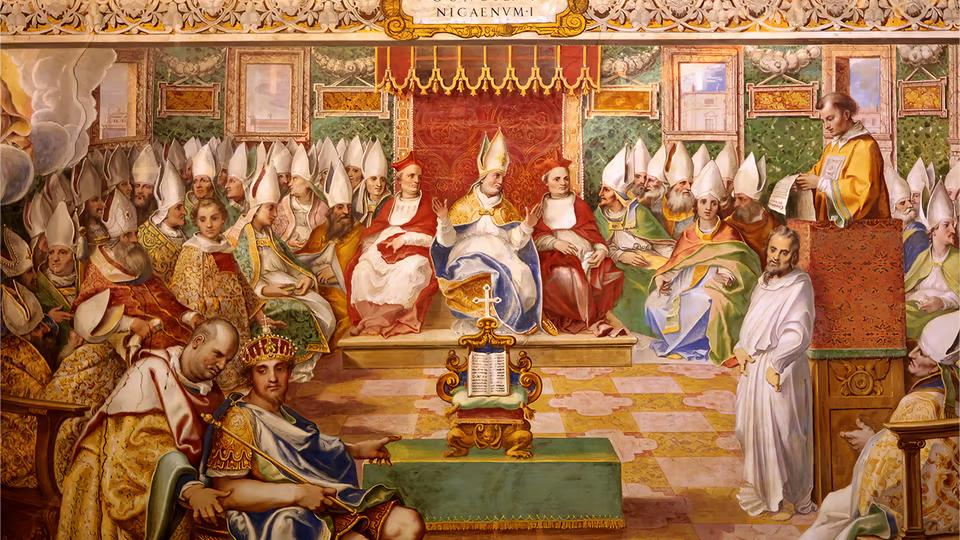
Image: commons.wikimedia.org/Council of Nicaea 325. Fresco in Salone Sistino, Vatican
This year marks the 1,700th anniversary of the Council of Nicaea.
Could a meeting so long ago matter to your life today? You might be surprised.
The legacy of the Council of Nicaea in 325 lingers across the Christian world. Decisions made and precedents established by this council continue to affect the beliefs and practices of billions today.
It’s important to realize that the form of Christianity taught by Jesus and the apostles came under pressure even while the New Testament was being written during the first century. The apostles issued warnings about deceptions and false doctrines entering the Church (see “Was Christianity Designed to Evolve?”).
By the fourth century, the landscape of Christian beliefs was diverse. Authentic, biblical Christianity was hard to find—and things weren’t done changing.
Let’s take a look at what happened 1,700 years ago.
The emperor calls a meeting
The Council of Nicaea was organized by Roman Emperor Constantine. By most accounts, Constantine was not a practicing Christian. His purported adoption and endorsement of Christianity remains a source of debate among historians and scholars. (See our online article “Church History: Constantine, an Emperor Who Defied God.”)
Despite allegedly converting to Christianity in 312, Constantine continued his devotion to Sol Invictus, the Roman sun god.
Historian Alice Bennett notes, “As late as AD 324, coins depicting the sun god were still being minted, twelve years after his [Constantine’s] supposed conversion!” (“Constantine the Great: Pious Christian or Clever Pragmatist?”).
As emperor, Constantine capitalized on the growing interest in the Christian faith. Christian practices often produced responsible, productive, submissive subjects—traits valued by a despot ruling an expansive empire. However, doctrinal disputes and controversies threatened Constantine’s idea of a state-sanctioned religious system.
The end result was a version of Christianity that looked to political leaders for deliverance and guidance rather than to God and Scripture.
In his opening address to the Council, Constantine lamented internecine strife. “An internal sedition in the Church is, in my apprehension, more dangerous and formidable than any war” (Eusebius’ Ecclesiastical History, 1998, p. 395).
Constantine’s concerns tended toward self-preservation and imperial glory rather than doctrinal accuracy. “For Constantine,” Cameron Hughes writes, “it was crucial that the whole Church was united. If it were then his propagation of the Christian faith conferred upon him the divine blessing of the one true God” (“How Did the First Ecumenical Council of Nicaea Change Christianity?”).
That prestige could help the emperor consolidate and expand imperial power.
To stamp out controversy, Constantine summoned clergy from across the empire to meet in Nicaea—a city located in modern Turkey. Their job was to iron out differences and agree on a universal Christian dogma that he would support.
The issues
The Council of Nicaea attempted to address two significant issues: the nature of Jesus Christ and a dispute involving Passover and Easter.
The doctrinal teaching on the nature of Jesus Christ had been stirred into controversy by Arius, a church leader from Alexandria.
Arius gained notoriety by advancing the view that Jesus was merely a created being. According to Eusebius, Arius argued that “if the Father begat the Son, the latter must have had a beginning . . . [and] there was a time when he [Jesus] was not” (Ecclesiastical History).
Arius essentially argued that Jesus was not eternal or divine. The implications of Arianism were staggering. Arius’ teachings were dividing Christian communities.
While many faithful Christians continued to observe Passover and the Days of Unleavened Bread, by 325 many communities had adopted pagan traditions as substitutes for biblical festivals (for example, Easter for Passover).
Another issue addressed was a recurring dispute regarding which should be celebrated—Passover or Easter. Concerns over this question had generated significant debate in the second century between Polycrates (bishop of Ephesus, who held firmly to the teachings of the apostles) and Victor (bishop of Rome).
How did the nonbiblical Easter celebration develop? As Christianity spread in areas where the worship of the Greek and Roman pantheon was the norm, some prospective Christians combined pagan traditions and practices with the Christian faith. (See our online article “What Is Religious Syncretism? Does God Accept It?” for more information on this.)
The development of new holidays such as Easter fostered disputes over which festivals Christians should observe.
Constantine expected the leaders at the Council of Nicaea to resolve these issues.
21st-century relevance
While these debates may seem dusty and ancient, the impact of Nicaea lingers across much of the Christian world.
Certainly, the issues presented to the council needed to be addressed. However, the decisions affirmed by the council would have dire consequences for Christian communities. The Council of Nicaea established a pattern whereby councils or synods could—independent of Scripture—establish dogma.
Consider some of the outcomes that continue to impact the Christian world today.
Scripture takes a backseat
In addressing the questions about the nature of Jesus Christ, the council drifted from scriptural authority.
Soon after the founding of the Church, the true gospel was challenged and subverted by ideas rooted in gnosticism and Greek/Roman religious traditions (Galatians 1:6).
Both Paul and John wrote letters warning about such heresy. See our online article on John’s first epistle as an example. Many church leaders wrestled with creative arguments and mysticism that gnostics peddled as secret knowledge.
Arius developed a significant following by rejecting the eternal nature of Jesus Christ. Arius argued that the Son of God was created, rather than having always existed. His arguments spread across the Roman world. Some religious groups today—Jehovah’s Witnesses, Mormons and Unitarians—still embrace elements of Arianism.
The questions were fair. What is the nature of the Son of Man? Was Jesus created?
And the answers are found in Scripture.
John affirmed Jesus’ eternal existence: “In the beginning was the Word, and the Word was with God, and the Word was God. He was in the beginning with God. All things were made through Him, and without Him nothing was made that was made” (John 1:1-3).
Jesus—the Word—existed for eternity with the Father. Review our online article “Was Jesus Created?” for a longer discussion of this passage.
Other passages confirm Jesus’ eternal nature (1 Corinthians 10:1-4, 9; Colossians 1:16-17; Hebrews 1:2). Jesus acknowledged this fact: “And now, O Father, glorify Me together with Yourself, with the glory which I had with You before the world was” (John 17:5, emphasis added throughout).
Scripture clearly addresses this issue. Scripture should have been enough to establish sound doctrine.
Unfortunately, the Council of Nicaea incorporated ideas and concepts from outside influences to establish doctrine. Some “men of the Church began to explore and interpret the Divinity in new ways, trying to reach conclusions through logic when scripture alone could not explain. Therefore, like the philosophers of classical Greece, metaphysical debates emerged between leading members of the clergy” (“How Did the First Ecumenical Council of Nicaea Change Christianity?”).
Ultimately, the council adopted a Greek word to define Jesus’ nature: homoousios. And yet, rather than adding clarity, the word has instead prompted “long and complicated debates . . . concerning its origin and meaning” (“The Word ‘Homoousios’ From Hellenism to Christianity,” Church History, Vol. 71, Issue 2).
This word is not found in Scripture and yet has become—in the view of many religious organizations—“one of the most important words in the Christian theological vocabulary” (ibid.). This reliance on extrabiblical ideas to establish core doctrine only paved the way for future errors about the nature of God and other doctrines.
Scripture warns against this practice. “If anyone adds to these things, God will add to him the plagues that are written in this book; and if anyone takes away from the words of the book of this prophecy, God shall take away his part from the Book of Life” (Revelation 22:18-19).
The resulting precedent weakened the reliance on Scripture while elevating cultural and philosophical ideas. This precedent would prove dangerous.
This pattern continues today in various traditions. Reliance on human wisdom and reasoning, often informed by cultural or social developments, commonly results in doctrinal tenets and teachings that are unmoored from biblical principles and direct statements of Scripture.
Jesus declared that God’s Word is truth (John 17:17). Right doctrine is to be established by the inspired Word of God (2 Timothy 3:16). Authentic Christianity is rooted in the truth preserved in Holy Scripture.
Unfortunately, the Council of Nicaea lowered the standard. The decision to underpin doctrine with philosophical and cultural concepts sanctioned centuries of error.
More than a calendar
The Council of Nicaea also addressed a few concerns regarding the calendar.
The notion of calendar arguments is likely foreign to many today. The average person’s calendar perspective is no longer tied to celestial cycles, and most haven’t had to deal with several different calendars.
Early Christians observed the festivals established by God—those observed by Jesus, the apostles and converts (see “Christian Festivals”). Those annual festivals were based on the Hebrew calendar. For more information, download our free booklet From Holidays to Holy Days: God’s Plan for You.
Over time, as Christianity spread beyond Jewish communities to areas steeped in Greco-Roman religious practices, the trend toward syncretism—blending religious traditions—began to infiltrate congregations. Check out the Life, Hope & Truth Presents episode “Modern Holidays: Biblical or Pagan?” for more information.
While many faithful Christians continued to observe Passover and the Days of Unleavened Bread, by 325 many communities had adopted pagan traditions as substitutes for biblical festivals (for example, Easter for Passover).
Those communities were keen to remove any association with what they considered Jewish ideas. Those who advocated celebrating Easter desired to divorce the date from any association with a festival celebrated by the Jews.
The festival calendar was ordained by God, followed and endorsed by Jesus, and used to guide the faithful Christians in determining when to observe the festivals of God.
The Council of Nicaea, however, chose to reject Passover in favor of Easter. Review the article “The Holy Days They Changed but Couldn’t Kill” in this issue for more information.
The decision to break free from biblical concepts and practices plunged much of the Christian world into darkness regarding the festivals of God and their significance.
Church and state
Christianity—as presented in Scripture—is centered on the message of the gospel. The gospel Jesus taught was the good news of the coming Kingdom of God.
Jesus eschewed any attempt to make Him King during His earthly ministry. Jesus declared, “My kingdom is not of this world. If My kingdom were of this world, My servants would fight” (John 18:36).
Scripture affirms a Christian’s duty to pray for leaders and submit to civil governments (Romans 13:1-7). This submission is expected unless it would require a Christian to disobey God (Acts 5:29).
The Council of Nicaea erased this distinction. The council was not organized or called by church leaders. Instead, it was arranged and ordered by Emperor Constantine.
“The Council of Nicea was summoned by Emperor Constantine and held in the imperial palace under his auspices. Constantine viewed the Arian teachings—that Jesus was a created being subordinate to God—as an ‘insignificant’ theological matter. But he wanted peace in the Empire he had just united through force” (“325 The First Council of Nicaea,” Christianity Today).
The council’s legacy of mixing human government with religion had devastating consequences. As a result, political leaders manipulated church authority for power, while corrupt religious officials exploited the state for their own gain.
The end result was a version of Christianity that looked to political leaders for deliverance and guidance rather than to God and Scripture. This state-sanctioned Christianity was not the model Jesus taught or the one followed by the apostles and early Church.
Unsurprisingly, the version of Christianity that looked to Rome stopped teaching the true gospel—that Jesus will return to establish His Kingdom on earth and replace all human governments. This message no longer made sense in a church so closely tied to a powerful human government.
Walk in truth
The Council of Nicaea remains an important event that shaped the development of religious thought and practice for centuries—but not always in ways that harmonize with Scripture.
The legacy is a troubling one for those who desire to remain faithful to Scripture and the example of the early Church. Christians should “walk in truth” (3 John 1:4). This requires carefully reviewing doctrines in the light of Scripture rather than the traditions of men.
For further study about what the Bible teaches about the nature of God and the history of the Church, see Getting to Know the God of the Bible and Where Is the Church Jesus Built?
About the Author

Jason Hyde
Jason Hyde serves as the pastor for three congregations of the Church of God, a Worldwide Association. He was ordained as a minister in 2014 and began serving in the full-time ministry in 2025.