.
Problems With Evolution
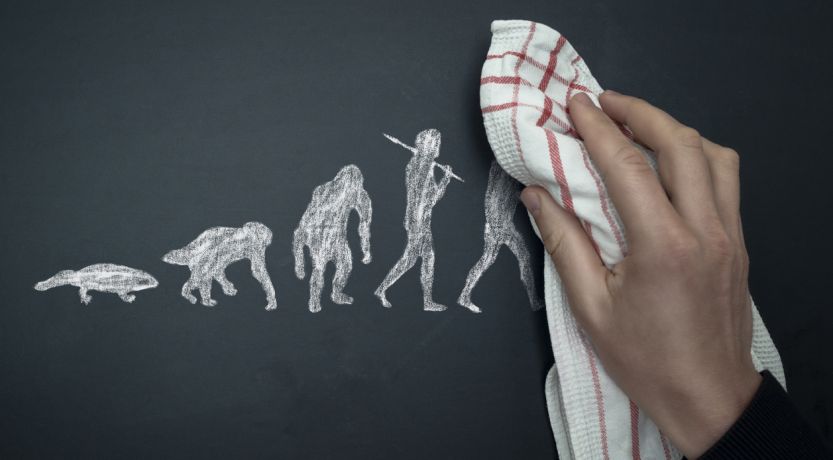 “Do evolutionists believe in evolution solely because of science? Or is it rooted in belief in a materialistic philosophy? Consider the problems with evolution.
Over the last couple hundred years an evolutionary worldview has replaced a biblical worldview in Western science and education.
The Bible contains statements that are quite at odds with many of the accepted “truths” of the modern world.
Creation or evolution?
Often, a person must make a fundamental choice, with no wiggle room for compromise: Do I believe that the Bible is the inspired, inerrant Word of God, and do I therefore believe what is stated in the Bible?
Or do I believe what is confidently taught and believed by fallible human beings—including the majority of the elite, the intellectual leaders, the teachers, the powerful and the trendsetters in the world around me?
The Bible asserts that God created everything, and this has significant implications that will make a real difference for each person.
A prime example of the choice a person must make in what to believe is found in the book of the prophet Jeremiah.
“No more shall every man teach his neighbor, and every man his brother, saying, ‘Know the LORD,’ for they all shall know Me, from the least of them to the greatest of them, says the LORD. For I will forgive their iniquity, and their sin I will remember no more.
“Thus says the LORD, who gives the sun for a light by day, the ordinances of the moon and the stars for a light by night, who disturbs the sea, and its waves roar (the LORD of hosts is His name)” (Jeremiah 31:34-35, emphasis added throughout, except where noted).
 Here is a description in the Bible of a time when all people in the world will personally know (not just know about, but know) the “LORD.” He is the eternal, uncreated, self-existent Creator God of the Bible. He’s the One who created the sun, moon and stars—the One who is the moral judge of mankind (with the authority and power to forgive the sins of people). Is that believable?
Disbelief in God
In today’s world, a person who believes in the literal truth of all aspects of Jeremiah’s statement is in the minority. What the Bible teaches is contrary to what is considered possible by most people.
Jeremiah’s description is a stark contrast to what is commonly believed in today’s world—when so many people don’t really know God at all—primarily because they have doubts that He even exists! It’s obviously hard to know someone when you don’t even believe, with certainty, that he is real.
But why? The impact of evolution on society
And so we ask, what is it that contributes to so much doubt in so many people’s minds that the God of the Bible even exists—and that someday, everyone will know Him personally?
What is it in today’s world—in the foundation of popular culture, politics, entertainment and especially in education—that causes so much doubt in people’s minds as to whether the Creator God of the Bible even exists?
Answer: the theory of evolution.
This idea is nearly universally taught in modern schools, at all levels. It’s the belief that everything in the universe (including the sun, moon and stars and all life) just came into existence—by sheer chance. It is the idea that everything we can perceive came about by undirected forces with no intelligent planning or purpose—caused by no intelligent and powerful and righteous Creator. Thus, no God would be necessary, and no God would judge mankind for its sins or forgive them.
The theory of evolution permeates the modern world. And yet, the idea of evolution is completely inconsistent with what is revealed in the Bible. Accepting the theory of evolution necessitates disbelieving the Bible—or at minimum engaging in the tortuous mental gymnastics of reinterpreting the clear statements of the Bible in such a way as to squeeze evolution into it.
Theistic evolution?
A significant number of Christian denominations have adopted a belief in theistic evolution, which holds that God’s method of creation was to cleverly design a universe in which everything would naturally evolve. Others hold to a belief in directed evolution, in which God had a hand in guiding the evolutionary process.
But these views assume that the biblical description of creation is allegorical rather than literal. For a discussion on these questions, see our articles “Theistic Evolution,” “Can Christians Believe in Evolution?” “How Long Were the ‘Days’ in Genesis 1?” and “The Gap Theory.”
Creation summary
The Bible states that God created the world and all that is in it by speaking the created realm into existence, and that the majesty of what He made should cause those who observe it to glorify and praise Him.
Here are some summary Bible verses about the creation:
- “For in six days the LORD made the heavens and the earth, the sea, and all that is in them, and rested the seventh day. Therefore the LORD blessed the Sabbath day and hallowed it” (Exodus 20:11).
- “By the word of the LORD the heavens were made, and all the host of them by the breath of His mouth. He gathers the waters of the sea together as a heap; He lays up the deep in storehouses. Let all the earth fear the LORD; let all the inhabitants of the world stand in awe of Him. For He spoke, and it was done; He commanded, and it stood fast” (Psalm 33:6-9).
- “Praise Him, sun and moon; praise Him, all you stars of light! Praise Him, you heavens of heavens, and you waters above the heavens! Let them praise the name of the LORD, for He commanded and they were created” (Psalm 148:3-5).
- “The heavens declare the glory of God; and the firmament shows His handiwork” (Psalm 19:1).
Evolution summary
Evolution-based teaching presents quite a different story. It is the story that nothing became everything long ago, beginning with a quantum fluctuation—a Big Bang—all matter, energy, time and space emerging from an infinitesimally small compaction. (No real explanation for how this could come into existence without a Creator can be offered.)
Then all sorts of things are hypothesized to have happened that have never been observed, and that violate all known laws of physics. This was followed by stars and galaxies assembling themselves together. Followed much later by non-living chemicals somehow (no one knows how) becoming alive. Followed by single cells mutating and eventually developing, over eons of time, through various intermediate life-forms, into modern human beings.
No scientist has observed any of this happening. But that is the story. And the God of the Bible is not a part of it. It all happened by itself, with no guidance, no intelligence, no purpose. It just happened.
Evolution as a religion
The evolutionary ideology and worldview is much more than a scientific theory. It is, in fact, a religion—a competing religion to the religion of the Bible—with nothing in it but matter and energy and its own set of miracles.
It has its own assumptions, which pointedly invalidate and suppress the conclusions that should be obvious from examining the marvels of the physical world. It flatly contradicts the Bible’s account of the origin of the world.
In the stark terms of the Bible, the theory of evolution is “foolish” and a “lie” (see Romans 1:25 and surrounding verses).
What greater lie could there be than the one that claims that the ultimate cause of everything that can be seen doesn’t even exist? And yet, it dominates our modern world. Science curricula require the teaching of evolution to all students in much of the world’s formal education system.
But is it based on real science?
Regarding the development of living things, the “Neo-Darwinian Synthesis” is an attempt to update Charles Darwin’s 1859 theory (published in his book On the Origin of Species) with the modern findings of genetics. Darwin’s book sought to explain the variety of life-forms, from simple to complex, through natural processes entirely.
Charles Darwin’s book sought to explain the variety of life-forms, from simple to complex, through natural processes entirely.
No intelligent, wise and powerful Creator God was necessary, according to Darwin. He theorized that unguided and unintelligent forces in nature itself (“natural selection”) would see to it that small differences between life-forms would be “selected” if those differences conveyed some sort of reproductive advantage. And thus those creatures that had somehow been endowed with these advantageous differences would survive, and those without them would die out.
Darwin proposed that in this process, over great periods of time, one sort of creature would gradually develop and gain advantages and turn into another sort of creature.
The source of all those small, cumulative, advantageous changes was unknown to Darwin. In more modern times, evolutionary proponents point to random mutations as a source. The information needed to build and maintain living things is found in the DNA in their cells. When cells divide and when organisms reproduce, this DNA code must be copied. The occasional random errors that take place in this copying process are called mutations.
Thus, the modern theory of biological evolution assumes that life somehow began (no one knows how), and then simple life changed into more and more complex forms of life through mutation and natural selection. All this was theorized to occur gradually, over immense periods of time.
No God was involved in this process. No intelligence. No purpose. Thus, in the theory, there are no divine standards to guide humans morally, or to which they are accountable.
Faith in evolution
Evolution’s advocates acknowledge that it is a religion—and they are zealous for their faith in it.
Michael Ruse, an atheist and evolution-believing professor of philosophy and zoology who taught at the University of Guelph in Canada for 35 years before accepting a position at Florida State University, wrote the following in Canada’s National Post:
“Evolution is promoted by its practitioners as more than mere science. Evolution is promulgated as an ideology, a secular religion—a full-fledged alternative to Christianity, with meaning and morality. I am an ardent evolutionist and an ex-Christian . . .
“The literalists are absolutely right. Evolution is a religion. This was true of evolution in the beginning, and it is true of evolution still today. . . Evolution therefore came into being as a kind of secular ideology, an explicit substitute for Christianity” (“How Evolution Became a Religion: Creationists Correct?” May 13, 2000).
Humanist beliefs oppose Christianity
If there is no Creator God, then man looks to himself as a god—thus the modern philosophy of humanism.
The American Humanist Association listed six “primary beliefs” of humanism in its 2003 Humanist Manifesto III. The second of these beliefs is, “Humans are an integral part of nature, the result of unguided evolutionary change” (“Humanism and Its Aspirations,” American Humanist Association, 2003).
Secular humanists have a zeal to spread their belief in evolution, especially through the public schools. In their zeal, they see it as their mission to eventually win the battle of beliefs and to stand triumphant over the “rotting corpse of Christianity.” They don’t hide their agenda, as seen in the following statement.
“I am convinced that the battle for humankind’s future must be waged and won in the public school classroom by teachers who correctly perceive their role as the proselytizers of a new faith: a religion of humanity that recognizes and respects the spark of what theologians call divinity in every human being. These teachers must embody the same selfless dedication as the most rabid fundamentalist preachers, for they will be ministers of another sort, utilizing a classroom instead of a pulpit to convey humanist values [including a belief in evolution] in whatever subject they teach, regardless of the educational level—preschool day care or large state university.
“The classroom must and will become an arena of conflict between the old and the new—the rotting corpse of Christianity, together with all its adjacent evils and misery, and the new faith of humanism . . .
“It will undoubtedly be a long, arduous, painful struggle replete with much sorrow and many tears, but humanism [and its fundamental principle of evolution] will emerge triumphant. It must if the family of humankind is to survive” (John Dunphy, “A Religion for a New Age,” The Humanist, January-February 1983).
Is it science at all?
So, is this science? Or, is it not an antibiblical, godless philosophy—a religion opposed to Christianity? Is it entirely objective? Do the observations and measurements of the natural world lead scientists inevitably to these conclusions—as summarized in the theory of neo-Darwinism?
Or was an agenda driving the development of the theory of evolution from the start—back to Darwin’s day, and even before?
What do leading proponents of the theory have to say about all of that? Consider the following statements by leading zealous proponents of the modern theory of evolution.
Richard Lewontin, a leading evolutionist, author, geneticist and retired professor of biology at Harvard University, wrote:
“We take the side of science in spite of the patent absurdity of some of its constructs, in spite of its failure to fulfil many of its extravagant promises of health and life, in spite of the tolerance of the scientific community for unsubstantiated just-so stories, because we have a prior commitment, a commitment to materialism.
“It is not that the methods and institutions of science somehow compel us to accept a material explanation of the phenomenal world, but, on the contrary, that we are forced by our a priori adherence to material causes to create an apparatus of investigation and a set of concepts that produce material explanations, no matter how counter-intuitive, no matter how mystifying to the uninitiated. Moreover, that materialism is absolute, for we cannot allow a Divine Foot in the door” (“Billions and Billions of Demons,” The New York Review, Jan. 9, 1997, p. 31, emphasis in original).
Thomas Nagel wrote:
“I want atheism to be true . . . It isn’t just that I don’t believe in God and, naturally, hope that I’m right in my belief. It’s that I hope there is no God! I don’t want there to be a God; I don’t want the universe to be like that. My guess is that this cosmic authority problem is not a rare condition and that it is responsible for much of the scientism and reductionism of our time. One of the tendencies it supports is the ludicrous overuse of evolutionary biology to explain everything about human life, including everything about the human mind . . . This is a somewhat ridiculous situation” (The Last Word, 1997, pp. 130-131).
Professor Nagel is an American intellectual and professed atheist. He is professor of philosophy and law, emeritus, at New York University, where he taught from 1980 to 2016. Later in life, he controversially questioned materialism as the answer for all things, including human consciousness, and in so doing raised the ire of his fellow evolution-believing atheists.
Stephen J. Gould wrote: “The extreme rarity of transitional forms in the fossil record persists as the trade secret of paleontology.”
Stephen J. Gould wrote:
“The extreme rarity of transitional forms in the fossil record persists as the trade secret of paleontology . . . To preserve our favored account of evolution by natural selection we view our data as so bad that we never see the very process we profess to study” (“Evolution’s Erratic Pace,” Natural History, May 1977, 86:14).
Dr. Gould was an American paleontologist, evolutionary biologist and historian of science. He admitted that the evidence to support the evolutionary story just isn’t there—certainly not in the fossil record. He was one of the modern world’s most influential and widely read authors on the subject of evolution. Gould taught at Harvard University and worked at the American Museum of Natural History in New York.
D.M.S. Watson said, “Evolution itself is accepted by zoologists not because it has been observed to occur or . . . can be proved by logically coherent evidence to be true, but because the only alternative, special creation, is clearly incredible” (quoted in Herbert Schlossberg, Idols for Destruction: Christian Faith and Its Confrontation With American Society, [1983] 1993, pp. 144-145).
Dr. Watson was a professor of zoology and comparative anatomy at University College, London.
Scott C. Todd wrote, “Most important, it should be made clear in the classroom that science, including evolution, has not disproved God’s existence because it cannot be allowed to consider it (presumably). Even if all the data point to an intelligent designer, such an hypothesis is excluded from science because it is not naturalistic. Of course the scientist, as an individual, is free to embrace a reality that transcends naturalism” (“A View From Kansas on That Evolution Debate,” Nature, Vol. 401, Sept. 30, 1999, p. 423).
This statement by Professor Todd highlights an important modern reality. The term science has been co-opted by the evolutionist academic and intellectual elite to exclude God and the supernatural, by definition!
Playing the game by these rules means that anyone who disbelieves the theory of evolution, and who instead believes the biblical account of creation, is “unscientific.”
Scientific flaws in evolution
Even though evolutionists have defined the Creator God out of the discussion, they are still left with devastating weaknesses in their theory. Other articles on this website address many of these problems. In briefest summary, some of the problems are these.
The links between kinds of creatures are missing.
Darwin’s theory postulates innumerable in-between life-forms as life evolved from single-cell creatures to man. It was true in Darwin’s day, and it remains true today—the fossil record is full of holes. The innumerable missing links are still missing!
The biblical account is true. Each “kind” of creature reproduces after its kind—never changing into a completely different kind (Genesis 1:11-12, 21, 24-25). There is variety within biblical “kinds”—within definite limits of variability—but no evidence has ever been found of one kind giving rise to another. Cows give birth to cows. Fish produce fish. Birds produce birds. Roses generate new roses.
Even among evolutionists this is known and admitted. Harvard Professor Stephen J. Gould wrote, “The absence of fossil evidence for intermediary stages between major transitions in organic design, indeed our inability, even in our imagination, to construct functional intermediates in many cases, has been a persistent and nagging problem for gradualistic accounts of evolution” (“Is a New and General Theory of Evolution Emerging?” Paleobiology, Winter 1980, p. 127).
Life—including the molecular machinery of life at the cellular level—is far too complex and obviously designed to have developed by the unguided process of natural selection acting on random mutations.
The “irreducibly complex” molecular machines in living cells—consisting of many precisely fitted parts, all of which must be present for these biomechanical machines to function—cannot possibly be constructed and “selected” one small step at a time. All the parts have to be present and properly assembled from the start for these machines to support life.
No one has a clue as to how the first life could have come into being, without the biblical Creator.
Though evolutionists may speculate about a chemical soup in ancient oceans, in which certain chemicals randomly attached themselves to each other to make the first living cell, no scientist has been able to reproduce this in a laboratory, or even describe in detail the steps by which it could possibly have happened.
Evolution probability
Even the most optimistic odds are against evolution.
Various researchers have concluded that the odds of chemicals coming together to produce life by chance are vanishingly small. Even evolutionists admit this. British astronomer Sir Fred Hoyle estimated the odds of even one step along the way from chemicals to a living cell by random chance at one in 1040,000 (Fred Hoyle and Chandra Wickramasinghe, Evolution From Space, 1981, p. 148).
One evolutionist, information theorist Hubert Yockey, on the faculty of the University of California at Berkeley, put it this way: “The origin of life by chance in a primeval soup is impossible in probability in the same way that a perpetual [motion] machine is in probability. The extremely small probabilities calculated in this chapter are not discouraging to true believers [i.e., committed evolutionists, those who choose to believe it simply because they want it to be true] . . . [however] a practical person must conclude that life didn’t happen by chance” (Information Theory and Molecular Biology, 1992, p. 257).
Some evolutionists, when honestly considering the impossibility of life beginning on earth from random processes, take the next step and speculate that life then must have begun in outer space. Then it must have somehow arrived on earth via comets or alien spacecraft or other means, then developed further here through Darwinian processes!
Included among the well-known evolutionists who, at some points in their careers, have postulated about some sort of outer space origin for life on earth are Hoyle, Francis Crick (codiscoverer of the structure of DNA), and physicist Stephen Hawking.
The information needed to build and maintain living things is found in their DNA. The occasional random errors that take place when the DNA is copied are called mutations. And mutations are nearly always harmful.
The thinking here, apparently, is that the odds are so small that it could have begun on earth that it is ridiculous to even consider it, so maybe it started in outer space and was brought to earth. But that doesn’t solve the problem. It only speculates that the incredibly unlikely event of a chance beginning of life here on earth could have better odds somewhere else in the universe—a notion with absolutely no scientific basis.
Mutations and natural selection
Mutations—the alleged source of new genetic information to allow life to develop from single cells into all of today’s the complex organisms—are nearly always degradative, destroying information from the genome, not adding to it.
Mutations harm and set life back, instead of being the engine that pushes it forward. This is the conclusion of many studies. A good summary of this material is found in the recently published book Darwin Devolves, by American biochemist and author Michael Behe (2019).
Natural selection culls out, but doesn’t create.
The very process of natural selection accounts for the elimination and extinction of life-forms that are not “fit” enough for survival, but it has never been shown to lead to upward development of life-forms, beyond fairly strict limits.
Famed evolutionist Lynn Margulis acknowledged as much. “Natural selection eliminates and maybe maintains, but it doesn’t create” (“Discover Interview: Lynn Margulis Says She’s Not Controversial, She’s Right,” discovermagazine.com, June 16, 2011).
This once again vindicates the biblical principle of creatures being able to reproduce within narrow bounds set by God—“after their kind.”
Blind pitiless indifference
Evolution is a religion of despair and one that offers no hope or purpose or cheer.
It’s all so dispiriting. The high priests of the religion of neo-Darwinian evolutionary theory may claim that it is true and liberating, and they do indeed have a zeal to proselytize and spread their religion—especially to young, impressionable minds in school. However, they seem to know that it is an utterly bleak idea.
Cambridge University evolutionary biologist, atheist and author Richard Dawkins put it this way:
“The total amount of suffering per year in the natural world is beyond all decent contemplation . . . It must be so . . . In a universe of blind physical forces and genetic replication, some people are going to get hurt, other people are going to get lucky, and you won’t find any rhyme or reason in it, nor any justice. The universe that we observe has precisely the properties we should expect if there is, at bottom, no design, no purpose, no evil and no good, nothing but blind pitiless indifference” (River Out of Eden: A Darwinian View of Life, p. 131-133, 1995).
Not to be outdone in spreading the anti-cheer of evolutionary theory, atheist professor of evolutionary biology William Provine said:
“There are no gods, no purposeful forces of any kind, no life after death. When I die, I am absolutely certain that I am going to be completely dead. That’s just all—that’s gonna be the end of me. There is no ultimate foundation for ethics, no ultimate meaning in life, and no free will for humans, either” (Darwinism: Science or Naturalistic Philosophy? video, 1994).
Does science prove evolution?
As we have seen, committed and leading evolutionists have arbitrarily and arrogantly redefined “science” in such a way that:
- It excludes even the possibility of the God of the Bible being the creator of the world.
- Their “science” thus must support evolution, because it’s the only game in town.
Evolution is their religion and their faith. They choose to believe their theory (and disbelieve the Bible) because they want it that way.
However, as the many quotes in this article have demonstrated, no one need be held mentally captive to the theory of evolution nor feel intimidated into thinking that the evidence for evolution is overwhelming. It isn’t. Precisely the opposite is true.
A sound-minded person has the freedom to choose to believe the truth—that this marvelous world, in all its complexity, is indeed the product of design by a powerful and brilliant Creator—Jeremiah’s LORD.
We can base our religion on truth, instead of the falsehood of evolutionary theory. To do so does not make us ignorant or mean we have to reject the evidence and facts of science.
Evolution and Christianity
What a person chooses to believe is important. The stakes are pretty high.
One evolutionist expressed it in stark terms: “The most devastating thing though that biology did to Christianity was the discovery of biological evolution. Now that we know that Adam and Eve never were real people the central myth of Christianity is destroyed. If there never was an Adam and Eve there never was an original sin. If there never was an original sin there is no need of salvation. If there is no need of salvation there is no need of a savior. And I submit that puts Jesus, historical or otherwise, into the ranks of the unemployed. I think that evolution is absolutely the death knell of Christianity” (Frank Zindler, American atheist, in a debate with William Craig, Atheism vs Christianity video, 1993).
Another atheist evolutionist, the famous historian and science fiction writer H.G. Wells, made the same ominous point long ago.
“For since the creation of the world His invisible attributes are clearly seen, being understood by the things that are made” (Romans 1:20).
Discussing the undeniable ramifications of the theory of evolution, he wrote, “If all the animals and man had been evolved in this ascendant manner, then there had been no first parents, no Eden and no Fall. And if there had been no fall, then the entire historical fabric of Christianity, the story of the first sin and the reason for an atonement, upon which the current teaching based Christian emotion and morality, collapsed like a house of cards” (The Outline of History—Being a Plain History of Life and Mankind, fourth revision, Vol. 2, 1925, p. 616,).
God has the last word
The words of the apostle Paul, referred to earlier, are appropriate as a concluding summary.
“For the wrath of God is revealed from heaven against all ungodliness and unrighteousness of men, who suppress the truth in unrighteousness, because what may  be known of God is manifest in them, for God has shown it to them. For since the creation of the world His invisible attributes are clearly seen, being understood by the things that are made, even His eternal power and Godhead, so that they are without excuse, because, although they knew God, they did not glorify Him as God, nor were thankful, but became futile in their thoughts, and their foolish hearts were darkened.
“Professing to be wise, they became fools, and changed the glory of the incorruptible God into an image made like corruptible man—and birds and four-footed animals and creeping things . . . [they] exchanged the truth of God for the lie, and worshiped and served the creature rather than the Creator, who is blessed forever. Amen” (Romans 1:18-23, 25).” From: https://lifehopeandtruth.com/god/is-there-a-god/proof-of-god/problems-with-evolution/?
________
This cancer-causing chemical may be lurking in your bread
 “Potassium bromate is a possible human carcinogen added to the flour of many packaged baked goods.
- Potassium bromate is banned in several countries, including Brazil, Canada, the European Union and the United Kingdom.
- Despite health concerns, potassium bromate is legal for use in the U.S., and the FDA hasn’t reviewed it since at least 1973.
Many packaged baked goods are made with flour that may contain potassium bromate, an additive linked to cancer. The chemical is added to flour to strengthen dough and allow it to rise higher, benefits that have led many U.S. companies to embrace it.
EWG has identified over 130 different products that contain potassium bromate, including Best Choice Wheat Sliced Bread, Gomez Flour Tortillas, Hy Vee Blueberry Crisp and Balducci's Sugar Cookies, among others. The use of this additive in the U.S. is widespread and legal, even though it’s been banned in other countries because of health concerns.
In 1999, the International Agency for Research on Cancer, echoing findings in several studies, determined potassium bromate is a possible human carcinogen.
In ab tests<?XML:NAMESPACE PREFIX = "[default] http://www.w3.org/2000/svg" NS = "http://www.w3.org/2000/svg" />,l animals exposed to it had increased incidences of both benign and malignant tumors in the thyroid and peritoneum, the membrane that lines the abdominal cavity. Later research found that ingesting potassium bromate resulted in significant increases in cancer of the animals’ thyroid, kidneys and other organs.
Because of these health concerns, potassium bromate is not allowed for use in several countries, including the United Kingdom, Canada, Brazil and the European Union. California requires food with potassium bromate to carry a warning label.
Even with plenty of evidence showing potassium bromate’s potential to harm human health, it’s still legal for use in food sold in the U.S.
The food industry has long argued that potassium bromate isn’t a concern in baked products, because in theory the baking process fully converts it into potassium bromide, a similar yet non-carcinogenic chemical. But tests in the U.K. found that potassium bromate remains detectable after baking, with all six unwrapped breads and seven out of 22 packaged breads tested found to have measurable levels.
Potassium bromate was first approved for use in the U.S. by the Food and Drug Administration in the 1960s. In 1973, the FDA announced a planned literature review of the additive, but it’s unclear whether the review was completed, and the chemical hasn't been assessed since.
Absent federal action, California has taken measures to warn residents of potassium bromate’s dangers. The additive has been on the state's Proposition 65 list since 1990, so products containing it must carry a cancer warning. But no other regulatory agency has acted to regulate or remove potassium bromate from grocery store shelves.
Get Your Free Guide: EWG's Guide to Food Additives Link at: https://www.ewg.org/news-insights/news/2022/05/cancer-causing-chemical-may-be-lurking-your-bread Stay informed by signing up to receive email tips, action alerts, promotions to support our work and more from EWG. You can opt-out at any time.
Our broken food chemical review system
The U.S. food additive review system fails repeatedly to keep Americans safe and needs an overhaul if it is to protect us from potentially cancer-causing chemicals like potassium bromate.
Congress is considering legislation that aims to break through the regulatory standstill. The Food Chemical Reassessment Act of 2021<?XML:NAMESPACE PREFIX = "[default] http://www.w3.org/2000/svg" NS = "http://www.w3.org/2000/svg" />, introduced by Rep. Jan Schakowsky (D-Ill.), would help bolster our food regulatory system. If enacted, the bill would create an Office of Food Safety Assessment within the FDA to confirm that chemicals that entered the food supply chain through legal loopholes, or were reviewed by the FDA decades ago, are still safe to eat. The bill identifies 10 chemicals for immediate reassessment, including potassium bromate.
While we await the passage of this bill or new federal action, consumers can minimize exposure to potassium bromate by checking food labels and avoiding products that use it. You can also check our Food Scores database to find alternatives without potassium bromate.” From: https://www.ewg.org/news-insights/news/2022/05/cancer-causing-chemical-may-be-lurking-your-bread
_________

 “Did you know that honey contains a substance that helps the human brain work better?


 “Why are some of the most prosperous people some of the least satisfied? What is the real secret of satisfaction and contentment?