Showing posts with label Christ. Show all posts

Thursday, December 11, 2025

How the Bible Came Together.

.

How The Bible Came Together

How the Bible came together“Many professing Christians find the Bible a mysterious book filled with ancient writings that can seem of little relevance in our digital age, but our Creator is a God for every age and his purpose and goal for mankind has never changed.

The modern western world is often referred to as a “post-Christian” society, with few being taught the Bible is the Word of God, and that we should be living by the instructions found within its pages (Matthew 4:4). As the Apostle Paul wrote to his fellow minister Timothy in 2 Timothy 3:16-17: “All Scripture is given by inspiration of God, and is profitable for doctrine, for reproof, for correction, for instruction in righteousness, that the man of God may be complete, thoroughly equipped for every good work.”

It is important to have a general knowledge of how the books of the Holy Bible came together and to be assured that the canon–the group or list of books that are considered to be inspired by God–are inspired by God and contain the books that it should.

The books of the Bible (originally on scrolls) were written by various historians, priests, prophets and kings over a period of at least 1600 years. Their writings cover events such as the Creation and Flood; the histories of Israel, Judah and their respective kings; God’s rules and regulations for living healthy and fulfilling lives, instructions on how to strengthen our relationships with God and our fellow man; and prophecies concerning the future salvation of the vast majority of human beings through Jesus Christ.

Chapter breaks were only added in the thirteenth century and verses in the sixteenth century. These additions sometimes do marginal damage to the text, for example a chapter break can occur in the middle of an account, but have the great advantage of making it easier to find various passages quickly.

The books of the Old and New Testaments were written and canonized beginning in the 15th century BC with the Pentateuch (the first five books of the Bible) and finishing near the end of the first century after Christ with the book of Revelation. No historian has left an account of the steps taken in this long process. However, we do have titbits of information here and there that give us some knowledge regarding what took place.

The Old Testament or Hebrew Bible

Over the thousand years during which it was written, the Old Testament underwent at least five periods of canonization. Ezra, a priest and scribe, apparently was the one responsible for the final collection and arrangement of the books of the Hebrew Bible (what we call the Old Testament) around 450 B.C. With this canonization the Old Testament was essentially complete.

Jesus Christ affirmed His acceptance of the three divisions of the Old Testament – Law, Prophets and Writings (or Psalms after its first and largest book) – as canonical. Notice His statement in Luke 24:44: “These are the words which I spoke to you while I was still with you, that all things must be fulfilled which were written in the Law of Moses and the Prophets and the Psalms concerning Me.”

The New Testament

No one is certain how the New Testament canon came together. In A.D. 397 the Synod of Carthage confirmed as canonical the 27 books of our New Testament, but it really only recognized that these books had been in use and read in the churches for some three centuries.

One theory maintains that the Apostles Paul, Peter and John were the final canonizers of the New Testament and that John, with the help of other believers, was able to finalize and distribute copies of the entire 27 books to the churches in Asia Minor and the Holy Land.

This view is supported by several New Testament passages. Peter, writing to the early Church, commented that he considered the letters of Paul part of the “Scriptures” (2 Peter 3:15-16), putting the writings of the Apostle Paul on an equal footing with the Old Testament Scriptures. This indicates that the Apostles already considered some of their writings to be divinely inspired and deserving of inclusion in the canon of Holy Scripture.

Paul appears to have helped in selecting which books and letters, particularly of his writings, were to be preserved for us. In 2 Timothy 4:13 he asks Timothy to “Bring the cloak that I left with Carpus at Troas when you come – and the books, especially the parchments.”  This is a puzzling request, unless Paul was asking Timothy to bring books and letters from which he would select those that would be part of the canon.

Some of his letters, such as the one to the church in Laodicea mentioned in Colossians 4:16, were not preserved. Presumably those Paul chose were then passed on to other Apostles. It seems most likely that the Apostle John, who outlived all the other apostles, under God’s inspiration made the final selections of the writings that would be included as Scripture in what we know as the New Testament.

In the final chapter of the final book of the Bible, John gives a warning that appears to indicate that the Bible was then complete with nothing more to be added or taken away. “If anyone adds to these things, God will add to him the plagues that are written in this book; and if anyone takes away from the words of the book of this prophecy, God shall take away his part from the Book of Life, from the holy city, and from the things which are written in this book” (Revelation 22:18-19).

Which Bible translation is best?

More than 60 English-language versions of the Bible are available. Scholars divide them into three broad types: word-for-word, meaning-to-meaning (also called thought-for-thought) and paraphrased. Usually a particular Bible version will explain, on its introductory pages, which approach was used in preparing it. Word-for-word versions most accurately follow the Hebrew, Aramaic and Greek texts.

Generally speaking, the King James Version and its modern counterpart, the New King James Version, are word-for-word translations. Meaning-to-meaning versions, such as the New International Version (NIV) can be valuable in putting the Scriptures into more understandable wording. The Revised English Bible, Good News Bible and New Living Translation are other popular meaning-to-meaning translations.

Paraphrased Bibles, such as The Living Bible or The Message, can also be useful. Their goal is to make the Bible even easier to read in modern language. However, caution is needed when working with these, because the authors exercised considerable “poetic license” in interpreting biblical terms and passages according to their own personal religious ideas. Paraphrased versions can be consulted to better grasp the story flow, but should not be relied upon exclusively to establish doctrine or for accurately determining the meaning of any text.

Many Bible versions are now also available as part of Bible software packages or for free viewing on various Internet sites, enabling the reader to compare different versions nearly instantaneously. With the Word of God so freely available, the most important factor is that we actually read it and learn to live by it.”  From: https://ucg.org.uk/wp-content/uploads/2019/07/Supplement-MayJune-2019.pdf

_______

    Monday, September 29, 2025

    Rahab’s Lie. A Great Blessing. Making America Healthy Again.

    .

    Rahab’s Lie

    Rahab’s lie“When the spies approached Jericho Rahab and the Canaanites had already heard stories of the Red Sea crossing 40 years before. The Israelites had also completely destroyed the Amorites just east of the Jordan (Joshua 2:10) and now they were camped on Jericho's doorstep.

    'When the soldiers arrived she did not betray them. ‘There were two men here but I did not know who they were,’ she explained, ‘at dusk before the city gate was closed they left and I don’t know where they are heading.’ (freebibleimages.org)

    While most of the people of Jericho were faint with fear, Rahab recognized who was behind the Israelite successes: “I know that the Lord has given you the land...for the Lord your God, He is God in heaven above and on earth beneath” (Joshua 2:9 and 11). Rahab hid the Israelite spies and lied to the king of Jericho (Joshua 2:4-5). Joshua then spared her and her household “because she hid the messengers…” (Joshua 6:25). God also miraculously kept her walls from tumbling down when the other walls surrounding Jericho were reduced to ruble.

    Hebrews 11, the faith chapter, tells us the reason why Rahab did this: “By faith the harlot Rahab did not perish with those who do not believe, when she had received the spies with peace” (verse 31). But was it OK for her to lie in those circumstances?

    The Nelson Study Bible states: "A lie is a lie, and...Rahab's action was wrong.... Rahab sinned no matter how noble her intentions. Of course, in her case, her sin is understandable because she lacked complete knowledge of the living God. That is, what she did was wrong, but she did not know any better. We must be careful to make a distinction between Rahab's faith and the way Rahab expressed it. The Bible praises Rahab because of her faith in God, not because of her lying. That is, her actions would have been more noble had she protected the spies in some other fashion…" ("In Depth: Lying").

    The United Church of God’s Bible Commentary (see the link below) explains it clearly: “Some view the Bible’s praise of Rahab as an endorsement of her lying…. Based on this, they argue that it is okay to lie when it is ‘for a good cause.’ However, that is simply not the case—ever….”

    The Israelites accepted Rahab and her family into the nation of Israel (Joshua 6:25). Over time, she would have learned the laws of God and come to serve Him more completely, repudiating the mistakes of her past. She eventually married Salmon, a prominent member of the tribe of Judah. King David would descend from them and eventually Jesus Christ (Ruth 4:20-21).

    Lying is never a trivial matter for a Christian: “Who may climb the mountain of the Lord? Who may stand in his holy place? Only those whose hands and hearts are pure, who do not worship idols and never tell lies" (Psalm 24:3-4 NLT). God's law makes it clear that lying is never acceptable (Proverbs 12:22), and we are told God “cannot lie” (Titus 1:2). We should bear in mind that Rahab is commended for her faith (Hebrews 11:31) not her lying and realize that she would grow in faith and the knowledge of God’s way of life.

    _________

    A Great BlessingA great blessing

    “The desire for revenge, retaliation and mudslinging is reflected in our entertainment and society in general. In spite of the fact we are told to forgive, many seek an active or passive form of revenge against their real or perceived enemies.

    The sacrifice of Jesus Christ paid the death penalty earned by mankind as a result of sin. "But God demonstrates His own love toward us, in that while we were still sinners, Christ died for us.... when we were enemies we were reconciled to God through the death of His Son..." (Romans 5:8-10). God expects us to develop this same attitude of mercy, graciousness and forgiveness. He will not forgive our sins if we are unforgiving toward others.

    "And forgive us our debts, as we forgive our debtors.... For if you forgive men their trespasses, your heavenly Father will also forgive you. But if you do not forgive men their trespasses, neither will your Father forgive your trespasses" (Matthew 6:12,14-15). II Timothy 3:1-4 includes being unforgiving in the list of characteristics people will exhibit in the “perilous times” prevalent in the “last days” just before Jesus Christ returns to earth.

    When a woman caught in adultery was brought to Jesus the Scribes and Pharisees demanded: “'Teacher, this woman was caught in adultery...Moses, in the law, commanded us that such should be stoned. But what do You say?'  This they said, testing Him, that they might have something of which to accuse Him.”  Jesus’s response was, “'He who is without sin among you, let him throw a stone at her first.' And…those who heard it, being convicted by their conscience, went out one by one…When Jesus had raised Himself up and saw no one but the woman, He said to her, 'Woman, where are those accusers ... .Has no one condemned you?' She said, 'No one, Lord.' And Jesus said to her, 'Neither do I condemn you; go and sin no more'" (John 8:1-11).

    Another example showing Christ expects us to develop a forgiving attitude occurred when Peter asked, “‘…how often shall my brother sin against me, and I forgive him? Up to seven times?' Jesus answered, “…up to seventy times seven'" (Matthew 18:21-22). The Apostles were stunned at this statement and answered, “‘Increase our faith.’” (Luke 17:5).

    The parable in Matthew 18:23-35 illustrates the consequences of being unforgiving. The account of the forgiven servant persecuting someone who owed him a pittance in comparison with the amount he had just received forgiveness for is a lesson for us. Christ warned the unforgiving servant his attitude was unacceptable, pointing out: "Should you not also have had compassion on your fellow servant, just as I had pity on you?' (verse 33).

    This is not to say we cannot make a judgment regarding other people's actions as to whether or not we should follow their example, but we cannot read minds and hearts. Christ instructs us not to judge others: "Judge not, that you be not judged... First remove the plank from your own eye, and then you will see clearly to remove the speck from your brother's eye" (Matthew 7:1 and 5). Luke 6:36-37 reinforces this admonition: "Judge not, and you shall not be judged. Condemn not, and you shall not be condemned. Forgive, and you will be forgiven" (Luke 6:37).

    Proverbs 19:11 states, “it is his [our] glory to pass over a transgression” (King James Version). Jesus' example just before His death sets the standard for us as far as forgiveness is concerned: "When Jesus was being crucified and in agony He prayed: Father, forgive them, for they do not know what they do" (Luke 23:34). When we forgive, we reflect the Father’s love, giving us the opportunity to extend to others the great blessing God has extended to us.

    Source: United News (May 2001)   From: https://www.ucg.org/members/united-news/united-news-may-2001/where-do-you-draw-line-sand

    ________

    Here’s My 2 Cents: "Making America Healthy Again"

    Dr. Eric Berg says:

    “Robert F. Kennedy is receiving a lot of pushback for his ideas on health and reform. As secretary of the Department of Health and Human Services, his ideas would radically change the US healthcare system. In this video, I’m going to share some of the changes I would make to address the current healthcare crisis and improve America’s health.

    RFK has the following goals for healthcare reform in America: RFK healthcare policy 1:22 Institutional foods 2:35 Subsidized foods 3:54 Vote for me! 4:25 GRAS 5:00 Food fortification 5:35 Tax money and drugs 6:55 End the rounding rule 7:47 Sun phobia

    He will be actively working against big food companies, big chemical companies, and big pharma, so naturally, he’s getting a lot of pushback. The U. S. spends over 4.1 trillion dollars each year on healthcare, yet we’re at the bottom as far as health. Why? Here's what I think can improve America’s health! 

    1. Change the institutional foods.  Prepackaged foods are given to people in nursing homes, prisons, schools, hospitals, and other public institutions. These institutional foods are very low-quality, highly processed foods. The health of the people in these institutions would quickly improve by simply removing the refined sugars, starches, and oils from their diets.

    2. Address the subsidized foods.  Subsidized foods are paid for by taxpayers. Corn, soy, wheat, sugar, and rice are the most highly subsidized foods. Changing the types of foods that are subsidized and investing in small farmers can significantly improve this problem.

    3. Changing GRAS.  “Generally Recognized As Safe” is a term used by the FDA for products that have been safety tested by their own manufacturers. To avoid conflict of interest, these tests should be conducted by third-party independent companies.

    4. Change food fortification.  Synthetic folic acid and iron fortification of food can cause serious problems for many people.

    5. Disallow tax dollars from being used for drugs.  Every year, 40 billion dollars of taxpayer money is used to pay for medical research to develop new drugs.

    6. The rounding rule. If a product contains less than .5 grams of an ingredient, it can be rounded down to 0. This is misleading and should be eliminated. People need to be more aware of what's really in their food. Companies also need to be forced to raise the quality of the ingredients in their products.

    7. End sun phobia Sun phobia paired with low RDAs for vitamin D is contributing to massive vitamin D deficiency in the population, putting people at risk for disease.”  More at: https://www.drberg.com/blog/heres-my-2-cents-making-america-healthy-again

    __________

    Friday, August 15, 2025

    Danger, Fake News. Heeding an Alarm: The Texas Tragedy Still Haunts Us. The Same Diet That’s Anti-Cancer Is Also Anti-Heart Disease And Anti-Lung Disease.

    .

    image

    Fake News in the Church? It Started in a Garden...

    “Fake news isn’t new.

    In fact, the very first fake news story was broadcast in the Garden of Eden when Satan told Eve:
    “You will not surely die...” (Genesis 3:4)

    That was a lie — and it’s been spreading ever since.

    Christ called Satan the father of lies (John 8:44), and to this day, he remains the invisible broadcaster behind every slander, whisper, distortion, and deception — including many that make their way right into the Church of God.

    In a world trained to doubt everything and mock everyone, the spirit of fake news has crept in among God’s people — not just through media, but in our conversations, our comments, our posts, and even our fellowship.

    Let’s be real:
    Gossip, rumors, harsh opinions, character assassinations — these are all modern forms of false witness, and they violate the Ninth Commandment:

    “You shall not bear false witness against your neighbor.” (Exodus 20:16)

    Even if something is “technically” true, if it’s told with the intent to damage, divide, or discourage — it becomes spiritual fake news.

    God hates it.

    “A lying tongue… a false witness who speaks lies… and one who sows discord among brethren.” (Proverbs 6:16–19)

    It’s easy to fall into it.
    We’ve all heard it — maybe we’ve even spread it.

    That’s why we must wake up and take spiritual inventory.

    Christ didn’t just speak truth — He was the Truth (John 14:6).
    As His followers, we must reflect that same Spirit of truth — in our words, our tone, our posts, and even in our private conversations.

    So ask yourself:

    Do I speak negatively about others?

    Do I pass on things I haven’t personally confirmed?

    Do I allow cynicism or distrust to shape my attitude in the Church?

    Cynicism isn’t harmless. It damages your faith and erodes others’. It causes stumbling — and Christ warned that causing a brother to stumble is no small thing (Matthew 18:6).

    This isn’t about being naïve. It’s about being spiritually responsible.
    We must not become the carriers of a spiritual virus that Satan uses to weaken the Church from within.

    So here’s the challenge:

    ▸ Don’t engage in or pass along gossip
    ▸Speak well of others when possible — and stay silent when it’s not
    ▸Change the subject when others veer negative
    Choose your words — and your thoughts — carefully

    “Let all that you do be done with love.” (1 Corinthians 16:14)
    “To him who overcomes I will grant to sit with Me on My throne.” (Revelation 3:21)

    You were called to truth — not just to know it, but to live it.

    Let’s overcome the spirit of fake news — and be vessels of faith, clarity, and peace.

    With sincerity and encouragement in Christ,
    Bob Schenfield

    __________

    Heeding an Alarm: The Texas Tragedy Still Haunts Us

    “Have you ever heard an emergency alarm sound and ignored it?  I have.
    I remember the alarm system when I was young in my hometown. A weather alert would come on the television or the radio. Those were the only two systems we had. Because my mother had once experienced a tornado, and we had a next-door neighbor who took the alarms seriously and came knocking on our door, we took it seriously. We would go to our basement until the alarm passed.

    Recently, I visited my hometown. One night, storms came through, spawning tornadoes, and the tornado alarms went off. The town now has a system of very loud alarms. When the alarms sounded my wife and I did nothing. We turned over and went back to sleep. Fortunately, nothing occurred. I am alive to write this piece.

    I am still digesting the recent flooding tragedy in south Texas along the Guadalupe River. Every time I think of the young girls who were swept away in the dark of night, I grieve for their families. The whole incident haunts us. The region will take a long time to recover. Parents and family of the dead will never fully recover.

    Could the devastating loss of life have been prevented? Had it occurred in daylight, rather than the early hours of morning when all were asleep, the number of casualties would certainly have been reduced. It happened when it did, when people were sleeping and evidently the only alarm system was on people’s cell phones. When you are asleep it is difficult to hear and heed an alarm.

    I read that Kerr County, Texas, where this occurred is about the size of the state of Rhode Island (1,107 square miles) and only has 54,000 inhabitants. Rhode Island has more than a million people. Emergency services were likely tailored to the size and resources of the population. They proved inadequate.

    What do we learn from this tragedy?

    I will pay more attention to the sounding of an alarm, whether it is a tornado, fire or other emergency. It is the right thing to do. One day danger will strike. If we prepare even a small amount, it can save a life.

    I have thought about the biblical references to the coming of the Lord as a “thief in the night.”  This phrase is used in four locations in the New Testament. Revelation 16:15 says, “Behold, I am coming as a thief. Blessed is he who watches, and keeps his garments, lest he walk naked and they see his shame.” (Luke 21:34; 1 Thessalonians 5:4; 2 Peter 3:10; Revelation 3:3).

    The metaphor is striking—“a thief in the night.”  While we sleep—when we are least able to hear and respond to danger.
    These scriptures refer to spiritual watchfulness.
    The events of the Day of the Lord will begin suddenly. Spiritual deception is high. World events suddenly shift. These biblical references speak to preparedness, alertness and righteous works.
    My lack of reaction to a local alarm tells me I may need to study these scriptures again.
    There is much to learn.” From: https://mailchi.mp/ucg/heeding-an-alarm-texas-tragedy?e=72c729d811

    __________

    The same diet that’s anti-cancer is also anti-heart disease and anti-lung disease.

    “Following cancer prevention guidelines for lifestyle and diet may increase longevity.

    Adherence to cancer prevention recommendations isn’t just associated with higher survival in cancer patients and lower risk of dying from cancer, but lower risk of dying overall. That’s the beauty of eating a more plant-based diet.

    Thirty to 50 percent of common cancers are preventable with diet and lifestyle. We have the power to change our health destiny.

    A healthy lifestyle that includes a diet rich in fruits, vegetables, whole grains, and legumes may help reduce the number of breast cancer incidences, for example.

    The American Institute for Cancer Research recommendations include maintaining a healthy weight, exercising, and eating a diet rich in whole grains, vegetables, fruits, and beans, while limiting fast food, processed junk, meats, soda, and alcohol.

    Specific to breast cancer, those who met most of those recommendations only had half the risk, compared to individuals who only met a couple. If you could only do one of those recommendations, limiting animal foods seems most protective. Adherence to the recommendations is also associated with higher survival in people who already have cancer.

    Higher dietary fiber consumption was associated with a 37 percent lower risk of dying from all causes put together and a 28 percent lower risk of dying specifically from breast cancer among breast cancer survivors––and it didn’t take much. There was about a 10 percent drop in death risk for every increment of 5 daily grams of dietary fiber. That’s like a cup of oatmeal or broccoli, or just a third of a cup of beans.

    Watch the video “Diet and Lifestyle for Cancer Prevention and Survival” at see.nf/3O4GyAa

    _______

    Sunday, June 29, 2025

    Simon The Magician. A Great Blessing. God Cares About What We Eat.

    .

    Simon The Magician

    Simon the Magician“Simon the Magician came from the Middle East, but his religious cult expanded over a wide area perverting the teachings of Jesus Christ. He is mentioned in the book of Acts and founded a counterfeit Christianity promoting false ideas and doctrines.

    After Jesus' crucifixion, death and resurrection His followers spread the Gospel message. A disciple named Philip taught in Samaria, an area not far from Jerusalem, and many people began to respond to his message.

    During his time in Samaria Philip came in contact with a pagan religious leader known as Simon the Magician, who is described in Acts 8:9-10: “But there was a certain man, called Simon, which beforetime in the same city used sorcery, and bewitched the people of Samaria, giving out that himself was some great one. To whom they all gave heed, from the least to the greatest, saying, "This man is the great power of God.”

    Many of Simon's followers believed Philip's message about Jesus as the prophesied Messiah, and were baptized. Even Simon himself professed to be a Christian and he too was baptized (Acts 8:12-13). A short time later the Apostles Peter and John traveled to Samaria to teach the new converts and lay hands upon them so they would receive the Holy Spirit (Acts 8:17-19). When Simon saw the people were given God's Spirit, he offered the Apostles money to give him this power. (This is the origin of the English word ‘simony’, which refers to the selling and buying of religious offices.)

    The biblical account doesn't say Simon wanted to give up his false teachings or even change his way of life. What he wanted was power (Acts 8:19). The Apostles knew this and called him a man of “...bitterness, and in the bond of iniquity” rejecting his request (Acts 8:23). After this, Simon Magus (magus means magician or sorcerer) disappears from the biblical account, but he continued to lead his religious cult, adding elements of the teachings of Jesus to his pagan-Jewish mixture, and becoming part of a movement to create a paganized Christianity.

    Simon carried his message from city to city, just as Christ’s Apostles spread the true Gospel. He translated the doctrine of grace as license to disobey God’s law. The Encyclopaedia Britannica, 11th edition, Vol. 25, states, in its article titled “Simon Magus,” that he identified with the “Hellenized Gnosticism of Samaria.” The article referred to him as the “Samaritan Messiah” and the “father of all heresy.” The Samaritans had been placed in the land from which the northern kingdom of Israel had been taken captive by the Assyrians. These Samaritans had been brought from Babylon and continued to practice their ancient Babylonian religion, mixed with other religions.

    The belief, at the heart of Simon's heresy, was he could receive power from God without changing his ways. The religious movement became known as gnosticism, and in the New Testament this false teaching is referred to as ‘lawlessness’.  Even today many believe the law of God was done away by the sacrifice of Jesus Christ. The Apostle Paul maintained this approach was already gathering momentum during his lifetime, "For the mystery of lawlessness is already at work..." (2 Thessalonians 2:7).

    The Ten Commandments define the most basic behaviors of love. Do not steal. Do not lie. Do not murder. 1 John 5:3 very plainly tells us that love is keeping the commandments. In the Sermon on the Mount, Jesus expanded the meaning of the word ‘love’ beyond the simple letter of the law. For example he explained obedience to the commandment "do not murder" entailed learning not to hate, because hatred is the root cause of murder.

    Nearly 300 years after Peter confronted Simon, a bishop named Eusebius lamented the Simonian cult still existed: "It is an astonishing fact that this is still the practice of those who to the present day belong to his (this) disgusting sect. Following in…. [Simon's] footsteps they slip into the church like a pestilential and scabby disease, and do the utmost damage to all whom they succeed in smearing with the horrible, deadly poison concealed on them" (The History of the Church by Eusebius.)

    Even after Simon died in AD 68 his greatest heresies were still infecting Christianity hundreds of years after he is mentioned in the book of Acts. One of the reasons God inspired Luke to record these events is because Christians will be combating the "mystery of lawlessness" until the return of Jesus Christ. No wonder the Apostle John warns Christians: “Beloved, believe not every spirit, but try the spirits whether they are of God: because many false prophets are gone out into the world” (1 John 4:1)

    _______

    A Great Blessing

    A great blessing“The desire for revenge, retaliation and mudslinging is reflected in our entertainment and society in general. In spite of the fact we are told to forgive, many seek an active or passive form of revenge against their real or perceived enemies.

    The sacrifice of Jesus Christ paid the death penalty earned by mankind as a result of sin. "But God demonstrates His own love toward us, in that while we were still sinners, Christ died for us.... when we were enemies we were reconciled to God through the death of His Son..." (Romans 5:8-10). God expects us to develop this same attitude of mercy, graciousness and forgiveness. He will not forgive our sins if we are unforgiving toward others.

    "And forgive us our debts, as we forgive our debtors.... For if you forgive men their trespasses, your heavenly Father will also forgive you. But if you do not forgive men their trespasses, neither will your Father forgive your trespasses" (Matthew 6:12,14-15). II Timothy 3:1-4 includes being unforgiving in the list of characteristics people will exhibit in the “perilous times” prevalent in the “last days” just before Jesus Christ returns to earth.

    When a woman caught in adultery was brought to Jesus the Scribes and Pharisees demanded: “'Teacher, this woman was caught in adultery...Moses, in the law, commanded us that such should be stoned. But what do You say?' This they said, testing Him, that they might have something of which to accuse Him.” Jesus’s response was, “'He who is without sin among you, let him throw a stone at her first.' And…those who heard it, being convicted by their conscience, went out one by one…When Jesus had raised Himself up and saw no one but the woman, He said to her, 'Woman, where are those accusers ... .Has no one condemned you?' She said, 'No one, Lord.' And Jesus said to her, 'Neither do I condemn you; go and sin no more'" (John 8:1-11).

    Another example showing Christ expects us to develop a forgiving attitude occurred when Peter asked, “‘…how often shall my brother sin against me, and I forgive him? Up to seven times?' Jesus answered, “…up to seventy times seven'" (Matthew 18:21-22). The Apostles were stunned at this statement and answered, “‘Increase our faith.’” (Luke 17:5).

    The parable in Matthew 18:23-35 illustrates the consequences of being unforgiving. The account of the forgiven servant persecuting someone who owed him a pittance in comparison with the amount he had just received forgiveness for is a lesson for us. Christ warned the unforgiving servant his attitude was unacceptable, pointing out: "Should you not also have had compassion on your fellow servant, just as I had pity on you?' (verse 33).

    This is not to say we cannot make a judgment regarding other people's actions as to whether or not we should follow their example, but we cannot read minds and hearts. Christ instructs us not to judge others: "Judge not, that you be not judged... First remove the plank from your own eye, and then you will see clearly to remove the speck from your brother's eye" (Matthew 7:1 and 5). Luke 6:36-37 reinforces this admonition: "Judge not, and you shall not be judged. Condemn not, and you shall not be condemned. Forgive, and you will be forgiven" (Luke 6:37).

    Proverbs 19:11 states, “it is his [our] glory to pass over a transgression” (King James Version). Jesus' example just before His death sets the standard for us as far as forgiveness is concerned: "When Jesus was being crucified and in agony He prayed: Father, forgive them, for they do not know what they do" (Luke 23:34). When we forgive, we reflect the Father’s love, giving us the opportunity to extend to others the great blessing God has extended to us.

    ________

    God Cares About What We Eat.

    God cares about what we eat“God’s instructions to mankind concerning the food we should eat was an established law of God long before the time of the Mount Sinai covenant (See Leviticus 11 and Deuteronomy 14).

    Noah was aware of these laws at the time of the flood. When God told him in Genesis 7:2, “You shall take with you seven…pairs of every kind of clean animal…and one pair of every kind of unclean animal….” He did not explain which creatures were clean and unclean because Noah already knew.

    Act 10:13-35 describes a dream the Apostle Peter had ten years after Christ’s crucifixion, in which he initially thought God was instructing him to eat unclean food. It is clear from Peter’s reaction the Apostles did not think Christ had abolished the food laws of Leviticus 11 and Deuteronomy 14. His response was: "Not so, Lord! For I have never eaten anything common or unclean" (Acts 10:14). Peter eventually correctly understood the significance of his dream was that God’s message of salvation applies to all nations, and He was calling people from all races and backgrounds. “...God has shown me that I should not call any man common or unclean (verse 28).” Shortly thereafter Peter baptized the first uncircumcised gentiles God called into the Church (Acts 10:34-35; 45-48).

    The account in Mark 7 is also often misunderstood and thought to indicate the food laws in Deuteronomy and Leviticus no longer applied in the New Testament era. However, the topic of discussion here is food in general, as Mark 7:2 points out: “Now when they (the Pharisees) saw some of His disciples eat bread with defiled, that is, with unwashed hands, they found fault." They then asked Jesus, "Why do Your disciples not walk according to the tradition of the elders, but eat bread with unwashed hands?" (verse 5).

    In Mark 7:18-19 Jesus explained: “...whatever enters a man from outside cannot defile him because it doesn’t enter his heart, but his stomach, and is eliminated….” Many modern translations of the New Testament erroneously insert additional words into the text of Mark 7:18-19. The New International Version ends verse 19 with the comment: "In saying this, Jesus declared all foods 'clean'." The New King James Version has "thus purifying all foods."   The food laws are not in question here. The disciples were being criticized for not following ceremonial hand-washing procedures and, after decrying the hypocrisy of this and other religious practices, Jesus describes the attitudes that defile us “... out of the heart of men, proceed evil thoughts, adulteries, fornications, murders, thefts, covetousness, wickedness, deceit, licentiousness, an evil eye, blasphemy, pride, foolishness. All these evil things come from within and defile a man" (Mark 7:21-23). Some of these same qualities are listed in Galatians 5:19-21 as "works of the flesh." They are contrasted with the "fruit of the Spirit" which are listed as: "Love, joy, peace, longsuffering, kindness, goodness, faithfulness, gentleness [and] self-control…." (Galatians 5:22-23).

    Many also believe Romans 14 tells us Christians are free from all former biblical restrictions regarding the meats they may eat. They cite as proof verse 14 in which Paul wrote, "I know and am convinced by the Lord Jesus that there is nothing unclean of itself; but to him who considers anything to be unclean, to him it is unclean." This approach, however, fails to consider the context of Paul's letter as well as the specific Greek words he used.

    The food controversy here was over meat sacrificed to idols. The Romans of the day commonly offered both meat and wine to idols, with portions of the offerings later being sold in the marketplace. Some thought there was nothing wrong with eating this meat, while others had a guilty conscience about it. Paul explained those whose consciences were not troubled by eating meat that might have been ceremonially offered to idols could go ahead and eat it as long as they did not offend others who may believe it was a wrong thing to do. Paul instructs, "..let each be fully convinced in his own mind" (Romans 14:5) because "...whatever is not from faith is sin" (Romans 14:23). (See our article Does Romans 14 Abolish God’s Law About Clean And Unclean Meats for a more detailed explanation of these scriptures and the Greek words Paul used here.)”

    _________

    Monday, May 5, 2025

    It's Called Irreducible Complexity. What Does It Mean To Be Redeemed? Bee Facts.

    .

    Biblical Creation's Post

    “One of the most difficult things for evolutionists to explain. Yes it's been asked before, but bears repeating.

    It's called irreducible complexity. You can't remove one part or the whole thing fails. Also, you have to be fit to survive in the first place. The earth could be 100 trillion years old and that's still not enough time for macro evolution to occur. If you go to any anthropology department and ask them for proof of one kind changing into another kind, they have nothing.

    You could give Darwin the benefit of the doubt, but now we have millions of fossils and nothing demonstrates one kind changing into another. The truth of it is it's a religion claiming there is no God and when you get rid of God then you're responsible to no one. It takes a lot of faith, more than I have to believe everything is here by accident.

    What a sad way to live to believe you're here by accident, your life has no purpose and when you're gone it will never have mattered you existed. This kind of belief is why kids are destroying kids in school.”

    No photo description available.

    https://youtu.be/aA-FcnLsF1g

    Biblical Creation  ·  From:

    odnprsoteS55r21ua3b62c2Ft9,320uua g0hy9mfu23 ir4e0790u3aag8h 

    _________

    What does it mean to be redeemed?

    “In a Psalm of repentance David prayed: "Create in me a clean heart, O God, and renew a steadfast spirit within me" (Psalms 51:10), and in Psalm 69:18 he asked his Creator to "draw near to my soul, and redeem it."

    In another Psalm King David exclaimed "When I kept silent, my bones grew old through my groaning all the day long. For day and night Your hand was heavy upon me ...[Finally] I acknowledged my sin to You ...I said, 'I will confess my transgressions to the LORD,' and You forgave the iniquity of my sin" (Psalms 32:3-5).

    Redemption is bound up with the sacrifice of Jesus Christ. To redeem is to buy back, whether as a purchase or a ransom price. With regard to Christ's shed blood, redemption essentially means deliverance from death by means of payment of high price. After repentance, which is a firm resolve to turn away from sin, and the admission of our guilt, God promises to totally forgive all our transgressions, because of the sacrifice of Jesus Christ (John 3:16).

    David looked ahead to the sacrifice of Jesus Christ, and we are told that Abraham, Isaac and Jacob will be in the Kingdom of God (Matthew 8:11), as they were redeemed in advance by Christ's sacrifice. The Apostle Peter tells us just how high a price Christ paid for our redemption: "... you were not redeemed with corruptible things like silver or gold... but with the precious blood of Christ, as of a lamb without blemish and without spot" (1 Peter 1:18-19), and Paul adds, "... we have redemption through His blood, the forgiveness of sins" (Colossians 1:14).

    An important aspect of our redemption lies in the future. The book of Hebrews tells us that "with His own blood He [Christ] entered the Most Holy Place once for all, having obtained eternal redemption" (Hebrews 9:12). This passage introduces us to the concept of eternal redemption—encompassing everlasting life in God's Kingdom.

    Jesus spoke of our redemption to eternal life in the prophecy He gave to His disciples on the Mount of Olives shortly before His death. "Then they will see the Son of Man coming in a cloud with power and great glory. Now when these things begin to happen, look up and lift up your heads, because your redemption draws near" (Luke 21:27-28). This occurs at the second coming of Christ when those who have faithfully served God over the centuries, will be resurrected to eternal life (1 Corinthians 15:22-23; 1 Thessalonians 4:16-17).

    Redemption cancels out our sins through the blood of Christ and also looks forward to everlasting life in the Kingdom of God, when our physical bodies will be transformed from flesh into spirit (1 Corinthians 15:50-54). In the last book of the Bible the Apostle John quotes the 24 elders (powerful angelic beings residing in heaven) as singing a new song about Christ to His Church. "...You were slain, and with your blood you purchased men for God from every tribe and language and people and nation. You have made them to be a kingdom and priests to serve our God, and they will reign on the earth" (Revelation 5:9-10, NIV).

    It is always an important moment when an individual admits their sins to God and firmly resolves to turn away from their former life of sin and strive to obey God. Redemption is eternal in its effects, and ultimately means everlasting life in the Kingdom of God.”

    From: https://www.ucg.org/good-news/good-news-magazine-march-april-2005/what-does-it-mean-be-redeemed

    _________

    Bee Facts.

    No photo description available.“Did you know that honey contains a substance that helps the human brain work better?

    - Did you know that honey is the ONLY food on earth that can sustain human life alone?

    - Did you know that a teaspoon of honey is enough to sustain human life for 24 hours?

    - Did you know that propolis produced by bees is the most powerful natural antibiotic?

    -Did you know that honey has no expiration date?

    - Did you know that to gain 1 kg. treasure, do you need the nectar of more than 1,000,000 flowers?

    - Did you know that there is a special wooden spoon for honey, and not a metal one?

    -Did you know that bee grazing is the healthiest food in the world?

    - Did you know that pollen can have over 1500 colours and shades?

    - Did you know that the bodies of the world's great emperors were buried in coffins of gold and then covered with honey to avoid rotting?

    - Did you know that bees are the ONLY insects that produce food for humans?

    - Did you know that the mother (queen) puts twice her weight in eggs in one day?

    - Did you know that bees flap their wings more than 11,000 times per minute?

    - Did you know that the only honey that can be enjoyed by people allergic to beekeeping products is manuka honey.

    -Did you know that Manuka honey is the best honey for women?

    - Did you know that acacia honey is not sweetened?

    Did you know that?

    A bee lives less than 40 days, visits at least 1000 flowers and produces less than a teaspoon of honey, but for her it is a lifetime!”

    THANK YOU BEES, FOR THE DEDICATION... ������

    ________

    Tuesday, January 21, 2025

    God Rules With Strength and Gentleness. Want to Live to 100? Eat More Beans!

    .

    God Rules With Strength and Gentleness

    Isaiah 40:10-11

    Behold, the Lord GOD shall come with a strong hand, and His arm shall rule for Him; behold, His reward is with Him, and His work before Him. He will feed His flock like a shepherd; He will gather the lambs with His arm, and carry them in His bosom, and gently lead those who are with young.

    “These two verses condense a tremendous amount of information about how God will rule when Jesus Christ returns to establish the Kingdom of God on this earth.

    The book of Revelation explains that as Jesus Christ is coming down to this earth, the armies of the nations of this world will attack Him as if He were an alien invader (Revelation 19:19). Christ’s response to these unprovoked attacks will be with “a strong hand,” as He forcefully puts down the rebellion and makes it clear who is in charge (Revelation 19:20-21).

    But that is just one aspect of Jesus Christ’s rule. Isaiah mentions that He will bring a “reward” with Him for His faithful followers who will then assist Him in “His work” of teaching His way of life to the survivors of the end-time troubles.

    Isaiah 40:11 is a beautiful picture of our all-powerful God gently gathering people like little lambs and feeding and caring for them.

    God is both strong and gentle at the right times. He wants us to learn to follow His lead in this area of life as well.”          Listen to the "Verse by Verse" episode covering this scripture at:  https://lifehopeandtruth.com/bible/blog/god-rules-with-strength-and-gentleness/?

    For more about Isaiah 40, see “God’s Perspective on Prophecy.” For more about how God will rule in the Kingdom of God, see the articles in our “Kingdom of God” section. 

    _________

    It's time to get to know God. Start your 7-day guided Journey.

    ________

    Want to Live to 100? Eat More Beans!

    Eat beans and live 100“Want to know how to live to 100? Eat plenty of beans, says plenty of research studies on the longest-living populations in the world.

    Campodimele, Italy, a hilltop village south of Rome, has so many centenarians that it’s known in Europe as the “Village of Longevity.” Daily, its citizens enjoy a diet full of beans like lentils, chickpeas, and white beans.

    How to live to 100

    A few years ago, scientists identified five groups of long-lived elderly people (aged 70 and older) – Japanese in Japan, Swedes in Sweden, Anglo-Celtic people in Australia, and Greeks in both Greece and Australia – and observed them for the next seven years, tracking their health status and food choices among nine different categories: vegetables, legumes, fruits, nuts, cereals, dairy products, meat, fish, and monounsaturated fats. A total of 785 elderly people were followed.

    Eating Beans May Help You Live To 100Nowadays, there are many tasty varieties of beans on the market, not only staples like garbanzos but also choices like cranberry, cannellini, and fava beans. Eat beans and live longer, maybe even live to 100.
    The researchers found that legumes were the most important dietary predictor of survival among the elderly, “regardless of their ethnicity,” they wrote.* For every 20-gram increase in daily legume intake (20 grams is about three-quarters of an ounce), “there is a 7 to 8% reduction in mortality hazard ratio.”

    You’d be hard-pressed to find a more perfect food than beans. They are an excellent source of protein, vitamins, minerals, and complex carbohydrates. They’re very low in fat and virtually sodium-free. Plus, they’re filling.

    And fiber? Even the lowest-fiber bean puts most other foods to shame. A cup of high-fiber beans, like pinto or black beans, tallies up 16 grams of fiber.You’d have to eat about eight slices of whole-wheat bread to get the same amount of fiber. And it’s primarily cholesterol-reducing soluble fiber, which makes beans an excellent heart-healthy alternative to meat.

    Bean prep these days has gotten so much easier, thanks to the ready availability of cans of already-cooked beans, and you can find many “no salt added” varieties, which is really wonderful for keeping blood pressure under control. If all you can find is salted varieties, get rid of some of the salt by rinsing the beans through a colander.

    Here are some simple tips for how to get more beans into your life (and how to live to 100):
    • Toss a handful of beans into your salads (try the rich, buttery flavor of cannellini  beans)
    • Stir beans into your pasta sauces or soups. Make an easy, sensational bean soup by combining canned white beans, any vegetables you already have, low-sodium chicken stock, and chopped fresh Italian parsley. Season with no-salt-added Italian blend seasonings and 1 tablespoon of low-sodium soy sauce. Bring to a boil and simmer for about 15 minutes.
    • Fold beans, like black and pinto beans, into corn tortillas with salsa, shredded nonfat jalapeno cheese, and shredded lettuce.
    • Puree beans for dips. For a zesty Mexican-style dip, combine pinto beans, chopped red onion, fresh cilantro leaves, and lime juice in a food processor and blend. Whip up your own delicious and inexpensive hummus dip in a processor with just five ingredients: two garlics, one can of no-salt-added garbanzo beans, three-quarter teaspoon sesame oil, two tablespoons plain nonfat yogurt, and two tablespoons fresh lemon juice.
    Source:   https://www.pritikin.com/your-health/healthy-living/eating-right/539-want-to-live-to-be-100-eat-more-beans.html

    * Asia Pacific Journal of Clinical Nutrition, 2004; 13 (S): S126.

    _________

    Tuesday, December 31, 2024

    Are New Year Celebrations Pagan in Origin?

    .

    image

    Spike Mafford/Photodisc/Thinkstock

    Are New Year Celebrations Pagan in Origin?

    “Simply put, the answer is yes—New Year celebrations did originate in paganism.

    Much of the symbolism associated with New Year’s celebrations today has very definite pagan origins.

    In the earliest days of the Church (the first and second centuries after Christ) there were no such celebrations as Christmas and New Year’s Day.

    The New Catholic Encyclopedia states: “According to the hypothesis . . . accepted by most scholars today, the birth of Christ was assigned the date of the winter solstice (December 25 in the Julian [Roman] Calendar, January 6 in the Egyptian), because on this day, as the sun began to return to northern skies, the pagan devotees of Mithra celebrated dies natalis Solis Invicti (birthday of the invincible sun)” (1967, Vol. 3, p. 656).

    Those customs carried over in the observance of Christmas (with its many traditions and practices steeped in paganism), and the “birth” of the “new year” of the sun. This is why the Roman calendar in use today designates Jan. 1 as the beginning of the new year as opposed to God’s designation of the spring month of Abib or Nisan on the Hebrew calendar as the beginning of the year (Exodus 12:1-2).

    Much of the symbolism associated with New Year’s celebrations today has very definite pagan origins. Kissing at the moment of transition to the next year is rooted in pagan sexual practice and superstition. And evergreen wreaths associated with Christmas were originally part of the pagan Calend celebration of Jan. 1.

    Because we live in this secular society and most of the world operates according to the commonly used Roman calendar, it’s common to think of a new calendar year as beginning Jan. 1. Yet involvement in the celebration of that is not appropriate.

    That said, one should be careful not to become too judgmental if, for example, someone is viewing a football game or parade at that time of year—as opposed to actually celebrating a New Year festival.

    If you’d like to learn more, many resources are available that show the pagan origins of New Year’s Day celebrations. You can find related material in reference encyclopedias and online research resources as well.”  From:  https://www.ucg.org/learn/bible-questions-and-answers/are-new-year-celebrations-pagan-origin

    ________

    Sunday, December 22, 2024

    It is Not OK! The Lamb of God

    .

    460954255_122113445492503299_5515890[2]

    _________

    The Lamb of God

    John 1:29

    The next day John saw Jesus coming toward him, and said, “Behold! The Lamb of God who takes away the sin of the world!”

    The unblemished lambs sacrificed in the Old Testament could not take away sin. They were only a reminder of Jesus Christ’s true purity and innocence. As our Creator (John 1:3), His life is worth far more than all human lives combined. Only His death could pay all the penalties and truly remove sin from those who repent.

    The apostle Paul referred to Jesus Christ in a similar way. “For indeed Christ, our Passover, was sacrificed for us” (1 Corinthians 5:7). The Passover lambs, along with all the other sacrificial lambs, represented the sacrifice of Christ.

    Study more about the Lamb of God and His sacrifice in our article “Sacrifice of Jesus.”  To listen to the "Verse by Verse" episode covering this scripture go to: https://lifehopeandtruth.com/bible/blog/the-lamb-of-god-1/

    ________

    Sunday, June 23, 2024

    Did Jesus Reaffirm All 10 Commandments? Lipstick Contaminated with Lead?

    .

    Did Jesus Reaffirm All 10 Commandments?


    “Does a Christian have to keep all of the 10 Commandments? Some believe the answer is no—that if Jesus didn’t reinforce a commandment, it’s no longer binding. Is this true?

    Did Jesus Reaffirm All 10 Commandments?In last month’s column, we asked, “Did Jesus’ Commandments Replace the 10 Commandments?” We looked at the idea that the 10 Commandments were replaced by the simpler new commandment of Jesus to love others. We showed that the new commandment didn’t abolish the 10 Commandments, but was Jesus’ example of how to show love to others. Love has always been the intent of the 10 Commandments.

    But there is another common misunderstanding we need to examine: the idea that only the specific commandments Jesus reaffirmed are required for us today.

    Let’s take a deeper look at this premise and see if it aligns with what Jesus taught.

    Did Jesus need to reaffirm each commandment?

    First, consider this: Did Jesus say that only the commandments He specifically mentioned are binding on Christians? That is easy to answer: No. If you read the Gospel accounts, you will find no such statement.

    Did Jesus say that all of the Commandments would remain intact and relevant? In fact, He did. Shortly after giving the Beatitudes, Jesus addressed “the Law” and “the Prophets” and whether or not He came to abolish all or parts of them.

    Let’s dissect what He said in Matthew 5:17-19:

    • Do not think that I came to destroy the Law or the Prophets. I did not come to destroy but to fulfill” (verse 17).

    Jesus plainly said He did not come to “destroy” the law. The Greek word translated destroy (Greek, katalyo) can also be translated “dissolve,” “demolish,” “abrogate” or “deprive of force.” Instead of abolishing the law, He came to fulfill (pleroo) it—which means to “make full,” “fill up” or “accomplish.” Not only did He come to fulfill Old Testament prophecies, He also came to perfectly obey the 10 Commandments and, by doing so, fill them with greater meaning and relevance—just as the Messiah was prophesied to do (Isaiah 42:21).

    • “For assuredly, I say to you, till heaven and earth pass away, one jot or one tittle will by no means pass from the law till all is fulfilled” (Matthew 5:18).

    Jesus used this graphic figure of speech to reinforce His previous statement. As long as heaven and earth exist, not the smallest detail (a jot was the smallest letter in the alphabet and a tittle was a small stroke used in writing) would pass away from God’s law. This reinforces every detail of the 10 Commandments. (See also our online article “Did Jesus Fulfill the Law?”)

    • “Whoever therefore breaks one of the least of these commandments, and teaches men so, shall be called least in the kingdom of heaven; but whoever does and teaches them, he shall be called great in the kingdom of heaven” (verse 19).

    Jesus made it personal by saying that anyone who knows better yet teaches against any of God’s commandments will not be in God’s Kingdom (compare Matthew 5:20 and 19:17). The Greek word translated “break” means to loose, destroy or dissolve. Sadly, this strongly worded warning applies to many professing Christian leaders who teach their followers that all or parts of the 10 Commandments were abolished.

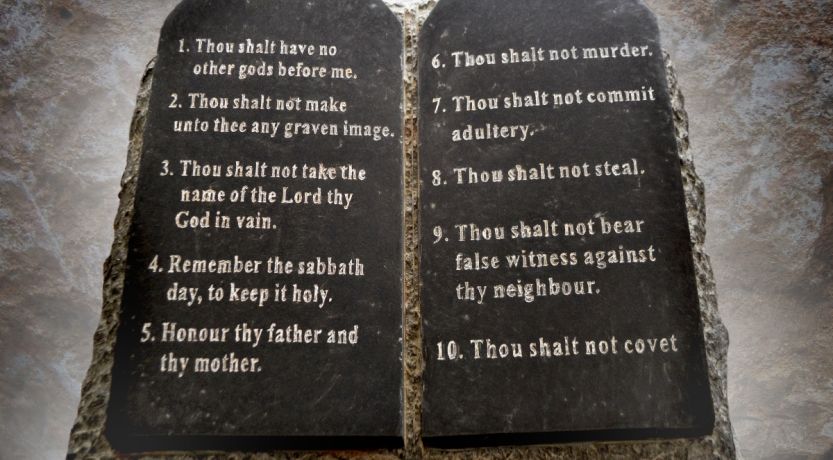
    In these three simple yet powerful verses, Jesus affirmed that the 10 Commandments—every single one of them—were carrying forward into New Covenant times. In these three simple yet powerful verses, Jesus affirmed that the 10 Commandments—every single one of them—were carrying forward into New Covenant times. They would continue to be binding as long as the heaven and earth still existed.

    Later in the Sermon on the Mount He singled out two specific commandments (the prohibitions against murder and adultery) to teach about the spiritual intent behind those laws (Matthew 5:21-30). Of course the other eight have deep spiritual meanings as well, but He covered only those two at that time.

    Jesus reciting the Commandments

    But despite Jesus’ clear words, some still argue that if He didn’t specifically mention a commandment, its relevance to Christians is questionable. But consider Jesus’ discussion with a man identified as “a certain ruler.”

    This man asked Jesus, “What shall I do to inherit eternal life?” (Luke 18:18). Jesus answered that the basic starting point was keeping the Commandments, and then He listed five of them: “‘Do not commit adultery,’ ‘Do not murder,’ ‘Do not steal,’ Do not bear false witness,’ ‘Honor your father and your mother’” (Luke 18:20).

    Jesus only listed five commandments, so does that mean the other five are irrelevant and nonbinding? That reasoning would mean:

    • We are free to place any other god before the true God (Exodus 20:3).
    • We are free to make and worship idols of anything we wish (verses 4-5).
    • We are free to revile and misuse God’s name as much as we want (verse 7).
    • We are free to do work on the seventh-day Sabbath (verses 8-11).
    • We are free to covet (verse 17).

    Sadly, this is taught by some—but in reality, it’s usually only used to zero in on one of the above commandments (the seventh-day Sabbath).

    Jesus’ statement in Matthew 5 proves this isn’t true. But still, by listing only five, did Jesus ignore some of the 10 Commandments? Not at all!Download God's 10 Commandments Still Relevant Today

    Next time we will take a closer look and discover that the New Testament actually does specifically reinforce every single one of God’s 10 Commandments.

    Sidebar: Why Did Jesus List Only Those Five Commandments?

    When speaking to the rich ruler, Jesus said that obedience to the Commandments was necessary and then listed five of the 10 Commandments (Luke 18:18-20). Why would He do this? Here are some possibilities.

    We don’t know exactly what this man was a “ruler” of, but he could possibly have been a member of the Pharisees (who ruled the synagogues). The Pharisees had developed their own commandments, which were very burdensome and in some cases actually led people to disobey God. Jesus had little regard for their law, which He called “the commandments of men” (Mark 7:6-7).

    By listing a few of the 10 Commandments, He was clarifying exactly which commandments were necessary for eternal life: God’s 10 Commandments, not the cumbersome laws of the Pharisees.

    But why would He have chosen the five examples He did—adultery, murder, stealing, lying and honoring parents (Luke 18:20)?

    One of the major problems with the Pharisees’ laws was that they often led to the abuse and mistreatment of other people. For example, in Matthew 23 Jesus Christ strongly rebuked them for putting unnecessary burdens on people (verse 4), abusing widows (verse 14), neglecting justice and mercy (verse 23) and even being complicit in the murder of righteous men (verse 34-35). In another place, He scolded them for inventing a loophole that allowed them to avoid caring for their elderly parents (Mark 7:11-13).

    The main flaw was neglecting to show love to their fellow man.

    If the rich ruler was a Pharisee, it would make sense that when Jesus mentioned a few commandments as examples, He chose ones about loving other people (Matthew 22:39). These were five commandments the Pharisees needed to hear. But, of course, that didn’t mean the other commandments dealing with loving God and not coveting were any less important.

    In fact, after the man answered that he had obeyed these commandments from childhood, Jesus challenged him to sell his possessions and follow Him—which, it appears, the man was unwilling to do. This demonstrated his unwillingness to fully obey the other commandments to love God and to not covet.”  From: https://lifehopeandtruth.com/bible/10-commandments/the-ten-commandments/did-jesus-reaffirm-all-10-commandments/?

    ________

    Which Is the Great Commandment?

    Matthew 22:35-38

    Then one of them, a lawyer, asked Him a question, testing Him, and saying, “Teacher, which is the great commandment in the law?” Jesus said to him, “‘You shall love the LORD your God with all your heart, with all your soul, and with all your mind.’ This is the first and great commandment.”

    Listen to the "Verse by Verse" episode covering this scripture.

    The lawyer seemingly intended this as a trick question with many possible answers that would be considered wrong by those experts who had ranked the laws differently.

    But Jesus Christ cut to the core of all the laws to identify what is truly most important. Loving God with all our being means we will seek to please Him and do everything else He asks us to do.It's time to get to know God. Start your 7-day guided Journey.

    This first, great commandment summarizes the first four of the 10 Commandments (Exodus 20:1-11) where God explains how to love Him the way He wants to be loved. Human ideas of how to worship God may be well-intentioned, but to be assured we are pleasing God, we must worship and obey Him the way He wants us to.

    The first four Commandments, and the entire Bible, show us that way.

    Study more about how God wants us to love Him in our article “The Great Commandment.””  From: https://lifehopeandtruth.com/bible/blog/which-is-the-great-commandment/

    _________

    Lipstick Contaminated with Lead?

    “Dozens of lipsticks and lip glosses are put to the test.

    “Over the past years, using cosmetic products has increased worldwide at an alarming rate due to unending pursuit for individual beautification…” There’s nothing necessarily wrong with that unless cosmetic products contain ingredients that may be linked to disease—ingredients such as toxic heavy metals like lead.

    As you can see at 0:28 in my video Flashback Friday: Is Lipstick Safe Given the Lead Contamination?, lead has been found in a wide range of cosmetic products, from eye shadow to skin cream, and foundation to blush. You may recall that I talked about lead in henna in my video Is Henna Safe?, but in looking at the data, “important warnings can be recognized”: the presence of lead in lipsticks. This is concerning because lipstick wearers may actually swallow a little bit of it. In fact, it has “been estimated that a woman inadvertently ingests 1.8 kg [about 4 lbs] of lipstick during her lifetime.” “Moreover, lipsticks can be used by pregnant women or women of child bearing age.” (I mean, obviously.) Yes, lead is highly toxic, but how much lead can there be in lipstick? Surely, it is “a very minor source….Nonetheless, one should not exclude the fact that lead accumulates in the body due to over time and repetitive lead-containing lipstick or hair dye application, which lead to significant exposure levels.” You don’t really know, though, until you put it to the test.”                      Continued at: https://nutritionfacts.org/blog/lipstick-contaminated-with-lead/?

    _________

    Sunday, June 9, 2024

    Pentecost and God’s Gifts. PENTECOST PROVES THE SABBATH. Why Meat Is Bad For You- In 60 Seconds.

    .

    shavuot.png[7]Pentecost, Shavout, will start on the evening of Sat. 15th. June this year, and end on evening of 16th.

    For in depth look at the festival:

    https://thebiblicalnutritionist.com/why-christians-celebrate-shavuot/

    _________

    Pentecost and God’s Gifts

    Acts 2:38-39

    Then Peter said to them, “Repent, and let every one of you be baptized in the name of Jesus Christ for the remission of sins; and you shall receive the gift of the Holy Spirit. For the promise is to you and to your children, and to all who are afar off, as many as the Lord our God will call.”

    “Peter’s call to action also provides a list of some of God’s greatest gifts.

    The basic idea of repentance is “a reversal of thinking which changes one’s life” (The Nelson Study Bible, note on Matthew 3:2). When we see how our sins have gone against God’s perfect law, and that Jesus Christ gave His life to pay for our death penalty, it is only right to have godly sorrow and a fervent desire to change. But even repentance is a gift from God (Romans 2:4).

    It's time to get to know God. Start your 7-day guided Journey.After repenting, God wants us to demonstrate our commitment through water baptism, a symbol of the death of our old person. This is followed by God’s gift of forgiveness of sins and the gift of God’s Holy Spirit—a seed of spiritual life, a lifeline to God, a connection to the spiritual vine. Through the Holy Spirit, God makes available so many other priceless gifts.

    So, while Peter called on new believers to take action in this passage, it is really God whose acts of giving make the difference.

    For more about responding to God’s call to repent and be baptized, download our free booklet Change Your Life!”  From: https://lifehopeandtruth.com/bible/blog/pentecost-and-gods-gifts/

    _________

    PENTECOST PROVES THE SABBATH

    “In Leviticus chapter 23, God revealed a series of celebrations to be observed throughout the year. One of them is called Pentecost. It also goes by other names such as Shavuot, the Feast of Weeks, and First fruits (of the wheat harvest). It is a unique festival in two aspects. Firstly, it is the only holy day that does not fall on a specific day of the Hebrew Calendar. Instead, we must calculate its timing. Secondly, we must know when the weekly Sabbath occurs.

    The verses about this celebration are found in Leviticus chapter 23:15-22. We will look at a few of these verses: “15 And you shall count for yourselves from the day after the Sabbath, from the day that you brought the sheaf of the wave offering: seven Sabbaths shall be completed. 16 Count fifty days to the day after the seventh Sabbath; then you shall offer a new grain offering to the Lord…21 And you shall proclaim on the same day that it is a holy convocation to you. You shall do no customary work on it. It shall be a statute forever in all your dwellings throughout your generations.”

    Notice that Pentecost is the day after the seventh weekly Sabbath from Unleavened Bread. This means it always occurs on the first day of the week. Any church body who celebrates Pentecost on Sunday is acknowledging that the true Sabbath is from Friday sunset to Saturday sunset. This includes the Catholic Church. Some of their authors and clergy have admitted this!

    John Laux, an author of textbooks for Catholic schools, wrote: “If we consulted the Bible only, we should still have to keep holy the Sabbath Day, that is, Saturday, with the Jews, instead of Sunday…” (Laux, p 51).

    John Gibbons, a Catholic Cardinal, wrote: “But you may read the Bible from Genesis to Revelation, and you will not find a single line authorizing the sanctification of Sunday. The Scriptures enforce the religious observance of Saturday, a day which we never sanctify” (Gibbons, pp 72-73).

    The Catholic Church acknowledges the timing of the Biblical Sabbath. Any church that celebrates Pentecost on Sunday reflects the same belief. Pentecost proves the Sabbath.”

    Kelly McDonald, Jr, BSA President, www.biblesabbath.org

    ________

    Why Meat Is Bad For You- In 60 Seconds

    The Vegan Activist

    “We have been told that animal flesh is an essential part of a healthy diet, but meat consumption has been associated with almost all the major diseases. Meat is high in fat, saturated fat and cholesterol, which will increase the risk of heart disease and can cause other serious health problems like diabetes. It is high in animal-protein, which is far too acidic for the human body and has been linked to kidney disease, cancer and osteoporosis.

    Most meat also contains antibiotics and growth hormones, like oestrogen and testosterone, which can promote cancer growth. And fish is often contaminated with mercury, which is toxic, and can cause brain damage, and may also contribute to atrial fibrillation and fatal heart attack risk. Fortunately, there is no need to consume meat or other animal products, and a wholefoods, plant-based diet can provide all the essential nutrients for long-term health.”        

    RESEARCH REFERENCED: http://www.pcrm.org/health/health-top... http://cebp.aacrjournals.org/content/... http://nutritionfacts.org/topics/merc... http://nutritionfacts.org/video/uproo...   YouTube: / @theveganactivist

    ________