Showing posts with label Christmas. Show all posts

Tuesday, December 23, 2025

Christmas: The Untold Story (Part 1) (Part 2)

.

Christmas: The untold story (part 1)

Christmas: The untold story (part 1)“Christmas is one of the world’s most popular holidays, celebrated by people of many faiths. Yet the holiday has a strange and convoluted past, one hinted at in such puzzling symbols as decorated trees, holly wreaths and mistletoe.

William Walsh (1854-1919) summarizes the holiday's origins and practices in his book The Story of Santa Klaus: "We remember that the Christmas festival ... is a gradual evolution from times that long antedated the Christian period ... It was overlaid upon heathen festivals, and many of its observances are only adaptations of pagan to Christian ceremonial" (1970, p. 58). 

During the second century B.C. the Greeks practiced rites to honor their god Dionysus (also called Bacchus). The Latin name for this celebration was Bacchanalia, which spread from Greece to Rome. "It was on or about December 21st that the ancient Greeks celebrated what are known to us as the Bacchanalia or festivities in honor of Bacchus, the god of wine. In these festivities the people gave themselves up to songs, dances and other revels which frequently passed the limits of decency and order" (Walsh, p. 65).

In addition to the Bacchanalia, the Romans celebrated the Saturnalia, held "in honor of Saturn, the god of time, [which] began on December 17th and continued for seven days. This also often ended in riot and disorder. Hence the words Bacchanalia and Saturnalia acquired an evil reputation in later times" (p. 65).

Notice the customs surrounding the Saturnalia: "All businesses were closed except those that provided food or revelry. Slaves were made equal to masters or even set over them. Gambling, drinking, and feasting were encouraged. People exchanged gifts, called strenae, from the vegetation goddess Strenia, whom it was important to honor at midwinter ... Men dressed as women or in the hides of animals and caroused in the streets. Candles and lamps were used to frighten the spirits of darkness, which were [considered] powerful at this time of year. At its most decadent and barbaric, Saturnalia may have been the excuse among Roman soldiers in the East for the human sacrifice of the king of the revels" (Gerard and Patricia Del Re, The Christmas Almanac, 1979, p. 16).

"From the Romans also came another Christmas fundamental: the date, December 25. When the Julian calendar was proclaimed in 46 [B.C.], it set into law a practice that was already common: dating the winter solstice as December 25. Later reforms of the calendar would cause the astronomical solstice to migrate to December 21, but the older date's irresistible resonance would remain" (Tom Flynn, The Trouble With Christmas, 1993, p. 42). On the heels of the Saturnalia, the Romans marked December 25 with a celebration called the Brumalia. Bruma is thought to have been contracted from the Latin brevum or brevis, meaning brief or short, denoting the shortest day of the year.

"The time of the winter solstice has always been an important season in the mythology of all peoples. The sun, the giver of life, is at its lowest ebb….It is the time when the forces of chaos that stand against the return of light and life must once again be defeated by the gods. At the low point of the solstice, the people must help the gods through imitative magic and religious ceremonies. The sun begins to return in triumph. The days lengthen and, though winter remains, spring is once again conceivable. For all people, it is a time of great festivity" (The Christmas Almanac, 1979, p. 15).”   From: https://www.ucg.org/learn/bible-study-tools/bible-study-aids/holidays-or-holy-days-does-it-matter-which-days-we-observe/christmas-untold-story

________

Christmas: The untold story (part 2)

Christmas: The untold story (part 2)“During the days of Jesus' Apostles, in the first century, the early Christians had no knowledge of Christmas as we know it. But, as a part of the Roman Empire, they may have noted the Roman observance of the Saturnalia while they themselves persisted in celebrating the customary "feasts of the Lord" (listed in Leviticus 23).

The image is a painting titled "A Roman Feast" (also known as "Saturnalia") by Italian artist Roberto Bompiani, depicting a lively banquet scene during the ancient Roman festival of Saturnalia.

The Encyclopaedia Britannica tells us "the first Christians ... continued to observe the Jewish festivals, though in a new spirit, as commemorations of events which those festivals had foreshadowed" (11th edition, Vol. 8, p. 828, "Easter"). But over the following centuries, new, nonbiblical observances such as Christmas and Easter were gradually introduced into traditional Christianity.

These new days came to be forcibly promoted while the biblical feast days of Apostolic times were systematically rejected. "Christmas, the [purported] festival of the birth of Jesus Christ, was established in connection with a fading of the expectation of Christ's imminent return" (Encyclopaedia Britannica, 15th edition, Macropaedia, Vol. 4, p. 499, "Christianity"). The Christmas celebration shifted Christianity's focus away from Christ's promised return to His birth, something the Bible does not direct Christians to do.

Gerard and Patricia Del Re explain the further evolution of December 25 as an official Roman celebration: " the tradition of celebrating December 25 as Christ's birthday came to the Romans from Persia. Mithra, the Persian god of light and sacred contracts, was born out of a rock on December 25…. and in the third century [274] the unchristian emperor Aurelian established the festival of Dies Invicti Solis, the Day of the Invincible Sun, on December 25.

"Mithra was an embodiment of the sun, so this period of its rebirth was a major day in Mithraism, which had become Rome's latest official religion with the patronage of Aurelian. It is believed that the emperor Constantine adhered to Mithraism up to the time of his conversion to Christianity. He was probably instrumental in seeing that the major feast of his old religion was carried over to his new faith" (The Christmas Almanac, 1979, p. 17).

Although Christmas had been officially established in Rome by the fourth century, later another pagan celebration greatly influenced the many Christmas customs practiced today. That festival was the Teutonic feast of Yule (from the Norse word for "wheel," signifying the cycle of the year). "During this time log-fires were burnt to assist the revival of the sun. Shrines and other sacred places were decorated with such greenery as holly, ivy, and bay, and it was an occasion for feasting and drinking.

"Equally old was the practice of the Druids… to decorate their temples with mistletoe, the fruit of the oak-tree which they considered sacred. Among the German tribes the oak-tree was sacred to Odin, their god of war, and they sacrificed to it until St Boniface, in the eighth century, persuaded them to exchange it for the Christmas tree, a young fir-tree adorned in honour of the Christ child ..." (L.W. Cowie and John Selwyn Gummer, The Christian Calendar, 1974, p.22).

It wasn't long before such non-Christian rites and practices were assimilated into a new church religious holiday supposedly celebrating Christ's birth. William Walsh describes the rationalization behind it: " In order to reconcile fresh converts to the new faith, and to make the breaking of old ties as painless as possible, these relics of paganism were retained under modified forms ...Thus we find that when Pope Gregory [540-604] sent Saint Augustine as a missionary to convert Anglo-Saxon England he directed that so far as possible the saint should accommodate the new and strange Christian rites to the heathen ones with which the natives had been familiar from their birth.... On the very Christmas after his arrival in England Saint Augustine baptized many thousands of converts and permitted their usual December celebration under the new name and with the new meaning" (p. 61).

Even colonial America considered Christmas more of a raucous revelry than a religious occasion: "So tarnished, in fact, was its reputation in colonial America that celebrating Christmas was banned in Puritan New England, where the noted minister Cotton Mather described yuletide merrymaking as ‘an affront unto the grace of God'" (Jeffery Sheler, "In Search of Christmas," U.S. News and World Report, Dec. 23, 1996, p. 56).”  From: https://www.ucg.org/learn/bible-study-tools/bible-study-aids/holidays-or-holy-days-does-it-matter-which-days-we-observe/christmas-untold-story

_________

Tuesday, December 31, 2024

Are New Year Celebrations Pagan in Origin?

.

image

Spike Mafford/Photodisc/Thinkstock

Are New Year Celebrations Pagan in Origin?

“Simply put, the answer is yes—New Year celebrations did originate in paganism.

Much of the symbolism associated with New Year’s celebrations today has very definite pagan origins.

In the earliest days of the Church (the first and second centuries after Christ) there were no such celebrations as Christmas and New Year’s Day.

The New Catholic Encyclopedia states: “According to the hypothesis . . . accepted by most scholars today, the birth of Christ was assigned the date of the winter solstice (December 25 in the Julian [Roman] Calendar, January 6 in the Egyptian), because on this day, as the sun began to return to northern skies, the pagan devotees of Mithra celebrated dies natalis Solis Invicti (birthday of the invincible sun)” (1967, Vol. 3, p. 656).

Those customs carried over in the observance of Christmas (with its many traditions and practices steeped in paganism), and the “birth” of the “new year” of the sun. This is why the Roman calendar in use today designates Jan. 1 as the beginning of the new year as opposed to God’s designation of the spring month of Abib or Nisan on the Hebrew calendar as the beginning of the year (Exodus 12:1-2).

Much of the symbolism associated with New Year’s celebrations today has very definite pagan origins. Kissing at the moment of transition to the next year is rooted in pagan sexual practice and superstition. And evergreen wreaths associated with Christmas were originally part of the pagan Calend celebration of Jan. 1.

Because we live in this secular society and most of the world operates according to the commonly used Roman calendar, it’s common to think of a new calendar year as beginning Jan. 1. Yet involvement in the celebration of that is not appropriate.

That said, one should be careful not to become too judgmental if, for example, someone is viewing a football game or parade at that time of year—as opposed to actually celebrating a New Year festival.

If you’d like to learn more, many resources are available that show the pagan origins of New Year’s Day celebrations. You can find related material in reference encyclopedias and online research resources as well.”  From:  https://www.ucg.org/learn/bible-questions-and-answers/are-new-year-celebrations-pagan-origin

________

Tuesday, October 29, 2024

It’s All Pagan Tradition. Acrylamide in Table Olives

.

· ·May be an image of text

“Don’t dabble in it. Don’t do it for the kids. Don’t keep one and get rid of the others. It’s all pagan tradition. Who cares where it comes from? Who cares if it’s different than it once was? Who cares if it’s not as bad as something else?

It’s pagan. If you are trying to be pagan then carry on…If not then walk away. All the way.

YHWH (Our Lord) has given you many great things to celebrate. Things that actually honor Him and give Him due glory and praise. Why would you want to choose pagan things over His things? And yes it is choosing theirs over His. You can’t have both.

Either own the holidays as pagan and yourself as pagan too or else surrender them all to Yeshua and follow Him in celebrating the Holidays of YHWH.”

Question Everything”

templecrier.com/paganism

_______

Researchers Find Ways to Reduce Acrylamide in Table Olives

“A recent study conducted by Extremadura’s provincial government in Spain has identified some strategies to mitigate the presence of acrylamide during the industrial processing of black olives.

Acrylamide is a compound found in carbohydrate-rich foods after being heated. The International Agency for Research on Cancer considers the compound carcinogenic.

The study provides different strategies that, without imposing any additional cost in its manufacture, upgrade the processing of Californian-style black ripe olives by removing acrylamide from the final product.- Daniel Martín-Vertedor and Antonio Fernández, researchers, Junta de Extremadura

According to the researchers, acrylamide generation in table olives is evident in larger quantities in Californian-style black ripe olives. The compound develops as a result of oxidation after thermal sterilization occurs during the table olive production process.

The amount of acrylamide in table olives is dependent on many factors such as how olives are processed, thermal sterilization conditions, packaging methods that may or may not involve the use of brine and cooking.

The researchers conducted their study using Hojiblanca olives, a common Spanish variety with an intermediary level of acrylamide content.

By changing different phases of the production process – olive maturation stage, length of storage period and type of washing treatment – the researchers were able to lower levels of acrylamide and thus improve the quality of the table olives.

“Applying these mitigation measures at industrial scale, black table olives consumers will intake a significatively minor quantity of this toxic compound,” Daniel Martín-Vertedor and Antonio Fernández, the two lead researchers on the project, told Olive Oil Times.

“Therefore, this type of table olive elaboration can be more present in the human diet, taking advantage of the benefits of table olives,” they added.

The researchers used olives harvested at two different points of maturation: the green and yellow-green stages. Olives harvested at the yellow-green maturation stage – when they are one step closer to veraison – had higher levels of acrylamides.

Furthermore, green olives stored for 21 months presented the lowest acrylamide levels. Acrylamide levels also lowered by 18 percent when the olives were sprayed with water before rinsing. Washing the olives with water heated to 25 ºC for 40 minutes also led to a 36-percent reduction in the chemical.

However, following treatment with lye, which is commonly used to remove the compound responsible for the bitter taste of table olives, acrylamide levels increased. Pitted olives retained the lowest levels of the chemical, followed by unpitted olives and sliced olives.

The researchers further found that table olives canned in brine with higher concentrations of salt after the production process also increased the acrylamide content. However, this was not observed in olives stored in other liquids.”  More at: https://www.oliveoiltimes.com/health-news/researchers-find-ways-to-reduce-acrylamide-in-table-olives/97968

Also see: The major food sources of acrylamide are French fries and potato chips; crackers, bread, and cookies; breakfast cereals; canned black olives; prune juice; and coffee.  From: https://www.cancer.gov/about-cancer/causes-prevention/risk/diet/acrylamide-fact-sheet

__________

Saturday, March 9, 2024

Maundy Thursday and Good Friday. Three Days and Three Nights. Increased Lifespan from Beans.

.

3 Things You May Not Know About Maundy Thursday and Good Friday

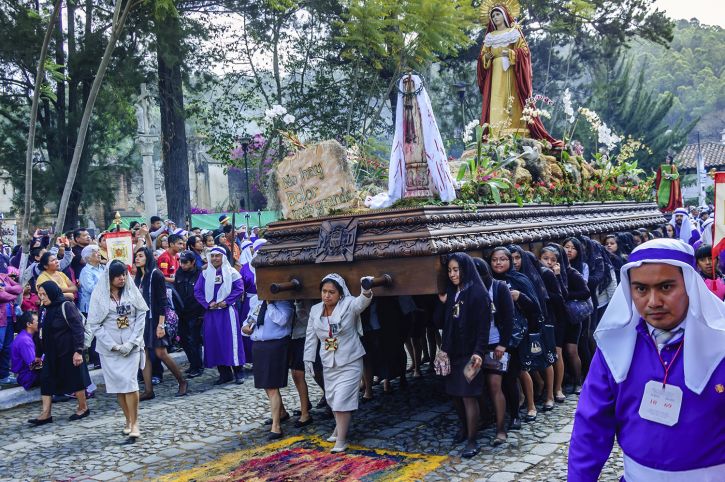
3 Things You May Not Know About Maundy Thursday and Good FridayDevout Catholics participate in a Good Friday procession.
“Reflecting on Jesus’ death is sobering. Unfortunately the timing is rarely understood. Do Maundy Thursday and Good Friday fit the timing in the Bible?

Churches will soon be packed with some of their largest attendances of the year. The “CEOs” (Christmas and Easter Only attendees) will make one of their semiannual appearances for Easter, the most holy observance of the year for mainstream Christianity. Good Friday, which occurs two days before Easter Sunday, is also significant as the most solemn occasion because it recalls the crucifixion of Christ.

Most professing Christians understand that Jesus died so our sins can be forgiven. What is not common knowledge is the timing of His death, which has been hidden by the establishment of Easter and its closely related observances of Lent, Palm Sunday, Holy Wednesday, Maundy Thursday and Good Friday in lieu of the biblical festivals observed by Jesus, His apostles and the first-century Church.

If you sincerely want to honor Christ at this time of year, you need to know the real story—the one that shows us the correct timing of His death and how to properly commemorate this event.

Doesn’t Christ deserve the respect to have the true, biblical history of His death told and remembered on this sobering occasion?

In that light, here are three important things to know about Maundy Thursday and Good Friday:

1. Of all the man-made holidays, Maundy Thursday and Good Friday are the only ones that claim to commemorate something Jesus said to commemorate.

On the evening before His crucifixion, Jesus told His disciples to keep the Passover as an annual festival “in remembrance of Me” (Luke 22:19; 1 Corinthians 11:24-25).

In teaching the Corinthians to observe this solemn service, Paul told them that through this memorial they would “proclaim the Lord’s death till He comes” (verse 26, emphasis added throughout).

Jesus never commanded Christians to celebrate His birth or resurrection. Rather, His instruction was for us to memorialize His death—something that Maundy Thursday and Good Friday actually do attempt to do.

But does that mean you should observe Maundy Thursday and Good Friday?

2. Maundy Thursday and Good Friday aren’t the biblical names of the observance that commemorates Christ’s death.

The terms Maundy Thursday and Good Friday appear nowhere in the Bible. But the Bible does talk about another festival to honor Christ’s death: the Passover.

The New Testament Passover established by Christ Himself includes taking bread and wine. The bread represents His broken body and the wine represents His shed blood (Matthew 26:26-28).

Churches vary in how often they partake of the symbols of bread and wine. Some take these symbols daily, some monthly and some on Maundy Thursday. But the Bible instructs us to observe it only once a year on a specific day (Leviticus 23:5). When we take the Passover symbols of unleavened bread and wine, we annually “proclaim the Lord’s death till He comes” (1 Corinthians 11:26).

Observing the Passover is a memorial of Christ’s death. Jesus did not die on many different days throughout the year. He died on only one day, and He observed the Passover on the prescribed evening before the day of His death.

Passover is the annual festival that reminds us of Christ’s death. To learn more about this observance, see “Passover: What Did Jesus Do for You?” and “Questions and Answers About the Passover.”

3 Things You May Not Know About Maundy Thursday and Good Friday

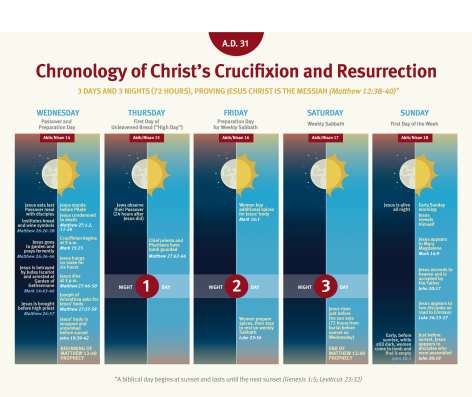
Download "The Chronology of Christ’s Crucifixion and Resurrection" infographic.

This chart includes the key events during this momentous week, demonstrating how Jesus’ promise to rise after three days and three nights was fulfilled, proving He is the Messiah.

3. Jesus didn’t die on a Friday.

Today documentation is commonly recorded for births and deaths. While we don’t have these same types of records from the first century giving us the exact day of Christ’s death, the Bible does give us enough details to show that Jesus definitely didn’t die on a Friday.

Let’s begin with the best known facts about Christ’s death. The Bible clearly tells us: “Now after the Sabbath [Saturday], as the first day of the week [Sunday] began to dawn, Mary Magdalene and the other Mary came to see the tomb,” but Jesus was not there because He had risen (Matthew 28:1, 6). So Jesus had already been resurrected by very early Sunday morning.

The next biblical key to note is that Jesus said, “As Jonah was three days and three nights in the belly of the great fish, so will the Son of Man be three days and three nights in the heart of the earth” (Matthew 12:40). We can also note that Jesus died at about 3 p.m., the ninth hour after sunrise, and was buried that evening shortly before the beginning of a Sabbath (Matthew 27:46-50, 57, 62).

People have assumed that the Sabbath mentioned in these verses is a Saturday, leading them to the conclusion that Jesus died on a Friday—hence the name Good Friday. But there is a problem with this timeline. There simply are not three days and three nights between Friday evening and Sunday morning. There aren’t even parts of three days and three nights in this time period between Friday evening and Sunday morning (as some have tried to interpret the three days and three nights).

The biblical fact is, Jesus died on a Wednesday—not on a Friday as many believe. A careful reading of a companion scripture explains this apparent dilemma. John 19:31 tells us that the day Jesus was buried preceded a “high day”—a designation reserved for an annual Sabbath, which could fall on any day of the week and not necessarily Saturday. In fact, Jesus was buried just prior to the beginning of the first day of the Feast of Unleavened Bread—an annual Sabbath.

The weekday timeline that fits the facts we have noted is easily constructed. Jesus observed the Passover with His disciples on Tuesday evening. He was crucified and died on Wednesday, buried near sunset on Wednesday prior to the beginning of the annual Sabbath called the first day of the Feast of Unleavened Bread, and resurrected three days and three nights later near sundown on Saturday, the weekly Sabbath. When the women arrived at the tomb early Sunday morning, they discovered that He had already been resurrected.

The fact that there were two Sabbaths during the timeline of Jesus’ burial and resurrection is confirmed by several Bible translations, including the International Standard Version, which translates Matthew 28:1: “After the Sabbaths, around dawn on the first day of the week, Mary Magdalene and the other Mary went to take a look at the burial site.” The annual Sabbath occurred on Thursday that year; the weekly Sabbath, on Saturday.

The biblical fact is, Jesus died on a Wednesday—not on a Friday as many believe. Interestingly when we look at the years for God’s holy days falling on the days of the week indicated by the Scriptures, we find that Jesus died on the 14th day of the first month of the Hebrew calendar in A.D. 31."   From: https://lifehopeandtruth.com/life/blog/3-things-you-may-not-know-about-maundy-thursday-and-good-friday/

_________

Three Days and Three Nights

Matthew 12:39-40

But He answered and said to them, “An evil and adulterous generation seeks after a sign, and no sign will be given to it except the sign of the prophet Jonah. For as Jonah was three days and three nights in the belly of the great fish, so will the Son of Man be three days and three nights in the heart of the earth.”

Listen to the "Verse by Verse" episode covering this scripture.

In our Fundamental Beliefs “8. Three Days and Three Nights,” we state, “Jesus Christ was raised from the dead by the Father after His body lay for three days and three nights in the grave. The length of time that He was in the grave was the only sign He gave to prove He was the Messiah.”

Jesus had done many miracles, but still the Pharisees sought “how they might destroy Him” (Matthew 12:14). So Jesus didn’t offer them more miracles as a sign, only this reference to the length of time He would be in the grave.

Strangely, though, most Christians today do not believe that Christ was literally three days and three nights in the grave as He promised, since it is not possible to count three days and three nights between Good Friday afternoon and Easter Sunday morning.

For a detailed explanation of the biblical chronology of Christ’s crucifixion and resurrection, including a helpful chart, see “Sign of Jonah: Did Jesus Die Good Friday, Rise on Easter?” From: https://lifehopeandtruth.com/bible/blog/three-days-and-three-nights/

_________

Increased Lifespan from Beans

“The intake of legumes—beans, chickpeas, split peas, and lentils—may be the single most important dietary predictor of a long lifespan. But what about concerns about intestinal gas?”

Transcript of video at: https://nutritionfacts.org/video/increased-lifespan-from-beans/

Below is an approximation of this video’s audio content. To see any graphs, charts, graphics, images, and quotes to which Dr. Greger may be referring, watch the above video.

“Legumes may be “the most important…predictor of survival in older people” from around the globe. They looked at “five [different] cohorts in Japan, Sweden, Greece, and Australia.” And, of all the food factors they looked at, only one was associated with a longer lifespan across the board: legume intake. Whether it was the Japanese eating their soy, the Swedes eating their “brown beans and peas,” or those in the Mediterranean eating “lentils, chickpeas, and white beans,”…”[o]nly for legumes intake was the result plausible, consistent, and statistically significant from [the] data” across all the populations combined. We’re talking an “8% reduction in risk of death for every 20 grams increase in daily legumes intake.” That’s just like two tablespoons’ worth! So, if a can of beans is 250 grams, and you get 8% lower mortality for every 20 grams, maybe, if we eat a can a day, we’ll live forever? Let’s find out!

If you want to increase your lifespan, eat beans. If, however, you’re suicidal, and want to decrease your lifespan, “A bean-free diet” may increase the risk of death.

So, having arrived at the one dietary fountain of youth, what’s the #1 reason people aren’t clamoring for them? Fear of flatulence. So, is that the choice we’re left with? Breaking wind or breaking down? Passing gas or passing on? Turns out that “[p]eople’s concerns about excessive flatulence from eating beans may be exaggerated.”

Add a half-cup of beans every day to people’s diets for months, and what happens? What’s the #1 symptom? Nothing. The vast majority of people experienced no symptoms at all—though a few percent did report increased flatulence. So, it may occur in some individuals. But, “not all people are affected.” Even among those that were, “[s]eventy percent or more of the participants who experienced flatulence felt that it dissipated [no pun intended] by the second or third week of bean consumption”. So, we’ve just got to stick to it.

And, you know, a small percentage reported increased flatulence on the control diet without any beans. People have preconceived notions about beans, such that “just the expectation of flatulence from eating beans may influence their perceptions of having gas.” They didn’t actually measure farts in this study; they just asked people what their perception of the amount of gas they had was. And, we know from previous studies that you give someone a product labeled to contain something that may cause intestinal distress, and it causes more intestinal distress whether it actually contains the ingredient or not. In other words, “just thinking they were eating [it] caused digestive distress, or the perception of it, to a proportion of persons.”

So, people thinking beans are going to cause gas may just be more likely to notice the gas they normally have. Either way, it tends to go away; “after a few weeks of daily bean consumption, people perceive that flatulence occurrence returns to normal levels.”

In this other study, where they added more than a half a cup of kidney beans to people’s daily diets, the research subjects reported that the discomfort they initially felt within the first day or two of adding beans “quickly disappeared.” So, again, stick with it.

Bottom line (no pun intended!): “An increasing body of research and the [latest] Dietary Guidelines…supports the benefits of a plant-based diet, and legumes specifically, in the reduction of chronic disease risks.” In some people it “may result in more flatulence initially.” However, doctors should emphasize that it “will decrease over time” if we just keep it up.

And, “the nutritional attributes of beans in the diet outweighs the potential for transitory discomfort. The long-term health benefits of bean consumption are great.” And, indeed, eating beans in the long term may make your term—on Earth—even longer.” From: https://nutritionfacts.org/video/increased-lifespan-from-beans/

_________

Wednesday, January 3, 2024

The Roots and Fruits of New Year’s Eve. God’s Festivals as Shadows of Things to Come. The Fruit Whose Juice Is Healthier

.

The Roots and Fruits of New Year’s Eve

The Roots and Fruits of New Year’s Eve“Some of the customs may seem crazy or quaint, but what are the real origins and results of the New Year’s holiday?

I admit it. I have been up at midnight on New Year’s Eve a few times. Not celebrating exactly. In fact, most of those times I was part of a volunteer security force on the campus where I went to college—which happened to be along the Rose Parade route in Pasadena, California.

Our job was to be alert to criminals, vandals and even people camping out along the parade route and searching for anything they could burn to keep warm. You might be surprised that it gets fairly cool in January in Southern California. Of course, it is much warmer there than in New York’s Times Square (where it averages 33.7 degrees Fahrenheit at midnight) and other northern gathering places where people count down to the new Roman year.

It makes you wonder: How did New Year’s Eve come to be celebrated in the winter and at midnight? Blame it on the ancient Romans.

Julius Caesar, the calendar fixer

Many ancient societies began their new year in the spring. But by the time of Julius Caesar, the Roman calendar was off. Way off. To get the calendar to line up with the seasons, Caesar had to add 90 days!

History.com explains, “Over the centuries, the calendar fell out of sync with the sun, and in 46 B.C. the emperor Julius Caesar decided to solve the problem by consulting with the most prominent astronomers and mathematicians of his time. He introduced the Julian calendar, which closely resembles the more modern Gregorian calendar that most countries around the world use today.

“As part of his reform, Caesar instituted January 1 as the first day of the year, partly to honor the month’s namesake: Janus, the Roman god of beginnings, whose two faces allowed him to look back into the past and forward into the future. Romans celebrated by offering sacrifices to Janus, exchanging gifts with one another, decorating their homes with laurel branches and attending raucous parties.”

Beliefnet.com also notes that New Year’s is associated with the winter solstice and is “an ancient holiday with deep spiritual roots. … Ancient Romans celebrated with six days of carousing that would probably be familiar to us today.”

Customs and superstitions

From its ancient origins, a wide variety of traditions and superstitions have developed around the world. Here is just a sampling.

“In Ecuador, people make dummies, stuffed with straw, to represent the events [and people, such as politicians and pop culture icons] of the past year. These ‘[año] viejo’ effigies are burned at midnight, thus symbolically getting rid of the past” (Beliefnet.com). Some even try to jump through the flames 12 times!

MarthaStewart.com describes another jumping tradition: “Many Danish people celebrate the New Year by jumping off chairs at the stroke of midnight. Leaping is said to banish bad luck and bring good fortune into the new year. They also traditionally throw plates at neighbors’ doors to symbolize their friendship. The person with the most broken plates is said to have the most friends.”

On NPR.org, Maria Fe Martinez describes another Latin American New Year’s tradition: “If you want to have a very lucky year, you have to wear yellow underwear. And if you want to have a very passionate year, you wear red underwear. …

“And you can get them all over town. Like, if you’re driving in your car, you’re going to see a street vendor selling yellow underwear, which is hilarious. Right after Christmas, they show up.”

The International Business Times reports that 44 percent of Americans say they will kiss someone at midnight. But why?

According to Livescience.com, “Puckering up at the stroke of midnight is a venerable tradition with ancient roots. Many cultures considered the transition from the warm to the cold seasons to be an intensely vulnerable time, when evil spirits could run amok, Aveni [author of The Book of the Year: A Brief History of Our Seasonal Holidays] said.

“Many of our traditions, including kissing, originally come from the English tradition of ‘saining,’ or offering blessing or protection, during the period of Yuletide, Aveni said. (Yuletide was originally a pre-Christian Germanic festival that eventually became synonymous with Christmastide in Europe.)”

New Year’s crime rates

In addition to its pagan roots, the fruits of this holiday are not good. For example, according to Allprobailbond.com, “the holidays are the busiest time of year for the bail bond industry.” Why?

“• Increased alcohol consumption. … Driving under the influence is the leading cause for New Year’s Eve arrests. …

“• Increased emotions. Some people are very unhappy during the holidays. Domestic violence often increases during the holiday season as well as self-inflicted wounds. Consumption of alcohol also increases violent acts.”

What does the Bible say?

The Bible gives its own list of meaningful annual celebrations, but Jan. 1 is not on the list. It’s definitely not God’s new year; He set the first month of the year to begin in what we call March or April. The Bible gives its own list of meaningful annual celebrations, but Jan. 1 is not on the list. It’s definitely not God’s new year; He set the first month of the year to begin in what we call March or April (Exodus 12:2; Deuteronomy 16:1). And the Bible warns against getting ensnared by customs that are based on pagan religions. We are not to ask, “How did these nations serve their gods? I will do likewise” (Deuteronomy 12:30).

Superstitions and customs that may seem quaint or harmless to most people today can be repulsive to God who knows their roots and their fruits.

Playing with paganism isn’t cute—it is corrosive to our relationship with the true God. When God calls Himself a jealous God,” it’s actually a sign of His love and desire for the best for us (Deuteronomy 6:14-15).

And consider the apostle Peter’s call to avoid sinful celebrations where there is “lewdness, lusts, drunkenness, revelries, drinking parties, and abominable idolatries” (1 Peter 4:3). Peter acknowledged that our friends may think it strange we no longer party with them, but in the end we must answer to God.

For all these reasons, celebrating the pagan holiday of New Year’s Eve is not pleasing to God.”

From Holidays to Holy Days. Download Free BookletLearn more about what God says in our free booklet From Holidays to Holy Days: God’s Plan for You 

From: https://lifehopeandtruth.com/life/plan-of-salvation/holy-days-vs-holidays/new-year/new-years-eve/

________

God’s Festivals as Shadows of Things to Come

Colossians 2:16-17

So let no one judge you in food or in drink, or regarding a festival or a new moon or sabbaths, which are a shadow of things to come, but the substance is of Christ.

“In essence, Christians were still enjoying the biblical festivals with eating and drinking, and apparently were being judged by those who believed in philosophies of self-denial. Paul mentions these ascetic ideas later in the chapter: “Do not touch, do not taste, do not handle” (Colossians 2:21).

Some think that when Paul said the festivals are “a shadow of things to come,” it was a put-down. They think Paul was saying the festivals were not important.

But another way to look at these shadows is to see that they help us picture the objects of which they are shadows. For example, the Passover clearly represents the sacrifice of Jesus Christ and foreshadowed that event. Pentecost foreshadowed the coming of the Holy Spirit and the beginning of the New Testament Church.

In the same way, the four fall festivals foreshadow events that have not yet taken place. Learn more about these important events in God’s plan of salvation in our free booklet From Holidays to Holy Days: God’s Plan for You.”   From: https://lifehopeandtruth.com/bible/blog/gods-festivals-as-shadows-of-things-to-come/?

Listen to the "Verse by Verse" episode covering this scripture at: God’s Festivals as Shadows of Things to Come (lifehopeandtruth.com)

(This passage is explained in detail in “Colossians 2:16-17: Did Paul Warn Christians Against Keeping God’s Law?” We encourage you to study that explanation to clear up several misconceptions about this passage.)

________

The Fruit Whose Juice Is Healthier

Transcript of video at: https://nutritionfacts.org/video/the-fruit-whose-juice-is-healthier/

To see any graphs, charts, graphics, images, and quotes to which Dr. Greger may be referring, watch the above video. This is just an approximation of the audio contributed by veganmontreal.

“Can you name a fruit whose processed juice is healthier than just eating the fruit itself?


Here’s the VCEAC of fruits, and their juice. The black bars are the fruit; the white bars are the juice. VCEAC stands for vitamin C equivalent antioxidant capacity.

So, for example, even though apples don’t actually contain 150mg of vitamin C itself, they have other antioxidants that add up to the equivalent of that much antioxidant power. As you can see, across the board, as you go from fruit to juice, the antioxidant capacity is slashed. In fact, the only reason the grape juice was even that high is because it happened to have extra vitamin C added to it—so it kind of cheated.

But wait a second; what is this? A fruit’s juice that has significantly more antioxidants, and even greater phytonutrient availability? And the answer is: tomato juice. About twice the antioxidant power of tomatoes, and five times the phytonutrient lycopene.

And no, it was not a trick question. You may use it as a vegetable, but it is a fruit, because it’s got seeds. Don’t tell that to the Supreme Court, though, who, having nothing better to do, ruled in 1893 that tomatoes were vegetables—though they were only a batch of Justices away from those who ruled Mr. Scott was not a citizen, so I wouldn’t listen to them.

Arkansas decided to have it both ways, declaring tomatoes both the official state fruit, and the official state vegetable.”  From: https://nutritionfacts.org/video/the-fruit-whose-juice-is-healthier/

_________

Monday, December 25, 2023

You Don't Have to Know. The Christmas Shopping Season. Animal Protein Intake and IGF-1 Production.

.

You Don't Have to Know

a surface of gray stones slightly covered with water“Anyone can choose to humbly ask God for ways to serve when they see someone who may be struggling.

Aaron Burden/Unsplash

Encourage an open and healing connection with others so they may feel understood and supported.

Have you ever seen a situation in which you wanted to do something but were afraid you might say or do something wrong or unhelpful? I have.

Admittedly, there can be situations that may not be our business. If that is the case, realize it quickly and leave it alone, an issue for another time. But there may be times you encounter a situation where your heart is moved to help, but you are not sure how.

I had four brothers, one of whom was born with Down Syndrome and a number of even more challenging conditions. I was his legal guardian for the last 35 years of his life. It was difficult for my parents and later for me to deal with countless situations that involved difficult, binding decisions. When I see people in similar situations, I cannot turn away. I recall that Proverbs instructs: “Rescue those who are unjustly sentenced to die; save them as they stagger to their death. Don’t excuse yourself by saying, ‘Look, we didn’t know.’ For God understands all hearts, and he sees you. He who guards your soul knows you knew. He will repay all people as their actions deserve” (Proverbs 24:11-12, New Living Translation). This reminds us how important it is to be aware of serious situations of which we may be able to help, versus living in denial of the fact that I could do something to make the situation better.

I have been blessed to meet families in Church at Feast of Tabernacles sites etc., that, like me, faced similar challenging situations. Each time I was moved to action by considering the difficult times they faced as their lot in life. As I reached out to them, I experienced some feelings of nervousness but was able to overcome the apprehension by focusing on their needs and offering to serve.

It may seem easier to approach these situations with understanding and sensitivity when you’ve already had a similar experience. But, the fact is, anyone can choose to humbly ask God for ways to serve when they see someone who may be struggling.

I suggest your perspective should be: “I don't have to know or have the answers, just ask.” You could say something like, “How are you, really? But, if you’d rather not share, that’s fine.” Or you could say, “You appear to be distressed.” This may open a door and lead to meaningful conversation and additional ways to help and serve.

At the Feast of Tabernacles one year, I was saddened to hear one family tell me that they were rarely asked by brethren how they were getting along. It struck me how important it is to reach out and show true care and concern for others.

When faced with these circumstances, start by giving your ears and your heart, right then and there. Ask God to help you serve if you can (Proverbs 3:27-28). Don’t minimize or judge them, but encourage an open and healing connection so they may feel understood and supported (Proverbs 18:13). You can also make it a point not to ignore other family members who may feel neglected because of the necessary care and attention given to one family member. For me, reaching out resulted in that family feeling encouraged and comfortable enough to talk for a number of hours, sharing their situation.

People, in and out of Church struggle with many isolating and lonely battles. If you prove to someone that you are a “safe place” to trust and to share with, and you sense it is the appropriate time, you could use Fred Rogers’ simple but powerful question, “What’s the matter?” There may be potential here for fulfilling Galatians 6:2 to, “Bear one another’s burdens, and so fulfill the law of Christ.”

A good way to learn how some of your brothers and sisters are working through serious difficulties is to visit the Breaking Free blog at ucg.org. They have much to share that may help in breaking the silence that typically surrounds issues of overcoming.

We await the return of Jesus Christ, the Mighty God and Counselor (Isaiah 9:6), who will begin to create a safe place when He returns to earth. As His helpers and “princes” (Isaiah 32:1), we will become hiding places and “shelters” (Isaiah 32:2), for those who live through the Great Tribulation. So, as we look forward to that time ahead, let’s be present for others today by choosing to “just ask.” From: https://www.ucg.org/beyond-today/blogs/breaking-free/you-dont-have-to-know

________

Matthew 2:11

(11) And when they had come into the house, they saw the young Child with Mary His mother, and fell down and worshiped Him. And when they had opened their treasures, they presented gifts to Him: gold, frankincense, and myrrh.
“When it comes to the "most important" part of all in this Christmas observance—the Christmas shopping season—the buying and exchanging of gifts—many will exclaim triumphantly, "Well, at least the Bible tells us to do that! Didn't the wise men give gifts, when Christ was born?"

Again, we are due for some surprises, when we learn the plain truth. First, let us look at the historic origin of trading gifts back and forth, then see exactly what the Bible does say about it.

From the Bibliotheca Sacra, volume 12, pages 153-155, we quote, "The interchange of presents between friends is alike characteristic of Christmas and the Saturnalia, and must have been adopted by Christians from the Pagans, as the admonition of Tertullian plainly shows."

The fact is, this custom fastened upon people of exchanging gifts with friends and relatives at the Christmas season has not a single trace of Christianity about it, strange though that may seem! This does not celebrate Christ's birthday or honor it or Him! Suppose someone you love has a birthday. You want to honor that person on his or her birthday. Would you lavishly buy gifts for everyone else, trading gifts back and forth with all your other friends and loved ones, but ignore completely any gift for the one whose birthday you are honoring? Rather absurd, when viewed in that light, is it not?

Yet this is exactly what people the world over are doing! They honor a day that is not Christ's birthday by spending every dime they can scrape together—even spending what they cannot afford—in buying presents to trade back and forth among friends and relatives.

Now consider what the Bible says about giving gifts when Christ was born. It is in Matthew 2:1-11. "Now when Jesus was born in Bethlehem of Judea in the days of Herod the king, behold there came wise men from the east to Jerusalem, saying, Where is he that is born King of the Jews?' . . . And when they were come into the house, they saw the young child with Mary His mother, and fell down, and worshipped him: and when they had opened their treasures, they presented unto HIM gifts; gold and frankincense, and myrrh."

Notice, they inquired for the child Jesus, who was born King of the Jews! Now why did they present gifts to Him? Because it was His birthday? Not at all, because they came several days or weeks after the date of His birth! Was it to set an example for us, today, to trade gifts back and forth among ourselves? No, notice carefully! They did not exchange gifts among themselves, but "they presented unto Him gifts." They gave their gifts to Christ, not to their friends, relatives, or one another!

Why? Let me quote from the Adam Clarke Commentary, volume 5, page 46: "Verse 11. (They presented unto him gifts.) The people of the East never approach the presence of kings and great personages, without a present in their hands. The custom is often noticed in the Old Testament, and still prevails in the East, and in some of the newly discovered South Sea Islands."

There it is! They were not instituting a new Christian custom of exchanging gifts with friends to honor Christ's birthday. They were following an old and ancient eastern custom of presenting gifts to a king when they come into his presence. They were approaching Him, born King of the Jews, in person. Therefore custom required they present gifts—even as the Queen of Sheba brought gifts to Solomon—even as many people today take a gift along when they visit the White House for an appointment with the President.

No, the custom of trading gifts back and forth does not stem from this scriptural incident at all, but rather, as quoted from history above, it is the continuance of an ancient pagan custom.”

To learn more, see:
The Plain Truth About Christmas 

Related Topics:
Christ's Birth
Christ's Birth Not In December
Christ's Birth Not In Winter
Christmas
Christmas, Pagan Origins of 

From: https://www.theberean.org/index.cfm/main/default/id/6337/ver/nkjv/matthew-2-11.htm

________

Protein Intake and IGF-1 Production

Transcript of video at: https://nutritionfacts.org/video/protein-intake-and-igf-1-production/

“Animal protein consumption triggers the release of the cancer-promoting growth hormone IGF-1.

What is the mechanism by which our diet can affect our levels of this cancer-promoting growth hormone IGF-1? Imagine you’re a kid with some Tinkertoys. Then, Christmas comes early, and you get one of those huge sets dumped down in front of you. All excited with this new load of building raw materials, you may really start scaling up. And basically, it’s the same thing with your liver and Insulin-like Growth Factor 1.

When you dump a load of protein on your body, your liver’s like whoa, look at all this. What are we going to do with all? We can’t just waste it; we’ve got to do something with it. Let’s just start growing stuff; add a few new additions, maybe a new wing. So your liver decides to start pumping out IGF-1 to tell all the cells in the body, it’s growin’ time! Be fruitful and multiply. Spare no expense, go crazy—look how much excess protein we got to work with!

The problem, of course, is that some of the new additions may be tumors. When you’re a fully grown adult, cell growth is something we want to slow down—not accelerate. So one might imagine the goal would be to maintain adequate, but non-excessive, overall protein intake—but wait a second.

Studies have found no association between total protein intake and IGF-1 levels. Doesn’t that just go against everything I just said? Ah, but these studies didn’t take into account animal versus plant protein.

In this study of meat-eaters, vegetarians, and vegans, they found no significant difference in IGF levels between people eating lots of protein, compared to people eating less protein. But before ditching the theory that excessive protein intake boosts the levels of IGF-1, they decided to break it down into animal protein versus plant protein.

Higher IGF-1 levels were just associated with animal protein intake. In fact, the plant protein seemed to decrease IGF-1 levels. So, no wonder there was no net effect of total protein intake. Animal protein appears to send a much different signal to our livers than most plant proteins. So even those vegans eating the same amount of protein as meat-eaters still had lower levels of the cancer-promoting hormone, IGF-1.

So, it’s apparently not about excessive protein in general, but animal protein in particular.” From: https://nutritionfacts.org/video/protein-intake-and-igf-1-production/

To see any graphs, charts, graphics, images, and quotes to which Dr. Greger may be referring watch the above video. This is just an approximation of the audio contributed by Kerry Skinner.

__________

Sunday, December 17, 2023

Would Jesus Celebrate Christmas? 50 Years Without Christmas. Seeing Red No. 3: Coloring to Dye For.

.

Would Jesus Celebrate Christmas?

Would Jesus Celebrate Christmas?“People around the world celebrate Jesus’ birth on Dec. 25. However, this date held no particular significance to Jesus Himself. But other days did.


For millions of Christians around the world, the only time of the year they go to church is Christmas and Easter. These are sometimes called CEOs (Christmas and Easter Only attendees).

According to the Hartford Institute for Religion Research, only 20 percent of American Christians actually attend church on a weekly basis. (The number is even lower in Europe.) Many churches report that their attendance nearly doubles on Christmas, and there is a significant spike in Google searches for “church” in late December.

Why do people who normally don’t go to church show up on Christmas?

Well, only those people can really answer that, but it’s likely because they see it as a special celebration of Christ’s birth, so they want to do what they believe honors Him.

But consider this question: Does Christmas hold the same significance to Jesus Himself?

Missing from the Bible

To answer any question about Jesus Christ, our first (and really only) logical source is the Bible—particularly the four Gospels and the later writings of His contemporaries. When you study those documents, it’s striking that the most prominent celebration associated with Christianity is totally absent. Nobody—not Jesus, not Peter, not John, not Paul—gives any hint that he had ever celebrated Jesus’ birth in December (or any month).

Some people believe it is okay to celebrate holidays originally rooted in paganism because they have now been Christianized. But is God okay with this? That is not to say that the Bible doesn’t talk about Jesus’ birth, but it actually gives very few details about it. It is only covered in the Gospels of Matthew and Luke (Mark and John never discuss it). But if you read Matthew 1-2 and Luke 2 closely, you discover there are only a few verses that directly discuss the actual day of His birth (Matthew 1:25; Luke 2:7-16). The rest of these sections describe events that surrounded His birth, but did not actually occur on the same day.

What is typically called “the Christmas story” inaccurately squeezes almost all the events described in Matthew 2 and Luke 2 into one single day in late December.

For instance, the common perception is that three wise men visited the infant Jesus on the night of His birth. But the wise men actually didn’t arrive until much later, when the family was living in a house and Jesus was no longer a newborn (Matthew 2:11). And the Bible doesn’t say there were three wise men (verse 1). To learn more about the myths surrounding His birth, read “The Birth of Jesus: Myths and Misperceptions.”

What did Jesus celebrate?

But if Jesus didn’t celebrate the most popular religious holidays of today, did He celebrate anything? Yes. In fact, the New Testament provides a lot of details about the religious days He observed.

Throughout His life, Jesus faithfully observed the Sabbath on the seventh day of the week. It was such a regular part of His life that Luke described it as “His custom” (Luke 4:16). No matter where He was, from Jerusalem to Galilee, He always rested and would attend the synagogue to hear and read the Scriptures and sometimes teach (verses 17-21).

Jesus grew up in a family that faithfully observed the biblical holy days rooted in the Old Testament scriptures (Leviticus 23). For example, Luke records that His family “went to Jerusalem every year at the Feast of the Passover” (Luke 2:41).

Every year!

This wasn’t just to keep the feast known as the Passover. It included the two holy days that fall in a week’s time—the first and seventh days of the Feast of Unleavened Bread (verse 43; see also Leviticus 23:4-8). He also observed the other festivals taught in Leviticus 23. John 7, for example, provides an account of the last Feast of Tabernacles Jesus kept as a human being.

The early Church continued to follow His example by observing these special days. Our online article “Christian Festivals” highlights many scriptures that show the early Christians observed the same days Jesus did.

Follow Christ

One of Discern’s primary purposes is to help our readers discover Bible truths that are not widely understood or practiced. That’s why we write about the biblical holy days so often. These days were established by God and were a major part of Jesus’ life when He walked the earth. Yet most mainstream Christians ignore these biblically sanctioned days and instead keep unbiblical holidays like Christmas—which are man-made and based on ancient pagan worship. Consider that Christmas was first mentioned in A.D. 336—more than 300 years after Christ’s lifetime!

Some people believe it is okay to celebrate holidays originally rooted in paganism because they have now been Christianized. But is God okay with this? The truth is, God has never given people permission to appropriate paganism and redefine it as worshipping Him. In fact, He commanded in no uncertain terms that they never do that (Deuteronomy 12:29-31; Jeremiah 10:1-5; 2 Corinthians 6:17).

One of the apostle Paul’s most succinct and memorable lines is found in 1 Corinthians 11:1: “Imitate me, just as I also imitate Christ.”

In this short sentence, Paul captures the essence of what real Christianity is. When it comes to how you worship God, will you imitate the example of Jesus by observing the biblical festivals He observed? Or will you celebrate holidays invented by men?

To learn more about the problems with Christmas, read a past Christ vs. Christianity article “Jesus Christ vs. Christmas.”

Sidebar: Is Christmas Christian? Four Questions to Consider

Does it matter which holidays you celebrate? Most assume Christmas is a Christian holiday, even though it has been secularized and is celebrated by millions of non-Christians. Here are four questions to consider about Christmas. The answers may lead you to reconsider giving this holiday a “Christian” label.

  1. Is it Christian to celebrate Christ’s birth on the birthday of an ancient sun god?
  2. Is it Christian to keep ancient pagan worship practices alive by calling them Christian?
  3. Is it Christian to lie to children about a mythical figure’s existence?
  4. Is it Christian to ignore the festivals sanctioned in the Bible and instead keep holidays taught nowhere in the Bible?

These questions are addressed in our InSights blog post “Four Reasons Christmas Is Not Christian.”  From: https://lifehopeandtruth.com/life/plan-of-salvation/holy-days-vs-holidays/christmas/would-jesus-celebrate-christmas/

_______

50 Years Without Christmas

“Two years ago was a special Christmas for me.

It was the 50th consecutive year that I’ve been without it. Yes, a golden anniversary of not having something!

I remember it well. When you are 11 years old, it’s no small thing if your parents make the life-changing decision that it is intellectually dishonest, scripturally untruthful and spiritually hypocritical to celebrate Christmas.

Researching the facts was the easy part—history has never hidden the pagan origins of Christmas and how its customs became integrated into the church by powerful people who called themselves Christians but whose practices bore little resemblance to those of the Christians of the Bible.

The “Christ vs. Christianity” column on pages 28-30 gives a great summary of what the Bible clearly does say, and does not say, about God’s view of such behavior. The bottom line is that the pro-Christmas argument can never revolve around the historical or biblical facts; its only defense is human rationalizing and justifying.

It wasn’t hard to see the truth

Even as a child, I didn’t find it hard to clearly see the truth of the matter. Maybe I was more primed to accept it, since the memories of having been lied to about Santa Claus were still fairly fresh in my young head.

At any rate, it really wasn’t all that hard for me to stop celebrating Christmas. That we weren’t going to keep Christmas anymore was much more difficult for others than it was for us! I saw my grandparents all the time throughout the year, but one would have thought their world was coming apart when we announced that we were quietly bowing out of the Christmas scene!

Despite some of those challenges, from year one I never missed Christmas.

Those closest to us, though, adjusted after a while when they realized that we hadn’t turned into religious nuts. They found that we still loved Jesus, that we still loved them, and that, because we loved them, we would continue to give and receive gifts at other times of the year … just not at Christmas.

Others were less charitable

Other folks were sometimes less charitable. Through abandoning Christmas, I learned one of my early lessons about “freedom of religion”—it’s a nice notion, but in reality it usually comes with a price, such as having to deal with the hurts of other people ridiculing and badgering you.

It’s funny how the least tolerant were the most religious. Maybe they felt our decision tacitly challenged them to defend their own beliefs. Some people, when they cannot defend the biblically indefensible, resort to personal attacks. But through it all you learn other lessons you will need later in life, such as standing by the courage of your convictions.

Never missed it

Despite some of those challenges, from year one I never missed Christmas. Maybe it was the way my parents engaged me in the discovery process. I don’t remember the exact conversations we had about it, but I do remember coming to comprehend the core issue that I mentioned earlier: Mixing Christianity and Christmas just isn’t being honest with the truth. 

And isn’t honesty, sincerity and truth supposed to be a cornerstone of our relationship with God? Isn’t that one of the most important gifts we can give to our children?”    Clyde Kilough, Editor.  From: https://lifehopeandtruth.com/discern/nov-dec-2014/50-years-without-christmas/

_________

Seeing Red No. 3: Coloring to Dye For

(Lot of red going around at this time of year!!)

Transcript of video at: https://nutritionfacts.org/video/seeing-red-no-3-coloring-to-dye-for/

Below is an approximation of this video’s audio content. To see any graphs, charts, graphics, images, and quotes to which Dr. Greger may be referring, watch the above video.

“The artificial food coloring Red No. 3 has yet to be banned—despite its purported role in causing thousands of cases of thyroid cancer.

Fifteen million pounds of food dyes are sold every year in the U.S. Why? “Foods are artificially colored to make unattractive mixtures of basic ingredients and food additives acceptable to consumers.” See, food colorings are added to countless processed food products to “conceal the absence of fruits, vegetables, or other ingredients, and make the food ‘appear better or of greater value than it [actually] is.’” Otherwise, cherry popsicles might actually look like they have no cherries in them!

I’ve talked about the role of food dyes in causing ADH symptoms in kids. But, what about their role in cancer?

Due to cancer concerns, Red dye #1 was banned in 1961. Red #2 was banned in 1976, and then Red #4 was banned. What about Red #3, used today in everything from sausage to maraschino cherries? It was recently found to cause DNA damage in human liver cells in vitro, comparable to the damage caused by a chemotherapy drug whose whole purpose is to break down DNA.

But, Red #3 was found to influence children’s behavior more than thirty years ago, and interfere with thyroid function over forty years ago. Why is it still legal?

This is an article from the New York Times about Red #3 published way back in 1985. Already by then, the FDA had postponed action on banning the dye 26 times, even with the Acting Commissioner of the FDA saying Red #3 was “of greatest public health concern,” imploring his agency to “not knowingly allow continued exposure” (at high levels in the case of Red #3) of the public to…color additive[s] that [have] clearly been shown to induce cancer… The credibility of the [Department of Health and Human Services] would suffer if decisions are not made soon on each of these color additives.” That was written thirty years ago.

At the end of the day, industry pressure won out. “FDA scientists and FDA commissioners…have recommended that the additives be banned… But there has been tremendous pressure…to delay the recommendations from being implemented.”

In 1990, concerned about cancer risk, the FDA banned the use of Red #3 in anything going on our skin, but it remained legal to continue to put it in anything going into our mouths. Now, the FDA said at the time that they planned on stopping that too, and ending all “remaining uses” of Red #3, lamenting that “The cherries in 21st-century fruit cocktail could well be light brown.” That was 1990.

Over 20 years later, it’s still in our food supply. After all, the agency estimated that “the lifetime risk of thyroid tumors in humans [from Red #3 in food] was at most 1 in 100,000.”

“Based on today’s population, that would indicate that Red #3 is causing cancer in about 3000 people.” From: https://nutritionfacts.org/video/seeing-red-no-3-coloring-to-dye-for/

Still not banned by Oct. 1923!!  https://www.npr.org/2023/10/16/1206061294/theres-renewed-pressure-on-the-fda-to-ban-synthetic-food-dye-red-no-3

_________

Sunday, November 12, 2023

Dangerous Emotions: Pride. Thanksgiving Is More Biblical Than Christmas. It’s Time to Ban These Toxic Chemicals from Our Food.

.

Overcoming Dangerous Emotions: Pride

Overcoming Pride“The world doesn’t recognize pride as a problem, so how do we overcome something so sly and seemingly harmless?

It is easier to see pride in others than to recognize it in ourselves.      

One of the hardest things to recognize and confront in ourselves as Christians is our pride. For some of us, it has become a major part of our lives, sometimes without our even knowing.

The Bible warns time and time again against pride creeping into our lives. Perhaps the most well-known warning is in Proverbs 16:18: Pride goes before destruction, and a haughty spirit before a fall (emphasis added throughout).

Pride is different from the other emotions discussed in this series (with the possible exception of anger) because we don’t feel that anything is wrong with us. When overwhelmed with other emotions, we know for sure that something is wrong and we need to change. When overwhelmed with pride, we usually think that we are just fine, but it’s just that everyone else has to change.

How do we recognize pride, and how do we combat it once we know we have a problem?

Why is pride spiritually dangerous?

God expects Christians to be confident and strong in their beliefs and actions. However, the Bible is full of warnings against pride, which can manifest itself as undue confidence and strength in ourselves—not in God.

Pride can lead us to:

  • Seek recognition to exalt ourselves.
  • Treat others unfairly.
  • Accept no responsibility for wrongdoing.
  • Speak constantly without listening.
  • Be only concerned with ourselves.

These are all actions that we know from the Bible are not Christlike. The apostle John warns, “For all that is in the world—the lust of the flesh, the lust of the eyes, and the pride of life—is not of the Father but is of the world” (1 John 2:16).

Notice 1 Peter 5:5: “Likewise you younger people, submit yourselves to your elders. Yes, all of you be submissive to one another, and be clothed with humility, for God resists the proud, but gives grace to the humble.’”

Pride makes it impossible to be clothed with humility. Christians cannot fool themselves into excusing their pride, since the Bible plainly says that God will resist the proud. Pride hinders our demonstration of the spiritual fruits of love and goodness, so our thinking must change.

Identify the cause of prideful thinking

Until we admit to ourselves that we have a problem, we will make no progress in overcoming pride. How do we know if we have a problem with pride?

Some possible questions to ask ourselves to find out and then identify the cause could be: “How often do I admit I was wrong?” “Why is it so hard for me to admit when I’m wrong?” “How often do I need to be seen or heard by others to feel good?” “Why do I want others to see or hear me?” “How many of my Facebook posts are directed toward me and my opinions?” “Why do I have to talk about myself and my opinions so much to others?” “How much do I brag about my accomplishments or do things so others will see me doing them?” “Why do I need others to validate me?”

Analyze and compare the prideful thinking to reality

When we start to really examine our thoughts, it is shocking how easily pride can be found. When we examine our motives honestly, we may find thoughts like: “That was my idea, but no one is giving me credit.” “I’ll just keep talking since everyone else here is so boring.” “I don’t need your help! I can do this on my own, thank you very much.” “I’m the man! Look at me, everybody!” You are telling ME what to do? How dare you!”

Though we may never “say” these thoughts, in an honest evaluation we may find that we definitely think them or act on them.

We can justify and rationalize our prideful thoughts, but when we write them down and truly look at them, we will see they are so very shallow, arrogant, boastful, self-centered and jealous.

How do such prideful thoughts compare with reality?

  1. Is it fair/rational to believe that we know everything about every subject ever discussed? Is it fair/rational to believe we have to constantly let everyone know what an “expert” we are?
  2. Is it fair/rational to think that expressing our opinions about everything and dominating the conversation is a good thing? God tells us: “For in the multitude of dreams and many words there is also vanity. But fear God” (Ecclesiastes 5:7). “In the multitude of words sin is not lacking, but he who restrains his lips is wise” (Proverbs 10:19).
  3. Is it fair/rational to think that we are too good to need help from other people or too “whatever” to be associated with certain people or activities? Is it fair/rational to think that our talents, achievements or wealth in this life are solely through our own strength and excellence, rather than from God?
Replace the irrational with rational

The first place to start is to continually remind ourselves that God created us from dust. God remembers that we are dust, so we have to as well. Without going to the other extreme (self-degradation), we must always keep rational thoughts in our head about our limitations and our total reliance on God.

Our irrational desires of wanting more and more attention for ourselves must be replaced with godly desires of giving more attention to others. Instead of asking, “How can I make myself look good?” we can ask, “How can I build up others through recognizing and praising them for their good qualities, and sometimes through self-sacrifice for them?”

Satan wants us to think of ourselves only, while God wants us to have as much concern for others as we do for ourselves (Leviticus 19:18).

What if I’ve already lost control?

If we have a wonderfully clear moment in which we realize we are being prideful, we can immediately pray to God, thanking Him for showing us something that many people never see in themselves. We then can start backing away from the “me, me, me” mentality and move closer to the “love for others as much as we love the self” attitude, clearly demonstrated by Jesus Christ.

Satan wants us to continually believe we have no problem in the area of pride, but after we examine our thoughts and seek God’s help, we can move toward gaining control and overcoming pride.

This is the seventh in an eight part series on Overcoming Dangerous Emotions. To read part 6, see “Overcoming Depression.” To continue the series, see part 8 “The First Month.”

From: https://lifehopeandtruth.com/change/blog/overcoming-pride/

________

Three reasons why Thanksgiving is more biblical than Christmas:

“America just largely ignored its most biblical holiday: Thanksgiving.

Christmas shopping ad campaigns like Black Friday, Cyber Monday, Green Tuesday—even Black Friday Month—dominated advertising and even news coverage at the end of November. But so little attention was given to Thanksgiving.

Some Christians denounce the commercializing of the religious meaning of Christmas, but sadly, they miss many vital points of truth

1. Jesus Christ did give thanks to God the Father.

When He fed the 4,000 and the 5,000 hungry men plus women and children, Jesus gave thanks and blessed the food (Matthew 15:30-39; John 6:1-14). At the end of His ministry He specifically thanked God for the unleavened bread and wine of the Passover ceremony that commemorated the sacrifice of His own life for our sins (Luke 22:14-23).

The principle of thanking God for all our physical and spiritual blessings and for life itself is woven throughout the Bible. As national holidays America’s and Canada’s Thanksgiving Days are based on honoring the blessings that God has given their people. ( Is Thanksgiving Rooted in a Biblical Festival? )

2. Jesus Christ did not command that His birthday be observed.

Part of developing Christianity decided to observe Christ’s day of birth, but "Christ-mass," as it came to be called, was not widely observed until A.D. 354! However, Jesus, His disciples and the apostles did not observe His birthday.

Instead of His day of birth, Christ commanded His followers to observe the day of His death—the Passover (1 Corinthians 11:26). Unfortunately, Christianity long ago rejected the Passover and substituted Easter—a day named after and honoring the pagan fertility goddess Ishtar. This is something that Jesus doesn’t approve of!  ( Easter: Masking a Biblical Truth )

3. Jesus Christ was not born on December 25.

Despite the popular idea, the shepherds did not stay out at night with their flocks in mid-winter. It got too cold for that during winter near Bethlehem! Also, the Christmas-observing part of Christianity had no clear idea when He was born, so they suggested dates from all over the calendar during the early centuries after Christ.

However, had they more carefully read the details in the Bible, those early church leaders could have found that although the exact day of His birth is not revealed, Jesus of Nazareth was born in the autumn—not in the winter. ( Biblical Evidence Shows Jesus Wasn't Born on December 25 )”         From: https://www.ucg.org/beyond-today/blogs/thanksgiving-vs-christmas

________

It’s Time to Ban These Toxic Chemicals from Our Food

November 6, 2023

“Phthalates, a type of chemical used in food packaging and production materials, can leach into food and drinks and cause serious harm to human health. For years, the FDA has illegally ignored Earthjustice’s petition to ban these chemicals. In 2021, we sued to force the FDA to decide on banning phthalates. Last year it declined to do so, so we need your help in telling the FDA to get these hormone-disrupting chemicals out of our food.

This case is part of Earthjustice’s broader fight to remove toxic, dangerous products from our daily lives.

Phthalates cause harm — and they’re everywhere.

  • Phthalates leach from plastic wrapping into the foods they touch. They’re especially likely to leach into fatty foods like cheeses and meats. (Click here for a full list.)
  • In 2017, for example, lab testing found phthalates in 10 varieties of macaroni and cheese powders.
  • Even at low levels, phthalates can interfere with human hormones. Animal studies have linked phthalates to a host of serious health concerns, including birth defects, allergies and damage to the male genitals.
  • Phthalates also harm the developing brain, leading to reduced IQ and attention and behavior disorders in children.
  • Babies, young people, people of color in all age groups, and economically insecure people all face heightened risks of serious health problems from phthalate exposure.
  • More than 75 percent of Americans have phthalates in their bodies, according to the CDC.

The FDA has delayed measures for regulating phthalates for years.

  • Federal law prohibits the use of chemical additives in food unless the available scientific evidence demonstrates that they will not harm human health. This mandate also applies to chemicals used in food packaging and food-production materials if the chemicals are expected to migrate into food — as is the case with phthalates.
  • Yet the FDA allows 30 different types of phthalates to be used in food packaging and processing equipment.
  • In 2016, a coalition of advocacy groups petitioned FDA to ban phthalates as food additives.
  • Alongside the petition, the FDA received an overwhelming response from nearly 200,000 people, all of whom strongly urged the agency to withdraw its approval for phthalates in food.
  • Many commenters were concerned about the effects phthalates have on children — and rightly so. Others mentioned their battles with cancer and other diseases, and their desire to spare others similar pain.
  • Despite a legal mandate to make a final decision within 180 days, FDA sat on the petition for years.

The FDA’s decision means phthalate contamination will continue.

  • Advocates sued the FDA in federal court in December 2021, forcing the agency to finally make a decision.
  • In May 2022, the FDA declined to ban phthalates in food packaging. At the same time, the agency acknowledged that its safety assessment for food-contact uses of phthalates is out of date and requested new information from the public.

Top scientists agree we already have all the data we need. Tell the FDA to get phthalates out of our food once and for all! 

Take phthalates out of our food”

?  See more at: https://earthjustice.org/brief/2023/its-time-to-ban-these-toxic-chemicals-from-our-food

__________