Showing posts with label father. Show all posts

Sunday, June 23, 2024

Did Jesus Reaffirm All 10 Commandments? Lipstick Contaminated with Lead?

.

Did Jesus Reaffirm All 10 Commandments?


“Does a Christian have to keep all of the 10 Commandments? Some believe the answer is no—that if Jesus didn’t reinforce a commandment, it’s no longer binding. Is this true?
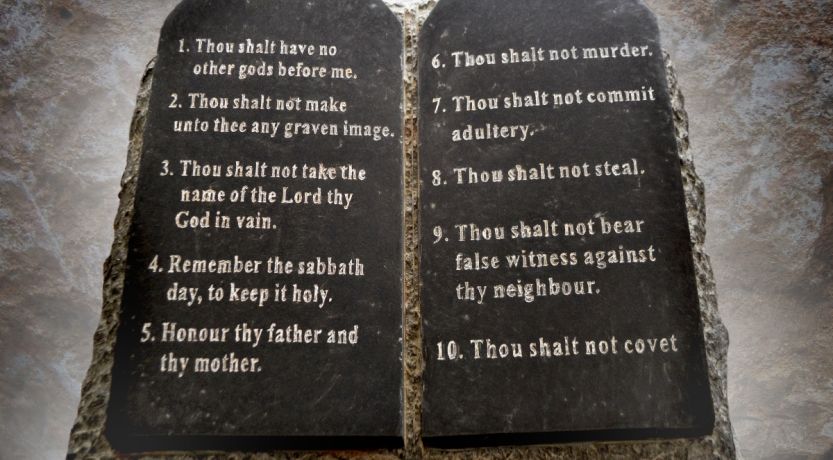
Did Jesus Reaffirm All 10 Commandments?In last month’s column, we asked, “Did Jesus’ Commandments Replace the 10 Commandments?” We looked at the idea that the 10 Commandments were replaced by the simpler new commandment of Jesus to love others. We showed that the new commandment didn’t abolish the 10 Commandments, but was Jesus’ example of how to show love to others. Love has always been the intent of the 10 Commandments.

But there is another common misunderstanding we need to examine: the idea that only the specific commandments Jesus reaffirmed are required for us today.

Let’s take a deeper look at this premise and see if it aligns with what Jesus taught.

Did Jesus need to reaffirm each commandment?

First, consider this: Did Jesus say that only the commandments He specifically mentioned are binding on Christians? That is easy to answer: No. If you read the Gospel accounts, you will find no such statement.

Did Jesus say that all of the Commandments would remain intact and relevant? In fact, He did. Shortly after giving the Beatitudes, Jesus addressed “the Law” and “the Prophets” and whether or not He came to abolish all or parts of them.

Let’s dissect what He said in Matthew 5:17-19:

  • Do not think that I came to destroy the Law or the Prophets. I did not come to destroy but to fulfill” (verse 17).

Jesus plainly said He did not come to “destroy” the law. The Greek word translated destroy (Greek, katalyo) can also be translated “dissolve,” “demolish,” “abrogate” or “deprive of force.” Instead of abolishing the law, He came to fulfill (pleroo) it—which means to “make full,” “fill up” or “accomplish.” Not only did He come to fulfill Old Testament prophecies, He also came to perfectly obey the 10 Commandments and, by doing so, fill them with greater meaning and relevance—just as the Messiah was prophesied to do (Isaiah 42:21).

  • “For assuredly, I say to you, till heaven and earth pass away, one jot or one tittle will by no means pass from the law till all is fulfilled” (Matthew 5:18).

Jesus used this graphic figure of speech to reinforce His previous statement. As long as heaven and earth exist, not the smallest detail (a jot was the smallest letter in the alphabet and a tittle was a small stroke used in writing) would pass away from God’s law. This reinforces every detail of the 10 Commandments. (See also our online article “Did Jesus Fulfill the Law?”)

  • “Whoever therefore breaks one of the least of these commandments, and teaches men so, shall be called least in the kingdom of heaven; but whoever does and teaches them, he shall be called great in the kingdom of heaven” (verse 19).

Jesus made it personal by saying that anyone who knows better yet teaches against any of God’s commandments will not be in God’s Kingdom (compare Matthew 5:20 and 19:17). The Greek word translated “break” means to loose, destroy or dissolve. Sadly, this strongly worded warning applies to many professing Christian leaders who teach their followers that all or parts of the 10 Commandments were abolished.

In these three simple yet powerful verses, Jesus affirmed that the 10 Commandments—every single one of them—were carrying forward into New Covenant times. In these three simple yet powerful verses, Jesus affirmed that the 10 Commandments—every single one of them—were carrying forward into New Covenant times. They would continue to be binding as long as the heaven and earth still existed.

Later in the Sermon on the Mount He singled out two specific commandments (the prohibitions against murder and adultery) to teach about the spiritual intent behind those laws (Matthew 5:21-30). Of course the other eight have deep spiritual meanings as well, but He covered only those two at that time.

Jesus reciting the Commandments

But despite Jesus’ clear words, some still argue that if He didn’t specifically mention a commandment, its relevance to Christians is questionable. But consider Jesus’ discussion with a man identified as “a certain ruler.”

This man asked Jesus, “What shall I do to inherit eternal life?” (Luke 18:18). Jesus answered that the basic starting point was keeping the Commandments, and then He listed five of them: “‘Do not commit adultery,’ ‘Do not murder,’ ‘Do not steal,’ Do not bear false witness,’ ‘Honor your father and your mother’” (Luke 18:20).

Jesus only listed five commandments, so does that mean the other five are irrelevant and nonbinding? That reasoning would mean:

  • We are free to place any other god before the true God (Exodus 20:3).
  • We are free to make and worship idols of anything we wish (verses 4-5).
  • We are free to revile and misuse God’s name as much as we want (verse 7).
  • We are free to do work on the seventh-day Sabbath (verses 8-11).
  • We are free to covet (verse 17).

Sadly, this is taught by some—but in reality, it’s usually only used to zero in on one of the above commandments (the seventh-day Sabbath).

Jesus’ statement in Matthew 5 proves this isn’t true. But still, by listing only five, did Jesus ignore some of the 10 Commandments? Not at all!Download God's 10 Commandments Still Relevant Today

Next time we will take a closer look and discover that the New Testament actually does specifically reinforce every single one of God’s 10 Commandments.

Sidebar: Why Did Jesus List Only Those Five Commandments?

When speaking to the rich ruler, Jesus said that obedience to the Commandments was necessary and then listed five of the 10 Commandments (Luke 18:18-20). Why would He do this? Here are some possibilities.

We don’t know exactly what this man was a “ruler” of, but he could possibly have been a member of the Pharisees (who ruled the synagogues). The Pharisees had developed their own commandments, which were very burdensome and in some cases actually led people to disobey God. Jesus had little regard for their law, which He called “the commandments of men” (Mark 7:6-7).

By listing a few of the 10 Commandments, He was clarifying exactly which commandments were necessary for eternal life: God’s 10 Commandments, not the cumbersome laws of the Pharisees.

But why would He have chosen the five examples He did—adultery, murder, stealing, lying and honoring parents (Luke 18:20)?

One of the major problems with the Pharisees’ laws was that they often led to the abuse and mistreatment of other people. For example, in Matthew 23 Jesus Christ strongly rebuked them for putting unnecessary burdens on people (verse 4), abusing widows (verse 14), neglecting justice and mercy (verse 23) and even being complicit in the murder of righteous men (verse 34-35). In another place, He scolded them for inventing a loophole that allowed them to avoid caring for their elderly parents (Mark 7:11-13).

The main flaw was neglecting to show love to their fellow man.

If the rich ruler was a Pharisee, it would make sense that when Jesus mentioned a few commandments as examples, He chose ones about loving other people (Matthew 22:39). These were five commandments the Pharisees needed to hear. But, of course, that didn’t mean the other commandments dealing with loving God and not coveting were any less important.

In fact, after the man answered that he had obeyed these commandments from childhood, Jesus challenged him to sell his possessions and follow Him—which, it appears, the man was unwilling to do. This demonstrated his unwillingness to fully obey the other commandments to love God and to not covet.”  From: https://lifehopeandtruth.com/bible/10-commandments/the-ten-commandments/did-jesus-reaffirm-all-10-commandments/?

________

Which Is the Great Commandment?

Matthew 22:35-38

Then one of them, a lawyer, asked Him a question, testing Him, and saying, “Teacher, which is the great commandment in the law?” Jesus said to him, “‘You shall love the LORD your God with all your heart, with all your soul, and with all your mind.’ This is the first and great commandment.”

Listen to the "Verse by Verse" episode covering this scripture.

The lawyer seemingly intended this as a trick question with many possible answers that would be considered wrong by those experts who had ranked the laws differently.

But Jesus Christ cut to the core of all the laws to identify what is truly most important. Loving God with all our being means we will seek to please Him and do everything else He asks us to do.It's time to get to know God. Start your 7-day guided Journey.

This first, great commandment summarizes the first four of the 10 Commandments (Exodus 20:1-11) where God explains how to love Him the way He wants to be loved. Human ideas of how to worship God may be well-intentioned, but to be assured we are pleasing God, we must worship and obey Him the way He wants us to.

The first four Commandments, and the entire Bible, show us that way.

Study more about how God wants us to love Him in our article “The Great Commandment.””  From: https://lifehopeandtruth.com/bible/blog/which-is-the-great-commandment/

_________

Lipstick Contaminated with Lead?

“Dozens of lipsticks and lip glosses are put to the test.

“Over the past years, using cosmetic products has increased worldwide at an alarming rate due to unending pursuit for individual beautification…” There’s nothing necessarily wrong with that unless cosmetic products contain ingredients that may be linked to disease—ingredients such as toxic heavy metals like lead.

As you can see at 0:28 in my video Flashback Friday: Is Lipstick Safe Given the Lead Contamination?, lead has been found in a wide range of cosmetic products, from eye shadow to skin cream, and foundation to blush. You may recall that I talked about lead in henna in my video Is Henna Safe?, but in looking at the data, “important warnings can be recognized”: the presence of lead in lipsticks. This is concerning because lipstick wearers may actually swallow a little bit of it. In fact, it has “been estimated that a woman inadvertently ingests 1.8 kg [about 4 lbs] of lipstick during her lifetime.” “Moreover, lipsticks can be used by pregnant women or women of child bearing age.” (I mean, obviously.) Yes, lead is highly toxic, but how much lead can there be in lipstick? Surely, it is “a very minor source….Nonetheless, one should not exclude the fact that lead accumulates in the body due to over time and repetitive lead-containing lipstick or hair dye application, which lead to significant exposure levels.” You don’t really know, though, until you put it to the test.”                      Continued at: https://nutritionfacts.org/blog/lipstick-contaminated-with-lead/?

_________

Sunday, June 16, 2024

PENTECOST. If I Were a Rich Dad. Helping Our Children Grow.

.Feast of Pentecost

FEAST OF PENTECOST

Note to parents

“We encourage you to read through this material with your children to provide an overview of the meaning of the Day of Pentecost and what it pictures in God’s plan. Then choose appropriate material from the supplemental pages that you feel will be helpful in teaching and reinforcing the meaning of this festival.

This solemn ceremony had profound spiritual significance because it depicted Christ’s ascension and acceptance by the Father as the first of the firstfruits of humanity.”

More at: https://lifehopeandtruth.com/uploads/eei/EEI-LessonOverview-WOG-Pentecost.svg

________

If I Were a Rich Dad

If-I-Were-a-Rich-Dad“The book Rich Dad, Poor Dad taps into our desire to understand what the rich know. But I look to a different book to understand fatherhood—and true riches!



Many years ago on a long road trip taking our kids to summer camp, a friend played an audio book called Rich Dad, Poor Dad. The subtitle of the book is “What the Rich Teach Their Kids About Money That the Poor and Middle Class Do Not!”

The author’s basic theme is that his real dad, a highly educated public servant, constantly complained about being broke, while his best friend’s father constantly enjoyed the finer things in life. The book claims to be a collection of financial lessons he learned from both men. From the parts I heard, it was clear that he had more respect for his “rich dad’s” street sense and his financial goals and choices.

I admit that I didn’t hear the whole book and I remember even less, so I’m not trying to comment on any financial principles the book might espouse. But what stuck with me was the low esteem the author seemed to have for his real dad’s accomplishments in life.

My poor dad

My own father has never been rich, but I have felt richly blessed to have him as my father. My dad was actually doing fairly well financially working for a huge aerospace firm, but when he learned about the biblical Sabbath, he faced a choice between keeping his job or obeying the things he was learning in a best-selling book: the Holy Bible. He chose faith over financial security.

In his new profession as a self-employed house painter, my dad worked hard. He was fair—and more than fair—to his clients. He never wanted to charge more than he thought was reasonable, and he ended up absorbing some losses because he was too nice.

Doing these things did not lead my dad to financial success, but they are admirable qualities of a true and giving Christian. I saw the biblical principles of turning the other cheek and esteeming others better than himself in action (Matthew 5:39; Philippians 2:3).

My rich Dad

As much as I respect and appreciate my poor dad, I also appreciate that he helped introduce me to my rich Dad and His wonderful instruction book. By bringing me up “in the training and admonition of the Lord,” my dad helped me to identify the true riches (Ephesians 6:4).

What are those true riches? The Bible records this breathtaking promise to those God is calling:

“Behold what manner of love the Father has bestowed on us, that we should be called children of God!” (1 John 3:1).

God—the Creator of the entire universe, the owner of all the gold and silver, the most powerful being imaginable—loves us and wants us to be His sons and daughters!

That’s a message that I want to share with my family and friends and everyone!

If I were a rich dad …

I am not considered rich in this society, but I have been blessed in many ways, including living in the United States and having a rewarding job that takes care of my needs. In talking with people from developing countries, I am reminded of how blessed I truly am!

However, I don’t have a large inheritance to pass on to my children in this world. Like Tevye in Fiddler on the Roof, I could wish I were a rich man—at least for the sake of my family.

But most of all, I hope that I have shared with my children what has been entrusted to me—the true riches of a spiritual relationship with God our Father. In the eternal scheme of things, that relationship is far more valuable than all the silver and gold in the universe.

I hope you will want to learn more about my rich Dad and His offer to humans to become His children. There is no priority more important! Please take time now to read more of what the Bible reveals about this wonderful truth in the article “Children of God.”

Happy Father’s Day to my poor dad and my rich Dad!”  From: https://lifehopeandtruth.com/life/blog/if-i-were-a-rich-dad/

_________

Helping Our Children Grow

“How can we create the best environment for teaching and helping our children grow? How can we make a peaceful home for the children God has entrusted to us?

Helping Our Children Grow

All humans start out as sweet, lovable and innocent little babies. They come into this world without emotional baggage or bad habits to break.

Practically everything has to be learned—how to eat, when to sleep, how to use the toilet, crawl, walk, talk, listen, read and so much more—and parents are their first and most important teachers. What and how they learn greatly affects whether they grow up to be wise or foolish.

Many factors influence the minds of our children as they grow up, including their peers, entertainment and the powerful influence of social media. But most studies show that the family still has the strongest effect of all of these.

How we parent our children determines to a great extent their future. It deeply impacts how well they will do on their jobs, the type of person they will choose to marry and the success of that relationship, how they will parent their own children and the relationship they will have with them.

No parent wants to go through the anguish of seeing his or her children choose a path that will destroy their future happiness. So what can we do to ensure our children become successful adults?

“Unless the Lord builds the house”

The foundation of a successful home and family begins even before you marry. What can you do to prepare to be a godly mate and parent? And what kind of person do you want to marry and have as the father or mother of your children?

Solomon wisely noted, “Unless the Lord builds the house, they labor in vain who build it” and “Behold, children are a heritage from the Lord” (Psalm 127:1, 3). A wise person will therefore first seek God’s blessing on his or her marriage. And once you are married and decide to have children, why not first ask God to bless the conception, birth and your parenting efforts?

God blesses us with these little ones, and He is the One who can teach us how to bring them to adulthood successfully.

Two great commandments: principles for how to raise a child

God has not left us without guidelines we can use to provide a more fulfilling life for our children. Certainly there is no guarantee, as children sometimes make bad choices, but applying these guidelines will greatly increase our odds of a good outcome.

The greatest laws of life are also the greatest guides to successful childrearing. Jesus said the entire law of God could be summarized as two great commandments: Love God with all our hearts and love our neighbors as ourselves (Matthew 22:36-39). These two great laws provide the most important framework for steering our children toward a successful, fulfilling life.

When we realize that every human has an awesome potential, including these little ones in our care for a brief period of time, parenting takes on a whole different outlook. What is our purpose in life? What is their future and purpose? It all ties in with our relationship with God and each other.

If God is first in our lives, then He will be our go-to source for the help we need in this most important task of parenting. He will help us create the environment to assist our children in growing into the kind of adults they need to be—people who love God with all their hearts and their neighbors as themselves!

Positive environment for child development

When I think about an environment for growth, an experience from years ago comes to mind.

Indiana is beautiful in the summer; but in the dead of winter, it can be a cold, dreary place. Very few evergreens exist to provide color, and when no snow falls the landscape is a dull gray.

On one of those cloudy days, my wife and I visited a couple who owned a nursery farm. We stepped from our car into the cold north wind and made our way over to some long buildings.

As we stepped through the doors, we were welcomed by a pleasant 72-degree temperature and met with rows and rows of beautiful flowers and many varieties of verdant young vegetable plants.

No matter how cold, snowy and windy it was outside, inside those buildings we found the ideal environment in which plants could thrive. If we create the right environment, we can grow almost anything we want to.

The same is true for children. Give them the right environment, and they will develop the qualities they’ll need for a great future.

We can’t totally insulate our children from all the negative things of this world, but we can create an environment in our homes where they can grow and thrive.

Peaceful home

My wife and I had the goal of making our home a sanctuary for our children. No matter what kind of day they had at school or in the neighborhood, we wanted our home to be a place they would find peace, security, kindness and love. The family environment is what makes a house a home. The world is not always the nicest place, and after a hard day at school or work, we all need a warm place to come home to.

My wife and I had the goal of making our home a sanctuary for our children. No matter what kind of day they had at school or in the neighborhood, we wanted our home to be a place they would find peace, security, kindness and love.

“For God is not the author of confusion but of peace” (1 Corinthians 14:33). Teaching family members to respect others and providing the security of structure for everyone establishes an atmosphere for growth.

A few of the building blocks for creating this kind of environment in the home include:

  • Settling differences without screaming and anger.
  • Having meals together.
  • Viewing television and computer screens less and talking and listening more.
  • Creating family traditions, such as family activity nights and family Bible studies.
  • Reading to children a lot, especially when they are small. They love it! It provides not only a great emotional connector with the parents but it instills in them a desire to learn.

And, of course, the most powerful method of instruction is our example. A picture is worth a thousand words, and a good example of what to do is worth a thousand spoken “don’ts.” 

Above all, it’s vital that we teach our children about God as early as possible and also that they see that God is important to us. They need to know that He is the source of every good and perfect gift we have to enjoy (James 1:17).

Teaching our children

God tells us to teach our children about Him and His instructions for us every day, all through the day, to explain how obeying His laws makes life good for us and others.

“You shall love the LORD your God with all your heart, with all your soul, and with all your strength. And these words which I command you today shall be in your heart. You shall teach them diligently to your children, and shall talk of them when you sit in your house, when you walk by the way, when you lie down, and when you rise up” (Deuteronomy 6:5-7, 24; see also 10:13).

When our children were small, our family was frequently together in the car. On long trips, our children would often ask me to tell them stories. I would make up stories about young heroes and villains, but I always worked in a moral to the story as another way to teach them about honesty, serving others or sacrifice for a good cause.

It can be challenging to find time to teach our children. Thankfully, God gave us the Sabbath command—to cease from our work and play on the seventh day. (For more about this, download our free booklet The Sabbath: A Neglected Gift From God.) My family found that the Sabbath was special time unlike the rest of the week, because it provided great opportunities to enjoy time together and to talk about God’s Word and way of life.

My wife always prepared a nice meal for the beginning of the Sabbath, Friday evening. Our children knew that dessert came after our family Bible study, so they were always excited for the study to begin. We tried to keep it interesting and relevant for their ages and to involve them by making it interactive.

Helping our children grow in discipline and accountability

Rules and discipline are a necessary part of life. If parents don’t require their children to live within the boundaries of correct conduct, life will, and experience can be the harshest disciplinarian. Even God, our Father, disciplines us for our benefit (Hebrews 12:10).

The Bible teaches loving discipline and instructs parents to avoid harsh and unreasonable rules and enforcement (Proverbs 13:24; 22:6; Ephesians 6:4; Colossians 3:21).

Recent research backs up the effectiveness of this loving approach. “A large body of research on attitudes indicates that parental warmth together with reasonable levels of control combine to produce positive child outcomes” (Joan E. Grusec, PhD, and Tanya Danyliuk, BA, “Parents’ Attitudes and Beliefs: Their Impact on Children’s Development”).

Wise parenting, however, looks deeper than just correcting specific infractions. Even more important than wrong actions are the attitudes or motives behind them. Consider what those may be so you can address those when necessary.

There are no perfect parents

No matter how well parents have done, they all say in hindsight, “I made some mistakes. I could have done better.” There are no perfect parents. So don’t get discouraged. Do the best you can with God’s help, and entrust the outcome to Him.

God gave His Son as a gift to the world. Although God’s gift is far above anything we can imagine, there is a way in which He wants us to give our children as a gift as well. He wants us to prepare them to make a contribution to the world—to make it a better place for others!

We encourage you to learn more about what the Bible says about parenting and building a strong family. The articles in the “Parenting” and “Family” sections can help.

Bible Verses About Parenting Responsibilities

The apostle Paul tells us the most important things a parent can teach:

“Fathers, do not provoke your children to wrath [lest they become discouraged, Colossians 3:21 adds], but bring them up in the training and admonition of the Lord” (Ephesians 6:4).

Paul packs a lot into this short instruction to parents.

First, he gives a warning not to be unreasonable, severe or demeaning—not to dishearten them, but to encourage them.

“Bring them up” is from the same Greek word translated “nourishes” in Ephesians 5:29, where Paul points out how much we nourish and cherish our own bodies. It is natural that parents should lovingly feed their children’s bodies and minds.

And what is the main subject of all the training and admonition? It is the way of the Lord. This is the most important thing a parent can teach. How to obey God. How to fear Him, please Him and even become like Him. Why?

Because children are a heritage from the Lord (Psalm 127:3)—He gives them to us to raise, but they are really His.

We must learn the way of the Lord ourselves in order to teach it, but, thankfully, it is all laid out for us in one textbook—the Holy Bible. The Bible gives us the foundational truths that help us—and our children—make sense of all other important truths.

Introduce your children to God through age-appropriate Bible study, prayer, exploring His creation and practical application of biblical principles. As your child sees you live out your faith, he or she will learn how reverence of God leads to wise choices and blessings. Obeying God’s laws brings benefits now—and forever.

Some of those benefits are described in the verses at the beginning of Ephesians 6. Learning to honor parents is a step toward honoring God, and God specifically listed the benefits obeying this Fifth Commandment can bring: “‘Honor your father and mother,’ which is the first commandment with promise: ‘that it may be well with you and you may live long on the earth’” (verses 2-3).

Read more in our articles “How to Help Your Children Build a Relationship With God” and “Fifth Commandment: Honor Your Father and Your Mother.”

Parenting: Instructions Not Included

Even though we might not endorse the film itself, the title to the 2013 movie Instructions Not Included certainly resonates with many new parents!

Many governments require training for teachers, camp directors and child protective services, yet it seems we expect parents to intuitively know what to do. We expect mothers and fathers to learn on the job—and they sure do!

But the biblical expectation is more effective and encouraging. God ideally wanted parents to learn to be parents from their parents. If your parents haven’t given you this training, consider asking them for it. It’s a biblical principle and even if they made some big mistakes, perhaps they learned from those and can now provide meaningful advice within the framework of God’s principles.

If your parents aren’t available or qualified, other family members or wise people you know might step into this role.

Beyond personal experience, it can be helpful to study child development and what parenting “experts” have to teach. But beware of the parenting “fad of the year,” and compare the advice you read with that which has truly stood the test of time—the Bible. God created children and family, and our Heavenly Father truly knows what’s best. For more on Christian parenting, see the biblically based articles in our Life, Hope & Truth “Parenting” section.”  From: https://lifehopeandtruth.com/relationships/parenting/helping-our-children-grow/

_________

Sunday, March 31, 2024

Did Jesus Replace the Passover? I’m A Christian, But I Don’t Keep Easter. Are Fortified Children’s Breakfast Cereals Just Candy?

.

This is Easter weekend, but Passover isn’t until the end of next month!!  Starts evening of 22nd. April 2024.

_______

Did Jesus Replace the Passover?


Did Jesus Replace the Passover?

“Did the God of the Old Testament do things that Jesus Christ had to clean up? For example, is the Passover outdated and no longer necessary?

Religious writers of a gnostic bent, past and present, frequently mix truth with error. One of their major themes falsely claims that the Creator God was rather “over the hill,” necessitating a youthful, vigorous Jesus to zoom in to repair the damage and rescue human souls.

In his book Primitive Christianity in Crisis, Alan Knight explains the gnostic approach: “Salvation depends on rejecting both the material world and the God that created it. … The wrathful God of the Old Testament cannot be the same as the true spiritual Father” (third edition, pp. 22, 48).

Is the big story plot of the Bible, “Jesus Christ the Savior replaces a fading Creator God”?

Did Jesus scrap the Creator’s work, or did He build on it, adding the finished structure to the foundation God had laid?

Jesus came to reveal the Father, not replace Him (Matthew 11:27; John 5:37). Could it be that Father and Son have been closely collaborating all along? They are on the same page, with the same goals and same objectives, in complete agreement.

As a case in point, consider the biblical story of the Passover, in the Old Testament and the New.

The Old Testament Passover

In Exodus 12 we read of the Passover being revealed to the Israelites. It was to be observed on the 14th day of the first month of the Hebrew calendar. For each household a lamb was slaughtered, a male without blemish. No bones of the lamb were broken. They smeared the Passover lamb’s blood around the doors of their homes as a sign.

God spared the congregation of Israel as He passed over the blood-stained doors in the night and did not send destruction on their firstborn.

The following day, the 15th of the first month, was a holy day, the first day of the Feast of Unleavened Bread. On that day Israel began leaving Egypt and eating unleavened bread. Israel was finally delivered from their hard bondage in slavery.

Jesus’ New Testament Passover

Some 15 centuries later the Bible records another Passover, this time in the holy city, Jerusalem. Compare this one to that first ancient drama.

  1. A key event of the New Testament is the sacrifice of a human male Passover lamb, Jesus Christ. “For indeed Christ, our Passover, was sacrificed for us” (1 Corinthians 5:7).
  2. Jesus was crucified on the exact same 14th day of the first month, the preparation day before the first day of the Feast of Unleavened Bread, a holy day. “Therefore, because it was the Preparation Day, that the bodies should not remain on the cross on the Sabbath (for that Sabbath was a high day), the Jews asked Pilate that their legs might be broken, and that they might be taken away” (John 19:31).
  3. Jesus’ sacrifice delivered mankind from bondage to sin and death (Romans 8:2).
  4. Jesus was without sin, an unblemished sacrifice (1 Peter 2:22; 1 John 3:5).
  5. None of His bones were broken. “But when they came to Jesus and saw that He was already dead, they did not break His legs” (John 19:33).
  6. Jesus spared all repentant sinners from eternal death, the consequence of our sins. We have been washed in His own blood (Revelation 1:5). Compare this to how the Israelites were saved from the death of the firstborn.
  7. Jesus’ disciples continued to keep the Passover annually to remember His sacrifice and still do even to this day, along with the Feast of Unleavened Bread. “Therefore let us keep the feast, not with old leaven, nor with the leaven of malice and wickedness, but with the unleavened bread of sincerity and truth” (1 Corinthians 5:8, penned some 20-plus years after Jesus ascended).
Finishing touches?

Did Jesus start a new approach with the nonbiblical holidays of Christmas and Easter? Or did He put the finishing touches on the age-old Passover festival to be observed for all time, precisely as the Father and Jesus planned in exact detail from the very beginning?

  • “In the beginning was the Word, and the Word was with God, and the Word was God” (John 1:1).
  • “I and My Father are one,” of one mind and purpose (John 10:30).
  • “O My Father, if this cup cannot pass away from Me unless I drink it, Your will be done” (Matthew 26:42, Jesus prayed this to the Father about His terrible trial that was to commence).

The Bible shows that the first Passover festival of the sacrifice of unblemished lambs back in ancient Egypt was a brilliantly fashioned shadowy precursor of greater things to come centuries later—the sacrifice of Jesus Christ for all sins, for all mankind, for all time (Colossians 2:16-17).

For more about Passover, see “Passover: What Did Jesus Do for You?” For more about God and Jesus, check out the section about God. “  From: https://lifehopeandtruth.com/god/blog/did-jesus-replace-the-passover/

________

I’m a Christian, but I Don’t Keep Easter

“The Bible gives us instructions on how to worship God, Easter is not commanded there, but the Passover is... which will you observe?

Transcript Of video at:  https://www.ucg.org/beyond-today/beyond-today-daily/im-a-christian-but-i-dont-keep-easter

[Darris McNeely]

“I'm a Christian but I don't keep Easter. I'm a Christian, and I keep Passover. Now, when I say the word Passover, you may think, "Well, that's Jewish. How can you be a Christian and keep what you consider think to be a Jewish festival Jewish holiday?" Well, very simply, very easily. I read the Scripture, and I understand what it says and I understand what the Passover of the New Testament really is. And I see instruction for me to keep that and I don't see the instruction for Easter, and a lot of other holidays that have been substituted for God's Festivals. But for a moment, let's just focus on the Passover.

As I speak here, at this time, we're just a few weeks away from keeping the Passover, a very important service for a Christian. One who has given their life to God, to Jesus Christ, accepted His sacrifice and are a disciple. In 1 Corinthians 5, Paul is writing to a Gentile church in the city of Corinth, and he's giving them instructions about their life, but then also about keeping the Festival of the Days of Unleavened Bread. And in verse 7 of 1 Corinthians 5, he tells them, "Purge out the old leaven, that you may be a new lump since you truly are unleavened." Now, that's a reference to putting out the leaven in anticipation of the seven days of unleavened bread, another festival, and keeping that with the unleavened bread of sincerity of truth. And he says, "For indeed, Christ, our Passover, was sacrificed for us." Christ, our Passover.

There are many scriptures that talk about the Passover service. There's certainly Old Testament Scriptures that define what it was in the Old Testament. And there are New Testament Scriptures that define what it means in the New Testament under the New Covenant, how Christ kept it, and how the church was instructed to keep it. And this is one of those and it says that Christ is our Passover, sacrificed for us. In the New Testament Passover, we don't kill a lamb. We don't spread its blood on the doorposts as they did back in Exodus, at the time of the Exodus.

We keep the Passover with the symbols of the body and blood of Jesus Christ, but we keep the Passover. We keep the Passover because it points us to Christ who is our Passover. It's something that you should think about if you haven't before because, from the scriptures, we find that Christ is our Passover. And that's what I keep as a Christian. And I hope it will make you think if you're not already doing it, that that's what you should be doing instead of whatever you may be doing to worship God. Doing it this way is the godly way, the biblical way.”  From: https://www.ucg.org/beyond-today/beyond-today-daily/im-a-christian-but-i-dont-keep-easter

________

Are Fortified Children’s Breakfast Cereals Just Candy? 

“The industry responds to the charge that breakfast cereals are too sugary.

In 1941, the American Medical Association’s Council on Foods and Nutrition was presented with a new product, Vi-Chocolin, a vitamin-fortified chocolate bar, “offered ostensibly as a specialty product of high nutritive value and of some use in medicine, but in reality intended for promotion to the public as a general purpose confection, a vitaminized candy.” Surely, something like that couldn’t happen today, right? Unfortunately, that’s the sugary cereal industry’s business model.

As I discuss in my video Are Fortified Kids’ Breakfast Cereals Healthy or Just Candy?, nutrients are added to breakfast cereals “as a marketing gimmick to “create an aura of healthfulness…If those nutrients were added to soft drinks or candy, would we encourage kids to consume them more often?” Would we feed our kids Coke and Snickers for breakfast? We might as well spray cotton candy with vitamins, too. As one medical journal editorial read, “Adding vitamins and minerals to sugary cereals…is worse than useless. The subtle message accompanying such products is that it is safe to eat more.”

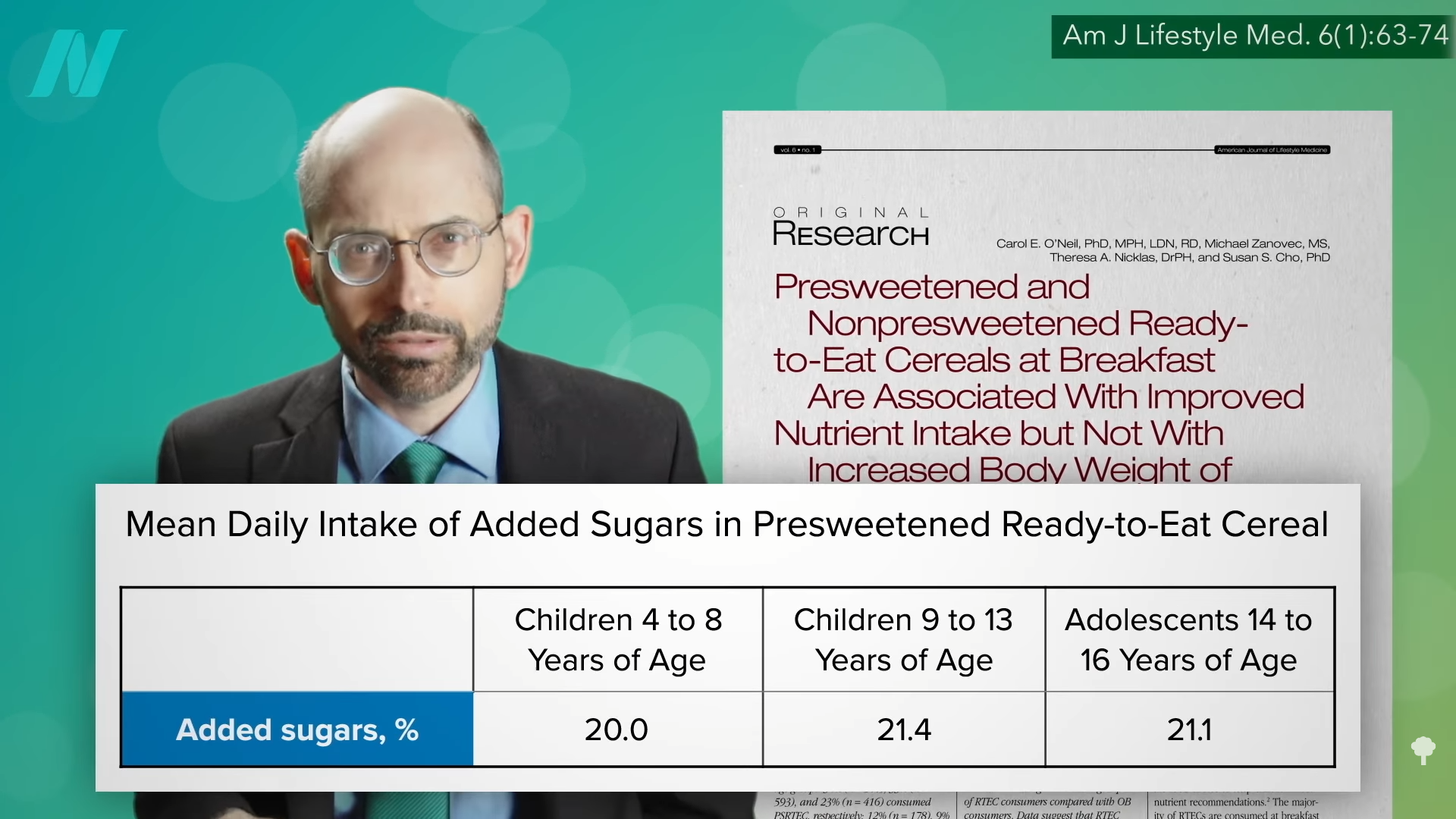
General Mills’ “Grow up strong with Big G kids’ cereals” ad campaign featured products like Lucky Charms, Trix, and Cocoa Puffs. That’s like the dairy industry promoting ice cream as a way to get your calcium. Kids who eat presweetened breakfast cereals may get more than 20 percent of their daily calories from added sugar, as you can see below and at 1:28 in my video.

Most sugar in the American diet comes from beverages like soda, but breakfast cereals represent the third largest food source of added sugars in the diets of children and adolescents, wedged between candy and ice cream. On a per-serving basis, there is more added sugar in a cereal like Frosted Flakes than there is in frosted chocolate cake, a brownie, or even a frosted donut, as you can see below and at 1:48 in my video.

Kellogg’s and General Mills argue that breakfast cereals only contribute a “relatively small amount” of sugar to the diets of children, less than soda, for example. “This is a perfect example of the social psychology phenomenon of ‘diffusion of responsibility.’ This behavior is analogous to each restaurant in the country arguing that it should not be required to ban smoking because it alone contributes only a tiny fraction to Americans’ exposure to secondhand smoke.” In fact, “each source of added sugar…should be reduced.”

The industry argues that most of their cereals have less than 10 grams of sugar per serving, but when Consumer Reports measured how much cereal youngsters actually poured for themselves, they were found to serve themselves about 50 percent more than the suggested serving size for most of the tested cereals. The average portion of Frosted Flakes they poured for themselves contained 18 grams of sugar, which is 4½ teaspoons or 6 sugar packets’ worth. It’s been estimated that a “child eating one serving per day of a children’s cereal containing the average amount of sugar would consume nearly 1,000 teaspoons of sugar in a year.”

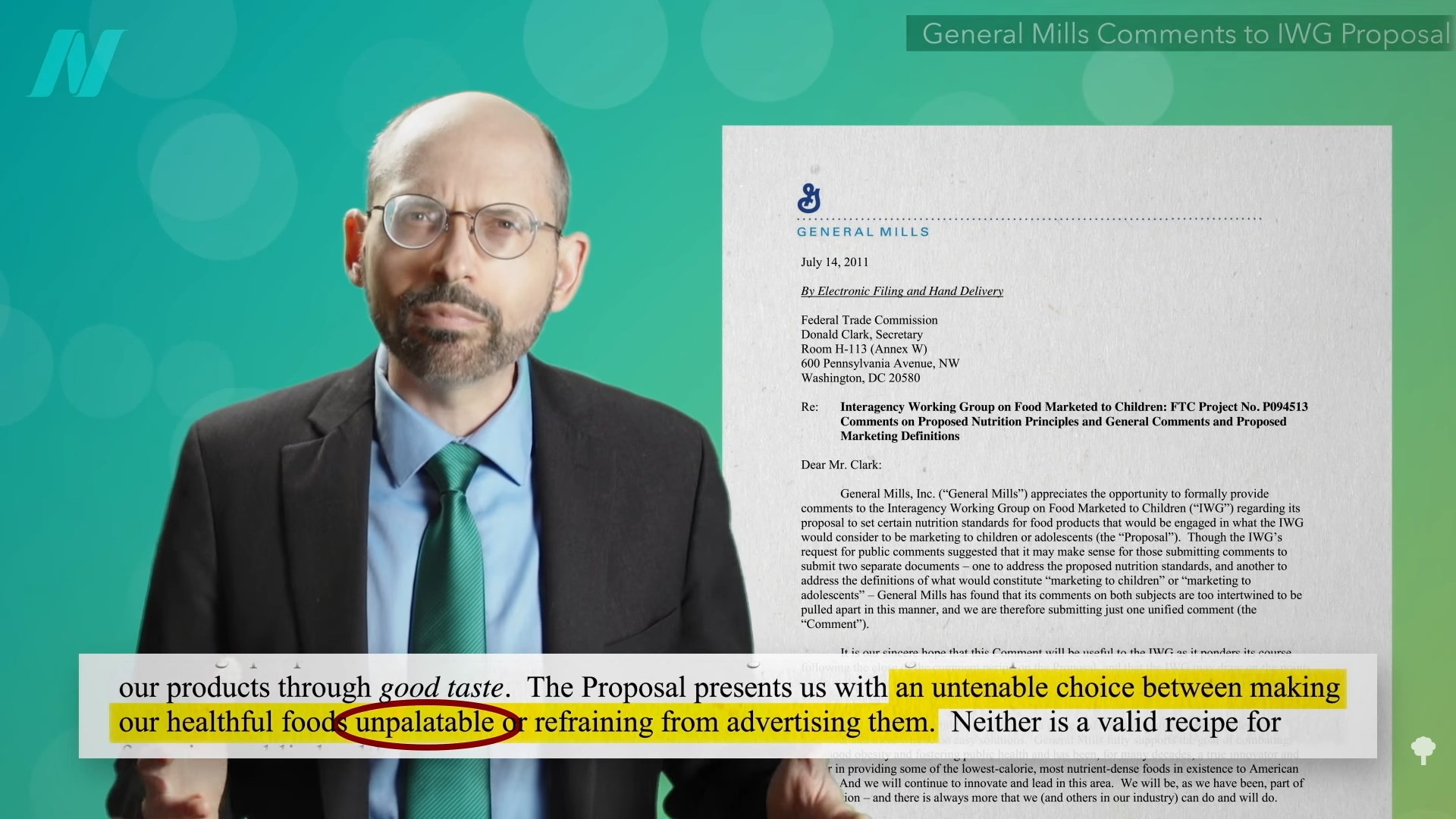
General Mills offers the “Mary Poppins defense,” arguing that those spoonsful of sugar can “help the medicine go down” and explaining that “if sugar is removed from bran cereal, it would have the consistency of sawdust.” As you can see below and at 3:17 in my video, a General Mills representative wrote that the company is presented “with an untenable choice between making our healthful foods unpalatable or refraining from advertising them.” If it can’t add sugar to its cereals, they would be unpalatable? If one has to add sugar to a product to make it edible, that should tell us something. That’s a characteristic of so-called ultra-processed foods, where you have to pack them full of things like sugar, salt, and flavorings “to give flavor to foods that have had their [natural] intrinsic flavors processed out of them and to mask any unpleasant flavors in the final product.”

The president of the Cereal Institute argued that without sugary cereals, kids might not eat breakfast at all. (This is similar to dairy industry arguments that removing chocolate milk from school cafeterias may lead to students “no longer purchasing school lunch.”) He also stressed we must consider the alternatives. As Kellogg’s director of nutrition once put it: “I would suggest that Fruit [sic] Loops as a snack are much better than potato chips or a sweet roll.” You know there’s a problem when the only way to make your product look good is to compare it to Pringles and Cinnabon.

Want a healthier option? Check out my video Which Is a Better Breakfast: Cereal or Oatmeal?.

For more on the effects of sugar on the body and if you like these more politically charged videos see the related posts below.

Finally, for some additional videos on cereal, see Kids’ Breakfast Cereals as Nutritional Façade and Ochratoxin in Breakfast Cereals.

Key Takeaways
  • Vi-Chocolin, a vitamin-fortified chocolate bar, was purportedly offered as a product with high nutritive value but was really just vitaminized candy. The sugary cereal industry follows a similar business model.

  • The sugary cereal industry has been criticized for adding nutrients to cereals “as a marketing gimmick,” creating an illusion of health benefits.

  • Children who consume pre-sweetened breakfast cereals may derive more than 20 percent of their daily calories from added sugar. Breakfast cereals rank as the third-largest food source of added sugars in the diets of kids and adolescents, listed between candy and ice cream. On a per-serving basis, a cereal like Frosted Flakes has more added sugar than a frosted chocolate cake, a brownie, or a frosted donut.

  • Kellogg’s and General Mills’ contention that breakfast cereals contribute only a “relatively small amount” of sugar to children’s diets is likened to the social psychology phenomenon of “diffusion of responsibility.”

  • Consumer Reports’ findings reveal that children often pour themselves 50 percent more cereal than the suggested serving size. A child eating a single daily serving of kids’ cereal with the average amount of sugar would consume almost a thousand teaspoons of sugar in one year.

  • The industry argues it has to add sugar to its cereals to make them palatable, which is a characteristic of ultra-processed foods.  From: https://nutritionfacts.org/blog/are-fortified-childrens-breakfast-cereals-just-candy/?

__________

Sunday, March 17, 2024

Do You Feel Lucky Today? St. Patrick's Day. How to Keep Yourself Off the Operating Table.

.

Do You Feel Lucky Today?

Do You Feel Lucky Today?Photos.com

“Good luck, bad luck, no luck and even luck that can follow you—is this really what controls your future?

Across the globe the seemingly harmless Irish tradition of having to wear green on March 17 so the luck of the Irish will be with you has saturated our society. What's all the fuss over a man called St. Patrick that has resulted in widespread partying and celebration?

Even more widespread is the concept of luck, a seemingly supernatural force that swings the odds of circumstances in people's favor or against them. Is this acceptable from a biblical perspective? Should we be wishing others "Good luck"?

As St. Patrick's Day comes around, it's a good time to take a hard look at luck.

Irish tradition

Throughout the past 1, 500 or so years, traditions have grown, folklore has spread, and "luck" has sprouted in our everyday language. The leprechaun and icons like the color green, the shamrock and the pot o' gold have all come to be associated with the celebration of St. Patrick's Day.

Legend states that St. Patrick used the shamrock or three-leaved clover to explain the Trinity. Its three leaves supposedly represented the Father, the Son and the Holy Spirit. Eventually, the custom was adopted of wearing a shamrock on his feast day. (The Trinity doctrine, however, is unbiblical—for more information, request our free booklet Is God a Trinity?)

A shamrock is different from a four-leaf clover. According to Celtic tradition, when a four-leaf clover is found, it is said to represent God's grace, with the four leaves standing for faith, hope, love and luck.

Ironically, the real Patrick would probably have frowned on the traditions associated with his feast day—as well as the holiday itself.

What's with luck?

Of course, the concept of luck or fortune is not exclusive to Irish tradition. We find it throughout human history and throughout the world today.

We now hear phrases like "good luck with the job interview," or "good luck on that test." While many deem this merely an expression of hoping for the best outcome, not really believing in luck, others take the concept of luck more seriously.

Some things associated with luck seem harmless, like wishing on a star, shooting stars, wishing wells, lucky trinkets or fairies. But there are underlying issues here that need to be raised.

Over the years luck has become like a god in society. Luck seems to decide things like your fate, car accidents, test scores, the job hunt, pay raises or even the answer you'll be given about that date you want to go on this Saturday night. People believe luck controls things and that it provides different opportunities for different people. Decisions are even based on it. Consider that many skyscrapers have no 13th floor—as 13 is considered unlucky.

No luck with the Bible

Looking to the Bible, we find that it gives no credibility to luck. In the first of the Ten Commandments, God states, "You shall have no other gods before Me" (Exodus 20:3). The intent of His command here is that nothing is to take a higher priority in our lives than Him! This first command warns us to not accept a religion or philosophy that teaches that our life and well-being originate or depend on anything other than the one true God.

As He often does, God colorfully portrays the utter foolishness of making gods of wood and stone, but the biblical nations of ancient Israel and Judah manufactured as many fake deities as the number of cities in the land of Judah (Jeremiah 2:27-28). "See if they can save you in the time of your trouble!" God taunted them and modern mankind (compare verse 28). Today our peoples still trust in worthless and inanimate things to save us—such as weapons, money and even actual idols by seeing power in crosses, religious statues and good luck charms.

God even laments over His people rejecting Him "and offering food and wine to the gods you call ‘Good Luck' and ‘Fate'" (Isaiah 65:11, Contemporary English Version). Any credit to luck is really a form of idolatry.

No luck at all

Maybe you've heard people say, "I know luck doesn't exist, but good luck anyway!" Perhaps they're conceding that there may be luck after all—or maybe they just don't know how else to wish someone well. They could simply say, "Do well" or "All the best." Or they could look to God, saying, "God be with you" or "God bless you" (yet only if He is truly sought).

After all, true power is with God, not with luck. As the Bible tells us: "Lift up your eyes on high, and see who has created these things … by the greatness of His might and the strength of His power; not one is missing … The Creator of the ends of the earth neither faints nor is weary" (Isaiah 40:26-28).

Using luck in our vocabulary and lives may seem harmless. But God is jealous for His people. He truly loves you and desires the best for your future. It does not please Him when we turn to fables and smooth phrases that announce our dependence on anything but Him. Everything we are and have ultimately comes from God. The only reliable assurance that our future is secure lies in our relationship with our Creator, not some ominous luck, wishes, stars or leprechauns.

God beats luck any day

God wants us to understand that we must never direct our worship toward anything He has created, or regard it as the source of our life and blessings. Worship only the Creator—never the creation. He is the sole miracle-working God who provides blessings, hopes and a promised future of eternal life in the Kingdom of God. Rainbows, waterfalls, clovers, stars and the rest of the creation were created for us to enjoy and use as a wonderful and beautiful environment to live in. We don't bow down, pray or make requests to any aspect of the creation.

So where are you placing your trust, faith and hope? That's a vital question for each of us.

God's ultimate plan and desire for us is that we live forever in His eternal family and Kingdom: "Now we are children of God … we know that when He [Jesus Christ] is revealed, we shall be like Him, for we shall see Him as He is" (1 John 3:2).

That is the purpose for which we have been created! Luck has nothing to do with it! Wishing wells, wishing on a star or making a wish when blowing out birthday candles simply skew and corrupt our relationship with our Creator.

There is one source of blessings. There is one way into the Kingdom of God. There is one sacrifice that removes the penalty of our personal sins. God alone is that true source—not luck!”  From: Do You Feel Lucky Today? | United Church of God (ucg.org)

_________

St. Patrick & St. Patrick's Day

“Who was this Patrick guy, anyway? Known as the patron saint of Ireland, he's an almost mythological figure in the Christian world, with tall tales of his legendary exploits known far and wide.

Theologian and historian James Moffatt said, “So much legend and fiction has been written about him that one is almost led to believe that there were two individuals—the real Patrick and the fictitious Patrick” ( The Church in Scotland , 1882, p. 140).

There are few hard facts about Patrick’s life, but we can draw some reasonable conclusions from what we do know.

Patrick is credited with establishing the Roman Catholic Church throughout Ireland. But does history match tradition? Moffatt commented, “He should not be placed where certain historians seem determined to assign him … He was in no way connected with the type of Christianity which developed in Italy” (ibid).

As it turns out, Patrick probably wasn’t even Catholic! His belief system was evidently quite different than that of continental Europe.

It’s probable that Patrick even honored God’s seventh day Sabbath! “It seems to have been customary in the Celtic churches of early times, in Ireland as well as Scotland, to keep Saturday, the Jewish Sabbath, as a day of rest from labor” (ibid).

Other historical records and Patrick’s own writings reveal him to have been closer to biblical instruction than to traditional Christianity. Part of the Bible’s teaching includes rejecting the use of pagan practices in the worship of the true God (Deuteronomy 12:29-32).

The real Patrick likely wouldn’t even have approved of observing his own namesake holiday! This holiday on March 17 was supposedly to commemorate his death, but that date was in fact the time of the Roman Bacchanalia—celebrating the god of wine and partying. It seems the pagan party goes on in another guise. Bear that in mind when March 17 comes around. Forget the leprechauns, and put God first!” Read the related article “Do You Feel Lucky Today? above.

_________

How to Keep David Letterman (and yourself) Off the Operating Table

by Caldwell B. Esselstyn, Jr., MD    March 1, 2011

“Last Friday night Barbara Walters television special highlighted six celebrities and their thoughts and emotions surrounding their open heart surgery.  Barbara Walters, Robin Williams, and Charlie Rose had valve surgery, while President Clinton, Regis Philbin, and David Letterman had bypass surgery for coronary artery disease.  Few would challenge that the stage of illness of these celebrities did not require surgical intervention. The real eye-opener of the show was David Letterman’s remark that he fully expected a second bypass operation in the future.  The sober resignation to an inevitable recurrence is what we must challenge vigorously.

Let’s be clear: coronary artery disease is a food borne illness and need never exist.  If the gifted surgeons identified in the television special had opened their offices in rural China, the Papua Highlands of New Guinea, Central Africa or among the Tarahumara Indians of Northern Mexico, they would need to take on second jobs.  Why all the empty waiting rooms? These cultures have a plant based nutrition no coronary artery disease, and no need for bypass surgeons or stents.

The key to our vascular health is the innermost single layer of endothelial cells which line our blood vessels. Those cells produce nitric oxide molecules, which smooth blood flow, enlarge blood vessels on demand, inhibit inflammation in the blood vessel wall, and most importantly prevent the formation of blockages or plaque.

So how does nitric oxide fail?

Every time we eat a western diet of oils, dairy, meat, fish, poultry, and caffeine in coffee we injure our endothelial cells and deplete our protective level of nitric oxide.  Autopsies of 20 year olds dying of accidents, homicides, and suicides confirm coronary artery disease is now ubiquitous (albeit still in an early stage.)  Continued nutritional insult to endothelial cells leads to plaque blockages, chest pain, heart attacks, strokes, and the need for stents and bypass surgery. Cardiologists agree these procedures are a temporary patch job and have nothing to do with the cause of the disease.

What about cholesterol?  Cholesterol is an innocent bystander in plant based populations with healthy uninjured endothelium and copious amounts of nitric oxide.  Once nitric oxide levels fall with the introduction of the western diet, the endothelial tissues become sticky allowing cholesterol to burrow into the vessel wall, creating plaque buildup and blockages, and impeding blood flow.

Lowering cholesterol is helpful, but the key is to avoid eating foods that further injure the endothelium.  That has been the focus of our counseling goal with patients since 1985.  It is also why we have been able to successfully treat this disease through dietary intervention in hundreds of patients with the technique described in my book, Prevent and Reverse Heart Disease.   With this dietary approach the endothelium can rapidly recover its nitric oxide production, halt disease progression, and often achieve significant disease reversal.  As a result, patients rarely require stents or bypasses.

Note to David Letterman: Your fate is on your fork.

Why don’t physicians offer the plant based nutrition option to their patients?

1.    They are not taught nutrition and are unfamiliar with the efficacy of a plant based approach.
2.    They don’t have time for patient nutritional counseling.
3.    They often lack the skill set for behavioral modification.
4.    Insurance support for counseling is sparse.
5.    The status quo offers a handsome income stream.

The cure for the coronary artery disease epidemic is not a pill, a procedure, or an operation.  The cure is to empower the public with nutritional literacy and to make each individual the locus of control when it comes to protecting their health and vanquishing this food borne illness.

Since the time of Hippocrates there has been a covenant of trust between the physician and the patient. Informing patients of the causes of their disease is a crucial part of that trust. In the case of coronary artery disease, that conversation is not taking place. While stents and bypass surgery may be lifesaving in an emergency, all too often at the first sign of disease, these invasive procedures are employed, with all the associated morbidity and mortality.

We perform 1.2 million stents annually in the United States, with a mortality of 1% and procedural heart attack rate of 4%. This translates to 12,000 deaths  and 48,000 heart attacks every year.  We perform 500,000 bypass operations with a mortality rate of 3% and similar procedural stroke rate.  This totals 15,000 deaths and 15,000 strokes annually.  Over a decade these procedures result in 270,000 deaths, 480,000 heart attacks, and 150,000 strokes.

More than forty years ago brilliant pioneers set the interventional mode of cardiology treatment in motion.  Back then it was all we had.  However, today with an understanding of this disease causation we have the powerful option to halt and prevent this epidemic. This can never happen while symptomatic therapy reaps enormous financial rewards. Change would also be disruptive for powerful institutions.  The USDA (United States Department of Agriculture), which subsidizes the animal food industry, constructs a food pyramid for the public every five years laden with nutrition suggestions that further promote, rather than prevent, disease.  The $5 billion stent and $25 billion statin drug industry are hardly anxious to see this epidemic go away.  Few interventional cardiologists or cardiac surgeons are seeking fewer patients.

As heart-warming as Barbara Walters’ television special on celebrity heart surgery was, just imagine a one-hour primetime special devoted to educating the public that coronary artery disease—our number one killer—need never exist and that our fate is in our hands.  Maybe David Letterman could host.”  From: https://www.dresselstyn.com/site/letterman/

________

Saturday, March 9, 2024

Maundy Thursday and Good Friday. Three Days and Three Nights. Increased Lifespan from Beans.

.

3 Things You May Not Know About Maundy Thursday and Good Friday

3 Things You May Not Know About Maundy Thursday and Good FridayDevout Catholics participate in a Good Friday procession.

“Reflecting on Jesus’ death is sobering. Unfortunately the timing is rarely understood. Do Maundy Thursday and Good Friday fit the timing in the Bible?

Churches will soon be packed with some of their largest attendances of the year. The “CEOs” (Christmas and Easter Only attendees) will make one of their semiannual appearances for Easter, the most holy observance of the year for mainstream Christianity. Good Friday, which occurs two days before Easter Sunday, is also significant as the most solemn occasion because it recalls the crucifixion of Christ.

Most professing Christians understand that Jesus died so our sins can be forgiven. What is not common knowledge is the timing of His death, which has been hidden by the establishment of Easter and its closely related observances of Lent, Palm Sunday, Holy Wednesday, Maundy Thursday and Good Friday in lieu of the biblical festivals observed by Jesus, His apostles and the first-century Church.

If you sincerely want to honor Christ at this time of year, you need to know the real story—the one that shows us the correct timing of His death and how to properly commemorate this event.

Doesn’t Christ deserve the respect to have the true, biblical history of His death told and remembered on this sobering occasion?

In that light, here are three important things to know about Maundy Thursday and Good Friday:

1. Of all the man-made holidays, Maundy Thursday and Good Friday are the only ones that claim to commemorate something Jesus said to commemorate.

On the evening before His crucifixion, Jesus told His disciples to keep the Passover as an annual festival “in remembrance of Me” (Luke 22:19; 1 Corinthians 11:24-25).

In teaching the Corinthians to observe this solemn service, Paul told them that through this memorial they would “proclaim the Lord’s death till He comes” (verse 26, emphasis added throughout).

Jesus never commanded Christians to celebrate His birth or resurrection. Rather, His instruction was for us to memorialize His death—something that Maundy Thursday and Good Friday actually do attempt to do.

But does that mean you should observe Maundy Thursday and Good Friday?

2. Maundy Thursday and Good Friday aren’t the biblical names of the observance that commemorates Christ’s death.

The terms Maundy Thursday and Good Friday appear nowhere in the Bible. But the Bible does talk about another festival to honor Christ’s death: the Passover.

The New Testament Passover established by Christ Himself includes taking bread and wine. The bread represents His broken body and the wine represents His shed blood (Matthew 26:26-28).

Churches vary in how often they partake of the symbols of bread and wine. Some take these symbols daily, some monthly and some on Maundy Thursday. But the Bible instructs us to observe it only once a year on a specific day (Leviticus 23:5). When we take the Passover symbols of unleavened bread and wine, we annually “proclaim the Lord’s death till He comes” (1 Corinthians 11:26).

Observing the Passover is a memorial of Christ’s death. Jesus did not die on many different days throughout the year. He died on only one day, and He observed the Passover on the prescribed evening before the day of His death.

Passover is the annual festival that reminds us of Christ’s death. To learn more about this observance, see “Passover: What Did Jesus Do for You?” and “Questions and Answers About the Passover.”

3 Things You May Not Know About Maundy Thursday and Good Friday

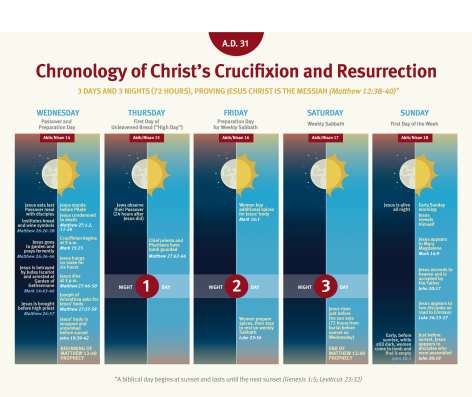
Download "The Chronology of Christ’s Crucifixion and Resurrection" infographic.

This chart includes the key events during this momentous week, demonstrating how Jesus’ promise to rise after three days and three nights was fulfilled, proving He is the Messiah.

3. Jesus didn’t die on a Friday.

Today documentation is commonly recorded for births and deaths. While we don’t have these same types of records from the first century giving us the exact day of Christ’s death, the Bible does give us enough details to show that Jesus definitely didn’t die on a Friday.

Let’s begin with the best known facts about Christ’s death. The Bible clearly tells us: “Now after the Sabbath [Saturday], as the first day of the week [Sunday] began to dawn, Mary Magdalene and the other Mary came to see the tomb,” but Jesus was not there because He had risen (Matthew 28:1, 6). So Jesus had already been resurrected by very early Sunday morning.

The next biblical key to note is that Jesus said, “As Jonah was three days and three nights in the belly of the great fish, so will the Son of Man be three days and three nights in the heart of the earth” (Matthew 12:40). We can also note that Jesus died at about 3 p.m., the ninth hour after sunrise, and was buried that evening shortly before the beginning of a Sabbath (Matthew 27:46-50, 57, 62).

People have assumed that the Sabbath mentioned in these verses is a Saturday, leading them to the conclusion that Jesus died on a Friday—hence the name Good Friday. But there is a problem with this timeline. There simply are not three days and three nights between Friday evening and Sunday morning. There aren’t even parts of three days and three nights in this time period between Friday evening and Sunday morning (as some have tried to interpret the three days and three nights).

The biblical fact is, Jesus died on a Wednesday—not on a Friday as many believe. A careful reading of a companion scripture explains this apparent dilemma. John 19:31 tells us that the day Jesus was buried preceded a “high day”—a designation reserved for an annual Sabbath, which could fall on any day of the week and not necessarily Saturday. In fact, Jesus was buried just prior to the beginning of the first day of the Feast of Unleavened Bread—an annual Sabbath.

The weekday timeline that fits the facts we have noted is easily constructed. Jesus observed the Passover with His disciples on Tuesday evening. He was crucified and died on Wednesday, buried near sunset on Wednesday prior to the beginning of the annual Sabbath called the first day of the Feast of Unleavened Bread, and resurrected three days and three nights later near sundown on Saturday, the weekly Sabbath. When the women arrived at the tomb early Sunday morning, they discovered that He had already been resurrected.

The fact that there were two Sabbaths during the timeline of Jesus’ burial and resurrection is confirmed by several Bible translations, including the International Standard Version, which translates Matthew 28:1: “After the Sabbaths, around dawn on the first day of the week, Mary Magdalene and the other Mary went to take a look at the burial site.” The annual Sabbath occurred on Thursday that year; the weekly Sabbath, on Saturday.

The biblical fact is, Jesus died on a Wednesday—not on a Friday as many believe. Interestingly when we look at the years for God’s holy days falling on the days of the week indicated by the Scriptures, we find that Jesus died on the 14th day of the first month of the Hebrew calendar in A.D. 31."   From: https://lifehopeandtruth.com/life/blog/3-things-you-may-not-know-about-maundy-thursday-and-good-friday/

_________

Three Days and Three Nights

Matthew 12:39-40

But He answered and said to them, “An evil and adulterous generation seeks after a sign, and no sign will be given to it except the sign of the prophet Jonah. For as Jonah was three days and three nights in the belly of the great fish, so will the Son of Man be three days and three nights in the heart of the earth.”

Listen to the "Verse by Verse" episode covering this scripture.

In our Fundamental Beliefs “8. Three Days and Three Nights,” we state, “Jesus Christ was raised from the dead by the Father after His body lay for three days and three nights in the grave. The length of time that He was in the grave was the only sign He gave to prove He was the Messiah.”

Jesus had done many miracles, but still the Pharisees sought “how they might destroy Him” (Matthew 12:14). So Jesus didn’t offer them more miracles as a sign, only this reference to the length of time He would be in the grave.

Strangely, though, most Christians today do not believe that Christ was literally three days and three nights in the grave as He promised, since it is not possible to count three days and three nights between Good Friday afternoon and Easter Sunday morning.

For a detailed explanation of the biblical chronology of Christ’s crucifixion and resurrection, including a helpful chart, see “Sign of Jonah: Did Jesus Die Good Friday, Rise on Easter?” From: https://lifehopeandtruth.com/bible/blog/three-days-and-three-nights/

_________

Increased Lifespan from Beans

“The intake of legumes—beans, chickpeas, split peas, and lentils—may be the single most important dietary predictor of a long lifespan. But what about concerns about intestinal gas?”

Transcript of video at: https://nutritionfacts.org/video/increased-lifespan-from-beans/

Below is an approximation of this video’s audio content. To see any graphs, charts, graphics, images, and quotes to which Dr. Greger may be referring, watch the above video.

“Legumes may be “the most important…predictor of survival in older people” from around the globe. They looked at “five [different] cohorts in Japan, Sweden, Greece, and Australia.” And, of all the food factors they looked at, only one was associated with a longer lifespan across the board: legume intake. Whether it was the Japanese eating their soy, the Swedes eating their “brown beans and peas,” or those in the Mediterranean eating “lentils, chickpeas, and white beans,”…”[o]nly for legumes intake was the result plausible, consistent, and statistically significant from [the] data” across all the populations combined. We’re talking an “8% reduction in risk of death for every 20 grams increase in daily legumes intake.” That’s just like two tablespoons’ worth! So, if a can of beans is 250 grams, and you get 8% lower mortality for every 20 grams, maybe, if we eat a can a day, we’ll live forever? Let’s find out!

If you want to increase your lifespan, eat beans. If, however, you’re suicidal, and want to decrease your lifespan, “A bean-free diet” may increase the risk of death.

So, having arrived at the one dietary fountain of youth, what’s the #1 reason people aren’t clamoring for them? Fear of flatulence. So, is that the choice we’re left with? Breaking wind or breaking down? Passing gas or passing on? Turns out that “[p]eople’s concerns about excessive flatulence from eating beans may be exaggerated.”

Add a half-cup of beans every day to people’s diets for months, and what happens? What’s the #1 symptom? Nothing. The vast majority of people experienced no symptoms at all—though a few percent did report increased flatulence. So, it may occur in some individuals. But, “not all people are affected.” Even among those that were, “[s]eventy percent or more of the participants who experienced flatulence felt that it dissipated [no pun intended] by the second or third week of bean consumption”. So, we’ve just got to stick to it.

And, you know, a small percentage reported increased flatulence on the control diet without any beans. People have preconceived notions about beans, such that “just the expectation of flatulence from eating beans may influence their perceptions of having gas.” They didn’t actually measure farts in this study; they just asked people what their perception of the amount of gas they had was. And, we know from previous studies that you give someone a product labeled to contain something that may cause intestinal distress, and it causes more intestinal distress whether it actually contains the ingredient or not. In other words, “just thinking they were eating [it] caused digestive distress, or the perception of it, to a proportion of persons.”

So, people thinking beans are going to cause gas may just be more likely to notice the gas they normally have. Either way, it tends to go away; “after a few weeks of daily bean consumption, people perceive that flatulence occurrence returns to normal levels.”

In this other study, where they added more than a half a cup of kidney beans to people’s daily diets, the research subjects reported that the discomfort they initially felt within the first day or two of adding beans “quickly disappeared.” So, again, stick with it.

Bottom line (no pun intended!): “An increasing body of research and the [latest] Dietary Guidelines…supports the benefits of a plant-based diet, and legumes specifically, in the reduction of chronic disease risks.” In some people it “may result in more flatulence initially.” However, doctors should emphasize that it “will decrease over time” if we just keep it up.

And, “the nutritional attributes of beans in the diet outweighs the potential for transitory discomfort. The long-term health benefits of bean consumption are great.” And, indeed, eating beans in the long term may make your term—on Earth—even longer.” From: https://nutritionfacts.org/video/increased-lifespan-from-beans/

_________

Sunday, February 11, 2024

What Is Marriage? 1 & 2. Farmed Fish vs. Wild-Caught.

.

What Is Marriage? 1  (Special thoughts for Valentine’s Day)

What Is Marriage?“The Creator God made humans male and female, and He made the institution of marriage. He tells us why He created it and what marriage is supposed to be.


There is only one original source on earth where you can find out how, when, where and why marriage began. More copies of this book—the Holy Bible—have been published than any other written work, yet it is little understood. But by going to it, you can find an understanding of the meaning of marriage.


Summing up what the Bible teaches about marriage

  1. God designed marriage to be a lifelong, faithful relationship between one man and one woman.
  2. Adam was created first and was initially the lone human. From one of his ribs God lovingly formed a woman and presented her to Adam. They were “one flesh,” and she was the perfect complement to Adam. Together they formed a whole, and together they were able to build a family, having and raising children together.
  3. Because of sin, polygamy and divorce entered. Christ said divorce was only allowed in Israel because of their hardness of heart. While God does provide provisions for a marriage to dissolve under some circumstances, it is an extremely painful experience. God didn’t want His children to hurt one another in that manner.
  4. Through the words of Jesus Christ and the apostles, we can see that God’s perspective of marriage as a loving, monogamous relationship between one man and one woman has not changed. In the New Testament God reaffirms it and shows how very important fidelity within marriage is.

God's Design for Marriage BookletMen and women are different by design, intended to complement each other. And it is only through the marriage relationship that God intended children to be brought into the world—to be raised and taught under the loving, thoughtful care of their mother and father.

If you would like to read further about how to have a happy marriage, this “Marriage” section has many related articles for you to read. You will be glad you did!”  Complete article at: https://lifehopeandtruth.com/relationships/marriage/what-is-marriage/

________

What Is Marriage?  2

“Some topics are more personal than others and tend to trigger more emotional reactions. Food and holidays, for example. Or “is that dress white and gold or blue and black” and, of course, marriage and sexual relations.

Although the Bible has a lot to say about marriage, it never explicitly answers the question, “What is marriage?” Probably for the same reason it doesn’t give a precise definition for travel, war, and sacrifice. Everyone in the Bible’s original audience already knew what marriage was, so why waste expensive paper and ink explaining it.

Our world, on the other hand, has become so full of confusion that we need to spell out even the most basic ideas. So, let me begin at the beginning…

Adam gave names to all livestock and to the birds of the heavens and to every beast of the field, but the man could not find a helper fit for him. So YHWH God caused a deep sleep to fall upon the man, and while he slept took one of his ribs and closed up its place with flesh. And the rib that YHWH God had taken from the man he made into a woman and brought her to the man. Then the man said, “This at last is bone of my bones and flesh of my flesh; she shall be called Woman (ishah), because she was taken out of Man.” Therefore a man shall leave his father and his mother and hold fast to his wife, and they shall become one flesh.      Genesis 2:20-24

This passage gives us the three most important elements of the definition of marriage.

  1. Marriage exists to help a man fulfill his assigned role in Creation.
  2. Marriage is meant to be a lifelong union of a man and woman.
  3. Marriage was instituted by God from the very beginning.

Marriage Exists to Help Man Fulfill His Mission

Although Genesis 1:28 records that the first collective mission of mankind was to be a caretaker over the earth and all life on it, Adam’s first individual assignment was to evaluate all of the other creatures to see if one of them might serve as a special helper for him. Of course, God knew that none of them would, but he had Adam go through this process so that the man would also know. When Adam was satisfied that none of the animals would meet his requirements, God created a woman, whom Adam named Eve.

Adam and most other creatures were created from the ground, but Eve was created directly from Adam. God didn’t create Eve from Adam’s head or foot, but from his side, showing that she wasn’t supposed to rule over him nor be his slave, but was supposed to be a peer. The woman was to be more like the man than any other creature in heaven or earth, a counterpart who would rule over and care for the earth together with him.

Eve wasn’t created to be exactly like Adam, though, or else God would have created another man and made them hermaphrodites or capable of parthenogenesis. Woman shares in the collective purpose of mankind as God’s stewards on earth, but each woman does so primarily by assisting her husband in his individual mission.

For man was not made from woman, but woman from man. Neither was man created for woman, but woman for man.    1 Corinthians 11:8-9 ESV

I know that doesn’t sit well with many people, but it is the plain teaching of Scripture. Eve was created specifically to be a helper for Adam, and Paul asserts that this principle applies within all marriages.

While the original task of humanity was to be a caretaker of God’s creation, the Fall necessitated a change in mission parameters. Our task now is to expand the Kingdom of God through procreation, evangelism, establishing justice, and generally doing good works according to God’s standards of justice and good. How each individual and family participates in this mission varies in as many ways as there are individuals and families, but you can know this with absolute certainty: A woman’s divinely appointed mission will never be at odds with her husband’s.

All kinds of things can prevent us from fulfilling marriage’s full purpose: illness and other circumstances that might be out of our control, the husband isn’t fulfilling his calling, or the wife isn’t fulfilling hers. However, our circumstances and failings can’t change the reason God created marriage.

Marriage Is a Lifelong Union

Genesis 2:24 says that the relationship of Adam and Eve is to be a pattern for all marriages, that a new marriage is inaugurated when a man leaves his father and mother to become one flesh with his wife.

“One flesh” implies that they are united in a way that would be painful and unnatural to separate and Yeshua (Jesus) confirmed this understanding when he said “They are no longer two but one flesh. What therefore God has joined together, let not man separate.” (See Matthew 19:4-6 and Mark 10:6-9.)

“Leaves his father and mother” doesn’t necessarily mean that he physically leaves their dwelling place. The Scriptural example is for extended families normally to live close together, frequently on the same land, and obedience to God’s instructions for the use of the land in Israel requires this. What this statement actually means is that the man steps outside of the nuclear family unit into which he was born and creates a new family still under the broad umbrella of his father’s clan and tribe.

This also doesn’t mean that marriage cannot be ended. God hates both divorce and death, but both happen, whether for good or bad, and both end a marriage. I’ll write more about this another time, but the Torah, Prophets, Yeshua, and Apostles all discuss when it is and is not appropriate to end a marriage. Divorce should be avoided because it breaks something that God didn’t want to be broken, but it is still possible.

Marriage Was Instituted by God

From the very beginning, God intended mankind to be male and female and to be joined in a union that he uses as a metaphor of his relationship with Israel.

Like the Sabbath, marriage was created for mankind’s benefit. Both parties, as well as their children, benefit from the arrangement, especially if it is conducted according to all of God’s instructions. However, also like the Sabbath, God created marriage because it suited his purposes. Every good master provides his servants with the tools necessary to accomplish his assigned tasks. The servant benefits because his job is made easier and more enjoyable. The master benefits because the servant is able to do a better job with greater economy.

Also like the Sabbath, marriage is not a man-made custom and man doesn’t get to define it. People today insist that they can make marriage whatever they want it to be: a man and another man, a woman and herself, and every other perversion one can imagine. Yet, Yeshua said that marriage is “what God has joined together”, so there can be no real question on this score. God makes the rules, not us.

Marriage was the very first government and was created by God to serve as the core of ministry, labor, justice, and civilization. It is a model of God and of our relationship to God and, as God is one (Hebrew echad), man and woman are to be one in spirit and flesh. Marriage benefits us and was created to help us in the work for which we were created, but ultimately both we and marriage belong to God and we have a responsibility to him to protect and honor it.”  From: https://www.americantorah.com/2023/03/27/what-is-marriage/

_______

Farmed Fish vs. Wild-Caught

Transcript of video at: https://nutritionfacts.org/video/farmed-fish-vs-wild-caught-2/

“The levels of industrial pollutants found in aquaculture.

Although the levels of dioxins and PCBs continue to decline, there is one dietary source that still remains a threat: fish. Everything eventually washes into the sea. Yes, we can get some from eating horses, but most of human dioxin exposure comes from eating fish. The World Health Organization puts the tolerable upper daily limit of intake at 1 picogram—one trillionth of a gram. As you can see, just eating dairy and we’re already skirting with the max, and fish takes us straight over the top.

Everyone agrees that the omega-3 fatty acids, like DHA, found in fish, are healthy. But, given the industrial contaminants in fish, as a recent analysis in Food and Chemical Toxicology concludes: “If people choose to get their recommended long-chain omega-3 intake from fish, the majority of consumers would exceed the safety limits for dioxins and dioxin-like substances (like PCBs).”

And, just like with eggs, factory-farmed fish have significantly more dioxins. In fact, for every toxin tested, farmed fish had higher levels of DDT, these other banned pesticides, over ten times more PCBs, and ten times more dioxins than wild-caught fish. Aquaculture fish can be considered farmed and dangerous.”

To see any graphs, charts, graphics, images, and quotes to which Dr. Greger may be referring, watch the above video. This is just an approximation of the audio contributed by Dianne Moore.

_________