Showing posts with label Lent. Show all posts

Sunday, April 20, 2025

Would Jesus celebrate Easter? How Easter Supplanted Passover Observance.

.

Would Jesus celebrate Easter?

Would Jesus celebrate Easter?“Many Christian churches prepare special easter programs commemorating the death and resurrection of Jesus Christ, and parents hide easter eggs so their children can hunt for them on Easter morning. Then there are the Easter sunrise services, when Jesus' miraculous resurrection is supposedly honoured by watching the sun rise in the east.”

Image: Church Easter egg hunt (source: wikimedia commons)

“But can we find any historical or biblical record of Jesus or His disciples celebrating Easter or teaching us to meet to honor His resurrection at sunrise on Easter Sunday—or at any other time, for that matter?

There is no reference to Easter anywhere in the New Testament. In the King James Version of the Bible the word ‘Easter' is used once in Acts 12:4, but it is an erroneous mistranslation. The original Greek word is ‘pascha’, which is correctly translated as Passover in virtually every modern version of the Bible.

The original Apostles, and even the Apostle John, who died near the end of the first century, left no record of celebrating Easter. The Apostle Paul, some 25 years after Jesus' death and resurrection, told the Corinthian church they should continue to keep the Passover as Christ commanded (1 Corinthians 11:23-27). (See also the previous issue of Bible Insights Weekly #324 Why Christians Should Keep The Annual Passover). Paul and Luke, his traveling companion and author of the book of Acts, regularly mention observing the weekly Sabbath day and the annual biblical festivals listed in Leviticus 23, but mention of Easter is conspicuously absent ( 1 Corinthians 5:6-8 and 6:8; Acts 2:1-4; 13:42-44; 17:1-3; 18:4; 20:6 and 16).

Many scholars point out Easter is a pre-Christian religious holiday, observed long before Jesus' human lifetime. Vine's Complete Expository Dictionary of Old and New Testament Words notes: "The term 'Easter' is not of Christian origin. It is another form of Astarte, one of the titles of the Chaldean [Babylonian] goddess, the queen of heaven. The festival of Pasch [Passover] held by Christians in post-apostolic times was a continuation of the Jewish feast…From this Pasch the pagan festival of 'Easter' was quite distinct and was introduced into the apostate Western religion, as part of the attempt to adapt pagan festivals to Christianity" (W.E. Vine, 1985, "Easter").

Alexander Hislop in his book The Two Babylons also explores the origins of Easter. Although his work has been criticized as lacking scholarship, it is heavily footnoted with sources—and much of what he presents can be verified through other historical works. He points out Easter and the practices associated with it can be traced back to pagan rituals. For example "the forty days' abstinence of Lent [a 40-day period of fasting, prayer, and almsgiving observed by many Christian denominations in preparation for Easter] was directly borrowed from the worshippers of the Babylonian goddess" (p. 104). Hislop continues, "Among the pagans this Lent seems to have been an indispensable preliminary to the great annual festival in commemoration of the death and resurrection of Tammuz…." (p. 105). Tammuz was a chief Babylonian deity and husband of the goddess Ishtar, and a great festival was held every spring to celebrate Tammuz's death and supposed resurrection.

One Catholic writer explains how eggs and rabbits came to be connected with Easter: "The egg has become a popular Easter symbol…In ancient Egypt and Persia friends exchanged decorated eggs at the spring equinox, the beginning of their New Year. These eggs were a symbol of fertility for them….Christians of the Near East adopted this tradition, and the Easter egg became a religious symbol. It represented the tomb from which Jesus came forth to new life" (Greg Dues, Catholic Customs and Traditions, 1992, p. 101). Rabbits came to be linked with Easter because they were potent symbols associated with ancient fertility rites.

Not until the Council of Nicaea in 325—almost three centuries after Jesus was crucified and rose again—did Easter replace the Passover, the biblical ceremony Jesus and the Apostle Paul instructed Christians to observe. "A final settlement of the dispute [whether and when to observe Easter or Passover] was one among the other reasons which led Constantine to summon the council of Nicaea in 325….The decision of the council was unanimous that Easter [which they wrongly called Passover] was to be kept on Sunday, and on the same Sunday throughout the world, and 'that none should hereafter follow the blindness of the Jews'" (The Encyclopaedia Britannica, 11th edition, pp. 828-829, "Easter").

Constantine's decision was a fateful turning point for Christianity. Those who remained faithful to the instruction of Jesus and the Apostles would become a persecuted minority as a vastly different set of beliefs and practices—recycled from ancient pre-Christian religions dressed in a Christian cloak—would take hold among the majority.

Easter is a pagan tradition that was involved in the worship of false gods and is abhorrent to God. It is rooted in ancient pre-Christian fertility rites that have nothing to do with Jesus. Scripture does not support this pre-Christian holiday and condemns pagan worship practices even if done to honor the true God (Deuteronomy 12:29-32).

______

How Easter supplanted Passover observance

How Easter supplanted Passover observance“After Adam and Eve rejected God in the Garden of Eden (Genesis 3), humanity looked for other explanations for life with fertility rites and customs being incorporated into religious practices early on in human history.

Forces of nature and seasons that could not be controlled began to be viewed as gods, goddesses and supernatural powers to be worshipped and feared. Man soon created his own gods, contradicting God's instruction against idolatry (Exodus 20:3-6; Deuteronomy 5:7-10). “The most prominent myth to cross cultural lines was that of the fertility cycle. Many pagan cultures believed that the god of fertility died each year during the winter but was reborn…in the spring." (Nelson's New Illustrated Bible Dictionary, 1995, "Gods, Pagan," p. 508).

The Babylonian and Assyrian fertility goddess was Ishtar. She was the goddess of love, and the practice of ritual prostitution became widespread in the fertility cult dedicated to her name. "Associated with Ishtar was the young god Tammuz (Ezek. 8:14)... [who] died annually and was reborn…representing the yearly cycle of the seasons and the crops. This pagan belief later was identified with the pagan gods Baal and Anat in Canaan" (Nelson's New Illustrated Bible Dictionary, "Gods, Pagan," p. 509).

It was believed that Ishtar brought about the rebirth or resurrection of Tammuz in the spring, coinciding with the blossoming of nature. Though Easter was clearly pagan in origin, Christian leaders of the first two centuries concluded it was easier to draw pagan worshippers into Christianity by identifying the time-honored spring resurrection feast of the pagan mystery religions with the resurrection of Christ. Believing that people are free to select their own times and customs of worship, they gradually replaced the biblically commanded Passover with their humanly devised celebration of Easter.

This movement to replace Passover with popular Easter customs was the basis for contention over the next three centuries: "The earliest Christians celebrated the Lord's Passover at the same time as the Jews…[but]...By the middle of the 2nd century, most churches had transferred this celebration to the Sunday after the Jewish feast….[however] certain churches of Asia Minor clung to the older custom, for which they were denounced as ‘judaizing' “(Eusebius, Ecclesiastical History, Book 5, chapters 23-25).

Before A.D. 70 Christianity was "regarded by the Roman government and by the people at large as a branch of the Jewish religion" (Jesse Lyman Hurlbut, The Story of the Christian Church, 1954, p. 34). Christianity and Judaism shared the biblical feast days, although Christians observed them with added meanings introduced by Jesus and the Apostles. However, two Jewish revolts against the Roman Empire, in 64-70 and 132-135, led to widespread persecution of Jews and suppression of Jewish religious practices.

As pressure mounted, some Christians began to abandon beliefs and practices perceived as being too Jewish, such as the weekly Sabbath and instead worshiped on Sunday, the pagan day of the sun, as well as abandoning the Passover in favor of Easter to distance themselves from Jews. The New Catholic Encyclopedia explains: "Originally both observances [Passover and Easter] were allowed, but gradually it was felt incongruous that Christians should celebrate Easter on a Jewish feast, and unity in celebrating the principal Christian feast was called for" (1967, Vol. 5, p. 8, "Easter Controversy"). The first ecumenical Council of Nicaea in 325 decreed that all churches should observe the feast together on a Sunday" (15th edition, Macropaedia, Vol. 4, pp. 604-605, "Church Year").

Two religious leaders of the mid-second century—Polycarp, bishop of Smyrna in Asia Minor, and Anicetus, bishop of Rome—debated this point. Anicetus argued for Easter while Polycarp, a student of the Apostle John, defended observing "the Christian Passover, on the 14th of Nisan…regardless of the day of the week" (Encyclopaedia Britannica, 15th edition, Micropaedia, Vol. 8, p. 94, "Polycarp"). Eusebius said Polycarp did so because this was the way "he had always observed it with John the disciple of our Lord, and the rest of the Apostles, with whom he associated" (Eusebius' Ecclesiastical History, 1995, pp. 210-211).

Several decades later another church leader, Polycrates, argued with a new bishop of Rome, Victor, over the same issue. Eusebius wrote of the continuing debate: “The bishops ... of Asia, persevering in observing the custom handed down to them from their fathers, were headed by Polycrates…."We,' said he, ‘therefore, observe the genuine day; neither adding thereto nor taking therefrom ...For they who are greater than I, have said, ‘we ought to obey God rather than men'" (pp. 207-209).

Regrettably, people's reasoning won out over the directions of God and the example of Jesus Christ and His original disciples. As Easter replaced Passover, not only was a new date selected, but a new theme was introduced. Rather than commemorating Christ's death as directed by the Scriptures (1 Corinthians 11:26), the new holiday was designed to celebrate His resurrection, easily accommodating the pagan fertility symbols. It also helped distinguish the Christian community from the Jews, a major goal of church leaders of the time.

Although Christ's resurrection is an important basis of our hope that we, too, can be resurrected (1 Corinthians 15:17; Romans 5:10), the love of God is primarily expressed to humanity through the crucifixion of Jesus Christ (John 3:16; Hebrews 9:28). His death, through which our sins may be forgiven, is the primary focus of the Passover.”     From: https://www.ucg.org/learn/bible-study-aids/holidays-or-holy-days-does-it-matter-which-days-we-observe/holidays-or-11

_______

Monday, March 31, 2025

What Are Ash Wednesday and Lent? "Making America Healthy Again"

.

What Are Ash Wednesday and Lent? Does the Bible Tell Us to Celebrate These Days?

“The Bible does teach the importance of fasting and self-examination, but it does not teach a 40-day period called Lent or an Ash Wednesday of putting ashes on the forehead.

After Mardi Gras comes Ash Wednesday and 40 days of Lent. Did the early New Testament Church observe these days?

The Bible does not mention Ash Wednesday or Lent, and the early New Testament Church did not observe these days. Here is how the BBC Religion page describes Ash Wednesday and Lent:   

    "Ash Wednesday is the beginning of Lent for Western Christian churches. It's a day of penitence to clean the soul before the Lent fast.

     "Roman Catholic, Anglican, and some other churches hold special services at which worshippers are marked with ashes as a symbol of death and sorrow for sin…

      "The Christian churches that observe Lent in the 21st century (and not all do significantly) use it as a time for prayer and penance. Only a small number of people today fast for the whole of Lent, although some maintain the practice on Ash Wednesday and Good Friday. It is more common these days for believers to surrender a particular vice such as favourite foods or smoking" (BBC).

Lent is counted differently by those of the Western Catholic tradition and those of the Eastern Orthodox tradition.

"      The western church excludes Sundays (which is celebrated as the day of Christ's resurrection) whereas the eastern church includes them. The churches also start Lent on different days. Western churches start Lent on the 7th Wednesday before Easter Day (called Ash Wednesday). Eastern churches start Lent on the Monday of the 7th week before Easter and end it on the Friday 9 days before Easter. Eastern churches call this period the 'Great Lent'" (BBC).

Various biblical events and customs are referred to by those who celebrate these days. The Bible mentions people mourning in sackcloth and ashes. The Bible also talks about repentance and fasting, and the number 40 is prominent in various biblical events.

The justification for the Lenten 40-day preparation for Easter is traditionally based on Jesus' 40-day wilderness fast before His temptation by Satan (Harper's Bible Dictionary, 'Lent'; Matthew 4:1-2; Mark 1:13). The problem with this explanation is that this incident is not connected in any way with Jesus' supposed observance of Easter. The 40-day pre-Easter practice of fasting and penance did not originate in the Bible" (The Good Friday—Easter Sunday Question).

Some have suggested that Lent may be connected to earlier, pagan holidays. In Ezekiel 8:14, the prophet in vision saw women weeping for the pagan god Tammuz.

       "It has been suggested by some scholars that the practice of 'weeping for Tammuz' was the actual origin of Lent, the Roman Catholic 40-day period of abstinence prior to Easter (starting after Mardi Gras, 'Fat Tuesday,' on Ash Wednesday). Consider that the name Easter itself is derived from Ishtar, the ancient Babylonian fertility goddess and Tammuz's mother". (See the Bible commentary on Ezekiel 8 for details.)

The Bible does teach the importance of fasting and self-examination, but it does not teach a 40-day period called Lent or an Ash Wednesday of putting ashes on the forehead. These customs appear to have pagan origins.  We seek to follow the customs and practices of the early New Testament Church as described in the Bible.”

Learn More: "God's Holy Day Plan: The Promise of Hope for All Mankind"              

From: https://www.ucg.org/learn/bible-questions-and-answers/what-are-ash-wednesday-and-lent-does-bible-tell-us-celebrate

_________

"Making America Healthy Again"

Dr. Eric Berg says:

“Robert F. Kennedy is receiving a lot of pushback for his ideas on health and reform. As secretary of the Department of Health and Human Services, his ideas would radically change the US healthcare system. In this video, I’m going to share some of the changes I would make to address the current healthcare crisis and improve America’s health.

RFK has the following goals for healthcare reform in America: 1. Clean up the corruption  2. Get back to science-based evidence   3. End chronic disease

He will be actively working against big food companies, big chemical companies, and big pharma, so naturally, he’s getting a lot of pushback. The U. S. spends over 4.1 trillion dollars each year on healthcare, yet we’re at the bottom as far as health. Why? Here's what I think can improve America’s health!

1. Change the institutional foods Prepackaged foods are given to people in nursing homes, prisons, schools, hospitals, and other public institutions. These institutional foods are very low-quality, highly processed foods. The health of the people in these institutions would quickly improve by simply removing the refined sugars, starches, and oils from their diets.

2. Address the subsidized foods Subsidized foods are paid for by taxpayers. Corn, soy, wheat, sugar, and rice are the most highly subsidized foods. Changing the types of foods that are subsidized and investing in small farmers can significantly improve this problem.

3. Changing GRAS “Generally recognized as safe” is a term used by the FDA for products that have been safety tested by their own manufacturers. To avoid conflict of interest, these tests should be conducted by third-party independent companies.

4. Change food fortification Synthetic folic acid and iron fortification of food can cause serious problems for many people.

5. Disallow tax dollars from being used for drugs Every year, 40 billion dollars of taxpayer money is used to pay for medical research to develop new drugs.

6. The rounding rule.  If a product contains less than .5 grams of an ingredient, it can be rounded down to 0. This is misleading and should be eliminated. People need to be more aware of what's really in their food. Companies also need to be forced to raise the quality of the ingredients in their products.

7. End sun phobia.  Sun phobia paired with low RDAs for vitamin D is contributing to massive vitamin D deficiency in the population, putting people at risk for disease.”  More at: https://www.drberg.com/blog/heres-my-2-cents-making-america-healthy-again

__________

Saturday, March 9, 2024

Maundy Thursday and Good Friday. Three Days and Three Nights. Increased Lifespan from Beans.

.

3 Things You May Not Know About Maundy Thursday and Good Friday

3 Things You May Not Know About Maundy Thursday and Good FridayDevout Catholics participate in a Good Friday procession.
“Reflecting on Jesus’ death is sobering. Unfortunately the timing is rarely understood. Do Maundy Thursday and Good Friday fit the timing in the Bible?

Churches will soon be packed with some of their largest attendances of the year. The “CEOs” (Christmas and Easter Only attendees) will make one of their semiannual appearances for Easter, the most holy observance of the year for mainstream Christianity. Good Friday, which occurs two days before Easter Sunday, is also significant as the most solemn occasion because it recalls the crucifixion of Christ.

Most professing Christians understand that Jesus died so our sins can be forgiven. What is not common knowledge is the timing of His death, which has been hidden by the establishment of Easter and its closely related observances of Lent, Palm Sunday, Holy Wednesday, Maundy Thursday and Good Friday in lieu of the biblical festivals observed by Jesus, His apostles and the first-century Church.

If you sincerely want to honor Christ at this time of year, you need to know the real story—the one that shows us the correct timing of His death and how to properly commemorate this event.

Doesn’t Christ deserve the respect to have the true, biblical history of His death told and remembered on this sobering occasion?

In that light, here are three important things to know about Maundy Thursday and Good Friday:

1. Of all the man-made holidays, Maundy Thursday and Good Friday are the only ones that claim to commemorate something Jesus said to commemorate.

On the evening before His crucifixion, Jesus told His disciples to keep the Passover as an annual festival “in remembrance of Me” (Luke 22:19; 1 Corinthians 11:24-25).

In teaching the Corinthians to observe this solemn service, Paul told them that through this memorial they would “proclaim the Lord’s death till He comes” (verse 26, emphasis added throughout).

Jesus never commanded Christians to celebrate His birth or resurrection. Rather, His instruction was for us to memorialize His death—something that Maundy Thursday and Good Friday actually do attempt to do.

But does that mean you should observe Maundy Thursday and Good Friday?

2. Maundy Thursday and Good Friday aren’t the biblical names of the observance that commemorates Christ’s death.

The terms Maundy Thursday and Good Friday appear nowhere in the Bible. But the Bible does talk about another festival to honor Christ’s death: the Passover.

The New Testament Passover established by Christ Himself includes taking bread and wine. The bread represents His broken body and the wine represents His shed blood (Matthew 26:26-28).

Churches vary in how often they partake of the symbols of bread and wine. Some take these symbols daily, some monthly and some on Maundy Thursday. But the Bible instructs us to observe it only once a year on a specific day (Leviticus 23:5). When we take the Passover symbols of unleavened bread and wine, we annually “proclaim the Lord’s death till He comes” (1 Corinthians 11:26).

Observing the Passover is a memorial of Christ’s death. Jesus did not die on many different days throughout the year. He died on only one day, and He observed the Passover on the prescribed evening before the day of His death.

Passover is the annual festival that reminds us of Christ’s death. To learn more about this observance, see “Passover: What Did Jesus Do for You?” and “Questions and Answers About the Passover.”

3 Things You May Not Know About Maundy Thursday and Good Friday

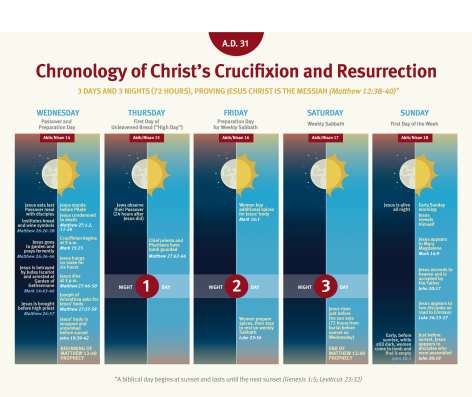
Download "The Chronology of Christ’s Crucifixion and Resurrection" infographic.

This chart includes the key events during this momentous week, demonstrating how Jesus’ promise to rise after three days and three nights was fulfilled, proving He is the Messiah.

3. Jesus didn’t die on a Friday.

Today documentation is commonly recorded for births and deaths. While we don’t have these same types of records from the first century giving us the exact day of Christ’s death, the Bible does give us enough details to show that Jesus definitely didn’t die on a Friday.

Let’s begin with the best known facts about Christ’s death. The Bible clearly tells us: “Now after the Sabbath [Saturday], as the first day of the week [Sunday] began to dawn, Mary Magdalene and the other Mary came to see the tomb,” but Jesus was not there because He had risen (Matthew 28:1, 6). So Jesus had already been resurrected by very early Sunday morning.

The next biblical key to note is that Jesus said, “As Jonah was three days and three nights in the belly of the great fish, so will the Son of Man be three days and three nights in the heart of the earth” (Matthew 12:40). We can also note that Jesus died at about 3 p.m., the ninth hour after sunrise, and was buried that evening shortly before the beginning of a Sabbath (Matthew 27:46-50, 57, 62).

People have assumed that the Sabbath mentioned in these verses is a Saturday, leading them to the conclusion that Jesus died on a Friday—hence the name Good Friday. But there is a problem with this timeline. There simply are not three days and three nights between Friday evening and Sunday morning. There aren’t even parts of three days and three nights in this time period between Friday evening and Sunday morning (as some have tried to interpret the three days and three nights).

The biblical fact is, Jesus died on a Wednesday—not on a Friday as many believe. A careful reading of a companion scripture explains this apparent dilemma. John 19:31 tells us that the day Jesus was buried preceded a “high day”—a designation reserved for an annual Sabbath, which could fall on any day of the week and not necessarily Saturday. In fact, Jesus was buried just prior to the beginning of the first day of the Feast of Unleavened Bread—an annual Sabbath.

The weekday timeline that fits the facts we have noted is easily constructed. Jesus observed the Passover with His disciples on Tuesday evening. He was crucified and died on Wednesday, buried near sunset on Wednesday prior to the beginning of the annual Sabbath called the first day of the Feast of Unleavened Bread, and resurrected three days and three nights later near sundown on Saturday, the weekly Sabbath. When the women arrived at the tomb early Sunday morning, they discovered that He had already been resurrected.

The fact that there were two Sabbaths during the timeline of Jesus’ burial and resurrection is confirmed by several Bible translations, including the International Standard Version, which translates Matthew 28:1: “After the Sabbaths, around dawn on the first day of the week, Mary Magdalene and the other Mary went to take a look at the burial site.” The annual Sabbath occurred on Thursday that year; the weekly Sabbath, on Saturday.

The biblical fact is, Jesus died on a Wednesday—not on a Friday as many believe. Interestingly when we look at the years for God’s holy days falling on the days of the week indicated by the Scriptures, we find that Jesus died on the 14th day of the first month of the Hebrew calendar in A.D. 31."   From: https://lifehopeandtruth.com/life/blog/3-things-you-may-not-know-about-maundy-thursday-and-good-friday/

_________

Three Days and Three Nights

Matthew 12:39-40

But He answered and said to them, “An evil and adulterous generation seeks after a sign, and no sign will be given to it except the sign of the prophet Jonah. For as Jonah was three days and three nights in the belly of the great fish, so will the Son of Man be three days and three nights in the heart of the earth.”

Listen to the "Verse by Verse" episode covering this scripture.

In our Fundamental Beliefs “8. Three Days and Three Nights,” we state, “Jesus Christ was raised from the dead by the Father after His body lay for three days and three nights in the grave. The length of time that He was in the grave was the only sign He gave to prove He was the Messiah.”

Jesus had done many miracles, but still the Pharisees sought “how they might destroy Him” (Matthew 12:14). So Jesus didn’t offer them more miracles as a sign, only this reference to the length of time He would be in the grave.

Strangely, though, most Christians today do not believe that Christ was literally three days and three nights in the grave as He promised, since it is not possible to count three days and three nights between Good Friday afternoon and Easter Sunday morning.

For a detailed explanation of the biblical chronology of Christ’s crucifixion and resurrection, including a helpful chart, see “Sign of Jonah: Did Jesus Die Good Friday, Rise on Easter?” From: https://lifehopeandtruth.com/bible/blog/three-days-and-three-nights/

_________

Increased Lifespan from Beans

“The intake of legumes—beans, chickpeas, split peas, and lentils—may be the single most important dietary predictor of a long lifespan. But what about concerns about intestinal gas?”

Transcript of video at: https://nutritionfacts.org/video/increased-lifespan-from-beans/

Below is an approximation of this video’s audio content. To see any graphs, charts, graphics, images, and quotes to which Dr. Greger may be referring, watch the above video.

“Legumes may be “the most important…predictor of survival in older people” from around the globe. They looked at “five [different] cohorts in Japan, Sweden, Greece, and Australia.” And, of all the food factors they looked at, only one was associated with a longer lifespan across the board: legume intake. Whether it was the Japanese eating their soy, the Swedes eating their “brown beans and peas,” or those in the Mediterranean eating “lentils, chickpeas, and white beans,”…”[o]nly for legumes intake was the result plausible, consistent, and statistically significant from [the] data” across all the populations combined. We’re talking an “8% reduction in risk of death for every 20 grams increase in daily legumes intake.” That’s just like two tablespoons’ worth! So, if a can of beans is 250 grams, and you get 8% lower mortality for every 20 grams, maybe, if we eat a can a day, we’ll live forever? Let’s find out!

If you want to increase your lifespan, eat beans. If, however, you’re suicidal, and want to decrease your lifespan, “A bean-free diet” may increase the risk of death.

So, having arrived at the one dietary fountain of youth, what’s the #1 reason people aren’t clamoring for them? Fear of flatulence. So, is that the choice we’re left with? Breaking wind or breaking down? Passing gas or passing on? Turns out that “[p]eople’s concerns about excessive flatulence from eating beans may be exaggerated.”

Add a half-cup of beans every day to people’s diets for months, and what happens? What’s the #1 symptom? Nothing. The vast majority of people experienced no symptoms at all—though a few percent did report increased flatulence. So, it may occur in some individuals. But, “not all people are affected.” Even among those that were, “[s]eventy percent or more of the participants who experienced flatulence felt that it dissipated [no pun intended] by the second or third week of bean consumption”. So, we’ve just got to stick to it.

And, you know, a small percentage reported increased flatulence on the control diet without any beans. People have preconceived notions about beans, such that “just the expectation of flatulence from eating beans may influence their perceptions of having gas.” They didn’t actually measure farts in this study; they just asked people what their perception of the amount of gas they had was. And, we know from previous studies that you give someone a product labeled to contain something that may cause intestinal distress, and it causes more intestinal distress whether it actually contains the ingredient or not. In other words, “just thinking they were eating [it] caused digestive distress, or the perception of it, to a proportion of persons.”

So, people thinking beans are going to cause gas may just be more likely to notice the gas they normally have. Either way, it tends to go away; “after a few weeks of daily bean consumption, people perceive that flatulence occurrence returns to normal levels.”

In this other study, where they added more than a half a cup of kidney beans to people’s daily diets, the research subjects reported that the discomfort they initially felt within the first day or two of adding beans “quickly disappeared.” So, again, stick with it.

Bottom line (no pun intended!): “An increasing body of research and the [latest] Dietary Guidelines…supports the benefits of a plant-based diet, and legumes specifically, in the reduction of chronic disease risks.” In some people it “may result in more flatulence initially.” However, doctors should emphasize that it “will decrease over time” if we just keep it up.

And, “the nutritional attributes of beans in the diet outweighs the potential for transitory discomfort. The long-term health benefits of bean consumption are great.” And, indeed, eating beans in the long term may make your term—on Earth—even longer.” From: https://nutritionfacts.org/video/increased-lifespan-from-beans/

_________

Tuesday, March 5, 2024

5 Things Christ Will Undo and Redo at His Return. Should Christians Keep Mardi Gras? How does Plant-Based Eating Benefit Your Health?

.

5 Things Christ Will Undo and Redo at His Return

5 Things Christ Will Undo and Redo at His Return “Mankind has done much damage to this earth, but God has a plan to fix man’s many mistakes. What will Christ “undo” and “redo” when He returns to earth?

As a software developer, I consider “undo” to be an essential tool, and I use it often. When making changes to software, I occasionally realize I made a mistake. The easiest way to fix that mistake is to undo the changes I made and go back and do it right. I am fortunate to use an editor that remembers changes I made even after it has been closed.

Wouldn’t life be great if we could undo our past mistakes and have a redo? Though life doesn’t provide us such an option, God has a plan that will undo the damage we humans have done to this earth, to one another and to ourselves. His plan is in motion and soon will be evident to all mankind when Jesus Christ returns to earth to establish God’s Kingdom here.

Under Christ’s perfect government, mankind will learn to “redo” life, but this time following the perfect laws of God.

Let’s consider some of the major things that will be undone and redone after Christ’s return.

1. Swords and plowshares

Undo: War between nations.

Redo: Peaceful, mutually beneficial relationships between nations.

After Christ returns, He will teach the nations His law, which is based on love Just before Christ returns to the earth, there will be a period of intense worldwide warfare when people will be beating “plowshares into swords” and “pruning hooks into spears” (Joel 3:10). This is ancient language describing implements of food production (which sustains life) being turned into implements of warfare (which destroys life).

But after Christ returns, He will teach the nations His law, which is based on love (2 John 1:6). When godly love is understood and practiced on an international level, the nations will turn “swords [back] into plowshares” and “spears [back] into pruning hooks” (Micah 4:3).

2. Food shortages

Undo: Hunger and malnutrition affecting millions of people.

Redo: An abundance of food where everyone’s needs are met.

As we covered above, after Christ returns, the nations will no longer devote their economic resources to warfare and defense, but will instead redirect their economies to food production. Christ will restore an emphasis on agriculture that will allow the nations to sustain healthy populations. The prophet Amos foresaw a world where the “plowman shall overtake the reaper” (Amos 9:13).

3. Dangerous animals

Undo: The instinctual nature in many wild animals that makes them dangerous to humans and each other.

Redo: A transformed nature of wild animals that makes them docile, tame and harmless.

In the creation described in the first two chapters of Genesis, there was perfect harmony between the animals and mankind. But when Adam and Eve sinned and were kicked out of the Garden of Eden, they found many wild animals were now hostile to human beings. Christ will change the violent natures of animals so they will dwell safety with one another and with mankind (Isaiah 11:6-9).

4. Knowledge of God

Undo: Rejection of God and His laws.

Redo: Acceptance of God and His laws in every aspect of life.

In the book of Romans, the apostle Paul described the current state of humanity as being in rebellion against God (Romans 1:28). But Christ will make God’s beneficial laws undeniable. He will lead an educational system based on the ways of God. It will eventually lead to the knowledge of God covering the earth “as the waters cover the sea” (Isaiah 11:9). The prophet Jeremiah foresaw a time when everyone will know God (Jeremiah 31:34).

5. God’s Sabbath and festivals

Undo: Ignorance of God’s Sabbath and festivals.

Redo: Knowledge and observance of the Sabbath and festivals.

Within God’s law are holy times: the weekly Sabbath (Exodus 20:8-11) and annual festivals (Leviticus 23). Not only are these days when we are to worship God, they also reveal the major stages of His plan. These days will be observed by the entire world after Christ returns (Isaiah 66:23, ZechariaThe Mystery of the Kingdom free bookleth 14:16).

This covered just a few aspects of our world that will be undone and redone after Jesus Christ returns. To learn more about this future time, download our free booklet The Mystery of the Kingdom.   From: https://lifehopeandtruth.com/prophecy/blog/5-things-christ-will-undo-and-redo-at-his-return/?

________

Should Christians Keep Mardi Gras?

Transcript of video at: https://www.ucg.org/beyond-today/beyond-today-dailys/should-christians-keep-mardi-gras

Mardi Gras has its roots in religious tradition. But what does the Bible say?

[Steve Myers] “Colorful costumes and masks and pageantry. That's all surrounding Mardi Gras. Mardi Gras is one of those traditions where...    sometimes I'll talk about the fact that it reminds me of the three Ds. There's dancing in the streets, there's drunkenness and debauchery. That kinda categorizes Fat Tuesday. That's literally what the term Mardi Gras means. Religiously it's called Shrove Tuesday because that's the day before Lent. Lent of course being more of a Catholic kind of a tradition that's rooted in pagan holidays. And what would happen at Lent is that you would give up something for Lent. And so before you give something up, you certainly want to overindulge and fatten up and, you know, get into food and drink and all those things so that you can then put that behind you and repent for the rest of this religious season.

But when you really think about the implications of that religiously, it's really ridiculous. In modern carnival traditions and celebrations all around the world and whether it's in New Orleans or Rio or Nice, France. These are areas where they'll often celebrate for weeks, leading up to that time. When we lived in New Orleans for a while, I remember they talk about Fat Tuesday, and then instead of Ash Wednesday, they'd call it Trash Wednesday because there was so much junk leftover from these Mardi Gras celebrations. Well, is that something we should have any part in? These Catholic traditions that are not really based in the Bible at all. I mean, there's a couple of interesting aspects when you consider this. I was thinking of the passage that's found in Romans 13:13. It says the basic things. As Christians it says, "Let's walk properly in the day, not in revelry or drunkenness."

Of course on TV, they'll show the parties and the fun but they don't show all of those types of things because that would certainly take away from the tourism of all those areas of the world. Romans goes on, "don't walk in lewdness and lust, not in strife and envy." And it's kind of a reminder, those are the things we should give up, but that's not good enough. This whole aspect of Mardi Gras and Lent, I think it is something that miss directs us to what the truth of God's word really is. Yes, we've got to give up lewdness and drunkenness and revelry and all those types of things that are against God's way of life. But Romans points out, it's not just about giving something up. We have to put something on and so verse 14 in Romans 13 says, "Put on the Lord Jesus Christ, make no provision for the flesh to fulfill its lust."

And so that's an important aspect of Christianity, true Christianity. We not only put off those things that are wrong, but we've got to take it a step farther. We've got to put on everything that's right. So when you begin to hear about Mardi Gras celebrations, and all of those types of things in this upcoming Lent season that this religious world will keep, remember, it's not rooted in the Bible. In fact, let it remind you of the fact we need to put off the ways of the world, but more importantly then, put on Jesus Christ.”  From: https://www.ucg.org/beyond-today/beyond-today-dailys/should-christians-keep-mardi-gras

________

How does Plant-Based Eating Benefit Your Health?

father holding broccoli high-five daughter

Whether you’re considering eating less meat or giving it up entirely, the benefits are clear: less risk of disease and improved health and well-being. Consuming less meat decreases the risk of:

Meat is often loaded with cholesterol and saturated fat, which have starring roles in poor heart health. And processed meats, including deli meat, bacon and sausage, often have too much sodium and other additives, and should be limited. However, if you want to include meat into your eating plan, choose lean meats. Be sure to include skinless poultry, seafood, fish, beans, nuts and legumes, too, because they are healthy sources of protein.

Diets or eating styles that do not or restrict meat include:

  • Vegan — entirely plant-based, excluding meat, fish, dairy, eggs, honey and any product that comes from an animal.
  • Vegetarians — a plant-based diet, but may include dairy and eggs.
  • Flexitarian — a vegetarian diet that sometimes indulges in meat or fish but mostly sticks to plant foods.
  • Plant-based — a style of cooking and eating that emphasizes plant-based foods but is not strictly limited to them. Meat may be included, but it’s usually not the main feature of the meal.

Lean protein

Not eating meat does not mean you can’t get enough protein in your diet. In fact, many people eat more than enough protein, especially from animal foods. There are plenty of other foods that can provide you with protein, such as tofu, edamame, quinoa, sorghum, lentils, chickpeas and most beans and legumes. And there are many good sources of protein from vegetables, too, including artichokes, asparagus, broccoli, Brussels sprouts, collards, corn, peppers, spinach, sweet potatoes and turnip greens. Did you know that every plant we eat has some protein in it? So, the more vegetables you eat, the more protein you’ll consume.

Not all plant-based diets are healthy

Don’t replace meats with highly processed meat substitutes or “vegan junk food.” Instead choose high-quality, nutrient-dense plant-based foods. A recent study showed that eating primarily these types of food, such as vegetables, fruits, whole grains, beans, legumes and nuts, was associated with a lower risk of death from cardiovascular diseases. The researchers concluded that even if you’ve eaten a poor diet for half your life, adding more healthy plant foods as an adult can help reduce your risk.

Making the switch

Going plant-based is not as difficult as you may think. In fact, getting started can be as easy as 1-2-3!

  1. Search for some vegetarian recipes that are easy to prepare and sound appealing to you and your family.
  2. Choose ingredients and flavors you know your family will enjoy.
  3. Try meatless Mondays! Experiment with a meatless meal once a week, then add more days as you get used to it.”          

Written by American Heart Association editorial staff and reviewed by science and medicine advisors. See our editorial

From: https://www.heart.org/en/healthy-living/healthy-eating/eat-smart/nutrition-basics/how-does-plant-forward-eating-benefit-your-health

_________

Sunday, February 26, 2023

Five Foolish Things We Do to Foul Up Our Future. Where Is Lent in the Bible? The Truth About Potassium Bromate.

.

Five Foolish Things We Do to Foul Up Our Future

Five Foolish Things We Do to Foul Up Our Future“There are some human tendencies that create pitfalls on the path to our future. Here are five of the most common and dangerous ones.

I cringe when I hear the words stupid, dumb or foolish. No one wants to hear those words applied to his or her actions or choices. But sometimes, looking back, we see that those words fit. It has nothing to do with intelligence—some of the smartest people do some of the stupidest things.

We all have blind spots. We can’t always see when we are making a colossal mistake.

But God has given us a book of wisdom to help us look past the blind spots to the reality beyond. The warnings of the Bible can help us avoid the traps that so easily ensnare us.

Consider the following five foolish things God wants to help us avoid. With each one we also provide the alternative wise choice and some resources for further learning. As we will see, studying the wisdom of the Bible is the real antidote to foolishness and failure.

1. Following the wrong things

It’s easy to follow the crowd, even if the crowd is confused or leading us into evil. Wise King Solomon warned, “My son, if sinners entice you, do not consent” (Proverbs 1:10). How many young people have been lured with money and precious possessions (verse 13), just to end up in prison—or worse?

It’s even more natural to follow our heart. But the Bible warns, “There is a way that seems right to a man, but its end is the way of death” (Proverbs 14:12).

Worthwhile goals and good actions seem to always be upstream, so just going with the flow won’t get us there.

So, what should we do?

Follow God: “Trust in the Lord with all your heart, and lean not on your own understanding; in all your ways acknowledge Him, and He shall direct your paths” (Proverbs 3:5-6).

Helpful reading: Check out these articles on the Life, Hope & Truth website: “Saying No,” “Temptation: How Does It Occur?” and “The Trouble With Listening to Your Heart.”

2. Blowing up!

How many bad decisions have been made in the heat of anger? As Solomon explained, “Any fool can start a quarrel” and “whoever has no rule over his own spirit is like a city broken down, without walls” (Proverbs 20:3; 25:28). Having a chip on your shoulder can leave you vulnerable—especially to our worst enemy, the devil.

Responding to slights by others can escalate. Even if the first provocation was unintentional, the belligerence can quickly boil over as each mad young man returns fire. (Of course, it’s not just mad men; women can fail at anger management too.)

What does anger do? “When anger is too intense, out of control, misdirected, and overly aggressive, it can lead to poor decision making and problem solving, create problems with relationships and at work, and can even affect your health” (PBS.org from Anger Research Consortium and American Psychological Association sources).

What should we do instead?

Don’t allow anger to cause you to sin. “‘Be angry, and do not sin’: do not let the sun go down on your wrath, nor give place to the devil” (Ephesians 4:26-27). God Himself gets angry (Numbers 25:3), but His anger is always righteous and always under control. We must not allow our anger to explode or to fester, or we will leave an opening for Satan to attack us and lead us into sin.

Helpful reading: “What Does the Bible Say About Anger?” and “Overcoming Dangerous Emotions: Anger.”

3. Starting a bad habit

Generally we don’t think we are starting a habit. But giving in once to something that can harm us can make it easier to repeat and repeat and (you get the idea). This is especially true of addictive substances like tobacco and drugs. Other habits can have varying levels of powerful psychological addiction, like gambling, pornography, eating disorders and video game addiction.

Even laziness can become a bad habit. Solomon wrote, “How long will you slumber, O sluggard? When will you rise from your sleep? A little sleep, a little slumber, a little folding of the hands to sleep—so shall your poverty come on you like a prowler, and your need like an armed man” (Proverbs 6:9-11).

The negative results of our habits aren’t always immediately discerned, so we tend to ignore the consequences (Ecclesiastes 8:11). But bad habits of every kind tend to get stronger and harder to break with time, so it is best to avoid them or nip them in the bud as early as possible.

So what should we do instead?

Develop a good habit! Good habits include prayer and Bible study, exercise, a healthy diet, making more good friends and using time productively.

Helpful reading: “Freedom From Addictions” series, including “Alcoholism,” “Pornography,” “Smoking,” “Gambling,” “Gaming” and “The First Month of Recovery: What to Expect”; How to Pray; “How to Study the Bible”; and “What Do You Do With All Your Time?”

4. Believing lies

From the very beginning, lies have come in attractive packages. The serpent convinced Eve that the delicious-looking (but forbidden) fruit would make her “like God, knowing good and evil” (Genesis 3:5). Humanity has accepted that lie ever since—the lie that we can decide for ourselves what is right and wrong, that we don’t need God to define it for us.

Along with that lie, Satan told Eve that she wouldn’t surely die. Humanity has since swallowed several other similar lies, including the one that humans have an immortal soul and that God was withholding good things from mankind. Humans began believing the liar and mistrusting the truth-teller. That’s a dangerous combination.

If we believe that our mind and feelings are the ultimate source of morality, we will believe other lies, such as: It feels so right, it can’t be wrong.

However, God created us and the laws of the universe, and He really does know what will help us and what will hurt us. He is the source of all truth.

But what about those who say there is no God or who reject the Creator and His laws?

God challenges us to examine the facts: “For since the creation of the world His invisible attributes are clearly seen, being understood by the things that are made, even His eternal power and Godhead, so that they are without excuse. … [They] exchanged the truth of God for the lie” (Romans 1:20, 25, emphasis added throughout). (Study this for yourself in our Life, Hope & Truth article “Intelligent Design: Can Science Answer the Question, Does God Exist?” and the related articles.)

And God strongly warns against falling for a widespread religious deception that rejects His laws in the last days.

“The coming of the lawless one is according to the working of Satan, with all power, signs, and lying wonders, and with all unrighteous deception among those who perish, because they did not receive the love of the truth, that they might be saved. And for this reason God will send them strong delusion, that they should believe the lie, that they all may be condemned who did not believe the truth but had pleasure in unrighteousness” (2 Thessalonians 2:9-12).

So what should we do?

Seek the truth. Jesus defined truth in His prayer to the Father: “Your word is truth” (John 17:17). The entire Bible was inspired by God (2 Timothy 3:16), and God is pleased by those who, like the Bereans, “searched the Scriptures daily to find out whether these things were so” (Acts 17:11).

Helpful reading: “What Is Truth?” “How to Find Answers to Your Bible Questions,” “Can You Handle the Truth?” and the biblical warnings about deception in the article “Antichrist.”

5. Committing to something we shouldn’t

Solomon advised against hasty decisions and thoughtless promises.

“Do not be one of those who shakes hands in a pledge, one of those who is surety for debts; if you have nothing with which to pay, why should he take away your bed from under you?” (Proverbs 22:26-27).

Too many people saddle themselves with unmanageable debt early in life. Others jump into other commitments without weighing the long-term consequences, whether it be marriage, military service or some other endeavor that can be difficult to extract oneself out of and have long-lasting effects.

So what does God want us to do?

Take commitment seriously, especially the commitment of marriage and the commitment to God through baptism. God is not against commitment! He just wants us to carefully count the cost and be sure we will follow through on the good commitments we wisely choose to make (Luke 14:28-30, Luke 14:31-33).

Helpful reading: “Decision Making: Seven Steps for Making Good, Christian Choices,” “What Is Marriage?” “What Is Baptism?” and Change Your Life!

Perhaps in your study of the wisdom of the Bible you will find many more foolish choices to avoid, and many more wise actions to take. But these five provide a start. Applying these points will help us get on God’s road that leads in the best possible direction: “You will show me the path of life; in Your presence is fullness of joy; at Your right hand are pleasures forevermore” (Psalm 16:11).”  From: https://lifehopeandtruth.com/bible/holy-bible/old-testament/the-writings/proverbs/five-foolish-things/

RELATED ARTICLES

Learn More About The Writings

_________

Where Is Lent in the Bible?

Transcript from Daily Video at: https://youtu.be/ZsLnzmTEegY

“The Bible shows the truth behind popular customs like Lent.

[Steve Myers] “Christianity has now entered the Lenten season. Mardi Gras is passed, Fat Tuesday into Ash Wednesday, and now the Lenten season is recognized by much of the Christian world. But when you check out what your Bible has to say about Lent, you're not gonna find anything. It's a man-made tradition, and when you recognize what God thinks about counterfeiting his way, it's a very serious thing.

There is a powerful passage in the book of Colossians, Colossians 3:23. This is what God inspired Paul to write. "These things indeed have an appearance of wisdom in self-imposed religion, false humility, and neglect of the body, but are of no value against the indulgence of the flesh."

You see the problem with false Christianity, made up Christianity, false traditions, they do a disservice to God and dishonor him. And when you really check out the basis for these practices, you'll find them rooted in false beliefs, paganism.

I hope you'll take some time to check it out. If you'll search on our website, just type in the words "Lent," and you'll find a number of articles where you can get into the details of how Lent is an imposter, how it is fake, how is it a counterfeit to what the true God wants us to observe. So check it out, I think you'll be surprised by what you find.” From: https://www.ucg.org/beyond-today/beyond-today-daily/where-is-lent-in-the-bible

________

The Truth About Potassium Bromate

    bread-wheat-gluten-100927-02(Image credit: Viktorfischer | Dreamstime) 

“In 2007, Chinese authorities pulled a batch of imported snack chips from store shelves because they believed the chips contained potassium bromate, a food additive banned in China. The chips' country of origin? The United States.

Potassium bromate is also illegal in the European Union, Canada, Brazil and elsewhere because it causes cancer in rats and mice. In the United States, however, it has remained legal since it was first patented for use in baking bread, in 1914.

Bread dough's beige and shapeless appearance belies the staggering complexity of the molecules that hold it together. Gluten — the wheat protein infamous for its indigestible components that some people have to avoid — is the glue that binds bread dough to itself. (Gluten-free bread relies on other thickening agents such as xanthan gum).

But in order for two gluten molecules to bind to each other, molecular bridges have to form between them.

Such bridges do not form spontaneously. Rather, they're the product of oxidation. Historically, bakers relied on oxygen in the air to form the molecular bridges in dough — they "aged" flour after milling it by exposing it to open air for weeks, and then slowly mixed the flour in dough, all the while allowing ambient oxygen to do the hard work of bridge building.

But potassium bromate is a powerful oxidizing agent that chemically ages flour much faster than open air. Potassium bromate bleaches dough, and enhances its elasticity by strengthening its network of molecular bridges, which makes for the formation of tiny, thin-walled bubbles as the bread rises. The end product is fluffy, soft and unnaturally white.

Ideally, that end product is also entirely devoid of potassium bromate, which changes to potassium bromide, a harmless byproduct, during baking.

In 1982, researchers in Japan published the first of a series of studies showing that potassium bromate causes cancer in the thyroids, kidneys and other body parts of rats and mice.

As a result of these findings, countries around the world banned the additive, but the U.S. Food and Drug Administration held back, in part because the amount of potassium bromate that remains in bread after baking should be negligible: less than 20 parts per billion (ppb).

According to information published by baking industry trade groups, it is "well within the normal production control measures in any modern bakery to ensure that bromate residues are well below 20 ppb."

However, whenever bromated flour isn't baked for long enough or at a high enough temperature, or if too much potassium bromate is added in the first place, this harmful additive can potentially be found in the final product in far greater quantities.

Today, many small and commercial bakeries voluntarily avoid using bromated flour. However, it's still found in many fast food buns and some flours, among other products.

To avoid this additive, check ingredients lists for "potassium bromate" and "bromated flour." Shoppers in California will have an easier time steering clear of potassium bromate: since 1991, California law has required products containing this additive to bear a warning on their labels.

Pass it on: Potassium bromate is an unnecessary and potentially harmful food additive, and should be avoided.” 

From: https://www.livescience.com/36206-truth-potassium-bromate-food-additive.html

_________

Sunday, February 19, 2023

What Is Mardi Gras? Should Christians Celebrate It? The Best Diet for Cancer Patients.

.

Mardi Gras: Should It Be on the Christian Calendar?

“Mardi Gras is marked by wild parades and raucous parties in places like New Orleans and Rio de Janeiro. So in what way is it connected to Christianity?

Mardi Gras-Should It Be on the Christian CalendarHow much do you know about all the various holidays and celebrations throughout the year?

If you study into them, you’ll find a lot of them have religious roots in the ancient pagan world and several more have a circuitous connection to paganism.

What about Mardi Gras?

Mardi Gras is considered to be the culmination of a festive season leading up to Lent (another custom not taught in the Bible but recognized by even more churches). Mardi Gras is purposely designed to commemorate frivolity, carousing and sin, but is considered in many quarters to be part of the Christian calendar.

History of Mardi Gras and its pagan roots

Most historians believe Mardi Gras was brought to the Americas by the French explorer Pierre Le Moyne d’Iberville in 1699, but the origins of Mardi Gras go back much farther. According to History.com, the day was celebrated in some fashion from ancient times:

“According to historians, Mardi Gras dates back thousands of years to pagan celebrations of spring and fertility, including the raucous Roman festivals of Saturnalia and Lupercalia. When Christianity arrived in Rome, religious leaders decided to incorporate these popular local traditions into the new faith, an easier task than abolishing them altogether. As a result, the excess and debauchery of the Mardi Gras season became a prelude to Lent, the 40 days of penance between Ash Wednesday and Easter Sunday.”  Continued at: https://lifehopeandtruth.com/life/plan-of-salvation/holy-days-vs-holidays/mardi-gras/

_______

What Is Mardi Gras? Should Christians Celebrate Mardi Gras (Shrove Tuesday)?

New Orleans during Mardi Gras.busito69/iStock/Thinkstock

“Mardi Gras literally means "Fat Tuesday" in French (called Pancake Tuesday in England) and is associated with the Roman Catholic custom of Lent. But is it taught in the Bible? Would God want Christians to celebrate it?

In places like New Orleans, the period of merrymaking with fancy balls and parades goes on for weeks leading up to Mardi Gras (Fat Tuesday).

The idea behind Mardi Gras or carnival celebrations is that people overindulge before giving up something for Lent, which begins the following day with Ash Wednesday. (Lent is the 40 weekdays from Ash Wednesday to Easter observed by the Roman Catholic, Eastern and some Protestant churches as a period of penitence and fasting.)

The idea of partying before repenting seems to be to get as much revelry and additional sin out of the way before you decide to do anything about it. But that attitude doesn't show a belief that God's way is really right and that sin is really wrong.

Note the following encyclopedia article excerpt:

"Some scholars have noted similarities between modern Mardi Gras celebrations and Lupercalia, a fertility festival held each February in ancient Rome. However, modern Carnival traditions developed in Europe during the Middle Ages (5th century to the 15th century) as part of the ritual calendar of the Roman Catholic Church.

"Today pre-Lenten Carnivals are celebrated predominantly in Roman Catholic communities in Europe and the Americas. Cities famous for their celebrations include Nice, France; Cologne, Germany; and Rio de Janeiro, Brazil. New Orleans, Louisiana, holds the most famous Mardi Gras celebration in the United States. Residents of New Orleans have been celebrating Mardi Gras since the 18th century" ("Mardi Gras," Encarta).

Mardi Gras "is a lively, colorful [not to mention bawdy and debased] celebration held on Shrove Tuesday, the day before Lent begins," says the World Book Encyclopedia. It "goes back to an ancient Roman custom of merrymaking before a period of fast. "In places like New Orleans, the period of merrymaking with fancy balls and parades goes on for weeks leading up to Fat Tuesday itself.

It has been suggested by some scholars that the pagan practice of "weeping for Tammuz" that Ezekiel decried (Ezekiel 8:14) was the actual origin of Lent. Tammuz was a pagan god associated with death and rebirth in nature and the husband of the goddess Ishtar (See the Bible commentary on Ezekiel 8 for details.)

The idea of partying before repenting seems to be to get as much revelry and additional sin out of the way before you decide to do anything about it. But that attitude doesn't show a belief that God's way is really right and that sin is really wrong, harmful and something to be avoided because it wars against us (1 Peter 2:11) and is contrary to God's instruction (Romans 13:13-14). It doesn't show the 100 percent commitment that God wants (Romans 12:1-2).

God says we should always live holy lives and obey His laws because they are good for us (Deuteronomy 10:12-13). Satan is the one who wants us to think that doing wrong things is fun, and his deception has been quite successful (Revelation 12:9; 1 John 2:16).

Neither Mardi Gras nor Lent are commanded in the Bible but come from pre-Christian, pagan customs. What does God think about such pagan customs?

"When the Lord your God cuts off from before you the nations which you go to dispossess…do not inquire after their gods, saying, 'How did these nations serve their gods? I also will do likewise.' You shall not worship the Lord your God in that way; for every abomination to the Lord which He hates they have done to their gods... Whatever I command you, be careful to observe it; you shall not add to it nor take away from it" (Deuteronomy 12:29-32).

The New Testament continues this theme. The apostle Paul addressed the issue of whether outside religious customs and practices had any place among Christians:

"What fellowship has righteousness with lawlessness? And what communion has light with darkness? And what accord has Christ with Belial? Or what part has a believer with an unbeliever? And what agreement has the temple of God with idols? For you are the temple of the living God. As God has said: 'I will dwell in them and walk among them. I will be their God, and they shall be My people.'

"Therefore 'Come out from among them and be separate, says the Lord. Do not touch what is unclean, and I will receive you. I will be a Father to you, and you shall be My sons and daughters, says the Lord Almighty.' Therefore, having these promises, beloved, let us cleanse ourselves from all filthiness of the flesh and spirit, perfecting holiness in the fear of God" (2 Corinthians 6:14–18; 2 Corinthians 7:1).

Instead of renaming some of the pagan customs as Christian or allowing the new converts to retain some of their former practices, Paul commanded them to leave behind all of these forms of worship.

Mardi Gras celebrations have nothing to do with God's commanded Holy Days. On the contrary, they are part of the system from which God's people should separate themselves.” From: https://www.ucg.org/bible-study-tools/bible-questions-and-answers/what-is-mardi-gras-should-christians-celebrate-mardi-gras-shrove-tuesday

For more information, please read our booklet "Holidays or Holy Days: Does It Matter Which Days We Observe?"

________

The Best Diet for Cancer Patients,  What diet should oncologists recommend?

Transcript of video at: https://nutritionfacts.org/video/the-best-diet-for-cancer-patients/?

Below is an approximation of this video’s audio content. To see any graphs, charts, graphics, images, and quotes to which Dr. Greger may be referring, watch the above video.

“Our lifetime risk of developing an invasive cancer, not some superficial skin cancer or ductal carcinoma of the breast, but serious cancer, is about 40 percent. Two in five of us are going to get a cancer diagnosis in our lifetimes. What can we do to reduce our risk? Only about 5 percent of cancers are caused by problem genes we inherited from our parents. The other 95 percent are caused by mutations in our DNA we acquire in our lifetimes. For example, based on a genetic analysis of lung cancer, smokers may acquire an average of one DNA mutation for every 15 cigarettes smoked. Smoking is bad, but the number one cause of these mutations is our diet––and that’s not even including the cancers attributed to obesity.

I’ve got tons of videos on dietary approaches to prevent cancer. But what if you already have it? Well-meaning professionals sometimes counsel cancer patients to “Eat whatever you want.” Given the time constraints that doctors face, it may be understandable that the treating oncologist––the treating cancer doctor––may be reluctant to engage in a conversation about nutrition. But given the critical role that diet may play, perhaps it should be “a critical part of [their] job to be able to answer patients’ questions about nutrition before and after cancer treatment and not default to the unhelpful ‘it doesn’t really matter, eat what you want’ which may not be in the best interest of the patient.”

The official recommendation of the American Institute for Cancer Research, a leading authority on diet and cancer, is that those with cancer should follow the same diet that helps prevent cancer from taking root in the first place. That means more whole grains, vegetables, fruits, and beans, while limiting fast food, processed food, meat, soda, and alcohol. Similar recommendations have been put forth by other cancer authorities: more fruit, vegetables, whole grains, and beans, and less salt, sugar, meat, and alcohol.

Cancer survivors adhering to these guidelines do seem to live significantly longer––or at least older female cancer survivors, the only group in which it’s been looked at so far.

They add that that are certain foods that may be beneficial in cancer care including: beans, berries, cruciferous vegetables, flax seed, garlic, green tea, tomatoes, and others, but emphasize it’s not about a single magic bullet food or component, but the combination of foods in a predominantly plant-based diet.

Here’s how some popular diets used by cancer patients stack up. The so-called alkaline diet gets high marks for being vegetable-focused, and encouraging people to cut down on animal foods. The keto diet does the worst, though they get points for keeping people away from refined grains, alcohol, and soft drinks. Macrobiotic diets win the day, being closest to a whole food, plant-based diet, centered around whole grains, vegetables, and beans, though may not be advising enough fruit. Paleo diets are a mixed bag, with insufficient whole grains, beans, and too much meat. The vegan diet starts out strong, but doesn’t necessarily preclude all manner of vegan junk food. Have any of these diets been put to the test?

I’ve done a video Is Keto an Effective Cancer-Fighting Diet? on the abject failure of the keto diet. The alkaline diet was tried on eleven lung cancer patients. They lived an average of 28 and a half months, which is about 40 percent longer than most patients have historically lived, but there was no direct control group. The only diet proven in a randomized controlled trial to reverse the progression of cancer was Dr. Dean Ornish’s whole food plant-based lifestyle program, which I’ve covered before in my video How Not to Die from Cancer.

Most randomized controlled trials to date on diet and cancer are like this: feasibility studies just to see if we can even get cancer patients to eat healthier, period. Otherwise, what’s the point of even running the study? In one study, researchers did find they could get patients with head and neck cancer to ramp up green leafy and cruciferous vegetable intake to nine cups a week. So, it’s at least something you could test. But we don’t yet have outcome data. But why wait? What’s the downside of trying to eat healthier? It may even save your life another way.

Cardiovascular disease competes with breast cancer as the leading cause of death for older women diagnosed with breast cancer. Researchers followed more than 60,000 women diagnosed with breast cancer over the age of 65 for an average of nine years, by which time half had died. And the number one cause of death was actually cardiovascular disease, edging out the breast cancer. And so, choosing a healthy diet centered around whole plant foods––the only diet ever proven to reverse heart disease in the majority of patients––may save your life, whether you have cancer or not.”  From: https://nutritionfacts.org/video/the-best-diet-for-cancer-patients/?

_______

Monday, March 9, 2020

Coronavirus Prayer. CDC. Where Is Lent in the Bible? What Are Ash Wednesday and Lent? Update.

Coronavirus Prayer

“A controversial photo provides us an important reminder.

VP Mike Pence praying with coronavirus task forceVP Pence ridiculed for praying with coronavirus task force

Transcript of YouTube: https://youtu.be/eiphnCKLhbk

[Darris McNeely] We’re all still watching news about the coronavirus as it continues to spread among the nations. More than 80,000 people have been infected by it, more than 3,000 people have died as of the last news report that I had on this subject. And we are still very much fearful of where it will go and what will happen even as nations such as the United States take the necessary precautions to shield its citizens and to work toward a vaccine to ward this off. We’re not out of the woods yet, but there is hope and there is reason to expect that we will see better days on this.

An interesting picture came up on the internet recently. In the United States, President Trump has appointed Vice President Pence to head up the team, the task force that is dealing with the coronavirus. In a meeting in the offices of the vice president, before they began, they did something that you see on that picture there. They all bound their heads and they asked a prayer. Pretty good thing, to ask prayer for something like the coronavirus or any other type of a pandemic or serious national crisis and emergency. It’s unbelievable, the criticism that came as a result of this picture when it got posted on the internet and what people thought. Critics, people of different ideas about God, Bible, religion, criticizing leaders praying for wisdom and for God’s hand and his intervention in this world crisis that is developing this pandemic of coronavirus. It brought to mind a scripture.

In 2 Chronicles 7:14, it says from God to the people of Israel what to do at a time of crisis. It says, “If my people, who are called by my name, will humble themselves and pray and seek my face and turn from their wicked ways, then I will hear from heaven and will forgive their sin and heal their land.” Those were God’s words to His people. Those were God’s words to any people, and they are words that we should listen to today.

I have no problem with the vice president leading a group prayer as they try to tackle this problem, and seek a solution, and come to a point for it. We should applaud that, and we all should go to God and ask God to give us wisdom and to heal our land. There may be a bigger crisis that will hit this land that will teach us this very same lesson, to call out to God, and to ask for his mercy, and ask for his help.”  From: https://www.ucg.org/beyond-today/beyond-today-daily/coronavirus-prayer

________

Don’t be alarmed by the media’s reports on Coronavirus, just check with the CDC: https://www.cdc.gov/coronavirus/2019-ncov/index.html

________

Where Is Lent in the Bible?

“The Bible shows the truth behind popular customs like Lent.

Transcript of YouTube: https://youtu.be/ZsLnzmTEegY

[Steve Myers] Christianity has now entered the Lenten season. Mardi Gras is passed, Fat Tuesday into Ash Wednesday, and now the Lenten season is recognized by much of the Christian world. But when you check out what your Bible has to say about Lent, you’re not gonna find anything. It’s a man-made tradition, and when you recognize what God thinks about counterfeiting his way, it’s a very serious thing.

There is a powerful passage in the book of Colossians, Colossians 3:23. This is what God inspired Paul to write. “These things indeed have an appearance of wisdom in self-imposed religion, false humility, and neglect of the body, but are of no value against the indulgence of the flesh.”  You see the problem with false Christianity, made up Christianity, false traditions, they do a disservice to God and dishonor him. And when you really check out the basis for these practices, you’ll find them rooted in false beliefs, paganism.

I hope you’ll take some time to check it out. If you’ll search on our website, just type in the words “Lent,” and you’ll find a number of articles where you can get into the details of how Lent is an imposter, how it is fake, how is it a counterfeit to what the true God wants us to observe. So check it out, I think you’ll be surprised by what you find.” From: https://www.ucg.org/beyond-today/beyond-today-daily/where-is-lent-in-the-bible

_______

What Are Ash Wednesday and Lent? Does the Bible Tell Us to Celebrate

These Days?

“After Mardi Gras comes Ash Wednesday and 40 days of Lent. Did the early New Testament Church observe these days?

A block letter sign that spells out the word "Lent".Enterline Design Services LLC/iStock/Thinkstock

The Bible does teach the importance of fasting and self-examination, but it does not teach a 40-day period called Lent or an Ash Wednesday of putting ashes on the forehead.

The Bible does not mention Ash Wednesday or Lent, and the early New Testament Church did not observe these days. Here is how the BBC Religion page describes Ash Wednesday and Lent:

“Ash Wednesday is the beginning of Lent for Western Christian churches. It’s a day of penitence to clean the soul before the Lent fast.

“Roman Catholic, Anglican, and some other churches hold special services at which worshippers are marked with ashes as a symbol of death and sorrow for sin…

“The Christian churches that observe Lent in the 21st century (and not all do significantly) use it as a time for prayer and penance. Only a small number of people today fast for the whole of Lent, although some maintain the practice on Ash Wednesday and Good Friday. It is more common these days for believers to surrender a particular vice such as favourite foods or smoking” (BBC).

Lent is counted differently by those of the Western Catholic tradition and those of the Eastern Orthodox tradition. “The western church excludes Sundays (which is celebrated as the day of Christ’s resurrection) whereas the eastern church includes them. The churches also start Lent on different days. Western churches start Lent on the 7th Wednesday before Easter Day (called Ash Wednesday). Eastern churches start Lent on the Monday of the 7th week before Easter and end it on the Friday 9 days before Easter. Eastern churches call this period the ‘Great Lent’” (BBC).

Various biblical events and customs are referred to by those who celebrate these days. The Bible mentions people mourning in sackcloth and ashes. The Bible also talks about repentance and fasting, and the number 40 is prominent in various biblical events.

“The justification for the Lenten 40-day preparation for Easter is traditionally based on Jesus’ 40-day wilderness fast before His temptation by Satan (Harper’s Bible Dictionary, ‘Lent’; Matthew 4:1-2; Mark 1:13). The problem with this explanation is that this incident is not connected in any way with Jesus’ supposed observance of Easter. The 40-day pre-Easter practice of fasting and penance did not originate in the Bible” (The Good Friday—Easter Sunday Question).

Some have suggested that Lent may be connected to earlier, pagan holidays. In Ezekiel 8:14, the prophet in vision saw women weeping for the pagan god Tammuz. “It has been suggested by some scholars that the practice of ‘weeping for Tammuz’ was the actual origin of Lent, the Roman Catholic 40-day period of abstinence prior to Easter (starting after Mardi Gras, ‘Fat Tuesday,’ on Ash Wednesday). Consider that the name Easter itself is derived from Ishtar, the ancient Babylonian fertility goddess and Tammuz’s mother”. (See the Bible commentary on Ezekiel 8 for details.)

The Bible does teach the importance of fasting and self-examination, but it does not teach a 40-day period called Lent or an Ash Wednesday of putting ashes on the forehead. These customs appear to have pagan origins.  We seek to follow the customs and practices of the early New Testament Church as described in the Bible. For more on the biblical religious festivals, such as the Passover and the Feast of Unleavened Bread in the spring, see God’s Holy Day Plan: The Promise of Hope for All Mankind.”  From: https://www.ucg.org/bible-study-tools/bible-questions-and-answers/what-are-ash-wednesday-and-lent-does-the-bible-tell-us-to-celebrate-these-days

_______

Update.

Apart from the bible studies here and going grocery shopping in College Station, there hasn’t been much to report.  My medical situation changed so I had to confer with the agent to get a different policy with United Care.  She was very thorough and helpful so now I will have a DO instead of an MD for my doctor.  Most MDs, all they know is how to write prescriptions.  DOs have a different kind of training, I hope this one is like that!

The most notable thing this last week was that my little abused, rescued dog, Foxie, finally got the message that it was OK to pee, and no one was going to punish her for peeing again.  She used to be so afraid when she wet her blankie and would tremble and try to hide it she was so afraid of being punished.  With lots of praise every time she peed outside, she got the message that it was OK and then she would smile, like an American Eskimo can.  Now she will wait until she is taken outside and doesn’t pee on her blankie any more.  But she is still terrified of strangers and will tremble when she sees them.  Now she has gone to an SPCA friend of mine who has a fenced yard, who will train her some more, and get her spayed.  I miss Foxie, but she needed a place to run, play with other dogs, and not be on a leash all the time. 

For the church potluck I made a pot full of organic veggies.  They don’t serve meat there at that church. The sermon was “Why Keep The Sabbath” and why it is a Sabbath made for man to rest on the seventh day.