Showing posts with label doctor. Show all posts

Friday, January 16, 2026

Well Known Atheist Changed His Mind. Do Good People Really Go To Heaven? Can You Reverse Type 2 Diabetes with a Whole Food, Plant-Based Diet?

My computer has crashed, so no more posts for now.

Why A Well Known Atheist Changed His Mind

Imagine being one of the world’s foremost atheists, having written more than 30 books, many of which are hailed as hallmarks of atheistic thought. Then, suddenly, you announce you now believe in God, resulting in a hail of criticism and scorn from most of your colleagues and the secular press.

Why a well known atheist changed his mind

Oxford professor Dr. Antony Flew, Author of 'There is a God: How the World’s Most Notorious Atheist Changed His Mind'

It’s a fascinating story, and one that holds many valuable answers for those who have asked the most basic and important question: Does God exist?

The name of this respected Oxford professor was Dr. Antony Flew, who spent 50 years teaching philosophy and constructing arguments to support atheism. Prior to his death in 2010, he wrote a book in 2007 titled There Is a God: How the World’s Most Notorious Atheist Changed His Mind, explaining what had compelled him to admit he had been wrong. Dr. Flew mentioned early in life he came on a principle that would guide his career: Follow the evidence wherever it leads, no matter how unpopular that may be.

In his youth, Dr Flew was convinced the evidence backed an atheistic perspective. Then, from the 1980s on, with increased knowledge about the complexities and precision of the universe, the evidence started turning against atheism and toward a Creator God. Dr. Flew then reluctantly reassessed his beliefs: “I now believe that the universe was brought into existence by an infinite Intelligence ... .that this universe’s intricate laws manifest what scientists have called the Mind of God…. Why do I believe this, given that I expounded and defended atheism for more than a half century? The short answer is this: this is the world picture, as I see it, that has emerged from modern science” (There Is a God, p. 88).

He offered three lines of evidence that led him to his belief in God.

How did the laws of nature come to be?

Dr. Flew wrote: “Over the last two decades, my whole framework of thought has been in a state of migration. This was a consequence of my continuing assessment of the evidence of nature. When I finally came to recognize the existence of a God, it was not a paradigm shift, because my paradigm remains, as Plato in his Republic scripted his Socrates to insist: ‘We must follow the argument wherever it leads’” (p. 89).

Dr Flew admitted the evidence dealing with the laws of nature increasingly indicated a Superior Mind was operating at a cosmic level: “The leaders of science over the last hundred years ... .have built a philosophically compelling vision of a rational universe that sprang from a divine Mind…. this is the particular view of the world that I now find the soundest philosophical explanation of a multitude of phenomena encountered by scientists and laypeople alike” (p. 91).

“One of the most enigmatic aspects of the laws of nature is that these invisible forces act on matter and energy, but are not matter or energy themselves. For them to work ….they had to be in place before matter and energy existed ... .To believe all these intricate laws that act in unison somehow appeared together at just the right time, with just the right force, without some organizing Intellect behind them, defies logic.” (p. 96).

How did life originate from non-life?

Flew’s second line of evidence for a belief in God has to do with the great difference that exists between life and non-life: “…biologists’ investigation of DNA has shown, by the almost unbelievable complexity of the arrangements needed to produce life, that intelligence must have been involved…especially where this first living matter already possessed the capacity to reproduce itself genetically….there was no satisfactory naturalistic explanation for such a phenomenon” (p. 123).

Dr. Flew concluded that a self-replicating living thing being produced by chance from non-life utterly defies all odds. He pointed out: “The philosophical question that has not been answered in origin-of-life studies is this: How can a universe of mindless matter produce beings with intrinsic ends, self-replication capabilities, and ‘coded chemistry’?” (p. 124). Although there is an increasing body of knowledge about how DNA and RNA work, scientists still don’t have a clue about how all these coding systems originated, which Flew concluded points to a Superior Intelligence at work: “The only satisfactory explanation for the origin of such ‘end-directed, self-replicating’ life as we see on earth is an infinitely intelligent Mind” (pp. 131-132).

Did something come from nothing?

Flew’s third line of evidence is related to the existence of the universe. In his early years, Flew believed the universe had always existed, and there was no need for a Creator to explain it. However new scientific discoveries made him question this premise and whether something could come out of nothing: “When I first met the big-bang theory as an atheist, it seemed to me the theory made a big difference because it suggested that the universe had a beginning and that the first sentence in Genesis (‘In the beginning, God created the heavens and the earth’) was related to an event in the universe… If the universe had a beginning, it became… almost inevitable, to ask what produced this beginning.” (pp. 135-137).

“Modern cosmologists seemed just as disturbed as atheists about the potential theological implications of their work. Consequently, they devised influential escape routes that sought to preserve the nontheist status quo. These routes included the idea of the multiverse, numerous universes generated by endless vacuum fluctuation events, and Stephen Hawking’s notion of a self-contained universe” (p. 137).

Flew found all these arguments to be quite unconvincing. He concluded: “The three items of evidence…in this volume…can only be explained in the light of an Intelligence that explains both its own existence and that of the world.” (p. 155). As Scripture attests: “From the beginning, creation in its magnificence enlightens us to His nature. Creation itself makes His undying power and divine identity clear, even though they are invisible; and it voids the excuses and ignorant claims of these people [who would deny Him]” (Romans 1:20, The Voice)   From: https://www.ucg.org/beyond-today/beyond-today-magazine/answers-from-a-famous-ex-atheist-about-god

________

Do Good People Really Go To Heaven When They Die?

God described King David as "a man after My own heart," and one who would "do all My will" (Acts 13:22), yet the Apostle Peter stated in his first sermon: "....the patriarch David died and was buried, and his tomb is here to this day…. For David did not ascend to heaven….." (Acts 2:29, 34, NIV).

The Apostle John also stated: "No one has ever gone into heaven except the one who came from heaven—the Son of Man [Jesus Christ]" (John 3:13, NIV). Spiritual giants such as Noah, Abraham, Sarah, Isaac, Jacob, Joseph and Moses, including others listed in Hebrews 11, did not ascend to heaven: "These were all commended for their faith, yet none of them received what had been promised" (Hebrews 11:39 NIV).

King Solomon was inspired to write: "For the living know that they will die; but the dead know nothing, and they have no more reward, for the memory of them is forgotten" (Ecclesiastes 9:5). The patriarch Job echoed Solomon's words: ".... Man dies and is laid away; indeed he breathes his last and where is he?.... so man lies down and does not rise. Till the heavens are no more, they will not awake nor be roused from their sleep" (Job 14:10 and 12).

The dead are unconscious and unaware. Our emotions, thoughts, knowledge and feelings go to the grave with us. Job goes on to say: "O that thou wouldest hide me in the grave, that thou wouldest keep me secret, until thy wrath be past, that thou wouldest appoint me a set time [the time of the resurrection], and remember me! If a man die, shall he live again? All the days of my appointed time will I wait, till my change come. Thou shalt call, and I will answer thee...." (Job 14:13-15, KJV).

The writers of the Bible describe the experience after death not as going to heaven or hell, but simply as sleep. Notice, for example, how Daniel refers to the state of the dead in this prophecy of the resurrection: "And many of those who sleep in the dust of the earth shall awake, some to everlasting life, some to shame and everlasting contempt" (Daniel 12:2).

Jesus spoke of death as sleep. Speaking of a deceased girl whom He intended to raise from the dead, He told the mourners, "Do not weep; she is not dead, but sleeping" (Luke 8:52; Matthew 9:24). Before He resurrected Lazarus, He told the disciples, "Our friend Lazarus sleeps, but I go that I may wake him up." The disciples misunderstood, thinking Lazarus was sleeping because he was ill. "However, Jesus spoke of his death, but they thought that He was speaking about taking rest in sleep" (John 11:11 and 13).

The key to the mystery of life after death is revealed in the resurrection of Jesus Christ, who said, "I am the resurrection and the life. He who believes in Me, though he may die, he shall live" (John 11:25). Paul confirms many were eyewitnesses to the fact Jesus Christ had risen from the grave (1 Corinthians 15:3-8). There were too many credible witnesses who saw and interacted with Him after He was raised from the dead for His resurrection to be denied.

Because Christ was resurrected we can be assured He will resurrect those who have been faithful to Him (1 Corinthians 15:12-21 NIV). The doctrine of the resurrection is listed among the fundamental doctrines of the Bible (Hebrews 6:1-2). It is a wonderful part of God's great master plan, and the hope of all true Christians (1 Corinthians 15:54).

When Jesus Christ resurrects those who have followed Him the Bible reveals it will not be so that they can go to live in heaven forever. Since Christ is coming back to earth (Zechariah 14:3-4), it makes sense that's where they will be as well: "And if I go and prepare a place for you, I will come again and receive you to Myself; that where I am, there you may be also" (John 14:3). (See our study guide Christ’s Reign On Earth: What It Will Be Like)

All of the dead —good and not so good alike—will eventually be resurrected, even those who have never heard the name of Christ in their lifetime, and have had no opportunity of salvation. (See issue 343 of Bible Insights Weekly for more information concerning when Jesus Christ will resurrect those who have died: The Second Resurrection To Judgment and The third resurrection.)  From: https://www.ucg.org/good-news/good-news-magazine-may-june-2003/do-good-people-really-go-heaven-when-they-die

________

Can You Reverse Type 2 Diabetes with a Whole Food, Plant-Based Diet?

Weight loss isn’t necessarily required for type 2 diabetes remission, but what is?

The goal of lifestyle treatment for type 2 diabetes is to reverse it, drive it into remission—meaning normal blood sugars on a normal diet without drugs—and exactly that can be achieved optimally with a whole food, plant-based diet, as I’ve reviewed before. For individuals who have had type 2 diabetes for more than eight years, often having faced multiple complications, remission may be harder to achieve because a significant number of insulin-producing beta cells in their pancreas are already depleted. Even though full remission may not be possible for all patients, most everyone may still be able to find their way towards better health and improve blood sugar control without adding more medications, and could even reduce the medications they are already on.

You’ve heard of prescribing medications, but what about deprescribing them? Deprescribing medications among patients with type 2 diabetes is actually something that’s more common in lifestyle medicine because intensive, therapeutic lifestyle change works pretty effectively and can result in substantial and rapid drops in blood glucose. In order to avoid blood glucose dropping too low, which results in hypoglycemia, medications need to be adjusted. And the potential benefits of deprescribing meds in older individuals is extensive, including reduced harm from taking many drugs at one time. It not only reduces risk of adverse drug reactions and lowers medication costs, but it actually improves people’s ability to take the drugs they need to be taking, because they aren’t overwhelmed with managing so many.

Deprescribing medications is individualized to each patient. But generally, most medical practitioners will first target the meds most likely to cause dangerously low blood sugars, such as sulfonylurea drugs like Glucotrol or Micronase, and insulin. When lifestyle medicine practitioners were surveyed, their perceived negative effects were minimal, with things like “pushback from insurance companies,” or patients upset they hadn’t been told earlier about the efficacy of a plant-based diet and that less medication is possible. I’d be angry too! The list of perceived positive effects is full of statements like “improved patient morale,” “empowering to patients,” and “improved sense of well-being and hope.”

Check out this randomized controlled trial of a whole food, plant‑based intensive lifestyle intervention among people with type 2 diabetes. It was successful in improving blood glucose measures, while also reducing medications, compared to standard medical care. More than half of those in the plant-based diet and exercise group reduced their diabetes medications, compared with only a fifth of those on the standard care. And this was also true for their heart disease medications. Double win. And contrary to what some may think, weight loss wasn’t necessarily required to result in remission. Just the plant foods and exercise were so powerful together, supporting what we already know: food can indeed be medicine.

What about those other health concerns that come along with diabetes, such as increased risk of cardiovascular disease? A systematic review and meta-analysis of randomized controlled trials found plant-based dietary patterns result in significantly better glucose control and lower LDL cholesterol levels, one of the big risk factors for heart attacks. People also lost weight and decreased their waist circumference, which serves as a sort of proxy for excess visceral fat, a kind of fat that can be particularly detrimental to health.

Type 2 diabetes is considered one of the most psychologically demanding chronic conditions. Just think about all that people with diabetes have to manage—medications, doctors’ appointments, and regularly stabbing their finger to get blood sugar readings, not to mention the fears of going blind, going on dialysis, and getting parts of their lower limbs amputated. A systematic review of the effectiveness of plant-based diets on wellbeing found that, compared to standard care, plant-based diets are associated with significant improvements in emotional wellbeing, depression, and quality of life, along with overall improvements in health.

As the incidence and prevalence of diabetes continues to rise, the time is now for clinicians to recommend a low-fat, whole food, plant-based diet to all of their patients, but especially those patients living with and at risk for type 2 diabetes. Whole food, plant-based diets can prevent diabetes, as well as change the course of the disease, by controlling blood sugar naturally with no known negative side effects.”

From: https://nutritionfacts.org/video/can-you-reverse-type-2-diabetes-with-a-whole-food-plant-based-diet/

Below is an approximation of this video’s audio content. To see any graphs, charts, graphics, images, and quotes to which Dr. Greger may be referring, watch the above video

________

Friday, February 28, 2025

Jesus Wasn't Crucified on Friday or Resurrected on Sunday. The 5 Supplements Pharmacists Would Never Take.

.

Jesus Wasn't Crucified on Friday or Resurrected on Sunday


How long was Jesus in the tomb?“How long was Jesus in the tomb?How can we fit three days and three nights between a Friday afternoon crucifixion and an Easter Sunday sunrise? The fact is, we can't. So what is the truth about when Jesus was crucified and resurrected? How long was Jesus Christ in the tomb?”

UCG.org

“Try as you might, it is impossible to fit three days and three nights between a late Friday burial and a Sunday morning resurrection. The Good Friday–Easter Sunday tradition simply isn’t true or biblical.

About one billion Protestants and another billion Catholics believe that Jesus Christ was crucified and entombed on a Friday afternoon—"Good Friday"—and raised to life again at daybreak on Easter Sunday morning, a day and a half later.

Yet when we compare this to what Jesus Himself said about how long He would be entombed, we find a major contradiction. How long did Jesus say He would be in the grave? "For as Jonah was three days and three nights in the belly of the great fish, so will the Son of Man be three days and three nights in the heart of the earth" (Matthew 12:40).

The key to understanding the timing of Christ's crucifixion and resurrection lies in understanding God's timetable for counting when days begin and end, as well as the timing of His biblical festivals during the spring of the year when these events took place.

The context in which Jesus Christ said these words is important. The scribes and Pharisees were demanding a miraculous sign from Him to prove that He was indeed the long-awaited Messiah. "But He answered and said to them, 'An evil and adulterous generation seeks after a sign, and no sign will be given to it except the sign of the prophet Jonah'" (verse 39).

This was the only sign Jesus gave that He was the promised Messiah: "For as Jonah was three days and three nights in the belly of the great fish, so will the Son of Man be three days and three nights in the heart of the earth" (emphasis added throughout).

Traditional timing doesn't add up

The Gospels are clear that Jesus died and His body was hurriedly placed in the tomb late in the afternoon, just before sundown when a Sabbath began (John 19:30-42).

By the traditional "Good Friday–Easter Sunday" timing, from Friday sundown to Saturday sundown is one night and one day. Saturday night to Sunday daybreak is another night, giving us two nights and one day.

So where do we get another night and two days to equal the three days and three nights Jesus said He would be in the tomb?

This is definitely a problem. Most theologians and religious scholars try to work around it by arguing that any part of a day or night counts as a day or night. Thus, they say, the final few minutes of that Friday afternoon were the first day, all day Saturday was the second day, and the first few minutes of Sunday morning were the third day.

Sounds reasonable, doesn't it?  The trouble is, it doesn't work. This only adds up to three days and two nights, not three days and three nights.

Also, John 20:1 tells us that "on the first day of the week Mary Magdalene went to the tomb early, while it was still dark, and saw that the stone had been taken away from the tomb."

The choice of a Sunday date for Easter is based on the assumption that Christ rose from the grave early on a Sunday morning. The popular belief is that Christ was crucified on a Friday and rose on a Sunday. But neither of these suppositions is true. A close reading of the Bible makes that quite clear.

Did you catch the problem here? John tells us it was still dark when Mary went to the tomb on Sunday morning and found it empty. Jesus was already resurrected well before daybreak. Thus He wasn't in the tomb any of the daylight portion of Sunday, so none of that can be counted as a day.

That leaves us with, at most, part of a day on Friday, all of Friday night, a whole daylight portion on Saturday, and most of Saturday night. That totals one full day and part of another, and one full night and most of another—still at least a full day and a full night short of the time Jesus said He would be in the tomb.

Clearly something doesn't add up. Either Jesus misspoke about the length of time He would be in the tomb, or the "Good Friday–Easter Sunday" timing is not biblical or accurate.

Obviously both cannot be true. So which one is right?

Understanding God's time is the key

The key to understanding the timing of Christ's crucifixion and resurrection lies in understanding God's timetable for counting when days begin and end, as well as the timing of His biblical festivals during the spring of the year when these events took place.

Most people have no idea that the Bible talks about two kinds of Sabbath days—the normal weekly Sabbath day that falls on the seventh day of the week and seven annual Sabbath days.

We first need to realize that God doesn't begin and end days at midnight as we do—that is a humanly devised method of counting time. Genesis 1:5 tells us quite plainly that God counts a day as beginning with the evening (the night portion) and ending at the next evening—"So the evening [nighttime] and the morning [daylight] were the first day." God repeats this formula for the entire six days of creation.

In Leviticus 23, where God lists all of His holy Sabbaths and festivals, He makes it clear that they are to be observed "from evening to evening" (Leviticus 23:32)—in other words, from sunset to sunset, when the sun went down and evening began.

This is why Joseph of Arimathea and Nicodemus, followers of Jesus, hurriedly placed His body in Joseph's nearby tomb just before sundown (John 19:39-42). A Sabbath was beginning at sundown (John 19:31), when work would have to cease.

Two kinds of "Sabbaths" lead to confusion

As John tells us in John 19:31: "Therefore, because it was the Preparation Day, that the bodies [of those crucified] should not remain on the cross on the Sabbath (for that Sabbath was a high day), the Jews asked Pilate that their legs might be broken [to hasten death], and that they might be taken away."

In the Jewish culture of that time, the chores of cooking and housecleaning were done on the day before a Sabbath to avoid working on God's designated day of rest. Thus the day before the Sabbath was commonly called "the preparation day." Clearly the day on which Christ was crucified and His body placed in the tomb was the day immediately preceding a Sabbath.

The question is, which Sabbath?

Most people assume John is speaking of the regular weekly Sabbath day, observed from Friday sunset to Saturday sunset. From John's clear statement here, most people assume Jesus died and was buried on a Friday—thus the traditional belief that Jesus was crucified and died on "Good Friday."

Most people have no idea that the Bible talks about two kinds of Sabbath days—the normal weekly Sabbath day that falls on the seventh day of the week (not to be confused with Sunday, which is the first day of the week), and seven annual Sabbath days, listed in Leviticus 23 and mentioned in various passages throughout the Bible, that could fall on any day of the week.

Because traditional Christianity long ago abandoned these biblical annual Sabbath days (as well as the weekly Sabbath), for many centuries people have failed to recognize what the Gospels plainly tell us about when Jesus Christ was crucified and resurrected—and why "Good Friday–Easter Sunday" never happened that way.

Most people fail to note that John explicitly tells us that the Sabbath that began at sundown immediately after Jesus was entombed was one of these annual Sabbath days. Notice in John 19:31 his explanation that "that Sabbath was a high day" —" high day" being a term used to differentiate the seven annual Sabbaths from the regular weekly Sabbath days.

So what was this "high day" that immediately followed Jesus Christ's hurried entombment?

The Gospels tell us that on the evening before Jesus was condemned and crucified, He kept the Passover with His disciples (Matthew 26:19-20; Mark 14:16-17; Luke 22:13-15). This means He was crucified on the Passover day.

Leviticus 23, which lists God's festivals, tells us that on the day after the Passover a separate festival, the Feast of Unleavened Bread, begins (Leviticus 23:5-6). The first day of this Feast is "a holy convocation" on which "no customary work" is to be done (Leviticus 23:7).

This day is the first of God's annual Sabbaths. This is the "high day" of which John wrote. Several Bible commentaries, encyclopedias and dictionaries note that John is referring to an annual Sabbath here rather than the regular weekly Sabbath day.

Passover began at sundown and ended the following day at sundown, when this annual Sabbath began. Jesus kept the Passover with His disciples, then was arrested later that night. After daybreak the next day He was questioned before Pontius Pilate, crucified, then hurriedly entombed just before the next sunset when the "high day," the first day of the Feast of Unleavened Bread, began.

Leviticus 23 tells us the order and timing of these days, and the Gospels confirm the order of events as they unfolded.

Jesus crucified on Wednesday, not Friday

Several computer software programs exist that enable us to calculate when the Passover and God's other festivals fall in any given year. Those programs show that in A.D. 31, the year of these events, the Passover meal was eaten on Tuesday night and Wednesday sundown marked the beginning of the "high day," the first day of the Feast of Unleavened Bread.

Jesus, then, was crucified and entombed on a Wednesday afternoon, not on Friday.

Try as you might, it is impossible to fit three days and three nights between a late Friday burial and a Sunday morning resurrection. The Good Friday–Easter Sunday tradition simply isn't true or biblical.

Can we find further proof of this in the Gospels? Yes, indeed we can!

Let's turn to a seldom-noticed detail in Mark 16:1: "Now when the Sabbath was past, Mary Magdalene, Mary the mother of James, and Salome bought spices, that they might come and anoint Him."

In that time, if the body of a loved one was placed in a tomb rather than being buried directly in the ground, friends and family would commonly place aromatic spices in the tomb alongside the body to reduce the smell as the remains decayed.

Since Jesus' body was placed in the tomb just before that high-day Sabbath began, the women had no time to buy those spices before the Sabbath. Also, they could not have purchased them on the Sabbath day, as shops were closed. Thus, Mark says, they bought the spices after the Sabbath"when the Sabbath was past."

But notice another revealing detail in Luke 23:55-56: "And the women who had come with [Christ] from Galilee followed after, and they observed the tomb and how His body was laid. Then they returned and prepared spices and fragrant oils. And they rested on the Sabbath according to the commandment."

Do you see a problem here? Mark clearly states that the women bought the spices after the Sabbath—"when the Sabbath was past."  Luke tells us that the women prepared the spices and fragrant oils, after which "they rested on the Sabbath according to the commandment."

So they bought the spices after the Sabbath, and then they prepared the spices before resting on the Sabbath. This is a clear contradiction between these two Gospel accounts—unless two Sabbaths were involved!

Indeed when we understand that two different Sabbaths are mentioned, the problem goes away.

Mark tells us that after the "high day" Sabbath, which began Wednesday evening at sundown and ended Thursday evening at sundown, the women bought the spices to anoint Jesus' body. Luke then tells us that the women prepared the spices—activity which would have taken place on Friday—and that afterward "they rested on the Sabbath [the normal weekly Sabbath day, observed Friday sunset to Saturday sunset] according to the commandment."

By comparing details in both accounts, we can clearly see that two different Sabbaths are mentioned along with a workday in between. The first Sabbath was a "high day"—the first day of the Feast of Unleavened Bread, which fell on a Thursday. The second was the weekly seventh-day Sabbath.

The original Greek in which the Gospels were written also plainly tells us that two Sabbath days were involved in these accounts. In Matthew 28:1, where Matthew writes that the women went to the tomb "after the Sabbath," the word Sabbath here is actually plural and should be translated "Sabbaths." Bible versions such as Alfred Marshall's Interlinear Greek-English New Testament, Green's Literal Translation Young's Literal Translation and Ferrar Fenton's Translation make this clear.

When was Jesus resurrected?

We have seen, then, that Jesus Christ was crucified and entombed on a Wednesday, just before an annual Sabbath began—not the weekly Sabbath. So when was He resurrected?

John 20:1, as noted earlier, tells us that "on the first day of the week Mary Magdalene went to the tomb early, while it was still dark, and saw that the stone had been taken away from the tomb." The sun had not yet risen— "it was still dark," John tells us—when Mary found the tomb empty.

Obviously, then, Jesus was not resurrected at sunrise on Sunday morning. So when did this take place? The answer is plain if we simply read the Gospels—and Jesus Christ's own words—and accept them for what they say.

"For as Jonah was three days and three nights in the belly of the great fish, so will the Son of Man be three days and three nights in the heart of the earth," said Jesus (Matthew 12:40).

As we have proven, Jesus was entombed —placed "in the heart of the earth"—just before sundown on a Wednesday. All we have to do is count forward. One day and one night brings us to Thursday at sundown. Another day and night brings us to Friday at sundown. A third day and night brings us to Saturday at sundown.

According to Jesus Christ's own words He would have been resurrected three days and nights after He was entombed, at around the same time—near sunset. Does this fit with the Scriptures? Yes—as we have seen, He was already risen and the tomb empty when Mary arrived "while it was still dark" on Sunday morning.

While no one was around to witness His resurrection (which took place inside a sealed tomb watched over by armed guards), Jesus Christ's own words and the details recorded in the Gospels show that it had to have happened three days and three nights after His burial, near sunset at the end of the weekly Sabbath.

Try as you might, it is impossible to fit three days and three nights between a late Friday burial and a Sunday morning resurrection. The Good Friday–Easter Sunday tradition simply isn't true or biblical. But when we look at all the details recorded in the Gospels and compare them with Jesus' own words, we can see the truth—and it matches perfectly.

The words of the angel of God, who so startled the women at the empty tomb, are proven true: "Do not be afraid, for I know that you are looking for Jesus, who was crucified. He is not here; he has risen, just as he said" (Matthew 28:5-6, New International Version).

Let's not cling to religious traditions and ideas that aren't supported by Scripture. Be sure that your own beliefs and practices are firmly rooted in the Bible. Are you willing to make a commitment to worship God according to biblical truth rather than human tradition?”  From: https://legacy.ucg.org/the-good-news/jesus-wasnt-crucified-on-friday-or-resurrected-on-sunday-how-long-was-jesus-in-the

_________

The chronology of the crucifixion and resurrection of Jesus Christ

The chronology of the crucifixion and resurrection of Jesus Christ“The following timeline for the crucifixion and resurrection of Jesus Christ accommodates three full nights (Wednesday night, Thursday night and Friday night) and three full daylight periods (Thursday, Friday and Saturday), as well as fitting in with the other details recorded in the Gospels.”

Tuesday

Jesus Christ ate an evening Passover meal with His disciples (at the beginning of Nisan 14, Jewish reckoning) and instituted the New Covenant symbols (Matthew 26:26-28). Jesus was then betrayed by Judas, arrested and during the night brought before the high priest.

Wednesday

Jesus was crucified and died around 3 p.m. (Matthew 27:46-50). This was the preparation day for the annual—not weekly—Sabbath, which began at sunset (Mark 15:42; Luke 23:54; John 19:31). Jesus' body was placed in the tomb just before sunset (Matthew 27:57-60).

Thursday

This was the high-day Sabbath, the first day of the biblical Feast of Unleavened Bread (John 19:31; Leviticus 23:4-7). It is described as the day after the "Day of Preparation" (Matthew 27:62). Wednesday night and the daylight portion of Thursday were the first of three days and nights Jesus' body was in the tomb.

Friday

The high-day annual Sabbath now past, the women bought and prepared spices for anointing Jesus' body before resting on the weekly Sabbath day, which began at Friday sunset (Mark 16:1; Luke 23:56). Thursday night and the daylight portion of Friday marked the second of three days and nights Jesus' body was entombed.

Saturday

The women rested on the weekly Sabbath day, according to the Fourth Commandment (Luke 23:56; Exodus 20:8-11). Jesus rose near sunset, exactly three days and three nights after His body was placed in the tomb, fulfilling the sign of Jonah and authenticating the sign He gave of His messiahship.

Sunday

The women brought the prepared spices early in the morning while it was still dark (Luke 24:1; John 20:1). Jesus had already risen (Matthew 28:1-6; Mark 16:2-6; Luke 24:2-3; John 20:1). He did not rise on Sunday morning, but near sunset the day before— three days and three nights after being put in the tomb, just as He foretold.

From: https://www.ucg.org/the-good-news/the-chronology-of-the-crucifixion-and-resurrection-of-jesus-christ

  • Source: The Good News magazine (Mar-Apr 2013)    
  • The Bible Insights Weekly e-letter is freely available upon request   Yes! Please Subscribe Me

_________

The 5 Supplements Pharmacists Would Never Take

woman consulting with a pharmacistImage Credit: Maskot/Getty Images

“It's your pharmacist's job to know the ins and outs of every medication in the drug store. But they're also a wealth of knowledge when it comes to vitamins and supplements — including the potential risks or downsides you should be aware of.

In fact, there may be some supplements on the drugstore shelf that the pharmacist might recommend avoiding, especially if you haven't consulted with your doctor first. At the top of the list: These five popular picks.

1. Ashwagandha

The traditional Ayurvedic herb is a favorite among health influencers for its potential to relieve stress and anxiety, enhance sleep and support energy levels.

"There is a lot of evidence to support its use; however, the amount in which each individual is able to tolerate varies, and there is not enough research with randomized controlled trials to know exactly how much each person can tolerate," says Sonia Amin Thomas, PharmD, BCOP, interim co-chair of the Department of Pharmacy Practice at PCOM Georgia.

That's problematic because ashwagandha often shows up in products like teas and latte blends, protein powders and even multivitamins — but we just don't have good data on the long-term safety of ashwagandha, Thomas says. And in rare instances, it's been shown to have negative effects on liver and thyroid function, according to the National Institutes of Health (NIH).

That's not to say you need to avoid ashwagandha completely. But it's important to have a conversation with your health care provider about whether it's a healthy choice for you.

2. Kava

Kava powders, tinctures, concentrates and pills abound, with many products claiming this herbal remedy can help ease feelings of anxiety. And indeed, there's some evidence to support that — but kava has also been linked to some harmful side effects, including severe liver toxicity according to the National Center for Complementary and Integrative Health (NCCIH).

That's why Katy Dubinsky, PharmD, CEO of Vitalize, recommends steering clear. "Kava's compounds actively harm liver cells, with the danger growing when one combines them with alcohol or medications that the liver also metabolizes," she says. "In spite of its calming effects, the potential for liver damage is considered a high-risk option."

3. Licorice

Some people turn to licorice root tea for help managing GI problems like bloating or nausea, or to support recovery for bacterial and viral infections. Problem is, "many people buy herbal teas over the counter and don't realize the amount of licorice that might be in each one," Thomas says. And consuming large quantities of licorice for long periods can cause harmful side effects like elevated blood pressure, according to the NCCIH.

Like ashwagandha, supplements with licorice root don't have to be a complete no-go. But you should discuss your use with your doctor first and decide together on how much to take, Thomas says. "My recommendation is to check the ingredients and know exactly how many milligrams you are ingesting," she adds.

4. St. John's Wort

Some people try this herbal remedy as a way to manage mild depression, and it can potentially be effective, notes the Mayo Clinic.

But St. John's wort also has the potential to interact with many types of medications, which could set the stage for harmful side effects, Dubinsky says. Those meds include birth control pills, chemotherapy drugs, cyclosporine, narcotics, heart medications like digoxin and blood thinners like warfarin.

"Birth control pills, blood thinners and chemotherapy drugs can experience reduced effectiveness," when taken alongside St. John' wort, Dubinsky warns.

You also shouldn't take St. John's wort if you're already on antidepressants. The combination could increase your risk for serotonin syndrome, a life-threatening condition that occurs when the brain's levels of the neurotransmitter serotonin get too high and cause symptoms like high blood pressure and rapid heartbeat, warns the NCCIH.

5. Red Yeast Rice

Sometimes touted as a natural cholesterol-lowering alternative to statins, red yeast rice comes with some serious health concerns, Dubinsky says. It's thought to potentially contain monacolin K, which is the same active ingredient in the prescription drug lovastatin. As such, red yeast rice may pose similar side effects to statins, like liver damage and muscle disorders, notes the Mayo Clinic. The risk for liver damage is higher if you drink alcohol or grapefruit juice (or eat grapefruit), according to Mount Sinai.

Monacolin K may also interact with other meds you might be taking, "such as certain antibiotics, the antidepressant nefazodone and drugs for fungal infections as well as HIV infections, along with other cholesterol-lowering medications," Dubinsky says.

Smart Tips for Buying and Taking Supplements

Many supplements can be a part of a healthy diet. But it's important to be thoughtful about what you take. Herbal remedies have different effects at different dosages and on different people. That's paired with the fact that you don't always know what you're actually getting from a given product, say Thomas and Dubinsky.

To reap the benefits of supplements while staying safe, you should:

  • Get the green light from your doctor first.‌ You can talk about the benefits and drawbacks of a given supplement with your current health and medical history in mind. Your doctor may also have recommendations for a specific product or brand that they know is high-quality.
  • Buy certified products.‌ Look for the seal of a third-party certifier like NSF or the United States Pharmacopeia (USP), recommends the Council for Responsible Nutrition (CRN). Verification can indicate that the product has met specific manufacturing standards and contains the ingredients and ingredient amounts listed on its label.
  • Stick with big-name brands from big-name retailers.‌ Major brands sold by long-established vendors (like GNC or The Vitamin Shoppe) are more likely to stand behind their products than some lesser-known brands or retailers.”       From:  https://www.livestrong.com/article/13779211-supplements-pharmacists-would-never-take/

_______


Sunday, May 12, 2024

God’s Harvest Festivals. Hurrying to Be at Jerusalem for Pentecost. How Did Doctors Not Know About the Risks of Hormone Therapy?

.LifeHopeandTruth_Proverbs_31_29_1280_1280_80


Happy Mother’s Day to all those so ordained!!


God’s Harvest Festivals

Exodus 23:14-16

“Three times you shall keep a feast to Me in the year: You shall keep the Feast of Unleavened Bread (you shall eat unleavened bread seven days, as I commanded you, at the time appointed in the month of Abib, for in it you came out of Egypt; none shall appear before Me empty); and the Feast of Harvest, the firstfruits of your labors which you have sown in the field; and the Feast of Ingathering at the end of the year, when you have gathered in the fruit of your labors from the field.”

God’s seven annual festivals listed in Leviticus 23 are several times grouped together as three main festival seasons of the year.

  • Passover and the Feast of Unleavened Bread fall in an eight-day period in the spring.
  • The Feast of Harvest, called Pentecost in the New Testament, falls in late spring or early summer.
  • And the Feast of Ingathering, better known as the Feast of Tabernacles, comes in the fall, along with the Feast of Trumpets, the Day of Atonement and the Eighth Day/Last Great Day.

For an overview of God’s festivals and God’s plan of salvation, see “Festival Meaning: What Are the Meanings of Each of God’s Festivals?”         From: https://lifehopeandtruth.com/bible/blog/gods-harvest-festivals/?

________

Hurrying to Be at Jerusalem for Pentecost

Acts 20:16

“For Paul had decided to sail past Ephesus, so that he would not have to spend time in Asia; for he was hurrying to be at Jerusalem, if possible, on the Day of Pentecost.

Listen to the "Verse by Verse" episode covering this scripture.

The apostle Paul planned his travel around God’s annual festivals. He spent the Passover and Days of Unleavened Bread that year in Philippi (Acts 20:6). Because of a plot on his life, he traveled overland instead of by sea (verse 3). But verse 16 shows that he was still determined to get back to Jerusalem in time for the Feast of Pentecost.

For an overview of God’s annual festivals, see “The Seven Feasts of the Lord.”

For more about Pentecost, see “Pentecost: God Gives the Holy Spirit” and “The Sermon That Launched the Church.” From: https://lifehopeandtruth.com/bible/blog/hurrying-to-be-at-jerusalem-for-pentecost/

_________

Paul Continues to Celebrate Pentecost

1 Corinthians 16:8

“But I will tarry in Ephesus until Pentecost.

Listen to the "Verse by Verse" episode covering this scripture.

“The apostle Paul’s first letter to the Corinthians was written perhaps 25 years after the New Testament Church of God was founded on the Day of Pentecost in A.D. 31. His note to the Corinthians in this passage shows that Paul and the Church continued to celebrate Pentecost, also called “the Feast of Weeks, of the firstfruits of wheat harvest” (Exodus 34:22) and other names in the Old Testament.

The New Testament record shows that the New Testament Church continued to observe all seven of God’s festivals. For example, earlier in 1 Corinthians Paul also mentioned the Passover and the need to “keep the feast, not with old leaven,” referring to the Feast of Unleavened Bread (1 Corinthians 5:7-8).”

For more about Pentecost, see “Pentecost: God Gives the Holy Spirit”  From: https://lifehopeandtruth.com/bible/blog/paul-continues-to-celebrate-pentecost/?

________

“I Must by All Means Keep This Coming Feast”

Acts 18:21

[Paul] took leave of them, saying, “I must by all means keep this coming feast in Jerusalem; but I will return again to you, God willing.” And he sailed from Ephesus.

“As we saw in Acts 20:16, the apostle Paul planned his journeys around the biblical festivals. Here in Acts 18:21 he also explains his need to get to Jerusalem for one of the festivals.

Though it is not explicit about which festival, this passage gives more evidence of the continued importance of God’s festivals to the New Testament Church.

For more about the biblical festivals, see the second half of the free booklet From Holidays to Holy Days: God’s Plan for You.”       From: https://lifehopeandtruth.com/bible/blog/i-must-by-all-means-keep-this-coming-feast/

_________

How Did Doctors Not Know About the Risks of Hormone Therapy?

Transcript of the video at: https://nutritionfacts.org/video/how-did-doctors-not-know-about-the-risks-of-hormone-therapy/

Below is an approximation of this video’s audio content. To see any graphs, charts, graphics, images, and quotes to which Dr. Greger may be referring, watch the above video.

“Women were placed in harm’s way by their physicians, who acted as unsuspecting patsies for the drug companies.

We’ve known about the role of estrogen in breast cancer going back to the 1800s, when in some cases, surgical removal of the ovaries seemed to help. Ovaries were said to send out mysterious influences to the rest of the body, which, in 1923, we identified as estrogen. The medical profession jumped on this discovery, and started injecting menopausal women by the thousands—shots that gave a respectable hook on which to hang visits to the doctor. Soon, there were pills, and patches, and medical journals—like the Journal of the American Medical Associationregaled doctors with ads on how they can “help women to happiness” by prescribing estrogen. You could turn this into that. “For when women outlive their ovaries,” there was Premarin.

As far back as the 40s, concerns were raised that this practice might cause breast cancer, noting it would have been nice to figure this out first, before we started dosing women en masse. But breast cancer risk didn’t matter, because heart disease is the #1 killer of women, concluded reviews, and because women taking hormones appeared to have lower heart attack rates that would outweigh the extra breast cancer.

But, women taking estrogen tended to be of higher socioeconomic class, tended to exercise more, and engage in other healthy lifestyle changes, like increased fiber intake and getting their cholesterol checked. So, maybe that’s why women taking estrogens appeared to be protected from heart disease. Maybe it had nothing to do with the drugs themselves. Despite the medical profession’s enthusiasm for the stuff, only a randomized clinical trial could really resolve this question—you split women into two groups; half get the hormones; half get a placebo, and you follow them out for a few years. But, there was no such study, until the 1990s, when the Women’s Health Initiative study was designed.

Wait a second. Why did it take the bulk of a century to decide to definitively study the safety of something they prescribed to millions of women? Maybe it’s because there had never been a female director of the National Institutes of Health until then. Just three weeks after being named NIH Director, she went before Congress to announce, “We need a moonwalk for women.” And, that “moonwalk” took the form of the Women’s Health Initiative study.

The bombshell landed. Summer, 2002. There was so much more invasive breast cancer in the hormone users that they were forced to stop the study prematurely. Yeah, but what about heart disease? Wasn’t that supposed to balance things out? The women didn’t just have more breast cancer; they had more heart attacks, more strokes, more blood clots to their lungs.

The news that women treated with hormone replacement therapy experienced higher rates of breast cancer, cardiovascular disease, and overall harm rocked women and physicians across the country. Estrogen started out as the most prescribed drug in America before the study, but the number of prescriptions dropped immediately, and, within a year, so did the incidence of breast cancer in the United States. Here’s the data from California; a nice drop-off in the rate of invasive breast cancer.

But the most important part of this story was why were we all so surprised? There had been decade after decade of repeated warnings about the risks of cancer. In fact, the reason breast cancer patients had so much trouble suing the drug company was that the drugs contained warning labels for decades. And, having disclosed it, surely, any reasonable physician would have included it in their risk and benefit discussion with their patients. It’s like the warning labels on packs of cigarettes. If you get lung cancer, now, you should have known better. And so, if you got breast cancer, don’t blame the drug company. They warned you about the risks, right there, clear as day.

Why didn’t more doctors warn their patients? Even after the study came out, millions of prescriptions continued to be dispensed. That’s a lot of cancer in our patients we caused, wrote one doctor. How long will it take us to stop listening to the drug companies, “admit that we are harming many of our patients, and…start changing our prescription habits?” Why did this practice continue in the face of mounting evidence of harm?

Well, it is a multibillion dollar industry. Despite an overwhelming amount of evidence to the contrary, many physicians still believe that estrogenic hormones have overall health benefits, a non-evidence-based perception that may be the result of decades of carefully orchestrated corporate influence on the medical literature. Dozens of ghostwritten reviews were published in medical journals to promote unproven benefits, and downplay the harms of menopausal hormone therapy. They’d pay PR companies to write the articles, and then pass them off as written by some expert.

So, “gynecologists must switch allegiance from eminence-based to evidence-based medicine”— consider what the science actually says, and not just what some so-called expert says. One might say the “current culture of gynecology encourages the dissemination of health advice based on advertising, rather than science. Women were placed in the way of harm by their physicians, who acted as unsuspecting patsies for the pharmaceutical companies.”

If we really wanted to prevent heart attacks in women, simple lifestyle behaviors can eliminate more than 90% of heart attack risk. So—instead of being Big Pharma’s pawns—recommending a healthful diet, increased exercise, and smoking cessation would truly benefit women’s health.”  From: https://nutritionfacts.org/video/how-did-doctors-not-know-about-the-risks-of-hormone-therapy/

_______

Sunday, March 17, 2024

Do You Feel Lucky Today? St. Patrick's Day. How to Keep Yourself Off the Operating Table.

.

Do You Feel Lucky Today?

Do You Feel Lucky Today?Photos.com

“Good luck, bad luck, no luck and even luck that can follow you—is this really what controls your future?

Across the globe the seemingly harmless Irish tradition of having to wear green on March 17 so the luck of the Irish will be with you has saturated our society. What's all the fuss over a man called St. Patrick that has resulted in widespread partying and celebration?

Even more widespread is the concept of luck, a seemingly supernatural force that swings the odds of circumstances in people's favor or against them. Is this acceptable from a biblical perspective? Should we be wishing others "Good luck"?

As St. Patrick's Day comes around, it's a good time to take a hard look at luck.

Irish tradition

Throughout the past 1, 500 or so years, traditions have grown, folklore has spread, and "luck" has sprouted in our everyday language. The leprechaun and icons like the color green, the shamrock and the pot o' gold have all come to be associated with the celebration of St. Patrick's Day.

Legend states that St. Patrick used the shamrock or three-leaved clover to explain the Trinity. Its three leaves supposedly represented the Father, the Son and the Holy Spirit. Eventually, the custom was adopted of wearing a shamrock on his feast day. (The Trinity doctrine, however, is unbiblical—for more information, request our free booklet Is God a Trinity?)

A shamrock is different from a four-leaf clover. According to Celtic tradition, when a four-leaf clover is found, it is said to represent God's grace, with the four leaves standing for faith, hope, love and luck.

Ironically, the real Patrick would probably have frowned on the traditions associated with his feast day—as well as the holiday itself.

What's with luck?

Of course, the concept of luck or fortune is not exclusive to Irish tradition. We find it throughout human history and throughout the world today.

We now hear phrases like "good luck with the job interview," or "good luck on that test." While many deem this merely an expression of hoping for the best outcome, not really believing in luck, others take the concept of luck more seriously.

Some things associated with luck seem harmless, like wishing on a star, shooting stars, wishing wells, lucky trinkets or fairies. But there are underlying issues here that need to be raised.

Over the years luck has become like a god in society. Luck seems to decide things like your fate, car accidents, test scores, the job hunt, pay raises or even the answer you'll be given about that date you want to go on this Saturday night. People believe luck controls things and that it provides different opportunities for different people. Decisions are even based on it. Consider that many skyscrapers have no 13th floor—as 13 is considered unlucky.

No luck with the Bible

Looking to the Bible, we find that it gives no credibility to luck. In the first of the Ten Commandments, God states, "You shall have no other gods before Me" (Exodus 20:3). The intent of His command here is that nothing is to take a higher priority in our lives than Him! This first command warns us to not accept a religion or philosophy that teaches that our life and well-being originate or depend on anything other than the one true God.

As He often does, God colorfully portrays the utter foolishness of making gods of wood and stone, but the biblical nations of ancient Israel and Judah manufactured as many fake deities as the number of cities in the land of Judah (Jeremiah 2:27-28). "See if they can save you in the time of your trouble!" God taunted them and modern mankind (compare verse 28). Today our peoples still trust in worthless and inanimate things to save us—such as weapons, money and even actual idols by seeing power in crosses, religious statues and good luck charms.

God even laments over His people rejecting Him "and offering food and wine to the gods you call ‘Good Luck' and ‘Fate'" (Isaiah 65:11, Contemporary English Version). Any credit to luck is really a form of idolatry.

No luck at all

Maybe you've heard people say, "I know luck doesn't exist, but good luck anyway!" Perhaps they're conceding that there may be luck after all—or maybe they just don't know how else to wish someone well. They could simply say, "Do well" or "All the best." Or they could look to God, saying, "God be with you" or "God bless you" (yet only if He is truly sought).

After all, true power is with God, not with luck. As the Bible tells us: "Lift up your eyes on high, and see who has created these things … by the greatness of His might and the strength of His power; not one is missing … The Creator of the ends of the earth neither faints nor is weary" (Isaiah 40:26-28).

Using luck in our vocabulary and lives may seem harmless. But God is jealous for His people. He truly loves you and desires the best for your future. It does not please Him when we turn to fables and smooth phrases that announce our dependence on anything but Him. Everything we are and have ultimately comes from God. The only reliable assurance that our future is secure lies in our relationship with our Creator, not some ominous luck, wishes, stars or leprechauns.

God beats luck any day

God wants us to understand that we must never direct our worship toward anything He has created, or regard it as the source of our life and blessings. Worship only the Creator—never the creation. He is the sole miracle-working God who provides blessings, hopes and a promised future of eternal life in the Kingdom of God. Rainbows, waterfalls, clovers, stars and the rest of the creation were created for us to enjoy and use as a wonderful and beautiful environment to live in. We don't bow down, pray or make requests to any aspect of the creation.

So where are you placing your trust, faith and hope? That's a vital question for each of us.

God's ultimate plan and desire for us is that we live forever in His eternal family and Kingdom: "Now we are children of God … we know that when He [Jesus Christ] is revealed, we shall be like Him, for we shall see Him as He is" (1 John 3:2).

That is the purpose for which we have been created! Luck has nothing to do with it! Wishing wells, wishing on a star or making a wish when blowing out birthday candles simply skew and corrupt our relationship with our Creator.

There is one source of blessings. There is one way into the Kingdom of God. There is one sacrifice that removes the penalty of our personal sins. God alone is that true source—not luck!”  From: Do You Feel Lucky Today? | United Church of God (ucg.org)

_________

St. Patrick & St. Patrick's Day

“Who was this Patrick guy, anyway? Known as the patron saint of Ireland, he's an almost mythological figure in the Christian world, with tall tales of his legendary exploits known far and wide.

Theologian and historian James Moffatt said, “So much legend and fiction has been written about him that one is almost led to believe that there were two individuals—the real Patrick and the fictitious Patrick” ( The Church in Scotland , 1882, p. 140).

There are few hard facts about Patrick’s life, but we can draw some reasonable conclusions from what we do know.

Patrick is credited with establishing the Roman Catholic Church throughout Ireland. But does history match tradition? Moffatt commented, “He should not be placed where certain historians seem determined to assign him … He was in no way connected with the type of Christianity which developed in Italy” (ibid).

As it turns out, Patrick probably wasn’t even Catholic! His belief system was evidently quite different than that of continental Europe.

It’s probable that Patrick even honored God’s seventh day Sabbath! “It seems to have been customary in the Celtic churches of early times, in Ireland as well as Scotland, to keep Saturday, the Jewish Sabbath, as a day of rest from labor” (ibid).

Other historical records and Patrick’s own writings reveal him to have been closer to biblical instruction than to traditional Christianity. Part of the Bible’s teaching includes rejecting the use of pagan practices in the worship of the true God (Deuteronomy 12:29-32).

The real Patrick likely wouldn’t even have approved of observing his own namesake holiday! This holiday on March 17 was supposedly to commemorate his death, but that date was in fact the time of the Roman Bacchanalia—celebrating the god of wine and partying. It seems the pagan party goes on in another guise. Bear that in mind when March 17 comes around. Forget the leprechauns, and put God first!” Read the related article “Do You Feel Lucky Today? above.

_________

How to Keep David Letterman (and yourself) Off the Operating Table

by Caldwell B. Esselstyn, Jr., MD    March 1, 2011

“Last Friday night Barbara Walters television special highlighted six celebrities and their thoughts and emotions surrounding their open heart surgery.  Barbara Walters, Robin Williams, and Charlie Rose had valve surgery, while President Clinton, Regis Philbin, and David Letterman had bypass surgery for coronary artery disease.  Few would challenge that the stage of illness of these celebrities did not require surgical intervention. The real eye-opener of the show was David Letterman’s remark that he fully expected a second bypass operation in the future.  The sober resignation to an inevitable recurrence is what we must challenge vigorously.

Let’s be clear: coronary artery disease is a food borne illness and need never exist.  If the gifted surgeons identified in the television special had opened their offices in rural China, the Papua Highlands of New Guinea, Central Africa or among the Tarahumara Indians of Northern Mexico, they would need to take on second jobs.  Why all the empty waiting rooms? These cultures have a plant based nutrition no coronary artery disease, and no need for bypass surgeons or stents.

The key to our vascular health is the innermost single layer of endothelial cells which line our blood vessels. Those cells produce nitric oxide molecules, which smooth blood flow, enlarge blood vessels on demand, inhibit inflammation in the blood vessel wall, and most importantly prevent the formation of blockages or plaque.

So how does nitric oxide fail?

Every time we eat a western diet of oils, dairy, meat, fish, poultry, and caffeine in coffee we injure our endothelial cells and deplete our protective level of nitric oxide.  Autopsies of 20 year olds dying of accidents, homicides, and suicides confirm coronary artery disease is now ubiquitous (albeit still in an early stage.)  Continued nutritional insult to endothelial cells leads to plaque blockages, chest pain, heart attacks, strokes, and the need for stents and bypass surgery. Cardiologists agree these procedures are a temporary patch job and have nothing to do with the cause of the disease.

What about cholesterol?  Cholesterol is an innocent bystander in plant based populations with healthy uninjured endothelium and copious amounts of nitric oxide.  Once nitric oxide levels fall with the introduction of the western diet, the endothelial tissues become sticky allowing cholesterol to burrow into the vessel wall, creating plaque buildup and blockages, and impeding blood flow.

Lowering cholesterol is helpful, but the key is to avoid eating foods that further injure the endothelium.  That has been the focus of our counseling goal with patients since 1985.  It is also why we have been able to successfully treat this disease through dietary intervention in hundreds of patients with the technique described in my book, Prevent and Reverse Heart Disease.   With this dietary approach the endothelium can rapidly recover its nitric oxide production, halt disease progression, and often achieve significant disease reversal.  As a result, patients rarely require stents or bypasses.

Note to David Letterman: Your fate is on your fork.

Why don’t physicians offer the plant based nutrition option to their patients?

1.    They are not taught nutrition and are unfamiliar with the efficacy of a plant based approach.
2.    They don’t have time for patient nutritional counseling.
3.    They often lack the skill set for behavioral modification.
4.    Insurance support for counseling is sparse.
5.    The status quo offers a handsome income stream.

The cure for the coronary artery disease epidemic is not a pill, a procedure, or an operation.  The cure is to empower the public with nutritional literacy and to make each individual the locus of control when it comes to protecting their health and vanquishing this food borne illness.

Since the time of Hippocrates there has been a covenant of trust between the physician and the patient. Informing patients of the causes of their disease is a crucial part of that trust. In the case of coronary artery disease, that conversation is not taking place. While stents and bypass surgery may be lifesaving in an emergency, all too often at the first sign of disease, these invasive procedures are employed, with all the associated morbidity and mortality.

We perform 1.2 million stents annually in the United States, with a mortality of 1% and procedural heart attack rate of 4%. This translates to 12,000 deaths  and 48,000 heart attacks every year.  We perform 500,000 bypass operations with a mortality rate of 3% and similar procedural stroke rate.  This totals 15,000 deaths and 15,000 strokes annually.  Over a decade these procedures result in 270,000 deaths, 480,000 heart attacks, and 150,000 strokes.

More than forty years ago brilliant pioneers set the interventional mode of cardiology treatment in motion.  Back then it was all we had.  However, today with an understanding of this disease causation we have the powerful option to halt and prevent this epidemic. This can never happen while symptomatic therapy reaps enormous financial rewards. Change would also be disruptive for powerful institutions.  The USDA (United States Department of Agriculture), which subsidizes the animal food industry, constructs a food pyramid for the public every five years laden with nutrition suggestions that further promote, rather than prevent, disease.  The $5 billion stent and $25 billion statin drug industry are hardly anxious to see this epidemic go away.  Few interventional cardiologists or cardiac surgeons are seeking fewer patients.

As heart-warming as Barbara Walters’ television special on celebrity heart surgery was, just imagine a one-hour primetime special devoted to educating the public that coronary artery disease—our number one killer—need never exist and that our fate is in our hands.  Maybe David Letterman could host.”  From: https://www.dresselstyn.com/site/letterman/

________

Saturday, March 9, 2024

Maundy Thursday and Good Friday. Three Days and Three Nights. Increased Lifespan from Beans.

.

3 Things You May Not Know About Maundy Thursday and Good Friday

3 Things You May Not Know About Maundy Thursday and Good FridayDevout Catholics participate in a Good Friday procession.
“Reflecting on Jesus’ death is sobering. Unfortunately the timing is rarely understood. Do Maundy Thursday and Good Friday fit the timing in the Bible?

Churches will soon be packed with some of their largest attendances of the year. The “CEOs” (Christmas and Easter Only attendees) will make one of their semiannual appearances for Easter, the most holy observance of the year for mainstream Christianity. Good Friday, which occurs two days before Easter Sunday, is also significant as the most solemn occasion because it recalls the crucifixion of Christ.

Most professing Christians understand that Jesus died so our sins can be forgiven. What is not common knowledge is the timing of His death, which has been hidden by the establishment of Easter and its closely related observances of Lent, Palm Sunday, Holy Wednesday, Maundy Thursday and Good Friday in lieu of the biblical festivals observed by Jesus, His apostles and the first-century Church.

If you sincerely want to honor Christ at this time of year, you need to know the real story—the one that shows us the correct timing of His death and how to properly commemorate this event.

Doesn’t Christ deserve the respect to have the true, biblical history of His death told and remembered on this sobering occasion?

In that light, here are three important things to know about Maundy Thursday and Good Friday:

1. Of all the man-made holidays, Maundy Thursday and Good Friday are the only ones that claim to commemorate something Jesus said to commemorate.

On the evening before His crucifixion, Jesus told His disciples to keep the Passover as an annual festival “in remembrance of Me” (Luke 22:19; 1 Corinthians 11:24-25).

In teaching the Corinthians to observe this solemn service, Paul told them that through this memorial they would “proclaim the Lord’s death till He comes” (verse 26, emphasis added throughout).

Jesus never commanded Christians to celebrate His birth or resurrection. Rather, His instruction was for us to memorialize His death—something that Maundy Thursday and Good Friday actually do attempt to do.

But does that mean you should observe Maundy Thursday and Good Friday?

2. Maundy Thursday and Good Friday aren’t the biblical names of the observance that commemorates Christ’s death.

The terms Maundy Thursday and Good Friday appear nowhere in the Bible. But the Bible does talk about another festival to honor Christ’s death: the Passover.

The New Testament Passover established by Christ Himself includes taking bread and wine. The bread represents His broken body and the wine represents His shed blood (Matthew 26:26-28).

Churches vary in how often they partake of the symbols of bread and wine. Some take these symbols daily, some monthly and some on Maundy Thursday. But the Bible instructs us to observe it only once a year on a specific day (Leviticus 23:5). When we take the Passover symbols of unleavened bread and wine, we annually “proclaim the Lord’s death till He comes” (1 Corinthians 11:26).

Observing the Passover is a memorial of Christ’s death. Jesus did not die on many different days throughout the year. He died on only one day, and He observed the Passover on the prescribed evening before the day of His death.

Passover is the annual festival that reminds us of Christ’s death. To learn more about this observance, see “Passover: What Did Jesus Do for You?” and “Questions and Answers About the Passover.”

3 Things You May Not Know About Maundy Thursday and Good Friday

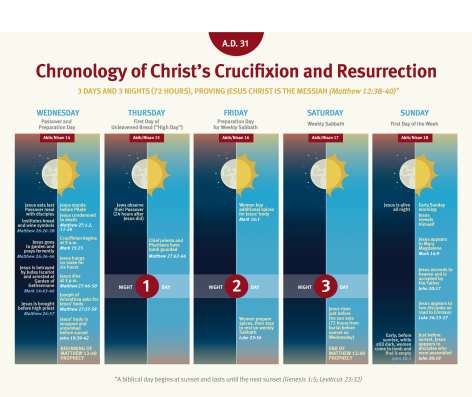
Download "The Chronology of Christ’s Crucifixion and Resurrection" infographic.

This chart includes the key events during this momentous week, demonstrating how Jesus’ promise to rise after three days and three nights was fulfilled, proving He is the Messiah.

3. Jesus didn’t die on a Friday.

Today documentation is commonly recorded for births and deaths. While we don’t have these same types of records from the first century giving us the exact day of Christ’s death, the Bible does give us enough details to show that Jesus definitely didn’t die on a Friday.

Let’s begin with the best known facts about Christ’s death. The Bible clearly tells us: “Now after the Sabbath [Saturday], as the first day of the week [Sunday] began to dawn, Mary Magdalene and the other Mary came to see the tomb,” but Jesus was not there because He had risen (Matthew 28:1, 6). So Jesus had already been resurrected by very early Sunday morning.

The next biblical key to note is that Jesus said, “As Jonah was three days and three nights in the belly of the great fish, so will the Son of Man be three days and three nights in the heart of the earth” (Matthew 12:40). We can also note that Jesus died at about 3 p.m., the ninth hour after sunrise, and was buried that evening shortly before the beginning of a Sabbath (Matthew 27:46-50, 57, 62).

People have assumed that the Sabbath mentioned in these verses is a Saturday, leading them to the conclusion that Jesus died on a Friday—hence the name Good Friday. But there is a problem with this timeline. There simply are not three days and three nights between Friday evening and Sunday morning. There aren’t even parts of three days and three nights in this time period between Friday evening and Sunday morning (as some have tried to interpret the three days and three nights).

The biblical fact is, Jesus died on a Wednesday—not on a Friday as many believe. A careful reading of a companion scripture explains this apparent dilemma. John 19:31 tells us that the day Jesus was buried preceded a “high day”—a designation reserved for an annual Sabbath, which could fall on any day of the week and not necessarily Saturday. In fact, Jesus was buried just prior to the beginning of the first day of the Feast of Unleavened Bread—an annual Sabbath.

The weekday timeline that fits the facts we have noted is easily constructed. Jesus observed the Passover with His disciples on Tuesday evening. He was crucified and died on Wednesday, buried near sunset on Wednesday prior to the beginning of the annual Sabbath called the first day of the Feast of Unleavened Bread, and resurrected three days and three nights later near sundown on Saturday, the weekly Sabbath. When the women arrived at the tomb early Sunday morning, they discovered that He had already been resurrected.

The fact that there were two Sabbaths during the timeline of Jesus’ burial and resurrection is confirmed by several Bible translations, including the International Standard Version, which translates Matthew 28:1: “After the Sabbaths, around dawn on the first day of the week, Mary Magdalene and the other Mary went to take a look at the burial site.” The annual Sabbath occurred on Thursday that year; the weekly Sabbath, on Saturday.

The biblical fact is, Jesus died on a Wednesday—not on a Friday as many believe. Interestingly when we look at the years for God’s holy days falling on the days of the week indicated by the Scriptures, we find that Jesus died on the 14th day of the first month of the Hebrew calendar in A.D. 31."   From: https://lifehopeandtruth.com/life/blog/3-things-you-may-not-know-about-maundy-thursday-and-good-friday/

_________

Three Days and Three Nights

Matthew 12:39-40

But He answered and said to them, “An evil and adulterous generation seeks after a sign, and no sign will be given to it except the sign of the prophet Jonah. For as Jonah was three days and three nights in the belly of the great fish, so will the Son of Man be three days and three nights in the heart of the earth.”

Listen to the "Verse by Verse" episode covering this scripture.

In our Fundamental Beliefs “8. Three Days and Three Nights,” we state, “Jesus Christ was raised from the dead by the Father after His body lay for three days and three nights in the grave. The length of time that He was in the grave was the only sign He gave to prove He was the Messiah.”

Jesus had done many miracles, but still the Pharisees sought “how they might destroy Him” (Matthew 12:14). So Jesus didn’t offer them more miracles as a sign, only this reference to the length of time He would be in the grave.

Strangely, though, most Christians today do not believe that Christ was literally three days and three nights in the grave as He promised, since it is not possible to count three days and three nights between Good Friday afternoon and Easter Sunday morning.

For a detailed explanation of the biblical chronology of Christ’s crucifixion and resurrection, including a helpful chart, see “Sign of Jonah: Did Jesus Die Good Friday, Rise on Easter?” From: https://lifehopeandtruth.com/bible/blog/three-days-and-three-nights/

_________

Increased Lifespan from Beans

“The intake of legumes—beans, chickpeas, split peas, and lentils—may be the single most important dietary predictor of a long lifespan. But what about concerns about intestinal gas?”

Transcript of video at: https://nutritionfacts.org/video/increased-lifespan-from-beans/

Below is an approximation of this video’s audio content. To see any graphs, charts, graphics, images, and quotes to which Dr. Greger may be referring, watch the above video.

“Legumes may be “the most important…predictor of survival in older people” from around the globe. They looked at “five [different] cohorts in Japan, Sweden, Greece, and Australia.” And, of all the food factors they looked at, only one was associated with a longer lifespan across the board: legume intake. Whether it was the Japanese eating their soy, the Swedes eating their “brown beans and peas,” or those in the Mediterranean eating “lentils, chickpeas, and white beans,”…”[o]nly for legumes intake was the result plausible, consistent, and statistically significant from [the] data” across all the populations combined. We’re talking an “8% reduction in risk of death for every 20 grams increase in daily legumes intake.” That’s just like two tablespoons’ worth! So, if a can of beans is 250 grams, and you get 8% lower mortality for every 20 grams, maybe, if we eat a can a day, we’ll live forever? Let’s find out!

If you want to increase your lifespan, eat beans. If, however, you’re suicidal, and want to decrease your lifespan, “A bean-free diet” may increase the risk of death.

So, having arrived at the one dietary fountain of youth, what’s the #1 reason people aren’t clamoring for them? Fear of flatulence. So, is that the choice we’re left with? Breaking wind or breaking down? Passing gas or passing on? Turns out that “[p]eople’s concerns about excessive flatulence from eating beans may be exaggerated.”

Add a half-cup of beans every day to people’s diets for months, and what happens? What’s the #1 symptom? Nothing. The vast majority of people experienced no symptoms at all—though a few percent did report increased flatulence. So, it may occur in some individuals. But, “not all people are affected.” Even among those that were, “[s]eventy percent or more of the participants who experienced flatulence felt that it dissipated [no pun intended] by the second or third week of bean consumption”. So, we’ve just got to stick to it.

And, you know, a small percentage reported increased flatulence on the control diet without any beans. People have preconceived notions about beans, such that “just the expectation of flatulence from eating beans may influence their perceptions of having gas.” They didn’t actually measure farts in this study; they just asked people what their perception of the amount of gas they had was. And, we know from previous studies that you give someone a product labeled to contain something that may cause intestinal distress, and it causes more intestinal distress whether it actually contains the ingredient or not. In other words, “just thinking they were eating [it] caused digestive distress, or the perception of it, to a proportion of persons.”

So, people thinking beans are going to cause gas may just be more likely to notice the gas they normally have. Either way, it tends to go away; “after a few weeks of daily bean consumption, people perceive that flatulence occurrence returns to normal levels.”

In this other study, where they added more than a half a cup of kidney beans to people’s daily diets, the research subjects reported that the discomfort they initially felt within the first day or two of adding beans “quickly disappeared.” So, again, stick with it.

Bottom line (no pun intended!): “An increasing body of research and the [latest] Dietary Guidelines…supports the benefits of a plant-based diet, and legumes specifically, in the reduction of chronic disease risks.” In some people it “may result in more flatulence initially.” However, doctors should emphasize that it “will decrease over time” if we just keep it up.

And, “the nutritional attributes of beans in the diet outweighs the potential for transitory discomfort. The long-term health benefits of bean consumption are great.” And, indeed, eating beans in the long term may make your term—on Earth—even longer.” From: https://nutritionfacts.org/video/increased-lifespan-from-beans/

_________