Saturday, March 9, 2024

Maundy Thursday and Good Friday. Three Days and Three Nights. Increased Lifespan from Beans.

.

3 Things You May Not Know About Maundy Thursday and Good Friday

3 Things You May Not Know About Maundy Thursday and Good FridayDevout Catholics participate in a Good Friday procession.

“Reflecting on Jesus’ death is sobering. Unfortunately the timing is rarely understood. Do Maundy Thursday and Good Friday fit the timing in the Bible?

Churches will soon be packed with some of their largest attendances of the year. The “CEOs” (Christmas and Easter Only attendees) will make one of their semiannual appearances for Easter, the most holy observance of the year for mainstream Christianity. Good Friday, which occurs two days before Easter Sunday, is also significant as the most solemn occasion because it recalls the crucifixion of Christ.

Most professing Christians understand that Jesus died so our sins can be forgiven. What is not common knowledge is the timing of His death, which has been hidden by the establishment of Easter and its closely related observances of Lent, Palm Sunday, Holy Wednesday, Maundy Thursday and Good Friday in lieu of the biblical festivals observed by Jesus, His apostles and the first-century Church.

If you sincerely want to honor Christ at this time of year, you need to know the real story—the one that shows us the correct timing of His death and how to properly commemorate this event.

Doesn’t Christ deserve the respect to have the true, biblical history of His death told and remembered on this sobering occasion?

In that light, here are three important things to know about Maundy Thursday and Good Friday:

1. Of all the man-made holidays, Maundy Thursday and Good Friday are the only ones that claim to commemorate something Jesus said to commemorate.

On the evening before His crucifixion, Jesus told His disciples to keep the Passover as an annual festival “in remembrance of Me” (Luke 22:19; 1 Corinthians 11:24-25).

In teaching the Corinthians to observe this solemn service, Paul told them that through this memorial they would “proclaim the Lord’s death till He comes” (verse 26, emphasis added throughout).

Jesus never commanded Christians to celebrate His birth or resurrection. Rather, His instruction was for us to memorialize His death—something that Maundy Thursday and Good Friday actually do attempt to do.

But does that mean you should observe Maundy Thursday and Good Friday?

2. Maundy Thursday and Good Friday aren’t the biblical names of the observance that commemorates Christ’s death.

The terms Maundy Thursday and Good Friday appear nowhere in the Bible. But the Bible does talk about another festival to honor Christ’s death: the Passover.

The New Testament Passover established by Christ Himself includes taking bread and wine. The bread represents His broken body and the wine represents His shed blood (Matthew 26:26-28).

Churches vary in how often they partake of the symbols of bread and wine. Some take these symbols daily, some monthly and some on Maundy Thursday. But the Bible instructs us to observe it only once a year on a specific day (Leviticus 23:5). When we take the Passover symbols of unleavened bread and wine, we annually “proclaim the Lord’s death till He comes” (1 Corinthians 11:26).

Observing the Passover is a memorial of Christ’s death. Jesus did not die on many different days throughout the year. He died on only one day, and He observed the Passover on the prescribed evening before the day of His death.

Passover is the annual festival that reminds us of Christ’s death. To learn more about this observance, see “Passover: What Did Jesus Do for You?” and “Questions and Answers About the Passover.”
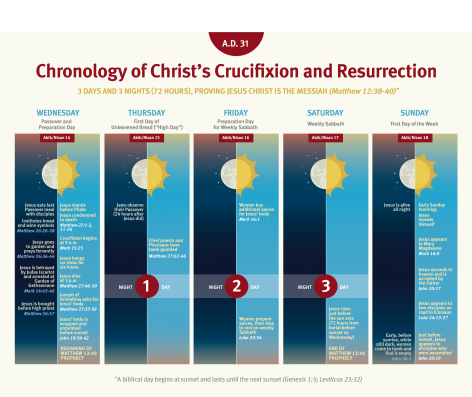
3 Things You May Not Know About Maundy Thursday and Good Friday

Download "The Chronology of Christ’s Crucifixion and Resurrection" infographic.

This chart includes the key events during this momentous week, demonstrating how Jesus’ promise to rise after three days and three nights was fulfilled, proving He is the Messiah.

3. Jesus didn’t die on a Friday.

Today documentation is commonly recorded for births and deaths. While we don’t have these same types of records from the first century giving us the exact day of Christ’s death, the Bible does give us enough details to show that Jesus definitely didn’t die on a Friday.

Let’s begin with the best known facts about Christ’s death. The Bible clearly tells us: “Now after the Sabbath [Saturday], as the first day of the week [Sunday] began to dawn, Mary Magdalene and the other Mary came to see the tomb,” but Jesus was not there because He had risen (Matthew 28:1, 6). So Jesus had already been resurrected by very early Sunday morning.

The next biblical key to note is that Jesus said, “As Jonah was three days and three nights in the belly of the great fish, so will the Son of Man be three days and three nights in the heart of the earth” (Matthew 12:40). We can also note that Jesus died at about 3 p.m., the ninth hour after sunrise, and was buried that evening shortly before the beginning of a Sabbath (Matthew 27:46-50, 57, 62).

People have assumed that the Sabbath mentioned in these verses is a Saturday, leading them to the conclusion that Jesus died on a Friday—hence the name Good Friday. But there is a problem with this timeline. There simply are not three days and three nights between Friday evening and Sunday morning. There aren’t even parts of three days and three nights in this time period between Friday evening and Sunday morning (as some have tried to interpret the three days and three nights).

The biblical fact is, Jesus died on a Wednesday—not on a Friday as many believe. A careful reading of a companion scripture explains this apparent dilemma. John 19:31 tells us that the day Jesus was buried preceded a “high day”—a designation reserved for an annual Sabbath, which could fall on any day of the week and not necessarily Saturday. In fact, Jesus was buried just prior to the beginning of the first day of the Feast of Unleavened Bread—an annual Sabbath.

The weekday timeline that fits the facts we have noted is easily constructed. Jesus observed the Passover with His disciples on Tuesday evening. He was crucified and died on Wednesday, buried near sunset on Wednesday prior to the beginning of the annual Sabbath called the first day of the Feast of Unleavened Bread, and resurrected three days and three nights later near sundown on Saturday, the weekly Sabbath. When the women arrived at the tomb early Sunday morning, they discovered that He had already been resurrected.

The fact that there were two Sabbaths during the timeline of Jesus’ burial and resurrection is confirmed by several Bible translations, including the International Standard Version, which translates Matthew 28:1: “After the Sabbaths, around dawn on the first day of the week, Mary Magdalene and the other Mary went to take a look at the burial site.” The annual Sabbath occurred on Thursday that year; the weekly Sabbath, on Saturday.

The biblical fact is, Jesus died on a Wednesday—not on a Friday as many believe. Interestingly when we look at the years for God’s holy days falling on the days of the week indicated by the Scriptures, we find that Jesus died on the 14th day of the first month of the Hebrew calendar in A.D. 31."   From: https://lifehopeandtruth.com/life/blog/3-things-you-may-not-know-about-maundy-thursday-and-good-friday/

_________

Three Days and Three Nights

Matthew 12:39-40

But He answered and said to them, “An evil and adulterous generation seeks after a sign, and no sign will be given to it except the sign of the prophet Jonah. For as Jonah was three days and three nights in the belly of the great fish, so will the Son of Man be three days and three nights in the heart of the earth.”

Listen to the "Verse by Verse" episode covering this scripture.

In our Fundamental Beliefs “8. Three Days and Three Nights,” we state, “Jesus Christ was raised from the dead by the Father after His body lay for three days and three nights in the grave. The length of time that He was in the grave was the only sign He gave to prove He was the Messiah.”

Jesus had done many miracles, but still the Pharisees sought “how they might destroy Him” (Matthew 12:14). So Jesus didn’t offer them more miracles as a sign, only this reference to the length of time He would be in the grave.

Strangely, though, most Christians today do not believe that Christ was literally three days and three nights in the grave as He promised, since it is not possible to count three days and three nights between Good Friday afternoon and Easter Sunday morning.

For a detailed explanation of the biblical chronology of Christ’s crucifixion and resurrection, including a helpful chart, see “Sign of Jonah: Did Jesus Die Good Friday, Rise on Easter?” From: https://lifehopeandtruth.com/bible/blog/three-days-and-three-nights/

_________

Increased Lifespan from Beans

“The intake of legumes—beans, chickpeas, split peas, and lentils—may be the single most important dietary predictor of a long lifespan. But what about concerns about intestinal gas?”

Transcript of video at: https://nutritionfacts.org/video/increased-lifespan-from-beans/

Below is an approximation of this video’s audio content. To see any graphs, charts, graphics, images, and quotes to which Dr. Greger may be referring, watch the above video.

“Legumes may be “the most important…predictor of survival in older people” from around the globe. They looked at “five [different] cohorts in Japan, Sweden, Greece, and Australia.” And, of all the food factors they looked at, only one was associated with a longer lifespan across the board: legume intake. Whether it was the Japanese eating their soy, the Swedes eating their “brown beans and peas,” or those in the Mediterranean eating “lentils, chickpeas, and white beans,”…”[o]nly for legumes intake was the result plausible, consistent, and statistically significant from [the] data” across all the populations combined. We’re talking an “8% reduction in risk of death for every 20 grams increase in daily legumes intake.” That’s just like two tablespoons’ worth! So, if a can of beans is 250 grams, and you get 8% lower mortality for every 20 grams, maybe, if we eat a can a day, we’ll live forever? Let’s find out!

If you want to increase your lifespan, eat beans. If, however, you’re suicidal, and want to decrease your lifespan, “A bean-free diet” may increase the risk of death.

So, having arrived at the one dietary fountain of youth, what’s the #1 reason people aren’t clamoring for them? Fear of flatulence. So, is that the choice we’re left with? Breaking wind or breaking down? Passing gas or passing on? Turns out that “[p]eople’s concerns about excessive flatulence from eating beans may be exaggerated.”

Add a half-cup of beans every day to people’s diets for months, and what happens? What’s the #1 symptom? Nothing. The vast majority of people experienced no symptoms at all—though a few percent did report increased flatulence. So, it may occur in some individuals. But, “not all people are affected.” Even among those that were, “[s]eventy percent or more of the participants who experienced flatulence felt that it dissipated [no pun intended] by the second or third week of bean consumption”. So, we’ve just got to stick to it.

And, you know, a small percentage reported increased flatulence on the control diet without any beans. People have preconceived notions about beans, such that “just the expectation of flatulence from eating beans may influence their perceptions of having gas.” They didn’t actually measure farts in this study; they just asked people what their perception of the amount of gas they had was. And, we know from previous studies that you give someone a product labeled to contain something that may cause intestinal distress, and it causes more intestinal distress whether it actually contains the ingredient or not. In other words, “just thinking they were eating [it] caused digestive distress, or the perception of it, to a proportion of persons.”

So, people thinking beans are going to cause gas may just be more likely to notice the gas they normally have. Either way, it tends to go away; “after a few weeks of daily bean consumption, people perceive that flatulence occurrence returns to normal levels.”

In this other study, where they added more than a half a cup of kidney beans to people’s daily diets, the research subjects reported that the discomfort they initially felt within the first day or two of adding beans “quickly disappeared.” So, again, stick with it.

Bottom line (no pun intended!): “An increasing body of research and the [latest] Dietary Guidelines…supports the benefits of a plant-based diet, and legumes specifically, in the reduction of chronic disease risks.” In some people it “may result in more flatulence initially.” However, doctors should emphasize that it “will decrease over time” if we just keep it up.

And, “the nutritional attributes of beans in the diet outweighs the potential for transitory discomfort. The long-term health benefits of bean consumption are great.” And, indeed, eating beans in the long term may make your term—on Earth—even longer.” From: https://nutritionfacts.org/video/increased-lifespan-from-beans/

_________

Tuesday, March 5, 2024

5 Things Christ Will Undo and Redo at His Return. Should Christians Keep Mardi Gras? How does Plant-Based Eating Benefit Your Health?

.

5 Things Christ Will Undo and Redo at His Return

5 Things Christ Will Undo and Redo at His Return “Mankind has done much damage to this earth, but God has a plan to fix man’s many mistakes. What will Christ “undo” and “redo” when He returns to earth?


As a software developer, I consider “undo” to be an essential tool, and I use it often. When making changes to software, I occasionally realize I made a mistake. The easiest way to fix that mistake is to undo the changes I made and go back and do it right. I am fortunate to use an editor that remembers changes I made even after it has been closed.

Wouldn’t life be great if we could undo our past mistakes and have a redo? Though life doesn’t provide us such an option, God has a plan that will undo the damage we humans have done to this earth, to one another and to ourselves. His plan is in motion and soon will be evident to all mankind when Jesus Christ returns to earth to establish God’s Kingdom here.

Under Christ’s perfect government, mankind will learn to “redo” life, but this time following the perfect laws of God.

Let’s consider some of the major things that will be undone and redone after Christ’s return.

1. Swords and plowshares

Undo: War between nations.

Redo: Peaceful, mutually beneficial relationships between nations.

After Christ returns, He will teach the nations His law, which is based on love Just before Christ returns to the earth, there will be a period of intense worldwide warfare when people will be beating “plowshares into swords” and “pruning hooks into spears” (Joel 3:10). This is ancient language describing implements of food production (which sustains life) being turned into implements of warfare (which destroys life).

But after Christ returns, He will teach the nations His law, which is based on love (2 John 1:6). When godly love is understood and practiced on an international level, the nations will turn “swords [back] into plowshares” and “spears [back] into pruning hooks” (Micah 4:3).

2. Food shortages

Undo: Hunger and malnutrition affecting millions of people.

Redo: An abundance of food where everyone’s needs are met.

As we covered above, after Christ returns, the nations will no longer devote their economic resources to warfare and defense, but will instead redirect their economies to food production. Christ will restore an emphasis on agriculture that will allow the nations to sustain healthy populations. The prophet Amos foresaw a world where the “plowman shall overtake the reaper” (Amos 9:13).

3. Dangerous animals

Undo: The instinctual nature in many wild animals that makes them dangerous to humans and each other.

Redo: A transformed nature of wild animals that makes them docile, tame and harmless.

In the creation described in the first two chapters of Genesis, there was perfect harmony between the animals and mankind. But when Adam and Eve sinned and were kicked out of the Garden of Eden, they found many wild animals were now hostile to human beings. Christ will change the violent natures of animals so they will dwell safety with one another and with mankind (Isaiah 11:6-9).

4. Knowledge of God

Undo: Rejection of God and His laws.

Redo: Acceptance of God and His laws in every aspect of life.

In the book of Romans, the apostle Paul described the current state of humanity as being in rebellion against God (Romans 1:28). But Christ will make God’s beneficial laws undeniable. He will lead an educational system based on the ways of God. It will eventually lead to the knowledge of God covering the earth “as the waters cover the sea” (Isaiah 11:9). The prophet Jeremiah foresaw a time when everyone will know God (Jeremiah 31:34).

5. God’s Sabbath and festivals

Undo: Ignorance of God’s Sabbath and festivals.

Redo: Knowledge and observance of the Sabbath and festivals.

Within God’s law are holy times: the weekly Sabbath (Exodus 20:8-11) and annual festivals (Leviticus 23). Not only are these days when we are to worship God, they also reveal the major stages of His plan. These days will be observed by the entire world after Christ returns (Isaiah 66:23, ZechariaThe Mystery of the Kingdom free bookleth 14:16).

This covered just a few aspects of our world that will be undone and redone after Jesus Christ returns. To learn more about this future time, download our free booklet The Mystery of the Kingdom.   From: https://lifehopeandtruth.com/prophecy/blog/5-things-christ-will-undo-and-redo-at-his-return/?

________

Should Christians Keep Mardi Gras?

Transcript of video at: https://www.ucg.org/beyond-today/beyond-today-dailys/should-christians-keep-mardi-gras

Mardi Gras has its roots in religious tradition. But what does the Bible say?

[Steve Myers] “Colorful costumes and masks and pageantry. That's all surrounding Mardi Gras. Mardi Gras is one of those traditions where...    sometimes I'll talk about the fact that it reminds me of the three Ds. There's dancing in the streets, there's drunkenness and debauchery. That kinda categorizes Fat Tuesday. That's literally what the term Mardi Gras means. Religiously it's called Shrove Tuesday because that's the day before Lent. Lent of course being more of a Catholic kind of a tradition that's rooted in pagan holidays. And what would happen at Lent is that you would give up something for Lent. And so before you give something up, you certainly want to overindulge and fatten up and, you know, get into food and drink and all those things so that you can then put that behind you and repent for the rest of this religious season.

But when you really think about the implications of that religiously, it's really ridiculous. In modern carnival traditions and celebrations all around the world and whether it's in New Orleans or Rio or Nice, France. These are areas where they'll often celebrate for weeks, leading up to that time. When we lived in New Orleans for a while, I remember they talk about Fat Tuesday, and then instead of Ash Wednesday, they'd call it Trash Wednesday because there was so much junk leftover from these Mardi Gras celebrations. Well, is that something we should have any part in? These Catholic traditions that are not really based in the Bible at all. I mean, there's a couple of interesting aspects when you consider this. I was thinking of the passage that's found in Romans 13:13. It says the basic things. As Christians it says, "Let's walk properly in the day, not in revelry or drunkenness."

Of course on TV, they'll show the parties and the fun but they don't show all of those types of things because that would certainly take away from the tourism of all those areas of the world. Romans goes on, "don't walk in lewdness and lust, not in strife and envy." And it's kind of a reminder, those are the things we should give up, but that's not good enough. This whole aspect of Mardi Gras and Lent, I think it is something that miss directs us to what the truth of God's word really is. Yes, we've got to give up lewdness and drunkenness and revelry and all those types of things that are against God's way of life. But Romans points out, it's not just about giving something up. We have to put something on and so verse 14 in Romans 13 says, "Put on the Lord Jesus Christ, make no provision for the flesh to fulfill its lust."

And so that's an important aspect of Christianity, true Christianity. We not only put off those things that are wrong, but we've got to take it a step farther. We've got to put on everything that's right. So when you begin to hear about Mardi Gras celebrations, and all of those types of things in this upcoming Lent season that this religious world will keep, remember, it's not rooted in the Bible. In fact, let it remind you of the fact we need to put off the ways of the world, but more importantly then, put on Jesus Christ.”  From: https://www.ucg.org/beyond-today/beyond-today-dailys/should-christians-keep-mardi-gras

________

How does Plant-Based Eating Benefit Your Health?

father holding broccoli high-five daughter

Whether you’re considering eating less meat or giving it up entirely, the benefits are clear: less risk of disease and improved health and well-being. Consuming less meat decreases the risk of:

Meat is often loaded with cholesterol and saturated fat, which have starring roles in poor heart health. And processed meats, including deli meat, bacon and sausage, often have too much sodium and other additives, and should be limited. However, if you want to include meat into your eating plan, choose lean meats. Be sure to include skinless poultry, seafood, fish, beans, nuts and legumes, too, because they are healthy sources of protein.

Diets or eating styles that do not or restrict meat include:

  • Vegan — entirely plant-based, excluding meat, fish, dairy, eggs, honey and any product that comes from an animal.
  • Vegetarians — a plant-based diet, but may include dairy and eggs.
  • Flexitarian — a vegetarian diet that sometimes indulges in meat or fish but mostly sticks to plant foods.
  • Plant-based — a style of cooking and eating that emphasizes plant-based foods but is not strictly limited to them. Meat may be included, but it’s usually not the main feature of the meal.

Lean protein

Not eating meat does not mean you can’t get enough protein in your diet. In fact, many people eat more than enough protein, especially from animal foods. There are plenty of other foods that can provide you with protein, such as tofu, edamame, quinoa, sorghum, lentils, chickpeas and most beans and legumes. And there are many good sources of protein from vegetables, too, including artichokes, asparagus, broccoli, Brussels sprouts, collards, corn, peppers, spinach, sweet potatoes and turnip greens. Did you know that every plant we eat has some protein in it? So, the more vegetables you eat, the more protein you’ll consume.

Not all plant-based diets are healthy

Don’t replace meats with highly processed meat substitutes or “vegan junk food.” Instead choose high-quality, nutrient-dense plant-based foods. A recent study showed that eating primarily these types of food, such as vegetables, fruits, whole grains, beans, legumes and nuts, was associated with a lower risk of death from cardiovascular diseases. The researchers concluded that even if you’ve eaten a poor diet for half your life, adding more healthy plant foods as an adult can help reduce your risk.

Making the switch

Going plant-based is not as difficult as you may think. In fact, getting started can be as easy as 1-2-3!

  1. Search for some vegetarian recipes that are easy to prepare and sound appealing to you and your family.
  2. Choose ingredients and flavors you know your family will enjoy.
  3. Try meatless Mondays! Experiment with a meatless meal once a week, then add more days as you get used to it.”          

Written by American Heart Association editorial staff and reviewed by science and medicine advisors. See our editorial

From: https://www.heart.org/en/healthy-living/healthy-eating/eat-smart/nutrition-basics/how-does-plant-forward-eating-benefit-your-health

_________

Tuesday, February 20, 2024

What Does Your Appearance Say About You? Slaves of Sin or Slaves of Righteousness? What You Should Know About Plant-Based Diets.

.

What Does Your Appearance Say About You?

What does your appearance say about you?“While sitting in a waiting room, waiting for an eye exam, an elderly gentleman walked in whose appearance caught my eye. He had a nice suit on with a very nice wool overcoat. His shoes where so shiny you could probably see yourself in them. I can assure you I did not try. I thought to myself, this guy is rich, probably a CEO. As I looked around the room, everyone else was dressed in their jeans and one lady even had holes in her jeans. When I looked at the other people in the room, and how they were dressed, I certainly was not left with the same impression as I with the immaculate dressed elderly gentleman.

It made me think about our appearance. We know that God looks at the heart, and that is what is most important. But, our appearance leaves a message in others peoples minds. What does our appearance say about us? What is the first impression that people see when they see you? Does appearance mean anything? Is your appearance modest? Do we strive to wear our very best for the occasion? The main question we should also ask is does our appearance represent God? We are representative of God in our behavior and in our dress. We should dress as Ambassadors for the coming Kingdom of God. We should dress to honor God.

You do not have to spend a lot of money to look well dressed. Many thrift or second hand stores have great clothing for a low budget. You can find great quality clothes at these second hand shops. I know after seeing this gentleman it made me want to try harder and dress better because I know our appearance projects an image of us and of God, especially if they know we are Christians.

We want our appearance to project a high quality person, a representative of God! So always remember when you get ready to go somewhere what does your and my appearance say to others and am I representing God as an Ambassador?” From: https://www.ucg.org/beyond-today/blogs/what-does-your-appearance-say-about-you#comments.  Yes, there are lots of comments to read about this, too!

_________

Slaves of Sin or Slaves of Righteousness?

Romans 6:15-16

What then? Shall we sin because we are not under law but under grace? Certainly not! Do you not know that to whom you present yourselves slaves to obey, you are that one’s slaves whom you obey, whether of sin leading to death, or of obedience leading to righteousness?

“The apostle Paul, after describing in Romans 5 the incredible sacrifice of Jesus Christ to pay the penalty of our sins and make possible the free gift of forgiveness and eternal life, saw the need to explain more fully.

We can do nothing to “earn” forgiveness or eternal life, but that doesn’t mean that God wants us to continue sinning. Obviously if God hates sin so much that He requires the death penalty for sin, He does not want us to go back to doing it. Sin causes pain and suffering and death. Obeying God’s law produces right relationships and life.

Paul points out that humans must choose whom they will serve: either sin leading to death or obedience to God’s good and righteous law, which leads to being right with God. Those are the only two choices; and as God said long before, He wants us to choose obedience and “choose life” (Deuteronomy 30:16-19).

For more about sin and God’s law, see “The 10 Commandments for Today.” From: https://lifehopeandtruth.com/bible/blog/slaves-of-sin-or-slaves-of-righteousness/?

________

What You Should Know About Plant-Based Diets

eating veggies in a buddha bowl“Learn the pros, cons and safe ways to remove meat products from your diet ​

Thinking about trying out a plant-based diet and want to know more? Here, dietitians Kate Patton, MEd, RD, CSSD, LD, and Julia Zumpano, RD, LD, explore some details that can help you decide if it’s right for you — and if so, how to jump right in.

What is a plant-based diet?

These vegan-like diets eliminate all animal products, including meat, poultry, fish, eggs, dairy and honey. As the name suggests, everything you eat — including whole grains, fruits, vegetables, legumes, nuts and seeds — is derived from plants.

Are plant-based diets healthy?

Research reflects that following a plant-based diet has significant health benefits as long as you do it correctly.

“No matter when you start, a diet that is focused on plant foods will help you work toward the prevention of many illnesses and feeling better overall,” Zumpano says.

If followed properly, a whole foods, plant-based diet limits the use of oils, added sugars and processed foods, leaving only whole foods to provide nutrition. This maximizes nutrient intake and virtually eliminates foods that can lead to poor health outcomes.

These diets are low in saturated fat, free of cholesterol, and rich in fiber, vitamins, minerals and antioxidants.

Research also reveals that following this type of diet will lower your risks of:

  • Heart disease.
  • Hypertension (high blood pressure).
  • Diabetes.
  • Digestive disease.
  • Colon and breast cancers.
  • Obesity.

Studies also show that a plant-based diet can help to lower body weight and reduce your LDL cholesterol.

The cons of a plant-based diet

Following a plant-based diet means saying goodbye to all animal products — including lean meat and dairy products such as milk, yogurt, cheese and ice cream.

“That’s easier said than done for many of us,” Patton says. “But when you have the right guidelines and wrap in changes over time, replacing animal products in your diet is possible.”

Another thing to note — if you don’t plan your plant-based diet correctly, you may not meet all your protein, vitamin and mineral needs. And you won’t feel or look your best if you develop a nutritional deficiency. But there are easy ways to make sure you’re getting the nutrients you need.

How to get enough protein

You’ll want to make sure that your diet includes enough protein to maintain muscle mass, strong bones and healthy skin. The following foods are packed with protein:

  • Beans, lentils and split peas.
  • Quinoa.
  • Fermented Soy products like tempeh, tofu, soybeans and soy milk.
  • Nuts and seeds.
How to get enough vitamins and minerals

You’ll also need to get adequate calcium and vitamin D in your diet to ensure healthy bones. This won’t be difficult if you:

  • Drink a milk alternative such as soy, almond, rice or hemp milk, which contain both calcium and the vitamin D needed to absorb it.
  • Eat plenty of dark green leafy lettuce and beans which contain calcium.
  • Eat mushrooms and fortified cereals which contain vitamin D. If you aren’t consuming fortified foods on a consistent basis you’ll need to take a vitamin D supplement. Sunlight is another source of vitamin D.

You’ll also need enough zinc in your diet to support a healthy immune system, enough iron to maintain energy and immunity and enough vitamin B12 to produce red blood cells and prevent anemia. This means you’ll want to:

  • Eat whole grains, beans and fortified cereals for zinc and iron.
  • Eat fortified cereals and soy products to get your vitamin B12.
  • Nutritional yeast is also a great source of vitamin B12.
How to get started on a plant-based diet  …………..
Continued at: https://health.clevelandclinic.org/is-a-plant-based-diet-right-for-you

__________