Showing posts with label cell phone. Show all posts

Monday, March 13, 2023

Rising Prices, Surging Crime What Can You Do? God Blessed the Seventh Day. How Effective Is Chemotherapy for Colon, Lung, Breast, and Prostate Cancers?

.

Rising Prices, Surging Crime, What Can You Do?

A woman reading her Bible.Priscilla Du Preez/Unsplash

“As the cost of living escalates and crime intensifies, what can you do to aid your family? And where can you find lasting help, hope and stability in this time of turbulent change and uncertainty?

When God is a priority in your life, you can ask Him to guide your daily decisions and actions and He will respond with favor.

Among today’s many troubling issues is the fact that families are enduring financial turmoil as prices for food, gasoline, housing and nearly everything else skyrockets. Bills are piling up and worries magnify as an increasing number of people are living paycheck to paycheck. At the same time, lawlessness is mounting while government officials seem unable to deal with these issues.

What can you do? Precautions are vital in dangerous times (Proverbs 22:3; Proverbs 27:12). What steps can you take? And what is the most important action you can take to bring help, hope and stability to you and your family?  

Taking action to deal with rising prices

Most of today’s escalating costs are the result of inflation—the increase in the cost of goods and services which decreases people’s purchasing power. Inflation is, in effect, an endless tax that impacts everyone, but especially those who are poor, middle class or living on a fixed income and already have difficulty affording necessities.

In addition, inflation leads to rising interest rates—increasing the cost of large purchases such as houses and vehicles—and slows overall economic growth.

So what are some practical actions you can take to contend with the rising expenses your family is experiencing?

If you’re a conscientious shopper, you’re likely already buying less expensive, generic-brand products, using manufacturers’ coupons and reducing purchases of expensive prepackaged convenience foods. But what else can you do?

Consider changing where you shop, at least for some products. You may want to look for online-only and “dollar”-type stores for discounted food items as well as outlet grocery stores that offer significant markdowns as product “sell by” dates draw near. Also, consider shopping at “bulk” stores to purchase larger quantities of nonperishable food items, household paper products and other essentials—since doing so reduces your per unit cost.

You might also take a close look at what you’re spending for cell phone plans, video streaming services, vehicle and home insurance premiums, gym memberships, cable subscriptions and your credit card interest rate if you have to carry a balance. The recurring costs in these plans and services may be negotiable. Calling or writing to request lower rates is frequently successful—which can be valuable in helping reduce your monthly expenses.

Other money-saving suggestions include checking to see if you qualify for an energy assistance program. These are designed to help with monthly utility bills.

Consider replacing your old thermostat with a programmable one. You could save as much as 10 percent annually by turning down the heat in winter while you’re at work or school. You could also consider asking your employer for a pay raise if you’ve been a reliable, hardworking employee—good employees are increasingly hard to find.

You can probably come up with some other ways to cut costs too. Do additional research online for more ideas.

Protecting your home and family as crime surges

Sadly, criminal activity is surging in today’s society. Since crime can occur nearly anywhere—including your own neighborhood—take preventative measures to safeguard your family. According to a recent article in Forbes magazine, “You can start protecting yourself by evaluating your home, changing your habits when you leave and putting other measures in place that could improve your home’s security” (Emily Glover, “10 Ways to Secure Your Home Against Home Invasion,” Forbes, July 25, 2022).

The article goes on to explain that “according to the U.S. Department of Justice, a burglary is considered a home invasion when a resident is present. Although burglaries can and do happen at any time, they are most common during daytime hours.” Below are some valuable actions you can take to help protect your home and family:

“Keep Curtains and Blinds Pulled. Criminals may look through windows to scout potential burglary targets or to evaluate whether residents are home. Keep curtains or blinds pulled down in any room where you aren’t currently enjoying the natural light. This also goes for when you leave the house for work, errands or trips.

“Invest in a Home Security System. From ones that can be professionally installed and monitored to [do it yourself] options that offer great protection against home invasions.

“Get Motion-Sensing Lights. You can set motion-sensing smart lights to activate when you are out of the house. If you’re on vacation, this can also signal to helpful neighbors who are keeping watch that something isn’t right.

“Don’t Broadcast Upcoming Departures. As tempting as it may be to share upcoming travel plans on social media, it’s not worth the risk. Even telling a friend about your itinerary when you are in a public place can be ill-advised as you don’t know who else may be eavesdropping on the conversation.

“Keep the Doors Locked and Garage Shut. If doors are left unlocked or the garage is open, fast-moving burglars can strike when you go out on a walk, or even are just in the yard. It’s also worth keeping your windows locked, and don’t forget any windows to the basement.

“Look Out for Neighbors (and Vice Versa). What’s good for your neighborhood is good for your home. By making it clear to burglars that you live in a place where neighbors look out for each other, they may be deterred from trying their chances. If you decide to make a house key available to a neighbor, give it to them directly rather than leaving it in an outdoor hiding place.”

The most important action you can take

While the above measures involving cost savings and protecting your home and family can be highly beneficial, there is another extremely important action you can take to assure that you and your family will have what is needed to live satisfactorily and safely.

At Beyond Today magazine we desire to help our readers understand the crucial significance of placing their lives in the hands of their Creator who says in His Word, the Bible, that there is no real security apart from Him: “Unless the Lord guards the city, the watchman stays awake in vain” (Psalms 127:1).

Yet to those who trust Him He promises: “Fear not, for I am with you; be not dismayed, for I am your God. I will strengthen you, yes, I will help you, I will uphold you with My righteous right hand” (Isaiah 41:10, emphasis added throughout).

The Eternal God is supremely willing to offer you and your family the help, strength and guidance needed to successfully handle life’s many troubles (Psalms 18:2-3; Psalms 91:5-7). King David of ancient Israel stated: “I lift up my eyes to the hills. From where does my help come? My help comes from the Lord, who made heaven and earth” (Psalms 121:1-2, English Standard Version).

Also, the apostle Paul wrote, “My God will supply every need of yours according to his riches in glory in Christ Jesus” (Philippians 4:19, World English Bible).

These awesome promises can be yours if you place Him first in your life, turn from sin and diligently keep His commandments, which He designed for your full benefit (Psalms 119:2; Matthew 6:31-34; Matthew 19:17).

Jesus Christ declared, “And you shall love the Lord your God with all your heart, with all your soul, with all your mind, and with all your strength” (Mark 12:30). When God and His ways are a priority in your life, you can ask Him to guide your daily decisions and actions, and He will respond with great favor. Plus, He will gladly help you prepare for eternal life in His coming magnificent Kingdom (John 10:28).

All of this involves maintaining a close and enduring relationship with God through Jesus Christ—by daily prayer and living by “every word of God,” the Bible (Luke 4:4).

Why is a steadfast relationship with Christ so crucially important? It’s because your human strength and resolve can take you only so far. However, with the overwhelming aid, power and peace of mind He provides, you enjoy a huge advantage, as the following passages make clear. Psalms 46:1 says, “God is our refuge and strength, a very present help in trouble.” Also, Hebrews 4:16 says we can “come boldly to the throne of grace, that we may obtain mercy and find grace to help in time of need.”

Furthermore, as the apostle Paul wrote, “Let your requests be made known to God; and the peace of God, which surpasses all understanding, will guard your hearts and minds through Christ Jesus” (Philippians 4:6-7).

These and other biblical promises affirm marvelous benefits that tower far above and beyond anything you could ever obtain on your own or even think up (Ephesians 3:20). So why carry the entire burden yourself when Jesus said, “Come to Me, all you who labor and are heavy laden, and I will give you rest” (Matthew 11:28).

As you face increasing expenses today and as crime and lawlessness could perhaps affect the safety of your family, be sure to take the appropriate actions to care for and safeguard them. But most importantly, place yourself and your concerns in the hands of your Creator!

If you diligently and humbly seek, trust and obey Him, He will be more than willing to give you the help, hope and stability you need. To be sure, “He is a rewarder of those who diligently seek him” (Hebrews 11:6). Therefore, will you seek God and follow His ways? He wants to help you and your family and is looking forward to doing so!” From: https://www.ucg.org/beyond-today/beyond-today-magazine/rising-prices-surging-crime-what-can-you-do

________

God Blessed the Seventh Day

Genesis 2:2-3

And on the seventh day God ended His work which He had done, and He rested on the seventh day from all His work which He had done. Then God blessed the seventh day and sanctified it, because in it He rested from all His work which God had created and made.

“Genesis, the book of beginnings, recounts the six days of creation, followed by a seventh day of rest. By resting, God set the seventh day apart and made it holy.

This act of creation is recounted again in the Fourth of the 10 Commandments, which is about the Sabbath day (Exodus 20:8-11). See more about this in “Did God Create the Sabbath in Genesis 2?

Here’s more about the Sabbath from our Fundamental Belief  “11. The Seventh-Day Sabbath”:

“The seventh day of the week is the Sabbath of the Lord our God, and on this day humans are commanded to rest from their labors and worship Him. Established and blessed by God at creation, the seventh day of the week begins at sunset on Friday and continues until sunset on Saturday. The Sabbath is an identifying sign and a perpetual covenant between God and His people. True Christians follow the example of Jesus Christ, the apostles and the New Testament Church in observing the seventh-day Sabbath.”         From: https://lifehopeandtruth.com/bible/blog/god-blessed-the-seventh-day/?

________

How Effective Is Chemotherapy for Colon, Lung, Breast, and Prostate Cancers?

Image Credit: Unsplash. This image has been modified.

“How effective is chemotherapy for colon, lung, breast, and prostate cancers?

“Over the last several decades…medicine has waged a major war against cancer, concentrating on earlier diagnosis and improved therapy. The war is not being won. Nevertheless, medicine shows few signs of admitting that its strategy may be flawed. In this it resembles a World War I general who stated: ‘Casualties: huge. Ground gained: negligible. Conclusion: press on.’”

If you look at the contribution of cancer-killing chemotherapy to five-year survival in cancer patients, it’s on the order of only about 2 percent. As you can see below and at 0:50 in my video How to Win the War on Cancer, we’ve gotten pretty good at treating some pediatric cancers, testicular cancer, and Hodgkin’s disease.
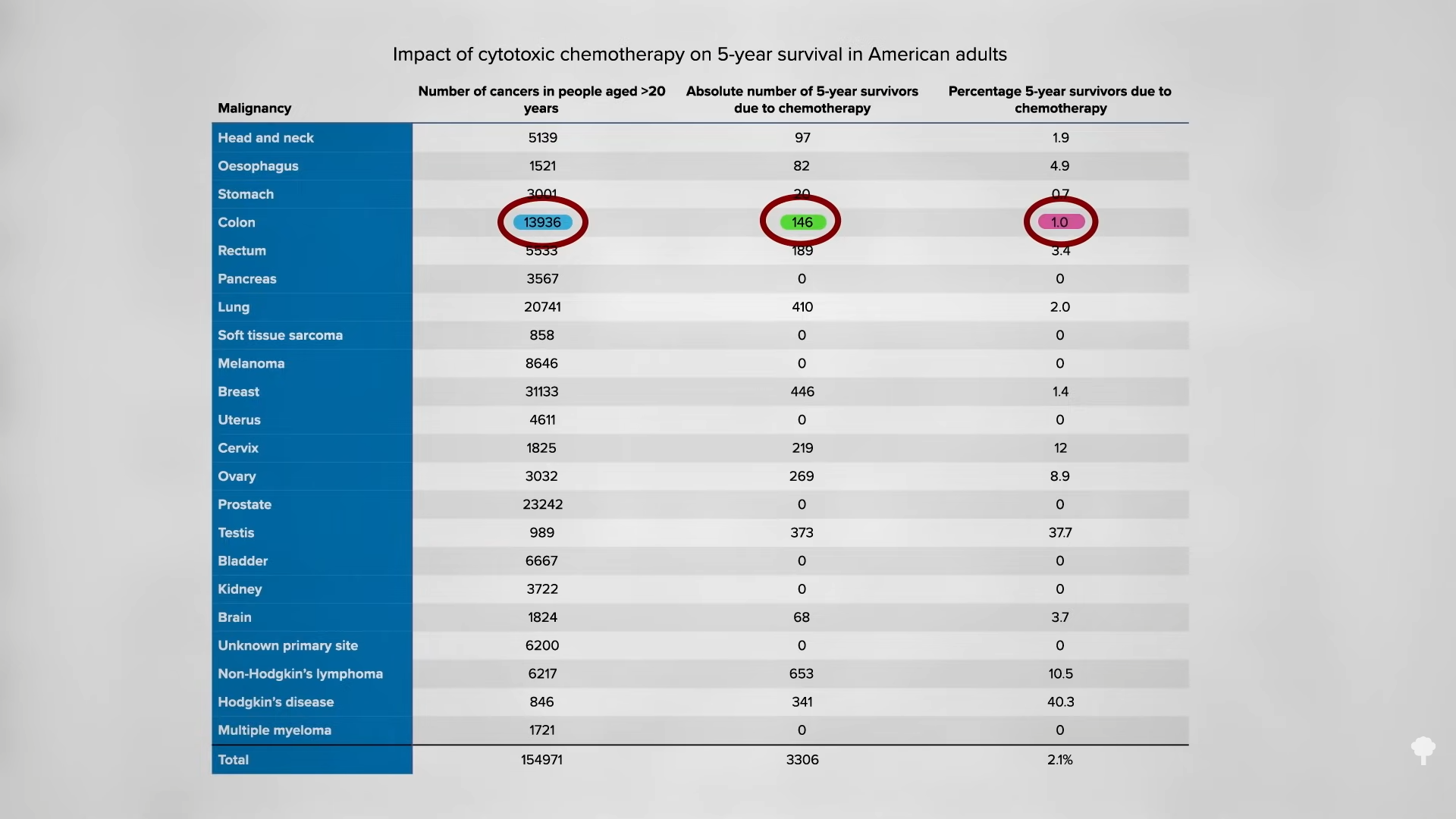
But, if you look at our most common cancers—that is, of the colon, lung, breast, and prostate—the success rate is only about 1 percent. That means out of nearly 14,000 colon cancer patients, for example, only 146 lived out five years, thanks to chemotherapy. The chance of survival benefit of chemo is about one in a hundred, but doctors don’t tell patients that. “Any new chemotherapy drug is still promoted as a major breakthrough in the fight against cancer, only to be quietly rejected without the fanfare that accompanied its arrival.”

Indeed, the “minimal impact on survival in the more common cancers conflicts with the perceptions of many patients who feel they are receiving a treatment that will significantly enhance their chances of cure…In view of the minimal impact of cytotoxic chemotherapy on 5-year survival, and the lack of any major progress over the last 20 years, it follows that the main role of cytotoxic chemotherapy is in palliation.” It can shrink tumors, relieving pain and pressure, but that doesn’t tend to translate into living any longer. “The failure of therapy, coupled with the realization that the overwhelming majority of cancer is related to environmental, particularly lifestyle factors, dictates that prevention should be our foremost aim.”

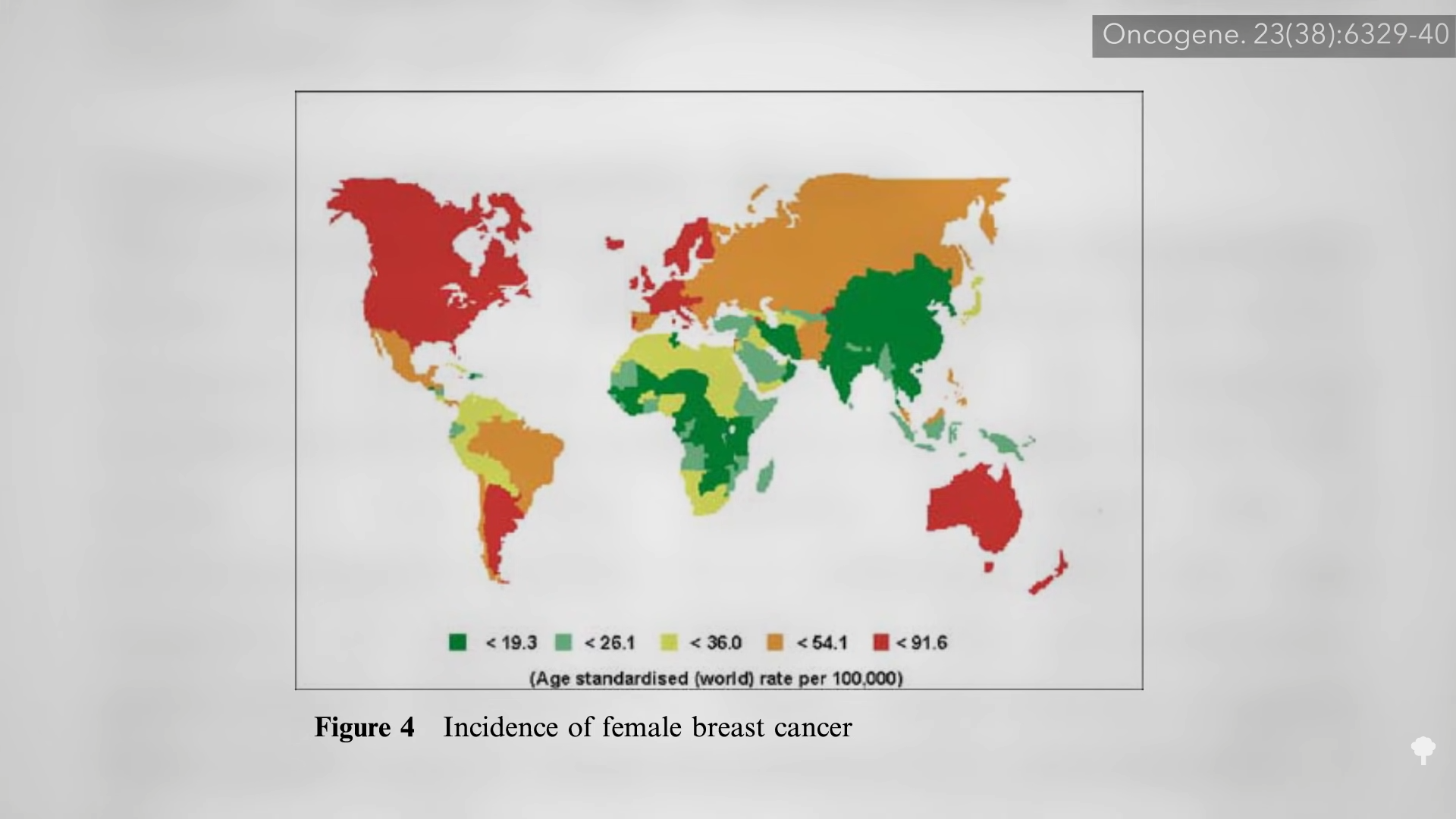
Cancer is largely a preventable disease, but it does require major lifestyle changes. Of the millions of cancer diagnoses every year, as many as 90 to 95 percent of the cancers are caused by lifestyle factors, with only 5 to 10 percent caused by bad genes. We know this because of “enormous differences in the incidence of particular forms of cancer in differing geographical and socio-economic situations” around the world, which then change when people move from one place to another. For example, as you can see below and at 2:40 in my video, breast cancer rates differ by an order of magnitude, with the lowest rates in parts of Africa and Asia, until those Africans and Asians move and start eating and living like Americans, Argentinians, Europeans, or Australians.
So, “there is need for a major reappraisal of how the problem of cancer is approached.” The key to winning the war on cancer is prevention, which not only works better, but “has the great advantage that it entails nothing worse than nicotine [or jellybean] withdrawal symptoms. On the other hand, cancer treatment, even when successful, often exposes the patient to much suffering, both physical and psychological. Indeed, some cancer treatments are considered worse than the disease.”

Most importantly, a healthy lifestyle can nip cancer in the bud, whereas, by definition, early diagnosis and treatment don’t change the cancer rate or the number of people getting cancer in the first place. In terms of cancer prevention and treatment with nutrition, the “consumption of nutrients of animal-based foods were associated with increased cancer risk while nutrients of plant-based food were associated with decreasing risk.” It’s not enough just to avoid the bad stuff, though. Eating is pretty much “a zero-sum game.” Everything we put in our mouth is a lost opportunity to put something even more healthful in our mouth. It’s not just about avoiding foods with cancer-promoting properties. We need to eat foods with active cancer-suppressing mechanisms. By “wholistic nutrition,” we’re talking about whole foods, and we should get their nutrients not from extracts or pills, but from the whole foods themselves.

Ultimately, “cancer development is primarily a nutrition-responsive disease rather than a genetic disease,” but, again, we aren’t talking about nutritional supplements; we’re talking about “whole, intact food.”

I’m very excited to share some of Professor Emeritus Colin Cambell’s six new papers on redefining the role of nutrition in medicine.

For an overview on the power of diet, see my How Not to Die from Cancer and The Best Advice on Diet and Cancer videos. I’ve produced hundreds of videos about the role of different foods and food consumption patterns on different cancers. Browse all of the titles through the search bar on my website NutritionFacts.org.

Key Takeaways
  • Despite a “major war against cancer,” chemotherapy only contributes about 2 percent to five-year survival in cancer patients.
  • Although chemotherapy treatment is fairly effective for some pediatric cancers, testicular cancer, and Hodgkin’s disease, our most common cancers (of the colon, lung, breast, and prostate) only have about a 1 percent success rate, which means, for example, out of about 14,000 colon cancer patients, only 146 live for five years, thanks to chemo.
  • Chemotherapy can shrink tumors and relieve pain and pressure, but does not tend to result in longer life.
  • Up to 90 to 95 percent of cancers are caused by lifestyle factors, and bad genes are responsible for only 5 to 10 percent.
  • The key to actually winning the war on cancer is prevention, not treatment.
  • A healthy lifestyle can prevent cancer, whereas early diagnosis and treatment—by definition—do not change the cancer rate or number of people getting cancer to begin with.
  • Animal-based foods are associated with increased cancer risk, while plant-based foods are associated with decreased risk. We should get our nutrients from whole, intact plant foods rather than extracts, pills, or supplements.”  From: https://nutritionfacts.org/2022/07/14/how-effective-is-chemotherapy-for-colon-lung-breast-and-prostate-cancers/

_______

Sunday, May 15, 2022

How to Parent a Teenager. You Can’t Give Too Much Love! Fighting the Ten Hallmarks of Cancer with Food.

.

How to Parent a Teenager

How to Parent a TeenagerThe years in which a young person transitions from childhood to adulthood can be challenging. How should we deal with our children during the teen years?

Teenagers.

Just mentioning the word can cause anxiety for some people. Perhaps it’s because of memories of their own trip through the teen years, or perhaps it reflects experiences with their own children during that stage.

For many, those years of not being a child—but not quite being an adult either—are years of uncertainty, insecurity, learning, pushing boundaries and sometimes outright rebellion.

While adolescence has probably always been a challenging transitional time, it was faced very differently in the past. As the world has changed, the teenage experience has changed.

A better understanding of what those changes are can help us and our children better navigate this developmentally important time.

Adolescents in centuries past

Throughout much of history, adolescents were workers. In fact, children as young as 7 years old were often brought into the workforce. In both towns and farms, children worked beside their parents, doing what was necessary to support the family. As the age of industrialization spread in the 18th and 19th centuries, children began working long hours in factories.

As the standard of living rose in the developed world, educational opportunities began to change. Families were able to survive without their children’s financial contributions, so adolescents often stayed in school longer. Young people could now spend leisure time with peers, and this growing sense of freedom affected the way average teens viewed themselves and the world.

And this brought profound changes to the family.

Evolution of the teenager

It may come as a surprise to some, but prior to World War II, the term teenager was rarely used. In fact, many trace the view of adolescence as a distinct developmental stage to this time period. This newly defined stage of life, combined with a greater level of family income, resulted in other societal changes.

One of those changes in the U.S. and much of the Western world was the availability of the automobile, which provided a degree of freedom and autonomy previously unheard of. Beginning in the 1950s, teenagers suddenly became trendsetters in music, fashion, film and dance.

It became the norm for teenagers to focus on experimentation rather than labor. Teens of the 1960s and 1970s were known for rebellious attitudes and a proclivity for risky behavior that included illegal drugs, abuse of alcohol and a high rate of sexual activity. Parents faced new challenges in helping their teenage children navigate the world and avoid destructive decisions.

But over the last 20 years, the behavior of the average teenager has changed. Recent studies by psychologists like Jean Twenge, professor of psychology at San Diego State University, have revealed profound changes in teenage behavior.

Parents, grandparents and guardians need to be certain they are modeling the kind of behavior they want to see from their teens! According to Dr. Twenge’s research, when compared with teenagers from past decades, 17- and 18-year-olds today are slightly less likely to have tried alcohol and drugs or to have had sex. They are also waiting longer to get a driver’s license or move out of their parents’ homes. On average, they are waiting longer to get married and to have children as well.

Commenting on these findings, the BBC article “Why Teenagers Aren’t What They Used to Be” states, “By many measures, adolescence now continues until around the age of 24 to 25” (Feb. 1, 2022).

What does the modern teen face?

According to studies, the rates of sexual activity and drug and alcohol use among teens have declined since the early 2000s. Smoking has declined by nearly 70 percent among teens. Of course, all of this is good news for teen and parents!

But does this mean modern teens are choosing to refrain from all risky behaviors? Not necessarily.

A slew of studies in recent years reveal teen behaviors have changed, but not always for the better. The reality is that today’s teens have the ability to be involved in activities that didn’t exist for previous generations. The digital age has dramatically changed the fabric of adolescence and is forcing parents to worry about new challenges.

While smoking has declined across all age groups, we can’t ignore the alternative that has appeared: the e-cigarette (commonly known as vaping). Between 2011 and 2019 the use of e-cigarettes among teens rose by 1,800 percent!

With the dramatic rise in vaping, the medical community is now reporting a similar rise in lung problems, heart disease, gum inflammation, and negative impacts on brain development directly tied to use of e-cigarettes.  

The more we learn, the clearer it is that e-cigarettes are not a healthy alternative to smoking.

The impact of smartphones on teens

According to an August 2019 Pew Research Center report, 95 percent of U.S. teenagers have access to a smartphone. These mobile electronic devices have single-handedly revolutionized teenage life. Social media platforms like Facebook, YouTube, Instagram, Twitter, Tumblr and Snapchat—which didn’t exist a generation or two ago—now dominate the life and time of today’s teens.

The cell phone is so embedded in teenage life that an earlier (2018) Pew Research survey found 45 percent of teens say they’re online on a near constant basis!  A 2018 Common Sense Media survey found that 60 percent of teens said they would rather socialize with friends online instead of face to face.

The artificial world of social media has created a heightened obsession with beauty and glamour that the average teen feels unable to attain. This has been linked to increased feelings of discouragement and depression among teens. As a result, a Science Daily study connected the unrealistic images of life shown on social media with a rise in suicides among teenage girls.

Smartphones have also contributed to automobile accidents. Studies show that a texting driver is 20 times more likely to have an accident, and yet 35 percent of teen drivers report responding to text messages when they are behind the wheel!

Access to smartphones has also increased access to pornography. It’s not an overstatement to declare pornography one of the greatest pandemics of our time. The U.S. Department of Justice recently stated: “Never before in the history of telecommunications media in the United States has so much indecent (and obscene) material been so easily accessible by so many minors in so many American homes with so few restrictions.”

Other studies reveal that 93 percent of our sons and 62 percent of our daughters have been exposed to online pornography before the age of 18, with more than half of boys and nearly a third of girls having their first exposure before they’re 13. Over a third of teenage boys reported viewing pornographic videos “too many times to count.”

This issue recently came to the forefront when musician Billie Eilish acknowledged she had viewed explicit content starting at 11 years old and had been negatively affected by it. She described her brain being “destroyed” and suffering nightmares because of it.

Considering that the digital world is only expanding, and creating new challenges as it does so, it’s worth noting that it’s never been more important for parents and teens to be grounded in the eternal standards of God.Another new challenge associated with this is the rise of sexting, or “self porn.” Different studies show different statistics about teens who have sent nude images of themselves by text, email or app, but all of the estimates are alarming. Laws against child pornography seem to have a limited impact.

These are just some of the many challenges that teens face today.

How can a parent respond?

The world of a typical teenager suddenly seems far more complicated than in previous generations. So where does that leave parents and teens who desire to live a godly life? There are several important points for us to keep in mind.

1.  God’s standards don’t change. Parents must keep in mind that no matter where societal trends might go, the solid truth of the Bible never changes! God told the prophet Malachi, “For I am the LORD, I do not change” (Malachi 3:6). And the book of Hebrews declares, “Jesus Christ is the same yesterday, today, and forever” (Hebrews 13:8).

What was sin in the past is still sin today. Our responsibility is to understand the principles our Creator gives us in Scripture and understand how to apply them to modern challenges. Though none of the challenges cited in this article are directly mentioned in the Bible, the core principles of moral purity that they break have always been there.

Considering that the digital world is only expanding, and creating new challenges as it does so, it’s worth noting that it’s never been more important for parents and teens to be grounded in the eternal standards of God.

2.  Stay connected with your children. God instructed Moses to tell the Israelites to teach their children about God’s ways “when you sit in your house, when you walk by the way, when you lie down, and when you rise up” (Deuteronomy 6:7). This instruction must be a constant part of our relationship with our children. Proverbs 22:6 instructs parents to “train up a child in the way he should go, and when he is old he will not depart from it.” 

But when our own lives are flooded with so much to do that we can hardly find time to stop and catch our breath, how can we possibly keep up with what our children are doing? School and a wide range of social activities are only a few of the items on their plate. Is it possible for parents to keep up with all of that?

The number one key is open communication. 

It’s critical to be involved and informed about their lives, their friends, and where and what they do. Although our relationship with our children evolves over time, we must never forget we are first and foremost parents who have their best interests at heart.

If we want to provide counsel and guidance, we must know what they’re facing.

3. Set appropriate boundaries. Teenagers are almost adults, but not quite. So, they will continue to require rules and the motivation to follow them. You will naturally adjust your rules depending on the age and maturity of your teen, but it is essential to establish limits and curfews for them. There are also a wide variety of parental control apps for computers, tablets and smartphones. It would be wise to do research and eventually invest in a program that will set proper boundaries for your teen.

4. Pray for discernment and wisdom. James wrote, “If any of you lacks wisdom, let him ask of God, who gives to all liberally and without reproach, and it will be given to him” (James 1:5). Parents of teens know how much they need wisdom to properly guide and teach their children!

5. Set the right example. In addition to taking the important steps listed above, parents, grandparents and guardians need to be certain they are modeling the kind of behavior they want to see from their teens! We should ask ourselves if we are being honest, if we are trustworthy, if we are living by the moral standards we want our teens to hold. “Do as I say, not as I do” doesn’t work with child-rearing, and it most certainly will not work with teenagers!

The teen years are something everyone must go through. The way society has viewed these years has changed over the centuries, and the influences teens face today are different from those past generations faced. But these years need not be so dreadful for teens and parents.

We all need to focus on the never-changing truths of God to form the foundation for our values and behaviors. There will be challenges, detours and difficult times, but parents can use the Bible as their guide to help their children navigate through their teenage years.”

From: https://lifehopeandtruth.com/relationships/parenting/how-to-parent-a-teenager/?

________

You Can’t Give Too Much Love!

You Can’t Give Too Much Love!“At one time or another most parents will hear warnings of “don’t spoil your child!” It’s helpful to know the real cause of spoiling—and it isn’t love!

Sometimes relatives or acquaintances express concern that parents are giving too much to their child. The feared result is a child who is demanding, pampered and self-centered and expects everyone to cater to his or her whims.

Spoiling happens!

We parents take such admonishments seriously. We’ve all seen spoiled kids, and we know they’re no fun to be around! As well, we realize that, for all they might rake in, spoiled children do not have happy lives.

Many followed the sad (and outrageous) case of Ethan Couch and his “affluenza” defense—that his family’s wealth was responsible for his poor choices that caused the deaths of four people when he drove drunk in 2013 at the age of 16. Couch was sentenced to 10 years of probation and mandatory treatment, which he violated in 2015.

Another case in point: Steven Miner II and his sister Kathryn Miner were raised in a $1.5 million home in a wealthy Chicago suburb. But it seems they didn’t feel they were treated well enough.

In 2009, when Steven was 21 and Kathryn was 18, they filed a lawsuit against their mother for the “emotional distress” they suffered as children from her alleged abuses, such as “failing to take her daughter to a car show, telling her then-7-year-old son to buckle his seat belt or she would contact police, ‘haggling’ over the amount to spend on party dresses and calling her daughter at midnight to ask that she return home from celebrating homecoming.”

A third example would be the sons of Eli, Israel’s high priest before the nation had its first human king. Reading the description of them in 1 Samuel 2, one can’t help but imagine that they were used to getting everything they asked for.

Eli’s timid rebuke had no effect on them at all (verses 23-25), and ultimately God gave this evaluation of Eli’s parenting: “You honor your sons more than Me” (verse 29).

Overindulged

So, yes, we parents should take care not to spoil our children. But what is spoiling caused by? Is it caused by too much time, attention or love?

Is it even possible for us parents to give our children too much time, attention or love?

Child development professionals have concluded that spoiling does come from overindulging, but it is overindulging in permissiveness, low standards and lack of restraint.  Child development professionals have concluded that spoiling does come from overindulging, but it is overindulging in permissiveness, low standards and lack of restraint. It comes from parents giving children material things and privileges as a substitute for their time, attention and love.

As Laurence Steinberg Ph.D., author of The Ten Basic Principles of Good Parenting, writes, “I can think of plenty of children who have suffered because their parents were too busy, too selfish, or too preoccupied to attend to their needs. But I’ve never met a child who was worse off because his parents loved him too much. It is simply not possible to spoil a child with love” (2004, p. 27).

Madeline Levine Ph.D., a clinical psychologist who works with teens in prosperous Marin County, California, has written a book outlining the danger affluence poses to families. Titled The Price of Privilege, the book’s subtitle says a lot: “How Parental Pressure and Material Advantage Are Creating a Generation of Disconnected and Unhappy Kids.”

Levine writes, “Study after study shows that teens want more, not less, time with their parents, yet parents regularly overestimate the amount of time they spend with their teenagers. … Nor a son grieve for gifts not received—except, perhaps, the gift of time and love.”

Let your children know every day that you love them, that they are special to you and that you appreciate them. There’s no danger of spoiling them with love.”  From: https://lifehopeandtruth.com/relationships/parenting/you-cant-give-too-much-love/?

For more foundational principles about parenting, see “Helping Our Children Grow” and “Raising Children: The Early Years.”

_______

From me:  As I was deserted at age 4, I never knew what it was like to be loved by parents and I was sent from place to place until I got out on my own at age 15.  So unfortunately, I didn’t know how to show my children that I loved them.  I figured surely they knew that because I was working so hard trying to support them.  Love is something that should not be quiet, it needs to be told out loud!!   Thank the Lord for your parents and tell them you love them.

_______

Fighting the Ten Hallmarks of Cancer with Food

“The foundation of cancer prevention is plants, not pills

Transcript of YouTube: https://youtu.be/HcAN8BjPjuE

Below is an approximation of this video’s audio content. To see any graphs, charts, graphics, images, and quotes to which Dr. Greger may be referring, watch the above video.

“The vast majority of cancer research is devoted to finding cures, rather than finding new ways to prevent disease.” And the results of these skewed priorities are plain to see: 2021 is the 50th anniversary of Nixon’s declaration of war on cancer, and the death tolls from the most common forms of cancer in the United States have continued unabated.

“We have been looking at the very nature of cancer in the wrong way.” Breast cancer doesn’t begin when a lump is first detected. All the common cancers like lung, colorectal, breast, and prostate (which account for the majority of deaths) have a long latency period—often 20 years or more. So, it’s not like you were healthy, and then one day you got cancer. You haven’t been healthy—you’ve had cancer growing in you for decades. Indeed, there’s a bizarre misperception that people are “healthy” until they have actual symptoms of invasive cancer. But “[t]he barn in which hay is smoldering before it bursts into flames is not a safe place.”

So, what does this professor of pharmacology recommend? Drugs, of course—chemoprevention: putting people on drugs to prevent cancer. Hey, the pharmaceutical industry spends huge amounts of money to promote chemoprevention of heart disease and strokes with statins and blood thinners. So, why shouldn’t people take drugs every day for the rest of their lives to protect against cancer? There has to be a better way.

What about using diet and nutrition to prevent and treat cancer? Okay, but what kind of cancer? There are more than 200 types of cancer. Ah, but they all share the same hallmarks. In a series of papers cited more than 40,000 times in the biomedical literature, ten hallmarks of cancer have been identified.

Increased sensitivity to growth factors; evading your body’s tumor suppressors; dodging your immune system; being able to grow forever; tumor promoting inflammation; the ability to invade and spread and hook up its own blood supply; the accumulation of DNA mutations; disarming the self-destruct mechanisms in place; and hijacking the cell’s metabolism. And yes, of course, there are classes of drugs to try to counter each one—chemotherapy agents designed to target each piece of the cancer puzzle.

Now ideally, there would be drugs able to target multiple hallmarks at the same time, but that’s not how drugs tend to work. And this is one of the major reasons why, in the context of cancer research, there are so many proponents of investigating plant foods, as they can deliver a cocktail of bioactive compounds—bioactive compounds that may target most, if not all, of the hallmarks of cancer. Here’s a sampling of compounds found in fruits and vegetables such as berries, greens, and broccoli, shown to be able to target each of the ten hallmarks of cancer––at least in a petri dish.

Moreover, they fit the characteristics of an ideal chemopreventive agent. If you were to design the perfect candidate, you’d want them to be selective for cancerous or precancerous cells while leaving normal cells alone, be side effect-free, target most types of cancers, be able to be consumed as a part of a daily diet, be conveniently available almost everywhere, and be relatively inexpensive to boot. And plants have all of these. No wonder those eating more plant-based tend to have lower cancer rates.

However, it should be understood that we’re not talking about taking supplements containing extracts or purified phytochemicals, but rather eating whole plant foods themselves; more of a food-system based approach to targeting the hallmarks of cancer.

Foods contain many thousands of substances that lead to vast numbers of possible interactions, yet much of nutritional science has long been directed towards the impact of single dietary components. Yes, this kind of ‘reductionist’ approach can reveal the role of individual nutrients or foods in the development of disease, but let’s think about what the optimal research strategy would be to study the effects of bioactive natural plant compounds on disease prevention. Instead of using isolated phytochemicals in the management of cancer, how about using whole foods, because sometimes the whole can be greater than the sum of its parts, a concept known as food synergy.

Check out this study. The simultaneous inhibition of a series of cancer stages in breast cancer cells using a phytochemical super-cocktail. Two breast cancer cell lines were treated with six different plant compounds individually, and then altogether, at the level you might find in your bloodstream after eating foods like broccoli, grapes, soybeans, and turmeric. And while the compounds were ineffective individually, in combination they significantly suppressed breast cancer cell proliferation by more than 80 percent, inhibited cancer cell migration and invasion, stopped the cancer cells in their tracks, and eventually killed them all off. The plant compounds did all this without having any deleterious effects on the normal noncancerous cells used as control.

No wonder the foundation of cancer prevention, based on an update of the most extensive report on diet and cancer ever published is not pills, but plants. Cut down on alcohol, soda, meat, and processed junk, and center your diet around whole grains, vegetables, fruits, and beans.”   From: https://nutritionfacts.org/video/fighting-the-ten-hallmarks-of-cancer-with-food/?

______

Monday, February 14, 2022

4 Romantic Alternatives to Valentine’s Day. Lower Cholesterol Without Medication.

.

4 Romantic Alternatives to Valentine’s Day

“As Valentine’s Day is here, many will celebrate romantic love. But what about true love? Here are four ways to escape the superficiality of Valentine’s Day.

3 Romantic Alternatives to Valentine’s Day Valentine’s Day!  Millions of people have already made plans for romantic getaways, ordered flowers or chocolates, and started writing valentines. For the holiday that is supposed to epitomize romantic love, it is very materially based and commercialized. Nothing says I love you like stuff, apparently.

Can a couple express true love in better ways than heart-shaped chocolates and bland, poorly worded cards?   We all better hope so.

Origin of Valentine’s Day

Before we discuss the meaningful alternatives to Valentine’s Day, consider why we should seek alternatives in the first place. What is the origin of Valentine’s Day?

Valentine’s Day is based on a very bizarre, ancient fertility festival called the Lupercalia. This festival was celebrated in mid-February in ancient Rome. The ancient Romans would sacrifice an animal on the Lupercalia and then use the hides to whip females in order to supposedly increase their fertility.

Valentine’s Day is based on a very bizarre, ancient fertility festival called the Lupercalia. Take a moment to soak in the irony of our modern society—with its concerns for women’s rights and empowerment—still celebrating a holiday rooted in a tradition of humiliating women by physically striking them with animal hides.

Another component of the festival was matchmaking. Males and females would be paired up at Lupercalia by a lottery and then would remain partners for either the duration of the festival or for a year.

Again, consider the irony of people using Valentine’s Day to express true love, when the origin of the day was based on random strangers hooking up. The original holiday was all about sex without love. So how did this perverse festival become associated with romantic love?

The Roman church later replaced the Lupercalia with St. Valentine’s Day in honor of a martyr named Valentine. But the popular celebration maintained the romantic and sensual elements of the pagan festival. (This is also the case with another popular holiday you might be familiar with: Easter. Ever wonder what rabbits and eggs have to do with Jesus Christ’s resurrection? You guessed it, nothing. Rabbits and eggs are all about pagan fertility worship.)

The fact that Cupid, a Roman god of love, is associated with this day is even more proof of its deep roots in ancient Roman paganism.

To learn more about why we should be careful about integrating paganism into our lives, read “How Much Pagan Is Too Pagan?

Alternatives to Valentine’s Day

But true romantic love is the foundation of a happy marriage and was created by God (Genesis 2:24). It is a beautiful thing that shouldn’t be corrupted with a holiday so rooted in sexual promiscuity and paganism. There are much better ways to build and celebrate true romantic love than a celebration like Valentine’s Day!

Here are a few ideas for how to celebrate your love for your spouse—without doing it on Valentine’s Day!

1. Supercharge your anniversary.

The day that should be a huge celebration of love with our mate is our wedding anniversary.

With all the hectic busyness of life, and all the splitting of our focus (including a pagan holiday with naked babies shooting arrows), it might be tempting to let anniversaries go by without much fanfare. This is a mistake. We should make sure we do something special with our spouse on this day that actually does have deep romantic meaning.

Doesn’t it make more sense to celebrate romantic love on a day that has actual significance to you both instead of a day in February that had a very corrupt and strange meaning to the ancient Romans?

Ideas: Plan a dinner at a special restaurant, a getaway weekend or an exciting vacation. Relive your first date—or do something entirely new together. Be sure to tell your spouse how much you love and appreciate him or her.

2. Get romantic at unexpected times throughout the year.

Though anniversaries are great times to celebrate your love for each other, romance does not have to be tied to a calendar date. Giving gifts, writing meaningful notes and going on romantic getaways are all great for a relationship—and they can be done at any time of the year! In fact, these things are even more meaningful when they are spontaneous and done out of sincere appreciation and love.

Gifts and romantic gestures done at unexpected times and for no other calendar reason will always be greatly remembered and treasured. It is somewhat shocking that so many people wait until a holiday inspired by fertility rites and a Roman god to actually show how much they love their mates. We are told not to worship God through pagan practices (Deuteronomy 12:31), and we also should be careful to not degrade love by mixing it with perverse paganism.

Gifts and romantic gestures done at unexpected times and for no other calendar reason will always be greatly remembered and treasured by those receiving them.

Ideas: Be consistent with little gifts, candies or gestures throughout the entire year. Plan something with lots of “us” time involved that is not tied to any specific date. Do it just because it’s good for the relationship!

3. Talk to each other every day.

Yes, it may sound simplistic—but it is actually a huge thing! It’s important to speak to one another.

Where does real romance that is related to true love come from? A solid, healthy relationship. The old adage of “we could talk for hours” should still be one of the most romantic things to us. The wonderful thing about the giving of gifts and the dinners, trips and adventures together is the closeness that should result from them. This closeness is mainly shared through conversation.

No, not from a three-line French poem that someone memorized to impress a date. No, not the seemingly wonderful wisdom of “be my valentine” (meaningless, if you think about it!) scratched on cheap candy. Closeness comes from real words and the development of a connection between two people who truly love each other.

Ideas: Have a set time every single night where the television, computer, phones and everything else are turned off—so you can talk with the person you love. Walk and talk. Eat and talk (not at the same time!). Sit and talk. Exercise and talk. Whatever you are doing, make sure talking is involved.

4. Put 1 Corinthians 13 into practice every day.

It’s nicknamed the Love Chapter for good reason. This chapter comprehensively lists what love is and what it isn’t. We can use this chapter as a daily, monthly or yearly project to improve our relationships. God wrote the book on love, so His Bible should be the primary place we go for guidance in expressing proper love within marriage.

The Love Chapter is filled with guidance on how to treat the love of your life. Here are some ways 1 Corinthians 13 can be put into practice to improve our relationships:

  • Love suffers long: When our mates do something that really bothers us, we should let it go or work on improving the problem together.
  • Love is kind: We should do something kind for our mates without being asked—often.
  • Love does not parade itself: We should be sure to tell our mates how much we love them privately—we don’t need to use Facebook to demonstrate our love for our mate!
  • Love is not puffed up: We should always be ready to admit when we’ve done something wrong.
  • Love does not behave rudely: We should make sure our marriage is characterized by considerate behavior toward each other.
  • Love does not seek its own: We should willingly and joyfully do something we have no interest in, but our mate enjoys.

The Love Chapter, though about a much deeper love than just romantic love, is filled with guidance on how to treat the love of your life. Read it often. For more insight on 1 Corinthians 13, read our article about “The Love Chapter.”

One 24-hour period involving candies and ancient fertility symbolism does not come close to the fulfilling and meaningful love God wants us to enjoy.

Isn’t it time for you to ditch Valentine’s Day and demonstrate true love God’s way?

Topics Covered: Relationships, Holidays, Marriage  From: https://lifehopeandtruth.com/relationships/blog/3-romantic-alternatives-to-valentines-day/?

________

Lower Cholesterol Without Medication

“Cholesterol numbers are one of the most powerful indicators of your risk for developing and dying from heart disease. Statins are commonly prescribed for lowering cholesterol, but they don’t offer significant improvements to the health of arteries or reductions in heart disease. Artery-clogging cholesterol is only found in substantial amounts in animal foods such as meat, poultry, fish, eggs and dairy. When you eliminate these foods from your diet and replace them with starches and whole foods, your cholesterol levels will go down and your arteries will begin to heal.

Doctors and drug companies aim to reduce blood fat levels through medications like Lipitor, but the benefits in lives saved by these drugs fall short of expectations. Well-informed patients will resolve elevated cholesterol and triglyceride values by dealing with the cause: a diet high in animal products and low in plant foods.

Beginning with an average cholesterol level of 220 mg/dl (5.79 IU), you can expect a 30 mg (1.1 IU) reduction in your cholesterol level in 2 weeks. If your cholesterol level is higher than that, then you can probably expect an even bigger improvement. Triglyceride reductions can also be dramatic but simple sugars, including fruit and juice, must be limited or eliminated for the best results.”     More at: https://www.drmcdougall.com/articles/common-health-problems/cholesterol-triglycerides/?

________

Sunday, March 7, 2021

Postmortems, Don't Dwell On The Past—Learn From It. There's Petroleum in That? Tech Manners Matter. The Bummer Lamb.

.

A young man watching the sun set.Postmortems

Jordan Niranjan/Unsplash

“Don't dwell on the past—learn from it.

Start thinking about what to do now and less about what you did then. Lift up your eyes to a bright future. God loved you enough to send His only begotten Son.

I have a friend who can recall every hunting trip we have been on and the details of each animal taken. He rehearses the stories often and we relive the events when we meet. That is not a bad thing, but when we rehearse sad stories or negative and depressing ones, we too can become experts in the details, and relive the events.

Doing postmortems on gripes and past losses can have a strong negative effect on plans for the future. It is important that we learn the correct way and time to bury the past so that we can live in the present and future. Amazing things happen when you put constructive thoughts to work. Learning from past mistakes is good, but after one postmortem, there needs to be a burial. Postmortems are not conducted over and over again on the same subject.

None of us have a history we wish would never have happened as the one the apostle Paul had. The memories of his terrible persecution against the Church never left his mind, but he learned to lock them in a compartment and leave them behind. Otherwise, he would never have been useful to God (Philippians 3:13). We are not able to erase memories completely, but we can learn that it’s possible to place our sins and faults in God’s hands, and we need not dwell on them every day. Repentance and baptism is only needed once in life to forgive sins.

Start thinking about what to do now and less about what you did then. Lift up your eyes to a bright future. God loved you enough to send His only begotten Son.”    From: https://www.ucg.org/beyond-today/blogs/this-is-the-way/postmortems

_______

There's Petroleum in That?

“Relevant News Item

The rising price of gasoline is frequently in the news these days, but it's easy to forget the other items made from petroleum. One expert suggested that 70 percent of products in a supermarket have some form of petroleum by-product in the item itself or in the packaging.

For instance, petroleum can often be found in antiseptics, baby strollers, balloons, bandages, cameras, clothing, computers, dentures, deodorant, food preservatives, glue, ink, medical equipment, shampoo, toothpaste and vitamin capsules, among other things.

In fact, in the United States, from each 42-gallon barrel of oil 34 gallons go to fuels of various kinds, while the rest goes to produce ingredients for products like those in the above list (Paul Wilson, "Gusher of Goods Made With Crude," The Columbus Dispatch, Jan. 5, 2008).

The price of oil contributes to the cost of more things than just fuel—something to ponder the next time you pick up a tube of toothpaste!” From: https://www.ucg.org/vertical-thought/in-the-news-theres-petroleum-in-that 

_______

Tech Manners Matter

“Relevant News Items

In the invariably invasive era of cell phones and other digital paraphernalia, how does one master good manners?

Marian McEvoy, hostess and etiquette writer, suggests a few guidelines for keeping the peace between cell phones and friends ("Tech Etiquette," Domino, November 2007):

• When visiting friends, don't greet your host while on the phone, never answer a call at the dining table and leave your cell phone in another room during the meal to avert the temptation to answer.

• Avoid chronic texting because the reason for accepting an invitation is to spend time with one's friends—hard to do if host or guest is constantly tapping texts. McEvoy suggests asking texting guests to do their typing in another part of the house since they are not inclined to mingle.

• Finally, in the case of thank-you notes, love letters, apologies, invitations, congratulations and condolences, opt for a written missive that includes a salutation and a signature. To those born before the digitized age, text messaging shorthand and emoticons are confusing. So make use of the beauty and delights of longhand language and practice your penmanship!”  From: https://www.ucg.org/vertical-thought/in-the-news-tech-manners-matter

_______

The Bummer Lamb

“Every once in a while, an ewe will give birth to a lamb and reject it. There are many reasons she may do this. If the lamb is returned to the ewe, the mother may even kick the poor animal away. Once a ewe rejects one of her lambs, she will never change her mind.

These little lambs will hang their heads so low that it looks like something is wrong with its neck. Their spirit is broken.

These lambs are called “bummer lambs.” Unless the shepherd intervenes, that lamb will die, rejected and alone. So, do you know what the shepherd does?

He takes that rejected little one into his home, hand-feeds it and keep it warm by the fire. He will wrap it up with blankets and hold it to his chest so the bummer can hear his heartbeat. Once the lamb is strong enough, the shepherd will place it back in the field with the rest of the flock.

But that sheep never forgets how the shepherd cared for him when his mother rejected him. When the shepherd calls for the flock, guess who runs to him first?

That is right, the bummer sheep. He knows his voice intimately.

It is not that the bummer lamb is loved more, it just knows intimately the one who loves it.

It's not that it is loved more, it just believes it because it has experienced that love one on one.

So many of us are bummer lambs, rejected and broken. But He is the good Shepherd. He cares for our every need and holds us close to His heart so we can hear His heartbeat.

We may be broken but we are deeply loved by the Shepherd.

The Lord is MY shepherd... I’m a bummer lamb.”

_______

Monday, January 11, 2021

Is the Old Testament Relevant? Pharaoh's Bad Marriage. Update.

.

Is the Old Testament Relevant?

“Jesus said, “Man shall not live by bread alone, but by every word that proceeds from the mouth of God.” Is the Old Testament relevant as well as the New?

Is the Old Testament relevant?

Is the Old Testament still relevant today?

Can it be proven that Jesus meant both the Old and New Testament Scriptures in Matthew 4:4? Many today believe we don’t have to follow God’s instructions as stated in the Old Testament. Some even believe that portion of the Bible was “done away” or that it was written and preserved only for Israel or the Jewish people of long ago. Therefore, they feel it has no significance for us today. Is the Old Testament relevant to our lives?

What do the Scriptures tell us?

Part of our foundation

Paul explains how the New Testament Church was “built on the foundation of the apostles [the New Testament] and prophets [the Old Testament], Jesus Christ Himself being the chief cornerstone” (Ephesians 2:20). Christ was sent from God the Father as the messenger of the New Covenant — yet He preached that message entirely out of the Old Testament Scriptures.

Furthermore, what Scriptures did Christ use when He preached in the synagogue? In Luke 4:16-21 Christ read a prophecy from the book of Isaiah, and He explained to those present that part of that prophecy was being fulfilled as He was speaking to them.

For several years after the crucifixion and resurrection of Jesus Christ and the founding of the New Testament Church, the ministry only had and used the Old Testament Scriptures. Jesus Christ preached the gospel of the Kingdom of God, and He did it altogether out of the Old Testament.

Proof that Christ was the true Messiah

How was one to know that Christ was who He said He was—what proof did He give? A careful reading of John 5:36-39 shows Christ revealing several very important proofs that He was indeed the true Messiah.

  • He said John was a witness, although there was greater proof.
  • He then pointed out that the Father represented even greater proof.
  • He also stated how the works He was doing were a witness or proof.
  • He concluded by telling them the “Scriptures” themselves testified—gave evidence to the fact—that He was the Messiah.

Remember, the Old Testament Scriptures—the ones Christ was referring to—were the only Scriptures available at that time. The Old Testament is so important that one would not be able to prove Jesus of Nazareth to be the Christ, the Messiah, the Son of God, our Savior, without using the Old Testament.

Notice the “sign” Christ gave to those who asked of Him proof that He was the Messiah. “Then some of the scribes and Pharisees answered, saying, ‘Teacher, we want to see a sign from You.’ But He answered and said to them, ‘An evil and adulterous generation seeks after a sign, and no sign will be given to it except the sign of the prophet Jonah. For as Jonah was three days and three nights in the belly of the great fish, so will the Son of Man be three days and three nights in the heart of the earth [grave or tomb]’” (Matthew 12:38-40).

Christ directed those asking for proof that He was indeed the true Messiah to examine the Old Testament writings of the prophet Jonah concerning the length of time He would be dead.

Christ’s admonition to believe the Old Testament Scriptures

Jesus also said to those calling Him into question concerning His messiahship, “Do not think that I shall accuse you to the Father; there is one who accuses you—Moses, in whom you trust. For if you believed Moses, you would believe Me; for he wrote about Me. But if you do not believe his writings, how will you believe My words?” (John 5:45-47).

Moses wrote the first five books of the Old Testament—often referred to as the “Law” or the “Torah.” Christ is pointing out to these doubters that if they did not believe what Moses wrote, they would not believe what He was telling them. Said another way, Christ was telling them that what Moses wrote is just as much a part of Scripture as what He was saying.

Moreover, it is not only necessary to believe what Moses wrote in the first five books of the Bible, but we must also believe what all the prophets wrote, in addition to the Psalms and other writings—the entire Old Testament.

Luke records what Christ had to say about the authenticity of the Old Testament, “Then He said to them, ‘O foolish ones, and slow of heart to believe in all that the prophets have spoken! Ought not the Christ to have suffered these things and to enter into His glory?’ And beginning at Moses and all the Prophets, He expounded to them in all the Scriptures the things concerning Himself” (Luke 24:25-27).

Luke adds more, “Then He [Christ] said to them, ‘These are the words which I spoke to you while I was still with you, that all things must be fulfilled which were written in the Law of Moses and the Prophets and the Psalms concerning Me” (verse 44). Christ authoritatively states His approval of the entirety of Scripture, showing the Old Testament is relevant.

Paul’s support of the Old Testament

Paul reminded his young associate Timothy, “And that from childhood you have known the Holy Scriptures, which are able to make you wise for salvation through faith which is in Christ Jesus” (2 Timothy 3:15).

What were the Scriptures Timothy would have known from childhood? The Old Testament Scriptures were the only ones Timothy had.

Paul continues, “All Scripture is given by inspiration of God, and is profitable for doctrine, for reproof, for correction, for instruction in righteousness” (verse 16). Notice Paul said, “All Scripture,” not just the New Testament.

Peter, Philip and Paul preached Christ from the Old Testament

Peter preached a powerful sermon on the Day of Pentecost—the beginning of the New Testament Church—that resulted in the conversion of 3,000 people. Moreover, Peter preached his sermon using only Old Testament Scriptures (Acts 2:14-41).

What about Philip’s example of preaching? Philip knew that Jesus was the Christ because of what he had read in the Old Testament Scriptures. Philip helped an Ethiopian understand what the Scriptures said about Christ out of the Old Testament (Acts 8:26-35).

But some will say, “You can’t do that; you can’t preach Christ out of the Old Testament!” You can’t? Peter did it, Philip did it, Paul did it and, as we have seen, Jesus Christ did it!

Speaking of Paul’s preaching, notice his use of the Old Testament, “So when they had appointed him a day, many came to him at his lodging, to whom he explained and solemnly testified of the kingdom of God, persuading them concerning Jesus from both the Law of Moses and the Prophets, from morning till evening” (Acts 28:23).

Matthew and Isaiah add more

Matthew makes an interesting statement as he records King Herod’s demanding request of the chief priests and scribes concerning where Christ was to be born. Why would Herod make such a demand? Was it because he suspected this information was recorded in a prophecy of their Scriptures—the Old Testament? If so, he was right.

Notice their response to Herod’s question, “So they said to him, ‘In Bethlehem of Judea, for thus it is written by the prophet.” The chief priests and scribes continued by quoting the prophet Micah, “But you, Bethlehem Ephrathah, though you are little among the thousands of Judah, yet out of you shall come forth to Me the One to be Ruler in Israel, whose goings forth are from of old, from everlasting” (Matthew 2:5; Micah 5:2).

The prophet Isaiah tells us that the Messiah would be born of a virgin and His name would be called “Immanuel” (Isaiah 7:14). This prophecy was fulfilled according to Matthew 1:22-23.

So the Old Testament Scriptures add yet another detail about the birth of Christ.

Moreover, Isaiah recorded several more prophecies about Christ, all of which were fulfilled. Some of the prophecies in the book of Isaiah point to the time when the Messiah was to be born and grow up from a child. The prophet also explains how Jesus was to be despised and rejected, not hailed as a mighty King and Deliverer. Again, we find the Old Testament is relevant in filling in more details about the life of Jesus Christ (Isaiah 53:1-9).

Additional points of interest
  • The New Testament quotes the Old Testament more than 1,000 times!
  • The four Gospels (Matthew, Mark, Luke and John) refer to the Old Testament Scriptures on an average of three to four times per chapter.
  • Of the 39 books in the Old Testament, Christ, in the book of Revelation makes references to 31 of them.
  • In the 22 chapters of the book of Revelation, there are 228 references made to the Old Testament—that’s an average of 10 times per chapter.
  • Actually, there are only four New Testament books that do not have a direct quote from the Old Testament: Philemon and 1, 2 and 3 John (An American Translation—The New Testament in the Language of Today by William F. Beck, 1964).

The New Testament is based on the Old Testament. How would one be able to understand the book of Revelation, for example, without Old Testament writers like Daniel and several of the other prophets?

Christ meant what He said

Therefore, when Christ countered Satan in Matthew 4:4 by saying man must live by “every word that proceeds from the mouth of God,” Jesus meant exactly what He said.  So is the Old Testament relevant? Yes, Christ meant “every word”—in both the Old and New Testaments—the entirety of the Bible, not just part of it.

For further study on the Old Testament, read the article “Old Testament.”  From: https://lifehopeandtruth.com/bible/holy-bible/old-testament/is-the-old-testament-relevant/

________

Pharaoh's Bad Marriage

“Exodus 1:10 Come on, let us deal wisely with them; lest they multiply, and it come to pass, that, when there falleth out any war, they join also unto our enemies, and fight against us, and so get them up out of the land.
And we all know how that worked out.
There are four ways to preserve a relationship that has begun to deteriorate:
  1. Disable the other person. Through emotional abuse, you can make a person doubt themselves and their ability to survive on their own. Through physical abuse, you can confine or even cripple a person so that they are physically incapable of leaving. Perhaps the most common method today of disabling a person to keep them in a relationship is by keeping them financially dependent. Your credit card issuer and your neighbor with two upside down mortgages can tell you how effective this tactic can be.
  2. Instill fear of the unknown. Convince the other person that there is a big bad wolf hiding behind every tree outside the door, that every person they encounter will take advantage of them, and they will be very reluctant to strike out alone. This method has worked very well for politicians throughout history.
  3. Bond. Be friends. Spend time together in situations that develop emotional attachment. Study, explore, play, fight, and work together. Have an adventure.
  4. Improve yourself. Make a relationship with you look more attractive than a relationship with someone else by becoming a better you. You have probably heard it said that you can’t change someone else. You can only change you. I haven’t read it yet, but Athol Kay’s Married Man Sex Life Primer appears to be based on this idea. It’s on my reading list.

Each of these methods works to a greater or lesser extent and there is a time and place in which each would be appropriate. A healthy relationship, however, will be almost exclusively characterized by methods three and four. Pharaoh tried to keep the Hebrews in Egypt by physically and financially hobbling them.

Although they wanted more than ever to leave Egypt, they had no ships, no weapons, no chariots, and no gold with which to obtain such things. They had no allies. They came to believe that they were too weak to face the Canaanites and that their God was too weak or too busy to rescue them. Pharaoh’s strategy might have worked if he had not dismissed Joseph’s God along with Joseph himself. God is the champion of the oppressed and does not allow his people to be abused, enslaved, and terrorized forever.” From: https://soilfromstone.blogspot.com/2012/01/pharaohs-bad-marriage.html?

_______

Update

We three had our Bible study for the Sabbath School on Thursday because I had surgery on my left eye on Friday.  The bus that had taken me there was not one of the usual busses, it was rattley, squeaky and he drove way over the speed limit with the radio blaring. The driver insisted that I should call him when I needed to be picked up and even gave me his own phone number.  He must have been someone that the bus company contracted because the bus didn’t have the bus company logos on it.

Wendy, my daughter, met me at the ophthalmologist so we went to lunch at Cracker Barrel, and she shopped a bit for craft stuff.  My eyes were dilated so I couldn’t navigate too well but I made it.  When she called for the bus to pick me up and told them that I didn’t want to go home on the same bus, they put us on hold for so long, twice, that Wendy drove me home.

Then about 5.00pm the internet, phone and cable went out, and my cell phone wasn’t working either.  A high, wide load had been illegally driven down the main drag of the little city of Navasota and pulled the overhead wires loose.  But, thank goodness, we did have electricity.  My cat was sitting staring at a blank TV!  So I went to bed to let my eyes rest and sort themselves out.  A couple of hours later I was able to see well enough to read a book until I fell asleep. Everything was fixed about 3.00am. 

I don’t know whether the surgery has fixed my ‘light blindness’ yet because it was cold and overcast when Sherry and I went to the church the next day.

Sunday, September 20, 2020

Why Should Christians Celebrate the Feast of Trumpets? The Feast of Trumpets: Alarm of War, Announcement of Peace. Update. RIP

Why Should Christians Celebrate the Feast of Trumpets?

Friday evening, Sept. 18th. 2020 started the Feast of Trumpets, so it was a double Sabbath on Saturday, because it was the first day of Rosh Hashanah.

“Prophecies of the end time include trumpet plagues and the return of Jesus Christ at the last trump. What does the Feast of Trumpets mean for Christians today?

Sunrise over the crest of a hillPhilipp Reiner/Unsplash

Christ's return is announced by the seventh and final trumpet

The fourth festival of God (after Pentecost) is the Feast of Trumpets (or a "memorial of blowing of trumpets," Leviticus 23:24-25), which falls in September or October. This festival is called Rosh Hashanah by the Jews today. Ancient Israel understood that trumpets were used as a way of announcing special, very important messages (Numbers 10:1-10).

In the New Testament, Jesus Christ reveals that before His return to the earth, there will be the blowing of seven trumpets, announcing progressive stages of the downfall and overthrow of this world's kingdoms, ending with the return of Christ to take possession of the earth. Christ's return is announced by the seventh and final trumpet (Revelation 8:2; Revelation 11:15). This day also pictures the time when faithful Christians will be resurrected to eternal life at the time of the seventh trumpet (1 Corinthians 15:52; 1 Thessalonians 4:16) to reign with Jesus Christ for 1,000 years (Revelation 20:4-6).

Interestingly, it was around this time of year that Jesus was born—not in the dead of winter (see "Biblical Evidence Shows Jesus Wasn't Born on December 25"). And the fall feast season represents the time when Jesus Christ will come to the earth again to reign in glory.

The remaining fall feast days describe steps in the establishment of the prophesied Kingdom of God on earth and judgment of humanity after Christ's return. The Feast of Trumpets is followed by the Day of Atonement.   For more information, please read our booklet God's Holy Day Plan: The Promise of Hope for All Mankind.”

From: https://www.ucg.org/bible-study-tools/bible-questions-and-answers/why-should-christians-celebrate-the-feast-of-trumpets

________

The Feast of Trumpets: Alarm of War, Announcement of Peace

“Trumpets are used as signals of important events, and the Bible describes earthshaking end-time events that are pictured by the Feast of Trumpets.

Feast of Trumpets

The first three festivals, Passover, the Feast of Unleavened Bread and Pentecost, reenact events that have already taken place and are ongoing in the lives of Christians. The last four festivals listed in Leviticus 23 preview dramatic future events in God’s plan of salvation. All four festivals occur during the fall harvest season in the Holy Land.

The fall festivals begin with the Feast of Trumpets. Trumpets are used as signals of important events, and the Bible describes earthshaking end-time events that are pictured by this festival.

Trumpet plagues

The book of Revelation lists seven terrible plagues announced by seven trumpets (Revelation 8-11). These plagues will come in the times just ahead of us because of humanity’s sins. Consider the sixth trumpet and its announcement of a 200-million-man army preparing for a battle that will kill a third of humanity (Revelation 9:16-18). In spite of these punishments, human leaders and their subjects will continue to pursue selfish and ungodly goals and sins (Revelation 9:20-21).

Thankfully, the seventh trumpet also heralds good news: “Then the seventh angel sounded: And there were loud voices in heaven, saying, ‘The kingdoms of this world have become the kingdoms of our Lord and of His Christ, and He shall reign forever and ever!’” (Revelation 11:15).

Finally Jesus Christ will intervene in world affairs to stop humanity from self-destruction (Matthew 24:21-22). He will then begin to establish His long-promised utopian Kingdom of God.

The first resurrection to eternal life

At Jesus Christ’s return another incredible event will occur. The apostle Paul announced it this way:  “Behold, I tell you a mystery: We shall not all sleep, but we shall all be changed—in a moment, in the twinkling of an eye, at the last trumpet. For the trumpet will sound, and the dead will be raised incorruptible, and we shall be changed” (1 Corinthians 15:51-52). Paul also made clear that this would occur when Jesus Christ was returning (1 Thessalonians 4:16).

The Feast of Trumpets focuses on these pivotal events that signal the end of human rule and the establishment of God’s wonderful Kingdom on earth.

Zechariah 14 and Revelation 19 recount the final battle when the evil end-time “beast” and other world leaders try to fight the returning Christ. They will prove no match to our all-powerful Messiah, and the stage will be set for the fifth step in God’s plan, pictured by the Day of Atonement.”           CONTINUE READING   From: https://lifehopeandtruth.com/life/plan-of-salvation/feast-of-trumpets/?

________

Update.

Oh!  Whatever next!  My sweet little cat decided she wanted to taste what I was drinking and knocked my water glass over my cell phone.  I didn’t realize what she had done   because the placemat on my bedside table had soaked it up, so I turned on my phone, wondering why it had turned itself off.  Then when it didn’t act right, I started to investigate.  It has to be charged constantly for me to even use it, and so I ordered a battery for it, which hasn’t arrived yet, and another phone. 

The phone arrived but it is a Smart phone, and it is so smart that I don’t even know how to turn it on.  The instructions are in a tiny little book that I can’t even read with a magnifying glass, so I will have to look for them online and print them out.  But I am going to wait until the battery arrives for my old phone so that I can copy my contacts list into my computer in case any important ones get lost.

On Wednesday the foot doctor gouged the corns out of the bottom of my feet.  The last time a podiatrist that did it to me, he was so quick and dexterous that I didn’t even feel it, but this time she dug and dug and made my foot bleed. But it does feel a lot better, I don’t feel like I have sharp rocks in my shoes anymore. Now at least my several trips to get the laundry done in the club house, or shopping, doesn’t hurt.

As usual on Friday morning, June, Cherry and I went through the study book in preparation for the Sabbath School the next day, and June went with us to church. Everyone participates in that, even those who are joining us on Zoom through the laptop and TV at the church.   We always have a good time at Sabbath School, and we enjoy being there.  We just stayed for the Sabbath School because Cherry can’t sit for very long, and the sermon was going to be on FaceBook anyway.

The Sabbath started out being a happy day until my daughter phoned, thankfully I have a landline too, and said that her sweet 87 year old father-in-law had died. Though it was a relief really, because his quality of life had really declined.  Now she will be alone, still partially handicapped from her accident, during the day.