Showing posts with label computer. Show all posts

Monday, February 14, 2022

4 Romantic Alternatives to Valentine’s Day. Lower Cholesterol Without Medication.

.

4 Romantic Alternatives to Valentine’s Day

“As Valentine’s Day is here, many will celebrate romantic love. But what about true love? Here are four ways to escape the superficiality of Valentine’s Day.

3 Romantic Alternatives to Valentine’s Day Valentine’s Day!  Millions of people have already made plans for romantic getaways, ordered flowers or chocolates, and started writing valentines. For the holiday that is supposed to epitomize romantic love, it is very materially based and commercialized. Nothing says I love you like stuff, apparently.

Can a couple express true love in better ways than heart-shaped chocolates and bland, poorly worded cards?   We all better hope so.

Origin of Valentine’s Day

Before we discuss the meaningful alternatives to Valentine’s Day, consider why we should seek alternatives in the first place. What is the origin of Valentine’s Day?

Valentine’s Day is based on a very bizarre, ancient fertility festival called the Lupercalia. This festival was celebrated in mid-February in ancient Rome. The ancient Romans would sacrifice an animal on the Lupercalia and then use the hides to whip females in order to supposedly increase their fertility.

Valentine’s Day is based on a very bizarre, ancient fertility festival called the Lupercalia. Take a moment to soak in the irony of our modern society—with its concerns for women’s rights and empowerment—still celebrating a holiday rooted in a tradition of humiliating women by physically striking them with animal hides.

Another component of the festival was matchmaking. Males and females would be paired up at Lupercalia by a lottery and then would remain partners for either the duration of the festival or for a year.

Again, consider the irony of people using Valentine’s Day to express true love, when the origin of the day was based on random strangers hooking up. The original holiday was all about sex without love. So how did this perverse festival become associated with romantic love?

The Roman church later replaced the Lupercalia with St. Valentine’s Day in honor of a martyr named Valentine. But the popular celebration maintained the romantic and sensual elements of the pagan festival. (This is also the case with another popular holiday you might be familiar with: Easter. Ever wonder what rabbits and eggs have to do with Jesus Christ’s resurrection? You guessed it, nothing. Rabbits and eggs are all about pagan fertility worship.)

The fact that Cupid, a Roman god of love, is associated with this day is even more proof of its deep roots in ancient Roman paganism.

To learn more about why we should be careful about integrating paganism into our lives, read “How Much Pagan Is Too Pagan?

Alternatives to Valentine’s Day

But true romantic love is the foundation of a happy marriage and was created by God (Genesis 2:24). It is a beautiful thing that shouldn’t be corrupted with a holiday so rooted in sexual promiscuity and paganism. There are much better ways to build and celebrate true romantic love than a celebration like Valentine’s Day!

Here are a few ideas for how to celebrate your love for your spouse—without doing it on Valentine’s Day!

1. Supercharge your anniversary.

The day that should be a huge celebration of love with our mate is our wedding anniversary.

With all the hectic busyness of life, and all the splitting of our focus (including a pagan holiday with naked babies shooting arrows), it might be tempting to let anniversaries go by without much fanfare. This is a mistake. We should make sure we do something special with our spouse on this day that actually does have deep romantic meaning.

Doesn’t it make more sense to celebrate romantic love on a day that has actual significance to you both instead of a day in February that had a very corrupt and strange meaning to the ancient Romans?

Ideas: Plan a dinner at a special restaurant, a getaway weekend or an exciting vacation. Relive your first date—or do something entirely new together. Be sure to tell your spouse how much you love and appreciate him or her.

2. Get romantic at unexpected times throughout the year.

Though anniversaries are great times to celebrate your love for each other, romance does not have to be tied to a calendar date. Giving gifts, writing meaningful notes and going on romantic getaways are all great for a relationship—and they can be done at any time of the year! In fact, these things are even more meaningful when they are spontaneous and done out of sincere appreciation and love.

Gifts and romantic gestures done at unexpected times and for no other calendar reason will always be greatly remembered and treasured. It is somewhat shocking that so many people wait until a holiday inspired by fertility rites and a Roman god to actually show how much they love their mates. We are told not to worship God through pagan practices (Deuteronomy 12:31), and we also should be careful to not degrade love by mixing it with perverse paganism.

Gifts and romantic gestures done at unexpected times and for no other calendar reason will always be greatly remembered and treasured by those receiving them.

Ideas: Be consistent with little gifts, candies or gestures throughout the entire year. Plan something with lots of “us” time involved that is not tied to any specific date. Do it just because it’s good for the relationship!

3. Talk to each other every day.

Yes, it may sound simplistic—but it is actually a huge thing! It’s important to speak to one another.

Where does real romance that is related to true love come from? A solid, healthy relationship. The old adage of “we could talk for hours” should still be one of the most romantic things to us. The wonderful thing about the giving of gifts and the dinners, trips and adventures together is the closeness that should result from them. This closeness is mainly shared through conversation.

No, not from a three-line French poem that someone memorized to impress a date. No, not the seemingly wonderful wisdom of “be my valentine” (meaningless, if you think about it!) scratched on cheap candy. Closeness comes from real words and the development of a connection between two people who truly love each other.

Ideas: Have a set time every single night where the television, computer, phones and everything else are turned off—so you can talk with the person you love. Walk and talk. Eat and talk (not at the same time!). Sit and talk. Exercise and talk. Whatever you are doing, make sure talking is involved.

4. Put 1 Corinthians 13 into practice every day.

It’s nicknamed the Love Chapter for good reason. This chapter comprehensively lists what love is and what it isn’t. We can use this chapter as a daily, monthly or yearly project to improve our relationships. God wrote the book on love, so His Bible should be the primary place we go for guidance in expressing proper love within marriage.

The Love Chapter is filled with guidance on how to treat the love of your life. Here are some ways 1 Corinthians 13 can be put into practice to improve our relationships:

  • Love suffers long: When our mates do something that really bothers us, we should let it go or work on improving the problem together.
  • Love is kind: We should do something kind for our mates without being asked—often.
  • Love does not parade itself: We should be sure to tell our mates how much we love them privately—we don’t need to use Facebook to demonstrate our love for our mate!
  • Love is not puffed up: We should always be ready to admit when we’ve done something wrong.
  • Love does not behave rudely: We should make sure our marriage is characterized by considerate behavior toward each other.
  • Love does not seek its own: We should willingly and joyfully do something we have no interest in, but our mate enjoys.

The Love Chapter, though about a much deeper love than just romantic love, is filled with guidance on how to treat the love of your life. Read it often. For more insight on 1 Corinthians 13, read our article about “The Love Chapter.”

One 24-hour period involving candies and ancient fertility symbolism does not come close to the fulfilling and meaningful love God wants us to enjoy.

Isn’t it time for you to ditch Valentine’s Day and demonstrate true love God’s way?

Topics Covered: Relationships, Holidays, Marriage  From: https://lifehopeandtruth.com/relationships/blog/3-romantic-alternatives-to-valentines-day/?

________

Lower Cholesterol Without Medication

“Cholesterol numbers are one of the most powerful indicators of your risk for developing and dying from heart disease. Statins are commonly prescribed for lowering cholesterol, but they don’t offer significant improvements to the health of arteries or reductions in heart disease. Artery-clogging cholesterol is only found in substantial amounts in animal foods such as meat, poultry, fish, eggs and dairy. When you eliminate these foods from your diet and replace them with starches and whole foods, your cholesterol levels will go down and your arteries will begin to heal.

Doctors and drug companies aim to reduce blood fat levels through medications like Lipitor, but the benefits in lives saved by these drugs fall short of expectations. Well-informed patients will resolve elevated cholesterol and triglyceride values by dealing with the cause: a diet high in animal products and low in plant foods.

Beginning with an average cholesterol level of 220 mg/dl (5.79 IU), you can expect a 30 mg (1.1 IU) reduction in your cholesterol level in 2 weeks. If your cholesterol level is higher than that, then you can probably expect an even bigger improvement. Triglyceride reductions can also be dramatic but simple sugars, including fruit and juice, must be limited or eliminated for the best results.”     More at: https://www.drmcdougall.com/articles/common-health-problems/cholesterol-triglycerides/?

________

Sunday, March 7, 2021

Postmortems, Don't Dwell On The Past—Learn From It. There's Petroleum in That? Tech Manners Matter. The Bummer Lamb.

.

A young man watching the sun set.Postmortems

Jordan Niranjan/Unsplash

“Don't dwell on the past—learn from it.

Start thinking about what to do now and less about what you did then. Lift up your eyes to a bright future. God loved you enough to send His only begotten Son.

I have a friend who can recall every hunting trip we have been on and the details of each animal taken. He rehearses the stories often and we relive the events when we meet. That is not a bad thing, but when we rehearse sad stories or negative and depressing ones, we too can become experts in the details, and relive the events.

Doing postmortems on gripes and past losses can have a strong negative effect on plans for the future. It is important that we learn the correct way and time to bury the past so that we can live in the present and future. Amazing things happen when you put constructive thoughts to work. Learning from past mistakes is good, but after one postmortem, there needs to be a burial. Postmortems are not conducted over and over again on the same subject.

None of us have a history we wish would never have happened as the one the apostle Paul had. The memories of his terrible persecution against the Church never left his mind, but he learned to lock them in a compartment and leave them behind. Otherwise, he would never have been useful to God (Philippians 3:13). We are not able to erase memories completely, but we can learn that it’s possible to place our sins and faults in God’s hands, and we need not dwell on them every day. Repentance and baptism is only needed once in life to forgive sins.

Start thinking about what to do now and less about what you did then. Lift up your eyes to a bright future. God loved you enough to send His only begotten Son.”    From: https://www.ucg.org/beyond-today/blogs/this-is-the-way/postmortems

_______

There's Petroleum in That?

“Relevant News Item

The rising price of gasoline is frequently in the news these days, but it's easy to forget the other items made from petroleum. One expert suggested that 70 percent of products in a supermarket have some form of petroleum by-product in the item itself or in the packaging.

For instance, petroleum can often be found in antiseptics, baby strollers, balloons, bandages, cameras, clothing, computers, dentures, deodorant, food preservatives, glue, ink, medical equipment, shampoo, toothpaste and vitamin capsules, among other things.

In fact, in the United States, from each 42-gallon barrel of oil 34 gallons go to fuels of various kinds, while the rest goes to produce ingredients for products like those in the above list (Paul Wilson, "Gusher of Goods Made With Crude," The Columbus Dispatch, Jan. 5, 2008).

The price of oil contributes to the cost of more things than just fuel—something to ponder the next time you pick up a tube of toothpaste!” From: https://www.ucg.org/vertical-thought/in-the-news-theres-petroleum-in-that 

_______

Tech Manners Matter

“Relevant News Items

In the invariably invasive era of cell phones and other digital paraphernalia, how does one master good manners?

Marian McEvoy, hostess and etiquette writer, suggests a few guidelines for keeping the peace between cell phones and friends ("Tech Etiquette," Domino, November 2007):

• When visiting friends, don't greet your host while on the phone, never answer a call at the dining table and leave your cell phone in another room during the meal to avert the temptation to answer.

• Avoid chronic texting because the reason for accepting an invitation is to spend time with one's friends—hard to do if host or guest is constantly tapping texts. McEvoy suggests asking texting guests to do their typing in another part of the house since they are not inclined to mingle.

• Finally, in the case of thank-you notes, love letters, apologies, invitations, congratulations and condolences, opt for a written missive that includes a salutation and a signature. To those born before the digitized age, text messaging shorthand and emoticons are confusing. So make use of the beauty and delights of longhand language and practice your penmanship!”  From: https://www.ucg.org/vertical-thought/in-the-news-tech-manners-matter

_______

The Bummer Lamb

“Every once in a while, an ewe will give birth to a lamb and reject it. There are many reasons she may do this. If the lamb is returned to the ewe, the mother may even kick the poor animal away. Once a ewe rejects one of her lambs, she will never change her mind.

These little lambs will hang their heads so low that it looks like something is wrong with its neck. Their spirit is broken.

These lambs are called “bummer lambs.” Unless the shepherd intervenes, that lamb will die, rejected and alone. So, do you know what the shepherd does?

He takes that rejected little one into his home, hand-feeds it and keep it warm by the fire. He will wrap it up with blankets and hold it to his chest so the bummer can hear his heartbeat. Once the lamb is strong enough, the shepherd will place it back in the field with the rest of the flock.

But that sheep never forgets how the shepherd cared for him when his mother rejected him. When the shepherd calls for the flock, guess who runs to him first?

That is right, the bummer sheep. He knows his voice intimately.

It is not that the bummer lamb is loved more, it just knows intimately the one who loves it.

It's not that it is loved more, it just believes it because it has experienced that love one on one.

So many of us are bummer lambs, rejected and broken. But He is the good Shepherd. He cares for our every need and holds us close to His heart so we can hear His heartbeat.

We may be broken but we are deeply loved by the Shepherd.

The Lord is MY shepherd... I’m a bummer lamb.”

_______

Saturday, July 11, 2020

Parenting. Honor Your Father and Your Mother. If Anyone Does Not Provide for His Own. Update.

.
Parenting
Parenting Advice
“Being a parent is a job full of challenges, large and small. Wouldn’t it be great to have a source of expert parenting advice? And especially in the biggest challenges, wouldn’t it be reassuring to have access to the best parenting advice of all?

Practical Tips for Positive Parenting

Parenting can be one of the most wonderful experiences—but it can also be frustrating. How can we increase the wonderful—and lower the frustration?
From planning and preparing for a baby’s arrival to first holding that precious new life in your arms—it is hard to put into words the feelings we have when starting a family!
Then begins the process of taking a little one who is dependent on you for every need and helping him or her develop into an independent, well-mannered and productive member of society.
It is a daunting task, and there are bound to be bumps along that path!
No matter where you are in your parenting “career”—from brand-new, first-time parent to experienced grandparent—virtually everyone feels at a loss from time to time while raising children. This section has been written for those times when a fresh perspective or the seasoned words of veteran parents can provide the insight you need.
The world is changing rapidly, but the basic needs of children, from infancy to young adulthood, remain the same. Meeting their physical, mental, social, emotional and spiritual needs are all as important today as ever.
The psalmist likened children to arrows in the quiver of an archer, stating that “happy is the man who has his quiver full of them” (Psalm 127:5 ). We invite you to explore the experiences and lessons in this section so your parenting experience can be more of the happy—and less of the frustrating!” More at: https://lifehopeandtruth.com/relationships/parenting/
_______
Honor Your Father and Your Mother
“Why is the Fifth Commandment called the “first commandment with promise”?
Without the Fifth Commandment, society can (and will) collapse on itself. What makes honoring your father and mother such an integral part of human civilization?
In giving the 10 Commandments, God specifically highlights how keeping the Fifth Commandment benefits both you and all of society.
The first four commandments define how God wants us to show love for Him. This Fifth Commandment begins a series of six commandments that show us how to love other people—starting from our earliest years in the family.
In a way, the Fifth Commandment connects the two sections, since God reveals Himself as our loving Father. No father deserves honor as much as our Heavenly Father! Yet the Bible shows that humanity, and even those chosen to be God’s people, have often failed in showing that honor and respect to our Creator God.
God pointed out this much-too-common problem in Malachi 1:6: “A son honors his father, and a servant his master. If then I am the Father, where is My honor? And if I am a Master, where is My reverence?”
This Fifth Commandment helps us see how learning respect and honor in the family setting helps prepare us to show honor to our ultimate Father.
The first commandment with promise
The Gospels record Jesus Christ repeating the Fifth Commandment several times, including Matthew 15:4 and 19:19.
The apostle Paul also reiterated the Fifth Commandment, emphasizing that it’s the “first commandment with promise: ‘that it may be well with you and you may live long on the earth’” (Ephesians 6:2-3). Paul adds to this in Colossians 3:20: “Children, obey your parents in all things, for this is well pleasing to the Lord.” All of God’s commandments are given for our benefit, but this one is especially highlighted by God for the blessings that it brings for the individual, the family and society in general.
Paul expands on this subject of family relationships with commands to both children and parents: “Children, obey your parents in the Lord, for this is right” (verse 1). A smooth functioning society and happy relationships are based on respect and obedience to authority. It is much easier if we learn this early in life—without requiring the harsh taskmasters of boot camp, prison or being fired.
God wants us to learn to “honor all people” (1 Peter 2:17). We must submit to authority, “For there is no authority except from God” (Romans 13:1). This does not mean God condones repressive, heavy-handed leadership. He holds parents, teachers and other leaders to a stricter judgment (James 3:1).
Honor shouldn’t end when we leave home
Family is a lifetime commitment, reflecting the permanence of the family relationship we are called to in becoming children of God. As the apostle John wrote, “Behold what manner of love the Father has bestowed on us, that we should be called children of God!” (1 John 3:1).
Family is a lifetime commitment, reflecting the permanence of the family relationship we are called to in becoming children of God. God intends for us to continue to show respect and honor for our parents long after we leave home and perhaps even more as they age and may require support and care. Read more about honoring parents as adults in our article “How to Honor Your Parents as an Adult” and the blog post “Honor Our Mothers.”
Jesus Christ showed the hypocrisy of some who tried to get out of honoring and supporting their elderly parents:
“Why do you also transgress the commandment of God because of your tradition? For God commanded, saying, ‘Honor your father and your mother’; and, ‘He who curses father or mother, let him be put to death.’ But you say, ‘Whoever says to his father or mother, “Whatever profit you might have received from me is a gift to God”—then he need not honor his father or mother.’ Thus you have made the commandment of God of no effect by your tradition” (Matthew 15:3-6).
God wants our honor to extend throughout our parents’ lives.
The vital parental role
The apostle Paul also commanded parents: “And you, fathers, do not provoke your children to wrath, but bring them up in the training and admonition of the Lord” (Ephesians 6:4). To the Colossians Paul added, “Lest they become discouraged” (Colossians 3:21). Parents must not shirk their teaching role, but must do it in a way that is encouraging and doesn’t provoke their children.
The “training and admonition of the Lord” is explained more fully in the book of Deuteronomy. God told parents: “You shall love the LORD your God with all your heart, with all your soul, and with all your strength. And these words which I command you today shall be in your heart. You shall teach them diligently to your children, and shall talk of them when you sit in your house, when you walk by the way, when you lie down, and when you rise up” (Deuteronomy 6:5-7).
The parental role is a vital one, and it is challenging. It is worthy of respect.” From: https://lifehopeandtruth.com/bible/10-commandments/honor-fifth-commandment/?
For further study about applying the Fifth Commandment and strengthening our families today, see the helpful articles in the “Family: Keys to Building a Strong Family” and the “Practical Tips for Positive Parenting” sections.Are God's 10 Commandments Still Relevant Today?
For more about the rest of the 10 Commandments, read the article “What Are the 10 Commandments?
________

Daily Bible Verse Blog

If Anyone Does Not Provide for His Own

1 Timothy 5:8
“But if anyone does not provide for his own, and especially for those of his household, he has denied the faith and is worse than an unbeliever.
The Bible teaches us to love everyone, but the religion of the Bible is a practical religion that gives us priorities and starting places. God gives us family as a support structure and a workshop for human relations.
Showing love must start at home and with our nearest relatives. If we can’t love and fulfill our responsibilities toward our own family whose needs we know, how can we show love for those we don’t know? Paul pronounced those Christians who did not care for their family members as worse than the unbelievers, since many unbelievers take better care of their families than that.
Jesus Christ mentioned an example of people trying to get out of caring for their own parents by claiming to dedicate the money to God instead (Mark 7:9-13). This tradition, called Corban, “was evidently a pious-sounding evasion of the requirement of honoring one’s parents by supporting them financially” (The Nelson Study Bible, note on Mark 7:11-13). Jesus said it was rejecting “the commandment of God” (verse 9).”  For more about the commandments of God, including the Fifth Commandment about honoring parents, see our section on “The 10 Commandments.”        From: https://lifehopeandtruth.com/bible/blog/if-anyone-does-not-provide-for-his-own/?
_______
Update.
Like most folk now that the country, or at least my part of it, has almost shut down again, there isn’t much going on, not even the air conditioning!  It was off for 2 days and 2 nights.
On the Friday, I had called the emergency number for the apartment office and the answering service relayed my message so the apartment manager called me to tell me that she had left a message for the AC guy.  So I didn’t dare leave. I hardly even dared take a shower because you can’t hear the doorbell in there. If I had know that he wasn’t coming, I would have gone somewhere, a motel or something.  My family had already left on their trip and knew nothing about it, so I was on my own as usual.  I waited and waited, but by Sunday midday, I knew that I had to do something. 
My neighbor drove me to Lowes in College Station to buy a window unit.  I was feeling weak, and didn’t want to drive myself.  Before I left, I turned the system off, and then realized that IF the AC guy came, he would need it on.  After the 50 mile round trip to get the window unit, when I walked in I immediately knew that the AC was cooling again.  Before we left, my neighbor had banged on the old rusty outside unit, so we don’t know if the compressor was stuck, or if it had frozen up, or if it was a dodgy on/off switch on the thermostat.  The AC man had not been there, he didn’t show up until Monday and couldn’t find out what was wrong with it.
The new computer arrived, and it is fast.  I spent a few days getting it sorted out with the programs that I use, but I can’t get it to be friends with Open Live Writer, so I have to do this on my laptop.
On Thursday, I ventured back to College Station Lowes by myself and exchanged the AC. The one I had picked up on Sunday was the wrong one anyway, so I got the right one.  I will keep it it case the old central AC goes out again.  I really dislike driving to College Station, it is a fast 75mph road, and you know ‘they’ are going faster than that.  What would happen if they had a blow-out at those speeds?
I also went to a super Walmart, and to PetSmart. We don’t have either one of those in Navasota. No, my cat isn’t back home, but I needed new filters for my kitty water fountain. I looked at an older cat for adoption, but resisted because he is a biter! My thin skin would leak!  I went to visit my daughter and took a cauliflower crust pizza for us to eat.  I thought it was good, so did her father-in-law.
As usual, on Friday morning, my church neighbor and I studied the Bible study book. New health rules, so we couldn’t go to the church service, or even the Zoom Bible study at the church. We wanted to keep up with our studies even though we knew that we wouldn’t be going to the church Bible study on the Sabbath the next day.


Saturday, July 4, 2020

July 4 Reflections, What's Ahead for America? July 4th, Independence Day and the Meaning of Liberty. Update.

.

July 4 Reflections  What's Ahead for America?

July 4 Reflections: What's Ahead for America?Photos.com

“We hold these truths to be self-evident, that all men are created equal, that they are endowed by their Creator with certain unalienable Rights, that among these are Life, Liberty and the pursuit of Happiness.”

These words, some of the most famous in the English language, are found in the Declaration of Independence of what would become the United States of America, adopted on July 4, 1776—a pivotal point in human history. As I write this on the evening of July 4, 2011, I can hear the thunder of fireworks exploding in the distance as Americans celebrate the nation’s 235th birthday.

Notice a truth that is self-evident in the words above: The men who wrote and signed this famous declaration believed that “all men are created” and that they have a Creator. The Declaration also refers to “Laws of Nature and of Nature’s God” and to “the Supreme Judge of the world.” Obviously God was very much in their thinking at that pivotal time.

What would the nation’s Founding Fathers think if they could see their nation today?

They would obviously be profoundly impressed at the material wealth and prosperity of the country. Our houses, highways, cities and communications would astound them. Our standing as the world’s lone superpower would amaze them. The sheer size of the country—“from sea to shining sea”—would astonish them.

But many other things would shock them, and clearly not in any positive way.

What would they think of the fact that we murder more than a million helpless, innocent, unborn children every year through abortion?

What would they think of the shocking plagues of immorality, adultery, sexually transmitted diseases, drug and alcohol abuse, divorce, sexual perversions, violence and crime that rot our nation?

What would they think of the staggering amount of debt run up by our governments—currently totaling more than half a million dollars per U.S. household—with no realistic way to pay it off?

Why is this nation, so strong for so long, now facing problems seemingly at every turn? Why does it seem that things have suddenly gone so wrong in so many ways all at once?

Thomas Jefferson, primary author of the Declaration of Independence and later the third President of the United States, wrote this warning: “Can the liberties of a nation be thought secure when we have removed their only firm basis, a conviction in the minds of the people that these liberties are the gift of God? That they are not to be violated but with His wrath? Indeed, I tremble for my country when I reflect that God is just; that His justice cannot sleep forever.”

Jefferson knew enough about history to know that a nation that forgets God will reap the consequences of rejecting our Creator—a lesson the United States is increasingly learning the hard way.

Another famous American President, Abraham Lincoln, said: “We have forgotten God . . . We have become . . . too proud to pray to the God that made us. It behooves us then, to humble ourselves before the offended Power, to confess our national sins, and to pray for clemency and forgiveness.”

What did these men know that we don’t? One thing they understood is the eternal truth of Proverbs 14:34: “Righteousness exalts a nation, but sin is a reproach to any people.”

They understood that ultimately a nation’s strength is only as strong as its faith in and obedience to its Creator. And they warned of exactly what we are seeing today. May we have the wisdom and heart to heed their warnings!:  From: https://www.ucg.org/beyond-today/blogs/july-4-reflections-whats-ahead-for-america

________

July 4th - Independence Day and the Meaning of Liberty

“America’s Declaration of Independence continues to inspire hopes of liberty. What is the source of real freedom and liberty?

Transcript of YouTube: https://youtu.be/9fzxsTGrdyY

[Steve Myers] “It’s the 4th of July. What comes to your mind when you think of the 4th? Many things probably do - things like freedom, liberty, picnics…

[Darris McNeely] Absolutely, watermelon.

[Steve Myers] What about fireworks? All those things I think come to mind when you think of the 4th.

[Darris McNeely] Well, the July 4th holiday in the United States is a day that commemorates the signing of the Declaration of Independence. And it was not only a declaration of independence for the United States, but it really was the signing of a document that means - meant a great deal to the entire world. For a hundred years after the signing of the Declaration, more than 200 nations and peoples signed similar declarations declaring their independence from whatever form of tyranny and oppression that they were under. The document that Thomas Jefferson penned inspired a whole generation and continues to motivate us today. Probably the most quoted phrase is where it says, “We hold these truths to be self-evident, that all men are created equal, that they are endowed by their Creator with certain unalienable rights, but among these are life, liberty, and the pursuit of happiness.”  Inspiring words really rooted and founded in Scripture.

[Steve Myers] It is found in Scripture. In fact, it’s not just an American condition. This is a human condition. It’s something that we as human beings, we all long for. And of course that was identified as an important part of God’s plan. God’s plan talks about liberty. 2 Corinthians 3:17 it says, “Now the Lord is the spirit and where the spirit of the Lord is, there is liberty.” And so God’s plan is wrapped around this concept of liberty and what it truly means to have spiritual liberty.

[Darris McNeely] And so, when we look at a document like this, when we observe a day like July 4th in the United States and other nations have their own periods and reflections on liberty as well. It is really from Scripture that we should gain our ultimate understanding of where freedom and liberty comes. But a document like this, signed by a group of people in July 1776, did begin something that continues to burn bright today. July 4, 1776 - a day that started a great movement and a great idea, the United States of America, freedom and liberty for all peoples, hopefully, and always in the Kingdom of God.”  From: https://www.ucg.org/beyond-today/beyond-today-daily/july-4th-independence-day-and-the-meaning-of-liberty

________

The 4th of July and the Bible

“Though the Fourth of July is celebrated as America’s founding, our true heritage goes back further than 1776. Was America’s independence prophesied in the Bible?

The Fourth of July in ProphecyOn July 4, the United States celebrates its 244th anniversary.

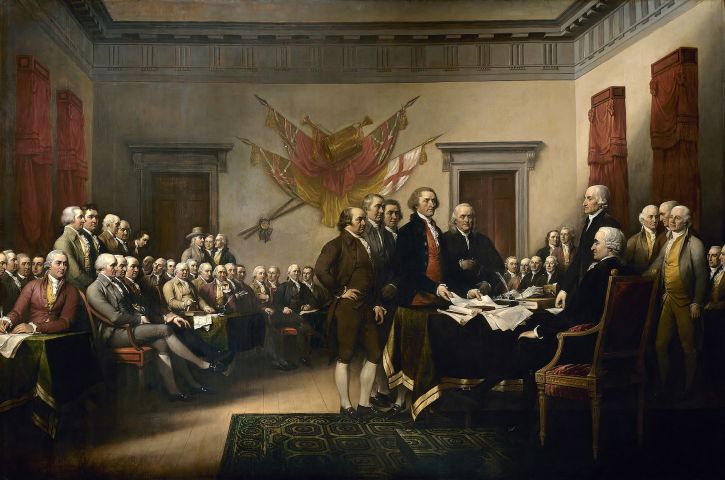
The Fourth of July holiday celebrates the signing of the Declaration of Independence, which declared the American colonists’ independence from Great Britain. Though this was when the founders declared their intention to break away from Great Britain, that independence wasn’t fully realized until after the bloody seven-year Revolutionary War. 

On Sept. 3, 1783, the Treaty of Paris was signed, officially ending the American Revolution. In that treaty, Great Britain recognized the United States as a free, sovereign and independent nation. Historians continue to debate how a ragtag group of colonists with no national government could defeat a global empire and the world’s most powerful army. On paper, it was certainly a war Britain should have won, and there are many reasons the American victory over the British Army was miraculous.

Is there a reason to believe God’s providence was at work in history?

Victory did not settle America’s fate.  The United States of America as we know it was not created spontaneously when Britain signed the Treaty of Paris or when the last British soldiers left New York in November 1783. The greatest challenge that faced the newly independent states was creating a functioning union that would bind the states into one nation.

The states’ becoming one unified nation was not at all a given early in its history. One of the greatest controversies after the Treaty of Paris was this issue: Would America become a collection of individual, sovereign states loosely tied together as a confederation, or would the individual states be unified as a nation—bound together by a powerful national government that would allow it to act as a single nation?

That issue took years to settle. If it were not for a series of miracles and compromises, the United States could have easily become a confederation of sovereign states (similar to today’s European Union)—or even fragmented into separate nations across the various regions of the American landmass. Imagine North America looking like Africa, Europe or South America—a continent containing several independent nation-states. That outcome could have happened.

From Articles to Constitution

The first attempt at a functioning union of the states was the Articles of Confederation. The United States operated under this document for eight years (1781-1789). It formed a very loose confederation between the states, led by a Continental Congress that had little power. Each individual state retained its own sovereignty and was not required to submit to the national government. Under the Articles of Confederation, there was no national executive office (president), no national currency (each state printed its own), and no national taxation. The national Congress had no power to govern commerce between the states or require the states to abide by treaties made with foreign governments. Throughout those eight years, the Articles of Confederation proved to be unworkable.

Failure at the Philadelphia convention could have resulted in a regional fracturing of America—preventing one union from coming into existence.A growing number of American thinkers began to promote a different form of governance called federalism. This called for a stronger national government with an executive branch and a clearer delineation of powers between the states and national government. Those who supported this stronger union were called Federalists, and those who opposed it came to be known as Anti-Federalists. (History buffs can dive deeper into the arguments of both sides by reading the Federalist Papers and the Anti-Federalist Papers.)

It wasn’t until 1787 that the controversy began to be settled. Because of the inefficiencies of the Articles of Confederation (made obvious by the infamous Shays’ Rebellion), the states agreed to send delegates to Philadelphia to discuss making improvements to the Articles of Confederation.

Eventually, the delegates decided that the convention would become a constitutional convention, with the goal of designing an entirely new system of governance based on the principles of federalism. The challenge was whether or not the delegates could agree on a constitution that all states (large and small, north and south) would ratify. The stakes were high. Failure at the Philadelphia convention could have resulted in a regional fracturing of America—preventing one union from coming into existence.

Again, this outcome was not only possible, but was highly likely given the political atmosphere of early America.

A new Constitution

But, in about four months, the delegates were able to produce a new Constitution for the United States of America. It would bind the states into a strengthened union led by a national government with more powers. This was achieved through savvy politics, political compromise and intentionally not addressing one of the most divisive issues of the time—slavery.

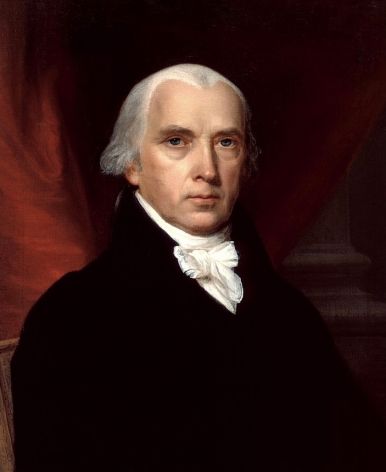
James Madison

James Madison was one of the principle authors of the Federalist Papers and U.S. Constitution. 

After the Constitutional Convention finally had a finished document, the next order of business was convincing the individual states to ratify the proposed Constitution. The document itself stipulated that it needed to be ratified by at least nine states before it could go into effect. The challenge was getting large states like Virginia and New York to vote for ratification because, as large and powerful states, they had the most to lose in surrendering more authority to a national government. The Constitution could have theoretically been passed without all states ratifying it, but that would have ultimately left the land divided.

But all states eventually did ratify the Constitution. The whole process was completed (for the original 13 states) when Rhode Island finally ratified the new Constitution in 1790. With all 13 original states joining the union under the new Constitution, America was set on course to develop as one unified nation—eventually spanning from the Atlantic to the Pacific. But maintaining the union was not without its hardships—it took many more compromises and a bloody four-year Civil War to settle the issue of slavery once and for all.

The United States in prophecy

Okay, you may be asking, why is all this history important?

Did you realize that the United States’ breaking from Great Britain to become a nation was a fulfillment of a prophecy made over 3,600 years ago? As we explain in our article “How the Blessings of Abraham Came to the United States,” certain physical blessings were promised to Abraham. These blessings were passed down to his son Isaac, then to Isaac’s son Jacob and finally to Joseph’s two sons, Ephraim and Manasseh.

Jacob, in a very specific prophecy, declared that Ephraim would become a “multitude of nations” and Manasseh would become a single great nation (Genesis 48:19). Genesis 49:1 reveals that these promises were to be fulfilled in “the last days”—in other words, the modern era (from our historical viewpoint).

The promise of a “multitude of nations” was fulfilled by the British people—who became an empire and later a commonwealth of nations. Today Ephraim’s promises are primarily fulfilled in the nations of the United Kingdom, Canada, Australia, New Zealand and South Africa (as well as other smaller nations that are part of the Commonwealth).

Americans would do well to consider the life of their original founding father—the patriarch Abraham—and recall his life of faithful obedience to God.   Manasseh’s promise of being a single great nation was fulfilled in the United States of America.

As Americans celebrate the Fourth of July, they would do well to consider that the Declaration of Independence from Britain was necessary in order to fulfill the Genesis 48:19 promise. For the prophecy to be fulfilled, America had to be independent from Britain and had to unite into a unified single nation. The entire history of the development and ratification of the U.S. Constitution was essential for that prophecy to be fulfilled. This understanding helps us to see God’s providential hand in history (Isaiah 46:10).

This Fourth of July comes at a troubled time in this nation’s history. It comes as we are dealing with a persistent global pandemic and increased racial tensions and unrest. This nation seems to be increasingly more divided on a host of issues that many fear could tear it apart. Now is a time when America could greatly benefit from returning to its spiritual roots. Those roots go back much further than the days of Washington, Jefferson, Adams and Franklin.

Americans would do well to consider the life of their original founding father—the patriarch Abraham—and recall his life of faithful obedience to God, as described in chapters 12-25 of Genesis. In his life, we can find insight into our nation’s troubles today. He was a man who had his flaws and made mistakes, but grew from them and faithfully relied on God. You can learn more about him in our article “The Faith of Abraham.”

Originally posted on July 4, 2017; Updated on July 3, 2020.” From:  https://lifehopeandtruth.com/prophecy/blog/the-fourth-of-july-in-prophecy/?

________

Update.

These posts about Independence Day are a history lesson for me.  Being British, we didn’t learn as much about it as the American kids do.

With the new surge in Corona cases, we have ordered to wear masks most everywhere.  This has some people wondering who can dictate to them and order them around.  Me, not so…  Give to Caesar what is Caesar’s, and to God what is God’s.”  Luke 20:25 and Mark 12:17.  I assume that our TX governor has studied this, and knows what is best for us.  Just like wearing our seat belts, it is to be safe, “Just in Case”.  But they are stifling hot in this over 90° weather.

Finally, I was tired of my slow computer and ordered another desktop. It is a refurbished Dell High Performance Business one, with 16 GB Ram, and i7, so we will see how it does.  It has a 60 day return, so that should give it a good try.  I don’t know how I will get along with Windows 10 Pro, because I am used to Windows 7 and 8 Home!

Still no word as to when my cat can come home.  Now that we have found out that he is a young cat, he might be better off if I let him be adopted to a permanent family.  Then I could try to find and care for, an older, or special needs cat, an unwanted one, to give it a taste of a loving home.

My church neighbor and I had our Bible study on Thursday because I was making another trip to College Station on Friday to the HEB store for groceries that we can’t get here in this little Brookshire's in Navasota.  But this time I rode with one of the other tenants here at the senior apartments, and he didn’t scare me driving that 75mph highway like some folks do.

But when I got home I found out that my AC wasn’t blowing cold!  It is over 90° in the apartment.  I reported it and here it is, a day later, and the 4th. of July, and still hot in here.  Doesn’t the AC man realize when he got into the Heat and AC business, that it is like buying a milk cow… there are no days off.  So I am still waiting to see if the AC man is coming here today.

Sunday, April 19, 2020

Do You Pray the Way Jesus Taught? Praying and Preying! Update.

Do You Pray the Way Jesus Taught?

“People pray many different ways across the various denominations of Christianity. How do you pray? How did Jesus pray? What did Jesus say about prayer?

Do You Pray the Way Jesus Taught?

Most would agree that one of the basic elements of Christianity is prayer.

But when you survey the wide variety of forms of Christianity, you find that there are many different practices and ideas about prayer. Consider:

  • Those who are Roman Catholic or Eastern Orthodox typically see prayer as the recitation of prewritten prayers. Roman Catholicism has hundreds of these prayers for people to recite in a variety of situations. For instance, there are specific prayers for Catholics to recite before and after meals, when dealing with depression, and in many other situations. Catholic and Orthodox traditions include the practice of praying to Mary, angels and saints as intercessors between God and man.
  • In general, the Protestant world is less liturgical about prayers. There are many different forms of praying in Protestantism—from emotional prayers spoken from the pulpits of churches to prayer groups meeting together to pray about specific issues.

Though the way people pray varies within mainstream Christianity, all major branches frequently pray “the Lord’s Prayer” found in Matthew 6:9-13. Catholics, Orthodox and Protestants will pray the Lord’s Prayer many times throughout their lives because they believe that Jesus instructed His followers to pray this prayer verbatim.

But is this what Jesus Christ intended when He taught His disciples about prayer in the Sermon on the Mount? What did Jesus really teach about prayer?

What did Jesus say about prayer?

The Lord’s Prayer is found in the middle of Christ’s Sermon on the Mount—the heart and core of what genuine Christianity is all about. Christ broached the subject of prayer in a portion of the sermon that explains Christians should not flaunt their good deeds for everybody to see. He said that good deeds—giving to charitable causes, serving others, etc.—should be done “in secret” (Matthew 6:4).

He didn’t mean that we should be embarrassed about doing good, but that our motivation should be to do good because we are trying to please God and do the right thing. Our motivation should not be for other people to see us!

After making that important point, Christ transitioned to the topic of prayer. He gave a number of points that are very important for all Christians to understand—and that contradict many of the practices found in Christianity today.

Prayer is not for show

Jesus applied the same principle He made about good works to prayer: “And when you pray, you shall not be like the hypocrites. For they love to pray standing in the synagogues and on the corners of the streets, that they may be seen by men” (verse 5). In other words, we shouldn’t use prayer to show off our spirituality to others.

Pray in private

Instead of a public show, Jesus taught: “When you pray, go into your room, and when you have shut your door, pray to your Father who is in the secret place; and your Father who sees in secret will reward you openly” (verse 6).

In order to build a strong relationship with our Creator, we need to spend daily, concentrated time praying to Him privately, one-on-one. Instead of praying publicly to be seen by others, prayer is to be done primarily in private. There is an important reason for this. Prayer is designed as a means of communication to “draw near to God” (James 4:8)—to deepen our personal relationship with Him. In order to build a strong relationship with our Creator, we need to spend daily, concentrated time praying to Him privately, one-on-one.

Jesus Christ didn’t just teach about this; it was a regular part of His life (Matthew 14:23; Mark 1:35; Luke 6:12).

(Note that there are times when praying in public is appropriate, such as at a family meal, church service, wedding or a funeral.)

Pray to the Father

Jesus was very clear that our prayers are directed to God the Father: “Pray to your Father who is in the secret place” (Matthew 6:6). Now that Jesus Christ is in heaven as the Mediator between God and man, we pray “in the name of our Lord Jesus Christ” (Ephesians 5:20; 1 Timothy 2:5). Jesus said we can ask the Father for anything in His name (John 14:13-14).

Though Christ was very clear, it is amazing how many churches pray in ways that directly contradict this instruction. Prayers are not to be directed to angels, Mary or any saints!

Pray from the heart

Jesus made another clear statement that is widely ignored: “And when you pray, do not use vain repetitions as the heathen do. For they think that they will be heard for their many words” (Matthew 6:7).

Christ was referring to the pagan form of recitation and chanting prayers based on the idea that repeating a prayer will bring favor from God (or the gods). This form of repeating or chanting prewritten prayers is practiced extensively in the Catholic and Orthodox churches.

God doesn’t want prewritten prayers to be repeated over and over. This does nothing to fulfill the basic purpose of prayer, which is to develop a close, personal relationship with God.

If you do a study of the many prayers recorded in the Bible, you will notice that they are distinct, personal and heartfelt communication between the individual and God. Here are a few prayers that are helpful to study:

  • 1 Samuel 1:11; 2:1-10: Hannah’s prayer requesting a child and her prayer of thanksgiving to God after He provided her a son named Samuel. 
  • Psalm 51: David’s heartfelt prayer of repentance for his adultery with Bathsheba and his murder of Uriah the Hittite.
  • 2 Kings 19:15-19: King Hezekiah’s prayer for God to deliver Judah from being conquered by Assyria.

To learn more about how to have real, meaningful prayers to God, read the article “Prayer From the Heart.”

Jesus Christ provides an outline for prayer

Then Jesus got more specific. He said, “In this manner, therefore, pray” (Matthew 6:9).

He then gave an example prayer that, sadly, has been misused by many in mainstream Christianity—in direct contradiction of His instruction in verse 7 to not use repetitious prayers! This is commonly called the “Lord’s Prayer” and is recited repetitively in many denominations.

But Christ did not give this prayer for us to repeat over and over.

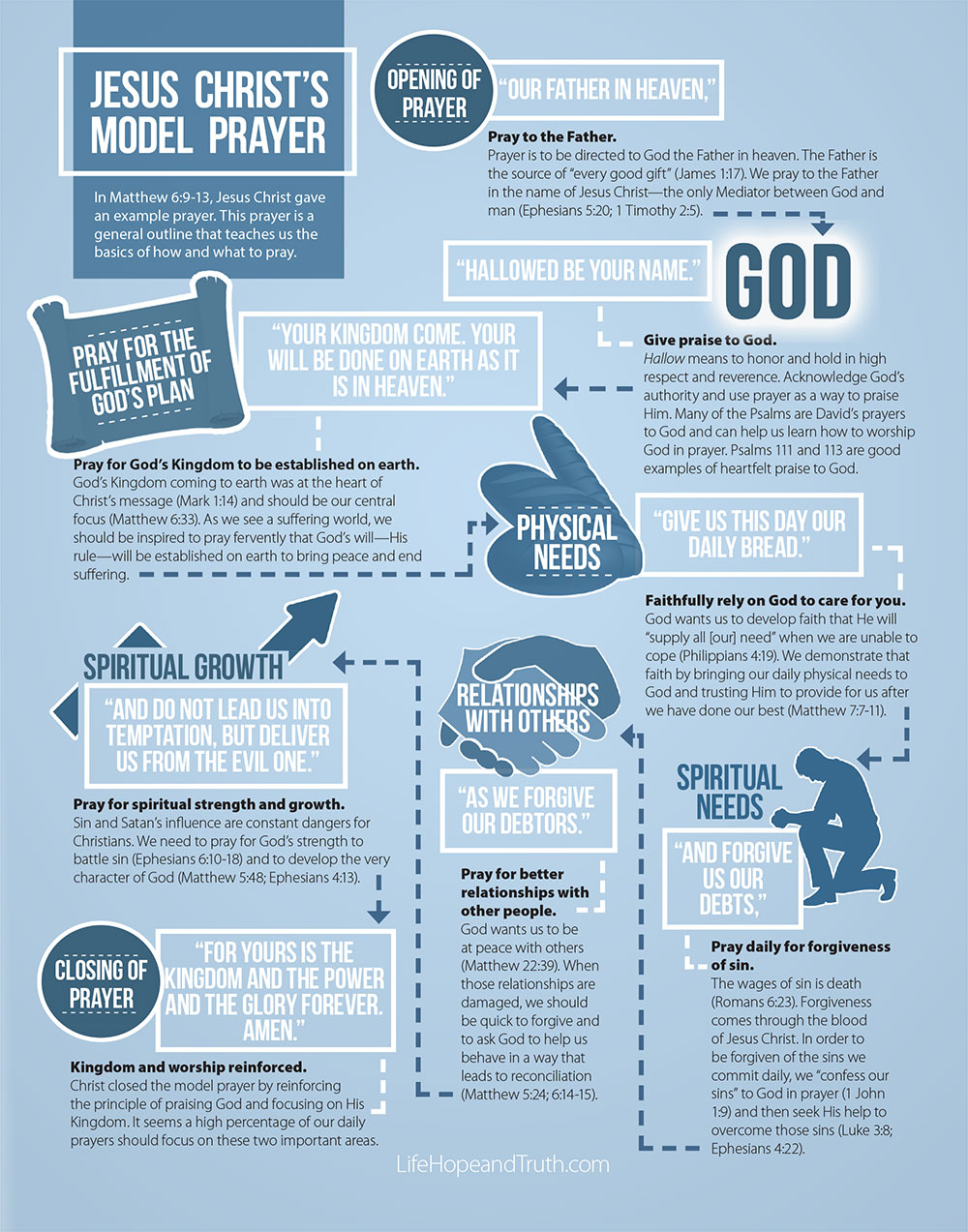
So what was Christ teaching us in the so-called “Lord’s Prayer”? Essentially, Jesus was providing an outline to show the general structure and topics that should be included in our regular prayers to God. This outline would more accurately be called a model prayer.

Study the accompanying graphic to better understand what Christ was teaching through this example prayer.

God wants a deep, personal relationship with you. To build that relationship, you need to communicate with Him through prayer. In order for those prayers to be “effective” and “fervent” (James 5:16), we must allow Jesus Christ to teach us how to pray and remove traditions that contradict what He taught!

To learn more about the Bible’s teachings on prayer, read “How to Talk to God.”

View larger or download infographic PDF of Jesus' Model Prayer

Jesus Christ's Model Prayer

Learn How God Wants Us to Pray. Download Free Booklet

Learn More About God

________

Praying and Preying!

“Even during a crisis, our society cannot escape human nature.

Transcript of YouTube: https://youtu.be/xN4fpdlm7R4

[Steve Myers] This is a time that we have to be careful about praying. Now, what do I mean by that? Well, there’s a couple of different kinds of praying. Certainly, right now, during this difficult time of all the health challenges that we face, we definitely want to be praying. We have to be a praying people. We should be praying for our families. We should be praying for our communities. We should be praying for our government leaders. We should be praying for the church. Absolutely, we should be a praying people.

But there’s another kind of praying that we’ve gotta be very careful about. And that’s this kind of praying. Yeah, believe it or not, during this time, there are those that are out there that are preying in this way. They’re preying on people. There is cyber criminals out there that are taking advantage of the Coronavirus. If you ever get an email that says, “Click here for a cure,” be careful, it’s probably a scam. If you get a text or an email that says, “Get your COVID-19 tax refund,” don’t do it. It is a scam. You’ve gotta be careful if you hear from the WHO, the World Health Organization, be careful. They don’t send out personal emails. That is probably a scam as well. And if you click on it, it’ll record every keystroke on your computer and they can steal your information. So, watch out. In fact, I’ve also heard about people that are going door-to-door. And they’re claiming to be able to come in and sanitize your home, so that you won’t be infected. That is a scam. They’ll come in and they’ll steal you blind. So, watch out.

What this reminds us of, these two kinds of praying, it reminds us that even during a crisis, there are people out there that cannot get away from their human nature. The Bible talks a lot about our human nature. A passage that specifically comes to mind for me is one that’s found in 1 John 2:16. It tells us about normal, everyday human way of thinking. It says, “All that is in the world, the lust of the flesh, the lust of the eyes, and the pride of life is not of the Father but is of the world.” It is against God and there are those that are out there that would take advantage of you.

So, be careful. And of course, it’s a reminder for us, too. We need to be careful. Don’t be a hoarder. Don’t take advantage of others. Be selfless. Try to serve others during this difficult time. That’s the Godly thing to do.

So, let’s be sure we recognize the difference between praying and preying. And let’s be a people that’s praying to our God.”  From: https://www.ucg.org/beyond-today/beyond-today-daily/praying-and-preying

_______

Update

Like everyone else who is ‘sheltering in place’ there isn’t much going on here.  My neighbor and I ventured to Tractor Supply, mostly to get some of the good pet food that they sell.  I had something to return anyway.  My neighbor has a sweet Westie, West Highland White dog, they look like a white Scottie. We have to go past our little Walmart to get there, so we went in, donned in masks and gloves. That seems to be everyone’s uniform these trying days.

Yes, I still have the cat that nearly died.  I am pretty sure that he has Feline Leukemia, among other things, but I want to give him some happy time as a beloved housecat before he gets too sick and has to be PTS.  He has lots of scars on all four legs where he must have gone through some awful trauma, but still has a very sweet personality. He finally realizes that he is going to be fed canned and dry food regularly, and doesn’t try to pry open the dry food bin anymore.  He had chewed through the bag when I got him, so I had to put it in a lidded pail. I have to mix canned pumpkin in with his canned food to help his digestion and elimination.  That works for people too.

Bible study was on Zoom, and I finally figured out how to make that work, but I didn’t know how to turn on my camera. When I was given this laptop, I was told to tape over the camera, so that “Big Brother Couldn’t Watch Me”, so had to take that off.  But that was OK, they didn’t need to see me.  The folks’ faces participating in the Bible study were so distorted anyway, their cameras didn’t do them justice.  I watched several church’s services on my computer, and spent more time watching them than I would have if I had gone to church.

Now we just have to do our best to help slow the curve, so that we can all live for a better day.

Wednesday, October 23, 2019

Feast of Tabernacles in Today’s World. The Last Great Day: The Final Harvest. Update.

For “Scripture Sunday” and Monday.

Celebrating the Feast of Tabernacles in Today’s World

“This 7-day biblical festival gives you a preview of the coming wonderful age beyond today.

Transcript of YouTube: https://youtu.be/0JWFfikMwHE

[Steve] Did you know there’s a biblical festival that Jesus Christ celebrated in the first century and even today, thousands of Christians still look forward to it each year?

> I think the greatest benefit of the Feast of Tabernacles is spiritual energy.

» I love it! I wouldn’t trade it for anything.

> Yes! Yes! I’m going to the Feast of Tabernacles!

[Steve] From a biblical perspective, is there significance to the Feast of Tabernacles? What does this seven-day festival picture in God’s plan? What does it mean for us today?

Could this festival that Jesus observed unlock a secret for your life?

Stay tuned as we discuss why you should: “Celebrate the Feast of Tabernacles in Today’s World.”

[Steve] What is the Feast of Tabernacles? Could there be a spiritual significance to the Feast of Tabernacles that you may have overlooked? Why do Christians from around the world take time away from their jobs and schools to attend this seven-day celebration?

I had the opportunity to talk to Christians who celebrate this special biblical festival called the Feast of Tabernacles.

> I”m excited about the Feast because there are so many people here of like mind, you know everybody’s got the holy spirit and when you’re out in the world, I guess doing battle in a sense on a day-to-day basis, it’s just good to come somewhere and I guess, spiritually recharge.

» God’s Kingdom—it’s gonna be so awesome, we can’t imagine what it’s like.

[Steve] Well, let’s try to imagine it from another perspective for a moment.

There was a life-changing event in the New Testament that most don’t realize has everything to do with the Feast of Tabernacles — the transfiguration.

Notice the details. Jesus said, “‘I tell you, there are some here who will not die until they have seen the Kingdom of God come with power.’ Six days later Jesus took with him Peter, James, and John, and led them up a high mountain…a change came over Jesus, and his clothes became shining white… There the three disciples saw Elijah and Moses talking with Jesus. Peter spoke up and said to Jesus, ‘Teacher, how good it is that we are here! We will make three tents…’ he and the others were so frightened that he did not know what to say” (Mark 9:1-6).

Now what an amazing event! Exactly what was that all about? Well in a vision, the men were suddenly whisked into the future to see Jesus Christ in His glory in His Kingdom!

Now don’t miss Peter’s reaction. What did Peter associate with this vision? Remember he said: “We will make three tents.” Peter connected tents with this event!”        Continued at: https://www.ucg.org/beyond-today/beyond-today-television-program/celebrating-the-feast-of-tabernacles-in-todays-world

________

The Last Great Day: The Final Harvest

“After the Millennium, pictured by the Feast of Tabernacles, comes another time of spiritual harvest pictured by the Eighth Day or Last Great Day.

The Last Great Day

The Last Great Day pictures the final stage of God’s spiritual harvest.

The seven-day-long Feast of Tabernacles is associated with the 1,000 years of Jesus Christ’s rule on the earth. So continuing in Revelation 20, we come to the Great White Throne Judgment, which corresponds with the Eighth Day or Last Great Day. Verse 5 points out that “the rest of the dead” wouldn’t be resurrected until after the thousand years, which would make this the second resurrection.

“Then I saw a great white throne and Him who sat on it, from whose face the earth and the heaven fled away. And there was found no place for them. And I saw the dead, small and great, standing before God, and books were opened. And another book was opened, which is the Book of Life. And the dead were judged according to their works, by the things which were written in the books” (Revelation 20:11-12).

Another view of the second resurrection

This same resurrection is described in other passages that help us to understand it more fully.

Ezekiel 37 describes a valley full of bones that God resurrects to physical life. In this passage God addresses the children of Israel being resurrected: “Then you shall know that I am the LORD, when I have opened your graves, O My people, and brought you up from your graves. I will put My Spirit in you, and you shall live, and I will place you in your own land” (verses 13-14).

During this time, pictured by the Last Great Day, God raises these Israelites as living, breathing human beings, and He offers them His Holy Spirit, which is the same as offering them the chance for salvation and eternal life. God is completely fair and merciful, so these are people who did not have a chance for salvation in their previous lives in this world.

That is why He opens the Book of Life to them—to give them the chance to be written in it! The other books mentioned in Revelation 20:12 would be the books of the Bible, opened to their understanding for the first time.

But will only descendants of Israel have this chance? No, Jesus Christ makes plain that gentiles from all ages will have their opportunity during this Day of Judgment as well (Matthew 10:15; 11:21-24; 12:41-42). And so God’s stated desire will be fulfilled: “Who desires all men to be saved and to come to the knowledge of the truth” (1 Timothy 2:4; see also 2 Peter 3:9).

What an amazing, merciful plan of salvation is pictured by this Last Great Day and all seven of God’s festivals! What a wonderful future God has in store for us and everyone who will respond to Him!” From: https://lifehopeandtruth.com/life/plan-of-salvation/last-great-day/?

From Holidays to Holy Days. Download Free Booklet

_________

Update.

Well, the cable, internet and phone went out a day after the repair man fixed it, when we had another storm.

Fortunately, I have a working laptop, as long as it is plugged in, so the Service Coordinator let me use his WiFi again.  But I had to take my printer too, because a lot of paperwork has to be ready for my appointment with the Social Security Administration next week. The repairman didn’t come back until the end of the week, so it was another week that I had to tote my big old heavy laptop and printer down to the Community Room.  But I had bought one of those shopping cats on wheels so it came in very handy for that, also for taking the laundry.  I always seem to be toting something in it.

For the Sabbath church potluck I made a Butternut Squash Pie with Bisquick and cottage cheese, no milk, and no eggs.  I didn’t think that it was as good as the Bisquick Crustless Canned Pumpkin Pie I had made the week before, but the congregation loved it.  The Sabbath theme was “Faith does not make things easy, it makes them possible”, Luke 1:37, and the Message was about The Imminent Return of Christ.  Our pastor wasn’t there, so the pastor of the Spanish congregation gave it.  He has a thick accent, and I don’t do well understanding folks with accents, but I got the gist of it.

Sunday afternoon we had the usual Bible study at the apartment Community Room, and the subject was about “The Power of Words”, how they can hurt or heal.  The pastor chose that because the week before one of the ladies had a tizzy about something, and stormed out.  It was actually a paper that she herself had written, but she wasn’t there to hear it.

Then on Sunday, I made another pie, because I was going to celebrate “The Last Great Day”, the holy day at the end of The Feast of Tabernacles, with my old church in Willis on Monday.  I used the rest of the butternut squash and made a pie with the Bisquick, eggs and milk recipe that I had used for the crustless canned pumpkin pie.  It went down very well.

The Bible readings were Deut. 14:22-16,17, 1 King. 82-21, John 7:37-39. These were chosen because they are about The Last Great Day.  The Teaching was also about that. 

For a couple of days I had a helper. He is a caregiver for one of the residents here.  We drove to Willis and brought six dining room chairs with arms and some other stuff back to Navasota.  That made a lot of space there at that storage.  Another day he got on my little step ladder and hung some pictures for me.  We had agreed on an hourly rate and I paid him more than he worked.  Then he didn’t come back, so I hired another guy and we moved some stuff around in the two storage units that I have in here in Navasota.  I had to get a bigger storage unit here, temporarily, to house the things that are in the Willis one.  I hope to have that unit empty by the following Thursday.


Wednesday, March 20, 2019

Prophecy: What Lies Ahead for You and Your World? Update.

For “Scripture Sunday”:

Prophecy: What Lies Ahead for You and Your World?
  • Kingdom of God

    Kingdom of God
    What is the Kingdom of God or Kingdom of Heaven? When will it come? Where is it? Why is the message of the Kingdom of God called good news?
  • Revelation

    Revelation
    Can the mysterious book of Revelation—the last book of the Bible—be understood today? What does it mean for your future?
  • Understanding the Book of Daniel

    Understanding the Book of Daniel
    Does the book of Daniel have any significance for us today? Or is it simply a good book for children’s stories like “Daniel in the Lion’s Den”?
  • End times

    End Times
    Where are we in Bible prophecy? Is this age the time of the end? Can people calculate the date of Jesus Christ’s return to this earth?
  • Prophets

    Prophets
    Was Nostradamus a true prophet? How can you tell a true prophet from a false prophet? What does God have to say about true and false prophets?
  • America in Prophecy

    America in Prophecy?
    Many small nations are mentioned in Bible prophecy. Wouldn’t God also address a major world power like the United States of America in prophecy?
  • 12 Tribes of Israel

    12 Tribes of Israel
    What promises did God make to the 12 tribes of Israel? What were His plans and expectations for them? What is the significance of these things today?
  • Middle East

    Middle East
    Bible prophecy is heavily focused on the Middle East. It is destined to be the focal point of end-time conflict—and of the Kingdom of God beyond!

______

Update.

The post for last Sunday was all ready, but it is in my laptop, then a lot of things happened and I couldn’t post it.  So now this quick one, hopefully with a lot of Bible info.  One thing which has really hampered me this week is that I hurt my tail-bone and it hurts to sit down and even worse getting up.  So I didn’t go to the YMCA for the Yoga and Senior exercises. I did a lot of standing this week and cooked a lot of veggies that I had been given, including two great big Bok Choy.

I bought a used fridge for the mini-house, it is 5’ tall but only 24” deep, so it doesn’t overpower the space like the deeper, taller one did.

My new 14 year old foster cat arrived, a full grown skinny bag of bones weighing only 4 lb called “Oreo”.  She has to have thyroid and heart medicine rubbed inside her ears twice a day, and she wouldn’t eat. Her previous foster-mom had been force-feeding her with a syringe (without a needle, of course), and poor little Oreo didn’t like that, and nor did I. 

I wanted to get her eating by herself, so I bought her some KRM (Kitten Replacement Milk, that is for orphan kittens) which she would lap up a bit from time to time.  Gradually, she ate some Greenies, a nutritious cat treat, and then a couple of days later I took her to the vet for her twice monthly thyroid blood test, and they also gave her a B12 shot.  They said that she looked a lot better now as she was allergic to something at her previous place where her nose and sinuses were so messed up that she had to have a humidifier there.  She hasn’t shown any signs of that here. 

Poor little black and white Oreo, had been in a cattery, in a cage, with no home life for 12 years, and my SPCA boss wanted her to know what it was like to be in a loving home, being individually loved, and sleeping on someone’s bed.  That is why I was given the privilege of caring for her.  She is really loving it here, and last night she crawled up on my bed and slept there, purring. Finally, she is eating a little canned food, (Wellness, the best), diluted with water, so I hope when she goes back for her next thyroid check in two weeks, that she will have gained some weight.

As usual, we have been battling the winter scattering of pine needles and pine cones.  I heard that the pine cones will really do a number on a mower blade, so we have been raking and picking them all up before it was mowed.

Then more battling with this desktop which kept suddenly restarting like there had been a power failure, and I was frantic to save my pictures which I thought had gone into Google Drive but they hadn’t.  I need My Pictures to earn money by selling stuff, and if this computer dies, then I need my pictures in my laptop.  Finally, we got them on a thumb drive, so now Maybe I can get them in the laptop. Well, not me, I will have to get my neighbor to help me, as I don’t know how to do that. 

I am just an old great-grandma who all she knew when she was given a computer was how to type so I have had to teach myself how to work it to sell things to help pay the bills.  In the beginning, I knew how to sell stuff on eBay, but didn’t know how to write an email !  So, after a few weeks, I went to the library for them to show me how to do that. 

As I had some stew meat, I made a Beef and Barley Stew with organic veggies for the church potluck. Then there were the usual salads, lasagne, other beef dishes, pies, cookies and fruit.

The Bible readings were Prov. 8:1-17, Exo. 2:23-4:11, Isa. 40:11-19, Acts 10:9-28 and all of Matt 10.  The Teaching wa about The Readiness in The Believer.  About the desire to do something and then the preparation.

It was another ‘no-heat-nor-air-needed’ day.