Showing posts with label Blinds. Show all posts

Sunday, July 18, 2021

Humility: Why It Matters. Do It With Your Might. Can We Eat To Starve Cancer?

Humility: Why It Matters

“Humility isn’t valued very highly today. But the Bible shows it’s not just a nice characteristic—it’s one that’s essential to please God.
Humility: Why It Matters

Arrogance is certainly not among the most desirable characteristics in a person. People who are arrogant, full of themselves, and who deem themselves superior to others are so annoying. They’re condescending, selfish, egotistical and blind to the needs of others.

For many, the arrogance of others is an annoyance and source of frustration, but nothing more. Most would prefer that others not be arrogant, but society doesn’t really put a high value on its opposite—humility. The self-assured seem to succeed, while the humble get walked on.

A look at the Bible, however, shows that God places great emphasis on humility—and says some very condemning things about pride in all its forms.

God hates pride

“These six things the LORD hates, yes, seven are an abomination to Him,” begins the list of things that God absolutely hates. They are not things that annoy God, His pet peeves or a few minor frustrations. This is the list of things that God will not tolerate. The first thing on this list is “a proud look” (Proverbs 6:16-17).

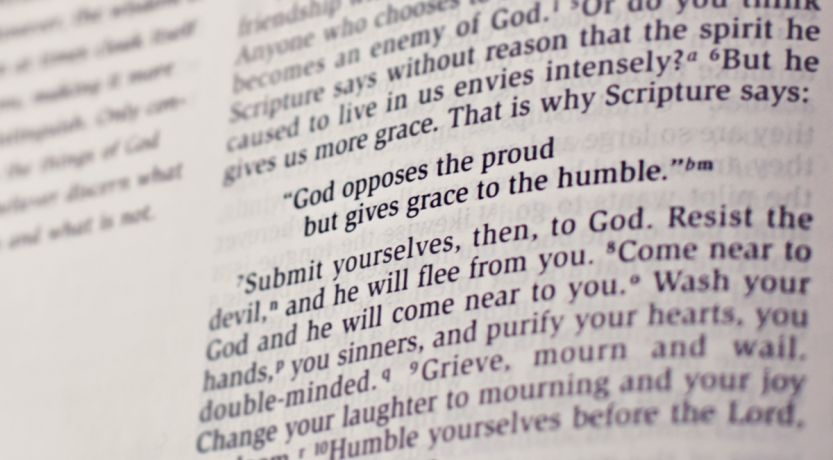
God does more than hate pride. Pride is so offensive that He actually “resists the proud,” while, in contrast, He “gives grace to the humble” (James 4:6).

God also requires humility of those who choose to follow Him (Micah 6:8). It is on the humble one He will look, not the arrogant (Isaiah 66:2). The contrast is so strong that the Bible declares, “The LORD will destroy the house of the proud, but He will establish the boundary of the widow” (Proverbs 15:25). The possessions of the proud will be destroyed, while God will look after and protect the humble, such as widows.

Why are pride and humility such big deals to God?

Pride’s grand entrance

Humans generally see pride in others as an annoyance, but we have a hard time seeing it in ourselves. God sees pride for exactly what it is—a terrible instigator of evil.

The universe was originally ideal and full of peace. Everything was perfect. There was no strife, confusion, violence, evil or destruction.

Then things began to change. Gradually, one of God’s greatest angels started to think how great he was. The angel—the one often called Lucifer—began to think that he was even greater than God Himself. As his pride grew, he apparently corrupted a third of the other angels and staged a rebellion against the very God of heaven (Isaiah 14:12-15; Ezekiel 28:11-19; Revelation 12:7-9). For more on how Lucifer became Satan, read “Satan: A Profile.”

Pride and the plan of God

To fully understand why God hates pride and esteems humility so much, it’s necessary to understand what God has planned for the human race. This physical life is not all there is—it’s a time to prepare for a limitless life dwelling in eternity.

Mankind was made with a purpose—the purpose of becoming sons and daughters of God Himself (2 Corinthians 6:18; Hebrews 2:10). Those who become children of God will be given awesome power.

That power can’t go to just anybody. God will only give it to those He trusts to use it wisely. If He gave that power to someone as arrogant as Satan, the potential for evil and destruction would be unimaginable.

It’s vital that we learn the lesson of humility now—in this physical life. Pride destroys, devastates and corrupts. It’s vital that we learn the lesson of humility now—in this physical life. Pride destroys, devastates and corrupts. No member of God’s family can possess pride. God doesn’t, and neither will His children.

For more on man’s purpose for life, read our article “Purpose of Life.”

God’s example

God is superior to mankind in every way imaginable. In spite of this, God loves us enough to deal with us and, more amazing still, is willing to share all that He is and all that He has with us.

When Jesus Christ was on the earth, He revealed to us the very mind of the Father (John 5:19). The example that Christ set was one of humility (Luke 22:27; John 13:1-16). Christ’s willingness to become human and sacrifice Himself for His creation was the supreme act of love and humility (Philippians 2:5-7).

How pride destroys

Pride is an overinflated sense of self-worth, or thinking that we are greater than we actually are. Pride occurs when our perspective becomes so skewed that we think we are superior to those around us. It destroys relationships and is the opposite of godly love.

Pride causes us to forget that the nations are a drop in the bucket compared to God (Isaiah 40:15). Pride makes us think that we do not need God. As man elevates himself, God eventually gets shoved out of the picture entirely (Romans 1:18-25).

Thinking that we don’t need God is one of the biggest mistakes we can make. Satan—the arrogant being who started all of the evil we see in the world—is still “the ruler of this world” (John 14:30). His goal is the utter destruction of every single human being in existence. The only way that we can prevent him from achieving that goal is to “submit to God. Resist the devil and he will flee from you. Draw near to God and He will draw near to you” (James 4:7-8).

Pride’s ugly future

In the last days, before Christ’s return, pride will bring mankind to the brink of total destruction. The apostle Paul provided a list of the predominant characteristics that men and women will have in the end times, and it’s not a pretty list. The descriptions range from traitors to those without self-control to the haughty (2 Timothy 3:1-5).

These characteristics—including haughtiness or pride—will cause mankind to defy God. When He causes plagues to strike the earth for the purpose of bringing mankind to repentance, many will be too arrogant to turn to Him. They will grow angry and blaspheme God instead of humbly bending to His will (Revelation 16:9, 11, 21).

In the end, prideful men will be humbled, and Satan will be put away.

Getting to Know the God of the Bible BookletIn the meantime, it is up to us to destroy the pride in our lives and develop the humility that was in the mind of Christ. If we are to be exalted as members of the family of God, then we must humble ourselves now (Luke 14:11). Humility matters that much.” From: https://lifehopeandtruth.com/life/christian-living/humility/

_______

Do It With Your Might

Ecclesiastes 9:10

Whatever your hand finds to do, do it with your might; for there is no work or device or knowledge or wisdom in the grave where you are going.

Solomon’s writings repeatedly encourage diligence and hard work as necessary ingredients of success. (For more on this, see our article “How to Be Successful.”) Here the wise king adds the perspective that this life is short, and so we must apply our full efforts now. This passage may have been on the apostle Paul’s mind when he wrote, “And whatever you do, do it heartily, as to the Lord and not to men” (Colossians 3:23).

Many churches dispute Solomon’s assertion that “the dead know nothing” (Ecclesiastes 9:5) and that there is no knowledge or wisdom in the grave. The common teaching is that man has an immortal soul. But is this what the Bible teaches? For more on this, see our article “Immortal Soul.”  From: https://lifehopeandtruth.com/bible/blog/do-it-with-your-might/

_______

Can We Eat To Starve Cancer?

Below is an approximation of this video’s audio content. To see any graphs, charts, graphics, images, and quotes to which Dr. Li may be referring, watch the above video. “So why should we care about blood vessels? Well, the human body is literally packed with them -- 60,000 miles worth in a typical adult. End to end, that would form a line that would circle the earth twice. The smallest blood vessels are called capillaries. We've got 19 billion of them in our bodies. And these are the vessels of life, and as I'll show you, they can also be the vessels of death. Now, the remarkable thing about blood vessels is that they have this ability to adapt to whatever environment they're growing in. For example, in the liver, they form channels to detoxify the blood; in the lungs, they line air sacs for gas exchange. In muscle, they corkscrew, so that muscles can contract without cutting off circulation. And in nerves, they course along like power lines, keeping those nerves alive.

01:19

We get most of these blood vessels when we're actually still in the womb. And what that means is that as adults, blood vessels don't normally grow. Except in a few special circumstances. In women, blood vessels grow every month, to build the lining of the uterus. During pregnancy, they form the placenta, which connects mom and baby. And after injury, blood vessels actually have to grow under the scab in order to heal a wound. And this is actually what it looks like, hundreds of blood vessels, all growing toward the center of the wound.

01:53

So the body has the ability to regulate the amount of blood vessels that are present at any given time. It does this through an elaborate and elegant system of checks and balances, stimulators and inhibitors of angiogenesis, such that, when we need a brief burst of blood vessels, the body can do this by releasing stimulators, proteins called angiogenic factors, that act as natural fertilizer, and stimulate new blood vessels to sprout. When those excess vessels are no longer needed, the body prunes them back to baseline, using naturally-occurring inhibitors of angiogenesis. There are other situations where we start beneath the baseline, and we need to grow more blood vessels, just to get back to normal levels -- for example, after an injury -- and the body can do that too, but only to that normal level, that set point.

02:40

But what we now know, is that for a number of diseases, there are defects in the system, where the body can't prune back extra blood vessels, or can't grow enough new ones in the right place at the right time. And in these situations, angiogenesis is out of balance. And when angiogenesis is out of balance, a myriad of diseases result. For example, insufficient angiogenesis -- not enough blood vessels -- leads to wounds that don't heal, heart attacks, legs without circulation, death from stroke, nerve damage. And on the other end, excessive angiogenesis -- too many blood vessels -- drives disease, and we see this in cancer, blindness, arthritis, obesity, Alzheimer's disease. In total, there are more than 70 major diseases affecting more than a billion people worldwide, that all look on the surface to be different from one another, but all actually share abnormal angiogenesis as their common denominator. And this realization is allowing us to re-conceptualize the way that we actually approach these diseases, by controlling angiogenesis.

03:45

Now, I'm going to focus on cancer, because angiogenesis is a hallmark of cancer -- every type of cancer. So here we go. This is a tumor: dark, gray, ominous mass growing inside a brain. And under the microscope, you can see hundreds of these brown-stained blood vessels, capillaries that are feeding cancer cells, bringing oxygen and nutrients. But cancers don't start out like this, and in fact, cancers don't start out with a blood supply. They start out as small, microscopic nests of cells, that can only grow to one half a cubic millimeter in size. That's the tip of a ballpoint pen. Then they can't get any larger because they don't have a blood supply, so they don't have enough oxygen or nutrients.

04:28

In fact, we're probably forming these microscopic cancers all the time in our body. Autopsy studies from people who died in car accidents have shown that about 40 percent of women between the ages of 40 and 50 actually have microscopic cancers in their breasts. About 50 percent of men in their 50s and 60s have microscopic prostate cancers, and virtually 100 percent of us, by the time we reach our 70s, will have microscopic cancers growing in our thyroid. Yet, without a blood supply, most of these cancers will never become dangerous. Dr. Judah Folkman, who was my mentor and who was the pioneer of the angiogenesis field, once called this "cancer without disease."

05:14

So the body's ability to balance angiogenesis, when it's working properly, prevents blood vessels from feeding cancers. And this turns out to be one of our most important defense mechanisms against cancer. In fact, if you actually block angiogenesis and prevent blood vessels from ever reaching cancer cells, tumors simply can't grow up. But once angiogenesis occurs, cancers can grow exponentially. And this is actually how a cancer goes from being harmless, to being deadly. Cancer cells mutate, and they gain the ability to release lots of those angiogenic factors, natural fertilizer, that tip the balance in favor of blood vessels invading the cancer. And once those vessels invade the cancer, it can expand, it can invade local tissues, and the same vessels that are feeding tumors allow cancer cells to exit into the circulation as metastases. And unfortunately, this late stage of cancer is the one at which it's most likely to be diagnosed, when angiogenesis is already turned on, and cancer cells are growing like wild.

11:14

So to look for a way to prevent angiogenesis in cancer, I went back to look at cancer's causes. And what really intrigued me, was when I saw that diet accounts for 30 to 35 percent of environmentally-caused cancers. Now the obvious thing is to think about what we could remove from our diet, what to strip out, take away. But I actually took a completely opposite approach, and began asking: What could we be adding to our diet that's naturally antiangiogenic, and that could boost the body's defense system, and beat back those blood vessels that are feeding cancers? In other words, can we eat to starve cancer?”  

Excerpts from: https://www.ted.com/talks/william_li_can_we_eat_to_starve_cancer?

_______

Sunday, September 8, 2019

Dealing with Difficult People. Mind Your Steps. Update.

For “Scripture Sunday”:

Dealing with Difficult People

“They’re everywhere: on the road, at work, in the grocery line, at church and even in our own family. How can we respond to difficult people in a godly way?

When we think of difficult personality types, we can be quick to attach a label: bossy, rude, know-it-all, phony, whiner, judgmental. These and other words are used to describe and categorize others. Perhaps these labels have even been used on us.

The Diagnostic and Statistical Manual of Mental Disorders (DSM) lists some additional labels that professional health-care providers use: antisocial, obsessive-compulsive, narcissistic and passive-aggressive, to name a few.

Unfortunately, while they may be helpful in terms of treatment, labels can also prevent us from truly understanding individuals.

See the human being

People are more than the labels attached to them. Labels can keep us from truly getting to know a person and finding out how unique and complex he or she really is. No two people are alike, nor are they motivated or shaped by the same things.

Imagine that each person you come in contact with is a puzzle for you to put together. Usually when assembling a jigsaw puzzle you have all the pieces as well as a picture of what you are constructing. But what if you had the picture, but not all the pieces? What if you didn’t even know what pieces were missing or what to look for?

When therapists see new clients, they ask them lots of questions so they have as many pieces of their puzzle as possible. Therapists don’t want to assume anything, and they need to be able to put the difficult parts into a meaningful context. This helps them understand and empathize with the unique individuals these people have become.

In personal relationships, however, we are hampered by social norms and a person’s desire for privacy. What is acceptable in a professional setting becomes nosiness in any other.

So how do we truly get to know and appreciate someone—especially when that person is difficult to be around?

Live by the Golden Rule

We start by realizing there is One who already knows everything about each and every one of us. God sees the complete picture; He has all the pieces; and He truly understands us. His love and compassion for us are not defined by how easy we are to get along with. He loves us despite our difficult parts, and He sets us a beautiful example of how to do the same with others (Romans 5:6-8).

In Matthew 7:12 Jesus tells us to treat others the way we want to be treated, otherwise known as the Golden Rule. This is not always easy to do, because our natural tendency is to retaliate when we have been hurt by the words or actions of another. “Fair is fair,” we might tell ourselves.

But true Christianity is about rising above what our human nature wants to do. It is about living as Jesus lived, for He came to show us a better way. That’s why He shared these words:

“You have heard that it was said, ‘An eye for an eye and a tooth for a tooth.’ But I tell you not to resist an evil person. But whoever slaps you on your right cheek, turn the other to him also. If anyone wants to sue you and take away your tunic, let him have your cloak also. And whoever compels you to go one mile, go with him two. Give to him who asks you, and from him who wants to borrow from you do not turn away” (Matthew 5:38-42).

This is not to say God expects us to allow someone to abuse or beat on us, or to allow someone to take our possessions. Rather, He is addressing the human desire to retaliate or take revenge. As much as we might think it is right to “make things even” with someone who hurt us, that is not what we are expected to do. Instead, we are instructed to leave the vengeance to God, who always knows exactly what is best (Romans 12:19).

Give to others what they DON’T deserve

If God were to give us what we deserve, what would we receive? Since we are all sinners, we are all deserving of death (Romans 6:23). Yet God, in His infinite love, paid the price of our sins through the sacrifice of His Son, Jesus Christ. He gives each of us an opportunity to have eternal life at the perfect time.

God loves all of us, and He expects us to treat others as He treats us. That’s why He says, Love your enemies, do good to those who hate you, bless those who curse you, and pray for those who spitefully use you” (Luke 6:27-28, emphasis added throughout).

With God’s help, these four action steps—love, do good, bless and pray—are possible, no matter how challenging someone may be.

Don’t antagonize

Each of us has “trigger points” that, when set off, can and will bring out the worst in us. When we understand this about someone else, we should avoid pushing his or her “buttons.” Don’t get into pointless debates or arguments or bring up inflammatory subjects (see 2 Timothy 2:23).

We should choose our words carefully.

Everyone knows that you don’t throw gasoline on a fire to put it out—you’ll have an explosion or a raging inferno on your hands! Yet how many times do we inflame a situation with our words? Proverbs 15:1 says, “A soft answer turns away wrath, but a harsh word stirs up anger.” And in Romans 12:18 Paul writes, “If it is possible, as much as depends on you, live peaceably with all men.”

Change the subject as necessary. If that doesn’t work, perhaps you can politely excuse yourself from the conversation. At other times it may be necessary to be frank and say, “Let’s talk about something else.”

Look in the mirror

Astute observers have noted that we are all somebody else’s difficult person at least occasionally.

Sometimes the reason people rub us the wrong way can be found by simply taking a good look at ourselves and our own motivations. Some people may, at least outwardly, remind us of past hurts, which can dredge up painful memories. It’s easy to be defensive, until we stop and ask ourselves why we are reacting in that way. In doing so, we may gain some insight about ourselves that will help us in the future.

Look for the best in everyone

Remember, you don’t have all the pieces to this person’s puzzle. There are things about this person you don’t know and/or don’t understand. But God does. He can help you be kind and patient until you discover things to appreciate about the individual.

In 1 Corinthians 13:4 we read that love is patient and kind. We are not naturally that way, but God is. Go to Him in prayer and ask for Him to reveal to you what you need to know—to help you be around this person, to treat him or her with the patience and kindness with which God treats each of us.

Be realistic

Some people are truly damaged, and that damage often spills over and touches others. It may be that their wounds will not be healed in this lifetime, which means that we have to accept the reality and the limitations of who they are.

But though they may never change, we can, by changing our outlook toward them and our way of responding. We should think about the way we usually interact with them. Is there a different, gentler way to respond? Can we replace defensiveness with compassion? Sometimes being polite may be the best we can do, but that’s better than retaliation. Politeness goes a long way in getting along with difficult people.

When all else fails, walk away

There comes a time when it’s necessary to distance ourselves from some people—those who for whatever reason always want to antagonize or even harm you. Minimal and even no contact may be the best option in certain situations. God doesn’t expect us to stay in abusive relationships (Proverbs 22:24; also see our article “Toxic Friendships?”).

He does, however, want us to develop His mind to help us to interact with everyone in a more godly manner in the future.

People can be difficult, no doubt, and how they live may tend to bring out some of the worst in us. We need to remember that our natural reaction is not always the best way to respond. God gave us a better way—a kinder, more patient, loving way—to view and interact with others. It’s His way, and it needs to become ours as well.

For additional information about learning to treat others more as God does, see “How to Be a Good Neighbor” and the articles in our section “The Fruit of the Spirit.” From: https://lifehopeandtruth.com/relationships/friendship/dealing-with-difficult-people/

________

Mind Your Steps, Part 1

“How much do you think about the steps you take? What we do can have long term implications.

Transcript of YouTube: https://youtu.be/QEX67TX_rUg

[Darris McNeely] “If you see right here, I’ve not just swollen my leg and grown bigger, but I’ve actually injured my leg. I’ve torn a calf muscle. Six weeks of rehabilitation with this boot on, and a very very tender calf as I ripped the muscles in my calf. So I’m into a period of rehabilitation and it’s made me think a lot about every step I take. I have to be very careful to not step improperly, to put too much weight on my right leg. I can’t go up steps easily, I use a cane. And in all of this time, I have been rehabbing, and I have been very mindful about my steps.

Now, it’s got me to thinking about another spiritual application of this very thing. And that is how we are to be mindful about the steps of our life, in everything that we do everything we say, and the consequences of that. Because I have to be very careful now how I step. But you know what? You and I should be very careful with the actions we take, the steps we take with our life.

There’s a scripture in Psalm 17, beginning in verse 4, that talks about this. Psalms17:4-6, we can read, it says this, “Concerning the works of men, by the word of Your lips, I have kept away from the paths of the destroyer.” Because of God’s teaching, the Psalmist is saying, “I’ve kept my paths clean, right.” He says, “Uphold my steps in Your paths that my footsteps may not slip.” Great advice, praying to God. I have kept my paths from the destroyer and to God, he says, “Uphold my steps in Your paths that my footsteps may not slip. I have called upon You, for You will hear me, O God.”

It’s good advice. It’s a good prayer to me. You know, some decisions you and I make are lifelong. They have long term consequences. The job you take, the career you pursue, the person that you marry has lasting implications for the success and the happiness of your life. Get advice, get counsel, take God as your help in that.

Do what it says here to ask God to uphold your steps in His paths, that your footsteps may not slip. I’m thinking about every step that I take these days as I rehab my calf and just let it have the time to heal. Think about the steps that you take in your life and make sure that every one of them is sure.””  From: https://www.ucg.org/beyond-today/beyond-today-daily/mind-your-steps-part-1

________

Update

I am getting to know my way around this little city, and it is so neat. Lots of antique shops and Victorian homes.  Wide tree lined roads which remind me of the historical homes in Galveston.  Also, still staying busy, so much, that I have lost some weight.  But I do walk more here, like going to the mail box, to the Community Room and laundry.   I am not scared to walk around here, it just feels safe. Still sorting my things out, donating more things, and taking more things to my storage in Navasota.  And still missing some things, which must have been put in my storage in Willis.  I am hoping to get there soon.  I just have to make up my mind to make the trip there and back with the sun hurting my eyes, especially on the way back driving into the sun, though wearing the big sunglasses the eye clinic gave me does help.

I don’t know why my eyes are so sensitive to the bright light, even the overhead lights bother me, so I have table lamps in strategic areas. The management said that the light bulbs must not be changed to lower wattage, they are energy efficient ones supplied by the light company.  Wendy, my daughter, came to visit and helped me put up room darkening shades in my living room and bedroom windows which are pummeled by the afternoon sun.  Thank goodness that I am in an “end” apartment so I have a another window on the side in my kitchen, or it would be like being in a cave.  My storm door feels like an oven in the afternoons, and I have to put on sunglasses every time I go outside, to stop the glare of the white concrete pathways.  Fortunately, my van is shaded by a big tree.

This was my fourth Sabbath at this church and another great service.   I made German Potato Salad, and we had an array of delectable dishes and a good feed. Our pastor, who is also a chaplain at a hospital in Houston, gave his sermon in the last of a series on the subject of grief. The five stages are: First there is Denial, then Anger, then Bargaining, then Depression, then Acceptance.  He is always smiling, though he sees a lot of that every day.

Sunday, December 2, 2018

Pity Me. What Must I Say or Do for God to Hear My Prayers? Update.

For “Scripture Sunday”:

Pity Me!

“Self-pity is the first step in a downward spiral that leads to discouragement.  

A silhouette of a man sitting by a window.Andrik Langfield Petrides/Unsplash

Self-pity is a bad way of thinking because it robs us of the ability to get on with life.

Self-pity is a luxury that we cannot afford, and it is bad for our health. The simplest cure is to count what you have left. As children, we used to hum and sing the words to “Count Your Many Blessings.” The positive frame of mind that came when we assessed what we did have rather than focused on what we did not have was always uplifting.

It is good to write your assets down on a piece of paper and think about them from time to time. We train our brains through seeing, hearing and feeling. Writing, and maybe even talking to yourself as you write, will put you in a positive frame of mind. The old question that asks, “Is the glass of water half full or half empty?” reflects this thought. Half full is positive.

Our minds are wonderfully created—perhaps the most marvelous of all the creation—but we can develop good or bad habits of thinking. Self-pity is a bad way of thinking because it robs us of the ability to get on with life. We may wallow in a sea of storms and waves in our lives and never see the sunshine and calm waters that will come.

Calm, decisive, successful action depends on clear thinking. Good thinking is not clouded with doubts and fears. One of the most powerful moments in which God reached into people’s lives was in Jesus’ first message to the masses (Matthew 5-7). He encouraged people to do something about their lives and not lose hope. He said they were the salt of the earth and were to let their lights shine so others may see. Jesus did not leave room for self-pity. He encouraged us to put all our energy into living. Never feel sorry for yourself.”      From : https://www.ucg.org/beyond-today/blogs/this-is-the-way/pity-me

_________

What Must I Say or Do for God to Hear My Prayers?

“There is no prayer our Creator is unable to hear; He is all-knowing and all-seeing. God also has all power over all things, so He is not limited in what He can do in response. Our actions and attitudes can influence God's decision in granting our requests in prayer, however.

A woman with head bowed in prayer.Ezra Jeffrey/Unsplash

We should pray completely convinced and confident that God hears our prayer and is fully capable of answering our every request.

God has the ability to hear all prayers but obviously does not grant all requests made in prayer. What if two people entered into a contest and both prayed for victory—they both can’t be given what they want. So God must decide when to act and when not to act.

Let’s ask the question a slightly different way

Is there anything I can do, or must do to get God to grant my requests? For Him to rescue or assist me in times of distress, or get Him to use His awesome power to help me accomplish my goals?

We are instructed to pray constantly, to keep hanging in there, and to expect an answer.

There is no set formula for prayer that would obligate God to grant a request. If that were true then God would be more like a magic genie in a lamp. We cannot control or manipulate God through any words, actions or rituals. He chooses to answer, or not, as He pleases. We are specifically told not to pray like this. (Matthew 6:7-8).

How do our actions and attitudes influence God’s decision to grant a request made through prayer?

On the negative side, indifference or disobedience to His commands, violence, dishonesty, pride, and injustice create a separation between us and our Creator. God does not give attention to the prayers of people who act and think like that. He may act in mercy towards them to get their attention and lead them towards meaningful change, but He acts as He pleases (Isaiah 59:1-2).

On the positive side, taking His commands seriously and trying to live by them, seeking peace, and having honesty, humility, personal integrity, generosity and fairness—these please our Creator and draw us closer to Him. God will give careful attention to the prayers and requests of such people. He will consider our requests and choose to act, or not act, according to what is good for us. (1 Peter 3:12).

Our Father knows what is best for us

The good that God desires for us is to learn to think and act like Jesus Christ and receive the gift of everlasting life. The path to that good involves suffering and perseverance, just as it did for Jesus Christ.

Consider how Jesus prayed the night before His execution. He prayed that God the Father not require Him to endure the painful suffering and death that lay only hours ahead of Him. The request was not granted. Jesus’ long session of prayer that last night ended with His submission to the will of the Father (Matthew26:39-44). Jesus’ suffering was the only path to the greater goal: God’s desire that many children receive eternal life.

In the same manner, our sessions of prayer and our requests are often the way in which we get our thoughts, attitudes and goals in sync with the thoughts, attitudes and priorities of our Creator.

How to pray

We might pray for release from pain, sickness or suffering, or we might pray for specific blessings, and our Father is happy to give us these good things. But if granting a certain request actually held us back from achieving our full potential as an eternal child of God, would it be good for us? We must have confidence that God knows the difference between the two and can make a better decision than we alone can.

We must not give up prayer thinking we are powerless to influence events. We are instructed to pray constantly, to keep hanging in there, and to expect an answer (1 John 5:14).

We should pray completely convinced and confident that God hears our prayer and is fully capable of answering our every request (Hebrews 11:6). We should also pray with a humble attitude, understanding that what we think is best for us may not be the way to achieve the greater goal our Creator has in mind for us: growing in spiritual completeness after the pattern of Jesus Christ, and to receive the gift of everlasting life.”          From: https://www.ucg.org/bible-study-tools/bible-questions-and-answers/what-must-i-say-or-do-for-god-to-hear-my-prayers?source=btupdate

________

Update.

I knew that freezing weather was on it’s way, so Zack, my neighbor helped me do a bit of extra insulating that I hadn’t done before.  I had acquired a box of that insulating window film that you put around the inside of the window and tighten with a hair dryer, and so I thought I would try it out. I knew that when I opened the blinds on the north side it always felt colder, so this might stop that.  It did, and it felt cosier in there. It is invisable and it looks great.  So we put it on all the northern windows in my house and the guest house.

Then on Wednesday, my daughter Wendy arrived ready to take me for my eye surgery in Conroe the next day.  The surgery went OK, I guess, just sounded like someone was scraping dried cement off my eye ball, but it didn’t hurt.  Then because I can’t drive for a while she took me to the eye clinic for my post-op exam on Friday.  That was in Spring, TX as their Conroe office isn’t open on Fridays.  They said everything looked good, but I don’t see any difference in my sight.  Wendy and I had a great visit and then she went on to her daughter’s house.

On Saturday, a friend who has a unit at the storage place next door, picked me up and took me there as they were having one of their twice a month yard sale days.  I helped him put a few flashy and colorful things out to attract attention, and he said that it was his best sales day ever. Several large items that he had wanted out of there for ages, were sold.  He packed up the sale at his unit early as he had had enough, and took me to the afternoon church meeting starting at 2.00 pm.  But then he got a phone call that someone wanted to pick up their purchases so he left me at the church, tended to that, and picked me up later. 

The Teaching, Sermon, Message, call it what you will, was about “Faith vs. Work”.  And do James 2:14-17 and Romans 4:1-8 contradict each other? The conclusion was NO!  True faith and works are the same thing, as you can’t have one without the other, as faith produces good works. Faith without good works is dead.  I hadn’t been to that church for about 6 weeks, so it was great to see everybody.  Therefore,  I had an enjoyable and busy day.

Sunday, July 30, 2017

What Is Sin? Whose Slave Are You? Learning From a Pest? Update.

For “Scripture Sunday”:

What Is Sin?

“Many articles have been written about the meaning of sin, yet few people know what sin is or how the Bible defines it. Do you know what sin really is?

What Is Sin?

The clearest biblical definition of sin is found in 1 John 3:4: “Sin is the transgression of the law” (King James Version). To sin is to transgress the law. But what does it mean to transgress the law?

The meaning of transgression

The Bible discusses the concept of transgression and sin many times.

The Old Testament was written in the Hebrew language and the Hebrew words for transgression and transgress reveal a clearer understanding of what is sin. For example, consider 2 Chronicles 24:20, “The Spirit of God came upon Zechariah the son of Jehoiada the priest, who stood above the people, and said to them, ‘Thus says God: “Why do you transgress the commandments of the LORD, so that you cannot prosper?”’

The Hebrew word for transgress in the above verse is abar, meaning to “cross over.” It can also mean to “turn away” (Strong’s Exhaustive Concordance, #5674). The Hebrew word for transgression is pesha, which means rebellion or a revolt or sin (Strong’s, #6588).

A very encouraging scripture states: “Blessed is he whose transgression [rebellion, sin] is forgiven, whose sin is covered” (Psalm 32:1). The Hebrew word for sin here is chataah, which means an offense (Strong’s, #2401). So when our transgressions and sins are forgiven, that means our rebellion and revolt against God is removed from us.

The New Testament was written in Greek. The word for transgression in 1 John 3:4 is anomia, meaning lawlessness (law breaking). The word for sin is hamartia, which literally means “missing of the mark” (Vine’s Expository Dictionary of Old and New Testament Words, 1997, pp. 1045-1046, 1161).

The apostle John defines sin (the missing of the mark) as transgression (lawlessness, law-breaking). So, the Old Testament and the New Testament words define sin as being an offense and rebellion and off the mark, all of which violate the law.

What law defines what is sin?

Is the law in reference to sin a specific law? Does Scripture mean any laws or traditions or civil institutions? Sin is not defined by human laws but by God’s law. So 1 John 3:4 rephrased states that sin is violating the law of God.

Sin can refer to a general condition of living apart from God and His law either in ignorance or unbelief. Sin also refers to specific acts of disobedience. Both the condition of sin and committing specific acts of sin bring undesirable consequences.

God’s law was given to show mankind the best way to live in harmony with God and others. God gave the law as a blessing and intended it to guide mankind into an abundant way of life (John 10:10).  He wants all people to have prosperity, peace and joy in their lives.

Jesus and the law

Did Jesus uphold the law of God or did He do away with the commandments? He upheld the law! He explained it, preached it, referenced it and made an emphatic statement of support: “Do not think that I came to destroy the Law or the Prophets. I did not come to destroy but to fulfill” (Matthew 5:17). “Fulfill” means the opposite of “destroy.” He gave full meaning to the law and summarized it into two overall great commandments.

A man asked Him, “Which is the great commandment in the law?” Jesus answered, “‘You shall love the LORD your God with all your heart, with all your soul, and with all your mind.’ This is the first and great commandment. And the second is like it: ‘You shall love your neighbor as yourself’” (Matthew 22:36-39)

These two great commandments are a synopsis of God’s 10 Commandments. The first four commandments state how we are to love God. The last six commandments state how we should treat one another. Breaking any of these commandments is sin.

Blessings for obedience

From the beginning, God established blessings for obedience and penalties for disobedience (Deuteronomy 5:4-5). Sin is ultimately against God Himself. God has designed human life to work best when it is aligned with His law. He envisioned ancient Israel modeling obedience so that other peoples would obey and be blessed. But ancient Israel sinned—they did not obey God just as modern nations today do not obey God. The world exists in a state of sin and continues to write a sad, violent history.

A time is coming when Jesus Christ will break into history. He will return to rule the earth and to end moral confusion. He will establish God’s law as the law of the world. All people will understand the law. They will know what sin is and what the consequences of lawlessness are. Nations will no longer sin but will enjoy moral and upright government, righteousness, peace and joy.

Everyone will love the law and the rewards for obeying it. In the future government of Jesus Christ, the prophecy of Jeremiah will be fulfilled: “But this is what I commanded them, saying, ‘Obey My voice, and I will be your God, and you shall be My people. And walk in all the ways that I have commanded you, that it may be well with you’” (Jeremiah 7:23).

Does this apply to you?

Jesus Christ died for us. “Who Himself bore ours sins in His own body on the tree, that we, having died to sins, might live for righteousness—by whose stripes you were healed” (1 Peter 2:24). We have the opportunity to receive God’s gift of eternal life, but we must believe. That belief includes understanding that sin is breaking God’s law. Sin is against God, and it brings the death penalty. God provides a way of salvation through the sacrifice of Jesus Christ.

Sin and obedience to the 10 Commandments have an effect on everyone. The Bible states, “All have sinned and fall short of the glory of God” (Romans 3:23). As a result of our sins, everyone deserves eternal death (Romans 6:23). God, in His mercy, provided payment for the death penalty through the sacrifice of His Son Jesus Christ.

We can experience a great measure of peace and stability in keeping God’s law today. “Moreover by them [the law, testimony, statutes, commandments and judgments] Your servant is warned, and in keeping them there is great reward” (Psalm 19:11). “But let your heart keep my commands; for length of days and long life and peace they will add to you” (Proverbs 3:1-2).

You need to learn more about God’s law and about how to overcome sin. Download our free booklets God’s 10 Commandments: Still Relevant Today and Change Your Life! They will give you a concise, easy-to-read guide to what the Bible teaches on these vital subjects.”

_________

Whose Slave Are You?

An Amazing Fact:” It is estimated that there are more people in slavery today than at any previous time in history, with estimates as high as 27 million. The majority of these are debt slaves living in southern Asia.

In a sense, we are all slaves. We serve either righteousness or unrighteousness—God or sin. There is no neutral ground; we serve either one or the other.

Sin is a deceptive and brutal taskmaster. There is no real or lasting benefit in it. It does not easily release its subjects. And in the end it pays out death to its slaves.

But the Scripture says that being a slave of obedience gives hope. It leads to righteousness and, ultimately, eternal life.

How can a slave to sin change masters? If sin has a grip, how can one be freed? The only way to be rescued from this hopeless situation is to accept God’s gift. To anyone who asks, He will give freedom, forgiveness from sin, and everlasting life in Christ Jesus. That is the grace He offers to everyone.

KEY BIBLE TEXTS
What then? shall we sin, because we are not under the law, but under grace? God forbid. Know ye not, that to whom ye yield yourselves servants to obey, his servants ye are to whom ye obey; whether of sin unto death, or of obedience unto righteousness? Romans 6:15-16

What fruit had ye then in those things whereof ye are now ashamed? for the end of those things is death. But now being made free from sin, and become servants to God, ye have your fruit unto holiness, and the end everlasting life. For the wages of sin is death; but the gift of God is eternal life through Jesus Christ our Lord. Romans 6:21-23”

_________


Learning From a Pest?  

Solomon advised us to “go to the ant” (Proverbs 6:6).  

Sometimes it's amazing what we can learn from a pest! While the weather is nice and food can be found in abundance, the ant doesn't just collect what it needs for that day and then go play. Instead, it collects and stores up in the plentiful summer months for the leaner winter times.

What a contrast this is from the way many in our society live today. We borrow from tomorrow what we may not be able to repay. We refinance our homes—going deeper in debt—to buy expensive toys we have little time to use. In today's society, debt is a way of life in contrast to that of our forefathers who lived more by the philosophy of the ant.”

________

Update

Talk about ants, I haven’t had ants in the house for ages.  But Roy left an empty ice cream carton on my coffee table and it became covered in ants very quickly.  They had somehow found a way inside and made a trail across the carpet.  Food Grade Diatomaceous Earth to the rescue.  I sprinkled it around on the carpet and they are now gone.  That stuff will kill most insects and it is completely safe, even to sprinkle on your animal or to give them to help deworm them.  I have heard of people taking it too.

Since my last post was on a Tuesday there isn’t too much more that has been done to the mini-house.  The water heater started leaking at the new drain, it was plastic.  So when I was in the big city of Conroe for a Dr. appointment on Wednesday I went to Home Depot and bought a brass one.  We installed that on Thursday, and did some more to the kitchen shelves, and Friday it was more of the same.  Some of the permanent blinds and shades have been installed, now that the windows are all trimmed out.

I couldn’t understand why all the kitchen cabinets seemed so high in the minihouse, and as I am only 5” that was going to be very inconvenient.  Then I realised that when the first of the little side porthole windows were installed in the kitchen, the tall installer, Jay, had said that he would have to bend down to see out of them.  He had installed those little porthole windows 6” higher than in the plans, so that made all the cabinets too high, as some of the upper cabinets are above those portholes.   Roy and I have been moving the rest of the cabinets lower, and will make it look right by adding shelves above the lowered cabinets at the same height as the cabinets that couldn’t be lowered.  Even the cabinet above the range hood had to be lowered.  What a pain. 

One day Roy and I went the other side of Willis to his friend who was in the accident, the man with both legs and all his left ribs broken.  We picked up his lady friend and took her into Willis to get groceries for him.  As usual, I couldn’t believe what she was buying, all processed food and sodas.  No fresh veggies, meat or fish. A cart full of food in packages with all those chemicals and added sugar.  Doesn’t anyone cook from scratch any more?

For the church potluck I made Organic Mashed Potatoes, Organic Butternut Squash and Ground Beef in Gravy.  My three little white crockpots were all in a row. It was just one of those Sabbaths where everyone brought beef.  We had brisket, meat loaf, beef taquitos, roast beef and my ground beef, as well as an assortment of veggies, fruit and pies.

The Bible readings were Num. 22:2-25-9, Micah 5:6-8, and Rom. 11:25-33, and the Teaching was about Joseph and Jesus and how the prophecies were fulfilled.

One of the ladies was getting baptized and she wanted it to be in running water, not a swimming pool, so they went to a park on 105 West in Conroe for that great event.  Her parents, and brothers had come in from out of town for this special occasion.  I couldn’t go, but I look forward to seeing the pictures.  We will miss her as she is going to a new teaching job in Dubai on Monday.

Thursday, November 28, 2013

Gratitude. Biblical Roots of Thanksgiving. Decorate Naturally. RV Museum. Winter RVing. Workamping. RV Security Camera. No Spill Ice Tray. Duryea Wins First Car Race.


For "tRaVersing  Thursday", or RV Day, which today  is also Thanksgiving Day:

Peace of Mind through Gratitude

A man sitting on the ground holding an old Bible.

"In today's anxiety-soaked world, real peace of mind represents a priceless commodity for many. When we're bone-tired at night, turbulent thoughts may erupt just as we lay our head on our pillow, robbing us of much-needed sleep. During the day our productivity may suffer from too much stress. How can we achieve a state of mind that provides us with mental and emotional peace?

It is possible! Allow me to relate a personal story about how I found spiritual contentment and real peace of mind.

"Back in 1992 I visited my friends in the Ukraine shortly after that country became independent of the USSR. The country was in a bad way economically—in spite of its newly found freedom. Inflation was rampant as were shortages in basic necessities, namely food and fuel.

I was there in the Ukraine on one of my visits to work with people who held the same biblical beliefs as I did. Coming from America, I found it very intriguing that so much of what we believed was exactly the same, most notably the keeping of a Saturday Sabbath.

One insight that the Ukrainian Sabbatarians related to me was: "We hope to learn from you, but we also hope that you can learn from us."

I did! I learned a lot from them over many years of visits. On this particular visit I learned more about the critical virtue of thankfulness and gratitude.

We had to get around by car between two towns with populations of 40,000 people and 5,000.  Fuel was in short supply, and we could only get only about two liters a day (about half a gallon). It was brought to us by 10:00 a.m. each morning in bottles. This gave us a range of about 15 miles of travel a day, with the gas gauge always showing "empty."

Staple food was in short supply. Bread was rationed. The family I was staying with asked if I'd help them out by standing in line for the weekly bread delivery. If I stood in the bread line they could get a little more for their family's weekly needs.

It was a surreal experience for me. Wasn't this the late 20th century? I had only seen this in documentaries. But I did it. I stood on the street with everyone else with money in my hand. The bread truck arrived, and the back end was opened. People pushed their way up to the truck where unwrapped loaves of bread were stacked in a large pile. Everyone was allowed two loaves. When I got pushed from behind to the back end of the truck, one of the distributors shoved two loaves at me, grabbed my money and pushed me out of the way to "serve" the next customer. I'll never forget that experience.

Another family invited me for lunch. All that was served were fried potatoes. Nothing else. They were not ashamed. We were so happy to be with one another that the meager variety was hardly noticed. For dessert we stepped outside, and the lady of the house cut off a clump of grapes from the overhanging arbor. We enjoyed the Transcarpathian treat together.

As the week came to an end the family I stayed with practiced a tradition of kneeling in a circle at sunset and all praying separately, thanking God for all that they had. Compared to where I had traveled from, these people had almost nothing from a material sense. Yet it was clear that they were spiritually rich!

I was moved to tears as I realized how hard things were for these people suffering with these essential shortages. Yet with cheerfulness and sincerity they thanked God for the good things of the past week. They thanked God for freedom, faith, family, children, health and much more."

I couldn't get over how many things become important to be grateful for when the physical things that we take for granted are not available. I felt inadequate in my praise of God because I have never gone unintentionally hungry. I have always had enough gasoline in my car to drive to wherever I wanted to. I didn't give as much thought and show as much appreciation as they did for the many things that money doesn't buy.

What an example and what a lesson! I realized that wealth and plenty doesn't produce an automatic attitude of gratitude. In these impoverished people there was a built-in peace of mind by being grateful for what they already had.

In Philippians 4:6-7 we are given this lesson:  "Be anxious for nothing, but in everything by prayer and supplication, with thanksgiving, let your requests be made known to God; and the peace of God, which surpasses all understanding, will guard your hearts and minds through Christ Jesus"

For 2013 Canada has already celebrated its national holiday of Thanksgiving. Americans will do so today."  From: http://www.ucg.org/blog/peace-mind-through-gratitude/

_______

Is Thanksgiving Rooted in a Biblical Festival?

"Historians and Jewish sources point out that America's Thanksgiving holiday may not have been a totally new celebration—but that its roots may go back thousands of years to the biblical Feast of Tabernacles.

Is Thanksgiving Rooted in a Biblical Festival?

Did you know that the first Thanksgiving in the United States has some strong similarities to the biblical Feast of Tabernacles? Although the pilgrims did not consciously observe this biblical feast, it is interesting to study the parallels between these two celebrations that share the common spirit of thanksgiving to God.

Both were celebrated in the autumn in the northern hemisphere, and both were a time for giving thanks to God for the blessings of the harvest season. Although forgotten by many, the American Pilgrims were a deeply religious people whose heritage was strictly founded on the Bible, both Old and New Testament.

Why did the Pilgrims have this strong attraction to the Hebrew Scriptures? Is it a coincidence that the Pilgrims were the first successful colony in New England and were able to set their stamp on American culture and religion? Let's explore these questions and see what history reveals.

Few realize how solemnly and literally the Pilgrims took the Bible. Jewish sources in particular continue to note, although recognizing there is not a direct link between the two, the striking resemblance of the Thanksgiving celebration to the Feast of Tabernacles, which Scripture also calls the Feast of Ingathering.

Here is one typical opinion: "Sukkot, the Jewish Feast of Tabernacles, celebrates the autumn harvest; a similarity to the Thanksgiving holiday observed in the United States which is not coincidental. Prior to making their way to the New World, the Pilgrims, themselves the victims of religious persecution, spent several years among Sephardic Jews in Holland. When they later celebrated the legendary first Thanksgiving, their conscious frame of reference was Sukkot" ("Sukkot ,"Cyber-Kitchen.com).

English Harvest Home festival

Now it's true that the Harvest Home festival was celebrated in England at that time, but among the Pilgrims there was a general rejection of observing these English fall celebrations tainted by pagan traditions.

The Harvest Home was a holiday, but here was sufficient taint of idol worship and evidence of licentious behavior in the old English Harvest Home for Puritans to reject the custom summarily. They recoiled from these remnants of the pagan customs that predated Christianity in England, but memories of the harvest feast lingered all the same.

"The Puritans' shunning of the ancient Harvest Home left a void in the New England year that might not have been problematic had a similar attitude not been extended to other holidays. But the Puritans had disapproved of so many causes for celebration that a holiday vacuum existed in the young colonies. 'All Saint's Day' had been swept off the calendar along with Christmas and Easter, on the grounds that these mixed 'popish' ritual with pagan custom.

Biblical connection of Thanksgiving

So it seems the Pilgrims didn't base their Thanksgiving celebration on English feasts, which when linked with pagan customs were generally shunned by them. Where then did they get their inspiration for Thanksgiving? Could it have a biblical foundation?

Notice what David Stern says about the Feast of Tabernacles in The Jewish New Testament Commentary: "Families build booths of palm branches, partly open to the sky, to recall God's providence toward Israel during the forty years of wandering in the desert and living in tents.

"The festival also celebrates the harvest, coming, as it does, at summer's end, so that it is a time of thanksgiving. (The Puritans, who took the Old Testament more seriously than most Christians, modeled the American holiday of Thanksgiving after Sukkot [the Hebrew name for the Feast of Tabernacles])" (1996, comment on John 7:2).

This connection is not well known among most secular U.S. historians, but the Jews, who also arrived very early at the New England colonies, have kept track of this historical parallel.

"As Leviticus 23 teaches," explains Barney Kasdan, "Sukkot was to be a time of bringing in the latter harvest. It is, in other words, the Jewish 'Thanksgiving.' In fact, it is widely believed that the Puritan settlers, who were great students of the Hebrew Scriptures, based the first American Thanksgiving on Sukkot" (God's Appointed Times, 1993, p. 92).

Though it's a uniquely American tradition," adds a Jewish Web site, "the roots of Thanksgiving go back to ancient Israel. In a real sense, the Jews invented Thanksgiving. I count 28 references to the word thanksgiving in the King James Bible—all but six in the Old Testament. For the ancient children of Israel, thanksgiving was a time of feasting and fasting, of praising God, of singing songs. It was a rich celebration—and still is for observant Jews today."  More at: http://www.ucg.org/holidays-and-holy-days/thanksgiving-rooted-biblical-festival/

_______

Decorate for Thanksgiving, Naturally

image

http://online.nwf.org/site/R?i=1_YPVCSnc7wBRQgRHL9LAA


"Turn a nature scavenger hunt  into something to remember. Use materials kids find in your backyard or nearby park to decorate a table or room for the season!    Bring the outdoors in this Thanksgiving."   More at: NationalWildlifeFederation@nwf.org

_______

1937 Elkhart Traveler

image "Welcome to the Jack Sisemore Traveland RV Museum. The Sisemore’s began restoring and collecting unusual vintage RV’s over 25 years ago. They have built a museum that houses many of the RV’s in their collection.

imageThese include the Flxible Bus from the Movie RV, the 1st Itasca motor home ever built. The oldest  Fleetwood in existence and many other RV’s from the 30’s, 40’s, 50’s, 60’s and 70’s. The museum is free to the public and is open Monday – Saturday 9-5. Step back in time, reminisce and enjoy the progression of the RV industry from its inception till now."  More at: http://www.rvmuseum.net/about.htm

______

HOW TO: RV in the Winter

"We show you all the steps we're taking to winter in our motorhome. We'll demonstrate how to keep the water hose from freezing and how to keep ourselves warm too. We'll cover water hose insulation, heat tape, the differences between all five sources of heat we have available, moisture & humidity control, and even pest control."

______

How Am I Compensated Or Paid As A Workamper?

"A frequently asked question - How Am I Compensated Or Paid As A Workamper? Workamper News is here to help answer all of your questions about working while RV camping (aka Workamping)."

______

Would I Be Comfortable Living In An RV With A Partner?

"Steve Anderson poses a question you should be asking yourself when considering Fulltiming or Workamping.  - Would I Be Happy Living In An RV with A Partner? Take some time to consider this question before jumping into the Workamping lifestyle."

______

Fake Out Criminals with a FAKE Security Camera

"Many of us store our RVs and other valuables in private locations. A little extra security never hurt anyone. One of the more clever and cost effective security investments these days is a fake security camera (http://goo.gl/FKBgfY). These are available for less than $10 and offer a lot of bang for the buck.

This bad boy looks mean in black.  (Click the pic for more info.)

This bad boy looks mean in black.

A fake security camera is exactly what you think: it’s a dummy security camera that can be mounted just about anywhere you please. It’s realistic in appearance – at first glance there’s no way to tell it is fake. Many models even include a flashing red light for extra realism.

Many models include a flashing red light for extra realism.

Many models include a flashing red light for extra realism.

Fake security cameras are kind of like scarecrows for thugs. Upon spotting one of these cameras, many people who are “up to no good” will simply move on to easier targets.

For best results, post a "WARNING" sign. Make sure you get one that's constructed of a durable material. (Click the link to browse signs.)For an even more convincing effect, combine one of these fake cameras with a video surveillance warning notice sign.

For best results, post a "WARNING" sign. Make sure you get one that's constructed of a durable material.  Posting a “warning” sign next to the camera really enhances the message. Most criminals are not going to take chances once they realize they may be captured on video." by C.S. (Sean) Michael.

________ 

A Better Way to MAKE ICE

TRIVIA QUESTION: “Ice is civilization!” What movie includes this famous quote?* (Answer at the end of the article.) Yes, since ice is civilization, we use an OXO No Spill Ice Tray (http://goo.gl/hQ6OH0)

NO SPILL: You can even stack these trays at an angle! (Click the pic for more info.)

NO SPILL: You can even stack these trays at an angle!

Alas, our RV freezer lacks an ice maker. We are reliant on ice cube trays to make ice. There’s only one problem with ordinary ice cube trays: spillage! 

It’s bad enough when we are parked. But suppose we are traveling down the road and we’ve got loose water sloshing around in our freezer? That’s not a good scenario.

The OXO No Spill Tray is brilliant. It’s a thoughtfully designed ice cube tray that comes equipped with a soft silicone lid. The easy-to-use silicone lid seals the water inside the tray. Obviously the lid prevents the water from spilling, which is great for RV travel.

But wait! There’s more…

The OXO No Spill design allows you to easily stack two or more trays in a small space. You can even stack the trays at an angle! This makes the most out of a small RV freezer such as our own."  More at: http://blog.rv.net/2013/11/a-better-way-to-make-ice/

______

On This Day:

Duryea Motor Wagon wins first car race in U.S., Nov 28, 1895:

image "On this Thanksgiving Day in 1895, piloting a gas-powered "horseless carriage" of his and his brother's own design, the mechanic, inventor and now racecar driver Frank Duryea wins the first motor-car race in the United States. The race, sponsored by the Chicago Times-Herald, was intended to drum up publicity for the nascent American car industry. It worked, especially for the Duryeas: In the year after the Times-Herald race, the brothers sold 13 of their eponymous Motor Wagons, more than any other carmaker in America.

The race course was originally supposed to loop from Chicago to Waukegan, Illinois, and back (a harrowing 92 miles) but, thanks to the sudden arrival of a spectacular blizzard, race organizers decided to abbreviate the route. ("With eight inches of snow," one journalist wrote later, "Waukegan might as well have been Timbuktu.") The racers would be driving just 50 miles, from Chicago to Evanston, Illinois, and back again. The other rules would remain the same: Vehicles had to have at least three wheels, all wrapped in twine to give traction in the snow, and they also had to be able to carry at least two people, the driver and a race-appointed umpire who would ride along to guard against cheating.

Because of the bad weather, only six of 89 racers made it to the starting line: the Duryea; three Benz cars, one sponsored by Macy's in New York; and two electrics whose batteries died almost immediately after the race began.

About 10 hours after the race began, the Duryea chugged across the finish line. The only other finisher was one of the Benzes (not the one from Macy's: that one collided with a streetcar on the way to Evanston and with a sleigh and then a hack on the return trip), which sloshed to a finish almost two hours later. The victorious Duryeas won $2,000 and enough publicity to establish themselves as the American motor-car company. From then on, for the Duryeas and all who followed, automobile manufacturing was a business—not just a hobby."

______

Yesterday:

It was windy and cold, so Ray and I wanted to do things away from the north wind first, while waiting for it to warm up a bit.  Again, we went up to my attic and looked for another mini-blind for the screen porch.  The one that was there had some broken fins, and needed to be thrown away.  We found one that was just the right size and hung it up there.  Then we unhooked the water hoses, drained all the water out of them, put them up, and shut off the water to all the outside faucets, and the sink on the screen porch.  They are on a separate shut-off from the house.

When we went to plug in the little shed, we couldn't get any power, so we had to put a new end on the cord.  There is a lot of paint and caulk stored in there, which must not freeze, and two 100 watt light bulbs seem to do the job. 

By that time, the sun was shining, which always makes it seem warmer, so we put the soffit vent covers on the north side of the house.  That stops the cold north wind from getting in the first room in my attic, where the water pipes and water heater are located.  There are other vents for the attic to 'breathe'.

Then we had trouble with the back yard gate closing properly, and tried to fix that.  But it really needs a new gate.  In a few days, Mindi's dogs are coming to stay for a few days, so it will have to be fixed before then. 

Just as we were finishing that, Jay called and wanted me to take him into town to get a flat fixed on his ATV.  He took the wheel off here, and on the way to town we stopped at the motorcycle repair place to see how they were coming with his other ATV, and they fixed the tire there.  His mother had asked us to pick up some grits, so we still had to go all the way into our town.  Jay bought another kind of momentary switch for his ATV, but we couldn't find the type of grits that she wanted. 

I was still in my 'work' clothes, but we ate at a nice Mexican restaurant, and then came back here.  Jay put the wheel back on his ATV, and went to the store around the corner for gas, but came back with beer, too.  All his talk during lunch about quitting drinking, was forgotten yesterday!