Showing posts with label dog fighting. Show all posts

Monday, March 19, 2018

Stephen Hawking and the Big Question. The Patrick You Didn't Know. Cereal Bags Kill. Dog Fighting Is Not Entertainment! Update.

For “Scripture Sunday”, but late again.

Stephen Hawking and the Big Question

“Stephen Hawking’s brilliant mind revolutionized the world of theoretical physics—but did he ever find an answer to “the big question” that drove him?

Stephen Hawking and the Big QuestionFor Stephen Hawking, there was only ever one big question.

During his university years, everything came easy. He rarely studied or took notes because, in his words, “Nothing seemed worth making an effort for.” The exception was cosmology. He was drawn to the subject because it involved “the big question: Where did the universe come from?” (Kitty Ferguson, Stephen Hawking: An Unfettered Mind, 2013, p. 31).

He spent his career in pursuit of answering that question, even as amyotrophic lateral sclerosis (ALS, or Lou Gehrig’s disease) slowly destroyed his ability to move his own body. Over time, he lost all muscle control with the exception of the ability to flex a finger, twitch his cheek muscles and move his eyes.

But that was enough. Those few muscle movements were all he needed to turn the world of physics on its head and make a lasting impact on how we look at the universe itself.

A theory of everything

In 1973 Dr. Hawking spent months trying to decipher how quantum mechanics interacted with the forces of gravity. Since he was unable to write or even turn pages, “friends turned the pages of quantum theory textbooks as Dr. Hawking sat motionless staring at them for months. They wondered if he was finally in over his head” (“Stephen Hawking Dies at 76; His Mind Roamed the Cosmos”).

But he wasn’t.

Dr. Stephen Hawking was temporarily released from the constraints of his wheelchair when he took a zero gravity flight in 2007.

He succeeded not only in performing an astronomically complicated calculation entirely in his own mind, but also in making an astronomically important discovery. The result was a completely new way of looking at black holes—those supermassive collapsed stars so dense that even light itself can’t escape their pull—and the discovery of Hawking radiation.”      Continued at: https://lifehopeandtruth.com/life/blog/stephen-hawking-and-the-big-question/

________

The Patrick You Didn't Know

“Who was "Saint" Patrick? What did he believe? What did he teach? And was he really Irish?

Patch of cloverssxc.hu/shannahsin

Saint Patrick’s Day is a well recognized holiday in the Western world. Celebrated in mid-March with no other Christian holidays around it, Saint Patrick’s Day has taken on a very festive atmosphere. While many picture wearing green, three-leaf clovers, leprechauns, green beer and corned beef, do any of those things really have anything to do with Patrick himself?

Do you know who Patrick was—and more importantly what he taught?

Let’s start with what most people think they know. We have been told that Patrick was a Catholic monk who brought the Trinity doctrine to the people of Ireland. And along the way he drove all the snakes from the Emerald Isle. He became so renowned that the Catholic Church made him a “saint.”

None of that is true.

The Scottish slave in the Celtic Church

Patrick’s given name was actually Maewyn Succat (or Sucat). He took the name Patrick most likely because of the area he was from in Scotland. That’s right, Patrick was Scottish, not Irish! Here’s what Patrick said himself of his background:

I, Patrick…had Calpornius  for my father, a deacon, a son of the late Potitus, the presbyter, who dwelt in the village of Banavan…I was captured. I was almost sixteen years of age…and taken to Ireland in captivity with many thousand men” (William Cathcart, D. D., The Ancient British and Irish Churches , p.127).

Patrick labored for six years as a slave until he managed to escape back to his native Scotland around A.D. 376. He believed he had a calling from God, however, to go back to Ireland to teach God’s Word to the people there. The Catholic Church, while having had an impact in England and later Scotland, did not have a significant foothold in Ireland until the 12th century. They didn’t even acknowledge Patrick for about 200 years after his death.

Patrick was connected to what is known as the Celtic Church. It was very much opposed to what was taught in the Roman Catholic Church.

While we have little of Patrick’s history and teaching written by himself, what’s taught about Patrick now didn’t surface until about 500 years after his death. It was the Catholic priest Jocelyn, writing around A.D. 1130 who wrote most extensively about Patrick. He ignored much of what was known then about Patrick and inserted a Catholic background into Patrick’s story. Patrick never wrote about a connection to Rome or popes or that his authority came from there. So if Patrick wasn’t Roman Catholic, what did he teach?

Patrick’s actual teachings

In A.D. 596 Pope Gregory sent a group of monks to England to try and bring the Celtic Church under the authority of Rome. However, the Celts refused to acknowledge Gregory’s authority and rejected the teachings of the Roman Church. In Ireland the monks found that the Celtic Church permitted their priests to marry. They also practiced baptism by full immersion in water. The Celtic Church also rejected the doctrine of (papal) infallibility and veneration, transubstantiation, the confessional, the Mass, relic worship, image adoration and the primacy of Peter ( Truth Triumphant , by B.G. Wilkinson, pg. 108). The latter list is of specific Roman Catholic doctrines that the Celtic Church knew were not taught in the Scriptures.

Patrick also rejected the merging of church and state (a main teaching of Catholicism). He believed and taught the same as Jesus in John 18:36 that God’s Kingdom is not of this world. The Celtic Church had local ecclesiastical councils and kept Saturday as a day of rest, (A.C. Flick, The Rise of Medieval Church, pp. 236-327). In this matter of a Saturday (Sabbath) rest, Dr. James C. Moffatt wrote that, “They [the Celtic churches] obeyed the fourth commandment [the Sabbath commandment] literally upon the seventh day of the week” ( The Church in Scotland , pg. 140).

Patrick (and the Celtic Church) observed the other “festivals of the Eternal” (Leviticus 23), believed human beings were mortal (that is rejected the teaching of an immortal soul and the doctrine of going to heaven or hell), rejected the Trinity doctrine, followed the food laws of Leviticus 11, refused veneration of “saints” or worship of Mary, and believed that only Jesus Christ is our mediator (Leslie Hardinge, The Celtic Church in Britain ; B.G. Wilkinson, Truth Triumphant ).

The Celtic Church had a long history before the Catholic Church pushed deeper into England, Scotland and Ireland. Celtic writings speak of individuals coming from Asia Minor who brought with them the doctrines they received from John, Paul, Philip and other apostles of Jesus. A Catholic “father,” Bede, (who lived in the mid 700s A.D.) who wrote about the Celtic Church:

“They ignorantly refuse to observe our Easter [Pascha, or Passover] on which Christ was sacrificed, arguing that it should be observed with the Hebrew Passover on the fourteenth of the moon” (Bede, Historia Ecclesiastica ).
What about St. Patrick’s Day?

Conrtinued at: https://www.ucg.org/vertical-thought/the-patrick-you-didnt-know

_________

A Common Mistake Killed Her Dog, Now She Is Sharing His Story To Save Others

BY ANDREA POWELL

“Christina Young had to endure the sudden loss of her beloved dog, Petey, after a common mistake was made. This could be happening in many homes right now!

Young’s boyfriend, Christian, came home one day expecting Petey to greet him with a wagging tail and wet nose, but that didn’t happen. When he entered their home and Petey was not at the door, he became alarmed. Christian went further into the home, where he found their best friend, lifeless on the floor with a chip bag over his head.

Photo:Facebook/Christina Young

Photo: Facebook/Christina Young

Young posted to Facebook, “He was able to get them off the counter [and] we will forever blame ourselves for leaving [them] out. He ate every chip out but, of course, went back for crumbs…. With there being nothing left inside, every time he would go for more he would inhale, making the bag tighter and tighter around his head…ultimately resulting in suffocation .” 

Photo:Facebook/Christina Young

Photo: Facebook/Christina Young

Young couldn’t understand why Petey couldn’t get the bag off his head with his paws. She dived into researching the subject and found that it is more common than she thought. She was not alone, and she was not the first to wonder why there was not more information or awareness of this. She goes on to say, “3-5 pet suffocations get reported every week, and 42 percent of those occur while the owner is in the next room. It only takes about 3 minutes for their oxygen to drop to fatal levels.”

In her research, she discovered that literally any bag can cause suffocation and needs to be out of reach for your dog. She never imagined this could happen, and you may not have either.

She ends her post with a plea to all pet parents, “So I just ask that in honor of my boy, Petey, that you be extra careful, warn other dog owners, and give your fur babies some extra love today and every day after this. I pray none of you ever have to experience your heart breaking this way.”  From: http://blog.theanimalrescuesite.com/chip-bag-petey/ 

________

Dog Fighting Is Not Entertainment!

Please tell YouTube to remove all videos containing any form of dog fighting.

The Animal Rescue Site received a disappointing letter from YouTube in response to our request to ban dog fighting videos. Rather than agree to remove them, YouTube merely reiterated their flagging policy, and did nothing to acknowledge the harm these videos are causing. Your signatures are more important than ever -- help us tell YouTube that we won't take no for an answer!”  http://theanimalrescuesite.greatergood.com/clickToGive/ars/petition/YoutubeDogfighting

_______

Update.

Zack and I did a little bit of work in the mini-house, but most of the week was taken up with messing with my van.  My granddaughter helped me get it dropped off to get the oxygen sensor replaced and Chris took me to pick it up.    I had only driven it 14 miles when the light came back on again  !!!   I took it straight back so they scanned it again and said that it needs a catalytic converter now, and that’s $550.  It is a very quiet vehicle and it doesn’t smell of rotten eggs like bad converters usually do.

The van still has to be driven the required 100 miles to make sure the oxygen sensor is OK, so I drove to church as usual.  I was told that I have all the necessary paperwork if I am stopped for having out of date tags and inspection.

My little timid ‘Puddin’, foster cat, went to her new home, but I haven’t heard how she is getting along yet.  Luna, the Siamese, and I miss her, and Luna keeps on looking for her.

One morning, I was standing in my kitchen when water dripped on me.   Zack and I found out that the ceramic-lined water heater connector that goes in the top of the water heater had developed a pin point leak.  Fortunately I had another one, so with Chris’ help, as she is very strong because she trims horses feet, we got the old stubborn, calcium-ridden, corroded one off, and replaced it.

For the church pot-luck, I made a par-boiled shredded beet and carrot salad made with orange, lemon juice, olive oil, not vinegar.  Also a potato, leek and parsley dish, and another of cabbage with onions and matchstick carrots.  We had a lot of other dishes and veggies, and everything was enjoyed by all. Two separate familes who each have five children couldn’t come, so it was a lot quieter in the dining hall.  They keep all their children quiet during the service, so they get a bit rambunctious afterwards.

The Bible readings were Exo. 35:1-38:20, about the Sabbath and the making of the Ark of the Covenant and the Altar.  The Teaching was about “False Doctrines”, how they were foretold, and that we can see them being taught even today. 

Claudia isn’t at the nursing home near the church as she is back in the hospital on the west side of Houston, near her daughter’s houses, so I couldn’t go see her.

I did get another cheaper estimate for the converter, but I am going to investigate this further when I can leave here without going the long way around.  There was a bad fire at the storage units down the street, and the road will be blocked most of the day.

Sunday, April 24, 2016

A Child’s Story of the First Passover. Christ, Our Passover.


For “Scripture Sunday”:

A Story of the First Passover

This story gives a child’s view of what it might have been like for families on that first Passover leading to the freeing of Israel from Egypt (Exodus 3-13).

A Story of the First Passover

An artist’s concept of an Israelite putting the blood of a lamb on his doorposts before the first Passover (graphic © V. Gilbert & Arlisle F. Beers, visualbiblealive.com).

PDF to print for family reading

“The boy’s heart pounded as he helped his father secure the struggling lamb. He shivered a little as the sun’s rays dimmed and the coolness of the spring evening settled softly over Goshen. They had slaughtered animals before to provide meat for a special occasion. But this time was different.

This lamb would play a part in the last great plague the LORD was going to send on Egypt. Will Pharaoh finally give in? the boy wondered anxiously. Or will he refuse as he has done so many times before?”

More at: http://lifehopeandtruth.com/bible/bible-study/bible-stories/a-story-of-the-first-passover/

________

More Bible Stories for children:

Bible Stories: The Purpose Behind the Stories

________

Christ’s Body

Matthew 26:26

And as they were eating, Jesus took bread, blessed and broke it, and gave it to the disciples and said, “Take, eat; this is My body.”

“The breaking of the unleavened bread at the New Testament Passover service is symbolic of Christ’s suffering in our place for our sins. It reminds us of our deserved punishment that fell on Jesus as His body was beaten and broken.

Eating the bread is also symbolic of our allowing Jesus Christ to live His life in us, and our need to live by every word of God (John 6:35; Galatians 2:20; Matthew 4:4). Just as physical food is essential to maintain physical life, living by the spiritual “bread” is essential for a healthy spiritual life.”

________

Update:

A few things kinda got me down this week.  I am so tired of trying to keep up this house and fix the damaged guest house too.  I really wanted to be able to concentrate on getting this house sold.  The hedge looks like a weed patch, and the grass (weeds) is long and staggly.   Without the income from the guest house, my little pension only covers the the cost of the Property Taxes on both places, the Property Owners Assn fees, internet/phone/TV and the insurance on both places and the van.  So anything else I have to earn by selling stuff, and that is a lot of work. 

Especially as someone bought something that was brand new in blister pack, opened it and then found out it wasn’t what they thought it was, and wants a refund even though the ad was very specific and informative, so my funds are held up until it is resolved.  I don’t think it’s my fault that they didn’t research what they were buying.  Then there is a stolen dog that I am worrying about, hoping that he is not being used as a “bait dog” for dog-fighting.  I tried not to think about these things while I was cooking several dishes on Wednesday, and Thursday for the Passover meal on Friday evening.

Another helper has been working on the wiring, putting in switches and running wire to ceiling fans etc. but he didn’t show up today.  As we haven’t even started on the plumbing there still isn’t any water in the guest house yet, but I still have to pay the basic $40 a month for water.  Another expense.  Jay has been staying home with his mother taking care of her as she just got out of the hospital again. 

“Life is short, one should wake up everyday and ask themself if they’d rather be doing something else. And if so, do it.”    Well, I am getting to that point, I’d like to out from under the expense and responsibility of these two houses and be somewhere else.

The Sabbath service was so neat.  We had a young couple from another Saturday Sabbath church in Willis visit us because of the Passover.  Our pastor had married them 10 years ago, plus they are friends of our Song Leader, and I knew them from the other church, so they weren’t strangers. One thing that we were all so happy about is that we have been praying for his brother every week for a year as he has been dying several times from colon cancer, and yesterday we found out that he had one more surgery and is now fine and recovered.  Hallelujah!

The Bible readings were Psalm 67, Lev. 16:1-18:30,Eze. 22:1-19, and Heb. 9:1 22. The Teaching was about The Passover and the meaning of the leavening, ie. sin.  1 Cor.5:6 says that a little leavening will leaven the whole lump, and the elder explained how a little sin can lead to other larger ones.  Like when King David saw Bathsheba bathing, he should not have let it turn into all the sins that it did, including murder.  That is told at 2 Sam. 11th chapter.

For the potluck there were a lot of left-overs from the Passover meal the night before, so that we wouldn’t have to cook on the Sabbath. The lamb which had been relieved of all the bones the night before, was warmed up, and some of the liquid which had been separated from the meat was made into gravy for the left over baked potates.  They were cut up and made into Oven Roasted Potatoes with olive oil and seasonings.  There was some more Herbed Freekeh and other salads, Lentils with Veggies, and other veggies, gefilte fish loaf and chicken.  Several ladies had brought homemade unleavened bread, some flavoured with garlic or covered in cinnamon sugar.  Then there was plenty of matzos, jellys, fruits and honey.  We even had some lamb and liquid to freeze for another Sabbath.  After we had eaten and cleaned up the kitchen, we sat around talking for ages, and really enjoyed our time together.

I put the lamb bones in my pressure cooker and made the lamb bone broth today.

Tuesday, August 27, 2013

Lone Star Hiking Trail, TX. Best Place to Walk and Walk. Krakatau. Michael Vick. ‘Vickory’ Dogs.


For “Travel Tuesday”:  Let’s visit The Lone Star Hiking Trail in the Piney Woods Region of TX:

#Region.R_Description# “Experience the warmth and Southern hospitality of the Texas Piney Woods Region. This beautiful forest land offers visitors a glimpse of the history of the Republic of Texas and early statehood times. The Texas Piney Woods offers some of the best fishing, down home cooking, championship golf and family activities in the Lone Star State. Discover the Southern Hospitality of the Texas Piney Woods Region.”

Lone Star Hiking Trail, Texas in the Sam Houston National Forest

“East Texas’ Lone Star Hiking Trail runs for over 128 miles through the Sam Houston National Forest, but that’s too much hiking for me. I can handle, though, the challenging 27-mile section between Evergreen and Cleveland, which is a designated National Recreation Trail. Tree tags 25 to 50 yards apart mark the narrow path, but I suggest picking up a map from the Sam Houston National Forest district ranger’s office in New Waverly. Pines and magnolias shade the trail, which also blazes through thick brush and swampy areas, and crosses several creeks and the East Fork of the San Jacinto River (twice). You might also see white-tailed deer, turkey, quail, and rabbits. Foxes and bobcats live here, too, though you’re unlikely to see them. Old stumps covered in shades of green moss, strange fungi growing on fallen logs, and a variety of mushrooms lend an otherworldly, untamed feel to the landscape.

USDA Forest Service, Sam Houston Natl. Forest, 936/344-6205

“Driving Directions to Richards Trailhead: From Houston, go north on I-45 about 40 miles to Exit 87, Conroe/ Highway 105. Turn left (west) on Highway 105 and go 13 miles to Montgomery. Go north on FM 149 14.3 miles to Forest Service Rd 219. Turn right, go .1 miles and trailhead parking lot is on right.”

imagesCA19VPEL 

Smooth and easy hiking deep in the heart of Texas.

“They say everything's bigger in Texas, so a 140-mile trail should come as no surprise. The Lone Star Trail jaunts through the Sam Houston National Forest, deep in the heart of southeast Texas. Here densely packed pines and hardwoods tower overhead, and a rusty-red carpet of pine needles crunches underfoot. The going is smooth and easy, leaving you free to scan the forest for endangered red-cockaded woodpeckers or bald eagles.

images[8]

One of the trail's highlights is the Big Creek Scenic Area off FM 2666 in the eastern portion of the forest, where the path is laced with gently flowing streams and sprinkled with springtime flowers. Three developed recreation areas along the way (Double Lake on FM 2025, Huntsville State Park just west of I-45, and Stubblefield on FS 215 near New Waverly) offer convenient access.”  More at:  http://www.backpacker.com/february_1998_destinations_texas_lone_star_trail/destinations/792

-------

“A voice-over introduction to the Lone Star Hiking Trail in the Sam Houston National Forest north of Houston, Texas presented by the Lone Star Hiking Trail Club. http://lonestartrail.org/. Karen Borski Somers Guide to the Lone Star Hiking Trail is available at http://www.wildernesspress.com/produc....”


Best Place to Walk and Walk and Walk and Walk

“The Lone Star Hiking Trail is more than 120 miles long and runs from the tiny town of Richards at the west end to Montague Church (just east of Cleveland) at the east end. Much of it goes through the Sam Houston National Forest, and very little of the trail is “road walking.” The trail crosses rolling hills of tall pine forest and hardwood bottomlands with magnolias and rare beechnuts. It crosses two rivers, one named bayou, a number of swamps and flowing springs, and some very big creeks. The trail passes through both Huntsville State Park and the Double Lake campground, and is a joint effort of the Sierra Club and the National Forest Service.


images[5]


Lone Star Hiking Trail:

Hikers resting along the Lone Star Hiking Trail

“The National Recreation Trail meanders the breadth of the Sam Houston National Forest passing through the eastern edge of the forest near Montague Church on FM 1725 close to Cleveland, Texas to the extreme western edge near Richards, Texas.

Sections of the trail cross private property and public road rights-of-way. Therefore, visitors should show good trail manners, so private property owners will continue to allow foot passage across their land.

The terrain is relatively flat with some wet areas; and bridges allow for easy creek crossings. The southern portion of the trail follows an old railroad tramway.

Trailhead parking areas are at the main access points, but because the trail is intended to be primitive, there are no restroom facilities.  View these maps for trailhead locations:

East side Map    West side Map

At a Glance

Fees:  None

Best Season: Spring and fall

Busiest Season: Spring and fall

Closest Towns: Cleveland, Texas; Richards, Texas; Coldspring, Texas; New Waverly, Texas

Water: Fresh water is not reliable and hikers generally carry their own or obtain it at one of the two campgrounds (Stubblefield or Double Lake) along the trail.

Water Availability: Carry one bottle and use a purification pump the rest of the way. Plenty of Creek water flowing, untreated of course.

Recommended Clothing: long pants light jacket

Suggested Accessories: Need a walking stick to help over all the fallen trees.

Restroom: None

Activities

Hiking, Day Hiking,  Backpacking

Camping is permitted anywhere along the trail except September 15 through February 1. Overnight camping is allowed in designated camping areas only during that time period.

Off-road vehicles and horses not allowed on hiking trails.

“No trace” backpacking methods are recommended.

LAKE CONROE


Documented Icon - Location includes a detailed write-up:

Lone Star Hiking Trail - Big Creek/Double Lake Section
Lone Star Hiking Trail - Big Woods Section
Lone Star Hiking Trail - Four Notch Section
Lone Star Hiking Trail - Huntsville Section
Lone Star Hiking Trail - Kelly/Caney Creek Section
Lone Star Hiking Trail - Magnolia Section
Lone Star Hiking Trail - Phelps Section
Lone Star Hiking Trail - Stubblefield Section
Lone Star Hiking Trail - Tarkington Bayou
Lone Star Hiking Trail - Wilderness Section
Lone Star Hiking Trail - Winters Bayou Section

I hope you enjoyed another visit here in the state of TX.

________

On This Day:

Krakatoa erupts, Aug 27, 1883:

“The volcanic island of Krakatoa, (also called Krakatau), near Indonesia erupts on this day in 1883, killing thousands in one of the worst geologic disasters of modern times.

The beginning of the amazing events at Krakatoa in 1883 date to May 20 when there were initial rumblings and venting from the volcano, which had been dormant for about 200 years. Over the next three months, there were regular small blasts from Krakatoa out of three vents. On August 11, ash started spewing from the small mountain. Eruptions got progressively stronger until August 26, when the catastrophe began.

Krakatoa eruption lithograph.jpg

An 1888 lithograph of the 1883 eruption of Krakatoa.

At noon, the volcano sent an ash cloud 20 miles into the air and tremors triggered several tsunamis. This turned out to be just a small indication, however, of what would follow the next day. For four-and-a-half hours beginning at 5:30 a.m. on August 27, there were four major and incredibly powerful eruptions. The last of these made the loudest sound ever recorded on the planet. It could be heard as far away as central Australia and the island of Rodrigues, 3,000 miles from Krakatoa. The air waves created by the eruption were detected at points all over the earth.

The eruption had devastating effects on the islands near Krakatoa. It set off tremendous tsunamis that overwhelmed hundreds of villages on the coasts of Java and Sumatra. Water pushed inland several miles in certain places, with coral blocks weighing 600 tons ending up on shore. At least 35,000 people died, though exact numbers were impossible to determine. The tsunamis traveled nearly around the world--unusually high waves were noticed thousands of miles away the next day.

The volcano threw so much rock, ash and pumice into the atmosphere that, in the immediate area, the sun was virtually blocked out for a couple of days. Within a couple of weeks, the sun appeared in strange colors to people all over the world because of all the fine dust in the stratosphere. Over the ensuing three months, the debris high in the sky produced vivid red sunsets. In one case, fire engines in Poughkeepsie, New York, were dispatched when people watching a sunset were sure that they were seeing a fire in the distance. Further, there is speculation that Edvard Munch's 1893 painting "The Scream" depicting a psychedelic sunset may have actually been a faithful rendering of what Munch saw in Norway in the years following the eruption of Krakatoa. The amount of dust in the atmosphere also filtered enough sun and heat that global temperatures fell significantly for a couple of years.

Krakatoa was left only a tiny fraction of its former self. However, in the intervening years, a small island, Anak Krakatoa ("Son of Krakatoa") has arisen from the sea. It is growing at an average of five inches every week. This island is receiving a great deal of scientific attention, as it represents a chance to see how island ecosystems are established from scratch.”

_______

NFL star Michael Vick pleads guilty in dogfighting case, Aug 27, 2007:

“On this day in 2007, Michael Vick, a star quarterback for the Atlanta Falcons, formally pleads guilty before a Richmond, Virginia, judge to a federal felony charge related to running a dogfighting ring. That December, the 27-year-old Vick, once the highest-paid player in the NFL, was sentenced to 23 months in federal prison.

In April 2007, law-enforcement officials raided a 15-acre property owned by Vick in rural Surry County, Virginia, and discovered dozens of pit bulls, some of them neglected, along with evidence of illegal dogfighting activities. That July, Vick and three other men, Purnell Peace, Quanis Phillips and Tony Taylor, were charged with engaging in competitive dogfighting, obtaining and training pit bulls for fighting, and carrying out the enterprise across state lines.

images[8] All four men pled not guilty to the charges. However, Vick’s three co-defendants later changed their pleas to guilty and agreed to testify that the quarterback had participated in the execution of a number of dogs and had bankrolled the gambling and operating funds for the venture, known as Bad Newz Kennels, which had reportedly been in existence for about five years.

Animal-rights organizations as well as the general public expressed outrage against Vick and the barbaric details of the case—dogs that underperformed in fights were put to death by such means as drowning, electrocution and hanging.”

---------

Michael Vick Pit Bull Euthanized After Dogfighting Career

TMZ Sports. Breaking News, 6/20/2013

0620_mike_vick_dog2“Sad news in the dog world -- the top pit bull from Michael Vick's dogfighting ring has been euthanized.
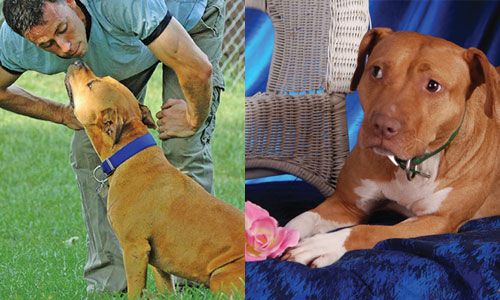
The dog -- named Lucas -- was humanely euthanized Wednesday at the Best Friends Animal Society in Kanab, Utah because of accumulating health problems. He was around 13 years old.
Lucas -- who was Vick's grand champion -- was one of nearly 2 dozen dogs that were rehabilitated at BFAS after they were rescued from the ring in 2007. Unfortunately, Lucas was not allowed to be adopted because of his vicious fighting history -- and therefore had to remain a lifetime-care dog at the animal sanctuary.
We're told Lucas was one of the friendliest dogs at the sanctuary -- and never stopped grinning.
Best Friends CEO Gregory Castle said, it was "a blessing in every way to be around him and to witness the wonderful effects on everyone he met."   Read more: http://www.tmz.com/2013/06/20/michael-vick-pit-bull-euthanized/#ixzz2cwF0zfRB

---------

Where the Former Michael Vick Dogs Are Now

“Since their rescue, they have gone on to find peace in the best ways they could.

Michael Vick Dogs: Sox and Hector

Sox and Hector

“Sox and Hector both received therapy dog certification, and spend their days at hospitals, nursing homes, and schools. Sox, who came into rescue as one of the worst of the low-response cases, has improved dramatically since being adopted by her foster family. Hector, with scars over his chest and legs bearing testament to his past life, was adopted into a home with a pack of six dogs, and has made many friends, canine and otherwise.”


Michael Vick Dogs: Zippy

Zippy

“Zippy, a small, energetic dog, has found peace and companionship
with the Hernandez
family, spending her days romping and rolling around the floor with two fellow dogs and three young children under the age of 10.”


Michael Vick Dogs: Johnny Justice

Jonny Justice

“Jonny Justice was adopted by a foster family who discovered his love of children, and he participated in a program called Paws for Tales, where dogs provide a nonjudgmental audience for children struggling with reading. Jonny excelled at it, until the librarian banned Pit Bulls from the program after receiving some complaints from parents. Jonny and his family resigned from the program in protest, and volunteers from BAD RAP looked into state law, finding the breed-based discrimination unlawful. When they brought this to the librarian’s attention, however, the library withdrew from the Paws for Tales program.”


Michael Vick Dogs: Bonita

Bonita

“Bonita, who was used in the dog-fighting ring as a bait dog for others to practice on, came into Best Friends rescue with scars, worn or broken teeth, and an instinct to flee from other dogs. She also had babesia, a blood-borne condition common in fighting dogs, and nerve damage in half of her face, so when she smiled nervously, it was crooked. She learned to crave warm laps to sleep in, and found a little bit of peace there. In 2008, she required dental surgery and never woke up from anesthesia.”

More about the other ‘Vickory’ dogs at:  http://blogs.bestfriends.org/index.php/2013/03/08/the-michael-vick-dogs/   and http://vickdogsblog.blogspot.com/

_______

Yesterday:

Misty and I went to get Jay, and a job that Jay and I thought wouldn’t take long, took almost all morning.

Ray and Shay live in my guest house, next to my house, and a couple of months ago, Shay’s sister had moved in with Ray and Shay’s son, who lives in the big mobile home on the other side of my house.  The two sisters have never got along, and they have worn a pathway across my grass going backwards and forwards, usually in a huffy gait.  Well, the sister found another place to live, and had a nice dining table and wooden daybed for sale, which I bought. The daybed has a new $380 mattress on it, and is in perfect condition.  The sister wanted me to leave the daybed in there for Shay to use and pay for it ‘later’.  BTDT. The sister still owes me $500 from many years ago!  Shay didn’t want to pay me the $100 that I had paid for it.  Sod her!

When I turn my Grooming Room into a bedroom, the daybed will be good for ‘staging’ the house.  The table matches my dining chairs and it is a foot longer than my table.  It will show how big my dining area really is.  All Jay and I had to do was move the table and daybed out of the mobile home, and store them in Pugsy, (my vintage motor home) which has a big wide back door.  The table and daybed were both put together with hex screws, and some of them were stripped.  I have a full set of Allen keys, but we also had to get vise-grips on the screws. It took a lot longer than anticipated. 

Also, I had just got a computer desk with file drawers, and we were supposed to move that into my guest house for Shay’s room.  It was a bit too long to go in the space that Shay had designated. It would have gone on another wall, but she didn’t want to move all that stuff.  So Shay decided that she wanted it in the newly vacated bedroom in the mobile home, and we had the job of moving that heavy thing up the tall steps.  Ray and Shay splitting up again?  I don’t know, but I know Shay’s overbearing ways, dramatics, and drinking get on Ray’s wick, and he might be glad if she moves. They argue all the time.  It was so peaceful when she wasn’t here for a year. 

By the time we had done all that, it was too late for Jay and I to start working on my screen porch roof.  Then the rains came, soaking the screen porch yesterday.

Monday, April 8, 2013

Toxic Plants. Ditch Corn Pet Food NOW. Wayne State’s Cruelty. Dog Fighting. Saved Prairie Dogs. Cats and Dry Food. Pottenger's Cats. Mink Farm. Wildlife on the Range. WPA. Hank Aaron.


For “Mammal Monday”:

6 Toxic Springtime Plants

“Many gardeners who are also pet owners are surprised to learn that certain beautiful, traditional spring flowers are potentially deadly for the family dog or cat.

#1: Tulips and Hyacinths. Tulips contain allergenic lactones. Lactones are derived from chemical compounds and taste a bit like whiskey. Hyacinths contain similar compounds. It's the bulbs of these two plants, not the leaves or flowers, that are toxic.
Symptoms of poisoning by one of these plants can include mouth and esophageal irritation, drooling, vomiting, diarrhea, increase in heart rate, and changes in breathing.  There's no antidote if your pup is poisoned by eating a tulip or hyacinth bulb, and severe symptoms need immediate treatment.

#2: Daffodils. If your pet licks or eats any part of a daffodil — the bulb, plant or flower — she will ingest an alkaloid called lycorine that can irritate the tissues of her mouth and throat and cause excessive drooling.
Lycorine can also trigger a gastrointestinal response like vomiting, abdominal pain or diarrhea. In more serious cases, heart and respiratory problems can occur. Severe symptoms such as these require immediate attention by a veterinarian.


#3: Lilies.  The variety of lily determines whether it is a relatively harmless or potentially deadly plant. Non-toxic varieties of lilies include the Calla, Peace and Peruvian. If your pet samples one of these plants, his upper digestive tract may become irritated and he may drool.
Types of poisonous lilies include the Tiger, Asiatic, Stargazer, Casablanca, Rubrum, Day, Japanese Show and Easter lily. These toxic lilies can prove deadly for your cat. If kitty swallows even a tiny amount of any portion of these plants, including the pollen, kidney failure can result.  If you suspect your cat has ingested any part of a lily, you should get both your pet and the plant to a veterinary clinic right away. Time is of the essence, so don't delay.

#4: Crocuses.  The variety of crocus plants that blooms in the spring is a member of the Iridaceae family. Spring crocuses can cause gastrointestinal upset in your pet, typically vomiting and diarrhea.
The crocus that blooms in autumn is known as the Meadow Saffron, and this plant is highly poisonous to companion animals.  If your dog or cat tastes a Meadow Saffron crocus, she can experience severe vomiting, gastrointestinal bleeding, liver and kidney damage, and respiratory failure. Symptoms of toxicity from this plant can appear immediately upon ingestion up to several days later.  If your pet shows signs of poisoning by an autumn blooming crocus, take her for veterinary treatment right away, and bring along the plant.


#5: Lily of the Valley.  Signs your dog or cat has eaten a lily of the valley plant can include vomiting, diarrhea, a drop in heart rate or severe cardiac arrhythmia, and seizures.
The substance in lilies of the valley that is toxic to your pet is called cardiac glycosides. If you think your pet has ingested a lily of the valley, you should get him to your vet for evaluation.


#6: Fertilized Plants.  The fertilizer you use on your plants can be just as dangerous, or more so, than the plants themselves. If you fertilize your lawn and garden in the spring, you should be aware of which types of fertilizer compounds are potentially fatal if swallowed by your pet.
Most fertilizers cause only mild gastrointestinal symptoms if eaten, but there are a few watch-outs including fertilizers containing blood meal, bone meal, disulfoton or another type of organophosphate, and iron.”  From:  http://healthypets.mercola.com/sites/healthypets/archive/2013/04/05/toxic-spring-plants.aspx

_______

Ditch This Pet Food Now - Can Be Deadly to Your Pets

Dry Dog Food“As we predicted in November of last year, dry dog foods containing corn and corn products harvested from last summer’s crop could present a significant risk of aflatoxin contamination.  The summer of 2012 across the Midwest was very dry and very hot, creating an environment in which certain types of plant mold proliferate. These molds produce metabolites called aflatoxins, which are mycotoxins known to cause acute lethal illness in both animals and humans.

Voluntary recalls of dry dog food due to high levels of aflatoxin contamination have already begun across states in the Midwest. Unfortunately, because of the behavior of the molds involved, it has proved difficult to control, minimize or even accurately assess levels of contamination.

If you feed dry dog food to your pet, we are repeating our recommendations to transition to another type of diet and/or carefully avoid any pet food containing corn or corn products.”    More at: http://healthypets.mercola.com/sites/healthypets/archive/2013/04/03/aflatoxin-contaminated-dog-food.aspx

_______

Court Says Wayne State Must Provide Records of Dog Heart Failure Experiments

“A Michigan court has rejected a Wayne State University lawsuit that attempted to stop the Physicians Committee from accessing public records showing the details of its heart failure experiments on dogs.

“Now that the facts can finally be made public, it will be clear that the experiments are cruel, and that there is no shortage of better research methods,” said Leslie Rudloff, senior counsel for the Physicians Committee.

Queenie, do used in medical experimentAccording to medical records obtained previously by the Physicians Committee, Charlie, a hound-Labrador mix, experienced two major surgeries to place medical devices in her body and had weeping wounds where catheters protruded. Jessie, a husky, didn’t suffer as long as Charlie. She died suddenly just six days after her first surgery. The Physicians Committee has obtained a photo of Queenie, a Dalmatian mix, who died in Wayne State’s laboratory in 2010.

Wasted Money, Wasted Lives,  Queenie, Charlie, and Jessie are three of the hundreds of dogs used in Wayne State’s heart experiments funded with millions of dollars from the National Institutes of Health.”     Please read this:  Queenie's Story: From Home to Laboratory     More at: http://www.pcrm.org/media/online/apr2013/wayne-state-records-dog-heart-failure-experiments

______

Dog Fighting Is Not Entertainment!

Tell YouTube to remove all videos containing any form of dog fighting

“The ASPCA recently assisted federal, state, and local agencies in a massive investigation that culminated in a multi-state dog-fighting raid. The dogs involved were rescued and transported to an emergency temporary shelter in an undisclosed location, where they will receive much needed veterinary care and treatment from the ASPCA.”

“Dog fighting, in and of itself is a heinous crime. What may be surprising to find out, however, is the idea that others are encouraging dog fighting by offering instructional videos about the activity. YouTube.com, the world's largest video sharing website, features videos depicting dog fights and material images[4]related to it.

Dog fighting is an abhorrent "sport" in which owners pit two dogs against each other in the ring and have them fight until one collapses or dies. The other dog is most often injured as well.  YouTube should not allow these videos to be featured on anywhere on the site as they only promote violence and carnage.

Write to YouTube's CEO asking him to prohibit these videos and stand up for dogs here: http://theanimalrescuesite.greatergood.com/clickToGive/ars/petition/YoutubeDogfighting?Origin=ETA_040413_YoutubeDogfighting_3 "

______

Prairie Dog Coalition Works With Colorado Highway Department

“The Humane Society of the United States Prairie Dog Coalition's latest project is advising the Colorado Department of Transportation on how to safely remove a prairie dog colony from a construction site near Boulder.

"We’re thrilled CDOT is using nonlethal means to relocate this keystone species," said Ghia Speakman, program manager for The HSUS’ Prairie Dog Coalition. "This effort demonstrates that we can protect imperiled prairie dogs at construction sites. We support CDOT with their humane and supported approach to prairie dog management and are excited to see these animals relocated."

To move the prairie dogs away from the heavy equipment, CDOT is catching them and actively relocating each one to a safer environment.”

“Business mogul and philanthropist Ted Turner talks about why it's so important to protect this country's prairie dogs. The Prairie Dog Coalition is thrilled to honor Turner with the 2011 Prairie Dog Protector award.”  From: http://thehungersite.greatergood.com/clickToGive/ths/article/Prairie-Dog-Coalition-Works-With-Colorado-Highway-Department397

_______WebMD: Better information. Better health.

Cat Feeding Mistakes: Feeding Only Dry Food

“The biggest mistake people make is feeding cats dry food,” says Lisa A. Pierson, DVM, a California veterinarian focused on feline medicine and nutrition, and creator of CatInfo.org.

As it turns out, today’s domestic tabby evolved from desert-dwelling ancestors, a heritage that no doubt left our furry felines with their grace, hunting prowess -- and low thirst drive.

“We know that a cat’s sensitivity to thirst is blunted compared to a dog,” Case says. “They don't voluntarily drink water like a dog would.” And because cats naturally produce highly concentrated urine “we're setting them up for urinary tract problems when their diet is low in liquids.”

“When cats present with urinary tract problems, the recommendation is to get them on a water-rich diet,” Pierson says. “However, why are we closing the barn door after the horse is a mile down the road? Why not practice preventive nutrition by feeding them [moisture-rich] canned food before they end up with urinary tract problems?”

Cats are designed to get their water with their food, Pierson says. Although mice, a cat's normal food, are about 70% water, and canned food about 78%, dry food is between 5%-10% water. That's why “canned food does a much better job of keeping your cat well-hydrated,” Pierson tells WebMD. “Think of canned food as hosing down your cat's bladder several times a day.”  More at: http://pets.webmd.com/cats/guide/mistakes-people-make-feeding-cats

______

Proper Feeding from Pottenger's Cats

“Between 1932 and 1942, Francis M. Pottenger, Jr., M.D. researched the use of adrenal hormones in respiratory complaints such as asthma. Because cats cannot live without their adrenal glands they were used as laboratory animals to standardize the extracts. Pottenger maintained his cats on what was considered to be a high quality, nutritionally complete feline diet. The cats were fed cooked meat scraps, consisting of liver, tripe, sweetbreads, brains, heart and muscle, from a local sanatorium, raw milk and cod liver oil. Commercial cat food did not appear on the markets until the 1960's. In Pottenger's time, domestic cats either hunted for their food or were fed table scraps.

Compared to the stainless steel cages laboratory cats live in today, Pottenger's cats dwelt in agreeable quarters. They lived in large outdoor pens overlooking the San Gabriel Valley. The outdoor area was covered with chicken wire for adequate sun exposure. They had a trench filled with clean sand for a litter box. The back of the pens was sheltered and contained a wooden floor and bedding. Caretakers removed the cats' uneaten meat and bones and cleaned and refilled the water containers daily.

Even though they received such good care, Pottenger could not understand why the cats were such poor operative risks. Many died in surgery or recovered slowly.

When the cats donated to Pottenger's study outnumbered the food available from the sanatorium, Pottenger placed an order at a local meat packing plant for raw meat scraps, again including the viscera, muscle and bone.

Pottenger fed the raw meat scraps (including raw milk and cod liver oil) to a segregated group of cats, keeping the remainder of his cats on the cooked meat diet. Within a few months the differences between the cats fed raw meat and those fed cooked meat became evident. The raw meat fed cats and kittens were more vigorous and survived surgery better than the cooked meat fed cats.”   More at: http://feline-nutrition.org/nutrition/proper-feeding-from-pottengers-cats

_______

Mink farm fined $48,000 for discharging manure into creeks

imagesCAGLQDX5 BELLINGHAM – “The owner of two Deming area mink farms is being fined $48,000 by the Washington Department of Ecology for discharging water contaminated with manure into nearby salmon-bearing creeks and spawning habitat in eastern Whatcom County.  The farms operate as Marr’s Black Plush Ranch, Inc. at 9471 and 9580 Mount Baker Highway.

imagesCA1XVWHHOn Dec. 10, 2012, Ecology inspectors found water contaminated with mink manure and feed draining directly into ditches that flow to Cornell and Hedrick creeks.  Both creeks are home to five species of salmon and two to three species of trout, and have prime spawning habitat. Two of the species of fish – steelhead trout and chinook salmon – are listed as threatened under the federal Endangered Species Act.

Water samples taken from the properties show the fecal coliform bacteria count was up to 240 times greater than the state limit. State law allows 100 fecal coliform bacteria per 100 milliliters of water. The ranch was discharging 24,000 fecal coliform bacteria per 100 milliliters of water.

imagesCASNBIJC Ecology fined the owner $24,000 for similar violations and issued a compliance order in 1999. During the most recent investigation, inspectors found contamination coming from sources documented in the previous case. Also, past improvements made to the ranch had not been maintained. 

This time inspectors discovered thick layers of bacteria on the property and in the ditches – a sign of ongoing contamination. Bacteria from manure pollution can create a human health risk, and can harm fish and other aquatic life by depleting needed oxygen from the water.”  More at: http://www.ecy.wa.gov/news/2013/098.html

--------

From me:  I cannot understand why people would want to hang a dead animal around their neck.  Something that died of old age in the Arctic makes good warm clothing, but to deliberately breed and make animals suffer for a useless adornment, beats me.

_______

Protecting a Home for Wildlife on the Range: Ode to a Fenceless Landscape

“Several years ago, I was driving along a snaking bend of State Highway 22 that bisects Jackson Hole, Wyoming, and encountered the body of massive bull elk hanging from a fence that paralleled the road, its back legs hamstrung by four unyielding strands of barbed wire. His antlers were partially buried in a deep, windswept trough of snow and his lifeless eyes fixed on some distant point on the horizon. I wondered how long he had been hanging there, (and how long it took him to die.)

Since that time, I have become more aware of man’s heavy hand on the landscape, and a deep desire has grown in my heart to change things—really fix the problems, beyond the ebb and flow of politics. Last year, Nature Valley generously granted my wish.

A volunteer removes wire to modify a fence near Grand Teton National Park

Grand Teton still permits some cattle grazing in the park—a grandfathered use from its historic ranching past. The fences in the North Elk Ranch allotment have been kept in good condition, but still block wildlife movement in the northern part of the park, where many species of animals migrate through. In the spring, we met with the manager of the Pinto Ranch to discuss how to make the fences in this area safer for wildlife, while still providing a reliable enclosure for his cows. We collectively agreed upon a modification of a five-mile fence that would raise the bottom wire to allow pronghorn to crawl under it, and then add a top rail to prevent wildlife from becoming ensnared as they jumped the fence.”  More at: http://www.parkadvocate.org/protecting-a-home-for-wildlife-on-the-range-ode-to-a-fenceless-landscape/

_______

On This Day:

WPA established by Congress, Apr 8, 1935:

“On April 8, 1935, Congress votes to approve the Works Progress Administration (WPA), a central part of President Franklin D. Roosevelt's "New Deal."

In November 1932, at the height of the Great Depression, Governor Roosevelt of New York was elected the 32nd president of the United States. In his inaugural address on March 4, 1933, Roosevelt promised Americans that "the only thing we have to fear is fear itself" and outlined his New Deal--an expansion of the federal government as an instrument of employment opportunity and welfare.

In April 1935, the WPA was established under the Emergency Relief Appropriation Act, as a means of creating government jobs for some of the nation's many unemployed. Under the direction of Harry L. Hopkins, the WPA employed more than 8.5 million persons on 1.4 million public projects before it was disbanded in 1943. The program chose work that would not interfere with private enterprise, especially vast public building projects like the construction of highways, bridges, and dams. However, the WPA also provided federal funding for students, who were given work under the National Youth Administration. The careers of several important American artists, including Jackson Pollack and Willem de Kooning, were also launched thanks to WPA endowments. Although its scale was unprecedented, the WPA never managed to serve more than a quarter of the nation's unemployed. Its programs were extremely popular, though, and contributed significantly to Roosevelt's landslide reelection in 1936.”

_______

Aaron sets new home run record, Apr 8, 1974:

“On this day in 1974, Hank Aaron of the Atlanta Braves hits his 715th career home run, breaking Babe Ruth's legendary record of 714 homers. A crowd of 53,775 people, the largest in the history of Atlanta-Fulton County Stadium, was with Aaron that night to cheer when he hit a 4th inning pitch off the Los Angeles Dodgers' Al Downing.

Although "Hammerin' Hank" specialized in home runs, he was also an extremely dependable batter, and by the end of his career he held baseball's career record for most runs batted in: 2,297.

Aaron's playing career spanned three teams and 23 years. He was with the Milwaukee Braves from 1954 to 1965, the Atlanta Braves from 1966 to 1974 and the Milwaukee Brewers from 1975 to 1976. He hung up his cleats in 1976 with 755 career home runs and went on to become one of baseball's first African-American executives, with the Atlanta Braves, and a leading spokesperson for minority hiring. Hank Aaron was inducted into the Baseball Hall of Fame in 1982.”

_______

Yesterday:

It was lovely weather, not too hot and not cold, so I was hoping that I would hear from Jay, as we need to start digging again, and find that survey stake. But he must have had other things to do.

I gave Terry-cat several breathing treatments, and it seems like it is breaking up the mucous in his nose.  But all I could get down him was a thimble full of beef baby food from a jar, so he is getting dehydrated again.  He just spits everything out, so I can see another trip to the vet coming up.

As it was a doors-and-windows-open day, Terry spent several hours basking in the sun on the screen porch.  That should help him get his strength up, and give him his Vitamin D dose for the day.

Monday, November 26, 2012

"Death Treats". Older Pets. Stop The Dog Fights. Separation Anxiety. Moving? More Rabid Cats Than Dogs. “Patrick”. “Bailey”. Diamond Hoax. "Cloverleaf". Thanksgiving Day.


For “Mammal Monday”:

Elected Officials Turn Up Heat on FDA's Handling of "Death Treats"

Pet Food

“One of the only ways a pet owner might learn about potentially deadly dog or cat treats is to visit the FDA website and look for pet food-related advisories. That's one of the reasons why, after five years and over 2,000 reported incidents of illness and death, unwitting consumers are still offering potentially deadly treats to their pets.

Recently, political leaders have become increasingly vocal in demanding the FDA do more to protect the health and lives of pets.

Unfortunately, with potentially deadly jerky pet treats still readily available on store shelves, word of mouth is one of the few options available to spread the news. Pet owners should avoid all treats containing ingredients from China - and any treat they aren't sure is entirely safe to feed their dog or cat.”    Complete article at: http://healthypets.mercola.com/sites/healthypets/archive/2012/11/07/fda-pet-food-warning.aspx?e_cid=20121107_PetsNL_art_3

Chicken JerkyMore at: Chicken Jerky Treat Casualties: 360 Dogs, 1 Cat

http://healthypets.mercola.com/sites/healthypets/archive/2012/11/16/chicken-jerky-treat-casualties.aspx?e_cid=20121116_PetsNL_art_1

_______

Anti-Aging Exercises to Keep Your Senior Pet Active

“Pets, just like their humans, need to stay active as they get up in years.

Your pet’s aging body will lose muscle tone, balance and fluid movement without regular exercise and healing therapies like massage.

Three groups of exercises that help senior pets stay active and pain-free include passive range-of-motion exercises, balance and movement exercises, and exercises that maintain large muscle groups like the hamstrings and glutes.

Massage can also be very beneficial to maintain flexibility and movement, as well as to ease sore muscles and joints.

There are lots of other things pet owners can do to help their older dog or cat age comfortably and in good health.”    Complete article at: http://healthypets.mercola.com/sites/healthypets/archive/2012/01/26/anti-aging-exercises-for-pets.aspx

_______

image

“Urgent: Tell Congress to Stop the Cruelty http://action.humanesociety.org/site/R?i=4qiZBSyHP8Q8eeLxh59UxQ

One of the top priorities for the Humane Society Legislative Fund (HSLF) this year was to expose Rep. Steve King’s dreadful animal protection record—most notably his defense of the barbaric “sport” of animal fighting. Thanks to you, animal issues became a key part of the debate in his congressional race and around the country.

Now, we have an opportunity to strengthen penalties for animal fighting spectators nationwide and to give law enforcement the tools they need to crack down on animal fighting. But, we must tell Congress to act on this important legislation NOW, before they adjourn for the year.

The Animal Fighting Spectator Prohibition Act (S. 1947/HR. 2492) fixes a major gap in federal law and would prohibit knowing attendance at organized dogfighting and cockfighting events and impose additional penalties for bringing a child to an animal fight.

Over the past decade, Congress has strengthened the penalties for and closed major loopholes in the federal animal fighting law, but has left the issue of spectators unaddressed. Without penalties for spectators who attend and help finance these fights, we’ll never be able to end this barbaric practice for good.” From: http://action.humanesociety.org/site/MessageViewer?em_id=50986.0&dlv_id=53782        More at: https://secure.humanesociety.org/site/Advocacy?cmd=display&page=UserAction&id=5793

_______

Separation Anxiety

“Separation problems are very common with dogs. Dogs are highly social
animals and some have a difficult time being left alone.
Separation problems can result in housetraining issues, chewing and
destructive behaviors, barking, digging and anxiety.
If your dog is having a separation problem--the following are some steps
you can take to help him overcome it:

Step #1:     Understand your dog's behavior. 
Your dog is not destroying your house to spite or get back at you.
Step #2:     Your dog is highly stressed and cannot handle being by herself.  You need to help your dog feel secure when left alone.
Step #3:     Help develop your dog's tolerance for being left alone. Your dog becomes stressed when you leave.
Step #4:     To increase your dog's stress tolerance, you need to gradually leave your dog alone for longer and longer periods.
Step #5:     This is accomplished by putting on your jacket, grabbing your keys like you're leaving and walking out the door.
Step #6:     Once you're outside, wait about 5 minutes and walk back in.
Step #7:     If your dog can handle the 5 minutes, increase the time to 10 minutes. Once your dog can handle the 10 minutes, keep gradually
increasing the amount of time you're outside. This does require some time and patience.
Step #8:     Crate training your dog can also be very helpful when you have to leave for longer periods of time.
Step #9:     Exercise your dog. A dog that has separation problems and a lot of pent-up energy will result in disaster.
Step #10:   Bringing your dog to a dog daycare may be an option if your dog does not like the crate and if your dog is very active.
Step #11:   The exercise and mental stimulation at the daycare should help your dog overcome separation anxiety.
Step# 12:   In extreme cases you may need the help of your veterinarian. A vet can provide medication for dogs that are extremely stressed when left alone.  Get more help with separation anxiety at the
Dog Training Inner Circle where I can answer your questions personally.
http://dogtraininginnercircle.com    All the best, Eric”     From: http://dogtraininginnercircle.com/element.php?varset=s:438-pm:p-se:19411-e:45645&SessId=

_________

Moving? How to Minimize Dog and Cat Stress

Woman with dogs in room with moving boxes

iStockphoto

“Moving is tough on families, and it's particularly stressful on dogs and cats. Animals always know when something's amiss, even if they can't understand exactly what's changing or why.

The key to moving pets is to keep them secure before and during the move and to settle them safely and quickly into a routine afterward.

The family dog is a bit easier to deal with. Put his leash on and drive him to his new address. Show him his new, warm home and the securely fenced backyard. Unless the dog is a high-jumper of Olympic caliber, he'll stay put while he adjusts.

Cats are a particular worry at moving time. They not only form a bond with the people in a home, but they are also attached to the home itself. Because of their mobility, cats can be difficult to keep around the new home long enough for them to realize that this is where the people they love now live.

Once they're moved, free-roaming cats often try to flee to their familiar dwelling. The cases of cats returning to their previous homes are common for people who move short distances, and the instances of cats disappearing forever are just as common for families moving great distances.

Confinement is essential when moving cats. It keeps them safe while they become used to their new territory and make it their own. If your cat isn't already an indoor cat, bring him inside before the movers arrive. Set him up in a "safe room" — a spare bathroom or bedroom is ideal — and leave him alone. Provide him with food and water, his bed, a scratching post, a litterbox and a couple of favorite toys while the packing and moving is under way.

The cat's ride to the new home is best undertaken in a carrier, especially for the cat who rarely sees the inside of a car.

At the new home, work the "leaving home" procedure in reverse. Put the cat into a "safe room" for a few days — until the movers are gone, the furniture arranged and most of the dust settled — and then allow him to explore inside the house on his own terms after things calm down a bit.

Quickly re-establish a routine. Pick a time and a place for feeding, and stick to it for all pets.

If you've been thinking about converting your free-roaming cat into a house dweller for his health and safety, moving to a new home is the perfect time to accomplish it. In your old home, you'd be constantly listening to your cat demanding to be let out into the rest of his territory. In a new home, he hasn't established any territory of his own yet, and you can make the new home his only turf by keeping him inside from day one.”   More at: http://www.vetstreet.com/our-pet-experts/moving-how-to-minimize-dog-and-cat-stress

_________

Study Finds Free-Roaming Cats Pose Threat from "Serious Public Health Diseases"

Among the key findings of the paper are:

  • Free roaming cats are an important source of animal-transmitted, serious diseases such as rabies, toxoplasmosis, and plague.
  • Free roaming cats account for the most cases of human rabies exposure among domestic animals, and are the source for one-third of rabies post-exposure treatments in the United States. Because of inconsistent incident reporting, that number is likely an underestimate of the actual cases of rabies exposure.
  • Trap, neuter, and release (TNR) programs may lead to increased, un-inoculated populations of cats that can serve as a source of transmittable serious diseases.

The study found that since 1988, rabies has been detected more frequently in cats than in dogs; in 2008, the number of cats detected with rabies was four times higher than dogs.  In 2010, rabies cases declined for all domestic animals except cats, which comprised 62 percent of all rabies cases for domestic animals.

“This is a significant study that documents serious wildlife and public health issues associated with 125 million outdoor cats in the United States.  Decision-making officials need to start looking at the unintended impacts these animals have on both the environment and human health when they consider arguments to sanction Trap, Neuter, and Return (TNR) cat colonies. These colonies are highly detrimental to cats, wildlife, and people, and only serve to exacerbate the cat overpopulation problem,” said Darin Schroeder, Vice President for Conservation Advocacy at American Bird Conservancy.”  More at: http://www.abcbirds.org/newsandreports/releases/120918.html

________

Patrick The Miracle Dog Survives Abuse In Newark, NJ.

Patrick the Miracle Dog


“A dog that was found near death in New Jersey has been nursed back to life. The dog had barely any skin over its bones when someone tossed it down a trash chute in Newark. The lucky dog they are calling “Patrick the miracle dog” is recovering.

“According to the Los Angeles Times, Kisha Curtis, the dog's 27-year-old owner, had tied him to a railing and left him there for a week. It's unclear if she threw him down the chute or if someone else did.

Patrick was then taken in and cared for by the Associated Humane Societies in New Jersey, reported ohmidog.com Volunteers took him to Garden State Veterinary Services where a giant hairball was removed from his stomach so that he could begin to eat again.  The Vets think it could be something he eat out of desperation while nearly starving to death.  "The veterinary staff immediately put him on intravenous fluid. His temperature was so low that it did not even register on the thermometer," says Patrick's Facebook page. He soon became an Internet celebrity, with donations pouring in from around the world.

Patrick weighed 19 pounds when he arrived at the hospital. He now weighs 50 pounds. Associated Humane Societies is seeking custody of Patrick, whose newfound fame is being used to advocate for stricter animal abuse laws. AHS wants to find a new forever-home for Patrick.  Garden State Veterinary Specialists of Tinton Falls, however, is also vying for a part in Patrick's plight. He has been staying with Patricia Smillie-Scavelli, the hospital’s administrator, who also wants to keep the brave dog. 

“He really gives love,” Scavelli told Irish Central. “He climbs into your lap, he would prefer to sit in your lap than lay on the floor. He also sleeps in our bed at night, along with the cat.”
However, a few physical scars remain from Patrick's ordeal. NBC reports that he is still fearful of strangers, but when fed a few dog treats, he quickly warms up.
Curtis is scheduled to appear in court on charges of animal cruelty. She is not accused with tossing Patrick down the chute, only with neglect and abandonment.” Patrick, The Miracle Dog, Recovers After Being Starved, Tossed Down Garbage Chute (PHOTOS)

Update: http://www.huffingtonpost.com/2012/09/18/patrick-the-miracle-dog-_n_1894325.html

See Patrick Play:

________

Dog Welcomes Home Sailor after 7 months in Afghanistan!!!

“Bailey Welcomes home Sean after 7 months. I was surprised she still remembered me, we got her at the pound as a stray only 3 months before I left!”

________

Help Shelters and Rescued Animals On The East Coast Recover!

http://www.theanimalrescuesite.com/tpc/ERA_110412_ARS_m

Click Here
and make your click
to fund food, FREE.

http://www.theanimalrescuesite.com/clickToGive/home.faces?siteId=3&ThirdPartyClicks=ERA_090309_ARS

_________

On This Day:

The Great Diamond Hoax is exposed, Nov 26, 1872:

“The Great Diamond Hoax, one of the most notorious mining swindles of the time, is exposed with an article in the San Francisco Evening Bulletin.

Fraudulent gold and silver mines were common in the years following the California Gold Rush of 1849. Swindlers fooled many eager greenhorns by "salting" worthless mines with particles of gold dust to make them appear mineral-rich. However, few con men were as daring as Kentucky cousins Philip Arnold and John Slack, who convinced San Francisco capitalists to invest in a worthless mine in the northwestern corner of Colorado.

Arnold and Slack played their con perfectly. They arrived in San Francisco in 1872 and tried to deposit a bag of uncut diamonds at a bank. When questioned, the two men quickly disappeared, acting as if they were reluctant to talk about their discovery. Intrigued, a bank director named William Ralston tracked down the men. Assuming he was dealing with unsophisticated country bumpkins, he set out to take control of the diamond mine. The two cousins agreed to take a blindfolded mining expert to the site; the expert returned to report that the mine was indeed rich with diamonds and rubies.

Joining forces with a number of other prominent San Francisco financiers, Ralston formed the New York Mining and Commercial Company, capitalized at $10 million, and began selling stock to eager investors. As a show of good faith, Arnold and Slack received about $600,000-small change in comparison to the supposed value of the diamond mine. Convinced that the American West must have many other major deposits of diamonds, at least 25 other diamond exploration companies formed in the subsequent months.

Clarence King, the then-little-known young leader of a geographical survey of the 40th parallel, finally exposed the cousins' diamond mine as a hoax. A brilliant geologist and mining engineer, King was suspicious of the mine from the start. He correctly deduced the location of the supposed mine, raced off to investigate, and soon realized that the swindlers had salted the mine--some of the gems he found even showed jewelers-cut marks.

Back in San Francisco, King exposed the fraud in the newspapers and the Great Diamond Hoax collapsed. Ralston returned $80,000 to each of his investors, but he was never able to recover the $600,000 given to the two cousins. Arnold lived out the few remaining years of his life in luxury in Kentucky before dying of pneumonia in 1878. Slack apparently squandered his share of the money, for he was last reported working as a coffin maker in New Mexico. King's role in exposing the fraud brought him national recognition--he became the first director of the United States Geological Survey.”

_________

First U.S. "cloverleaf" appears on the cover of the Engineering News-Record, Nov 26, 1931:

imagesCA95MWII“The first cloverleaf interchange to be built in the United States, at the junction of NJ Rt. 25 (now U.S. Rt. 1) and NJ Rt. 4 (now NJ Rt. 35) in Woodbridge, New Jersey, is featured on the cover of this week's issue of the Engineering News-Record. (By contrast, a piece on the under-construction Hoover Dam was relegated to the journal's back pages.)

These circular ramps move cars from one road to the other fairly efficiently, as long as the roads aren't too busy—but once traffic speed and volume increases, cloverleaves can be just as dangerous as the intersections they replaced. The Woodbridge interchange, for instance, had no merge lanes, so it forced motorists to stop without warning or to plunge directly into highway traffic. Many thousands of fender-benders were the result. It was "the Model T of cloverleafs," said a spokesman for the New Jersey Department of Transportation (NJDOT). "It worked well at one time, but it's beginning to reach the end of its usefulness." As a result, it's getting a facelift: the NJDOT plans to replace the sprawling cloverleaf with a more compact, diamond-style interchange that will eliminate both the dangerous merges and the associated gridlock.”

_______

FDR establishes modern Thanksgiving holiday, Nov 26, 1941:

“President Franklin D. Roosevelt signs a bill officially establishing the fourth Thursday in November as Thanksgiving Day.

The tradition of celebrating the holiday on Thursday dates back to the early history of the Plymouth and Massachusetts Bay colonies, when post-harvest holidays were celebrated on the weekday regularly set aside as "Lecture Day," a midweek church meeting where topical sermons were presented. A famous Thanksgiving observance occurred in the autumn of 1621, when Plymouth governor William Bradford invited local Indians to join the Pilgrims in a three-day festival held in gratitude for the bounty of the season.

Thanksgiving became an annual custom throughout New England in the 17th century, and in 1777 the Continental Congress declared the first national American Thanksgiving following the Patriot victory at Saratoga. In 1789, President George Washington became the first president to proclaim a Thanksgiving holiday, when, at the request of Congress, he proclaimed November 26, a Tuesday, as a day of national thanksgiving for the U.S. Constitution. However, it was not until 1863, when President Abraham Lincoln declared Thanksgiving to fall on the last Thursday of November, that the modern holiday was celebrated nationally.

With a few deviations, Lincoln's precedent was followed annually by every subsequent president--until 1939. In 1939, Franklin D. Roosevelt departed from tradition by declaring November 23, the next to last Thursday that year, as Thanksgiving Day. Considerable controversy surrounded this deviation, and some Americans refused to honor Roosevelt's declaration. For the next two years, Roosevelt repeated the unpopular proclamation, but on November 26, 1941, he admitted his mistake and signed a bill into law officially making the fourth Thursday in November the national holiday of Thanksgiving Day.”

_______

Yesterday:

Prissy-chasing-2012-11-251The animals had a quiet day, while I cleaned more glass, tended to stuff on the computer.

Except for Miss Priss that is!

She just tore around until she fell asleep on the porch!

Prissy on porch


She would rather chase around than eat! 

Misty-2012-11-25


It started out cold, and Misty had to wear her other coat, not her raincoat this time, to keep warm. 


Then I made some turkey in gravy from the dark meat from the carcass.  The broth is already strained out, but there was still a lot of meat left.  The white meat and broth have already been frozen.  That is a fiddly job, making sure all the tiny bones are discarded, and I still don’t have all the dark meat sorted through.  I don’t know if it is worth it.   I wonder how they do it in the Chinese restaurants.  Maybe they have a ‘bone magnet’!

They must do it when it is still raw, so much easier:

I should have been outside raking up the Red Maple’s leaves, as it warmed up to a lovely day.