Showing posts with label Travel. Show all posts

Sunday, June 11, 2023

Is Space the Final Frontier? Are We Alone in the Universe? The Role of Processed Foods in the Obesity Epidemic.

.

Is Space the Final Frontier?

Is Space the Final Frontier?“The vastness and unexplored mystery of outer space has inspired many. But is it truly the final frontier? What other vistas await the human race?

As a boy in the 1960s, I think I learned to count down from 10 almost as early as I learned to count forward. The thrill of each rocket launch in the race to the moon began to make anything seem possible.

When the original Star Trek television series launched in 1966, it seemed that space truly was “the final frontier,” as Capt. James T. Kirk declared at the start of each episode. Our collective mission was “to boldly go where no man has gone before.”

To boldly go

In the years since Star Trek’s short three seasons (1966-1969) and the brief period of human exploration of the moon (1969-1972), the excitement of space seems to have faded a little. But for many people it never lost its pull.

Now private companies have begun to take up the mission “to boldly go,” with space tourism serving as a stepping stone to the moon, Mars and beyond.

Feeling the overview effect

In October 2021, the actor who played Capt. Kirk finally got his chance to experience space in real life. William Shatner, then 90 years old, spent only three minutes in space with Blue Origin founder Jeff Bezos. But the effect was powerful.

The Atlantic reported that, with tears running down his cheeks, Shatner said, “What you have given me is the most profound experience I can imagine.”

What was it like touching the edge of his final frontier? “It’s extraordinary. Extraordinary. I hope I never recover from this.”

Shatner is not the only one who has felt powerful emotions upon looking down on our precious planet or out into the universe. The experience has even been given the name the overview effect.

  • “No one could be briefed well enough to be completely prepared for the astonishing view that I got,” wrote astronaut Alan Shepherd in 1962.
  • “If only everyone could relate to the beauty and the purposefulness of it,” said Gene Cernan, one of the 12 people who have walked on the moon. “It wouldn’t bring a utopia to this planet for people to understand it all, but it might make a difference.”

For more about this phenomena, see our blog post “The Overview Effect: Why We Need to See the Big Picture.”

Other frontiers

While outer space has gotten most of the headlines as the final frontier, others have suggested that inner space is where it’s at. Of course, this term has been defined in different ways. Merriam-Webster.com says the first known use of inner space was in 1958, in the sense of “space at or near the earth’s surface and especially under the sea.”

It has also been used to describe the microscopic world, as well as the inner self.

All of these frontiers, though closer to home, may be as mysterious and challenging as outer space.

The bottom of the sea

As man headed into space, undersea exploration was also taking off.

On Jan. 23, 1960, Jacques Piccard and Don Walsh descended for nearly five hours to reach the Challenger Deep, the deepest known point in the ocean. It is 6.83 miles (10.99 kilometers) below the surface of the Pacific Ocean near Guam.

Ever since, oceanographers have made amazing discoveries in an unseen world every bit as fantastic as science fiction:

  • “In the coastal waters of Shark Bay, Australia, scientists discovered that a seagrass bed of Poseidon’s ribbon weed (Posidonia australis) is actually one plant. The massive organism covers an area of 77 square miles” (Smithsonian).
  • Off the coast of Antarctica, “scientists discovered 60 million icefish nests covering an area the size of a small city” (ibid.).
  • “From 13m-long (43ft) voracious carnivorous squid, to scuttling Yeti crabs huddling near hydrothermal vents, to tusked whales dwelling thousands of feet down to avoid predatory orcas, sizeable marine animals new to science are still being documented every year” (BBC).
  • The deep ocean seemed to be “a harsh, monotonous place of perpetual darkness, frigid temperatures, limited food and extreme pressure—conditions that should make complex forms of life impossible. But new tools . . . have demonstrated that biodiversity in the darkest depths may rival that of rain forests and tropical coral reefs” (Scientific American).

But even with all the exploration that has been done, only 5 percent of the ocean has been explored.

According to the U.S. Geological Survey, “Humans know more about the physical and chemical properties of outer space than about planet Earth’s deep ocean regions.”

Inner space remains an exciting frontier for future generations. “The generation of kids in middle schools right now will explore more of Earth than all previous generations combined,” said National Geographic explorer-at-large Robert Ballard.

The microscopic world

Within the earth’s biosphere, the life-forms visible to the eye are outnumbered by the microscopic ones. This invisible world could also make a claim to the title final frontier.

Consider these amazing facts:

  • “Right beneath your nose—on your face, in your gut, and everywhere in between—trillions of bacteria, viruses, and fungi are so abundant in your body, they outnumber your human cells” (NOVA).
  • “Microalgae in the ocean produce half of all the oxygen in our atmosphere. Fungi and bacteria convert the organic material from dead animals into new raw materials. And intestinal bacteria help you digest your food. Without any of them, life on earth wouldn’t be possible” (Micropia.nl).
  • “Microbes eat almost everything, including metals, acids, petroleum and natural gas” (ibid.).
The human mind

Lawrence Galton wrote in 1958: “Of all things known in the universe, the human brain is by far, the most complex. As a subject for scientific study it presents infinite intricacies and difficulties.”

The National Institute of Neurological Disorders and Stroke said in 2023: “The brain is the most complex part of the human body. This three-pound organ is the seat of intelligence, interpreter of the senses, initiator of body movement, and controller of behavior. Lying in its bony shell and washed by protective fluid, the brain is the source of all the qualities that define our humanity. The brain is the crown jewel of the human body.”

Beyond the gray matter of the brain itself, deeper questions arise about the difference between animal brains and human minds. In this frontier we are still probing the mysteries of memory, creativity, consciousness and the subconscious. What gives us the ability to think, plan, calculate, design, enjoy, love and so many other things?

The human mind itself is a worthy frontier.

For more on this, see our article “The Miracle in the Mind.”

Our minds have allowed us to study and explore all of these frontiers. And beyond that, they have conceived of other frontiers of creativity and imagination, such as time travel, the metaverse and multiverse.  

Is there anything that all these frontiers have in common? Space, the oceans, the microscopic world, the human mind and the cyber world are all based on some combination of space, time, matter and energy.

In that sense, they are all physical.

In considering what our final frontier is, we should ask:

Is there anything beyond the physical?

Beyond space and time

While human beings enjoy imagining fictional multiple dimensions and universes, our minds can’t truly comprehend realms beyond dimensions and unlimited by time and space. 

As incredible as our imaginations are, they are shaped by what we know—matter, energy, space and time.

Yet there is a source that claims to be a message from beyond space and time. In fact, it claims to be from the Source of space and time. And it offers glimpses into that realm, translated into concepts humans can only begin to perceive.

Most amazing of all, it reveals directions that lead to a portal into that realm.

The Source—the Creator—had a reason for making us as finite beings who are always searching for new frontiers. In His unbounded love, He deeply desires for us to become like Him and to join Him in eternity!

This loving plan—this path leading to our transformation—is truly the final frontier that humanity has always sought.

A peek into eternity

The greatest library of inspirational literature ever written, which claims the Creator God as its Author, gives us tantalizing glimpses into our destiny.

God has big plans for His children, and they are never-ending plans (Isaiah 9:7). This final frontier will be an ever-increasing one, with fullness of joy and pleasures forevermore (Psalm 16:11). The Holy Bible reveals that from the beginning, we were actually created in the image and likeness of the Creator (Genesis 1:26). And though we are now mortal and corruptible, God plans to give us immortality and incorruption (1 Corinthians 15:53).

God is offering to share all things with us and to give us amazing glory (Hebrews 2:6-10).

What does this look like? The Bible hints that God’s plans for us are beyond what our senses can experience and beyond even our wildest dreams:

“Eye has not seen, nor ear heard, nor have entered into the heart of man the things which God has prepared for those who love Him” (1 Corinthians 2:9).

God has given us “exceedingly great and precious promises, that through these [we] may be partakers of the divine nature” (2 Peter 1:4). He gives us divine power through His Holy Spirit to begin our metamorphosis.

God wants us to begin the transformation process from the inside:

“And do not be conformed to this world, but be transformed by the renewing of your mind, that you may prove what is that good and acceptable and perfect will of God” (Romans 12:2).

Those living by the perfect will of God in this world will run into obstacles and enemies, but even these are just part of the training program God has for us.

In this world of dust, challenges abound. But God’s love for us is far more powerful than anything we face. The apostle Paul penned these words of encouragement:

“For I am persuaded that neither death nor life, nor angels nor principalities nor powers, nor things present nor things to come, nor height nor depth, nor any other created thing, shall be able to separate us from the love of God which is in Christ Jesus our Lord” (Romans 8:38-39).

The apostle John summed up God’s awesome plan in these immortal words:

“Behold what manner of love the Father has bestowed on us, that we should be called children of God! . . .

“Beloved, now we are children of God; and it has not yet been revealed what we shall be, but we know that when He is revealed, we shall be like Him, for we shall see Him as He is.

“And everyone who has this hope in Him purifies himself, just as He is pure” (1 John 3:1-3).

God has big plans for His children, and they are never-ending plans (Isaiah 9:7). This final frontier will be an ever-increasing one, with fullness of joy and pleasures forevermore (Psalm 16:11).

This is our ultimate purpose. It gives incalculable value to our lives. It provides profound meaning.

Whether this article has convinced you or not, you owe it to yourself to explore this further.

Study the inspiring human potential using our free booklet God’s Purpose for You: Discovering Why You Were Born. This booklet can enlighten and empower you to boldly go where your Creator is leading you!:  From: https://lifehopeandtruth.com/life/what-is-the-meaning-of-life/is-space-the-final-frontier/?

________

Are We Alone in the Universe?

Are We Alone in the Universe“The search for life in outer space is not just the stuff of science fiction. Scientists continue to look for evidence of life out there. Will they find it?

Is there anyone out there?

Do we share the universe with other life-forms? Is there anyone out in the vastness of space?

Many in the scientific community believe the answer is yes. According to astronomers, there are 70 sextillion (7 followed by 22 zeros!) stars in the cosmos. Deeply rooted in evolutionary theory, many scientists believe there is a great probability that life has evolved on other planets with conditions favorable for life.

Exploring exoplanets

Recently NASA has reported the discovery of an additional 65 exoplanets (planets that orbit a star outside our solar system) in our Milky Way galaxy, raising the total to more than 5,000. Yet despite these amazing discoveries in the field of astronomy, the search for life on other planets still eludes searchers.

Reporting on this, Marina Koren wrote in The Atlantic: “But no one has yet discovered evidence of life in another planet’s atmosphere, nor detected radio transmissions wafting from the direction of a distant world. Astronomers can predict how many planets are out there, but they can’t say how many we’d have to find to discover another Earth or a sign of extraterrestrial life. Even with more than 5,000 other worlds in the books, it’s still just us. In fact, scientists could find 5,000 more exoplanets and we might be exactly as alone as we are now” (March 22, 2022).

Others, such as Dr. Seth Shostak, a leading scientist at SETI Institute (in Mountain View, California), believe scientists will find intelligent life in space within the next few decades. SETI stands for Search for Extra-Terrestrial Intelligence, a research group with the stated mission “to understand the origins and prevalence of life and intelligence in the universe.”  Continued at: https://lifehopeandtruth.com/life/what-is-the-meaning-of-life/are-we-alone-in-the-universe/

_________

The Role of Processed Foods in the Obesity Epidemic

Transcript of the video at: https://nutritionfacts.org/video/the-role-of-processed-foods-in-the-obesity-epidemic/

“The rise in the U.S. calorie supply responsible for the obesity epidemic wasn’t just about more food but a different kind of food.

The rise in the number of calories provided the U.S. food supply since the 1970s is more than sufficient to explain the entire obesity epidemic. Similar spikes in calorie surplus were noted in developed countries around the world in parallel with, and presumed primarily responsible for, the expanding waistlines of their populations. By the year 2000, the United States was producing, after taking exports into account, 3,900 calories for every man, woman, and child—nearly twice as much as many people need.

It wasn’t always this way. The number of calories in the food supply actually declined over the first half of the twentieth century, only starting its upward climb to unprecedented heights in the 1970s. The drop in the first half of the century was attributed to the reduction in hard manual labor. The population had decreased energy needs, so they ate decreased energy diets. They didn’t need all the extra calories. But then, the so-called energy balance flipping point occurred, when the “move less, stay lean” phase that existed throughout most of the century turned into the “eat more, gain weight” phase that plagues us to this day. So, what changed?

What happened in the 1970s was a revolution in the food industry. In the 1960s, most food was prepared and cooked in the home. The average “not working” wife spent hours a day cooking and cleaning up after meals. (The husband averaged nine minutes.) But then, a mixed blessing transformation took place. Technological advances in food preservation and packaging enabled manufacturers to mass-prepare and distribute food for ready consumption. The metamorphosis has been compared to what happened a century before in the industrial revolution, with the mass production and supply of manufactured goods. This time they were just mass-producing food. Using new preservatives, artificial flavors, and techniques such as deep freezing and vacuum packaging, food corporations could take advantage of economies of scale to mass produce ready-made, durable, palatable edibles that offer an enormous commercial advantage over fresh and perishable foods.

Think ye of the Twinkie. With enough time and effort, any ambitious cook could create a cream-filled cake, but now they are available around every corner for less than a dollar––or delivered straight to your door for 30 cents! If every time someone wanted a Twinkie, they had to bake it themselves, they’d probably eat a lot less Twinkies. The packaged food sector is now a multi-trillion dollar industry.

Or, consider the humble potato. We’ve long been a nation of potato-eaters, but they were largely baked or boiled. Anyone who’s made fries from scratch knows what a pain it is, with all the peeling, cutting, and splattering. But with sophisticated machinations of mechanization, french fry production became centralized, and could be shipped at -40o to any fast food deep fat fryer or frozen food section in the country to become America’s favorite vegetable. Nearly all the increase in potato consumption in recent decades has been in the form of french fries and potato chips.

Cigarette production offers a compelling parallel. Up until automated rolling machines were invented, cigarettes had to be rolled by hand. It took 50 workers to produce the number of cigarettes a machine could make in a minute. The price plunged, and production leapt into the billions. Cigarette smoking went from relatively uncommon to almost everywhere. In the 20th century, the average per capita cigarette consumption rose from 54 a year to 4,345 cigarettes a year by the time of the 1964 Surgeon General’s report. The average American went from smoking about one cigarette a week to a half-pack a day.

Tobacco itself was just as addictive before and after mass marketing. What changed was cheap, easy access. French fries have always been tasty, but they went from being rare, even in restaurants, to omnipresent access around every and each corner (likely next to the gas station where you can get your Twinkies and cigarettes).

The first Twinkie dates back to 1930, though, and Ore-Ida started selling frozen french fries in the 1950s. There has to be more to the story than just technological innovation…which we’ll explore, next.”  From: https://nutritionfacts.org/video/the-role-of-processed-foods-in-the-obesity-epidemic/

Below is an approximation of this video’s audio content. To see any graphs, charts, graphics, images, and quotes to which Dr. Greger may be referring, watch the above video.

_________

Sunday, May 24, 2015

A Forgotten Memorial Day. Feast of Pentecost. Vatican’s Recognition of Palestine. Update.


For "Scripture Sunday":

A Forgotten Memorial Day: The Feast of Pentecost

"Monday is Memorial Day in the U.S. But there is another memorial day this weekend that commemorates one of the most momentous days in all of history.

A Forgotten Memorial Day: The Feast of PentecostOn Monday, May 25, most schools, federal offices and some businesses in the United States will be closed to observe Memorial Day. Memorial Day is a U.S. holiday remembering the Americans who died in all the wars fought throughout American history—perhaps 660,000 people.

But this coming weekend should mean more to us than just a three-day weekend of picnics and parades. In fact, this particular weekend is actually special for another reason. This Sunday, May 24, is a day even more important than Memorial Day—it is the biblical Feast of Pentecost (or Feast of Weeks).

The unique feast of counting

In Leviticus 23 God gave Israel a list of special observances that He declared “the feasts of the LORD” (verse 2). These festivals were to be observed by God’s people as “holy convocations” (verse 2). Israel was to assemble together on these days to worship and learn.

The third festival in this list was unique. Instead of having a fixed date, the date of its observance was based on counting: “You shall count for yourselves from the day after the Sabbath [during the Days of Unleavened Bread], from the day that you brought the sheaf of the wave offering: seven Sabbaths shall be completed. Count fifty days to the day after the seventh Sabbath” (verses 15-16). In fact, the name Pentecost is simply the Greek term for “fiftieth.”

This year, the counting began on April 5. Counting 50 days forward brings us to this Sunday, May 24." 

More at: http://lifehopeandtruth.com/life/blog/a-forgotten-memorial-day-the-feast-of-pentecost/

_______

Pentecost: God Gives the Holy Spirit

"Pentecost marked the giving of the Holy Spirit and the founding of the Church. What does this harvest festival show about God’s plan of salvation?

Pentecost, or the Feast of Weeks, is one of the harvest festivals that represent the plan of salvation.

Pentecost, or the Feast of Weeks, is one of the harvest festivals that represent the plan of salvation.

Jesus’ crucifixion on Passover was a pivotal event in history. And just over seven weeks later, another watershed event occurred on the Feast of Pentecost.

Pentecost of promise

“When the Day of Pentecost had fully come, they were all with one accord in one place. And suddenly there came a sound from heaven, as of a rushing mighty wind, and it filled the whole house where they were sitting. Then there appeared to them divided tongues, as of fire, and one sat upon each of them. And they were all filled with the Holy Spirit and began to speak with other tongues, as the Spirit gave them utterance” (Acts 2:1-4; for more about the miracle of speaking in tongues, see the article “What Is Speaking in Tongues?”).

During His ministry, Jesus Christ had told His disciples about the power of His Holy Spirit that they would need and would receive. By faithfully obeying God’s command to gather on His feasts, they were ready to receive this miracle.

God used the accompanying miracles to draw a large crowd to hear Peter preach a powerful sermon:

“‘Therefore let all the house of Israel know assuredly that God has made this Jesus, whom you crucified, both Lord and Christ.’ Now when they heard this, they were cut to the heart, and said to Peter and the rest of the apostles, ‘Men and brethren, what shall we do?

“Then Peter said to them, ‘Repent, and let every one of you be baptized in the name of Jesus Christ for the remission of sins; and you shall receive the gift of the Holy Spirit. …’

Then those who gladly received his word were baptized; and that day about three thousand souls were added to them” "(Acts 2:36-38, 41).

More at: http://lifehopeandtruth.com/life/plan-of-salvation/pentecost/

_______

What Will the Vatican’s Recognition of Palestine Mean?

The pope’s recognition of a Palestinian state was denounced by Israel, but what will its impact in Europe and the Mideast be? How will peace really come?

popecover1.jpg (2000×1334)

The Vatican signed a treaty recognizing a Palestinian state Wednesday, May 13.

The National Catholic Reporter said, “The move comes four days before the canonization of two Palestinian nuns and solidifies the standing of Palestinian President Mahmoud Abbas, who is scheduled to meet with Pope Francis at the Vatican on Saturday.

“Israeli Foreign Ministry spokesman Emmanuel Nahshon told The Times of Israel that the government is ‘disappointed by the decision. We believe that such a decision is not conducive to bringing the Palestinians back to the negotiating table.’

“Israel insists that for the Palestinians to achieve statehood, they must first end their armed struggle against Israel and recognize its right to exist as the homeland of the Jewish people.”

The pope’s play

Journalist Julian Pecquet wrote May 13, “From the beginning of his papacy Pope Francis hasn’t hesitated to jump into the bloody politics of the Middle East, starting with his September 2013 appeal for a day of fasting and prayer to protest the planned US military strikes on Syria. Since then he has recognized the Armenian slaughter of 1915 as a genocide and repeatedly called for peace in the region, all in the name of defusing conflicts that threaten to tear apart a rich mosaic of cultures in which Christians once thrived.

“‘We cannot resign ourselves to a Middle East without Christians, who have professed the name of Jesus there for [2,000] years,’ The New York Times quoted the pope as saying during his visit to Turkey last year.”

More at: http://lifehopeandtruth.com/prophecy/blog/what-will-the-vaticans-recognition-of-palestine-mean/

_______

Update:

Monday, Jay and I borrowed his mother's truck and got the 4x4's out of my van which is still in the shop.Jay said that he could make his mother's washer spin, so we didn't take it to the repair shop.  While we were out, I bought trip tags for the Puddle Jumper at the courthouse.  We returned the 4x4's to Lowes and bought chain link top rail. The swaged end will fit in the parts of the carport canopy.

Tuesday, BabyGirl's adopters couldn't wait until Thursday to get their new dog, so Chris and I took her to meet them at Petco.  All the forms were filled in and she is now theirs.  They have a lovely house and a salt-water pool.  They brought their other dog and he and BabyGirl got along great and even played a bit.  We are all so happy for her. 

Wednesday, the Puddle Jumper had it's new muffler installed in Conroe, and Jay and I did a bit of thrift shopping, too.  I bought another shredder, and he bought some shirts.  It was very strange to drive the little Puddle Jumper out on the road, and as it hasn't left the subdivision in 6 years it smoked when it was first driven over 20 miles an hour.  Once it got all the soot off the cylinders and valves, it ran like a top.

Thursday, before it started to rain again, we put two of the new long poles (top rail) in the car canopy.  We are raising it 18" so that it can accommodate my motor home.  Jay drilled 1-3/8" holes in the treated 2x4's that we had laid out, and pounded the poles through, about 2 ft. into the ground.  That canopy is anchored!

DSCF0279-001 Friday, we finished the carport. Here it is now.

Then, I went to lunch with my granddaughter at a very different place in Willis called YummyYummy.  They give you a bowl and you go through a buffet getting what you want.  I didn't really know what was going on, or I would have got some raw broccoli, cabbage, and cod, etc.  At the end of the buffet they take your bowl away from you and put the contents on a big grill.  You have a choice of different noodles and rice.  They give you a number and then your cooked food is brought to you. It was good, and enough to bring some home.

Over the weekend, Jay couldn't make his mother's washer spin any more, so we spun their washed clothes here.  I see a trip to the repair shop in the future after all.

Then we heard about the dam being weak at Lewis Creek Reservoir.  It will really affect me if it breaks, as I am at the highest place around and will get inundated with people!!  I have already been told by many "If we have to leave, we are coming to your place!!"  One RVer just left, she wanted to see where she could park her 42" motor home on my side lot!! The Corps of Engineers and Entergy are doing all they can to stop the dam from breaking. The reservoir was built to cool Entergy's power plant. Jay and his mother's houses will be in jeopardy as they are down by Lake Conroe.

Saturday, I drove the Puddle Jumper to church.  The readings were suitable for this Pentecost time.  Exo. 1:1- 4:20, Hosea 2:1-20 and 1 Cor. 12:12-31.  The Teaching was about "Emptiness and Fullness", and how everything is a choice and vanity is emptiness.  Psa.39:11, 62:9, Eccl. 2:2 "All is vanity". Then many verses which say how joyous it is to be filled.

The potluck was great, as usual.  Lots of fellowship and friendship.  One couple are full timers (live fulltime in their RV) and they are headed for Oregon.  We will miss them until they return to Thousand Trails Conroe next year. Some were staying for the evening Pentecost service. Some left and returned.  As we share the buildings with a Baptist church, we cannot use it on Sundays. 

Pentecost, like all the Holy Days, begins at sunset, so we had a small service after dusk.  I don't drive after dark so a church member who lives just past my house took me back at 7.30 for the evening service.  We had another great meal after the service and we didn't leave until after 10.00 pm. A really full and happy day.

Tuesday, January 14, 2014

Hallettsville, TX. "13 City". Domino Tournament Jan. 26th. Albert Schweitzer.


For "Travel Tuesday", Lets visit Hallettsville in the Texas Prairies and Lakes Region

#Region.R_Description#"The Texas Prairies and Lakes Region offers a wide variety of destinations & attractions, from the fast-paced cosmopolitan excitement of the Dallas/Fort Worth Metroplex with the best in shopping, dining & entertainment, to the beautiful lakes & laid-back country lifestyles found throughout the region. Discover the Excitement of the Texas Prairies & Lakes."

Welcome to Hallettsville,  City of Hospitality.

image "Hallettsville is a city in Lavaca County, Texas, United States. The population was 2,550 at the 2010 census. It is the county seat of Lavaca County. It is the only place called Hallettsville in the world. Hallettsville is named for an early founding family that colonized this area. John Hallett had received a land grant from Stephen F. Austin in 1831 and after his death in 1836 his wife, Margaret Hallett, donated the land for the town's location.

This woman's life reads better than a novel.
Married to a seafaring man against her family's wishes, the newlywed Halletts traveled west with a wagon whose tongue was cut from a ship's mast and the sails serving as the wagon cover. He even brought his anchor.

A Veteran of San Jacinto along with one of his three sons, Mr. Hallett died, as did all the males in the family, leaving Mrs. Hallett alone with her only daughter. Fluent in Spanish and able to defend herself in two Indian dialects, she left Goliad where they had been living and returned to the original grant in Lavaca, opening a trading post and making friends with nearly everyone. She once cudgeled an Indian who was making a nuisance of himself. The Chief paid her a visit and she explained the injury should be regarded as "a knowledge knot". The Chief laughed. Upon her death in 1863, local Indians decorated her grave. Her grave is in the Founder's cemetery, a short distance from the Town Square.

Lavaca County is also the home of "The Archives War" in which the citizens of Hallettsville rode into Petersburg to liberate the county records, which had been removed in a disputed election over the official county seat. The Hallettsville "committee" rode into Petersburg where the Petersburgans were celebrating their "victory" with a barbecue. They not only reclaimed the records, but also ate the barbecue for their trouble. Petersburg never recovered from this, the greatest Texan humiliation, and faded into oblivion."

More Hallettsville Stories: http://www.texasescapes.com/TOWNS/Hallettsville/Hallettsville.htm

Lavaca County Courthouse, Hallettsville

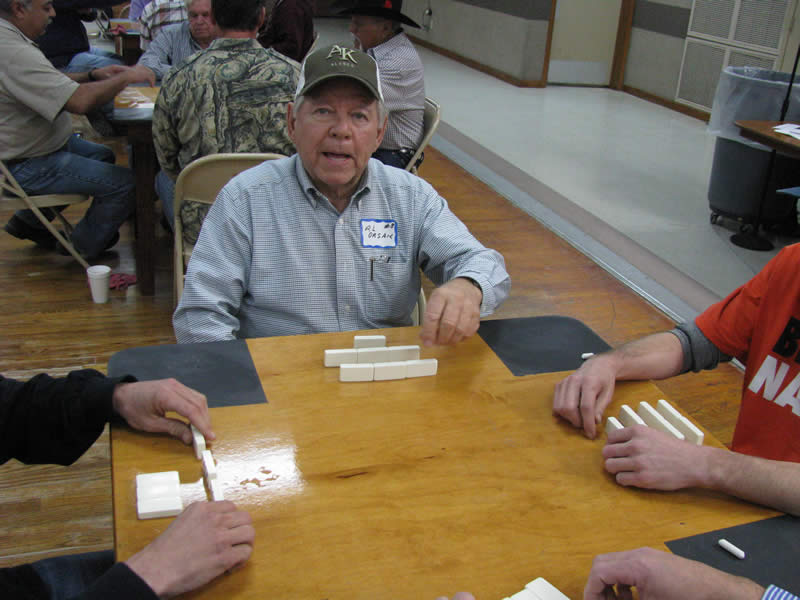
"Hallettsville is the home of the Lavaca Historical Museum (open weekends 2-5) at 413 N. Main.  The Texas Championship Domino Hall of Fame(tournament held every January) shares space with The Texas Fiddler's Hall of Fame (Fiddler’s Frolic held fourth week of April) at the Knights of Columbus Hall, Hwy 77 South. Both are open Mon - Fri 9am to 11am."

Best little whorehouse in texasposter.jpg"Although the actual town involved in the real story of the "Chicken Ranch" is located a few miles north of Hallettsville on Highway 77, film makers chose the town's historic Lavaca County Courthouse square to serve as backdrop for the city scenes in The Best Little Whorehouse in Texas, the 1982 musical starring Burt Reynolds and Dolly Parton.

image Hallettsville is also the featured location in the 2009 horror film titled Hallettsville, which stars Gary Busey and Derek Lee Nixon.

The town is mentioned in the Robert Earl Keen song "Armadillo Jackel" as the place where they pay $2.50 for dead armadillos.

Ripley's Believe It or Not! once called Hallettsville the "13 City" because in 1913 it had 13 letters in the name, a population of 1300, 13 churches, 13 newspapers, and even 13 saloons."

image "In 1887 the San Antonio and Aransas Pass Railway built through the town, and Hallettsville became the principal trading center and shipping point for area farmers and ranchers. By 1892 the town owned an electricity plant and had established a waterworks supplied by artesian wells."

Ancestries: German (32.2%), Czech (20.6%), Irish (8.5%), English (3.9%), United States (2.7%), Scotch-Irish (1.5%).

page82.jpg (1120×824)


 image

image


--------

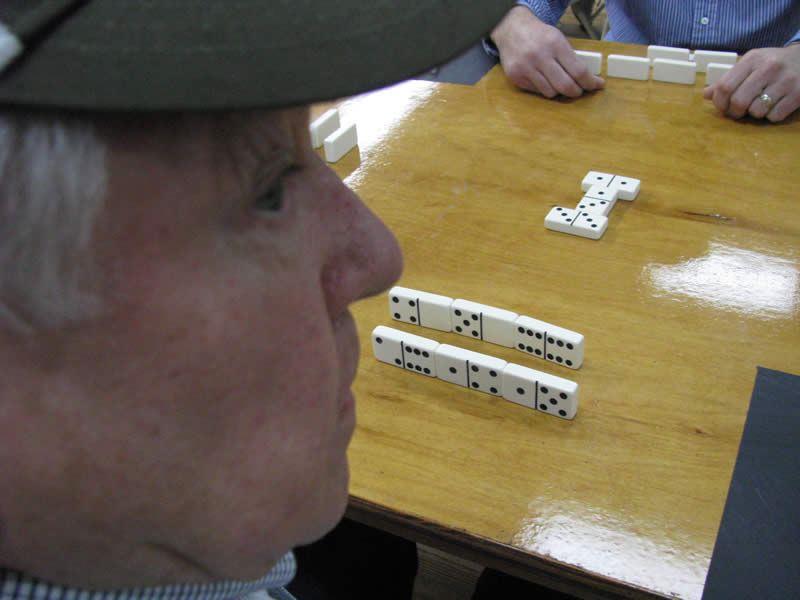
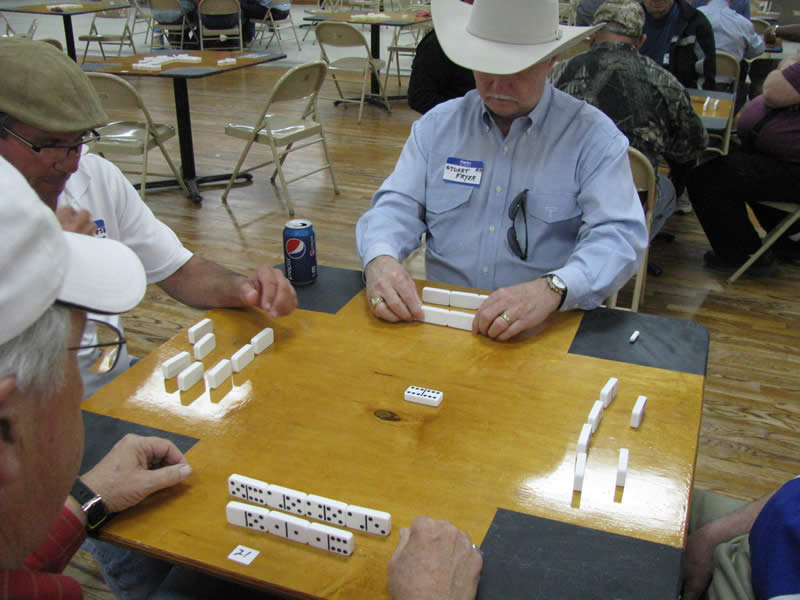
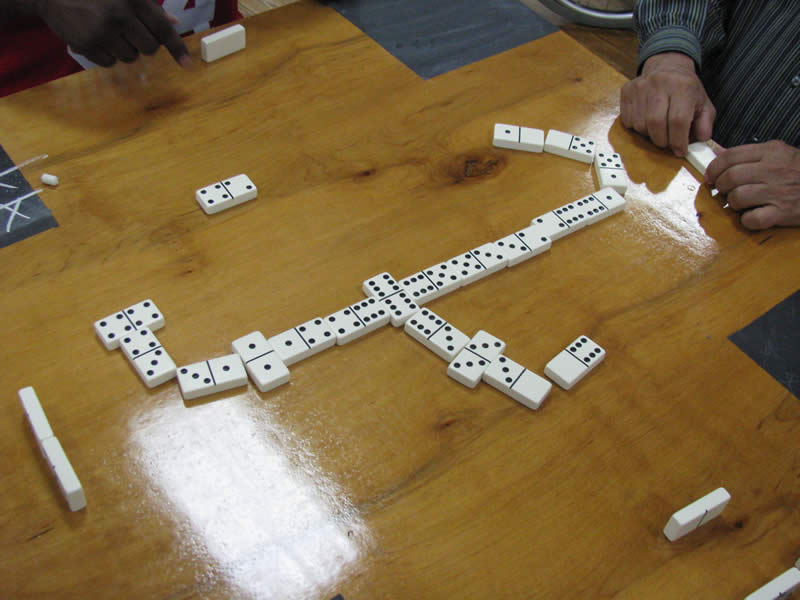
TEXAS STATE CHAMPIONSHIP STRAIGHT DOMINO TOURNAMENT

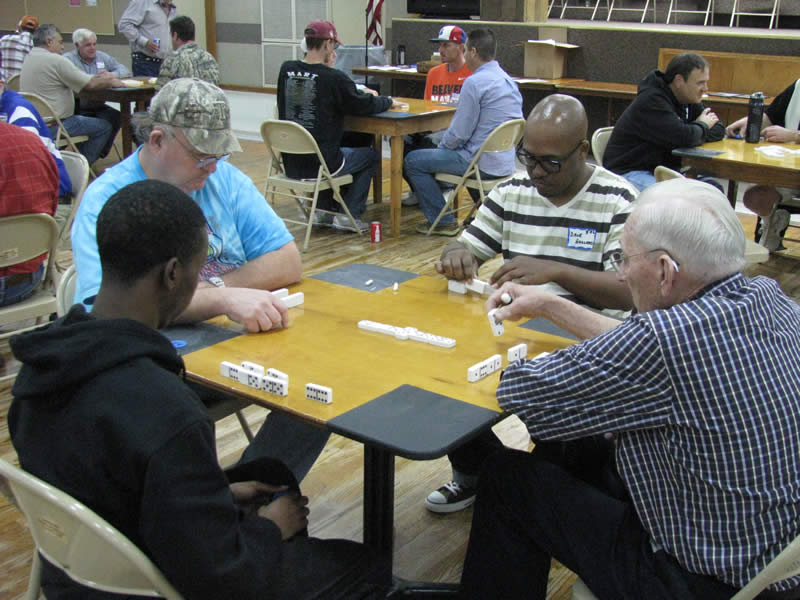
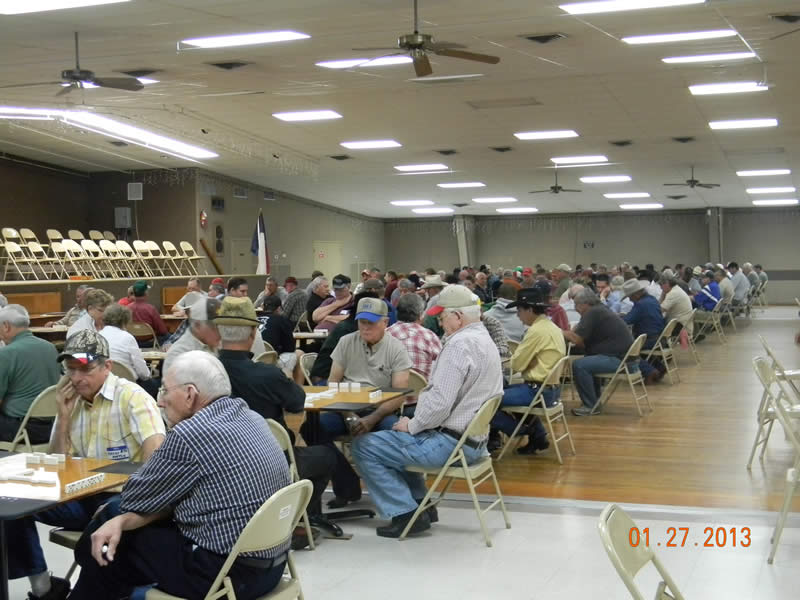
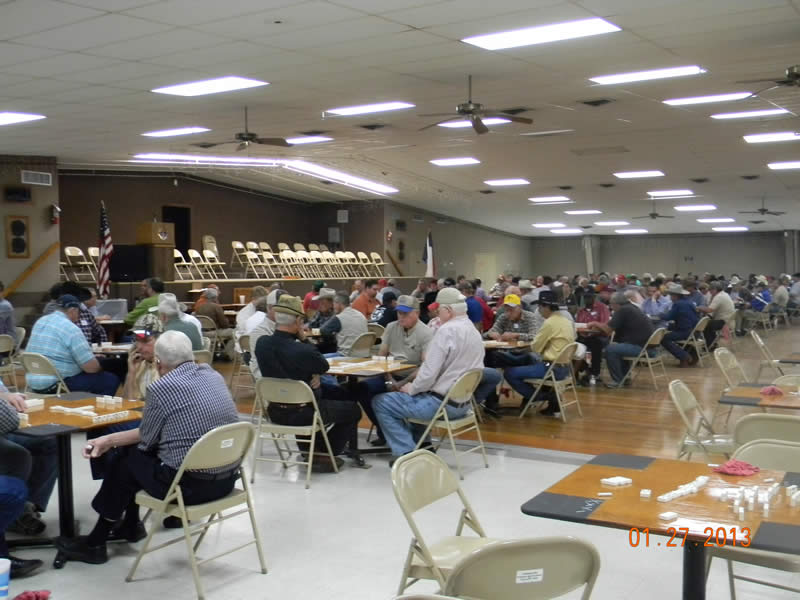
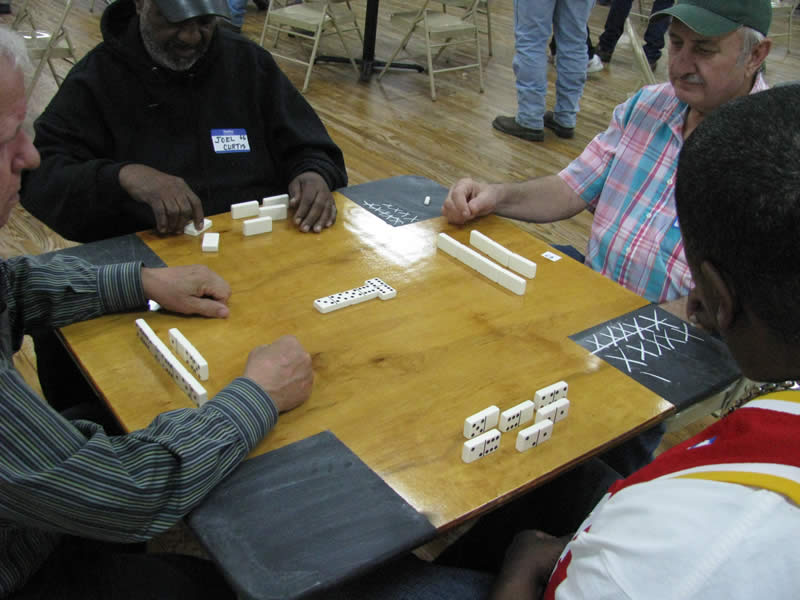
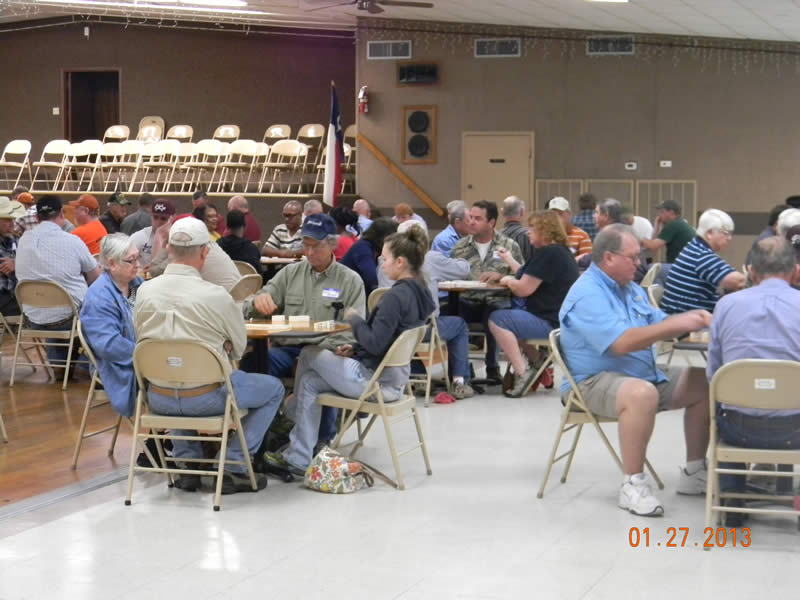
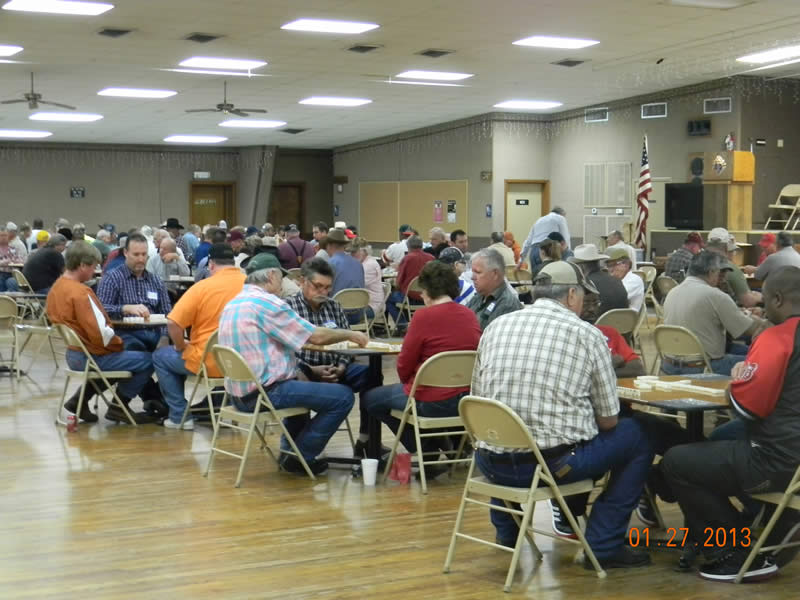
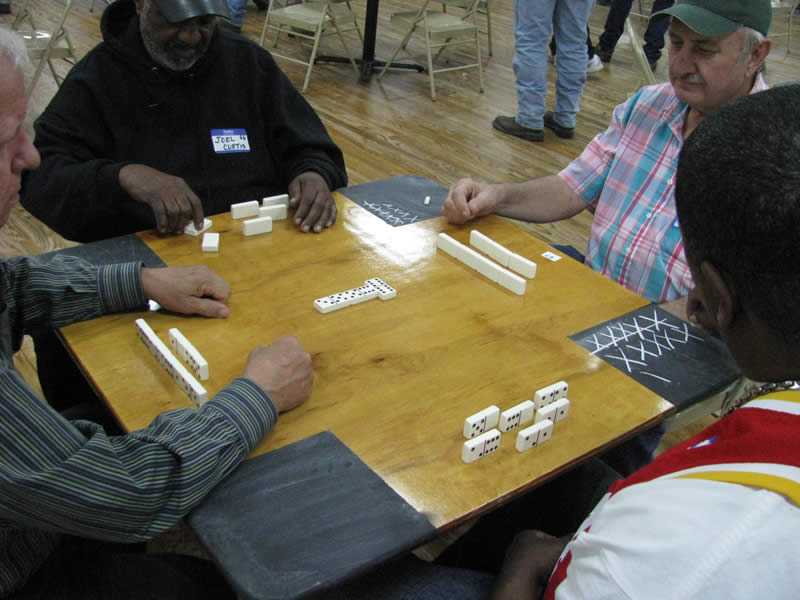
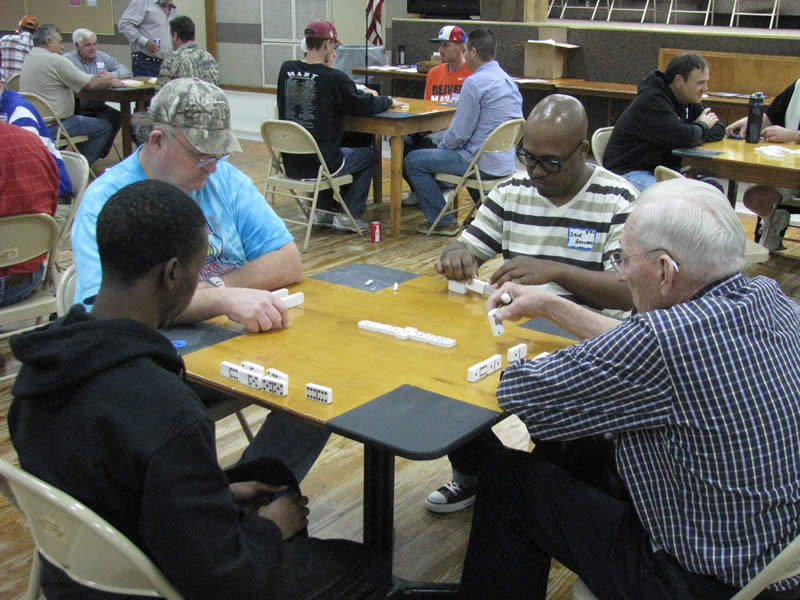
"The annual domino tournament is to determine the State Champion of Texas. From its humble beginning, this tournament has grown to be recognized as the finest competition of straight dominoes nationwide and is held in Hallettsville at the Knights of Columbus Hall.


Historically dominoes played a key role in the lives of people of all walks of life living in Central Texas. Domino halls and taverns had tables located in every nook and cranny to accommodate the legions of faithful players. In 1952 a group of men joined together to formulate a plan to determine the best domino players at straight dominos. The initial tournament, held at the American Legion Hall in Hallettsville, drew 30 teams that engaged in fierce competition.

Today the tournament held in January draws approximately 200 participants from all parts of the country.

Sunday January 26, 2014

Straight Domino’s

Double Elimination Partner Play

_______

On This Day:

Albert Schweitzer born, Jan 14, 1875:

"The theologian, musician, philosopher and Nobel Prize-winning physician Albert Schweitzer is born on this day in 1875 in Upper-Alsace, Germany (now Haut-Rhin, France).

The son and grandson of ministers, Schweitzer studied theology and philosophy at the universities of Strasbourg, Paris and Berlin. After working as a pastor, he entered medical school in 1905 with the dream of becoming a missionary in Africa. Schweitzer was also an acclaimed concert organist who played professional engagements to earn money for his education. By the time he received his M.D. in 1913, the overachieving Schweitzer had published several books, including the influential The Quest for the Historical Jesus and a book on the composer Johann Sebastian Bach.

Medical degree in hand, Schweitzer and his wife, Helene Bresslau, moved to French Equatorial Africa where he founded a hospital at Lambarene (modern-day Gabon). When World War I broke out, the German-born Schweitzers were sent to a French internment camp as prisoners of war. Released in 1918, they returned to Lambarene in 1924. Over the next three decades, Schweitzer made frequent visits to Europe to lecture on culture and ethics. His philosophy revolved around the concept of what he called "reverence for life"--the idea that all life must be respected and loved, and that humans should enter into a personal, spiritual relationship with the universe and all its creations. This reverence for life, according to Schweitzer, would naturally lead humans to live a life of service to others.

Schweitzer won widespread praise for putting his uplifting theory into practice at his hospital in Africa, where he treated many patients with leprosy and the dreaded African sleeping sickness. Awarded the Nobel Peace Prize for 1952, Schweitzer used his $33,000 award to start a leprosarium at Lambarene. From the early 1950s until his death in 1965, Schweitzer spoke and wrote tirelessly about his opposition to nuclear tests and nuclear weapons, adding his voice to those of fellow Nobelists Albert Einstein and Bertrand Russell."

_______

Yesterday:

Just catching up on more stuff around here.  I am overwhelmed with how am I going to get rid of all these parts, lumber and tools that I have accumulated over the years.  It seems that there is always something to fix, and they are needed.  There are still some carpentry jobs to be done, but I don't know when Jay will be here to complete them.

A lot of time was spent 'on hold', trying to make an appointment to see an ENT doctor. They don't have one at the clinic, so it seems I have to wait 2 weeks to see my doctor, just to get a referral.  My sinuses are my only health problem, so I should be grateful, especially at my age.

With the great weather, the cats spent some time out on the screen porch. They like to watch the birds at the feeder.  They still won't go near each other, but they will share that space.  The windows and doors were open most of the day.

Tuesday, January 7, 2014

Glen Rose, TX. Dinosaurs to Indian Country. First U.S. Presidential Election. Clinton Impeachment Trial. C O L D !


For "Travel Tuesday", let's visit the Glen Rose area again, it is in the Texas Prairies and Lakes region.

#Region.R_Description#"The Texas Prairies and Lakes Region offers a wide variety of destinations & attractions, from the fast-paced cosmopolitan excitement of the Dallas/Fort Worth Metroplex with the best in shopping, dining & entertainment, to the beautiful lakes & laid-back country lifestyles found throughout the region. Discover the Excitement of the Texas Prairies & Lakes."

Glen Rose Top Ten Fun Things To See & Do

image" Glen Rose is a fun and quaint town that was established as a trading post in 1849. The city is located at a picturesque spot on the Paluxy River, just above its meeting with the Brazos River.

We love Glen Rose and have spent a number of weekends there in our RV - to learn about one of the trips, read this Thank God For Weekends article.

Here is our list of favorite things to see and do in Glen Rose.Squaw Valley Golf Course

  • Golf - Squaw Valley Golf Course is located at the north eastern edge of town and they have 18 holes of very good golf. 17 miles to the north is another great golf course in Granbury - Harbor Lakes which is ranked in our Top Twenty Favorite Texas Courses. You can read a review of each of these golf course on our Golf Course Reviews Page.
  • Spend the Night - if you really want to enjoy Glen Rose and all it has to offer, you need to spend a couple days exploring. You have a number of excellent choices for for overnight lodging:
  • Visit a Nuclear Power Plant - Comanche Peak has a very informative information center with an exhibit of a nuclear power plant control room, a film, and more.
  • Enjoy a Special Event - plan your trip around one of the special events at Texas Amphitheater (The Promise, a musical drama of the reenactment of the life of Jesus in the open air amphitheater, is excellent) or horse shows and more at the Expo Center .
  • Hike, Bike, and Explore - Dinosaur Valley imageState Park is a great place to spend some time: hiking or biking the trails; leaning about dinosaurs and checking out their tracks or visiting the exhibits; playing in the Paluxy River; or just enjoying a picnic.
  • image Visit the Museums - Somervell Country Historical Museum depicts local history, fossils, and relics; Creation Evidences Museum includes artifacts and fossil displays, dinosaur footprints and bones, and more; and Barnard Mill and Art Museum is in one of the first structures built in the 1860's and houses art, primitive artifacts, and bronzes.
  • image Tube the Brazos or Play in the Rivers - a few miles north east of Glen Rose on 67 there are canoe and tube outfitters (Rhodes Rentals 254-897-4214) for riding the Brazos (not the most thrilling ride but a fun way to spend a few hours) or fish,   swim, or relax in theimage water.

The kids will enjoy the water and rocks at Big Rocks Park which is close to downtown. image

  • Listen to Some Good Music - Glen Rose is known as the Blue Grass Capital of Texas and throughout the year TresRios and Oakdale Park have bluegrass concerts with some excellent bands and musicians.

    Glen Rose Big Rocks Park

  • Stroll the Downtown Area - Glen Rose has a quaint downtown square featuring shops,restaurants, a museum, and the historic Somervell County Courthouse or go play in the Paluxy River at the park.
  • Feed the Exotic Animals - Fossil Rim Wildlife Center features some of the worlds most endangered animals like white rhino, image cheetah, and Grevy's zebra plus over 60 species that roam on the 2700 acres. You can drive your vehicle through the park and view the animals, some of which will stick their head in the window; stop at the top of the mountain for food, souvenirs, the museum, nature trail, picnic area, and petting zoo; or enjoy the park on one of their special bike safaris."

From: http://www.texasoutside.com/topten/glenrosetopten.html

______

Travels with Grandma...

Preserving the stories, legends & history of Texas for generations to come...

From Dinosaurs to Indian Country and beyond...

"Come & sit a spell, grab a glass of lemonade & some cookies. I want to tell you a story before we take off today. So, sit back and get comfortable…

This story begins over 100 million years ago. It’s a story about dinosaurs wandering wild and free, clomping down the river in a land untouched by man. All that remains are the tracks the three types – acroncanthosarus, pleurocoelus and an unidentified one, left behind. They must have been huge! The tracks range from 12-36” long and 9-24” wide. There are seven sites at Dinosaur Valley State Park where you can see them, and a museum in downtown Glen Rose that tells their history. We’ll stop by the park & take a look, maybe even take our shoes off and go wading in the river and walk in the tracks.

In the time before the white settlers started moving in around the mid 1800’s these lands belonged to the Indians. Like the dinosaurs, they roamed free, hunted buffalo, fished in the Brazos and Paluxy rivers, raised their families and celebrated life and death as free men. The Caddo and the Tonkawa, and sometimes the Apaches and Comanche called this area home.

Then, in 1849, that’s more than 150 years ago, a man named Charles Barnard and his brother George showed up. Charles built the first Indian trading post, a Torrey house, near Comanche Peak. George settled the area nearby. You may have seen the signs on the way to Cleburne - George’s Creek. The Torrey houses and trading activities were an important part of settling this area and an important part of Sam Houston’s peace policy. They did a fair trade business and it is said they also recovered stolen horses and captives from the Indians.

The post was located at Fort Spunky, built near a spring and tribe of peaceful Indians. It was near well traveled Indian highways and a one day ride from Comanche Peak. The Indians used Comanche Peak for a rallying place, campground and lookout. By the 1850’s the Indians had been moved to Fort Belknap and an agricultural center with a cotton gin, gristmill, general store, blacksmith shop and feed store remained. Fort Spunky, was given its name because of the fistfights that broke out, is gone now, but we’ll drive out and see where it was. Quite possibly the roads we’ll be following were the old Indian highways leading the Indians and settlers who traded there to Comanche Peak and Glen Rose.

Charles Barnard moved his trading post to Fort Belknap and returned to the Fort Spunky area in 1859 and built the first store in Glen Rose. A year later he started building a flour and grist mill and called the town Barnard’s Mill. The mill was a busy place. It served as a meeting hall, a dance hall, hospital and gathering spot for the settlers. It is in the process of restoration now and the hospital now hosts an art collection and some beautiful antiques. Barnard sold his mill in 1871 and the wife of TC Jordan wanted to name the town Rose Glen, but in 1872 the residents agreed to call it Glen Rose at a town meeting.

It grew slowly, but a few interesting stories from the times before Fossil Rim, Dinosaur Valley and the nuclear power plant are:

There were abundant mineral spring that brought doctors and healers and soon Glen Rose was known as a health and recreation center. In a letter written in 1902 JH Haney wrote “Our town in county seat of Somervell County and a health resort, i.e. a great number of flowing wells, and the people are coming in swarms from all about and filling our several parks along the Paluxy…” The springs can’t be seen now, but stop at Big Rock Park and look back towards town, and it’s not hard to see why they came.

Another story that I like is about the moonshiners. The laws changed and by the end of the 1800’s the moonshiners moved in, building stills, cooking and selling moonshine. During the Depression (1929-1940) the cedar brakes became known as the “whiskey woods capital of the state” and during the 1920’s it was reputed to be the “Moonshine Capital of Central Texas”. In 1923 the sheriff and county attorney, along with 38 other men, were arrested when the Texas Rangers decided to clean out the moonshiners.

These days Glen Rose has a bustling town square and “modern” development along Hwy 67. We’ll take time to visit the square and see the shops, and historical museum. It is home to the Warm Country Heart Theatre.

Well, that’s enough rambling for now; I’ll tell you more along the way. Put your shoes on and we’ll go exploring. We’re going to head west on Hwy 377 to Tolar, then take a left onto Hwy 56 on our way to Glen Rose. So let’s pack a picnic, load up the kids, fill up the gas tank, buckle up and we’ll be off…

Just as you get to Tolar take a left and go south on FM56. Tolar was settled in the 1890’s and a trade center for local farmers by the turn of the century. We are going up the winding hills towards the back of Comanche Peak – Indian country. Look on your right and you will see all that remains of an old family homestead…a chimney, leaning a little with age.. Stop and look out across the countryside and think about the times when the settlers first came and settled all alone out here, far from friends and family in this strange land with Indians all around.

The Panther Branch Post Office that is in downtown Granbury was found in an old frame house near here in 1968. It was known as the “eight mile stage stop” because the stagecoach made regular stops with both mail and passengers. Can you imagine riding across these rough hills in a bouncy stage coach on rutted paths and no paved roads, no air conditioning?

We’re continuing down Panther Branch Road another few miles and taking a right on to Hwy 51. Look to the right and you will see a barn. On the left you will see the remains of an old family homestead. It once stood proud on its hill – house and barns and outbuildings. Now you can see the sky coming through the buildings, but it still stands as a reminder of times gone by.

At the fork in the road we’re staying to the left, back on to FM 56 towards Glen Rose. Another old homestead is on the right a few miles down…with its windmill standing tall, remains of the piping that once led to the cisterns just to the south of the house. They’re overgrown now, but stop & listen you just might hear the laughter of children skinny-dipping the summer heat away in them.

Watch out the right side as you go up the hills. At the tops of the peaks you will begin to see Seven Knobs – count them. There are seven cone shaped, cedar covered knobs about 2 miles south of Glen Rose. They distinctly rise above the tops of the distant hills.

Take a right at Hwy 67 and a right on Park Road 59 into the land of Dinosaurs and the tracks they left behind - Dinosaur Valley State Park. The girls had a great time wading in the river and discovering the 113 million year old tracks.

Too soon we headed back down the road on Hwy51, crossing Hwy67 to Bernard St. Stop off at one of the best kept secrets in Glen Rose – The Barnard Mill Museum. The old hospital section of Barnard’s Mill is home of the private art collection of Richard H. Moore, Jr. It is a great place for little ones. The girls were fascinated by the drawings, paintings, bronze sculptures and Indian artifacts.

Take time to wander the Mill grounds, wander under the huge old trees and look up top and see the rifle slits that were used to protect the settlers from Indian raids. The mill used to be a busy place and was the gathering place for local settlers. If you find the mill open you can go inside and see the furnishings of the time period.

Leaving the mill, turn right and stop at the Glen Rose square. It’s a bustling place full of unique shops and antique stores, but that isn’t what the girls enjoyed the most; it was the Somervell County Historical museum, and the farmers on the square.

The museum is full of antiques from early Somervell County history and fossils and dinosaur history. It’s a “must see” on any trip to Glen Rose. The staff is warm and friendly and loves to answer questions.

You can’t leave the square without stopping to buy from the farmer’s trucks. The best watermelons, peaches and homegrown tomatoes can be found there. Not to mention a story or two. Mr. Murray (sorry I don’t remember his last name!) comes all the way from Eulogy and has been for over twenty years, carrying on a tradition that has brought farmers and their wares for decades.

Going south on FM56, take a left on FM202 to Rock Creek Cemetery. It is the first on our “old cemetery stops” today. My grandchildren love to explore them and are quick to point out the signs and it’s a challenge to see who can find the oldest marker and figure out how old it is (Ahhhh- math in the summer time and they don’t even know it!) The oldest one we found dated back to 1839. The cemetery and church are some of the few remains of a community established prior to 1880.

Back on FM56 go south through Eulogy, left on CR 1175. When you’re on Hwy56 just outside of Eulogy be sure to keep an eye out for the deer grazing under the trees. There are new babies that are fun to pull off the road and watch a while.

CR1175 crosses the Brazos River on the “new bridge”, but make the turn around at the end and get out, stretch your legs and explore the old iron bridge. It really is a work of art and you can’t catch the views or feel the wind blowing from the car. I’ve heard that this was once a ferry crossing. Do you know what a ferry is? It is a flat boat that people loaded themselves and their belongings on, and then the owner pulled everything across the river by a rope strung between the two sides.

Heading straight off the bridge, back on CR1175, will take us winding through the countryside (it turns into CR1119) and dead-ends into FM200. We’ll drive north a while and stop at the Nemo post office and take in the view. All that remains now are a few churches and a post office, but it was a thriving community around 1858 when it was settled. When the people gathered to name it, they wanted to name it Johnson Station, after Jimmie Johnson who found the area, but someone from the post office suggested a shorter name. One man stood up and said “Nemo” the Latin word for “no one” because if Jimmie Johnson’s name wasn’t good enough no one’s was.

We’ll turn around here and go back to FM 199, take a left and, if you haven’t had enough of the countryside, cross Hwy 67 and head into Fort Spunky country. If you want to see it, you better go soon; like a lot of the countryside around here it is quickly disappearing. The fort was located approximately at the intersection of FM 199 and FM 2174. To view the land as it used to be and have a beautiful view of the Brazos valley, turn right on FM 2174 and follow it all the way to the end. Keep going when it turns to a gravel road (CR 326). Once a simple one lane road, it’s wider now and the gas trucks are beating a path to the well at the end of the road. For us, it was worth the trip to stand at the end of the road and look out across the valley and take a few minutes to talk about what life would have been like if you lived when this was Indian country and the settlers were moving in, and what it would have been like to live as far away from anyone as the barn roof top in the distance.

After you’ve taken in the view (or if you didn’t make the trip), go west on HWY67 to FM200, take a right and cut through Rainbow on your way back to Hwy144 and home. By the 1890’s a community had developed here. Rumor has it the day the community gathered together to choose a name, a thunderstorm blew through and the residents were so struck by the rainbow that followed they named the town after it.

Till next time…Love, Grandma."   From: http://www.texasoutside.com/twg/2.html

------

I hope you enjoyed our second visit to Glen Rose, here is the first: http://pennys-tuppence.blogspot.com/2012/06/glen-rose-and-granbury-tx-dinosaur.html .  PS: Binkie was picked up by a relative of her owner and found a better home.

______

On This Day:

First U.S. presidential election, Jan 7, 1789:

"On this day in 1789, America's first presidential election is held. Voters cast ballots to choose state electors; only white men who owned property were allowed to vote. As expected, George Washington won the election and was sworn into office on April 30, 1789.

As it did in 1789, the United States still uses the Electoral College system, established by the U.S. Constitution, which today gives all American citizens over the age of 18 the right to vote for electors, who in turn vote for the president. The president and vice president are the only elected federal officials chosen by the Electoral College instead of by direct popular vote.

Today political parties usually nominate their slate of electors at their state conventions or by a vote of the party's central state committee, with party loyalists often being picked for the job. Members of the U.S. Congress, though, can’t be electors. Each state is allowed to choose as many electors as it has senators and representatives in Congress. The District of Columbia has 3 electors. During a presidential election year, on Election Day (the first Tuesday after the first Monday in November), the electors from the party that gets the most popular votes are elected in a winner-take-all-system, with the exception of Maine and Nebraska, which allocate electors proportionally. In order to win the presidency, a candidate needs a majority of 270 electoral votes out of a possible 538.

On the first Monday after the second Wednesday in December of a presidential election year, each state's electors meet, usually in their state capitol, and simultaneously cast their ballots nationwide. This is largely ceremonial: Because electors nearly always vote with their party, presidential election are essentially decided on Election Day. Although electors aren't constitutionally mandated to vote for the winner of the popular vote in their state, it is demanded by tradition and required by law in 26 states and the District of Columbia (in some states, violating this rule is punishable by $1,000 fine). Historically, over 99 percent of all electors have cast their ballots in line with the voters. On January 6, as a formality, the electoral votes are counted before Congress and on January 20, the commander in chief is sworn into office.

Critics of the Electoral College argue that the winner-take-all system makes it possible for a candidate to be elected president even if he gets fewer popular votes than his opponent. This happened in the elections of 1876, 1888 and 2000. However, supporters contend that if the Electoral College were done away with, heavily populated states such as California and Texas might decide every election and issues important to voters in smaller states would be ignored."

______

Clinton impeachment trial begins, Jan 7, 1999:

"On January 7, 1999, the impeachment trial of President Bill Clinton, formally charged with lying under oath and obstructing justice, begins in the Senate. As instructed in Article 1 of the U.S. Constitution, Supreme Court Chief Justice William Rehnquist was sworn in to preside, and the senators were sworn in as jurors. Congress had only attempted to remove a president on one other occasion: the 1868 impeachment trial of President Andrew Johnson, who incurred the Republican Party's wrath after he proposed a conservative Reconstruction plan.

In four hours of closed-door testimony, conducted in the Map Room of the White House, Clinton spoke live via closed-circuit television to a grand jury in a nearby federal courthouse. He was the first sitting president ever to testify before a grand jury investigating his conduct. That evening, President Clinton also gave a four-minute televised address to the nation in which he admitted he had an inappropriate relationship with Lewinsky. In the brief speech, which was wrought with legalisms, the word "sex" was never spoken, and the word "regret" was used only in reference to his admission that he misled the public and his family.

Clinton, the second president in American history to be impeached, vowed to finish his term. On January 7, 1999, the impeachment trial began. Five weeks later, on February 12, the Senate voted on whether to remove Clinton from office. Clinton was acquitted on both articles of impeachment. The prosecution needed a two-thirds majority to convict but failed to achieve even a bare majority. Rejecting the first charge of perjury, 45 Democrats and 10 Republicans voted "not guilty," and on the charge of obstruction of justice the Senate was split 50-50. After the trial concluded, President Clinton said he was "profoundly sorry" for the burden he imposed on Congress and the American people."

______

Yesterday:

It took until about 10.00am for the power to stop blinking, but even though it was inconvenient having to restart the computer every few minutes, at least we weren't without heat for all those hours.  As cold as it was here, that would have been awful.

There wasn't much anyone wanted to do outside, and I just stayed pretty close to this computer researching different things. 

Misty didn't protest when she had to wear her coat when we went out.  Each time I checked to see if the wind had blown the covers off my thousands of aloe plants. I clipped some hair off Misty as her face was getting shaggy, but I didn't cut her hair short, or bathe her, not with the temperature in the 20's most of the day. 

Tuesday, December 31, 2013

Travel TX: Padre Island. Tribute to the Turtle Lady. Sea Turtles. Allison's Prosthesis. Dangers Of Fishing Line. New Year's Eve. Rick Nelson. Panama Canal. Peekers To Habitat. Haddock.


For "Travel Tuesday", let's discover the sea turtles of Padre Island, TX in the Texas Gulf Coast region.

#Region.R_Description#"Home to some of the best beaches in America, the Texas Gulf Coast region draws millions of visitors to this Texas playground. Stretching some 350 miles from South Padre Island & the Rio Grande Valley, all the way to Beaumont & the Louisiana border, this region is renowned for its wildlife & natural beauty, as well as the home of America's space program. Discover the Beaches of the Texas Gulf Coast Region."


The Longest Stretch of Undeveloped Barrier Island in The World

"Padre Island National Seashore separates the Gulf of Mexico from the Laguna Madre, one of a few hypersaline lagoons in the world.  The park protects 70 miles of coastline, dunes, prairies, and wind tidal flats teeming with life.  It is a safe nesting ground for the Kemp’s ridley sea turtle and a haven for 380 bird species.  It also has a rich history, including the Spanish shipwrecks of 1554."

Dunes near the Laguna Shore

The dunes shown is how Padre Island probably appeared to Native Americans and early European settlers hundreds of years ago. NPS Photo

For almost its entire existence, Padre Island has remained undeveloped wilderness. Because the National Seashore endeavors to preserve Padre Island in its natural state, visiting the island is very much like stepping back into the past. With few exceptions, visitors can now see Padre Island as it has existed throughout most of its history and how it is described in the few extant descriptions by the early explorers.

Four nations have owned Padre Island at different times. The first was Spain, which owned Padre Island from its entry into the New World until the Mexican Revolution of 1820. Following the revolution, Mexico owned Padre Island from 1821 until 1836, when the newly formed Republic of Texas claimed the area between the Nueces river and the Rio Grande. Padre Island was under ownership by the Republic of Texas until its territory was acquired by the United States, following the War with Mexico of 1845-1848. Throughout these times, the island has been known by several names, with Padre Island being only the most recent. It has also been known as "la Isla Blanca" (White Island) and "Isla de los Malaguitas" (Island of the Malaquites, a band of the Karankawa people).

Novillo Bunkhouse

The Novillo Line Camp and bunkhouse can still be seen on the eastern side of the park, across from Bird Island Basin Road. NPS Photo

The first permanent settlement on the island was located on the island's southern tip. This area was established around 1804 by a Spanish priest, Padre Nicolas Balli, after whom the island is named. Prior to then, the only people known to have inhabited or visited the island were nomadic hunter-gatherers Native Americans, Spanish troops or ships, and the survivors of three shipwrecks on the island's shore in 1554.

From 1804 to 1970, after the National Seashore opened in 1962, the island was used almost solely for ranching. The most prominent and lasting exceptions to this have been the development of the tourism industry (including the development of the town of South Padre Island and the National Seashore) beginning in the early 1920's, and the exploitation of the island's oil and natural gas reserves, which began in the 1950's.

One of the most interesting periods of the island's history was from World War II to 1960, when a Navy bombing range existed on the northern section of the island."

A Kemp's ridley returns to the Gulf with a radio transmitter so that her travels outside of nesting season can be tracked.

Kemp's ridley sea turtles are both the smallest and the most endangered sea turtles in the world. Padre Island National Seashore is one of only a few places in the world where Kemp's ridley sea turtles come to nest. More...

_______


Speaking of Texas: Tribute to the Turtle Lady

Ila Loetscher changed the face of coastal conservation

Ila Loetscher dedicated the last 35 years of her life to the conservation of sea turtles. Her foundation at South Padre Island continues the mission. (Photo by Jack Lewis)

Ila Loetscher dedicated the last 35 years of her life to the conservation of sea turtles. Her foundation at South Padre Island continues the mission. (Photo by Jack Lewis)

"It often takes something spectacular to spark a worldwide interest in change, and for the conservation of the endangered Kemp’s ridley sea turtle, that spectacular something — or someone — was Ila Loetscher (1904-2000), who founded South Padre Island’s Sea Turtle Incorporated in the 1970s. Many people first learned of the turtles’ plight during Loetscher’s daily sea turtle shows, where she both amazed and educated her audiences.

Barely standing five feet tall, Loetscher would scoop a 90-pound sea turtle into her arms and coo into its bonnet-covered ear before leading it across a stage with a few of its similarly clothed companions. Though her methods seem antiquated by today’s standards, Loetscher dedicated her life to the turtles’ appreciation and preservation, and with her turtle “fashion shows,” she aimed to instill public awareness of their precarious position.

Ila Loetscher, born Ila Fox, grew up in Iowa. Her family spent frequent winters in Texas’ Rio Grande Valley, and they took occasional trips to the South Texas seashore. But at the time, Ila Fox’s head was in the clouds, literally. Flying fascinated her, and as a young woman, she spent time interacting with the pilots at the airport in Davenport, where she eventually took flying lessons. In 1929, Fox became the state’s first licensed female pilot and soon joined an elite group of female pilots called The Ninety-Nines, whose first president was Amelia Earhart.          

In the early 1930s, Ila gave up flying to move to the east coast with her new husband, David Loetscher. According to biographer Evelyn Sizemore, when David died of cancer in 1955, Loetscher decided to return to her childhood vacation spot in the Rio Grande Valley.

Kemp Riley Sea Turtle Baby

She soon moved to South Padre, where she learned of the sea turtle poaching occurring on the beaches of Rancho Nuevo, Mexico, some 225 miles south of the United States-Mexico border. At the time, this was the only major nesting spot of the Kemp’s ridley sea turtle, and poachers were harvesting nearly 100 percent of the population for their skin, shells, and eggs. In 1966, Loetscher joined forces with Dearyl Adams, a Brownsville contractor heading up Project Ridley, an experiment to increase turtle nesting in Texas.

Together with other scientists working on the project, they transported the eggs from Rancho Nuevo to South Padre Island, where they could be monitored and protected until they hatched, imprinted on their new home base in Texas, and swam out to sea. Then, the scientists waited. If the plan worked, the female turtles would return as adults to nest at South Padre Island. Because sea turtles can take up to 10 to 15 years to mature and return to nest, they knew the wait would be a long one. But in 1974, a lone turtle returned to the beach of South Padre Island to lay her eggs. Loetscher and others were hopeful that this adult turtle was one of the original South Padre Island hatchlings, though there was no way to be sure. After 52 days of protected incubation, a member of the next generation emerged from the nest in the sand and headed out to sea. The cycle continued.

As the scientists continued to monitor the turtles’ activity, they would sometimes discover injured turtles, and they would send them to Loetscher, who nursed them back to health in her backyard. Soon, she became known as “The Turtle Lady.”

Loetscher’s influence made an international impact. She campaigned tirelessly for recognition of the plight of the Kemp’s ridley sea turtle, making television appearances on Late Night with David Letterman, The Tonight Show Starring Johnny Carson, and Ripley’s Believe it or Not!. Despite her lack of scientific background, she gave sea turtles a voice during a time when conservation was not a household word.

“Ila was a champion at creating public endorsement,” said Jeff George, Curator of Sea Turtle Incorporated. “She did it in unorthodox ways at times, but she made a splash.”

In 1978, the United States and Mexican governments joined forces to further Adams’ and Loetscher’s efforts, transporting eggs from Mexico to Padre Island National Seashore, some 70 miles north of South Padre Island. In 1979, the program’s first turtles were released into the Gulf of Mexico. Donna Shaver, Chief of the Division of Sea Turtle Science and Recovery at Padre Island National Seashore, who has led efforts since 1986 to detect, investigate, and protect turtles that return here to nest, explains how Loetscher contributed to sea turtle recovery efforts.

“She educated a lot of people and inspired a lot of people to care about sea turtles,” Shaver says. “It was very important at a time when awareness of sea turtles was much less than it is today.”

Thanks to conservation efforts, the sea turtle population—the Kemp’s ridley in particular—has made a significant comeback since it dropped to near extinction in the mid- 1960s, but the work is far from done.

“Thanks to efforts of many, many people working very hard, the numbers are increasing,” Shaver says. “It looks promising for the eventual recovery of the species, but we need to continue our conservation measures to try to help continue that increase.”

Ila Loetscher died in 2000 at age 95, but the staff and volunteers at Sea Turtle Incorporated have made it their mission to carry on her legacy. Visitors can tour the facility Tuesday through Sunday to see rehabilitating turtles of several species and to learn more about ocean habitat.

“Every penny we generate goes toward sea turtle conservation,” says Patrick Burchfield, Chairman of Sea Turtle Incorporated’s advisory board. “Sea Turtle Incorporated was built and dedicated for one purpose and one purpose only, and that was to conserve the Kemp’s ridley and other sea turtle species.”

Ecologist and sea explorer Jacques Cousteau once called Ila a “wave maker.” And just as a wave’s ripples grow as they continue from their origin, so does Loetscher’s influence on marine conservation." From: http://www.texashighways.com/index.php/component/content/article/37-departments/6268-speaking-of-texas-tribute-to-the-turtle-lady  By Haley Dawson

______

Beloved Turtle Hugger of Texas

Ila Loetscher, Turtle Lady of Texas

Photo Sea Turtle Inc.

Ila Loetscher, 1905-2000


Ila Fox Loetcher, famed "Turtle Lady" of Texas, passed away on January 4, 2000. She was 95. Dr. Pamela Plotkin, of the Center for Marine Conservation, announced her passing on the CTURTLE mailing list with this tribute:

"Ila was the founder of Sea Turtles, Inc. and perhaps was most widely recognized for dressing sea turtles in clothes. She appeared in magazines, newspapers and on television with her turtles. I first learned of Ila back in the early 1980s when she appeared on the "Tonight Show" with Johnny Carson and brought with her a turtle wearing a dress and panties. Naturally you might think this to be a bit odd...but Ila dressed turtles primarily to catch the attention and interest of those she wanted to teach. And over the years she did a wonderful job teaching tens of thousands of people about sea turtles, their biology and threats to their survival.

"Ila built large tanks in her backyard and took in injured and sick turtles, nursed them back to health, and then released them. Turtles unable to be released were put on display to the public in her backyard. She held shows in her backyard every day, often several times each day, and she tirelessly educated those willing to listen...and pay a small fee. Ila used this money to support the upkeep of her turtles. In addition Ila provided very generous grants to support conservation and research that helped recover sea turtles and their habitats.

"I only met Ila once. In the short time I spent with her I was most impressed with her dedication to sea turtles as well as her generosity and her love for engaging people in discussion about sea turtles. She accomplished a great deal in her 95 years. In all my years of working with sea turtles I have never seen anyone hug a turtle the way Ila did."


Dr. Plotkin's tribute prompted these memories from Dr. Richard Byles, a member of the Board of Directors of Sea Turtle Inc. His farewell lovingly captures the spirit that made Ila Loetcher so special.

"Ila was truly an inspiration to many. She was old in years and young in spirit when I first met imageher in 1978.   Ila used to dress her "pets" up and perform skits for school-aged children. It sure got their attention. Her companion, Evelyn Sizemore, was even seamstress to the bale of turtles Ila kept. At first, I was dismayed at the shows she put on, I guess because it was seemingly unseemly and embarrassing to me as a young activist embarking on a sea turtle-influenced career. After all, weren't these endangered species? But she soon persuaded me that she was foremost a champion of sea turtles. She swayed me, not through words, but by dint of her heartfelt enthusiasm for bringing the plight of sea turtles before the public. And her success in doing so.

"Did you know that Ila was a pilot and friend of Amelia Earhart? She flew at a time when women were rarely found in the ranks of aviators and adventurers.

So even before the turtles captured her attention, she was an inspiration. She was a bold and charming woman. She charmed the public and spread the word about the declines of sea turtles and she charmed me. I remember one time when Pat Burchfield and I took Ila to dinner at Blackbeard's on South Padre. She was ready when we picked her up at home, dressed in a octogenarian floral print dress and running shoes. At that time, old people never wore tennis shoes and I personally had never seen such casual footgear worn with a dress. I think she unknowingly helped to spawn the term, "little-old-lady-in-tennis-shoes." She was in her eighties, slim, almost frail in appearance, but was sprightly and had a twinkle in her wrinkled eye. At the restaurant, she ordered fried oysters and ate a huge mound of them -- nothing wrong with her constitution. She impressed me with the gusto of her appetite; gusto she had for all of life's pursuits, only one of which was the saving of her cherished sea turtles.

"She confided in me that night how she got her show turtles to flap one flipper in a wave goodbye to the crowds of children she entertained and instructed.

"I just squeeze their arms up near the shell, I suppose it's the armpit. It is like tickling," she said. Well Ila, you sure tickled me. And in turn, I rarely pass an opportunity to tickle juvenile sea turtles I happen to hold. They always wave goodbye.   "Goodbye Ila.""

______

About Sea Turtles:

Sea-Turtle-Hatchling

"Many times, the most powerful education tools are the turtles themselves. These creatures touch the hearts of every single person that walks through our door. Our rehabilitation facility treats 40-100+ sea turtles each year. There are five species of sea turtles in the Gulf of Mexico and all are considered "threatened" or "endangered" in the United States. Please take the time to learn some fun facts about these species (and the other 3 species of sea turtles) and how their existence is vital to our own. 

A critical portion of Sea Turtle, Inc.'s mission is public education. Each year, Sea Turtle Inc. engages with over 80,000 tourists on South Padre Island. Our goal is to educate the general public about endangered sea turtles and their marine environments. An essential part of endangered species conservation is simply to help  people to understand the species and their importance not only to their habitat, but to our lives as well."

At: http://www.seaturtleinc.org/

-------

Allison's Prosthesis 

"We are home to "Allison", the first sea turtle in the world to use a successful prosthetic!  Please enjoy this video of Allison swimming with her harness."

image Allison survived a predator attack in 2005 with one remaining flipper. For years, Allison could only swim in circles. Allison has been featured in People Magazine, Discovery Channel, and the Today Show."

-------

One Flippered Sea Turtle Swims With Jacket

"This video shows Allison swimming in her 4th prototype of a prosthetic. This is the first successful sea turtle prosthetic in the world! For more information on Allison and where she lives please visit www.seaturtleinc.org,  which is a non-profit sea turtle hospital on South Padre Island, Texas."

_______

Boudreaux the Atlantic Green:

image "Boudreaux stranded at the Mansfield jetties on July 6, 2012. His front limbs were entangled in mono-filament line that was still attached to an old fishing rod. All that was left of his front right flipper was a bone fragment sticking out. He had already lost his back left flipper to a prior injury. Boudreaux is an education sea turtle. His purpose is to warn people about the dangers of leaving fishing line to drift in the ocean."

-------

Learn about the common threats to sea turtles.

http://www.seaturtleinc.org/rehabilitation/threats-to-sea-turtles

_______

New Year's Celebration

Two reasons not to celebrate New Year's.

Transcript at: http://www.ucg.org/beyond-today-daily/mans-holidays/new-years-celebration

What Would Jesus Do Between Christmas and New Years?  http://www.ucg.org/blog/what-would-jesus-do-between-christmas-and-new-years/

_______

On This Day:

Rick Nelson dies in a plane crash, Dec 31, 1985:

"Former teen idol Rick Nelson dies in plane crash in De Kalb, Texas, on December 31, 1985.

image When the teenage Ricky Nelson launched his pop career in 1957 by picking up a guitar and singing at the end of an episode of The Adventures of Ozzie And Harriet, he established a template for pop-music stardom that inspired hundreds of imitators in the decades that followed.

Beginning with his double-sided hit debut single, "I'm Walkin" b/w "A Teenager's Romance" (1957), Nelson reeled off a string of 30 rockabilly-tinged top 40 hits in the next five years—more than any other artist in the same period save for Elvis Presley and Pat Boone. Like Elvis himself, Nelson saw his commercial appeal take a major hit with the arrival of the Beatles in 1964. Nelson would remain musically relevant over the next decade, though, even earning credit for helping inspire the California sound of artists like Linda Ronstadt and The Eagles with his country-inspired late 1960s work.

Nelson continued to tour frequently, however, and it was on one such tour that he boarded a chartered DC-3 in Guntersville, Alabama, bound for a New Year's Eve appearance in Dallas. Shortly before reaching Dallas, however, the cabin of Nelson's plane apparently filled with smoke due to a fire of undetermined origin. While the two pilots of the plane would survive their attempted emergency landing in a field outside De Kalb, Texas, all seven passengers on board were killed, including the first pop star to cross over from the Nielsen charts to the Billboard chats, Rick Nelson.

In 1987, Rick Nelson was posthumously inducted into the Rock and Roll Hall of Fame—an honor no other former child actor has yet achieved."

_______

Panama Canal turned over to Panama, Dec 31, 1999:

image"On this day in 1999, the United States, in accordance with the Torrijos-Carter Treaties, officially hands over control of the Panama Canal, putting the strategic waterway into Panamanian hands for the first time. Crowds of Panamanians celebrated the transfer of the 50-mile canal, which links the Atlantic and Pacific oceans and officially opened when the SS Arcon sailed through on August 15, 1914. Since then, over 922,000 ships have used the canal.

image Ships pay tolls to use the canal, based on each vessel's size and cargo volume. In May 2006, the Maersk Dellys paid a record toll of $249,165. The smallest-ever toll--36 cents--was paid by Richard Halliburton, who swam the canal in 1928."

______

Yesterday:

After I had given the critters their breakfasts, except Peekers, Misty and I went to get Jay to take him to town to cash his check and pay a loan.  Wrapped up in our coats, we had our walk down there.  She enjoys her walks, but she still isn't carrying her tail high or wagging it, so something is bothering her, either her cancer or renal disease.

When we got back here, I loaded Peekers into a carrier.  It was his turn to go to our SPCA Cat Habitat until the end of the month, unless he gets adopted during that time. 

Nala, my other foster cat, was supposed to go too, but when she heard me getting a carrier, she ran, trembling, under the couch. No sense in taking her, if she is going to be that upset.  She was so stressed the last time she was at the Habitat, that I had to bring her back here after 2 days. The Petfinder website has been difficult to use since Nestlé-Purina bought it, so I hope that doesn't hurt her chances of being adopted.  She considers this her home, but she should outlive me, and then she will be an older, shy, traumatized cat looking for a 'furever' home.

The first stop was to get Peekers situated in the habitat, and give him his breakfast. He seemed quite at home, ate and played with the toys.  He was the first cat to arrive for this month, but some others would be arriving in the afternoon.

As it was on the way, we stopped at Home Depot and picked up my new thick padded toilet seat that I had ordered online.  The ones they sell in the stores are too chintzy and have cheap thin foam.  I have looked at a lot of them in different stores.

Then we went to Jay's bank and loan company.  The Kroger's there had some 10oz packages of walnuts on sale for $1.50, so I bought a load of them.

As we had a gift certificate, we ate at Red Lobster.  Jay had the Lobster Pizza, which just had a smattering of lobster, and I had good ole 'fish and chips'.  It was haddock, and I haven't had good fish and chips for years. Jay wished he had ordered that, too.

"Beware of Fish without Scales and Fins.

Clearly our Lord, the Law-giver, knew something that has taken scientists years to discover. Now we know that fish with scales AND fins are equipped with a digestive system that prevents the absorption of poisons and toxins into their flesh from the waters they call home. Flounder, cod, haddock, and salmon are a few examples of fish with scales and fins." From: http://www.medicine-plants.com/Articles.asp?ID=271 

After I had taken Jay home, let Misty out, and unloaded the van, Nala came and snuggled up to me, so I was glad that I hadn't made her go to the habitat. She would have been petrified if she was there again, she is such a sensitive cat. Then I installed the new toilet seat, which was as good as the reviews about it.

In the late afternoon, Ray and I covered up our plants, as it is supposed to freeze again for the next couple of days.