.
5 Major Differences Between Passover and Easter
 “Most consider Passover a Jewish holiday and Easter a Christian one. But when we compare the biblical Passover with Easter, we find big differences.
If you asked most people what they would associate the words Passover and Easter with, you would probably get something like “Passover is Jewish and Easter is Christian.” But would this basic answer be correct?
There is a big difference between Passover and Easter, but you may be surprised to learn that it isn’t that one is Jewish and one is Christian.
So, what is the difference between Easter and Passover? What do we discover when we compare them to each other: Easter vs. Passover?
Here are five major differences between the biblical Passover and Easter.
Difference 1: Passover’s biblical origin vs. no biblical reference for Easter
The origin of the Passover is found in Exodus 12.
The Israelites had been under harsh slavery to the Egyptian Pharaoh, who had refused to let them go. Because of Pharaoh’s stubbornness, God sent a series of plagues on Egypt and was about to send the 10th and final plague: killing the firstborn of all people and animals. God would spare, or “pass over,” only those who smeared lamb’s blood on their doorway (Exodus 12:12-13).
The day was called the Passover and was to be kept by Israel as a memorial of their deliverance from slavery in Egypt (Exodus 12:14; Leviticus 23:4-5).
What about Easter? You can’t find Easter commanded in the Bible. The word is actually located in Acts 12:4 in the 1611 King James Version, but most scholars recognize it as a clear translation error (modern translations replace it with the word Passover). There are over 70 references to Passover in the Old and New Testaments—but no legitimate references to Easter.
To learn more, read our article “Origin of Easter.”
Difference 2: God-ordained vs. human tradition
One of the significant differences between Passover and Easter is this: The Creator God commanded Passover to be kept by His people. He never commanded anyone to observe Easter to commemorate Christ’s resurrection.
Who commanded Easter’s observance?
It is a historical fact that the Catholic Church commanded Easter’s observance at the Council of Nicaea in A.D. 325. Church leaders did not appeal to scriptural authority, only their own authority, to make the change. Sadly, Christ’s warning against substituting human tradition for the commandments of God was ignored (Matthew 15:3; Mark 7:13).
You can learn more about the history of this change in our article “The Days They Changed but Couldn’t Kill.”
Difference 3: Passover’s fixed day vs. Easter’s movable day
 The Council of Nicaea established that Easter would always be celebrated on a Sunday and wouldn’t be tied to the phase of the moon, thus distinguishing it from the biblical Passover.
God ordained the Passover to be kept annually on a specific day: the 14th day of the first month on the Hebrew calendar (Deuteronomy 16:1; Leviticus 23:5).
The Catholic Church persecuted the early Christians who kept the Passover, calling them Quartodecimans (Latin for “14thers”) and Judaizers.
The Passover was so despised that “in 325 CE the Council of Nicaea established that Easter would be held on the first Sunday after the first full moon occurring on or after the vernal equinox. From that point forward, the Easter date depended on the ecclesiastical approximation of March 21 for the vernal equinox” (“Calculating the Easter Date,” timeanddate.com).
This gave Easter a movable date that wouldn’t fall on the Passover. Even then, the Western churches use the Gregorian calendar and the Eastern churches use the Julian calendar, so their dates for Easter differ.
To learn more, read “Festival Calendar: Which Calendar Should We Use?”
Difference 4: Passover as a memorial of Jesus’ death vs. Easter as a celebration of His resurrection
Jesus Christ was ordained as the Passover Lamb that would be sacrificed to make freedom from the penalty of sin possible (John 1:29). The Passover of Exodus 12 pointed forward to Christ’s sacrifice 1,500 years later! Just as the Israelites were saved from death by the lamb’s blood, we can be saved from eternal death by Christ’s blood.
The Passover of Exodus 12 pointed forward to Christ’s sacrifice 1,500 years later!
At His last Passover, Jesus instituted unleavened bread and wine as new symbols—representing His broken body and blood. He commanded us to “do this in remembrance of Me” (Luke 22:19). The apostle Paul taught us to keep it on the “same night in which He was betrayed”—the evening of the Passover (1 Corinthians 11:23).
To learn more, read “Should Christians Celebrate Passover?”
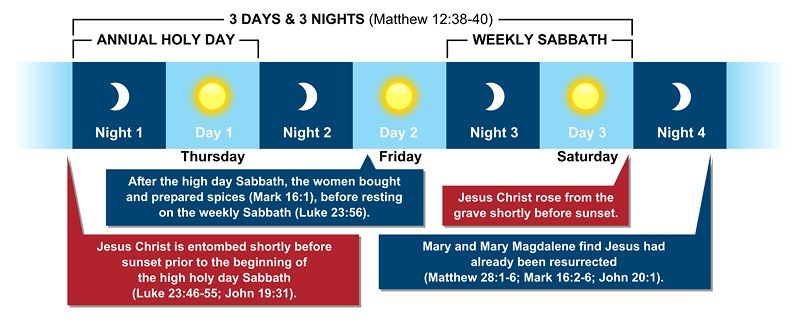
Easter purports to celebrate Christ’s resurrection. The problem is, though His resurrection was essential, Christ never commanded that it be celebrated with an annual observance or holiday. There is also no record of the apostles or early Church celebrating it. Plus, biblical evidence shows Jesus didn’t even rise on a Sunday morning.
Difference 5: Passover symbols vs. Easter symbols
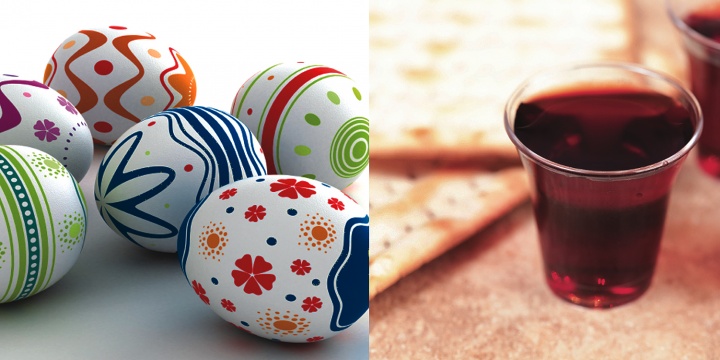
Symbols of the Passover are full of meaning. Jesus Himself is “our Passover” and “sacrificed for us” (1 Corinthians 5:7). The unleavened bread represents His sinless and broken body (Matthew 26:26). The wine represents His blood that was poured out for us (Matthew 26:28). The foot washing represents the humility and serving attitude of Jesus, which we are to emulate (John 13:5-8, 9-11, 12-15).
Every element of the biblical Passover is grounded in deep spiritual meaning.
The primary symbols associated with Easter are eggs and bunnies. But these have deep roots in ancient pagan practices. Bunnies and eggs are ancient fertility symbols that were appropriated years after Christ’s resurrection. Even the name Easter has origins in an ancient pagan goddess.
What does that have to do with Jesus and His sacrifice or His resurrection? To learn more, read “Bunnies Don’t Lay Eggs and Other Reasons to Ditch Easter.”
There are stark differences between Passover and Easter. We hope our readers will deeply consider these differences, reject Easter’s meaningless traditions and take a closer look at the biblical Passover and other “feasts of the Lord” found in the Bible.” From: https://lifehopeandtruth.com/life/blog/5-major-differences-between-passover-and-easter/
_______
Questions and Answers About the Christian Passover
“Most Christians believe Passover is a Jewish holiday. But should Christians celebrate Passover? This post covers this and other questions about the Christian Passover.
If you look at your calendar for March or April, you will probably see “Passover” marked. Most people think of the Passover as simply a Jewish national holiday commemorating Israel’s departure from Egypt as found in the book of Exodus. Around this season, network television usually airs The Ten Commandments, the epic 1956 film recounting the Exodus starring Charlton Heston and Yul Brynner.
This may be the extent of your knowledge about the Passover. It is largely ignored in Christianity, which observes other spring holidays such as Easter, Lent and Good Friday.
(To learn about the problems with Easter, read our article “Is Easter Pagan?”)
But did you know that the Passover is found throughout the Bible—both in the Old Testament and New Testament? So why don’t most Christians celebrate Passover? Should they?
This post will answer some frequently asked questions about the Passover.
Question 1: What does Passover celebrate? Doesn’t it celebrate the Israelites being “passed over” and protected from the 10th plague in Egypt?
Yes, when the Passover was introduced, it commemorated the night God performed the 10th and final plague against ancient Egypt. God caused the firstborn of Egypt to die—a plague that probably took millions of lives throughout the land. God would spare the Israelites from this plague only if they painted lamb’s blood on the doorposts of their dwellings (Exodus 12:7, 12-13).
Throughout their generations, the Israelites were to celebrate the Passover to remember how God delivered them from slavery in Egypt.
That evening, the Israelites were also instructed to prepare a special meal and get ready to leave Egypt the next day (verses 8-11). God declared this observance was “the LORD’S Passover” (verse 11). He commanded them to observe it as “a memorial,” “a feast to the LORD throughout your generations” and “an everlasting ordinance” (verse 14).
Years later, God reinforced the observance in the formal list of God’s festivals given to Moses: “On the fourteenth day of the first month at twilight is the LORD’S Passover” (Leviticus 23:2, 5).
Throughout their generations, the Israelites were to celebrate the Passover to remember how God delivered them from slavery in Egypt. This was the original meaning of the observance. Jews around the world understand and observe this.
These events are also meaningful for Christians, who are called “the Israel of God” (Galatians 6:16) and are delivered from the slavery of sin (Romans 6:7). But, as we will see, the Passover holds even deeper significance for Christians today.
Question 2: Did Jesus celebrate Passover?
Yes, Jesus observed the Passover throughout His life.
Luke records that Jesus and His family observed the Passover faithfully: “His parents went to Jerusalem every year at the Feast of the Passover” (Luke 2:41).
One of the most famous accounts of Jesus’ childhood—when He got separated from His parents and they frantically looked for Him, eventually discovering Him discussing the Bible in the temple—took place just after Jesus and His family had observed the Passover in Jerusalem (verses 42-50).
Jesus observed the Passover up until the day He died—literally. He celebrated the Passover with His disciples the night He was betrayed and arrested (Matthew 26:2, 17-19; Luke 22:15).
To learn more about the feast days Jesus celebrated throughout His life, read “Hidden in Plain Sight: The Festivals Jesus Celebrated.”
Question 3: Is there a connection between Jesus and the Passover?
Yes, the Bible makes a strong link between the Passover and the death of Jesus Christ. Putting the scriptures together, we see that the events of the first Passover foreshadowed Jesus Christ’s death. Notice the following parallels: Putting the scriptures together, we see that the events of the first Passover foreshadowed Jesus Christ’s death.
The Israelites were in bondage to Egypt (Exodus 1:14). All human beings are in slavery to sin (Romans 6:16-17, 20; 7:23; 2 Peter 2:19).
The Israelites were spared from death that night only through the sign of the Passover lamb’s blood on their doorposts (Exodus 12:22-23). Christians are freed from death only through Jesus’ shed blood as the “Lamb of God” (John 1:29; Ephesians 1:7; 2:13; Hebrews 9:14, 22; 1 Peter 1:19).
As a result of the plague against Egypt and the Israelites’ being spared through the Passover lamb’s blood, Israel was freed from slavery and started a new life by coming out of Egypt (Exodus 12:31-41). As a result of Jesus Christ’s sacrifice, Christians can have freedom from the captivity of sin and live a new way of life (Romans 6:4, 6, 18, 22; Ephesians 4:24).
These are just a few of the parallels between the Exodus Passover and Jesus Christ. It is also important to remember that Jesus observed the Passover on the evening before His crucifixion and that His sacrifice occurred on the daylight portion of the Feast of Passover (Matthew 26:18-19). But perhaps no scripture proves the link better than 1 Corinthians 5:7: “For indeed Christ, our Passover, was sacrificed for us.”
To learn more about the connection between Jesus and the Passover, read “Passover: What Did Jesus Do for You?”
Question 4: Did the early Church celebrate the Passover?
Yes, the New Testament is very clear that Christians in the early Church celebrated the Passover.
We must first understand that they didn’t observe it in the same way Israel did in the past. At His last Passover, Jesus Christ instituted new symbols to reflect His sacrifice for sins. These new symbols were a new element He added to the Passover for New Covenant Christians.
We read about the institution of the New Covenant Passover in Matthew 26.
Unleavened bread now symbolized the “body” of Jesus Christ (verse 26).
Wine now symbolized Jesus’ “blood” (verse 28).
Jesus commanded His disciples to “do this in remembrance of Me” (Luke 22:19). He also instituted a foot-washing ceremony to teach His people the importance of humility and service (John 13:3-15).
The Bible shows us that the early Church continued observing the Passover in obedience to Christ (1 Corinthians 5:7-8; 11:23-26). Today, Christians around the world observe the New Testament Passover in March or April (on the 14th day of Nisan on the Hebrew calendar) to remember and commemorate Jesus Christ’s death and its significance to our lives. In 2023 the New Covenant Passover ceremony will be observed after the sun sets on April 4 (on the Gregorian calendar).
You can learn about the dates of the biblical festivals for the next few years at “Festival Calendar.”
The fact that early Christians observed the Passover on the 14th of Nisan is a generally recognized historical fact. Unfortunately, the Roman Church eventually substituted Good Friday and Easter Sunday for the biblical Passover—a change that is still accepted and practiced by the majority of mainstream Christianity today.
To learn more about the change from Passover to Easter, read our article “Christian Festivals.”
Question 5: Isn’t the Christian ceremony of bread and wine called the Lord’s Supper or Communion?
This name, “The Lord’s Supper,” is a common title given to partaking of bread and wine in the Protestant community. Some denominations call this ceremony Eucharist (Greek for “give thanks”) or Communion (Latin for “fellowship” or “sharing”). There is much variance in how these ceremonies are kept. Some keep these ceremonies weekly; some, monthly; some, quarterly; and others, annually.
But none of these names are the biblical name for the ceremony Jesus instituted on the last evening of His life. The Gospels are very clear that He was observing the Passover (Matthew 26:18; Mark 14:14; Luke 22:8).
If you read through each Gospel record of this evening, you will notice that Jesus specifically said He was changing the symbols of the bread and wine—but He never said He was changing the name from Passover to anything else.
If you search the Bible, you will find the phrase “The Lord’s Supper” is only used once (in 1 Corinthians 11:20). But when you actually read the verse, you may be surprised that the verse is actually saying not to use that title for the observance. “Therefore when you come together in one place, it is not to eat the Lord’s Supper” (verse 20, emphasis added).
The apostle Paul was correcting the Corinthian congregation for not properly keeping the Passover ceremony with reverence and solemnity. These Christians were coming to the Passover and selfishly eating their own food while others went hungry. Some were even getting drunk (verse 21). So, instead of calling this observance “the Lord’s Supper,” Paul was actually reminding them that it wasn’t! They were to come together to solemnly partake of the bread and wine symbols—not to eat supper (verses 27-29).
The title “Communion” is taken from 1 Corinthians 10:16: “The cup of blessing which we bless, is it not the communion [the “fellowship” or “sharing”] of the blood of Christ?” This is not a designation of a title for the event, but a statement that the symbols of bread and wine are necessary to have a relationship, or fellowship, with Jesus Christ. The Passover is necessary for truly knowing and having a relationship with Jesus Christ.
To learn more about the proper name for this important observance, read “The Last Supper or Passover?”
Question 6: How do you celebrate Passover as a Christian?
As we have seen, the New Testament shows that Jesus Christ instituted new symbols for the Passover on the night He was betrayed and arrested. Those symbols are foot washing, unleavened bread and wine. In order to keep the Passover as a Christian in the 21st century, there are four basic requirements for baptized members of the Church of God:
- Observe it on the same night Jesus observed it, on the anniversary of the night of His betrayal and arrest. That is the evening of the 14th of Nisan on the Hebrew calendar. In 2023, that corresponds to the evening after the sun sets on April 4. (April 5 is the daylight portion of the Passover in 2023.)
- Wash the feet of another baptized Christian also observing the Passover.
- Eat a small, broken piece of unleavened bread that symbolizes Christ’s broken and beaten body.
- Drink a sip of red wine that symbolizes Christ’s shed blood.
The ideal way to observe the Passover is with other converted Christians who are partaking of the Passover in a ceremony conducted by a minister of Jesus Christ.
For more insight on keeping the Passover today, read “Should Christians Celebrate the Passover?” From: https://lifehopeandtruth.com/god/blog/questions-and-answers-about-the-passover/
Originally posted on April 4, 2016; updated on March 13, 2023.
_________
Dioxins in U.S. Farm-Raised Catfish
“Feed contaminated with toxic pollutants thought to originate from sewer sludge fed to chickens and fish results in human dioxin exposure through poultry, eggs, and catfish.
In 1957, for example, millions of chickens began dying, and it was blamed on toxic components in certain feed fats. Factory farming was taking off, and the industry needed cheap feed to fatten up the birds, and ended up using a toxic fleshing grease from hide stripping operations in the leather industry that were using dioxin-containing preservatives. A subsequent outbreak in ‘69 resulted from a pipe mix-up at a refinery that was producing both pesticides and animal feed.
In the 1990s, a supermarket survey found the highest concentrations of dioxins in farm-raised catfish. The source of dioxins was determined to be the feed, but that’s surprising, since catfish aren’t fed a lot of animal fat. In fact, that’s one of the reasons people eat catfish; they’re so low on the food chain. Turns out it was dioxin-contaminated clay added to the feed as an anticaking agent, which may have originally come from sewage sludge. The same contaminated feed was fed to chickens, so what may have started out in sewage sludge ended up on the plates of consumers in the form of farm-raised catfish and chicken.
How widespread of a problem did it become? Five percent of U.S. poultry production–that’s people eating hundreds of millions of contaminated chickens. And if it’s in the chickens, it’s in the eggs. Elevated dioxin levels in chicken eggs too. When the source of the feed contamination was identified, the USDA estimated that less than 1% of animal feed was contaminated, but 1% of egg production means over a million eggs a day.
But the catfish were the worst. More than a third of all U.S. farm-raised catfish were found contaminated with dioxins, thanks to that ball clay. So the FDA requested that ball clay not be used in animal feeds. They even asked nice. Dear producer or user of clay products in animal feeds, continued exposure to elevated dioxin levels in animal feed increases the risk of adverse health effects in those consuming animal-derived food products, so we are recommending that the use of ball clay in animal feeds be discontinued. They look forward to the industry’s cooperation.
So how cooperative did the industry end up being? Half a billion pounds of catfish continued to be churned out of US fish farms every year but only recently did the government go back and check. Published in 2013, samples of catfish were collected from all over the country. Dioxins were found in 96% of samples tested. Yeah, but just because catfish are bought in the U.S. doesn’t mean they came from the U.S. And indeed some of the catfish were imported from China or Taiwan, but they were found to be 10 times less contaminated. And indeed, when they checked the feed fed to U.S. catfish, more than half were contaminated, and so it seems likely that mined clay products are still being used in U.S. catfish feeds. Even just small amounts of mineral clays added to fish feeds together with the fact that catfish can be bottom-feeders may lead to higher than acceptable dioxin residues in the final catfish products. Maybe the government should ask nicely again and wait another sixteen years to retest.
The Institute of Medicine suggests strategies to reduce dioxin intake exposure, such as trimming the fat from meat, poultry, and fish and avoiding the recycling of animal fat into gravy, but if almost all dioxin intake comes from animal fat then eating a more plant-based diet could wipe out about 98% of exposure. Thus a vegetarian diet or even just eating more plants might have previously unsuspected health advantages along with the more commonly recognized cardiovascular benefits and decreased cancer risk.” From: https://nutritionfacts.org/video/dioxins-in-u-s-farm-raised-catfish/
To see any graphs, charts, graphics, images, and quotes to which Dr. Greger may be referring, watch the above video. This is just an approximation of the audio contributed by Katie Schloer.
________
Leviticus 11:9 says not to eat fish that don’t have scales AND fins….I wonder why??
“Leviticus 11:9 “Of all the creatures living in the water of the seas and the streams you may eat any that have fins and scales. 10 But all creatures in the seas or streams that do not have fins and scales—whether among all the swarming things or among all the other living creatures in the water—you are to regard as unclean. 11 And since you are to regard them as unclean, you must not eat their meat; you must regard their carcasses as unclean. 12 Anything living in the water that does not have fins and scales is to be regarded as unclean by you.”
It is because they (catfish, shellfish) are bottom feeders and designed to clean up the ocean and river floors of dead and decaying bodies. Ewww!!
________


 ginosphotos/Thinkstock
 iStockphoto
 “Peter Rabbit is a well-known, mischievous rabbit who loves to run through the neighbor’s garden.