Sunday, December 15, 2019

Thanksgiving, Purim and Hanukkah. When Was Jesus Born? Part 1, 2, 3. Update.

For “Scripture Sunday”:

Thanksgiving, Purim and Hanukkah

“Since so many holidays have pagan origins, some have wondered, is there anything wrong with national holidays like Thanksgiving, Purim and Hanukkah? 

Thanksgiving

Since so many religious holidays have pagan roots, some have wondered if all modern holidays are suspect. What about national holidays such as Thanksgiving in the United States and Canada, and the Jewish national holidays of Purim and Hanukkah?

Purim and Hanukkah mentioned in the Bible

Though Purim and Hanukkah are not commanded feasts of the Lord, they are mentioned in the Bible. The book of Esther describes the events that led to the establishment of the festival of Purim, as God saved the Jews from destruction by evil Haman. Hanukkah was also called the Feast of Dedication, mentioned in John 10:22-23. It celebrates the rededication of the temple after it had been defiled by Antiochus Epiphanes.

Days for giving thanks

Both of these holidays were established to give thanks to God, just as the American and Canadian Thanksgiving days are. Though some modern customs of these days may not be pleasing to God, they are not rooted in paganism and do not subvert any of the truths presented in the festivals of God.”    From: https://lifehopeandtruth.com/life/plan-of-salvation/holy-days-vs-holidays/thanksgiving/

________

Daily Bible Verse Blog

When Was Jesus Born?

Luke 1:5

“There was in the days of Herod, the king of Judea, a certain priest named Zacharias, of the division of Abijah. His wife was of the daughters of Aaron, and her name was Elizabeth.

The Bible does not tell us exactly when Jesus Christ was born. The closest hint, found in this verse, seems to point to Christ’s birth in the fall of the year.

What’s the connection? Verse 36 shows that Jesus Christ was born about six months after John the Baptist was born. And John the Baptist would have been conceived nine months earlier (15 months before Christ’s birth), shortly after his father Zacharias had received a message from an angel while serving at the temple.

When did Zacharias serve at the temple? One source says he probably served one-week stints around mid-May and mid-November. (E.W. Bullinger uses the dates June 13-19.) King David had divided the priests into 24 courses, of which the division of Abijah was the eighth (1 Chronicles 24:10). These divisions each served a week at a time, so that each division served two weeks at the temple each year according to the sacred calendar, in addition to the festivals.

A number of commentators lean toward a May or June date for Zacharias’ meeting with Gabriel. Adding 15 months to that would put Jesus Christ’s birth in perhaps August or September. (If Zacharias met Gabriel around November or December, Christ’s birth would have been in perhaps February or March.)

Either way would not support a Dec. 25 birth date.”        From: https://lifehopeandtruth.com/bible/blog/when-was-jesus-born-part-1/

_________

When Was Jesus Born? Part 2

Luke 2:1 

“And it came to pass in those days that a decree went out from Caesar Augustus that all the world should be registered.

The vast Roman Empire was a structured and expensive government, and this census was “organized to facilitate the collection of taxes” (NKJV Study Bible). In an agrarian society, both tithes and taxes were collected shortly after the fall harvest when the farmer would have sold his crop. Collecting taxes in the winter or any other time is not very effective.

Also, since such a census required people like Joseph to travel back to their ancestral home, it is unlikely the census would have been conducted in the winter time when travel was difficult. This is but one more hint in the text that Jesus Christ’s birth did not occur on Dec. 25. Though the Bible does not give an exact date for His birth, it seems clear that it could not have been in the winter.”      From: https://lifehopeandtruth.com/bible/blog/when-was-jesus-born-part-2/?

_________

When Was Jesus Born? Part 3

Luke 2:8

“Now there were in the same country shepherds living out in the fields, keeping watch over their flock by night.

One commentary states, “As these shepherds had not yet brought home their flocks, it is a presumptive argument that October had not yet commenced, and that, consequently, our Lord was not born on the 25th of December, when no flocks were out in the fields. On this very ground the nativity in December should be given up” (Adam Clarke’s Commentary,note on Luke 2:8).

The Interpreter’s One-Volume Commentary agrees: “These humble pastoral folk are out in the field at night with their flock—a feature of the story which would argue against the birth (of Christ) occurring on Dec. 25 since the weather would not have permitted it” (1971, note on Luke 2:4-7).” From: https://lifehopeandtruth.com/bible/blog/when-was-jesus-born-part-3/

For more about why Jesus Christ’s birth could not have been Dec. 25 and how it came to be celebrated that day, see our article “Christmas: Should Christians Celebrate It?”

________

Update

Not much seems to have happened this week, but I have been busy every day.  The pastor didn’t show up for the Sunday afternoon Bible study, so we just sat there and talked. The pastor had told one person that he had a family emergency, but they hadn’t passed it on. 

Took a neighbor to Huntsville (TX) just so that I could go to a larger food store to get a few more veggies.  That seemed like a long dreary trip, and not much to look at.

Then on Wednesday drove to Bryan again to the Social Security office and to take Joe,  a neighbor, for their driving test.  Social Security said that they would write to me with their findings.  So we went back into College Station to my daughter’s house and she drew me a map of how to get to a certain used furniture store because I am looking for an armoire type thing, a closet with big drawers underneath.  We found the place, but they didn’t have what I needed, so we went to Walmart, and that store in College Station is B-I-G.  Joe found the tires he needs to get, and they were cheaper than some used ones he had been looking at.  I went in the other direction to the Pharmacy to try to find Cod Liver Oil softgels.  Everybody has Fish Oil Capsules, but not just Cod.  I will have to order them online again.  One really needs an electric chair to get around in that enormous store, I must have done my 10,000 steps that day!

Leaving Walmart, that’s when everything went haywire. We had plenty of time to get to the driving test, if we had only known how to get there!  Joe insisted that Business 6 and Highway 6 were the same thing, so we stopped, started and crawled through dozens of traffics lights in College Station and then Bryan.  I said that we needed to be on Highway 6, but Joe insisted they were the same thing.  By the time we found Highway 6, we went the wrong way and didn’t arrive at the DPS until way after his appointment.  Now he has to look at a video online to get another appointment.

This Sabbath, my neighbor Cherry and I decided to go to a different church, one in Willis. It was a long drive, but worth it. She enjoyed the change, especially the music.  This week they were playing Bible Jeopardy instead of the usual Bible study, and that is always interesting. The sermon was about Nehemiah and how he resisted the temptations offered him, and how we should, too. 

I had made Cheesy Scalloped Potatoes for the church potluck and was told several times that it was very tasty.  I admitted that as I didn’t have the required 2 cups of milk to make it that I had substituted one cup of vegetable broth, maybe that’s what made it a hit. 

We didn’t know how long we would be, so we took Cherry’s West Highland White, (Westie dog), “Travis” with us. He traveled in his big wire cage and when we got there we left the van windows open for him and took him walkies a couple of times.  Thankfully it was a nice, not to hot, not too cold day.

Monday, December 9, 2019

WHEN WAS JESUS BORN? Was it really on December 25th?

For “Scripture Sunday”:

WHEN WAS JESUS BORN? Was it really on December 25th?

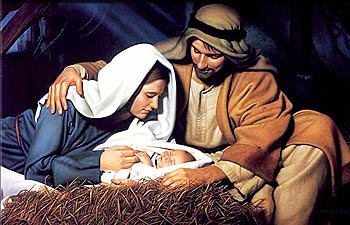
The Nativity

“According to Luke 1:24-26, Mary conceived Jesus in the sixth month of Elizabeth’s pregnancy with John the Baptist. This means that Jesus was born 15 months after the angel Gabriel appeared to Elizabeth’s husband, Zacharias, and informed him that his wife would bear a child.

According to Luke 1:5, Zacharias was a priest of the division of Abijah. Luke 1:8 says that Gabriel appeared to Zacharias while he was serving as a priest in the Temple.

We know from the Talmud and other sources that the division of Abijah served as priests during the second half of the fourth month of the Jewish religious calendar — which would have put it in late June (the Jewish religious calendar begins in March with Passover).

Fifteen months later would place the birth of Jesus in the seventh month of the Jewish calendar. That would be in the fall of the year, in either late September or early October. His conception, not His birth, would have occurred in December of the previous year.

The seventh month of the Jewish calendar is the month of the Feast of Tabernacles. John 1:14, speaking of Jesus as the Word, says: “And the Word became flesh and dwelt among us, full of grace and truth.” The word “dwelt” that is used here is the Greek word “skenoo” which literally means “to tabernacle”!

So, when God came to earth to tabernacle among Men it appears that He timed His arrival in the Bethlehem manger to coincide with the Feast of Tabernacles. That was only appropriate, for the Feast of Tabernacles is the most joyous of all the Jewish feasts. It is, in fact, their feast of thanksgiving.

The total meaning of that feast will not be fulfilled until the Lord returns again to tabernacle among Men for a thousand years while He reigns over the earth from Mt. Zion in Jerusalem. Isn’t the Word of God marvelous?

God created time “In the beginning…” and placed humans into this temporal world to separate the sheep from the goats in preparation for the eternal world where we sheep will live in His presence. So the title of my article “It’s about Time” has a double meaning: I want to write about topics related to questions of time, and the expression “it’s about time” reminds us that our Lord and Savior will soon return to conclude this phase of world history and to establish His Millennial Kingdom on earth.

The Christmas Tradition

We celebrate the birth of Messiah (Christ) on Christmas (from Old English, meaning “coming of Christ”), the 25th day of December. This date was first observed in 336 AD, some 24 years after the Roman emperor Constantine established Christianity as the state religion. Apparently, Pope Julius I chose to replace the pagan winter solstice feast in honor of Mithra, the “Unconquered Sun,” that had been officially recognized by the emperor Aurelian in 274 AD. From Rome, the new feast celebrating the birthday of the “Sun of Righteousness” (Malachi 4:2) spread to all other churches (except the Armenian church) over the following century.

As many Christians are aware, the modern Christmas celebration combines many strands of tradition including the ancient Roman pagan festival of Saturnalia (merrymaking, exchange of presents), the old Germanic midwinter customs (Yule log, decorating evergreen trees), the tradition of Francis of Assisi (displaying the crib, or crèche of Jesus), the medieval feast of St. Nicholas (Sinterklaas in Dutch, hence “Santa Claus”), and the British sending of greeting cards (1840s). The Puritan pilgrims did not celebrate Christmas because of its many unbiblical associations. The holiday was officially recognized in the United States in 1870.

The Dutch Sinterklaas (Saint Nicholas) is the origin of the North American Santa Claus. According to legend, Sinterklaas makes his rounds on December 5, Saint Nicholas’s Eve. Dressed in a catholic bishop’s robes, Sinterklaas rides through the streets distributing sweets to the children. According to some versions of the popular legend, another figure accompanies him named Black Peter, who carries a whip with which to chastise naughty children.

The Historical Evidence

I think it is fair and not overly critical for us to admit that the date chosen by Constantine and Pope Julius I to celebrate the birth of Jesus was not based on good historical or biblical evidence. Let’s look for that overlooked evidence in the historical account of the birth of Jesus recorded by Dr. Luke.

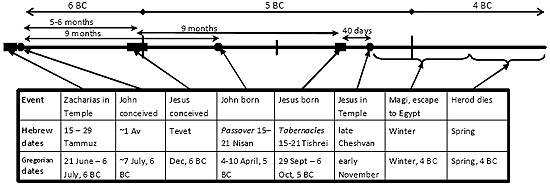
Chart Jesus' Birth

1) Our first clue is found in Luke 1:5. Here is how it reads in the Complete Jewish Bible:1 “In the days of Herod, King of Y’hudah (Judea), there was a cohen (Jewish priest) named Z’kharyah (Zacharias) who belonged to the Aviyah (Abijah) division.” The service of the Abijah division of priests was scheduled for the last two weeks of the fourth month of the Jewish religious calendar (15-29 Tammuz, June-July), according to the Talmud (rabbinic commentaries) and Qumran sources.2

Dr. Luke tells us that Zacharias was serving in the 2nd Jewish Temple in Jerusalem when he was chosen to enter the holy place to burn incense outside the Holy of Holies. The archangel Gavri’el (Gabriel) appeared to Zacharias and revealed that he and his barren wife Elisheva (Elizabeth) would have a son named Yochanan (John) who would precede and prepare the way for the Messiah. He returned home after his two-week service, then his wife conceived, as Gabriel had prophesied. The earliest date for John’s conception would be the 1st of Av (July).

2) In the 6th month (Kislev-Tevet, December) of Elizabeth’s pregnancy, Gabriel visited Miryam (Mary) in Nazareth to announce: “You will become pregnant, you will give birth to a son, and you are to name Him Yeshua (Jesus, meaning “God’s salvation”)” (Luke 1:31, CJB). Gabriel also revealed to Mary that her relative, Elizabeth, was six-months pregnant. Elizabeth’s sixth month included the celebration of the Jewish feast of Hanukkah, the “Feast of the Dedication” (John 10:22) connected with the rededication of the temple after the Maccabean revolt. Without delay, Mary hurried to visit Elizabeth (Luke 1:39), about a week’s journey on foot from Nazareth.

3) When Mary arrived, Elizabeth greeted her: “How blessed is the child in your womb!” (Luke 1:42). From this, we conclude that there was no delay between the time of Gabriel’s announcement to Mary and the conception of Jesus by the Holy Spirit. We can infer that the same was true for the conception of John. At most, only a few days passed between the announcement and the fulfillment of each of these two angelic prophecies.

4) Mary stayed with Elizabeth for three months, until John was born (probably during Pesach or Passover, 15-21 Nisan, April), circumcised on the eighth day, and given his prophesied name (Luke 1:57-80). One of the long-held Jewish traditions is that the prophet Elijah will return at Passover (Malachi 3:1; 4:5-6). Gabriel had prophesied to Zacharias that John would come “in the spirit and power of Eliyahu (Elijah)” (Luke 1:17, CJB).

5) Mary returned to Nazareth, where an angel (probably Gabriel again) reassured her betrothed husband: “Yosef (Joseph), son of David, do not be afraid to take Miryam (Mary) home with you as your wife; for what has been conceived in her is from the Ruach HaKodesh (Holy Spirit). She will give birth to a son, and you are to name Him Yeshua [which means ADONAI (God) saves], because He will save His people from their sins” (Matthew 1:20-21, CJB). Emperor Augustus ordered a census that required Joseph to take Mary to Beit-Lechem (Bethlehem) where she gave birth to Jesus (probably during Sukkot, the Feast of Tabernacles, 15-21 Tishrei, September-October).“The Word [Jesus] became a human being and lived [tabernacled] with us”(John 1:14).

6) The night of the birth of Jesus, an angel (probably the archangel Michael) appeared with the angelic armies of heaven to announce the birth to the shepherds of Bethlehem (Luke 2:1-15). Perhaps there is a long forgotten connection with Michaelmas (“coming of Michael”) Day, the feast of Michael the Archangel, which is celebrated in some traditions (particularly in the United Kingdom) on the 29th of September. Michael is the leader of the angelic armies who hurls Lucifer (Satan, the Devil) down from heaven because of his treachery (Revelation 12:7).

7) Joseph and Mary presented Jesus at the Jewish Temple on the 40th day after His birth (probably late Cheshvan, early November) for the ceremony of Pidyon HaBen (redemption of the firstborn son). There He received the blessings of Shim’on (Simeon) and Hannah, two righteous Jewish prophets (Luke 2:22-38).

8) Magi from the east came (probably in Winter) to inquire of King Herod about the birth of Jesus. The head cohanim (Jewish priests) admitted that Messiah must be born in Bethlehem, so the Magi went there (three miles from Jerusalem) and found Joseph, Mary, and Jesus living in a house. They worshipped Him and gave Him gifts, then obeyed an angelic warning (probably Gabriel) to avoid revealing to King Herod the location of Jesus (Matthew 2:1-12).

9) After the Magi departed Bethlehem, an angel (probably Gabriel) warned Joseph to take Mary and Jesus to Egypt to escape King Herod’s attempt to murder Jesus. They left that same night (Matthew 2:13-15). King Herod ordered the slaughter of all boys in Bethlehem up to age two, but Joseph escaped with his family to Egypt (possibly the Sinai peninsula), where they remained until Herod’s death (Matthew 2:16-18). I assume that Herod included a margin of error in calculating how old the newborn Messiah, King of the Jews, would be when he ordered the murder of all Bethlehem boys less than two years old.

10) After King Herod’s death, an angel (probably Gabriel) appeared to Joseph to tell him it was safe to return home to Nazareth (Matthew 2:19-23). The Jewish historian Flavius Josephus recorded the death of the evil King Herod in the spring of 4 BC.3 I assume that Herod did not live long after the slaughter of the innocent boys of Bethlehem, and thus that the family of Jesus did not stay long in Egypt. Therefore, we can place the birth of Jesus on a fairly well constrained timeline.

Determining the Date

If Jesus was born during Sukkot, the Feast of Tabernacles, (which began the 29th of September) in 5 BC, as we deduced from the evidence above, then His conception was probably during Hanukkah, possibly as late as the 25th of December in 6 BC. It is also possible that the Magi visited Bethlehem around the 25th of December in 5 BC, when Jesus would have been almost 3 months old.

‘Anno Domini’ (AD) dating was adopted in Western Europe during the 8th century. In 525 AD when the monk Dionysius Exiguus (Dennis the Little, meaning humble) calculated the year of Jesus’ birth, he missed by about 3 years. We now have evidence that Herod died in 4 BC, probably less than a year after Jesus was born.

The Significance

Does it really matter when Jesus was born?  In some ways, no, it doesn’t matter — after all, if it was critically important to know precisely when Jesus was born, rather let us celebrate that God’s Son became fully human and lived a perfect life so that He could become our perfect sacrifice and conquer sin and death in our place.

But, in another way, it IS important to consider the evidence God gave us and to place it in a proper Jewish context so that we can better understand the foundation of our faith. For example, the information I have presented in this article makes it clear that an important prophecy about the Messiah was fulfilled in the life of Jesus. That prophecy is found in Genesis 49:10 — “The scepter will not pass from Judah, nor the ruler’s staff from between his legs, until Shiloh [Messiah] comes, and it is He whom the peoples will obey.” Second Temple rabbis understood this as a Messianic prophecy.

In about 7 AD, the Romans abolished the power of the Jewish Sanhedrin Council in Judah to pronounce the death penalty.4 Furthermore, Herod was the first king of Israel who was not a descendent of the tribe of Judah. However, Jesus had already been born in 5 BC, before the scepter and staff (power) departed from Judah.

There is a deeper meaning and real significance to the conclusion that Jesus was probably born during the Feast of Tabernacles, thus bringing partial fulfillment to the prophetic type of that important feast established by God. Tabernacles (booths) are temporary, insecure dwellings and emphasize our reliance on God’s grace. So also the temporary human body in which the Son of God dwelled among us demonstrated what total reliance on God can accomplish.

The ultimate fulfillment of the prophetic significance of the Feast of Tabernacles will occur when Jesus returns in glory and majesty to tabernacle among us as King of kings and Lord of lords. Maranatha!”

Notes
  1. Dr. David H. Stern, Complete Jewish Bible, 1998, available from Lederer/Messianic Jewish Communications, 6120 Day Long Lane, Clarksville, MD 21029, 1-800-410-7367, www.MessianicJewish.net.
  2. Shmuel Safrai, “A Priest of the Division of Abijah,”www.jerusalemperspective.org/%5Cdefault.aspx?tabid=27&ArticleID=1847.
  3. Flavius Josephus, Antiquities of the Jews, Book 17, Chapter 8, www.sacred-texts.com/jud/josephus/ant-17.htm.
  4. George A. Barton, “On the Trial of Jesus before the Sanhedrin,” Journal of Biblical Literature, Vol. 41, No. 3/4 (1922), pp. 205-211, www.jstor.org/pss/3260096.

_______

Update.

Well, it was cold on the Sunday, but I went to the flea market anyway.  I sold several large items cheap just to get them gone, like a folding camping cot, a big plastic dollhouse, a new shower bench and things like that.  The sooner I can get everything sold out of the large storage unit, the better it will be.

Both Bible studies were interesting, the one on Sunday and on Friday.  One day, my helper Joe and I changed the fridge and freezer doors to open the other way.  That is a two “man” job, because someone has to hold up the door.  It is a lot more convenient than the way it was, opening to a wall.  Now I can get things out and put them on the counter next to it.

Other than phone calls and a visit to a government agency, it was a quiet week.  I wonder if they will ever get my Social Security and Medicare straightened out?  Even my HMO’s left hand doesn’t know what their right hand is doing, or exactly who is my doctor. 

For the church potluck, I made a Crustless Pomegranate Craisin Impossible Pie, and a big dish of Cheesy French Toast.  I had a lot of eggs, cheese and French bread to use up. The dish was so big that I had to use the oven in the stove for the first time.  Fortunately, I have an oven thermometer and found out about it’s temperature idiosyncrasies just in time.  Hopefully, I can just put it back to it’s former use as storage, because now I know that I prefer to use my convection/toaster oven which cooks more evenly and even turns itself off if I forget about it. 

The church’s Sermon was about “Picking Up Stones, or People.”  Because Jesus neither condemns nor condones people (sinners).

John 8:4-11 New International Version (NIV)

4 and said to Jesus, “Teacher, this woman was caught in the act of adultery. 5 In the Law Moses commanded us to stone such women. Now what do you say?”6 They were using this question as a trap, in order to have a basis for accusing him.  But Jesus bent down and started to write on the ground with his finger. 7 When they kept on questioning him, he straightened up and said to them, “Let any one of you who is without sin be the first to throw a stone at her.” 8 Again he stooped down and wrote on the ground. 9 At this, those who heard began to go away one at a time, the older ones first, until only Jesus was left, with the woman still standing there. 10 Jesus straightened up and asked her, “Woman, where are they? Has no one condemned you?” 11 “No one, sir,” she said.  “Then neither do I condemn you,” Jesus declared. “Go now and leave your life of sin.”

Well, we are using the AC again, but it is going to be cold and rainy tomorrow, and that's about it for today.


Tuesday, December 3, 2019

The New Covenant: What Is New About It?

For “Scripture Sunday”:

The New Covenant: What Is New About It?

“What was the problem with the Old Covenant, and what really changed with the New Covenant? What does the Bible say is new about the New Covenant?
The New Covenant

Throughout history, God has made various covenants, or agreements, with human beings. These covenants lay out the terms of the relationship God wants to have with humanity. Two of the key covenants recorded in the Bible are:

  1. The covenant God made with ancient Israel at Mount Sinai, also referred to as the “Old Covenant.”
  2. The “New Covenant,” which was inaugurated by Jesus Christ, and which is the covenant that is in force for spiritual Israel, the Church.

Scripture states that the New Covenant is making the Old Covenant obsolete (Hebrews 8:13). But what does that mean? Did God create an entirely different set of terms for this new agreement? Just what is “new” about the New Covenant?

This article highlights four key changes from the Old Covenant to the New Covenant. Although these four items do not encompass every difference, they illustrate the fundamental distinction between the two agreements.

A change of the sacrificial law

The Bible states that sinners earn the death penalty (Romans 6:23). Forgiveness of those sins requires blood to be shed to satisfy that penalty (Hebrews 9:22). Under the Old Covenant, the Israelites sacrificed animals as sin offerings, shedding the blood of those creatures as God commanded.

However, animal sacrifices were insufficient as substitutes for human beings. The sacrifices did not truly cleanse the Israelites from their wrongdoing, “for it is not possible that the blood of bulls and goats could take away sins” (Hebrews 10:4).

Since animal sacrifices could not blot out sins, why did God require them under the Old Covenant? Because those sacrifices reminded Israel of their sins and pictured the time when removal of the death penalty would truly become possible! God never intended for those sacrifices to be in force permanently! He had a plan in place “from the foundation of the world” to have Jesus Christ make the ultimate sacrifice (Revelation 13:8).

Christ’s sacrifice of Himself made it possible to take “away the sin of the world” (John 1:29). Because He is God, and human beings were created through Him (Colossians 1:16), His life is worth immeasurably more than all other human lives throughout history. Thus, His sacrifice was more than sufficient as total payment for the death penalty we have earned because of sin.

When Christ instituted the New Covenant with His shed blood (Luke 22:20), He made it possible for us to be truly cleansed from sin (Hebrews 9:13-14; 1 John 1:7). The result was that animal sacrifices were no longer required as symbols, because Christ was the ultimate fulfillment of that symbolism. We accept Christ’s sacrifice at baptism. Although we must still repent each time we sin in the future, Christ’s sacrifice is applied upon our repentance—no further sacrifices for our sins are needed (Hebrews 9:24-28; 10:12).

A change of the priesthood

Under the Old Covenant, priests came from the family of Aaron in the tribe of Levi. The high priest was required to offer a sacrifice for the Israelites’ sins each year on the Day of Atonement (Leviticus 16:29-34). He alone was allowed to enter the Most Holy Place (the innermost room) in the tabernacle and to approach the mercy seat—which represented the throne of God.

The Israelites all deserved the death penalty for their sins, and so the high priest’s responsibility was to make intercession for them. Since he was also “subject to weakness,” he understood how easy it was to sin, and he could show compassion for the people (Hebrews 5:1-4).

However, as we saw, the shed blood came from animal sacrifices under this physical system. Thus the priests under the Old Covenant were not able to truly make people right with God, and a change was necessary (Hebrews 7:11-12).

That change came with Jesus Christ’s sacrifice for all humanity, which fulfilled the symbolism of the yearly sin offering on the Day of Atonement. But Christ also filled the role of the high priest by offering Himself. He continues to serve as our High Priest, interceding on our behalf (Hebrews 7:23-28).

Under the New Covenant, Christ does not serve in a physical tabernacle (Hebrews 9:11). Instead, He performs His duties as High Priest in “the true tabernacle” (Hebrews 8:1-2). Today the Church is “the household of God” and “a holy temple” (Ephesians 2:19-22).

Members of the Church are able to draw near to the true mercy seat—the throne of God—as they develop a close and meaningful relationship with the Father. This is made possible because of Christ’s sacrifice and His continuing role as our High Priest (Hebrews 10:19-22).

Due to the change from the Levitical priesthood and the physical tabernacle, the rituals associated with the tabernacle and temple under the Old Covenant are no longer required—including various types of food and drink offerings, as well as ceremonial washings. These physical rituals were only “imposed until the time of reformation” (Hebrews 9:8-10)—which Jesus Christ ushered in with the New Covenant.

Under the New Covenant, God’s people now have a High Priest in Jesus Christ who intercedes for them continually. Since Christ lived as a human being, He understands our weaknesses, can help us when we are tempted, and can show us compassion when we sin. We can therefore be confident in seeking forgiveness when we repent (Hebrews 2:17-18; 4:14-16).

A change of the heart

God gave Israel His eternal laws that define sin—with the 10 Commandments serving as the core of Israel’s responsibility under the Old Covenant (Exodus 34:27-28; Deuteronomy 4:13). However, there was one key problem with this arrangement: Although God’s law was, and is, perfect (Psalm 19:7), the people were not.

God knew in advance that the Israelites were missing something very important. They did not have the necessary heart to be truly obedient to Him (Deuteronomy 5:23-29). The Israelites agreed to obey God because of external motivation. They were afraid of punishment from God (Exodus 20:18-21), but that type of external motivation does not guarantee right behavior! Unless a person is internally convicted to do what is right, it can become far too easy to choose to do what is wrong instead.

Ancient Israel sadly fell into this trap and repeatedly disobeyed God throughout history, despite the fact that they suffered punishment as a result. Time and time again, the Israelites broke the covenant they made with God, illustrating a key flaw in the covenant. The flaw was not with the laws they agreed to obey, but rather with the people themselves (Hebrews 8:7-8)!

The Israelites did not have a heart to truly know God because the time was not yet right for God to give them that heart (Deuteronomy 29:4). But even without a right heart, it was still possible for the Israelites to respond to the correction God gave them when they made wrong choices. Unfortunately, they failed to adjust their behavior in the long run. However, their example provides a powerful lesson to us of how easy it is to sin (1 Corinthians 10:11-12).

Under the New Covenant, God’s people have the opportunity to receive a heart to obey Him. In the Old Testament, God announced that the time would come when His people would have His laws internalized and written on their hearts—when they would truly be able to know Him (Jeremiah 31:31-34).

When God’s Spirit was made widely available on the Day of Pentecost, that goal became possible. Through the power of the Holy Spirit, Christians become able to think like God (1 Corinthians 2:11, 16). God’s mind—reflected in His law of love—can now be internalized within His people.

A change of promises

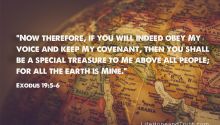
Under the Old Covenant, Israel agreed to obey God; and in return, God agreed to treat Israel as “a special treasure” (Exodus 19:5-6). He promised Israel specific blessings, including rain at the appropriate time; victory in battle; freedom from sickness; a fear of Israel among other nations; and such tremendous prosperity that Israel would lend to other nations, not borrow (Leviticus 26:3-13; Deuteronomy 7:12-15; 28:1-14).

These promises were all incredible. But they were also all limited to this physical existence! There was no opportunity under the Old Covenant for the nation of Israel to receive access to the gift of eternal life. Thus, the Israelites could only enjoy the blessings of the Old Covenant during their life span on this earth.

Why was eternal life not offered under the Old Covenant? Because Jesus Christ had not yet come to this earth as humanity’s Savior, and “there is no other name under heaven given among men by which we must be saved” (Acts 4:12). Christ’s sacrifice provided a way for humans who had not lived perfectly (all of us!) to avoid the death penalty. Forgiveness was a key requirement so that human beings could “receive the promise of the eternal inheritance” (Hebrews 9:15)—eternal life (Titus 3:7).

Another necessary missing component is the Holy Spirit. Jesus Christ called it “the Helper” (John 16:7), a “Promise” from God that He gave on the Day of Pentecost (Acts 1:4-5; 2:1-4).

As covered earlier, the Holy Spirit enables God’s laws to be written on our hearts. But beyond that, the Holy Spirit makes it possible for us to be “heirs of God,” so that we can “be glorified together” with Christ (Romans 8:16-17). God’s Spirit serves as a guarantee, or down payment, on our promised inheritance of eternal life in God’s family (Ephesians 1:13-14).

The Holy Spirit was made available to a select few of God’s servants who lived prior to Christ’s inauguration of the New Covenant (1 Peter 1:10-11). However, the vast majority of the Israelites did not have access to that Spirit, and thus did not have access to eternal life. But God intended from the beginning for all human beings to have that opportunity (Titus 1:2)—His purpose is to bring “many sons to glory” (Hebrews 2:10), expanding His family.

Access to salvation under the New Covenant makes this “a better covenant” than the covenant at Mount Sinai, because the New Covenant “was established on better promises” (Hebrews 8:6). Ultimately, all human beings throughout history will have an opportunity for eternal life as part of the New Covenant. Those who become part of God’s family will dwell with Him forever, and there will be no more death (Revelation 21:1-4).

The New Covenant amplifies the terms of the Old Covenant

This article has not covered every difference between the Old and New Covenants. However, the changes we have examined illustrate a consistent trend: Contrary to the belief of many, the New Covenant does not abolish all the terms of the Old Covenant!

Both covenants include provisions for a sacrifice for sin, a priesthood serving in a tabernacle, obedience to God’s laws, and promised blessings from God. However, in each case, the changes in the New Covenant amplify the terms of the Old Covenant!

Under the Old Covenant, God presented the Israelites with two options and told them to “choose life” (Deuteronomy 30:19-20). God offers that same choice today to those whom He calls into the New Covenant. What makes the New Covenant “new” is that it is a far better agreement than the one entered into at Mount Sinai.

Ultimately all humanity will have the opportunity to be part of the New Covenant. But if God is calling you to be part of that covenant now by helping you to understand His truth, you have a decision to make. Will you choose life—eternal life? The choice is up to you.”  From: https://lifehopeandtruth.com/bible/covenants/the-new-covenant/

For further study on this topic, read the article “Biblical Covenants.”

RELATED ARTICLES

_________


Thanksgiving Should Not Be Over:                                                                                                                

The Sacrifices of Thanksgiving

Psalm 107:22

Let them sacrifice the sacrifices of thanksgiving, and declare His works with rejoicing.

“Leviticus 7 describes a “sacrifice of thanksgiving” that involved offering grain and an animal sacrifice (Leviticus 7:12). This offering was not for sin, but for rejoicing and showing thankfulness to God.

We know from the book of Hebrews that the system of animal sacrifices has been superseded, yet Hebrews still talks about a “sacrifice of praise to God.” This is defined as “the fruit of our lips, giving thanks to His name. But do not forget to do good and to share, for with such sacrifices God is well pleased” (Hebrews 13:15-16).

Praising God, doing good and sharing are sacrifices that continue to please our Creator today.” From: https://lifehopeandtruth.com/bible/blog/the-sacrifices-of-thanksgiving/?

For more about thanksgiving, see “In Everything Give Thanks.”

________

Continue Earnestly in Prayer … With Thanksgiving

Colossians 4:2

Continue earnestly in prayer, being vigilant in it with thanksgiving. …

“The apostle Paul strongly connects prayer with thanksgiving in several other memorable passages:

“Be anxious for nothing, but in everything by prayer and supplication, with thanksgiving, let your requests be made known to God” (Philippians 4:6).

“Rejoice always, pray without ceasing, in everything give thanks; for this is the will of God in Christ Jesus for you” (1 Thessalonians 5:16-18).

“Giving thanks always for all things to God the Father in the name of our Lord Jesus Christ” (Ephesians 5:20).”        From: https://lifehopeandtruth.com/bible/blog/continue-earnestly-in-prayer-with-thanksgiving/? 

________

Update.

The Bible study at the apartments on Sunday afternoons is offered by a pastor who travels here from Anderson, TX, and on Thanksgiving Day I found out more about this church.  He has been showing us videos made by a Seacoast church and they have been interesting.  This week it was “The DNA of Joy and Happiness”, Joy is what you feel, and happiness is what happens to you.

Monday, my helper, Joe who also lives in these senior apartments, and I went to my big storage unit and loaded my van with a lot of items that were taking up room so that I could take them to the flea market the following Sunday.  That gave us some walking around room in there.  I had forgotten that I was supposed to take a lady and her dog to the groomer n College Station the next day, but it worked out well, because we met my daughter there and she took some of the items.  On Wednesday, Joe and I moved the loveseat out of the little storage unit that is really for the things that I am keeping, into the larger storage unit which is for the things that I have for sale.  Then we moved my van’s extra seats into the little storage where they belong.  Now I can show the loveseat to potential buyers more easily.  I had two inquiries about it, but no shows.

As I was walking around outside getting some exercise on Thursday, Thanksgiving Day,  I saw some men and women with children dragging two of those collapsible canvas wagons around the apartments.  One of the ladies looked at her list on a clipboard and asked my apartment number.  When I found out that they were toting Thanksgiving dinners, I told her that I wasn’t on her list because I didn’t know anything about it.  She gave me a dinner anyway.  There was white and dark turkey, mashed potatoes, dressing, giblet gravy, green bean casserole, cranberry sauce, pumpkin pie and peach cobbler.  A real feast.  Then I found out that they were from the same church as the pastor from our Sunday Bible study.  What great folks, ones who practice being Christians, not just say they are.

Friday, my friend from the apartments and church went though our pre-study of the Bible Study for the next day at church. It is still about Ezra and Nehemiah and the rebuilding of Jerusalem.  For the church potluck, I made another Crustless Impossible Pumpkin Pie with canned pumpkin because I know it is popular there and in keeping with this time of year.  The theme this week was “Love is patient, love is kind, it does not envy, it does not boast, it is not proud” from 1 Cor. 13:4  The Sermon was about having a “Thanksgiving Attitude” all the time.

Now, with all this stuff to take to the flea market, just pray for good weather on Sunday.