Showing posts with label Stevia. Show all posts

Wednesday, September 5, 2012

Hermit Warbler. Bird’s Clock. Eagles and PCB. Clapper Rails. Mini Refuges. Double Clutching. Eagle’s New Beak. Endangered Birds. Baby Hummer. Sam Houston. Coconuts.

For “Winged Wednesday”:

Hermit Warbler

Hermit Warbler by Bill Hubick

“Because it lives in the tops of some of the tallest trees on the planet, the Hermit Warbler is more easily heard than seen. This flashy, yellow-headed warbler’s nesting behavior is still largely unknown due to the dizzying height of its nests, which are placed as high as 120 feet. The species feeds by gleaning insects from the middle and outer portion of tree branches, often hovering to capture its prey.

Though Breeding Bird Survey data show that Hermit Warbler populations have remained stable since the late 1960s, the species faces threats due to loss and management of habitat on both the breeding and wintering grounds.

Since Hermit Warblers breed only in coniferous forests with a well-developed canopy, they are negatively impacted by logging. Hermit Warblers also hybridize with, and in many cases are being displaced by, the closely-related Townsend's Warbler, which has led to its disappearance in places where it formerly occurred.  Recommended conservation measures for the Hermit Warbler include longer logging rotations to keep more of the larger trees, and managing coniferous forests for closed canopies on the bird's breeding and wintering grounds.”

Help ABC conserve this and other birds and their habitats!

BirdNote logo

Listen to a two-minute broadcast about this bird!

Photo: Bill Hubick; Range Map, NatureServe

____________

Birds’ Internal Clock Chimes for Departure

A Wood Thrush with a geolocater attached to it's back. (/Faculty of Science & Engineering York University)“In a new study of wood thrushes, published in the online journal PLOS ONE, York University researchers found the cinnamon-brown birds with a flute-like whistle appeared to follow an internal clock in determining when to begin their 4,000-kilometre spring migration north from wintering sites in Nicaragua, Honduras and Costa Rica.

Of the 10 birds tracked via geolocators attached to their backs with a harness made of Teflon ribbon looped around their legs, the difference in departure from one April to the next was a mean of three days. One bird even left on the same date two years in a row, noted study co-author Bridget Stutchbury, a York University professor who has analyzed the behavioural ecology of birds for decades.

“This internal clock seems to be so finely tuned,” Prof. Stutchbury said. “In the spring, they’re in a rush to get back.””  More at: http://www.theglobeandmail.com/news/national/birds-internal-clock-chimes-for-departure/article4441509/?cmpid=rss1

_______

Bald eagles are back, but will Kalamazoo River toxins harm them?

Bald Eagles.JPG

“Bald Eagles have been spotted at the Kalamazoo Nature Center in recent days. Shirley Bumgardner and Sandy Stafford were out hiking Thursday and saw this pair sitting on the branch of a dead tree on private property, across the river from the nature center.

But birds along the Kalamazoo River may still be threatened by the levels of toxins that persist in fish, studies suggest.  "Historically, there have been some concerns about eagles and PCBs, Stuber said.

In 2005, the Natural Resource Trustees for the Kalamazoo River Environment completed the first stage of its assessment of damages to the entire Kalamazoo River environment caused by polychlorinated biphenyls (PCBs) that began polluting the river and its banks the 1950s.  Like harmful pesticides, PCBs, used in manufacturing, were banned in the U.S. in the 1970s because of their toxicity to the environment, the report explained.  Before that, they had been used in making some types of paper, and manufacturing waste disposed of in or near the river brought the PCBs along, where they settled in the river sediments.  Part of Portage Creek and an 80-mile stretch of the Kalamazoo River were declared a federal Superfund Site because of PCB contamination.”   More at: http://www.mlive.com/news/kalamazoo/index.ssf/2012/08/bald_eagles_are_back_but_will.html

________

It’s for the birds – creating snags for bird habitat
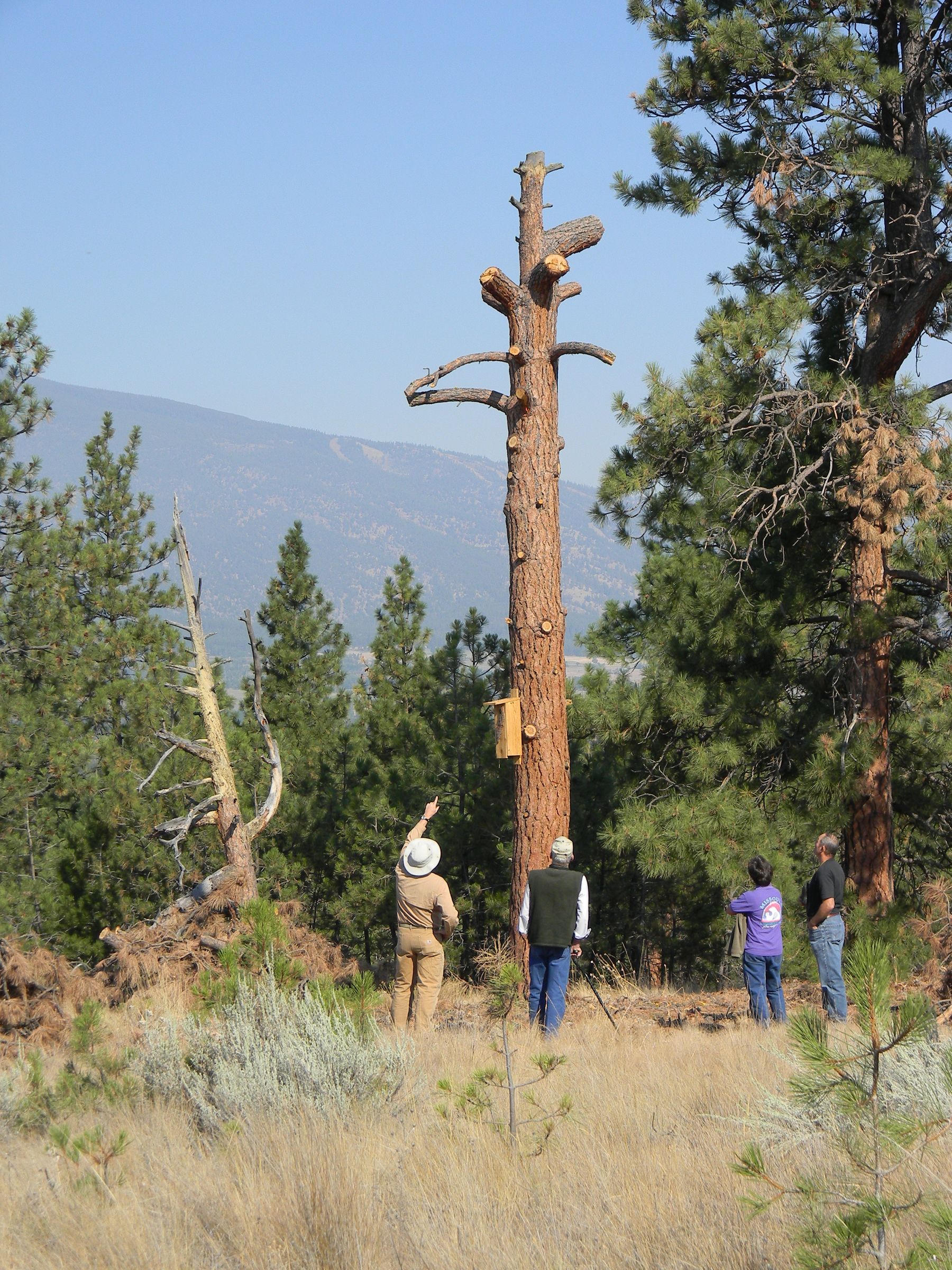
Through the selective use of limbing, topping and girdling and by choosing the right tree in the right place, a snag can be created offering a smorgasbord of insects and a potential home to cavity nesting birds that can last up to 40 or 50 years. Michael Howell photo.

“To the uneducated eye a snag is just an old, dead tree that’s still standing. To the educated eye of Dan Casey from the American Bird Conservancy, however, a snag is crucial wildlife habitat. In the eyes of a Lewis’ Woodpecker, or a Flammulated Owl, or other “cavity nesters,” it looks like a good place to raise a family.

Dead and dying trees are, in fact, an essential component of natural forest ecosystems, providing valuable wildlife habitat and a means for important nutrients to cycle back into the forest. Snags provide essential habitat for approximately one quarter of all breeding birds in western coniferous forests. The dead trees are used by birds for foraging, cavity nesting, perching, food storage and drumming (pecking against the tree to communicate). In the dry forests of the Pacific Northwest dominated by ponderosa pine, there is renewed interest in the importance of snags as part of forest restoration efforts.”  More at: http://www.bitterrootstar.com/2012/08/30/its-for-the-birds-creating-snags-for-bird-habitat/

_________

Clapper rails fly into wild on San Elijo Lagoon

502dd49a4dd79.preview-620[1]

Two of seven clapper rails fly off to their new home in the San Elijo Lagoon during a release of the birds at the lagoon Thursday.       BILL WECHTER | bwechter@nctimes.com

“As seven light-footed clapper rails stretched their wings in the wild for the first time, and flapped off across the San Elijo Lagoon Ecological Reserve, a group of scientists, volunteers and well-wishers burst into applause.  The endangered birds were among 300 of their species that have been painstakingly bred in captivity, then released into lagoons in Southern California since 2001.

Light-footed clapper rails once thrived on the coastline, where scientists estimate that 100 to 200 breeding pairs populated each lagoon, said Richard Zembal, principal investigator for the clapper rail recovery plan.  Habitat loss and urban effects of pets and pollution brought the clapper rails to the brink of extinction, and in 1970, the species was listed as endangered.”    More at: http://www.nctimes.com/news/local/san-marcos/environment-clapper-rails-fly-into-wild-on-san-elijo-lagoon/article_95bbd064-31ad-58c1-a04a-7e5fb2182f01.html

_______

Native Birds Can Be Helped With Native Landscaping In Urban Areas

Residential yards mimicking nearby native vegetation and wildlands offer birds “mini refuges.”  Credit: UMass Amherst

“A recent study of residential landscape types and native bird communities in Phoenix, Ariz., led by a University of Massachusetts Amherst urban ecologist suggests that yards mimicking native vegetation and wildlands offer birds “mini refuges”, helping to offset the loss of biodiversity in cities and supporting birds better than traditional grass lawns and non-native plantings.”    More at: http://www.redorbit.com/news/science/1112680374/native-birds-landscaping-urban-areas-082312/

_______

Warm weather prompts birds to breed again
baby_birds.JPGBaby robins open wide late last week as they wait for their mother to return with nourishment on the Rummel property in Belsano. They likely are the second clutch of hatchlings this year for a mother robin that started earlier than normal. Todd Berkey

JOHNSTOWN — “There’s a lot of double clutching going on this summer, and it has has nothing to do with driving a stick shift.
Rather, the phrase in this instance has more to do with the unusually warm winter, early spring, birds and their babies.
With little snow and few days of freezing temperatures during the winter of 2011-2012, some bird species were out earlier than normal – mating, building nests and hatching eggs.
It’s a process the experts call “clutching.”
Now with the first clutch raised and out of the nest, there’s little to do but have a second clutch, said bird expert Luke DeGroote.”  More at: http://tribune-democrat.com/local/x1971509899/Warm-weather-prompts-birds-to-breed-again

_______

Six South American Bird Species Now Protected as Endangered Under U.S. Law

Junin Grebe by Pete Morris

Junín Grebe by Pete Morris, Birdquest

“The U.S. Fish and Wildlife Service (FWS) has announced a final rule to protect six South American bird species as Endangered under the U.S. Endangered Species Act (ESA), including the Ash-breasted Tit-Tyrant, Junín Grebe, Junín Rail, Peruvian Plantcutter, Royal Cinclodes, and White-browed Tit-Spinetail. Two of these species, the Ash-breasted Tit-Tyrant and Royal Cinclodes, are native to Peru and Bolivia, while the remaining four species occur only in Peru.    The primary factor leading to the listing of these species is habitat destruction and degradation caused by ongoing human activities. All six species have specific habitat requirements and are at risk throughout their entire range.”  More at: http://www.abcbirds.org/newsandreports/stories/120730.html

_______

Last week we saw a pelican’s beak fixed, today it is a bald eagle.

Beauty and the Beak (VIDEO)

The beak let's this Eagle,Beauty the Bald Eagle gets a second chance with a little help from technology.” Shot and edited by Keith Bubach for Evening Magazine (KING-TV). 2008 Emmy winner.

 http://vimeo.com/15184546

“More than three years after a poacher shot off her upper beak, a bald eagle named Beauty can finally live up to her name — with the help of volunteers.  A team attached an artificial beak to the 15-pound eagle, improving her appearance and, more importantly, helping her grasp food.”

Image: Biologist and Beauty

Seen here before getting her new beak, Beauty feeds on salmon guided into her mouth by biologist Jane Fink Cantwell.

“The bird was found in 2005 scrounging for food and slowly starving at a landfill in Alaska. A bullet had taken from her curved upper beak, leaving her tongue and sinuses exposed, with a stump useless for grasping food. Cantwell said eating with her beak was like using one chopstick.  She also had trouble drinking and couldn't preen her feathers.”    More at: http://www.msnbc.msn.com/id/25000280/ns/technology_and_science-science/t/eagle-wounded-poacher-gets-new-beak/

_______

Rescued Baby Hummingbird  

“This is a baby hummingbird I rescued after it was attacked.
The song is "Better Together" by Jack Johnson.
UPDATE!!! When she thought she was ready to leave (and she was) she flew off to her favorite patch of the back yard, and her instincts instantly kicked in, and now she's just like all the other hummingbirds. For those that are concerned that she has imprinted on humans and wouldn't survive in the wild, don't worry, she is thriving. She has even successfully migrated and returned back to my yard, and for those who think I didn't know what i was doing, I did NOT feed her plain sugar water. I went outside 3 times a day and caught flies from my compost bin in big bags, crushed them, and mixed them in as well. I also helped her learn to catch flies while flying (not in the video because you obviously wouldn't be able to see the flies). In the end, I don't think it could have worked out any better.”

________

On This Day:

Sam Houston elected as president of Texas,  Sep 5, 1836:

“On this day in 1836, Sam Houston is elected as president of the Republic of Texas, which earned its independence from Mexico in a successful military rebellion.

Born in Virginia in 1793, Houston moved with his family to rural Tennessee after his father's death; as a teenager, he ran away and lived for several years with the Cherokee tribe. Houston served in the War of 1812 and was later appointed by the U.S. government to manage the removal of the Cherokee from Tennessee to a reservation in Arkansas Territory. He practiced law in Nashville and from 1823 to1827 served as a U.S. congressman before being elected governor of Tennessee in 1827.

A brief, failed marriage led Houston to resign from office and live again with the Cherokee. Officially adopted by the tribe, he traveled to Washington to protest governmental treatment of Native Americans. In 1832, President Andrew Jackson sent him to Texas (then a Mexican province) to negotiate treaties with local Native Americans for protection of border traders. Houston arrived in Texas during a time of rising tensions between U.S. settlers and Mexican authorities, and soon emerged as a leader among the settlers. In 1835, Texans formed a provisional government, which issued a declaration of independence from Mexico the following year. At that time, Houston was appointed military commander of the Texas army.

Though the rebellion suffered a crushing blow at the Alamo in early 1836, Houston was soon able to turn his army's fortunes around. On April 21, he led some 800 Texans in a surprise defeat of 1,500 Mexican soldiers under General Antonio Lopez de Santa Anna at the San Jacinto River. Santa Anna was captured and brought to Houston, where he was forced to sign an armistice that would grant Texas its freedom. After receiving medical treatment for his war wounds in New Orleans, Houston returned to win election as president of the Republic of Texas on September 5. In victory, Houston declared that "Texas will again lift its head and stand among the nations....It ought to do so, for no country upon the globe can compare with it in natural advantages."

Houston served as the republic's president until 1838, then again from 1841 to 1844. Despite plans for retirement, Houston helped Texas win admission to the United States in 1845 and was elected as one of the state's first two senators. He served three terms in the Senate and ran successfully for Texas' governorship in 1859. As the Civil War loomed, Houston argued unsuccessfully against secession, and was deposed from office in March 1861 after refusing to swear allegiance to the Confederacy. He died of pneumonia in 1863.”

________

Yesterday:

In the morning, the quest for tasty healthy sweeteners and creamer took up a lot of time.  There are so many conflicting articles about them. I thought that maybe Coconut Palm sugar might be the answer, until I found this article:

The Truth About Coconut Palm Sugar: The Other Side of the Story!

picture of coconut cluster hanging on a coconut palm tree and nourished by the sapCoconuts like these are sacrificed
when the sap from the tree is removed.

“As retailers in the U.S. and elsewhere also cash in on this new demand, sadly, the other side of the story is not being told. What no one is warning consumers about is that coconut palm trees cannot produce both coconuts and coconut palm sugar! When the sap used to make coconut palm sugar is collected from the coconut palm tree, from the flower bud that will eventually form a coconut, that tree can no longer produce coconuts! Think about that for a minute. No coconuts = no coconut oil, no dried coconut, no coconut flour.”  From: http://www.tropicaltraditions.com/coconut_palm_sugar.htm 

Coconut Oil is very good for you, you should have some every day, and it is the only healthy oil that can stand the high temps of sautéing, so we don’t want to lose that.  (Olive Oil should only be used cold.) 

First thing in the morning, my two cups of coffee are my special quiet time of the day, so I want it to be delicious. I tried Stevia again, but it still doesn’t taste right to me.  I also found out that one should only have two drinks a day sweetened with Stevia, and I like my hot decaffeinated green tea in the afternoon, so that’s out.  The ‘So Delicious’ creamer just isn’t creamy enough, maybe I will make café au lait, using the real milk from the local dairy.

Then with all this talk about wheat being bad for you, I searched for non-wheat recipes for my bread-making machine.  I only eat 2 slices of bread a day at lunch, so I don’t know if that would be worth it. This one looked interesting, and I wouldn’t have to drag out the big machine: http://www.edibleperspective.com/home/2012/5/3/quinoa-oat-bread-sandwiches.html

Finally, I got caught up with filling out more forms for my health insurance. One thing led to another, and while going through files, a bunch of old, no longer pertinent papers were run through the shredder.  Then a mess of junk mail lost it’s battle with the shedder’s blades. 

Now I will have to take all that to the paper recycling when I go shopping today.

Sunday, November 21, 2010

Where is it Raining? Sweeteners.


Traveling?  See where it is raining:

http://radar.weather.gov/Conus/full_loop.php
__________________

I know you are busy, but please read before going shopping:

Before you load up on sugar or sweeteners during the holidays, please take a look at what some are made of, where they are, and what foods to avoid to protect your health.

Diet sodas, if you look at the ingredients, are loaded with ASPARTAME.   http://supersweetblog.wordpress.com/list-of-products-containing-aspartame/  
They have sneaked it into many other foods, too, just like they have High Fructose Corn Syrup, which is in nearly everything.
http://www.naturodoc.com/library/nutrition/aspartame.htm
________________

"About Sweeteners:Artificial Sweetners

ASPARTAME:
This additive is sold under the names Equal® or NutraSweet®. There are thousands of everyday products that contain aspartame.   To name a few, yogurt, sodas, pudding, tabletop sugar substitutes, chewing gum.
"Aspartame is everywhere, from soda to salad dressing! Now let's look at what it's "contributed" to America's health...
After receiving some 10,000 consumer complaints, the FDA compiled a list of 92 symptoms linked to aspartame -- including death.

Other symptoms include headaches, migraines, memory loss, seizures, vision loss, coma, and cancer. It also appears to worsen or mimic the symptoms of such conditions as fibromyalgia, MS, lupus, ADD, diabetes, Alzheimer's, chronic fatigue, and depression...

Why so many? It could be because aspartame attacks your body at the cellular level so it can negate all kinds of medications Americans take, including antidepressants, Coumadin, cardiac drugs, hormones, insulin, vaccines, and many others.

It is a deadly neurotoxic drug masquerading as a harmless additive.

I can hear you asking: "Ok, so what can I sprinkle into my coffee?"

Let's run through the usual suspects then I'll tell you what I've been using...

SUGAR:
A spoonful once in a while is fine, but in time, too much sugar can lead to diabetes, which will lead to heart disease, renal disease, peripheral vascular disease, diabetic retinitis (blindness), diabetic peripheral neuropathy and the list goes on and on. (Even so, next to aspartame, sugar looks almost attractive!)

SUCRALOSE:
A very dangerous new chemical -- because in order to make sucralose, chlorine is added to sugar! Ever spilled chlorine bleach on your skin? No wonder that research by the Sucralose Toxicity Information Center showed that years of sucralose use can lead to serious compromise of the immune system and neurological disorders.

SACCHARINE:
adweek/photos/stylus/104426-sweet-n-low.jpg


Yuck. Despite those famous animal studies, I actually don't count saccharine as much of a cancer threat to humans.
But face it, saccharine tastes like the chemical experiment it is. Enough said.

STEVIA:
Yes, it's natural. Yes, it's safe. But no, it tastes nothing like sugar. Some brands are OK, but others leave a bitter aftertaste.

XYLITOL:
Almost gets a perfect score. Natural, tastes like sugar, good for your teeth, doesn't spike blood sugar. On the down side, it gives some folks the trots when first using it.

ERYTHRITOL:

 Erythritol is a sweetner made from sugar alcohols.Erythritol is a sweetener made from sugar alcohols. Many people believe the benefits of erythritol significantly outweigh the health dangers posed by the substance. Erythritol health risks include common, non-harmful side effects that gradually disappear or require treatment with common over-the-counter medications, such as erythritol diarrhea.

Many doctors and nutritionists agree that erythritol is the healthiest, safest and lowest-calorie sugar alternative out of all sugar alcohols used as sweeteners. In 1999, erythritol was reviewed by the WHO/FAO Joint Expert Committee on Food Additives and was given the highest food safety grading possible.


The erythritol health effects include diarrhea, bloating, gas and a rumbling sound from the stomach and intestinal tract. These side effects disappear in a few days as the body gets used to erythritol. If desired, these erythritol health effects are treatable with over-the-counter stomach medications.

Erythritol is not recommended for use by patients suffering from irritable bowel syndrome or other stomach disorders. In such patients, erythritol and its own side effects increase and aggravate the symptoms and side effects of the stomach disorder. Erythritol is not dangerous for such patients, but it may cause more discomfort for these patients than patients without stomach disorders.

Erythritol is used in different foods as an artificial sweetener, and it is safe for consumption by diabetic patients because it does not raise insulin levels. Some bulk foods like diet sodas and sugar-free cereals, cakes and juices are sweetened with erythritol. Erythritol is not as sweet as sugar, requiring that more be used to sweeten foods. Even when it is used in foods, no erythritol health risks are present--only such benefits as longer freshness, softer dough and even the control of crystallization.

Read more: Erythritol Health Dangers | eHow.co.uk http://www.ehow.co.uk/about_5544369_erythritol-health-dangers.html#ixzz15vUrIPr8

Children are the largest consumers of erythritol. Many teens and young children chew gum on a daily basis. If a child complains of stomach problems after chewing gum, erythritol might be the culprit. "

_____________________

Now about HIGH FRUCTOSE CORN SYRUP:
It is made from Genetically Modified Corn.
"Human health, of course, is of primary import to us, but ecological effects are also in play. Ninety-nine percent of GMO crops either tolerate or produce insecticide.

This may be the reason we see bee colony collapse disorder and massive butterfly deaths.

If GMOs are wiping out Earth’s pollinators, they are far more disastrous than the threat they pose to humans and other mammals."    From: http://foodfreedom.wordpress.com/2010/01/01/three-approved-gmos-linked-to-organ-damage/

HFCS  is cheaper than sugar that's why the companies use it, and it is addictive, so you buy more.
It is in everything, store bought bread, sodas, and even Stove Top Stuffing:  http://www.walmart.com/ip/Kraft-Cornbread-Stove-Top-Stuffing-Mix-6-oz/10313597

 "A number of studies conducted over the past few decades indicates that consumption of HFCS is connected with a wide range of health concerns. Here are a few of the more important health dangers of high fructose corn syrup you should know about:
  • 1. Significant Risk of Weight Gain & Obesity…….

    2. Increased Risk of Developing Type-2 Diabetes…….
    3. Hypertension and Elevated “Bad” Cholesterol Levels……
    4. High Fructose Corn Syrup & Long-Term Liver Damage…….
    5. Mercury Exposure from HFCS…….."

  • Read more about these 5 items at: http://www.globalhealingcenter.com/natural-health/high-fructose-corn-syrup-dangers/
    ___________________


  • It is also made with caustic soda.
    You will be surprised at the list of foods containing HFCS:
    http://worldevolved.blogspot.com/2009/06/what-are-dangers-of-high-fructose-corn.html
    and: http://www.webmd.com/food-recipes/news/20090127/mercury-in-high-fructose-corn-syrup
    ____________________


  • Foods made with natural sweeteners will cost more than those made with cheap chemical sweeteners, but they sure are a lot cheaper than doctors, hospitals, and prescriptions.


    So please, put on your glasses, and READ THE LABELS on everything before you buy it, every shopping day. 

    Sunday, November 14, 2010

    Coffee & Making Low Acid Coffee. Artificial Sweeteners. Wiring.

    The Ugly Side of Caffeine
    "Most coffee and tea contains a lot of caffeine. This is usually the primary reason people make coffee their drink of choice in the morning. Caffeine is a drug like any other and comes with a long list of side effects.
    Second, coffee is extremely acidic. Our bodies function at optimum levels when they are slightly more alkaline (the opposite of acidic). It is best for us to greatly reduce any foods that will drive our body's pH to be more acidic and eat more foods that are alkaline (like fruits and veggies).

    An acidic body pH is like a magnet for all kinds of illnesses. Also, an alkaline body has a much stronger immune system, making illness much less likely.

    Last but not least, the caffeine in coffee and tea is abuse to your adrenal glands. Your adrenals release your "fight or flight" hormones basically giving you a nice "boost" when needed. Unfortunately, people who drink coffee all day long are consistently beating on their adrenals.
    This is the equivalent of whipping a tired horse even when he is exhausted. Eventually he will not move at all.

    The Pretty Side of Caffeine
    Coffee tastes oh so yummy and makes me feel great in the morning. (What? Is that not a good enough reason to drink it?)
    Many studies have shown that coffee can help in the prevention and treatment of diseases and illnesses as varied as Alzheimer’s disease, diabetes, liver disease, skin cancer, Parkinson's disease and more.  Not to mention, small doses of caffeine can increase performance and mental focus.

    What is a coffee and tea drinker to do?
    Limit your coffee and tea intake to 2 – 8 oz cups per day. No, not 2 of each, 2 total. Any more than that is considered as a heavy addict.

    Do not jack up your coffee with sugar, milk, syrup and whip cream (So I guess that means no Starbucks, huh?). Use stevia or xylitol to sweeten and avoid all the empty, harmful calories. A teaspoon of half and half won’t hurt either. Please oh please, do not use any of those flavored creamers. They are closer to someone’s chemistry experiment than they are to real food.

    Make sure to make your food choices healthy. Avoiding other acidic foods like sugar, artificial sweeteners and processed foods will lighten the acid load on the body.

    Make sure the coffee you drink is organic. Conventional coffee is filled with pesticides and chemicals and should be avoided at all costs.

    There is no need to give up your morning coffee but it is important to drink the right types of coffee, without the added unhealthy extras and, as with most things, in moderation."
    From: http://elev8.com/health/latwanasstephens/is-coffee-good-or-bad-for-your-health/
    _____________

    Behind the Brew


    "Every day millions of Americans enjoy this delicious beverage.  Coffee is traditionally made by mixing ground coffee beans with hot water just long enough to extract the oils (flavor). 
    It is these oils that are full of acidic compounds which are rough on your teeth and stomach.   Those suffering with GERD (Gastro esophageal Reflux Disease) are stuck with limited low acid coffee choices and may still be unable to drink the stuff without experiencing painful heartburn.  This is where cold brewed coffee steps in.   Cold Brewed reduces Acid.
    ______________________

    How to Make Low Acid Coffee:

    Brew coffee with cold water for less acid
    Brew coffee with cold water for less acid,
    use the concentrate to make less acidic coffee.
    1. Put 1/4 pound course ground coffee in 1 quart water.
    2. Let sit for 15 hours, in refrigerator.
    3. STRAIN,  and keep the coffee liquid.
    4. Put 1/4 cup of coffee liquid in 3/4 cup boiling water.
    5. Add coffee cream (non-powder, organic Half-N-Half) if desired.
    6. Use sweeteners like Xylitol, not sugar, Splenda, or Equal 
    7. Enjoy.
    About Xylitol: http://www.laleva.cc/food/xylitol.html 
    About Stevia: http://www.cspinet.org/nah/4_00/stevia.html
    About Nutrasweet, Equal, Aspartame: http://marystod.blogspot.com/2010/10/aspartame-scientific-study-references.html
    About Splenda, Sucralose: http://www.suite101.com/content/sugar-substitutes-overview-a152352

    ___________________

    Cold Brewed Process Explained

    "Making cold brewed coffee is extremely easy, inexpensive, and uses no electricity. There are many devices and contraptions out there with the most popular from Toddy. "
    From: http://www.squidoo.com/LowAcidCoffeeSolution
    ___________________

    Cold Brewed Coffee: The Low Acid Solution


    Just Use Low Acid Coffee. Right?

    With the advent of "low acid" coffee why bother with cold brewed coffee?
    I can think of three good reasons not to use the "low acid" coffee grinds.

    First, "low acid" beans are processed or treated to eliminate about 25% of the acidity in the beans. Although it's a good start, 25% may not be enough for more sensitive stomachs.

    The second reason is the taste. There's something about the processing of "low acid" beans that creates an inferior tasting and smelling cup of coffee.
    It doesn't make sense to drink a sub-par cup of coffee and only get a 25% reduction in acid.

    The last and best reason is choice. With "low acid" coffee you're stuck with only a limited selection. Don't plan on your favorite Fair Trade Ethiopian blend to come in a "low acid" version.

    Cold brewing coffee allows you to use virtually any coffee variety you can find while drastically reducing the amount of acid.
    ___________________

    How to Make Low Acid TeaAvoid citrus-based teas

    Avoid citrus-based teas.
    Select caffeine-free or low-caffeine tea. Brew only for a few minutes.
    ___________________

    So I tried it,  I made the 1/4 lb to 1 quart of water recipe.  The next day, I strained it by putting a coffee filter in a strainer and let it strain into a wide mouth glass container to keep in the fridge.   To make coffee in my 4-cup coffee maker, I put 1 cup of coffee concentrate in the carafe, and 3 cups of water in the coffee maker, your taste might vary. Then when I turned it on in the morning, et voilà,  I had 4 cups (2 mugs) of good hot coffee.
    It did taste better, and smoother, than the hot brewed, and took less creamer and sweetener.
    __________________

    Today:
    Shrink-taping Jay and I started getting the wiring re-routed in the walls and ceiling in the cargo trailer.  First, we did the rear running lights.
    There were some places where we used shrink (heat) tape to cover connections.


    Wires-in-protector


    To protect the wires that run across under the trailer, we fished them through some pipe, and fastened it under the trailer.

    Test-light


    We temporarily hooked up one inside light with wire nuts, to check if we were getting power from the battery, and we were.


    Re-wiring


    We used the proper connectors for the wiring, as wire nuts are a no-no for RVs.

    As always we had a whole bunch of tools out to do it.

    It is a cooler, and we needed long sleeve shirts today.

    Tuesday, August 10, 2010

    News from 78 Countries! Sweeteners.

    If you are wondering what is going on elsewhere:
    "The Newseum displays these daily newspaper front pages in their original, unedited form. 831 front pages from 78 countries."
    http://www.newseum.org/todaysfrontpages/

    You can see them by clicking in a city on the map too: http://www.newseum.org/todaysfrontpages/flash/default.asp
    Which might have the weather forecast on the front page of the place where you are going.

    In today's Houston paper, it says 'Storms' at the top.  I wish!
    TX_HC.jpg
    _______________

    Today:

    Misty and I went down to Claudia's.  Misty likes to play on their fenced porch with Maddie the little Yorkie, and Pepper, the dog they are minding for Claudia's daughter.
    Something had gone wrong with Claudia's washing machine.  She filled it with water, and when she went to put the clothes in there, it wouldn't agitate, or even pump the water out.  We tried letting the drain pipe down on the floor with a piece of pipe attached, but it still wouldn't drain.  Jay had to bail it out.


    Misty and I went home, and I went back with the van.  Jay and I loaded the washer in the back of the van, and took it to the next town where we know there is a good appliance repairman, Mark.  There was a young lad in there, as Mark was gone.  I had never seen him before, and I mentioned that I had known Mark since before his kids were born, and the lad said that he was one of the kids!     Golly, how time flies.

    I have been scouring this area for a good health food store, as I want to get away from using coffee creamer with High Fructose Corn Syrup in it.  I had used Fat Free Half-and-Half until I looked at the ingredients in that.  I can't believe I bought it without looking at the label.

    Also I wanted to get a safe sweetener.   So much negative information is written about saccharin, (Sweet-N- Low),  Splenda, Aspartame (Equal), and Agave. 

    So we stopped at a health food store as I wanted to try Xylitol, that is the sweetener that is in chewing gum.  The lady gave me some packets of XyloSweet to try, and they were good.  No aftertaste like Stevia.

    I really wanted to go to another health food store in another town west of here, but we didn't get that far, it was just too darned hot today.

    Sunday, January 17, 2010

    Allergic To Something.

    This train of thought came about when I was looking into different chemicals that are in the foods we eat, because I know I am allergic to something. 

    I think that I have narrowed it down to either Stevia, Splenda, or something that is in a new brand of creamer that I bought.

    Note: Stevia is in the sunflower and aster family (Asteraceae for those of you into botany). If you have an allergy to those flowers, you might react to stevia.
    Read more: http://glutenfreegoddess.blogspot.com/2006/09/sugar-blues.html#ixzz0cv9eet3j
    _______________


    Flavored Coffee:
    “How do they get those nuts in there?
    There are some things in this world that were meant to taste like hazelnut. Actual hazelnuts, for instance, and also Aunt Sylvia's famous holiday pralines. Maybe even a hot cocoa or a cookie batter that has a dash of extract in it.    But what about coffee beans?
    Think of it this way: Does a quality butcher marinate his best cuts of meat in soy sauce before laying them out for sale? Do any world-class vintners reserve their best grapes for wine coolers?”

    “Many flavored coffees contain propylene glycol, a form of antifreeze that is regarded as "safe" enough to consume in small quantities. You can find this on ingredient lists on some company websites. On the other hand, if you look up propylene glycol on the manufacturer's product safety data pages, you see that the manufacturer does not claim it is safe to drink. Look up the possible side effects and you will stay away from it. (P.S. It's in fast food cocoa and many salad dressings too.)”

    “Pre-flavored coffee tastes like chemicals. I sometimes add a shake of cinnamon and a dash of pure vanilla to a basket of ground coffee right before I brew it and it tastes great- just like French vanilla.”
    From: http://www.slashfood.com/2010/01/12/leaving-a-bad-flavor/?icid=main|htmlws-main-n|dl5|link6|http%3A%2F%2Fwww.slashfood.com%2F2010%2F01%2F12%2Fleaving-a-bad-flavor%2F
    ________________

    PROPYLENE GLYCOL is even in Wendy’s Twisted Chocolate Frosty:
    Chocolate Frosty (milk, sugar, corn syrup, whey, nonfat dry milk, cocoa (processed with alkali), guar gum, mono and diglycerides, cellulose gum, carrageenan, calcium sulfate, disodium phosphate, artificial and natural flavoring, vitamin A palmitate). Coffee Syrup (water, high fructose corn syrup, PROPYLENE GLYCOL, caramel color, cocoa powder [processed with alkali], natural flavoring, potassium sorbate [preservative], instant coffee, citric acid. May contain xanthan gum). CONTAINS: MILK.


    Some other Surprise Ingredients in Fast Food:
    “Some of these food additives are not foods at all, but are chemicals that are generally recognized as safe. Most of these additives cannot be found at your local grocery store, probably because they aren't food. But some can be found at your local hardware store, though in inedible products like low tox antifreeze, silicone caulk, soap, sunscreen, and play sand.” From:  http://www.naturalnews.com/022194_sodium_food_Wikipedia.html
    ____________________

    http://www.womentowomen.com/healthyweight/splenda.aspx  has a lot of information about sugar and sugar substitutes, here are just a few of the items:

    “Excess sugar consumption also upsets the balance of intestinal flora in your digestive tract and can cause symptoms of intestinal distress such as bloating, cramping, and gas (for more on this, see our section on digestion). Other symptoms of sugar sensitivity are headaches, insomnia, aggression, panic attacks, irritability, mood swings, and depression. Too much sugar can deplete levels of serotonin, the neurotransmitter whose deficiency is linked to depression. What’s worse, low levels of serotonin actually trigger more sugar cravings.
    New studies in accelerated aging link elevated sugar intake with a process called glycosylation: proteins in our bodies morph into AGE’s, or advanced glycosylation end-products, a kind of metabolic debris that collects in our organ, joint, and skin tissues.

    Artificial sweeteners are chemicals, not food! They have no calories because they don’t nourish your body in anyway — they’re toxins your body has to clear, or, depending on how well you detoxify, store them.

    At our practice, we encourage our patients to build their snacks and meals from whole food, which means food that has not been processed and manipulated. Your food should resemble its source as closely as possible (e.g., fresh fish, not fish sticks). And this includes sugar.

    Even if you don’t have a reaction or sensitivity to sugar, continue to use refined sugar rarely, if ever. Instead, sweeten sparingly with the more nutritionally complex natural sugars such as honey, rice syrup, molasses, and maple syrup.”
    _____________________


    http://www.realage.com/tips/why-sugar-is-not-always-sweet   The dangers of sugar.

    Even most of the brown sugar available today is regular refined white sugar with molasses added for texture and color.  So which is the best sweetener for me?

    So I guess I will be going back to using good old honey with no chemicals, or refining, in my coffee, as of today.