Showing posts with label Valentines. Show all posts

Monday, February 12, 2018

Before You Ask Someone to Be Your Valentine...

For “Scripture Sunday”:

Before You Ask Someone to Be Your Valentine...

“Millions send Valentine’s Day cards to express their affection for someone special. But how did this holiday originate? And does Valentine’s Day represent what true love is all about?

A person drawing a red heart with a crayon.kaboompics.com

Does Valentine's Day really celebrate true, caring love?

Every year, more than a billion Valentine cards are bought and sent throughout the world. The act of sending a nice card seems to fill a natural yearning to express how much we care for someone.

But does Valentine’s Day really celebrate true, caring love? Or does this popular holiday actually promote something else?

Origins of Valentine’s Day

When we think of Valentine’s Day, we call to mind hearts, chocolates, flowers and expressions of love. Yet before joining in the fun, wouldn’t it be wise to know where this tradition came from?

Valentine’s Day may be acceptable to millions of people, but not to God.

First, we should understand that Valentine’s Day began when the early Roman Catholic Church tried to Christianize an ancient pagan Roman holiday called Lupercalia. That celebration was a licentious festival that honored Lupercus, the hero-hunter of wolves. This festival was so immensely popular among the Roman people that church leaders included it in their calendar, hoping to retain their new parishioners and turn them from sexual licentiousness to morality by linking it to a saint.

The saint they chose for this mid-February Roman festival was St. Valentine. One source explains:

St. Valentine is believed to have been a Roman priest who was martyred on this day [February 14] around [A.D.] 270. How he became the patron saint of lovers remains a mystery, but one theory is that the Church used the day of St. Valentine’s martyrdom in an attempt to Christianize the old Roman Lupercalia, a pagan festival held around the middle of February.

“Part of the ancient ceremony entailed putting girls’ names in a box and letting the boys draw them out. Couples would thus be paired off until the following year. The Church substituted saints’ names for girls’ names, in the hope that the participant would model his life after the saint whose name he drew.

“But by the 16th century, it was once again girls’ names that ended up in the box. Eventually the custom of sending anonymous cards or messages to those one admired became the accepted way of celebrating St. Valentine’s Day” (Helene Henderson and Sue Ellen Thompson, editors, Holidays, Festivals, and Celebrations of the World Dictionary, “Valentine’s Day,” 2005, p. 576).

Although all historical sources contain some of the same notions about how Valentine’s Day developed, each one highlights another facet of the story. Another states:

Some people have tried to connect the historical Saint Valentine with the later practices of Valentine’s Day by saying that the saint married couples despite the emperor’s prohibition, or that he sent a note signed ‘from your Valentine’ to the daughter of his jailer.

“However, the early Christian saint Valentine probably had nothing to do with the traditions later celebrated on his feast day; it is simply by his placement in the Christian calendar that his name became associated with it. Later, the word valentine may have been confused with the Norman French word galantine , meaning lover of women, as the g and v were often interchangeable in common pronunciation.

“In any case, February 14 gradually became a traditional date for exchanging love messages, and Saint Valentine became the patron saint of lovers” ( Macmillan Profiles: Festivals and Holidays, 1999, p. 363).

Theories differ as to how a holiday for lovers developed in February. Some think the mating of birds at that time of year is connected with the tradition:

One is based on the belief throughout rural Europe during the Middle Ages that the birds began to mate on February 14. Chaucer, in his ‘Parliament of Foules,’ refers to the belief in this way: For this was Seynt Valentyne’s day. When every foul cometh ther to choose his mate” (Stephen Christianson, The American Book of Days, 2000, p. 139).

Regardless of the varied sources and ambiguous history of Valentine’s Day, a few identifiable points continue to surface: Valentine’s Day originated with an ancient pagan Roman feast called Lupercalia. That festival was based on fertility and sexual licentiousness. In the third century, the Roman Catholic Church attempted to Christianize the ancient festival practice by naming it after a martyr.

The hope was that the festival adherents would thereafter follow the examples of church saints, no longer engaging in the ancient practice of free sex while honoring an ancient god. Despite some success, the holiday still contributes to immorality among many and promotes a wrong view of love.

A counterfeit holiday

Something that is counterfeit always indicates there is something real that it stands in place of, the genuine article. Could the same be true of a holiday? The roots of Valentine’s Day lie in a pagan festival, not the Bible. In the Catholic Church’s efforts to “Christianize” a pagan festival to gain adherents, did it overlook the real thing—holidays that reflect God’s perspective on love and giving?

In fact, what was overlooked in the adoption of pagan holidays was God’s true Holy Days and what they mean. We can find all of God’s Holy Days or festivals listed in Leviticus 23. And you can also find in the New Testament that Jesus Christ, the apostles and the entire early Church all kept those exact same festivals. Jude is apparently referring to these when he writes of “your love feasts” in Jude 12.

In contrast, the holidays that are widely celebrated in modern Christendom, including Valentine’s Day, are not found in the pages of the Bible. Instead, they are largely rooted in ancient pagan holidays that have been given a veneer of Christianity.

Where does God stand on Valentine’s Day?”    Continued at: https://www.ucg.org/the-good-news/before-you-ask-someone-to-be-your-valentine

(If you want to know more about God’s festivals, please request or download our free booklet God’s Holy Day Plan: The Promise of Hope for All Mankind .)

_________

Valentine's Day

“What's Wrong With Showing Love?     Valentine's Day has long been hugely popular as a romantic tradition despite its ancient and unseemly origins. So what's wrong with celebrating this holiday?

A round red heart laying on wood table.Thinkstock

Valentine's Day it is definitely not a holiday with true Christian values.

Valentine’s Day is all about showing “love,” giving a card or flowers or chocolates to a loved one. All of that’s good, right? Wrong.

Valentine’s Day is big business. According to the National Retail Foundation, Valentine’s Day for 2012 added around $17.6 billion to the U.S. economy—making retail spending for this day the second-largest behind Christmas.

It does matter to God how we worship Him.

For a lot of people it’s the holiday to express your love to someone special. According to Kemberly King, a business instructor at South University, young adults ages 25 to 34 spend the most on Valentine’s Day gifts. Interestingly, men will outspend women—almost 2 to 1—with the biggest categories for all spending being restaurants, candy, romantic getaways and flowers.

A quick Web search for the origins of Valentine’s Day will give you the basics of the accepted history of the day. A deeper search will acknowledge its pagan origins. The Good News has published a variety of articles on both of these aspects of the holiday.

While Valentine’s Day is the most promoted holiday after Christmas and Easter even among traditional Christian churches, it is definitely not a holiday with true Christian values.

How can “love” be wrong?

There’s nothing wrong in showing love to others—after all, isn’t that the most valued Christian characteristic? But what’s been lost in how we go about it, and how we worship God for that matter, is whether we are actually following what God teaches in the Bible.

It’s like an automobile manufacturer telling you to put only gasoline in the fuel tank, but then you decide that diesel fuel is just as good! It just won’t work.

Here’s a quick review of the background of Valentine’s Day—before exploring a deeper point about this holiday.

By most accepted historians, Valentine’s Day was an adaptation by the Catholic Church of the ancient pagan Roman celebration of Lupercalia, a fertility festival. The Catholic Church updated and connected it to a “Saint” Valentine sometime late in the third century A.D. (though there is some confusion as to who this person actually was). It really took off commercially as a holiday in the late 1800s, promoted as a day to show your “love” to others—especially romantic love to your special someone.

So what’s wrong with that? Here’s the problem: Lupercalia was an immoral fertility festival also featuring gluttony and drunkenness. At the end of the festivities young men would draw the name of a young lady from a box, and the two were considered a pair (sexually and otherwise) for the coming year.

As a festival, Lupercalia was dedicated to the Roman god Pan, recognized as the god of fields, groves and wooded glens—and pictured as having the hindquarters, legs and horns of a goat. This pagan deity was connected to fertility and the season of spring. None of what is connected to the feast of Lupercalia is worthy of a Christian’s observance.

But what’s wrong with a little paganism?

What about showing love on Valentine’s Day if I’m not doing it for pagan reasons? Isn’t that okay? No, because the expression of that kind of “love” is still rooted in a former pagan holiday. True Christians must not adopt pagan festivals as holidays, for they are to strive to please God in everything they do.

Even when you think you’re innocently observing a holiday like this, you’re still advancing the origins and meanings of the day—especially from God’s perspective, as He certainly knows where it came from. God said not to do this. He told the Israelites entering the pagan land of Canaan:

“When the Lord your God cuts off from before you the nations which you go to dispossess, and you displace them and dwell in their land, take heed to yourself that you are not ensnared to follow them, after they are destroyed from before you, and that you do not inquire after their gods, saying, ‘How did these nations serve their gods? I also will do likewise . You shall not worship the Lord your God in that way; for every abomination to the Lord which He hates they have done to their gods” (Deuteronomy 12:29-31, emphasis added).

When we merge pagan teachings with what God instructs through the Bible, we weaken the truth and violate God’s clear command.”  Continued at: https://www.ucg.org/the-good-news/valentines-day-whats-wrong-with-showing-love

________

It was explained to me thus: If you offered The Lord a glass of clear water, but there was a drop of sewage in it, he would not want it.  Please don’t have any paganism, (sewage) in your worship.

________

Update.

For several days I took Jay to the nursing home to see his mother, but one day his sisters were there and he was really rude to them, and me, because they wouldn’t let him have his mother’s car.  He doesn’t have a drivers license, and he always has more month than money, so how is he going to pay for insurance?  His sisters said that he needed to show to be responsible before he got behind the wheel again, as he has so many DWI and PI tickets.  He kept on turning the AC on in my van, even on winter days, because of his bad diet which causes him to have high blood pressure.  One day, he was so rude to me that I just left him at the nursing home, and haven’t had anything to do with him since.

Yes, I  missed posting and church last week.  I had got really cold and had congestion in my chest and stayed with my electric blanket most of the week.  My friend took me to the doctor and they did xrays, blood work and put me on antibiotics and steroids.  I didn’t have a fever, but they said it was a type of pneumonia.

Jay’s neighbor was going to the nursing home near the church, so he gave me a ride this last Saturday, and a couple in the congregation gave me a ride home.  The ignition is still acting up on the van, and so I am not driving it especially as I am not up to full strength yet.  I took a big crockpot of spaghetti bolognese to the pot luck.

The Bible readings were Ex.18:1-20:23, Isa. 6:1-7:6 and Mat. 5:8-20 and the Teaching was more about The Reformation and Martin Luther as it is near the anniversary of his death on February 18, 1546. Also about Tindale who was put to death by “Bloody Mary”.

I hope you are all well and this changeable weather hasn’r got you down to.  Hurrah for electric blanket days!

Monday, January 29, 2018

World InSight: China’s Dream. Dealing With Doubt. 5 Reasons NOT to Celebrate Valentine's Day. Update.


For “Scripture Sunday”:

World InSight: China’s Dream

LISTEN TO THIS ARTICLE

DOWNLOAD

“With an increasingly ambitious foreign policy and a leader newly infused with unprecedented power, China aims to restore its historical dominance in Asia and beyond. The global implications of this vision are immense.

As recently as 2005, China’s economy was less than half the size of the U.S., but it is on pace to be 40 percent larger than America’s by the end of Mr. Xi’s second term. The shift in power and confidence is noticeable.

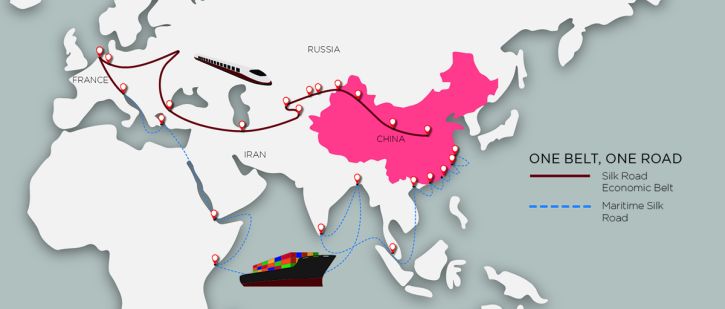
The new Silk Road

Forming the backbone of China’s audacious economic and political agenda is the titanic venture Mr. Xi announced in 2013, introduced as the “One Belt, One Road Initiative” (OBOR). Expected to become the greatest public works project in history, this unparalleled geopolitical and geo-economic game changer—still in its early stages—aims to link countries along the ancient Silk Road trade route with high-speed rail system that will cut the time required to move freight from Beijing to Rotterdam from a month to two days!

At a cost exceeding $1.4 trillion (the equivalent of 12 Marshall Plans), it will incorporate more than a thousand megaprojects spanning three continents and connecting 65 percent of the world’s population to strategically draw countries and companies more into China’s orbit while providing arteries for Chinese goods flowing into Europe.

The “One Road,” or maritime Silk Road, extends from coastal southeast China, touching nearly every country bordering the Indian Ocean, rounding the Horn of Africa, to the Mediterranean. To penetrate the struggling but affluent European market—China’s largest trading partner—Beijing is even financing the upgrade of the Greek port of Piraeus.

Similarly, the “One Belt” will be a colossal network of railroads, pipelines, highways and land bridges forming high-speed economic corridors to commercialize all of Central Asia—Pakistan, Russia, Iran, Turkey, Indochina and India.

China’s Dream Xi and Trump

“China,” Napoleon once remarked, “is a sleeping lion. Let her sleep, for when she wakes she will shake the world.” In 2014, while in Paris, Chinese President Xi Jinping invoked Napoleon’s remark and triumphantly declared that the lion had already awakened.

Mr. Xi has thrown out the “lay low” doctrine of Deng Xiaoping: “hide our capabilities and bide our time; never try to take the lead.” Instead, he has hailed the start of a new era—China’s Dream—with recovery from its “century of humiliation” at the hands of colonial powers like Japan, Britain and France. In a recent address to the Communist Party, He declared that the country “stood up” under Mao Zedong and became rich under Deng, but under Xi it has grown powerful and now seeks to shape the global system.

Exalting the new “emperor”

“Never before has a nation risen so far, so fast, on so many dimensions, as China has over the past generation,” according to Destined for War author Graham Allison. “The same could be said of Mr. Xi, who went from a politically exiled peasant … to ‘Chairman of Everything’” (Wall Street Journal, Oct. 16, 2017).

China’s recent 19th Party Congress—normally an opaque, twice-a-decade reshuffling of uncharismatic technocrats—emphatically ended an era of collective leadership by exalting Xi Jinping, who was already the most powerful Chinese leader in decades, to a second five-year term without an obvious successor, effectively crowning him China’s 21st-century emperor.

Now described as the party’s lingxiu—an honorific title meaning supreme leader that has not been used since the Mao era—Mr. Xi was elevated to the Chinese Communist Party pantheon with “Xi Jinping Thought” officially embedded into the party charter alongside Mao’s, making him politically untouchable.

Princeling, peasant, president

Because of his illustrious roots—born in Beijing in 1953 to a trusted revolutionary colleague and vice premier under Mao—Mr. Xi is seen as a princeling, a child of elite senior officials who has risen through the ranks.

However, shortly after his ninth birthday his father was purged prior to the Cultural Revolution and imprisoned, and his mother was assigned to hard labor on a farm. The younger Xi was sent to the remote countryside for “reeducation” through hard labor for seven years where he was forced to denounce his father while shoveling dung and living in a flea-infested cave. His older half-sister hanged herself because of the abuse, but the exceptionally ambitious young Xi, according to a longtime friend, “chose to survive by becoming redder than red” and clawing his way back to prominence (Evan Osnos, New Yorker, April 6, 2015).

Exhibiting incredible persistence, Mr. Xi—today the leader of a Communist Party with 89 million members—was actually rejected time after time when he sought to join the party. Later, as China grew richer, the unassuming Tsinghua University chemical engineering graduate grew adept at keeping his head down and avoiding ostentatious displays of wealth as he climbed the provincial political ladder, but he was always credited with overseeing spectacular growth.

After election to the presidency in 2013, he was expected to be a bland figurehead and technocratic spokesman of the collective leadership, but Mr. Xi moved with stunning skill, speed and determination, wielding a highly visible anticorruption campaign to purge dozens of powerful rivals and consolidate power.

As former Australian prime minister and noted China expert Kevin Rudd puts it, Xi has a “deep sense of national mission, a clear political vision for the country,” and is “very much a man in a hurry” (as quoted by Graham Allison, Destined for War, 2017, p. 118).

Winning without a fight 

With Mr. Xi tasking his military to be able to “fight and win” any military encounter, focus has been on the buildup of conventional forces and the transformation of reefs, rocks and sandbars in the South China Sea into forward-based military installations. America’s top military officer, General Joseph Dunford, recently sounded an alarm, telling the U.S. Congress that China is likely to be the “greatest threat” of any foe to the U.S. within the decade since “China is focused on limiting our ability to project power and weakening our alliances in the Pacific.”

Ancient Chinese strategist Sun Tzu’s maxim “subdue the enemy without fighting” reveals China’s primary direction today. As former U.S. Secretary of State Henry Kissinger explains in On China,victory for Sun Tzu was “not simply the triumph of armed forces,” but “the achievement of the ultimate political objectives” that a military clash would be intended to secure. “Far better than challenging the enemy on the field of battle is … maneuvering him into an unfavorable position from which escape is impossible” (2011, p. 28).

Excerpts from: https://lifehopeandtruth.com/discern/jan-feb-2018-discern/chinas-dream/ 

_________

Dealing With Doubt

“Spiritual doubt is common, even among those who want to believe. But the Bible shows us how to deal with doubts and grow in faith.

Dealing With Doubt

Our modern world seems designed to foster doubts about God and the Bible. Evolution discounts the need for a Creator. Scholars question the accuracy of the Bible. Public opinion redefines the biblical standards of right and wrong. Religious leaders too often show appalling hypocrisy. Evil grows, and yet God seems to be in hiding.

And religious people struggle with doubt.

For example, a Barna study showed:

“Just over one-quarter (26%) [of American adults who self-identify as Christian] say they still experience spiritual doubt, while four in 10 (40%) say they have experienced it in the past but have worked through it. Only about one-third (35%) claim to have never experienced it at all. …

“Having come of age in a more secular and pluralist culture, Millennials (38%) currently experience about twice as much doubt as any of the other generational groups (23% Gen-Xers, 19% Boomers, 20% Elders). Men are also more likely than women to actively experience doubt (32% compared to 20% women). Those who have been through college and encountered an array of ideas, philosophies and worldviews are twice as likely to experience doubt as those who have a high school education or less (37% vs. 19%).”

But though it seems to have grown in the modern age, doubt is nothing new.

Biblical doubters

When we have doubts, we can consider ourselves in good company. Jesus said to Peter, “O you of little faith, why did you doubt?” (Matthew 14:31). Of course, Peter did have faith to step out of the boat to walk on water! But as the wind hit him, so too did doubt.

However, over the years Peter did learn not to doubt and taught others to “not be afraid,” as he wrote in 1 Peter 3:14.

Then there was the disciple, soon to be apostle, whose name has become associated with doubting. After the resurrection, doubting Thomas said, “Unless I see in His hands the print of the nails, and put my finger into the print of the nails, and put my hand into His side, I will not believe” (John 20:25).

However, when the resurrected Christ did appear and speak to him, Thomas responded in verse 28: “My Lord and my God!”

Then Jesus pronounced a blessing on us today who face even more of a challenge. Jesus said, “Thomas, because you have seen Me, you have believed. Blessed are those who have not seen and yet have believed” (John 20:29).

But how do we claim that blessing? How can we deal with doubts and strengthen our beliefs?

How to deal with doubts

God is the Creator, and the Bible is His message to us today. He cares about us and is working out a plan that provides opportunities for every human who is alive or who has ever lived. But how can we prove these things and build the faith to deal with the overwhelming challenges and storms of life that can cause us to doubt? How can questioning our faith help it to grow?

Here are some biblical principles for dealing with doubts…….

Continued at: https://lifehopeandtruth.com/change/faith/dealing-with-doubt/

_________


5 Reasons NOT to Celebrate Valentine's Day

 Listen   Downloads 

“Here’s five tongue-in-cheek reasons not to celebrate Valentine’s Day. But can you find another?

Transcript

[Steve Myers] “Here’s a little tongue-in-cheek discussion on 5 reasons not to celebrate Valentine’s Day.

Number one: Flowers make you sneeze and they don’t last very long.

Number two: Pink does not make you look thinner.

In fact, number three: Pink’s a girly color that makes men feel wimpy.

Number four: Chocolate makes you fat.

Number five: Valentine’s Day is just commercialism by the greeting card companies to make millions of dollars.

Are those any reasons that you shouldn’t celebrate Valentine’s Day? There is a more important reason, but it comes back to realizing what is life all about. What is romance after all because Valentine’s Day is supposed to focus on romance? And we often think of the flowers and the candy and the meals out and all those kinds of things.

But you know what? Romance is sometimes vacuuming the house.  Romance is sometimes, yeah, cleaning the toilet or maybe changing a diaper or two or maybe making his favorite dessert. That’s what real romance comes down to so much of the time, real life. And sometimes we get fooled by taking one day and trying to make something huge out of it when in reality love is a daily thing. It’s something that we show every single day of our life.

Christ Himself said that whatever we want men to do to us, we should do to them. And it should be something that’s on going, not just a onetime thing.

It reminded me of a passage that’s over in Ecclesiastes in Ecclesiastes 9:9. Ecclesiastes 9:9 says, “Live joyfully with the wife whom you love all the days of your vain life, which He’s given you under the sun.” So it’s all our days not just one day.

And so you could probably come up with a longer list of reasons not to celebrate Valentine’s Day, but you know they’re not all humorous. There is another reason.

You know that many of the world’s holidays are focused and come from roots of paganism. That’s where they’re rooted. Valentine’s Day is no different, named after a Catholic saint. It’s rooted in paganism. Maybe that’s a question you could ask yourself. What does God think about Valentine’s Day?

Check it out a little bit. Look at what Deuteronomy 12 has to say about it . Check it out. Do a little bit of research . You may be very surprised what you find. In fact, you’ll probably add one more big reason not to celebrate Valentine’s Day.

From: https://www.ucg.org/beyond-today/beyond-today-daily/5-reasons-not-to-celebrate-valentines-day

________

Update:

Things here have been slow and hectic all at once.  No work has been done on either place, and I haven’t even had time to list items for sale this week, which will not improve my ‘bottom line’.  

Each morning since Claudia arrived at the Hospice 10 miles away in Willis, I have been taking Jay to see his mother, and have taken a picture of them each day, but I don’t know how much longer she can last.  She can’t eat, and she is only able to say a few words now and then. 

Jay didn’t want to be on his own at this time, so he stayed here for a while.  Not by invitation, he just said he might as well sleep on the couch, and it grew in to several nights from there.  But yesterday, I just had to ask him go home.  He eats all the time, makes a mess every time, fiddles with and moves things, and then all he wants to do is eat sweet stuff, which makes him more hyper, and tell me what to do in my own house.  Because of his terrible diet he has high blood pressure, and has to have the AC on when every one else, me, wants the heat.  There is no way he is going to stop eating a stick of butter or marg with his meals, so it is a case of “Let Go, and Let God”.  “The Fat You Eat, Is The Fat You Wear”.  It’s his overweight life and he won’t listen to his doctors, so let him ruin it, and suffer the consequences.  There are a lot of people like that, and guess what….they are the ones who wonder why they got cancer or diabetes.

It was such a relief when he packed up all his stuff in my van yesterday so I could take him home, that I forgot to post this.  I just sat in my recliner, which I hardly ever have time to do except for the half hour that Bible Study is on TV, and basked in the freedom of having my own home back to myself.

I had cooked one of Jay’s roasts in the crockpot for him, and sliced it up into several freezer bags for him to freeze and eat later, and the liquid that was poured off, refrigerated and de-fatted, made a good base for a gravy.  We had brought 5 lb of potatoes from his place, too, so I peeled and boiled all of them.  Some I made into mashed potatoes for the church, and took them in a crockpot, and I took another little crockpot of beef and mushroom gravy made with real mushrooms and the beef liquid.  The other thing I took to church was a Blueberry Crumble, made with some dried, frozen blueberries, and Bisquick.  Jay kept on getting into it before I could even get it to the church.  

Later, some more of the cooked potatoes were air-fried brown and smothered with left over gravy.  Mmmm!  There are still more in the freezer.

On the Sabbath, the Bible scriptures were Exo.10:1-13:16, (more about “Let My People Go”), Jer. 46:13-28 and Luke 22:7-30.  The Teaching was about the Pilgrimage of Israel, and being obedient.  They had to wander around in the wilderness for 40 years until that sinful, disobedient generation had passed, instead of going straight to Canaan, which was really only an 11 day trip.  I expect you will have that map in the back of your Bible.

I helped with the kitchen before and after the service.  Jay went to church with me, and then we visited his mother who is only three blocks from the church in the Health Care Home,  so it was a busy day.