For “Scripture Sunday”:
Deadly Tornadoes Hit Oklahoma: Searching for Hope and Understanding
 “Another natural disaster has struck an American city. As we deal with the loss and devastation in central Oklahoma, what hope can we find in the Bible?
The devastating results of a natural disaster have once again struck in the United States. Oklahoma City and surrounding communities were hit by a series of powerful storm cells that spawned a number of tornadoes on Monday, May 20.
These tornadoes—one estimated to have been two miles wide—have left communities and buildings in ruins. More heart-breaking is the report of deaths and injuries. At the time of writing, there have been 24 confirmed deaths and over 200 injured.
The nation woke up Tuesday to videos and photographs on the TV news and Internet that documented the tremendous suffering and physical damage left by these massive storms. The images alone would be awful enough, but they were coupled with reports of the complete destruction of the Plaza Towers Elementary School in Moore, Oklahoma. One could not help but fear the worst; and for the families of seven children confirmed dead at the site, that is certainly the case.
Condolences and hope
The staff members of Life, Hope & Truth send our condolences to all the families and individuals affected by the storms. We grieve with those who have lost homes, businesses, friends and family members.
When tragedies like these occur, people desire answers. They want to know why these things happen and what real hope there is for those affected. Life, Hope & Truth’s purpose is to give answers.
Three messages
As we mourn the loss of these children and adults in Oklahoma, let’s consider three major messages from the Bible:
- We should grieve for those who have died and are suffering, but we can look to God in hope. There is a time coming when those who have died will live again and suffering will end.
The feeling of grief and empathy for those suffering in Oklahoma is what Jesus Christ would want to see in us. Jesus felt empathy and grief when viewing the hopeless grief of others at the death of His friend Lazarus (John 11:33, 35). Unlike the mourners for Lazarus, if we are aware of God’s loving plan for humanity, our grief will be tempered with the knowledge that those who died still have a future ahead of them (1 Thessalonians 4:13).
- We should not ignore the fact that the intensity of natural disasters is increasing—and will continue to increase.
Though natural disasters (hurricanes, tornadoes, tsunamis, etc.) have been occurring on earth for thousands of years, many experts and commentators have noted a spike in the intensity and extent of devastation of natural disasters in recent years. An Oct. 17, 2012, Bloomberg article reported that there has been a “fivefold increase in weather-related natural disasters in North America over the past three decades.”
The statistics show that extreme weather catastrophes are becoming “more frequent and intense in various regions.”
Students of Bible prophecy understand that natural disasters will continue to increase as we approach the end times (Matthew 24:7). End-time weather disasters should lead us to examine our sins against God (Job 37:11-13).
- Beware of considering God only in times of disaster.
Though it is good to reach out to God in times of disaster and suffering, if that is the only time we reach out to God in prayer, we are in danger of demonstrating the spiritual short-sightedness that Jesus Christ talked about 2,000 years ago: “These people draw near to Me with their mouth, and honor Me with their lips, but their heart is far from Me” (Matthew 15:8, emphasis added).
Life, Hope & Truth offers this message to the people of the United States and other areas of the world that suffer tragedies: Properly support and grieve with those who have been affected. Pray for them. Help them rebuild. Among other nations, America is noted for its generosity to its own people and to suffering people of other nations.
But don’t stop there. Don’t make God your last resort for comfort and help in times like this.
Respond to tragedy in the way Jesus Christ commanded: Seek to know and love God at all times (Luke 13:3, 5). This spirit of turning to God with our whole heart is what is meant by repentance. The prophet Jeremiah’s words apply to our nation as much as they applied to sixth-century B.C. Judah: “Amend your ways and your doings, and obey the voice of the LORD your God; then the LORD will relent concerning the doom that He has pronounced against you” (Jeremiah 26:13).
Sorrows and tragedies will continue to escalate in the years ahead. Repentance and change will bring hope to your life and better prepare you to make sense of what is happening in the world around you.” From: http://lifehopeandtruth.com/prophecy/blog/deadly-tornadoes-hit-oklahoma-searching-for-hope-and-understanding/ by Erik Jones
______
Laying Down One’s Life
“If there’s any ray of light to come out of the tragic Oklahoma tornadoes, it is in the stories of several heroic schoolteachers who are being credited with saving the lives of their students by literally lying down on top of these children to shield them from the deadly, flying debris.
Amazingly, the children and their parents are able to thank these teachers in person, because none of them were killed. As a parent, it’s hard to imagine the depth of feeling you would have to look into the eyes of someone and try to adequately express your gratitude for her willingness to give her life to save your child. And in a world where we so often are beaten down with the steady stream of news stories about so much hatred and brutality toward others, it is truly inspiring to read of this type of selfless love. One of the first responders interviewed told the story of how they pulled a car off a teacher who had three little kids underneath her. In tears he barely choked out the words, “Good job, teach!”
“Greater love has no one than this,” Jesus once stated, “than to lay down one’s life for his friends.” In that concept we see something both marvelous—and limiting—about our human capacity. We marvel when we see someone literally lay down his or her life for someone else, because it so rarely happens. We may even wonder, “Could I—would I—do the same in such circumstances?”
But there’s something about Jesus’ words that makes us think about the limits to our love. You’ll note that He said, “lay down one’s life for his friends.” How far could I—would I—go to lay down my life for someone not my friend? A soldier throws his body on a grenade in a foxhole to save his buddies; would he do it for his enemies? A Secret Service agent threw himself into the path of a bullet intended for President Reagan, but would he do that for the president of, let’s say, North Korea?
A teacher lays her body over her students; but suppose she was a prison guard—would she do that for a convict?”
More at: http://lifehopeandtruth.com/speaking-of/laying-down-ones-life/
______
16 Minutes of Warning
![images[4]](https://blogger.googleusercontent.com/img/b/R29vZ2xl/AVvXsEiLuU7IaHpOeM_sbgW5M0jV8ioOUO_IDVFk3p2e82hG5qBQxpWV2hlxErXEZj97to8c38NT-CmpvcFzAovcYtjwu9UWcVZuvCxldAMMihf89o8aoimPGpZFloPypJVvnilRv22FWtE35QNf/?imgmax=800 "images[4]") “What if you had 16 minutes to get ready for a major storm that was headed right toward you? From news reports, it seems that this is exactly what happened to a group of teachers and students at an elementary school in Moore, Oklahoma, on the afternoon of May 20.
“What if you had 16 minutes to get ready for a major storm that was headed right toward you? From news reports, it seems that this is exactly what happened to a group of teachers and students at an elementary school in Moore, Oklahoma, on the afternoon of May 20.
During an interview, the city manager from Oklahoma City was asked what could be done for the people in the area. The answer from the city manager was “ask everyone to pray.”
We seem to have no problem invoking the name of God in the wake of natural disasters, but if God’s name is brought up regarding a social issue or an issue of morality, it seems that individuals are accused of being insensitive or, even worse, some sort of religious fanatic. No longer does it seem that our society wants to involve God in their personal lives, certainly they don’t want Him involved in setting any sort of standard for human conduct.
Think about that. As a nation, we declare that the taking of life through abortion is legal. So, on the one hand, we are asked to pray for human life when a storm strikes while, on the other hand, we legalize an activity which takes the lives of thousands of unborn babies each year.
With 16 minutes of warning on Monday, May 20, no doubt many lives were saved. Yet, as a nation, we overlook the fact that more than 2,000 years ago, warnings about human conduct, identifying what is sinful and what is not, were written in the pages of the Bible. Christ warned us to protect human life and not destroy it. He warned us to love our enemies, which forbids doing harm to another human being. But His words are universally ignored today.
Wouldn’t it be better if we asked for God’s involvement in all our activities and not just when a storm or tragedy strikes our nation? Wouldn’t it be better if we responded to warnings from 2,000 years ago just as we do the warnings of an impending natural disaster? After all, according to the Bible, the potential for harm and permanent damage is real if we ignore God’s warning messages, just as the damage from a major storm can only be minimized if we take the warnings seriously.
As Christians, we are praying for God’s mercy in the wake of this terrible storm in Moore, Oklahoma, and for the families that have been directly affected. And as those same Christians, we must be praying that we will rediscover the standard of moral conduct and behavior as laid out in Scripture.
Isn’t that the way it should be?” Complete article at: http://lifehopeandtruth.com/speaking-of/16-minutes-of-warning/
______
Memorial Day: A Day of Remembrance
 A family, aided by Sentinels of the Tomb, places a wreath at the Tomb of the Unknowns at the Arlington National Cemetery overlooking Washington D.C. on May 11, 2013. Memorial Day helps us remember those who have died in war. It can also help us long for the day when true peace will come to this war-torn world.
“On Memorial Day Americans will honor those who died fighting in the many wars that have marked this nation’s 237-year history. Flowers will be placed on the graves of the dead, and ceremonies will take place around the country to honor those who gave their lives in defense of this country. Prayers will also be offered up for the safety of those actively serving in harm’s way.
As we honor those who sacrificed their lives in war, we might ask ourselves, will war or the threat of war always be with us?
A brief history
Memorial Day was proclaimed in 1868 (three years after the Civil War) by General John Logan and was first observed on May 30 of that year when flowers were placed on the graves of Union and Confederate soldiers at Arlington National Cemetery. More Americans were killed fighting the Civil War than both world wars combined.
After World War I the holiday was changed to honor Americans who died fighting in any war. It is now celebrated on the last Monday in May.
Most have deep respect for those young men and women who willingly laid their lives on the line for the security of their families and country.
Sometimes in today’s ungodly world, it seems that there is no alternative to war.
A terrible toll
Though war is glorified in movies and video games, in reality it exacts a terrible toll on nations as well as individuals.
Marriage and family life are disrupted when a soldier has to leave for months at a time. Fathers and mothers are often deprived of the joy of being with their children in the most formative years of their lives. Bodies and minds are often scarred beyond repair by the carnage of war. Parents’ and grandparents’ hearts are torn apart by news of the sudden and tragic ending of the lives of their children and grandchildren in some far-off place.
Neither shall they learn war anymore
Thankfully, an age is coming when mankind will learn to live at peace with one another; when the disputes between nations will not be resolved on the battlefield, but by a just and righteous world government led by Jesus Christ, the King of Kings.
The Bible speaks of a future time following the return of Jesus Christ when there will no longer be a need for war colleges or warfare.
“Now it shall come to pass in the latter days that the mountain of the LORD’s house shall be established on the top of the mountains, and shall be exalted above the hills; and peoples shall flow to it. Many nations shall come and say, ‘Come, and let us go up to the mountain of the LORD, to the house of the God of Jacob; He will teach us His ways, and we shall walk in His paths.’ For out of Zion the law shall go forth, and the word of the LORD from Jerusalem.
“He shall judge between many peoples, and rebuke strong nations afar off; they shall beat their swords into plowshares, and their spears into pruning hooks; nation shall not lift up sword against nation, neither shall they learn war anymore. But everyone shall sit under his vine and under his fig tree, and no one shall make them afraid; for the mouth of the LORD of hosts has spoken” (Micah 4:1-4).”
From: http://lifehopeandtruth.com/prophecy/blog/memorial-day-a-day-of-remembrance/ by Bruce Gore
_______
Trinity Sunday
“The Trinity is not a biblical doctrine. What should you do?
Trinity Sunday is something many religions celebrate this weekend. Lutherans celebrate it. Catholics celebrate it. Most Methodists celebrate it, the Anglicans, the Lutherans, even many of the Baptists celebrate what's called Trinity Sunday. And yet there's an issue. Is God a Trinity?”
http://youtu.be/s3TKzwCqbaM
Video and Transcript at: http://www.ucg.org/beyond-today-daily/doctrinal-beliefs/trinity-sunday
_______
Boat
“The keel on a boat gives it stability and direction, and without this keel a boat can easily drift off course when facing the winds and currents upon the water.
God's law is our personal keel. Without the secure guidelines of the Bible we can find ourselves so far off course that it feels overwhelming to get back on track. As we read in the book of Hebrews: "We must pay much closer attention to what we have heard, lest we drift away from it" (Hebrews 2:1).”
“Going back every day to God's Word, our keel, helps us to keep His laws and His way in our minds.”
_______
The program on WGN TV this morning:
Where Are You God?
“Do you struggle in connecting to God? Learn how to build and maintain a more effective and meaningful relationship with Him.
Well today, we're going to look at six important building blocks of prayer that will help you have a more effective and meaningful relationship with God. You can have the faith that God is always there--even when you don't understand maybe what He's doing.”
Transcript at: http://www.ucg.org/beyond-today-program/christian-living/where-are-you-god
_______
On This Day:
Montana Territory created, May 26, 1864:
“Anxious to create new free territories during the Civil War, U.S. President Abraham Lincoln signs an act establishing the Montana Territory. However, as Montana was on the unstable frontier, it did little to add to the integrity of the Union, and Sidney Edgerton, the territory's first governor, fled after suffering through several months of Indian raids.
Among those Indians known to have inhabited Montana in the 19th century were the Sioux, the Blackfoot, the Shoshone, the Arapaho, the Cheyenne, the Kutenai, and the Flathead. The vast area of what we now call Montana became a U.S. possession in 1803 under the terms of the Louisiana Purchase. Two years later, explorers Meriwether Lewis and William Clark became the first known explorers of European origin to explore the region on their journey to the Pacific Ocean.
Significant U.S. settlement did not begin in Montana until the 1850s, when the discovery of gold brought people to mining camps such as those at Bannack and Virginia City. In 1864, Montana was deemed worthy of territorial status and 25 years later entered the Union as the 41st state.”
_______
Coolidge signs stringent immigration law, May 26, 1924:
“On this day in 1924, President Calvin Coolidge signs into law the Comprehensive Immigration Act, the most stringent immigration policy up to that time in the nation's history.
The new law reflected the desire of Americans to isolate themselves from the world after fighting the terrible First World War in Europe, which exacerbated growing fears of the spread of communist ideas. It also reflected the pervasiveness of racial discrimination in American society at the time. Many Americans saw the enormous influx of largely unskilled, uneducated immigrants during the early 1900s as causing unfair competition for jobs and land. Under the new law, immigration remained open to those with a college education and/or special skills, but entry was denied to Mexicans, and disproportionately to Eastern and Southern Europeans and Japanese. At the same time, the legislation allowed for more immigration from Northern European nations such as Britain, Ireland and Scandinavian countries. A quota was set that limited immigration to two percent of any given nation's residents already in the U.S. as of 1890, a provision designed to maintain America's largely Northern European racial composition. In 1927, the "two percent rule" was eliminated and a cap of 150,000 total immigrants annually was established.
The law particularly angered Japan, which in 1907 had forged with U.S. President Theodore Roosevelt a "Gentlemen's Agreement," which included more liberal immigration quotas for Japan. By 1924, strong U.S. agricultural and labor interests--particularly from California, which had already passed its own exclusionary laws against Japanese immigrants--favored the more restrictive legislation signed by Coolidge. The Japanese government viewed the American law as an insult, and protested by declaring May 26 a national day of humiliation in Japan. The law fanned anti-American sentiment in Japan, inspiring a Japanese citizen to commit suicide outside the American embassy in Tokyo in protest.
Despite becoming known for such isolationist legislation, Coolidge also established the Statue of Liberty as a national monument in 1924.”
_______
Yesterday:
After Wendy and I had our Saturday phone call, and I tended to the critters, I was able to take the rest of the morning leisurely getting ready for church. I had one of my breathless episodes, and so I was glad I didn’t have to rush around.
Jay had agreed to go to the afternoon Church of God service in Willis with me. He said that he had quit drinking, so going to the afternoon church would no longer interfere with his beer time! But he didn’t want to go early for Bible Study. That suited me as I had been up with my sinuses during the night, so I took quick nap before going to church. My sinuses and breathlessness didn’t bother me for the rest of the day.
I had been hoping to go to the Willis church Bible study, as one of the elders, Oscar, has been giving special Bible studies, and he is always good. We got there in time for the last 15 minutes of it, but Jay stayed in the dining hall, while I went in there. As I had been to Conroe Church for the last two weeks, Oscar’s wife is going to email me the Bible studies that I missed.
As it is done by turns, the Song Service was by a couple instead of one of the bands this time. He plays a guitar, and they both sing well. Anyone can do a ‘special’, after the song service. This week it was a Mexican lady who sang a hymn in Spanish, then a sister who was hand miming to a hymn we all sang, accompanied by keyboard and guitar.
The sermon was about “Cross-Cultural Witnessing”. It was how some missionaries spend so much time learning about the beliefs of other countries before they go to them, whereas they could be spending their time carefully diving right in witnessing to them. Examples of witnessing are Acts 17: 16-28, where Paul says “Ye men of Athens, I see how religious you are, but have an altar to the unknown god”, and proceeds to tell them about the One and Only God. Acts 26: 1-8, Paul and king Agrippa, John 4:5-25, Jesus and the woman of Samaria at Jacob’s well.
We didn’t stay for the pot-luck, but as the church is having a ‘clean-up’ team this morning, we are going back today.


![images[4]](https://blogger.googleusercontent.com/img/b/R29vZ2xl/AVvXsEiXyahLFeeqmW4OoV87ULEqbbquWCRUBGgnaSCgSx_2VEJuoVrTDHRlngQwYa_TDRuOgd_I-C7xx9f8WaqkCRJR01p8fEFIXgBgyCboWEWOfUM1B55RGrys1R9dQrFZ0NCaQI_03nLbg_r0/s1600-h/images43.jpg "images[4]")


 SKAGIT COUNTY, Wash. — “It was shortly after 7 p.m. when Dan Sligh and his wife Sally were near the Interstate 5 bridge over the Skagit River. The semi-truck ahead on the far right seemed too wide for the bridge span, and Sligh told his wife so.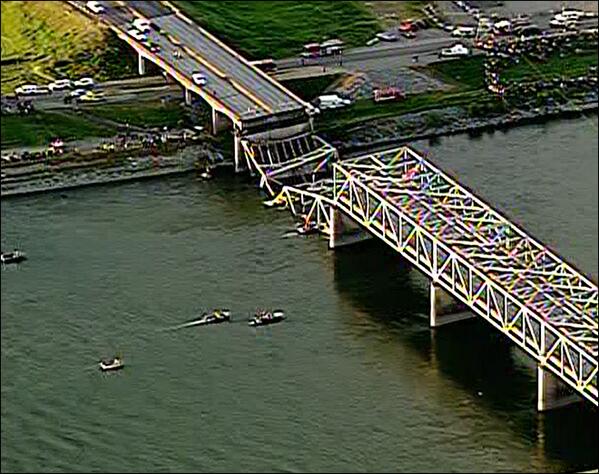




 “Some of the girls died. Some suffered serious adverse effects. Some of the girls developed autoimmune diseases that would require lifelong care. The manufacturers themselves acknowledged adverse events such as anaphylactic shock, seizures and paralysis, motor neuron disease, blood clots, eye, ear and vascular problems and even death, and problems affecting the nervous system, the immune system, the musculoskeletal system, the blood and lymphatic system, the respiratory system,the gastrointestinal system and the vascular system.