Keeping your RV cool in hot summer heat
"While the best place to be when summer's heat turns the landscape to "broil" is someplace cool, it's not always possible. Sometimes you're just stuck making out as best you're able. Once temperatures hit the triple digits, it can be tough to keep "a little tin box" cool. But there are some things that can make it easier.
First, wherever possible, park your rig in shade. Wide open spaces can be frightfully hot. Iowa-based non-profit Trees Forever found an average difference between shady spots and open areas of 27.5 degrees.
No shade to park under? Make your own! Unless high winds threaten, put out your RV awning and angle it to get the most available shade on the side of the RV. Parking orientation is important too; try and expose the least area of the RV to the sun. This usually means parking with the front or rear of the unit to the south.

It's possible to shade both of the long sides of the RV if you're a bit creative. We bought a roll of shade cloth and found an outfit willing to seam it for us. With the addition of brass grommets, the new awning was ready for hanging. Up at roof level, right along the edge of the roof, we mounted small cleats to tie off the upper edge of the cloth. A few stakes pounded into the ground gave us tie-offs for the bottom edge.
Inside the rig, keep the blinds closed, and if you have curtains, close the over the top of the blinds. We've found that reflective bubble insulation, (like Reflectix), will really keep heat out. The stuff comes on a roll and is basically a sandwich of thin plastic "bubble wrap" between layers of aluminum foil. Cut it to fit the windows tightly. We use a marking pen and write which window the piece belongs to so when we need it next time, it's an easy fit.
We also do our best to seal off the roof vents. If you're running your air conditioning unit, you won't want them open anyway. You can cut the reflective insulation and stick covers over the vents from inside; we did it by using double stick Velcro tape. Others have cut 2" or so foam rubber blocks to shove up into the vent holes.
From the mechanical standpoint, if your rig is equipped with two air conditioners, you'll need 50 amp electrical service. If you have but one air conditioner and it doesn't seem to be cutting the heat, it's decision time.
If you and the RV will be stuck where you are for a while, you might consider adding a small window air conditioner unit.
Once when locked up in Arizona for a few months, we popped a small window out of our fifth wheel, cut a piece of plywood to fit over the hole, then cut a hole in the center of the plywood for the a/c unit. Don't plug the a/c unit into the RV, but into a separate circuit. If you're in an RV park, you'll need to check with management to see if this is permissible.
Fans can make a huge difference in how well you'll be able to tolerate the heat. Moving air with the wind chill effect can make things far more tolerable than without.
What else can help? If the days are plenty hot, don't shut off your air conditioning at night; keeping the RV inside cool gives you a bit of a jump on the next day's heat. When going in and out of the rig, keep the door open for as short a time as possible. Pump plenty of fluids and look forward to the coming of fall!" http://www.newrver.com/keep_cool_hot_summer.shtml By Russ and Tina DeMaris
________________
New RVer asks: Do I need a special tailgate for my 5th wheel?

"We think fifth wheel trailers are great: Towing stability, excellent storage, and so livable. We towed our fiver up and down around the US with nary a complaint. But if you're new to "fivers," you may wonder--do I need that special "V" slotted tailgate on my truck?
There are pros and cons to the special fifth wheel gates. We've RV'd with both a V gate and a standard gate and find that while the V gate makes it easier to hitch up--no need to lower the gate--it's not all that critical. Detractors say that the V gates may actually reduce fuel economy, particularly when driving the truck solo, as truck manufacturers take tail gates into account when designing in aerodynamic factors. From our own experience we can't say whether that's true or not.
We will say from experience that forgetting to open the factory tailgate when unhitching can lead to no small amount of embarrassment and financial pain." By Russ and Tina DeMaris
__________________
"It’s an old rule among abalone divers–peek before you poke. You could just stick your finger into something–like a nasty set of teeth–that you don’t want hanging onto the end of your digits. There are areas in RV tech work that bear the same warning.
Obviously, pulling the cover off a live electrical panel is an area calling for a bit more attention than most, particularly if it’s a shore power panel. Indiscriminately placing pinkies in the wrong spot can really hurt, or worse. If you absolutely must have a panel energized when working on it, know what you’re doing, and look twice before poking in it.
When stuffing your fingers into chassis cavities, a bit of an inspection is usually best too. We have a couple of “dead space” areas in our fifth wheel that with a bit of dexterity can be reached. But don’t bet the farm that the boys back in Elkhart were careful about making sure screws, staples, or other sharp metal was carefully embedded and safely out of the way of fingers. Shine a flashlight, and use a hand mirror if needed, to see where your hands are going.
 We had one come up recently that caught us off guard. Took the truck camper down to the coast for a few days of R & R. The camper had been solidly placed on the truck bed for several months, and it never dawned that something might have happened between the truck bed and the outside of the camper box. That is, until we had to do a fancy leveling operation that brought the camper up out of the box several inches. It was then we noticed that the wasps had found a gas pipe was an excellent place to start new home construction.
Happily the little stinger-equipped varmints had been discouraged somehow, and hadn’t made it all the way to the coast with us. The male of this writing species is absolutely TERRIFIED of bees, wasps, and other winged stinging things, and just seeing this little construct tested out his blood pressure system in a hurry." Posted by Russ and Tiña DeMaris Published in do-it-yourself, safety
__________________
"My new motorhome leans to the passenger side. The weight record shows that the passenger side rear is about 1,000 pounds different then the driver’s rear side. Winnebago installed a two-inch block on the rear passenger side to lift the springs and it doesn't lean now but it drives differently. The rear end is all over the road. Was the block the proper repair or would you suggest adding leaf springs? " Peter.
" Peter, it is apparent you’ve had your coach weighed, which is good. It is very important to make sure you know the individual weights of your vehicle at each tire position. This includes axle weights as well as individual tire position weights. The 1,000-pound discrepancy is significant and should be addressed after a thorough evaluation.
In my opinion, the only acceptable way to correct this situation is to redistribute the weight if possible and add leaf springs instead of a solid block. In some cases, air bags can help. The block that was added is not resolving the underlying problem, as it did nothing to redistribute the weight. The result can indeed be poor handling issues, as you have indicated.
In addition, frame damage, abnormal tire wear among other ailments, may still be in your future. My concern here is that, although your vehicle no longer tilts to one side, the fundamental problem was not addressed, which can, and likely will, lead to other problems. I highly suggest you take your coach to an experienced frame shop and have the suspension evaluated fully. Recommended repairs may include additional leaves in the springs, a sway control bar and/or other aftermarket improvements. But the evaluation must be performed first."
__________________
RV generator exhaust solution in a box 
"You're at an RV rally, a racing event, a rodeo or any other place where you're packed in like sardines. You want to turn on your generator but if you do, you're next door neighbor will want to strangle you because you'll be blowing exhaust into his front door.
RV generator exhaust chimneys work great but not everyone has one or needs one all the time, so what can you do as a temporary fix?
Instead of asphyxiating your neighbor, just find a sturdy box, put a heavy rock in it and use it to deflect the direction of your exhaust. Put it far enough away so it doesn't come inside your coach but close enough to effectively prevent the exhaust from disturbing your neighbor."
_____________________
Be careful with Propane:
"An RVer was severely injured and his motorhome destroyed in a bizarre accident last week in an Alberta campground. The 34-year-old Canadian man attempted to repair his propane barbecue grill while standing next to a live campfire. Propane from the line seeped to the campfire, back-flashed and left him with burns over half his body."
____________________
 Fire Safety Tip from Mac McCoy
Liquid petroleum gas, like gasoline fumes, tends to pool in low spots in the coach until a spark sets it off. Newer motorhomes are equipped with an automatic shut-off for when its sensor detects an LPG leak. If you have a leak, be sure to shut the propane off at the tank. Learn more about Mac and fire safety.
___________________
Bears. CO.
Campers in southern Colorado are being warned to secure their food and garbage as the hungry bear season arrives. Natural food sources for brown bears are drying up and the opportunistic bruins may seek out easier pickings among human campgrounds.
___________________
NB extends permits in Jan.
Nebraska's Game and Parks Commission is lifting the 14-day camping limit at 25 of its state parks and recreation areas after RVers complained high fuel costs made two-week limits a burden. The change goes into effect in January and extends the limit to 90 days in select locations.
__________________
OR Reservoirs bans alcohol.
Not everyone at Oregon's Cottage Grove and Dorena Reservoirs are happy campers. A new park policy bans alcohol use at some popular campgrounds to increase safety and "family friendliness." Rangers say alcohol was the reason for 80 percent of disturbance calls.
_________________
NM Lincoln Forest reopens.
New Mexico's Lincoln National Forest has reopened to the public after being closed since mid-May due to extreme fire danger. Campfires are limited to some campgrounds and in fire pits only.
Kitchen Tips:
REHEATING REFRIGERATED BREAD -To warm biscuits, pancakes, or muffins that were refrigerated, place them in a microwave with a cup of water. The increased moisture will keep the food moist and help it reheat faster.
(If I have ever had to reheat them in a microwave, I have put them in a zippered sandwich bag, with a little wrung out wet paper towel. When the bag starts to expand, they are done)
NEWSPAPER KEEPS WEEDS AWAY - Begin putting in your plants… work the nutrients in your soil… Put layers of wet newspapers around the plants overlapping with dirt as you go… Cover with mulch and forget about weeds. Note - Weeds will get through some gardening plastic, they will not grow through wet newspapers.
To keep Squirrels from eating your plants, sprinkle them with CAYENNE PEPPER. It does not hurt the plant and the squirrels won't come near it. It also works with bunnies and raccoons too.
EASY DEVILED EGGS… Put cooked egg yolks in a zip lock bag… Seal, mash till they are all broken up.... Add remainder of ingredients, reseal… Keep mashing it up mixing thoroughly… Cut the tip off baggy … Squeeze mixture into egg… Throw bag away when done - easy clean up!
EXPANDING FROSTING… Buy container of cake frosting from the store… Whip with your mixer for a few minutes… It’ll double in volume… Frost more baking with the same amount – less sugar & calories.
BROKEN GLASS – Use a wet cotton ball or Q-tip to pick up small shards of glass you can't see.
__________________
Yesterday: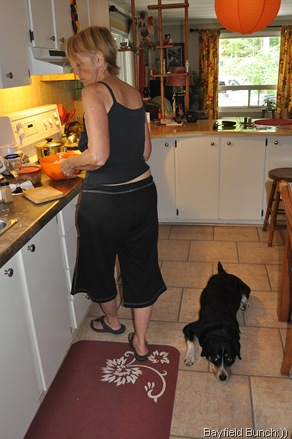
 The Bayfield Bunch now have their lovely "Eve". She is so much more suited to Kelly, Al, and Motormouse than Lexi was.
Just look at them together.
We all knew the right doggie would come along. Here is Eve being Mama's helper. (Photos from Al's journal)
http://thebayfieldbunch.com/2011/08/hi-everybodymy-name-is-eve.html There is a new post about their first day with Eve.
------------------
My animals put in their vote on the new AC, they now come in the computer area to hang out with me. Bobcat, Misty, and Prime, don't usually do that. The room temperature is down, and definitely the humidity. My sinuses and bronchitis felt so much better, and my cough has gone.
The other day, when Ray was cleaning the front of the AC that we took out, he had to spritz the directional fins with some diluted bleach water, as there were black spots on them. Maybe my coughing, aching and wheezing was due to mold, or maybe the meds are curing me? But I know I feel a lot better with the lower humidity.
 Before I go to bed, I check on my local http://www.zap2it.com/ to see if anything interesting is going to be shown on TV. Low and behold, PBS was airing "Food, Inc." on POV. http://en.wikipedia.org/wiki/Food,_Inc. So I tried to stay awake to watch it.
I had wanted to see this famous documentary for a long time, and even intended to buy the DVD on eBay, but never did it. I had already seen different scenes from it, but it was still interesting. http://www.foodincmovie.com/about-the-film.php
It just affirmed what we already know about Monsanto, ConAgra, Tyson, etc. That all the factory-farmed industries and gigantic food companies try to feed us the cheapest food possible, for the most profit, at the cost of our health, and the terrible suffering of the animals. I just can't knowingly put factory-farmed or GMO food in my mouth, it gags me.
--------------
The kitchen TV went to a white line, so I suppose the tube went out, so I put the motor home TV in it's place. I had intended to buy a HDTV for the MH anyway, as I didn't want to fool with conversion boxes.
Mark, the guy at the appliance repair place, is looking for a timer for my Maytag washer. The old Maytags can't be beat, and were one of the best machines out there, so I definitely want to get it fixed.
I bought it, and the matching dryer, from Mark, USED in 1994, when the flood ruined my previous one. (It was warranted if you put water in it, but not around it.) During that couple of weeks while I was without a washer, I had taken laundry to other very helpful folks, but their washers did not do as well as the old Maytags. I found out that it cleaned better, and remove the dinginess from the muddy water, that the other washers had not. It spins and rinses differently. The one that is being repaired belongs in the guest house where Ray lives. Fortunately, they have been able to use the washer where Shay works, though they could have used mine. I have another old Maytag set here for myself. The new ones are not as good.
But Mark couldn't find anything wrong with Jay's mother's dishwasher. Jay had it set on 'Heated Pre-Soak", and that's why it just sat there and the heated water, but didn't have the impeller going!! One of these days Jay will wear his glasses, and see what he is doing, if he even looks!
Jay and I went to Conroe to pick up the dishwasher. The huge new Kroger's store in Willis, which will be officially opening today, had gasoline on sale at $3.28, with card, so we gassed up first. Then Jay ate an enormous breakfast of eggs, pancakes, syrup, potato patties, and some sausage he said was horrible, at Jack In The Box.
When I showed the pictures of the dents on the new AC that I bought Monday to Lowe's Customer Service, they automatically took 10% off the price and credited to my account. I didn't ask for anything, that is Customer Service for you. We picked up some tool blades, bolts and acorn nuts there, too. My! Oh! My! How blue wide masking tape has gone up. But hasn't everything?
At a thrift shop, I bought some jeans and Jay bought some pants. He and I both bought several like-new Cabela's beige shorts, as they were really on sale, at 50 cents. Some clothing outlet must have donated them, all different sizes. Mine were for my son. After we had picked up the dishwasher, we stopped at the Dollar General near there, and Jay was hungry again, so he bought chips, cookies, and a box of puff pastry things. The big box only weighs 7 oz, and he said it was like eating air, what did he expect? It was just white flour, white sugar and air.
After complaining about doing dishes by hand for the last few days, Jay was glad to get the dishwasher back. Maybe he has learned to check things out more thoroughly, or maybe he was on more than beer that day.


 Over 500 scientific studies attest to the fact that IOWA DNR did the right thing in taking action that will reduce the proliferation of one of the world’s most toxic substances – lead. Tens of thousands of doves and other birds mistakenly ingest lead shot littering the ground after the hunting season. Every Mourning Dove that ingests a lead pellet is essentially a dead dove. The use of nontoxic shot will save these birds from needless and agonizing deaths from toxic lead left in fields. The Iowa decision is pro-wildlife and it is pro-environment,” said ABC President George Fenwick.
 "Contrary to what members of the gun lobby may say, this action is not anti-hunting. Hunters can still engage in a pastime that has been part of our culture for hundreds of years. The only change is that they need to use non-toxic ammunition,” said Fenwick. In 2010 the price of steel shotgun ammo for doves went on sale, and was actually lower than the price of steel shot.
 Manager, was effusive in his praise of its performance in the May issue of
  when animals scavenge on carcasses shot and contaminated with lead bullet fragments, or pick up and eat spent lead shot pellets or lost fishing weights, mistaking them for food or grit. Some animals die within days, while others suffer for years from lead’s debilitating effects.