“Who should be put on trial for the murder of the greatest Man to walk this earth? The answer may not be what you think.
You know, the answers are actually found in the ancient prophecies of the Old Testament. The prophets told of a coming Messiah, or Christ who would establish God’s Kingdom here on this earth. But there are also other prophecies about a great Servant of God who would suffer for the nations.
One prophecy that tells of this “suffering Servant” is found in Isaiah chapter 52 and 53. In this prophecy, the Servant of God is beaten and “His visage marred more than any man.” He is “wounded for our transgressions,”“bruised for our iniquities,” and made an “offering for sin.” In His death, He “bore the sin of many, and made intercession for the transgressors” (Isaiah 52:13-15)
Pontius Pilate, the Jewish leaders, the Roman soldiers who drove the spikes into His hands and feet, you and I—we’re all guilty of the blood of the Son of God.”
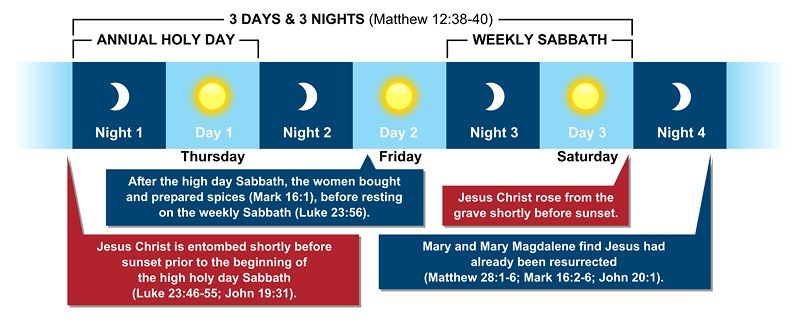
“Jesus said He would be in the grave three days and three nights. But how can you get that out of the traditional Good Friday afternoon to Easter Sunday morning?
You would think that most people could count to three without a problem. But that doesn’t seem to be true when it comes to the length of time that Jesus Christ said He would be in the tomb. Did He really mean “three days and three nights,” or is it possible He only meant parts of three days and parts of three nights?
Mainstream Christianity observes Christ’s death and subsequent resurrection on Good Friday and Easter Sunday, and Christian churches around the world attract large crowds for their worship services on these two occasions.
But for those who take the Bible at its word, it is extremely hard (actually impossible) to get either three days and three nights—or even parts of three days and three nights—between Friday sunset and Sunday sunrise.
So what is the truth? What does the Bible actually tell us?
Matthew 12:39-40 is key, “But He answered and said to them,‘An evil and adulterous generation seeks after a sign, and no sign will be given to it except the sign of the prophet Jonah. For as Jonah was three days and three nights in the belly of the great fish, so will the Son of Man be three days and three nights in the heart of the earth’” (emphasis added).
An impossible count
Before examining these verses, let’s first establish if it is even possible to get three days and three nights between Friday afternoon and early Sunday morning (“while it was still dark,”John 20:1). Let’s count together: Friday night is the first night; Saturday is the first day; and Saturday night is the second night. But that’s it! We have a grand total of two nights and one day!
It is impossible to count three days and three nights between Friday sunset and Sunday sunrise!”
Where did Easter and its customs come from? The Bible doesn’t mention rabbits or eggs or sunrise services. So what is the origin of Easter? See the article “Origin of Easter.”
_______
The Biblical Alternative to Easter
Discover the Biblical festival that was observed by the earliest Christians as chronicled in the New Testament. YouTube: https://youtu.be/Cp1rms7NZ9U
_________
Update:
Well, Easter is all over with for another year, and the articles above are just a few thoughts about it.
Zack and I were going to install the new white sink that I had bought for the mini-house remodel, when we realized that the drain hadn’t even been put in yet. We cut the 2+” hole in the floor and cabinet base where the sink drain will be. Then we took the cedar skirting off the front of the house where the kitchen is, and cut a section out of the 4” sewer line, ready for a “T”. Now I just need to get into Conroe to one of the home improvement places and buy the parts.
One morning, we pressure washed the north side of both houses, they get green with algae. The next morning we were doing a bit of painting in the minihouse when someone who came to Zack’s house next door, upset him, so we quit for the day.
I spent Friday morning making Corned Beef and Cabbage with carrots and potatoes, more like a New England Boiled Dinner, for the church potluck. Then I made a Tomato and Onion Salad as I had several pounds of tomatoes. I skinned them in a hot water bath and then cold water plunge, but it still took a long time to peel them all. There were lots left over, so they were put in the freezer. As Friday is “Preparation Day”, I was doing my hair, getting my clothes, shoes, and purse ready in the afternoon.
The Bible readings were Lev. 1:1-6:7, Isa. 43:21-44:23, and Heb. 10:1-18. and the Teaching was about Authority, Man’s, God’s, and The Messiah’s.
Being with friends at church made it an enjoyable day.
"Most have taken for granted Jesus' nativity story as commonly related - that when Joseph and Mary arrived in Bethlehem there was no room in an inn so Mary ended up giving birth to Jesus in a stable. But is this the true account in Scripture? See for yourself!
The Greek word translated "inn" in Luke 2:7 refers to a guest room.
A typical translation of Luke 2:7 says about Mary giving birth to Jesus, "And she brought forth her firstborn Son, and wrapped Him in swaddling clothes, and laid Him in a manger, because there was no room for them in the inn" (New King James Version).
We've grown up hearing the account that the "inn" in Bethlehem was full, with no "room" available, so Joseph and Mary ended up in a stable, with Jesus Christ born and laid in a manger there. This image has been used to promote the typical Christmas nativity scene for generations. Yet a careful analysis of the biblical text reveals quite a different story!
Not an inn but a guest room
The New Testament was originally written in Greek, and the Greek word translated "inn" here is kataluma. It means a place of rest, usually a guest room. In fact, the same writer Luke uses this very word later where it clearly refers to a guest room and not an inn. Notice Luke 22:11, where Jesus said to His disciples, "Then you shall say to the master of the house, 'The Teacher says to you, "'Where is the guest room [kataluma ] where I may eat the Passover with My disciples?"'"
Furthermore, Luke elsewhere in his Gospel uses a different Greek word when he writes about an actual inn—not the word kataluma. In the parable of the Good Samaritan, Jesus mentions that the injured man in the story was taken to an inn—and here Luke translates using the Greek word pandokheion, the normal word for an inn. We read this in Luke 10:34, where the kind Samaritan set the injured man "on his own animal, brought him to an inn,and took care of him."
Interestingly, the Arabic and Syriac versions of the New Testament, which reflect more of a Middle Eastern context, have never translated kataluma as meaning an inn, but instead as a guest room. As Kenneth Bailey, a Middle Eastern and New Testament scholar points out, "This translation [of the word as 'inn'] is a product of our Western heritage" ("The Manger and the Inn: The Cultural Background of Luke 2:7," Bible and Spade, Fall 2007, p. 103).
In addition, Young's Literal Translation uses the term "guest-chamber" instead of an inn. It says: "And she brought forth her son—the first-born, and wrapped him up, and laid him down in the manger, because there was not for them a place in the guest-chamber."
Note also the word here translated "place" or "room." In the context of "inn," most assume this is referring to an individual room ("no room in the inn"), yet even inns of that time did not often have individual rooms. The reference is simply to space. What Luke is telling us is that there was not enough room, or enough space, for them in the guest room.
The linguistic evidence shows that Luke used the term katalumato mean not an inn, but the guest room — indeed, "the" guest room (the definite article is used) of a particular house.
Historical factors
The International Standard Bible Encyclopedia, after pointing out that the word katalumais used elsewhere in the Gospels for the guest chamber of a private home, comments: "Was the 'inn' at Bethlehem, where Joseph and Mary sought a night's lodging, an upper guest room in a private home or some kind of public place for travelers? The question cannot be answered with certainty. It is thought by some that it may have been a guest chamber provided by the community. We know that visitors to the annual feasts in Jerusalem were entertained in the guest rooms of private homes" (1982, Vol. 2, "Inn," p. 826).
Another factor that powerfully argues against this term meaning an inn is that these places were not appropriate to giving birth to a child. Inns at that time were far from anything like typical motels or hotels we might think of today. "Generally speaking, inns had a bad reputation . . . This ill repute of public inns, together with the Semitic spirit of hospitality, led the Jews and the early Christians to recommend the keeping of an open house for the benefit of strangers" (ibid.).
Besides, for commercial reasons inns were usually found along the major roads. Yet Bethlehem was a small town in the upper mountains of Judea, and no major Roman road is known to have passed through it. Since it seems to have been an insignificant village at the time, it's doubtful that an inn even existed there then.
This gives yet more reason to realize that what Luke really wrote is that there was no room in the guest chamber. Certainly, due to the Roman census being taken at the time and the huge number of people traveling to their birthplaces, available space in the guest quarters was scarce.
So the question then becomes: Does that mean Joseph and Mary aimed to stay in someone's home but, since the guest room was full, were turned out into the night to a stable? When Mary was in labor? That might seem worse than being turned away from an inn. Of course, both scenarios seem rather terrible—certainly downright inhospitable, which is far out of line from the way things were at that time.
A culture of hospitality and honoring kinship
In Christ's day, hospitality to visitors among the Jews was essential, based on biblical example and law. In Deuteronomy 10:19, God told the Israelites to "love the stranger." And Leviticus 19:33 stated, "If a stranger dwells with you in your land, you shall not mistreat him." Denial of hospitality was shown throughout Scripture to be an outrage. Hospitality toward visitors is still important throughout the Middle East.
Moreover, since Bethlehem was Joseph's ancestral home, he probably had relatives there. And being a descendant of King David, whose hometown this was, he would have been highly respected upon his arrival. Think of a descendant of George Washington coming to his hometown of Alexandria, Virginia, after a long lapse of time. The townspeople would've shown him respect.
Note that it is only the manger, an animal food or water trough, that gives any indication of a stable. And indeed a manger might well have been found in a stable. But it's important to realize that they were also to be found within first-century homes!
A typical Judean house of that day consisted of an area near the door, often with a dirt floor, where the family's animals were kept at night—so they wouldn't be stolen or preyed upon and so their body heat could help warm the home on cool nights. The family lived and slept in a raised part of the same room set back from the door. There was also usually a guest room either upstairs on a second floor or adjoining the family common room on the lower floor. Typically the lower area near the door had a manger for food and/or water for the animals.
"Christ and the early Church didn’t celebrate Christmas. Why? If you strip it of its commercialism, pre-Christian customs and inaccuracies, what do you learn?"
Was the birth of Jesus really on Dec. 25? What else is questionable about Christmas?
Today, Christmas has become a nostalgic icon of a past that never was. Santa Claus, the Christmas tree and lots of gifts take center stage in Christian and non-Christian homes.
But these and other customs have little connection to the Bible and the true story of the birth of Jesus, or the message and meaning of His first coming. While the Bible teaches a great deal about Jesus and His message through the story of the birth of Jesus Christ (“Christ” means “messiah” or “anointed”), the traditions of Christmas often mislead, misinform and even contradict the Scriptures!
Would you be surprised to learn that the Bible doesn’t say when Jesus Christ was born? That the early New Testament Church didn’t celebrate Christmas? That Christmas was banned by the Puritans of New England? Or that some Christians today do not celebrate Christmas for biblical and doctrinal reasons?
Why? Honoring Christ?
The primary problem is that the roots of Christmas lie in polytheistic, pagan religious practices, rather than in Christian ones. The New Testament Church honored Christ as the One who came to deliver us from error, darkness and sin. Having turned from paganism to follow Christ, early Christians would never have continued in the practices of paganism in an effort to honor Him!
The apostle Paul wrote, “For you were once darkness, but now you are light in the Lord. Walk as children of light (for the fruit of the Spirit is in all goodness, righteousness, and truth), finding out what is acceptable to the Lord. And have no fellowship with the unfruitful works of darkness, but rather expose them” (Ephesians 5:8-11).
If something is grounded in practices dedicated to pagan worship and false gods, continuing in such “unfruitful works of darkness” would have been a fundamental violation of the allegiance and obedience they were pledging, as Christians, to their Savior and King!
No wonder, then, that the New Testament Church did not observe Christmas.
When did “Christmas” become “Christian”?
The World Book Encyclopedia explains, “The first mention of the celebration of Christmas occurred in A.D. 336 in an early Roman calendar, which indicates December 25 as the day of observance” (1990, article “Christmas”). Notice this first mention of Christmas is more than 300 years after Christ’s lifetime! The date of Christ’s birth is not recorded in the Bible. So why did they pick Dec. 25?
“This celebration was probably influenced by pagan (unchristian) festivals held at that time. The ancient Romans held year-end celebrations to honor Saturn, their harvest god; and Mithras, the god of light. Various peoples in northern Europe held festivals in mid-December to celebrate the end of the harvest season. … [Their] customs gradually became part of the Christmas celebration” (ibid.).
Even religious people who celebrate Christmas have written about its non-Christian roots. Consider this history from the “Grace to You” website: “The decision to celebrate Christmas on December 25 was made sometime during the fourth century by church bishops in Rome. They had a specific reason for doing so.
“Having turned long ago from worshiping the one true God and creator of all things, many early cultures in the Roman empire had fallen into sun worship. Recognizing their dependence on the sun’s yearly course in the heavens, they held feasts around the winter solstice in December when the days are shortest. As part of their festivals, they built bonfires to give the sun god strength and bring him back to life again. When it became apparent that the days were growing longer, there would be great rejoicing.
“The church leaders in Rome decided to celebrate Christ’s birth during the winter solstice in an attempt to Christianize these popular pagan celebrations. For the most part their efforts failed to make the people conform, and the heathen festivities continued.”
“An affront unto the grace of God”
Is adopting pagan customs acceptable to God?
“It’s common knowledge that Christmas and its customs have nothing to do with the Bible. … The theological question is quite simple: Is it acceptable to God for humans to choose to worship Him by adopting paganism’s most popular celebrations and calling them Christian?”
The Roman festivals were characterized by licentiousness—a trait that continued to characterize the supposedly Christian holiday through the centuries.
Over the decades, parents have told children about Santa Claus and his workshop at the North Pole. Where in the Bible does God excuse lying—especially to our children?
Even gift-giving customs have non-Christian roots. In his book 4,000 Years of Christmas: A Gift From the Ages (1997), Episcopal priest Earl Count relates historical connections between exchanging gifts on the 12 days of Christmas with the customs of ancient, pagan Babylon. He shows that mistletoe was adopted from Druid mystery rituals and that Dec. 25 derives from the ancient Roman Saturnalia rather than with Jesus.
What of the wise men?
That’s not the only biblical fact that Christmas customs have wrong. Joe Kovacs, author of Shocked by the Bible,points out, “If asked how many wise men were present at the Bethlehem manger when Jesus was born, most people would likely answer, ‘Three.’ They would be wrong. The correct answer from the Bible is actually … zero!” (2008, p. 3).
What difference does it make?
Some will wonder, “What difference does it make? Those pagan customs now have ‘Christian meanings.’ Doesn’t that make them acceptable?”
If we leave the decision up to human opinion, the debate could probably go on endlessly. But God specifically addresses the issue of what customs to use in worshipping Him. We should look to the Bible for the answer.
It’s found in Deuteronomy 12:29-32: “When the LORD your God cuts off from before you the nations which you go to dispossess, … take heed to yourself that you are not ensnared to follow them, after they are destroyed from before you, and that you do not inquire after their gods, saying, ‘How did these nations serve their gods? I also will do likewise.’ You shall not worship the LORD your God in that way; for every abomination to the LORD which He hates they have done to their gods; for they burn even their sons and daughters in the fire to their gods. Whatever I command you, be careful to observe it; you shall not add to it nor take away from it.”
To the devoutly religious Pharisees, Jesus said in Mark 7:6-9: “Well did Isaiah prophesy of you hypocrites, as it is written: ‘This people honors Me with their lips, but their heart is far from Me. And in vain they worship Me, teaching as doctrines the commandments of men.’ For laying aside the commandment of God, you hold the tradition of men. … All too well you reject the commandment of God, that you may keep your tradition.”
Imagine a purer, less commercial, more spiritual Christmas. But don't call it history.
"The only problem is that, as historians are increasingly discovering, this purer, simpler, more spiritual past is more a product of our cultural imagination than of historical fact. A series of new studies suggests that the observance of Christmas was never an entirely religious affair, that many of the most popular seasonal traditions are relatively modern inventions and that complaints of crass overindulgence and gross commercialism are nearly as old as the holiday itself." From: http://www.usnews.com/usnews/culture/articles/961223/archive_009449.htm
_______
The program on WGN TV this morning:
Is Something Missing in My Life?
"Is your life so busy you can't seem to get everything done? Even so, is something still lacking? Learn more."
"The North American Free Trade Agreement (NAFTA) is signed into law by President Bill Clinton. Clinton said he hoped the agreement would encourage other nations to work toward a broader world-trade pact.
NAFTA, a trade pact between the United States, Canada, and Mexico, eliminated virtually all tariffs and trade restrictions between the three nations. The passage of NAFTA was one of Clinton's first major victories as the first Democratic president in 12 years--though the movement for free trade in North America had begun as a Republican initiative.
During its planning stages, NAFTA was heavily criticized by Reform Party presidential candidate Ross Perot, who argued that if NAFTA was passed, Americans would hear a "giant sucking sound" of American companies fleeing the United States for Mexico, where employees would work for less pay and without benefits. The pact, which took effect on January 1, 1994, created the world's largest free-trade zone."
_______
Yesterday:
After a couple of checks during the night, when I woke up, the first thing was to see if Punkie, the sick, old dog, had made it through the night. She had, but she was so weak. She was already wearing a sweater, but I still put one of Misty's cozy coats on her, carried her outside, let her do her thing, and carried her back inside. Then I tried to feed her and give her more electrolyte water. She was suffering, so I was, too.
After tending to all the other animals, I knew that something had to be done about Punkie. I called her Mom who said that she should have had Punkie PTS a week ago, and gave me permission to have it done.
After calling the vet, I asked Ray if he would drive me there. I didn't want to drive myself and have to put Punkie in a carrier, I wanted to hold her and make her feel loved and safe. The vet was expecting us, and we didn't have to wait long. He saw Punkie's condition, gave her a shot in the arm, and she went to sleep in my arms. So Punkie is now at peace. The vet tech put her in a cardboard casket so she can go home to Mindi's ranch and be buried there. Punkie is the fourth of Mindi's poodles that have gone to Rainbow Bridge in the 15 years that I have known them.
Ray dropped me off at the church, but I was a few minutes late. They usually start with a couple of songs, and I arrived during the second one. Then we had the continued Bible reading of Genesis 25:19 – Genesis 28:9, about Isaac and Esau, and then Malachi 1:1-28.
For the main song service they usually have the words of the songs on a projector screen, but the bulb had gone out, or just didn't want to work due to the cold. Jeff, our guitarist, usually has the program all planned, but this time we chose songs from a hymnal. During the prayers for those in need, I asked for prayers for my ex-daughter-in-law, Becky, who after having a double mastectomy, now has cancer throughout her body.
Jeff gave the talk, and it was more on the subject of prophecy. This time about "The Date Setters". In Matthew 24:3 the disciples asked Jesus about the signs of the time of the end of the world, and He told them. Then in Matthew 24:36 He says that no one knows that day or hour, but My Father only. Jeff told us about many of the people throughout time, even as far back as 3200 BC, who have predicted the time of the end, and obviously have been wrong. Among them were emperors, mathematicians, astrologers, preachers, astronomers, rabbis, popes, all of different religions. Even Christopher Columbus made a prediction. Good examples of the foretold 'false prophets'. Just shows you that man should go by the Bible, not by what man thinks.
For the potluck, I had made a crockpot vegetable soup with homemade turkey broth, but didn't have time to go home to get it after the vet. So I will have to eat some, and freeze some. Fortunately, there was plenty of food for me to have a bite, good fellowship and discussions with the other diners. When I called Ray asking him to come and get me, he came in the dining hall and met the people there. They gave him a warm welcome and offered him some potluck, but he declined. I needed to get home and let the dogs out, anyway.
I took all the dogs out in the cold, some wearing their coats, and Caesar looked at me as if to say "Where's Punkie?" and then went back to sniffing the back yard. By this time, I was tired out, and wanted to lie down for a nap, but Misty gave her little "I'm hungry" bark, so I was back in feeding mode for the remaining 4 doggie boarders, my dog, and the three cats.
Ann, the previous foster mom of Ava, my 'new' old cat, didn't advise my sending Ava back, as the situation had changed at her house. She was re-fostering an adoption return in Ava's place, and Ann said that Ava and this cat did not get along, and it tormented Ava. It sounded like Ava would be very unhappy and have bad time. To make sweet, gentle Ava go back there would be cruel, and I couldn't do that to her. I knew that with all the fosters that Ann has, that Ava would get more attention, love and care here in her old age, so I have been taking allergy pills each day.
Before I forget, I would like to welcome all the new followers. I am honored and humbled that you, and all the old followers, are reading my little 2-cent's worths. Comments are welcomed, then I know how you feel about my ramblings. Thank you.
______________
First Things First
"Matthew 6:33 tells us very clearly that we have to put first things first in our life."
_____________________
What should be the response of Christians to suffering?
________________
Why believe in a god?
"If there is no God, who decides what's good and what's bad? Can we all decide for ourselves individually? How would we go about figuring out what "good" is? What if your definition clashes with and even interferes with mine; then what do we do?"
__________________
Yesterday, Jim, (the mechanic down the street), and Ray put the 'new' door on Ray's wrecked car.
Someone with 28 acres to fool around on, had rammed a 4-wheeler into it. The damaged door wouldn't close properly, so it had to be fastened closed, making it very awkward for Shay, the passenger, as she had to get in and out the driver's side. Also the mirror was broken off.
The insurance company wanted to total the car, but Ray didn't want to do that. He loves that car, so Ray and his son went to Houston, found another door, and it even had a good mirror on it.
The interior of the 'new' door matches the inside of the car, so when they fix the other dents, the outside can be painted to match.
Today:
Blackie and Orange Glow were taking it easy on Ray and Shay's porch, enjoying this nice weather. I got these chairs for them, and made the floral slip covers last year, and they use them all the time.
They know these are 'their' chairs! It is funny how they never get in each other's chairs.
The bottle-fed kittens are gaining weight, so I must be doing something right. They don't squeal and squall to be fed like they used to.
Jay and I tacked up the first part of the ceiling in the cargo trailer, and started making the closet.
I will probably have to put rosettes on the ceiling, so we made a template for the screw holes, so that they would be aligned all through the trailer, and temporarily screwed it up. We had to make sure that all the wires to the running lights were exposed, and we will make a removable crown molding, or something, to go over them.
The AC gets installed under the closet, so as it is getting warmer here, we want to tackle that as soon as the framework for the closet is in place.
The true cost of a thing is how much "life" must be surrendered to possess it.
Immigration
"ILLEGAL IMMIGRATION is not a new problem...Native Americans used to call it WHITE PEOPLE."
Life !
Life is what happens when you are making plans to do something else !
The Journey Counts.
If we agree that the bottom line of life is happiness, not success, then it makes perfect sense to say that it is the journey that counts, not reaching the destination. —Mihaly Csikszentmihalyi
Your Present
"Yesterday is history, tomorrow is a mystery, and today is a gift; that is why they call it the present" Eleanor Roosevelt (1884-1962)
Pet's World
...Saving just one pet won't change the world...But, surely, it will change the world for that one pet.....
Don't breed or buy while homeless pets die!
EVERY LITTER BIT HURTS
Spay or neuter your pet
Thank You
Low Cost Spay/Neuter
From: 'Healing Animals' by Dr. Michael W. Fox
“Our perception of animals determines how we treat them, and whether they suffer under our dominion or not. Behind our perception and treatment of animals lie our needs, wants, values, and cultural and religious traditions.
Until these are addressed and our perception changed so there is empathy, respect, and communication, the holocaust of the animal kingdom will continue. And those qualities or virtues that make us human – humility, compassion, and selfless benevolence – will continue to be crushed by arrogance, ignorance, and the selfishness of our species.”
Difference
Nature
"When one tugs at a single thing in nature, he finds it attached to the rest of the world." - John Muir
What is Man Without the Beasts?
"What is man without the beasts? If all the beasts were gone, man would die from a great loneliness of spirit. For whatever befalls the earth, befalls the sons of the earth. Man did not weave the web of life; he is merely a strand in it. Whatever he does to the web, he does to himself." (Chief Seattle, 1855)
Gandhi
As Gandhi once said, "The greatness of a nation and its moral progress can be judged by the way it's animals are treated".
Is There An Animal Abuser Near You? Please Report it!
http://exposeanimalabusers.org/section.php?id=163
Can They Suffer?
The basic issue is simple:
"The question is not, can they reason?
Nor, can they talk? But, can they suffer?"
(Jeremy Bentham, philosopher and animal rights activist; 1748-1832.)
Recycling
Where to recycle, no matter if you live permanently somewhere, or on the road: http://earth911.com/



 Was the birth of Jesus really on Dec. 25? What else is questionable about Christmas?