Friday, April 3, 2026

What does the Feast of Unleavened Bread mean for Christians? Sign of Jonah: Did Jesus Die Good Friday, Rise on Easter?

 What does the Feast of Unleavened Bread mean for Christians?

During the spring of each year (March-April in the northern hemisphere), immediately after Passover and before the Feast of Pentecost, another biblical feast is observed — the 7-day Feast of Unleavened Bread (Leviticus 23:6-8; Exodus 12:17-18).

What does the Feast of Unleavened Bread mean for Christians?

The Exodus from Egypt, which took place immediately after Passover during the Feast of Unleavened Bread (Numbers 33:3), was one of the great events to occur during this time. The crossing of the Red Sea is traditionally assigned to the seventh or last day of Unleavened Bread.

After Israel entered the Promised Land, the miraculous conquest of Jericho also took place during the Days of Unleavened Bread. Other great events occurring during this time of year involved rededicating the people of God to their Creator. 2 Chronicles chapters 29 through 31 describe the religious reform led by Hezekiah, and chapters 34 and 35 tell of the reform by Josiah.

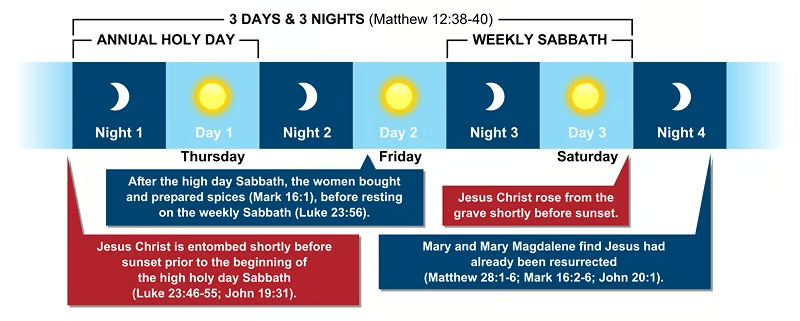
However, one other event that took place during the Days of Unleavened Bread had a much greater impact than any of these, and that was the resurrection of Jesus Christ. John 19:31 tells us He was crucified on the day before a Sabbath. While most people assume this was the regular weekly Sabbath (observed Friday sunset to Saturday sunset), John tells us this Sabbath "was a high day" — a term used for the seven annual Holy Days. A careful reading of the Gospels shows this "high day" was the first day of Unleavened Bread, a Holy Day (Leviticus 23:26-7) that can fall on a weekday.

Jesus remained in the grave for three days and three nights just as He had prophesied (Matthew 12:40), making it impossible to reconcile Jesus' statement in Matthew 12 with a Friday afternoon crucifixion followed by a Sunday morning resurrection. (See "Jesus Wasn't Crucified on Friday—or Resurrected on Sunday!")

Three days and three nights from the time of His entombment, just before the beginning of the first Holy Day of Unleavened Bread, brings us to the sunset at the end of the weekly Sabbath, during the seven-day Feast of Unleavened Bread, as the time Jesus was resurrected. On that Sunday, after His resurrection the day before, Jesus appeared first to Mary Magdalene (John 20:11-18) and then to others.

These Days of Unleavened Bread marked a turning point in the way the spring festival was celebrated. Christians observing these annual festivals would still recall the exodus from Egypt as a type of redemption from sin and release from the bondage of Satan. There would still be an emphasis on eating unleavened bread as a physical reminder we are to become spiritually unleavened by removing sin from our lives. But the core meaning of the Feast of Unleavened Bread is that Jesus Christ, the One who was resurrected during this time, now lives His life in every Christian.

Jesus repeatedly emphasized the importance of His own resurrection. During the last supper, He told the disciples that although He would soon be betrayed, He would live again: "Because I live, you will live also" (John 14:19). He had just promised they would not be left as orphans (verse 18)—that is, spiritually unprotected and vulnerable to Satan. Both the Father and He would live in the hearts and minds of Christians by the indwelling of the Holy Spirit (verses 20-26), empowering us to overcome "the sin which so easily ensnares us" (Hebrews 12:1).

The Apostle Paul encouraged the church there to "keep the feast, not with old leaven, nor with the leaven of malice and wickedness [lingering sinful attitudes], but with the unleavened bread of sincerity and truth"(1 Corinthians 5:8) —a clear reference to the Feast of Unleavened Bread.

The Feast of Unleavened Bread is a festival that helps us focus on replacing sin with righteousness. We are reminded to "...work out your own salvation with fear and trembling" (Philippians 2:12), but the Apostle Paul was not preaching a works-based salvation. In verse 13 he explains "it is God who works in you both to will [that is, to have the desire to overcome] and to do [to act on that desire] for His good pleasure." In 2025 the Days of Unleavened Bread will be observed from sundown April 13-19. (See Holy Day Calendar)

__________

Sign of Jonah: Did Jesus Die Good Friday, Rise on Easter?

Most churches commemorate Jesus’ crucifixion on Good Friday and His resurrection on Easter Sunday. But how does this fit with the sign of Jonah Jesus gave?

Was Jesus in the tomb from Good Friday evening to Easter Sunday morning?

No, Jesus said that the sign that He was the Messiah was that He would be buried for “three days and three nights” (Matthew 12:40). In other words, He would be entombed for exactly 72 hours. It is impossible to fit 72 hours between Friday night and Sunday morning. When we closely study the Gospel accounts, we learn that Christ was entombed on a Wednesday evening and resurrected on a Saturday evening. 

As proof that He was the Messiah, Jesus Christ promised in advance exactly how much time He would spend in the grave. He called it “the sign of the prophet Jonah.”


Sunday, March 29, 2026


Why some Christians don't celebrate Easter

Every year elaborate Easter programs are prepared commemorating the death and resurrection of Jesus Christ often involving Easter sunrise services and colourful baskets of chocolate eggs and rabbits. But if this celebration is so important, why didn’t Jesus teach His apostles and the early Church to observe it?

Why some Christians don't celebrate Easter
Easter is associated with ancient fertility rites such as eggs and rabbits.

The books of the New Testament were written decades after Jesus Christ’s death and resurrection, yet nowhere is any kind of Easter celebration described! Some cite Acts 12:4 as authority for celebrating Easter, but Easter isn’t really mentioned there at all. The King James Bible translators substituted “Easter” for the Greek word ‘Pascha’, which means “Passover.” The vast majority of Bible translations recognize the error in the King James Version and rightly translate the word in Acts 12:4 as “Passover”. The truth is, “there is no trace of Easter celebration in the [New Testament]” (The International Standard Bible Encyclopedia, 1986, Vol. 2, “Easter”).

So where exactly did Easter and its customs come from? The Encyclopaedia Britannica correctly records that: “At Easter, popular customs reflect many ancient pagan survivals—in this instance, connected with spring fertility rites, such as the symbols of the Easter egg and the Easter hare or rabbit” (15th edition, Macropaedia, Vol. 4, p. 605, “Church Year”). Many ancient pagan peoples marked the coming of spring with the worship of their gods and goddesses, particularly those associated with fertility. Among such deities were Baal and Astarte (or Ashtoreth) where the ceremonies included ritual sex to promote fertility throughout the land and the symbols of fertility—such as eggs and rabbits, which reproduce in great numbers.

“Associated with Ishtar was the young god Tammuz [mentioned in Ezekiel 8:14 ". . . In Babylonian mythology Tammuz died annually and was reborn year after year, representing the yearly cycle of the seasons and the crops...” (Nelson’s Illustrated Bible Dictionary, 1995, “Gods, Pagan,” p. 509). Alan Watts, an expert in comparative religion, wrote: “It would be tedious to describe in detail all that has been handed down to us about the various rites of Tammuz.… and many others….But their universal theme—the drama of death and resurrection—makes them the forerunners of the Christian Easter, and thus the first ‘Easter services.” ( Easter: Its Story and Meaning, 1950, p. 58).

Early Catholic Church leaders merged customs and practices associated with this earlier “resurrected” god and spring fertility celebrations and applied them to the resurrected Son of God. As the Catechism of the Catholic Church explains in the section titled “The Liturgical Year,” “At the Council of Nicaea in 325, all the Churches agreed that Easter… should be celebrated on the Sunday following the first full moon… after the vernal equinox” (1995, p. 332).

Up until this time, many believers had continued to commemorate Jesus’ death through the biblical Passover as Jesus and the Apostles had instructed (Luke 22:19-201 Corinthians 11:23-26). However, after the decision at the Council of Nicea, with the power of the Roman Empire behind it, the Catholic Church enforced its preference for Easter Sunday. Those who wished to continue to observe the biblical Passover had to go underground to avoid persecution.

We should ask ourselves if Jesus were on earth today, would He celebrate Easter or rather would He observe the biblical Passover as Scripture teaches and as He practiced and taught (John 13:15-171 Corinthians 5:7-8).

Thursday, March 26, 2026

Why should Christians keep the Passover?


Why should Christians keep the Passover?

In ancient Israel the first Passover was a time of deliverance, the rescuing of the Israelites from slavery in Egypt. The blood of the Passover lamb was smeared on the doorposts of those Israelites who put their trust in God, and He promised to deliver them from harm (Exodus 12:13-14 and 23). The Israelites were spared, while the firstborn of the Egyptians were slain.

Why should Christians keep the Passover?
The bread and wine of the annual Passover service was instituted by Jesus Christ.

Many years later, during Jesus Christ’s final Passover with His disciples, He introduced new symbols, which commemorate Him as “our Passover, [who] was sacrificed for us” (1 Corinthians 5:7). The observance of the New Testament Passover was revealed as the first step toward salvation. It reminds Christians not only of how God delivered ancient Israel out of Egypt, but of our deliverance from sin today.

All human beings are in slavery to corruption and death caused by sin: "for all have sinned and fall short of the glory of God" (Romans 3:23), and the Bible says, "the soul who sins shall die" (Ezekiel 18:4 and 20). Only the sacrifice of Jesus Christ, the Lamb of God, frees us from the bondage of sin. God will not compromise with His perfect law, and no human (other than Jesus Christ) has kept God's law perfectly.

God the Father willingly gave up His firstborn Son, and Jesus willingly poured out His life's blood, because there was no other way to save humanity from the consequences of our sins: “For God so loved the world that He gave His only begotten Son, that whoever believes in Him should not perish but have everlasting life” (John 3:16). We also read that the wages of sin is death, “but the gift of God is eternal life through Jesus Christ our Lord” (Romans 6:23).

The Bible makes it clear that all who follow Christ should observe the New Testament Passover annually, as He did, in remembrance of His love and sacrifice for our sins and as a reminder of our commitment to God for what He has done in our lives. The Passover, and all the other annual Holy Days are permanent observances. God never intended them to be temporary observances we could discard at a later date, as is commonly taught today. (See Bible Insights Issue 273 What Did Paul Really Say in Colossians 2:16? for more detail)

Paul shows the earliest Christians not only observed the Passover annually—with its new symbols of bread and wine, instituted by Jesus Christ to represent His suffering and death—but that all Christians should continue observing it until Christ returns. Jesus indicated it will also continue to be observed in His Kingdom (Matthew 26:29). The Passover should be observed once a year as God has commanded on the annual date which is the anniversary of Christ's death for our sins. In 2026 the Passover will be observed on the evening of March 31 after sunset (For the correct dates for all of God's festivals see "The Annual Festivals of God"). 

Christ's supreme sacrifice by means of His crucifixion —which occurred precisely on the biblically commanded Passover date—is the foundation of the Christian faith. It reflects the all-encompassing love God has for His creation and His concern for the ultimate well-being of every human being.