What does the Feast of Unleavened Bread mean for Christians?
During the spring of each year (March-April in the northern hemisphere), immediately after Passover and before the Feast of Pentecost, another biblical feast is observed — the 7-day Feast of Unleavened Bread (Leviticus 23:6-8; Exodus 12:17-18).
During the spring of each year (March-April in the northern hemisphere), immediately after Passover and before the Feast of Pentecost, another biblical feast is observed — the 7-day Feast of Unleavened Bread (Leviticus 23:6-8; Exodus 12:17-18).

- Source:
The Good News magazine (Mar-Apr 2006)
Sign of Jonah: Did Jesus Die Good Friday, Rise on Easter?
Most churches commemorate Jesus’ crucifixion on Good Friday and His resurrection on Easter Sunday. But how does this fit with the sign of Jonah Jesus gave?
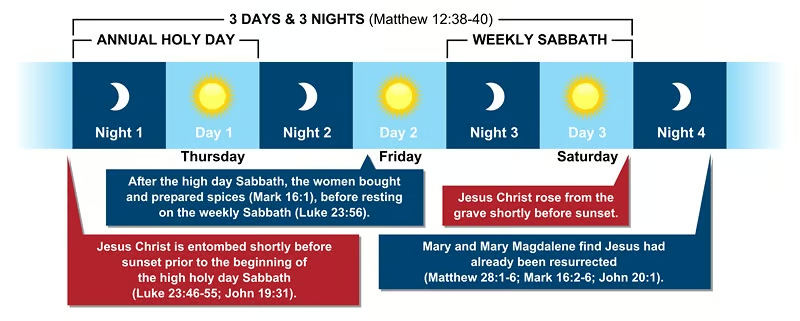
Good Friday afternoon to Easter Sunday sunrise does not add up to three days and three nights. This chart shows the chronology of Christ’s crucifixion and resurrection that matches the biblical festivals and confirms the sign of Jonah. (See a larger version of this chart at the end of the article.)
Was Jesus in the tomb from Good Friday evening to Easter Sunday morning?
No, Jesus said that the sign that He was the Messiah was that He would be buried for “three days and three nights” (Matthew 12:40). In other words, He would be entombed for exactly 72 hours. It is impossible to fit 72 hours between Friday night and Sunday morning. When we closely study the Gospel accounts, we learn that Christ was entombed on a Wednesday evening and resurrected on a Saturday evening.
As proof that He was the Messiah, Jesus Christ promised in advance exactly how much time He would spend in the grave. He called it “the sign of the prophet Jonah.”